

Pio Monte Caravaggio Schedule Tickets Location | Authorizations
Pio Monte della Misericordia and Caravaggio’s “The Seven Works of Mercy” in Naples, Italy
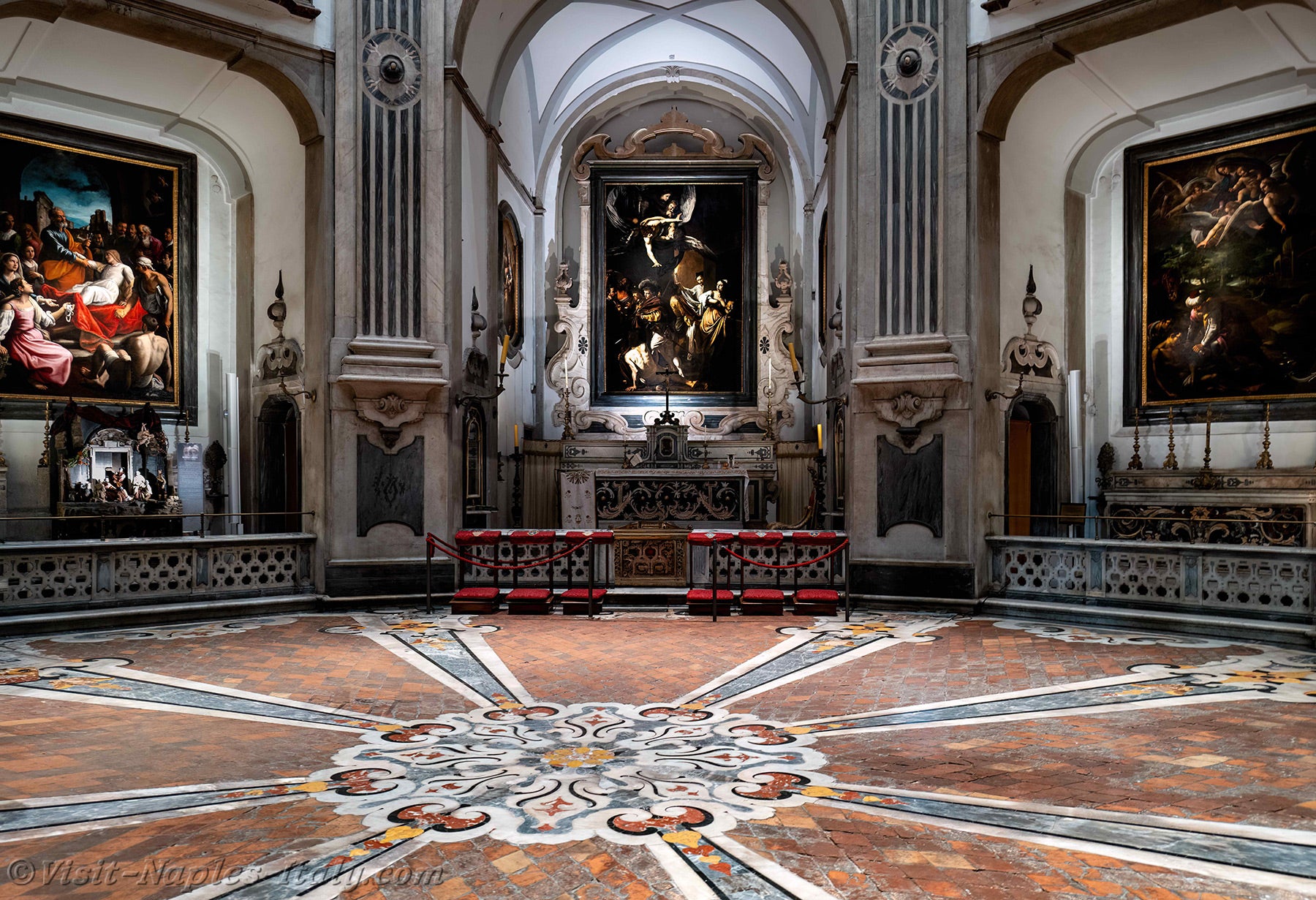
The Seven Works of Mercy Under the reign of Philip III of Spain, the situation of the poor in Naples had become catastrophic.
These Neapolitans living in utter destitution were left to fend for themselves by successive Spanish viceroys who ruled the city and imposed ever-higher taxes on it, including a tax on salt.
Thus, in 1601, seven young Neapolitan nobles decided to establish a lay brotherhood to bring relief to the poor and the sick in need.
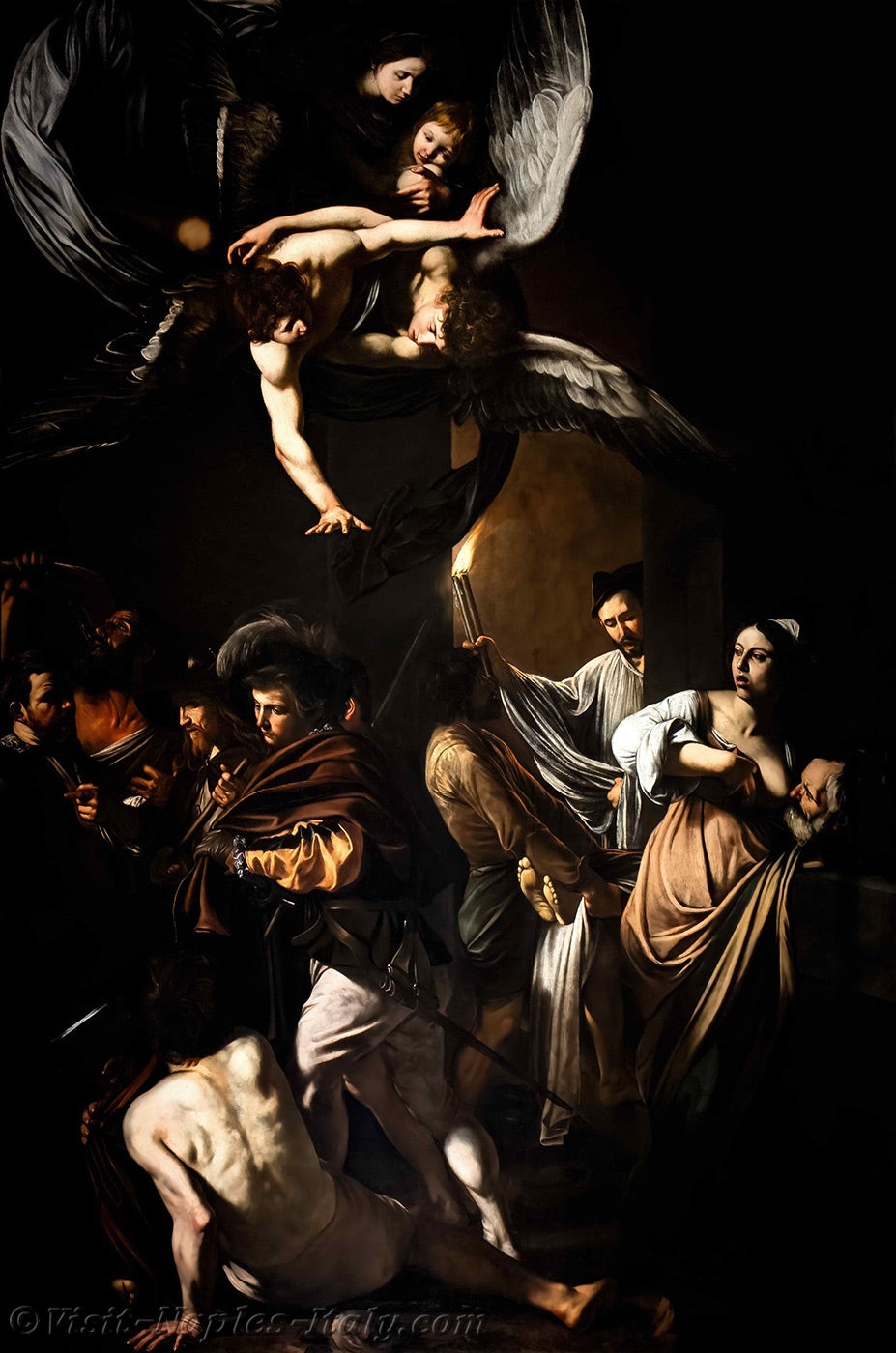
Seven Works of Mercy Within a few years, their charitable brotherhood had grown to such an extent that it enabled them to carry out the seven works of Christian mercy.
They then decided to build their own church, the Church of Pio Monte della Misericordia, which was consecrated in mid-September 1606, fifteen days before Caravaggio’s arrival in Naples.
In late October, they commissioned Caravaggio to paint a large canvas depicting the seven works of Christian mercy with the Virgin of Mercy, to be installed in their new church.
To this end, they had offered him 400 ducats, a considerable sum at the time.
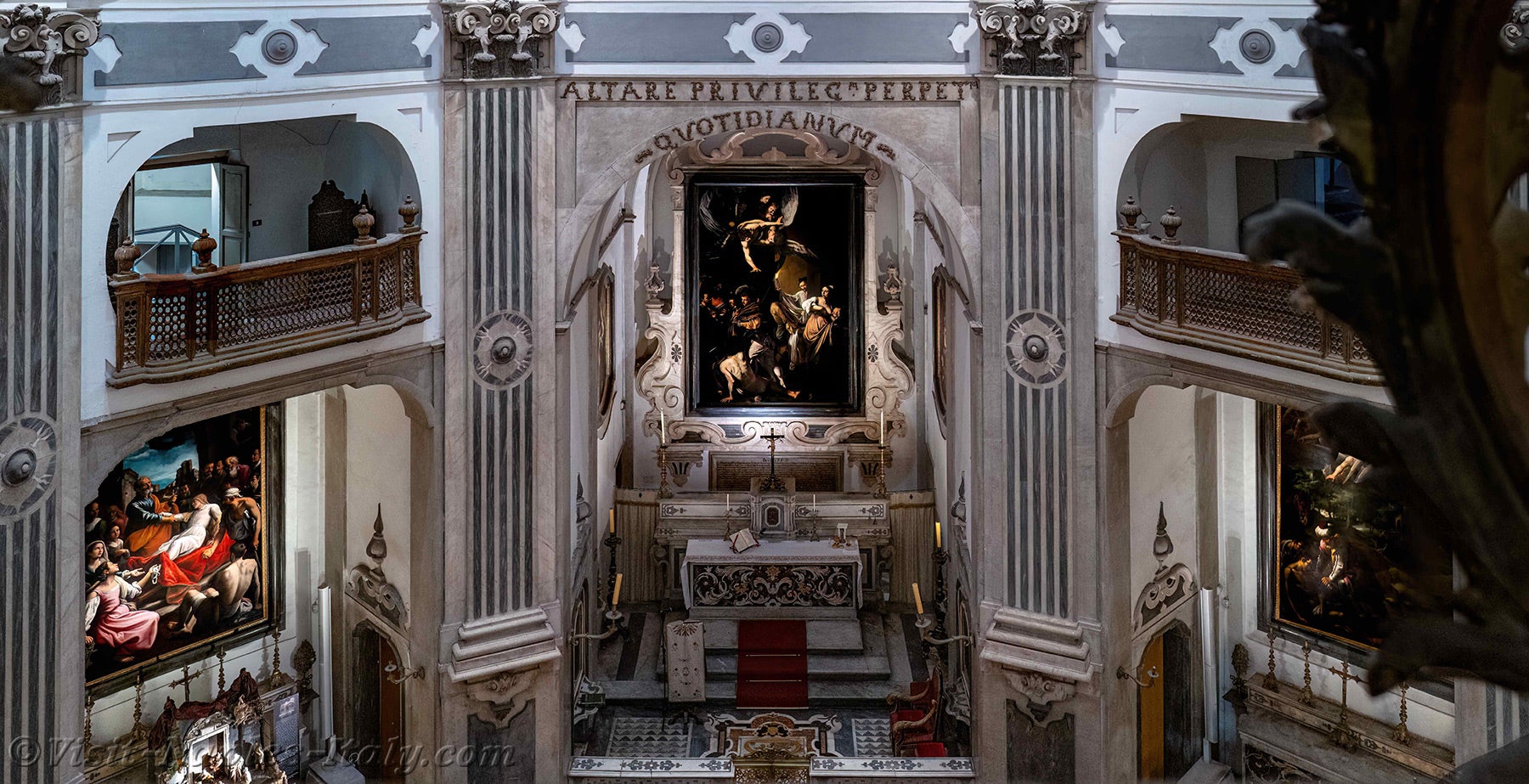
The Seven Works of Mercy A work combining the seven works of mercy with the Virgin Mary was far from easy to conceive; but Caravaggio accepted this challenge without hesitation and, in just over two months, he had created the masterpiece that can still be admired today at the Pio Monte della Misericordia.
Having been in Naples for just over a month at the time of this commission, Caravaggio had already witnessed the harrowing poverty of the people whilst walking through the city’s streets.
Caravaggio set the figures representing the seven works of mercy in a street in Naples
Seven Works of Mercy This explains his decision to set his seven works of mercy precisely where poverty was to be found: in a street in Naples.
The scene takes place in the evening, in a dark alley, dimly lit by the candles held by a priest.
The seven works of mercy depict the principal figures embodying the misery of the Neapolitan people, who occupy the entire lower half of the painting, whilst the upper half is occupied by the Virgin, representing the divine dimension that underpins the brotherly love of the benefactors.
The Virgin of Mercy and the Angels
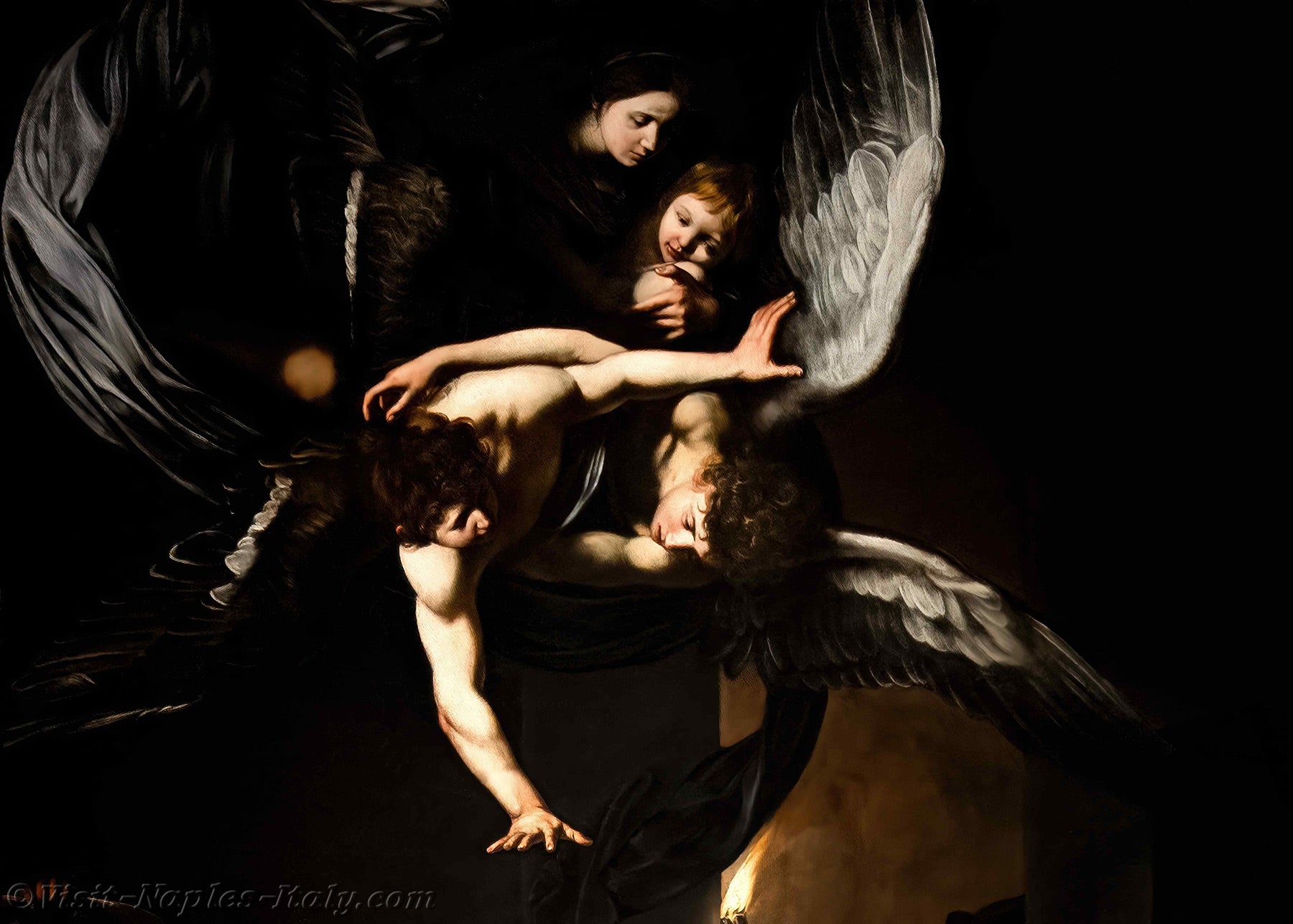
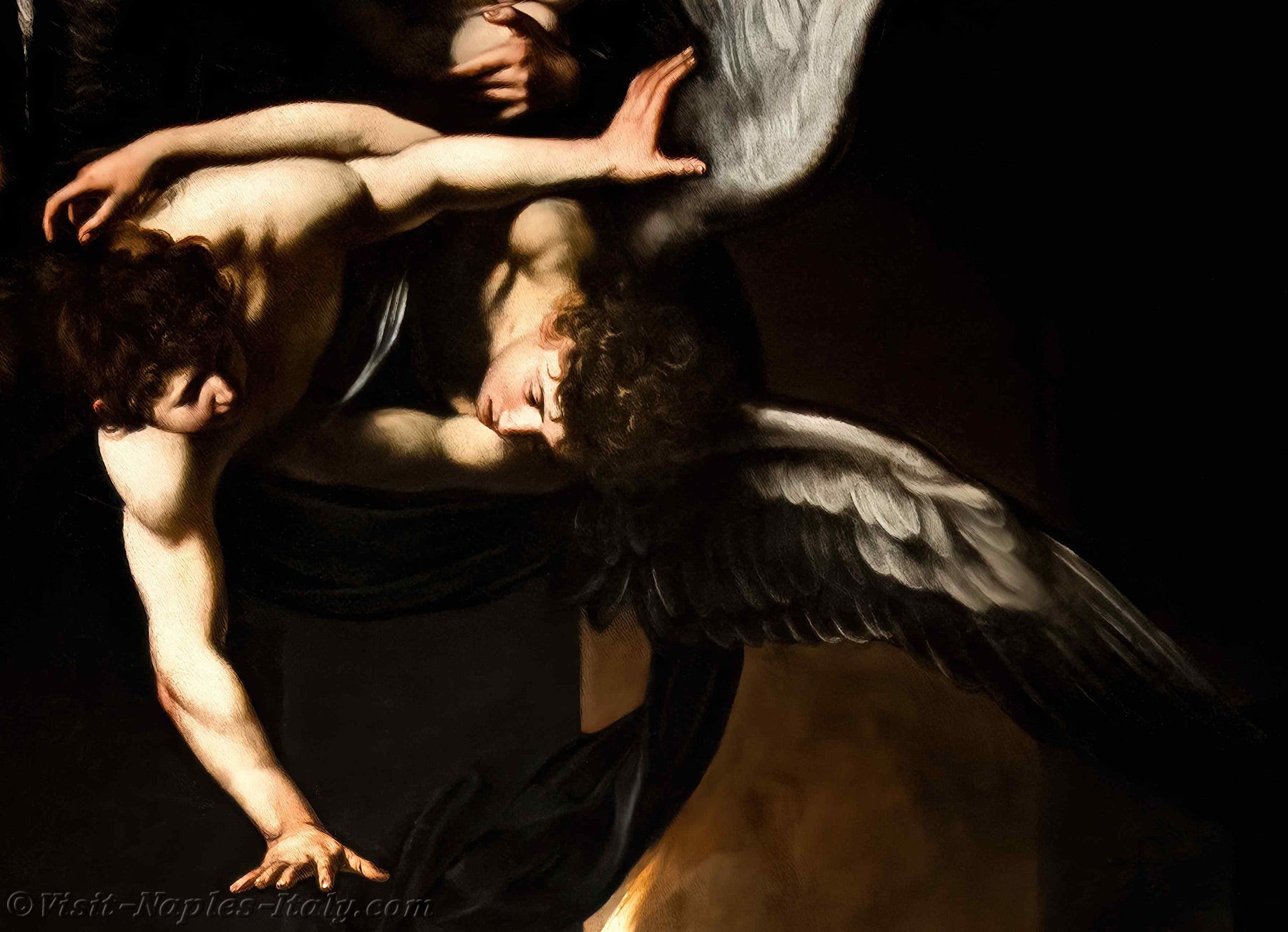
The Seven Works of Mercy The Virgin stands at the top of the painting, holding the Baby Jesus in her arms, whilst he looks at the two winged angels who stand entwined, carrying them in a protective cradle as they descend into the alleyway where they have come to alleviate human suffering.
Caravaggio’s talent is evident in his depiction of the lightness of these two angels in mid-flight, with their fluttering wings, their waving arms, and their whirling bodies in a rapid movement emphasised by the superb billowing of their robes.
The Virgin and the angels appearing in the alleyway, this is love descending from Heaven to the aid of the Neapolitan people.
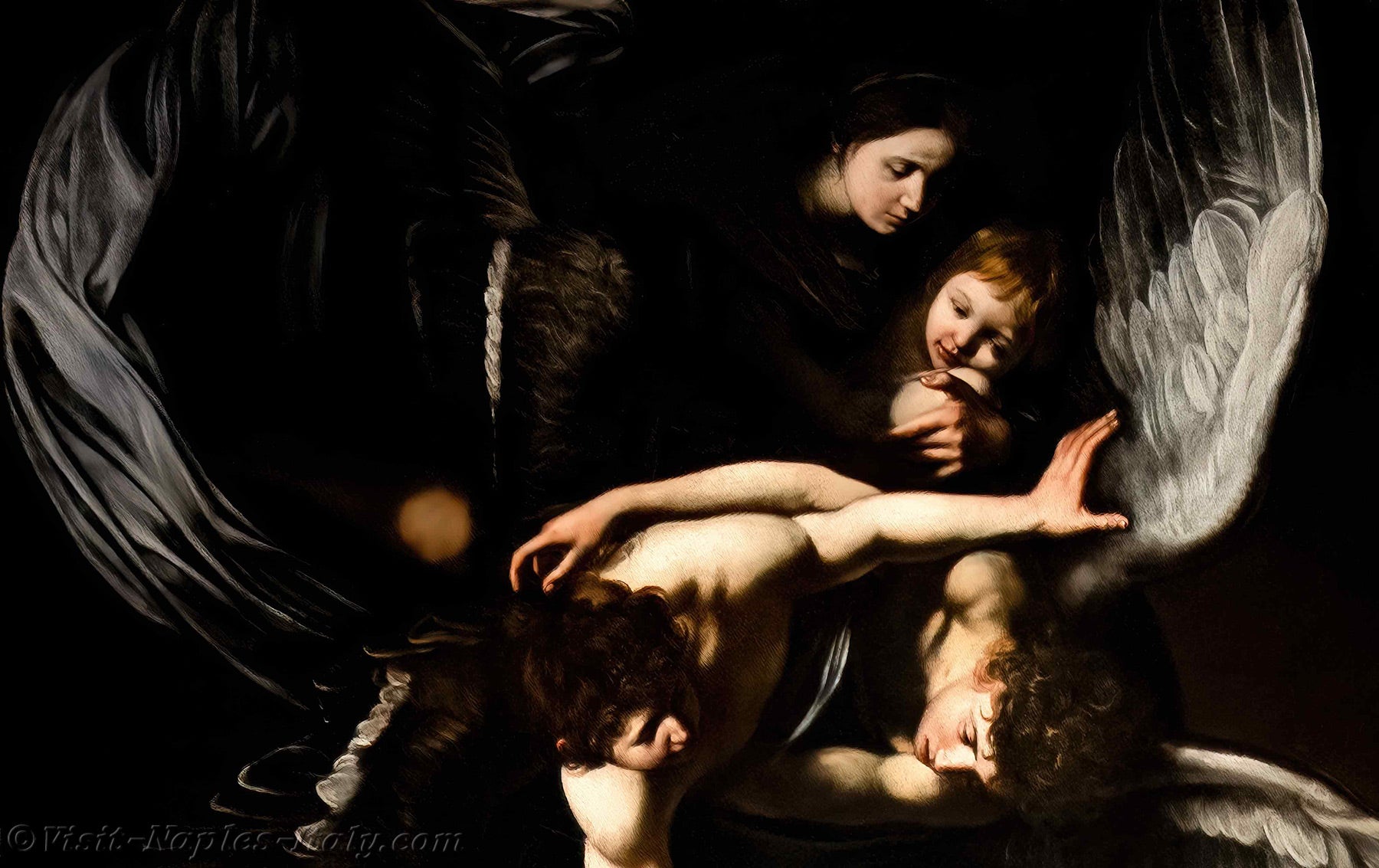
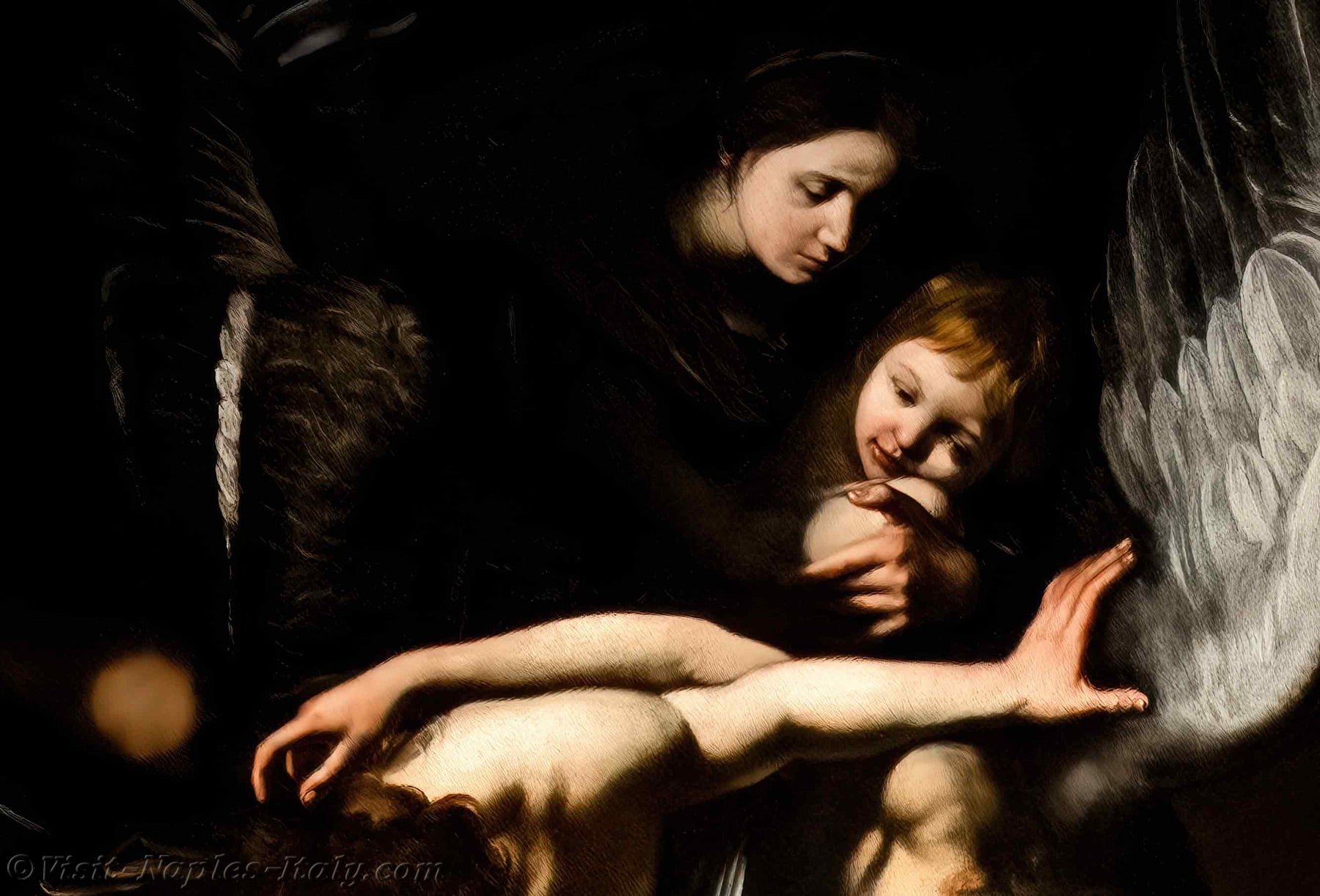
The Seven Works of Mercy This divine space is full of life and vitality; here is the Madonna of Mercy, cradled by the brotherly embrace of the two angels, who come to support and inspire those who are able to perform acts of charity to alleviate suffering and give hope to their fellow human beings.
The Virgin of Mercy and these angels rush to the aid of the destitute by urging the wealthy to come to their aid, and, at the same time, this heavenly flight seems fleeting, precarious, too swift to last.
As if this divine inspiration might vanish just as quickly as it had appeared, for destitution and suffering destroy these lives that need help before it is too late, and this help must be sustained over the long term.
The Seven Corporal Works of Mercy
The Seven Works of Mercy Just as the seven young noblemen who founded the Confraternity of Pio Monte della Misericordia, the divine presence of the Virgin of Mercy in Caravaggio’s painting is there to invite the Neapolitans to follow the words of Jesus in his sermon (Gospel according to Saint Matthew, XXV, 35-36):
“For I was hungry and you gave me food; I was thirsty and you gave me drink; I was a stranger and you welcomed me; I was naked and you clothed me; I was ill and you looked after me; I was in prison and you came to see me.”
Et Jésus ajoute:
“Whenever you have done this for even one of the least of my brothers, you have done it for me.”
The Seven Works of Mercy To the six works of mercy mentioned in Jesus’ sermon, a seventh was added in the 12th century, taken from the Book of Tobit (Tobit 12:12): burying the dead.
Alongside the extraordinary beauty and dynamism of the divine portion of his canvas, Caravaggio succeeded in the same way in depicting, within such a small space, the seven corporal works of mercy, and in an equally vivid and dynamic manner.
Nothing is static in his painting; everything is action; each of the seven works is carried out before our very eyes in this dark alleyway in Naples.
Saint Martin clothes the naked
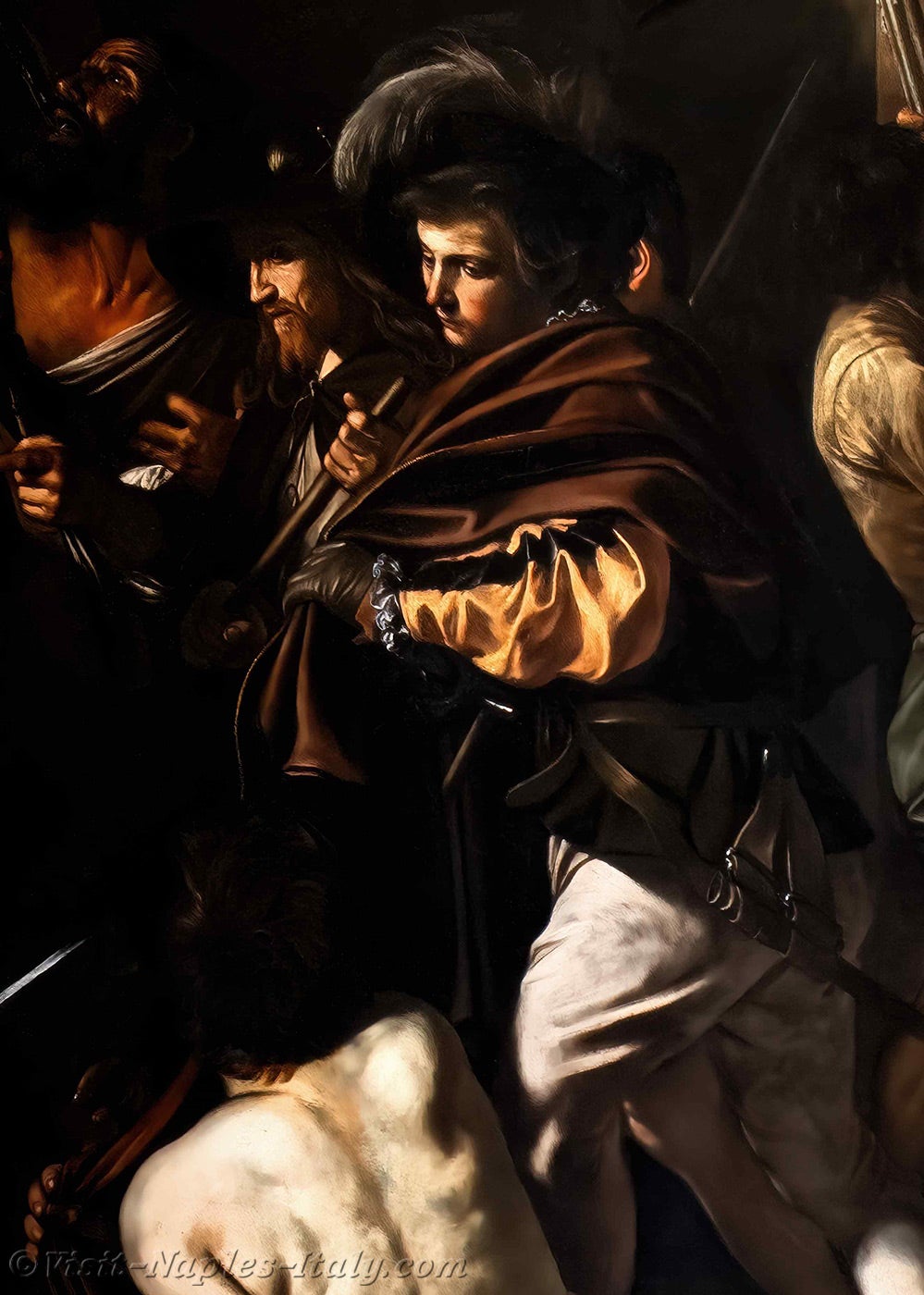
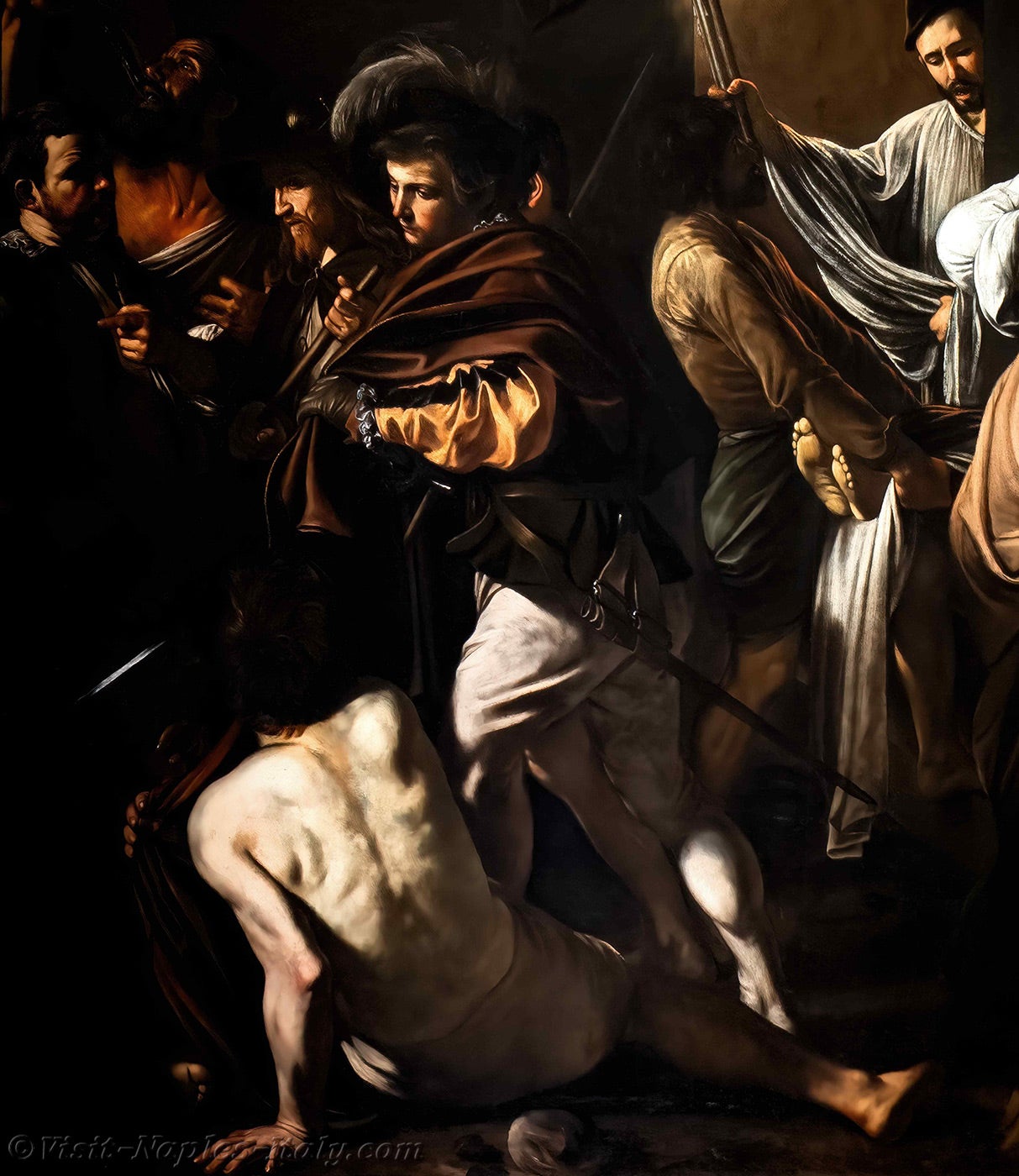
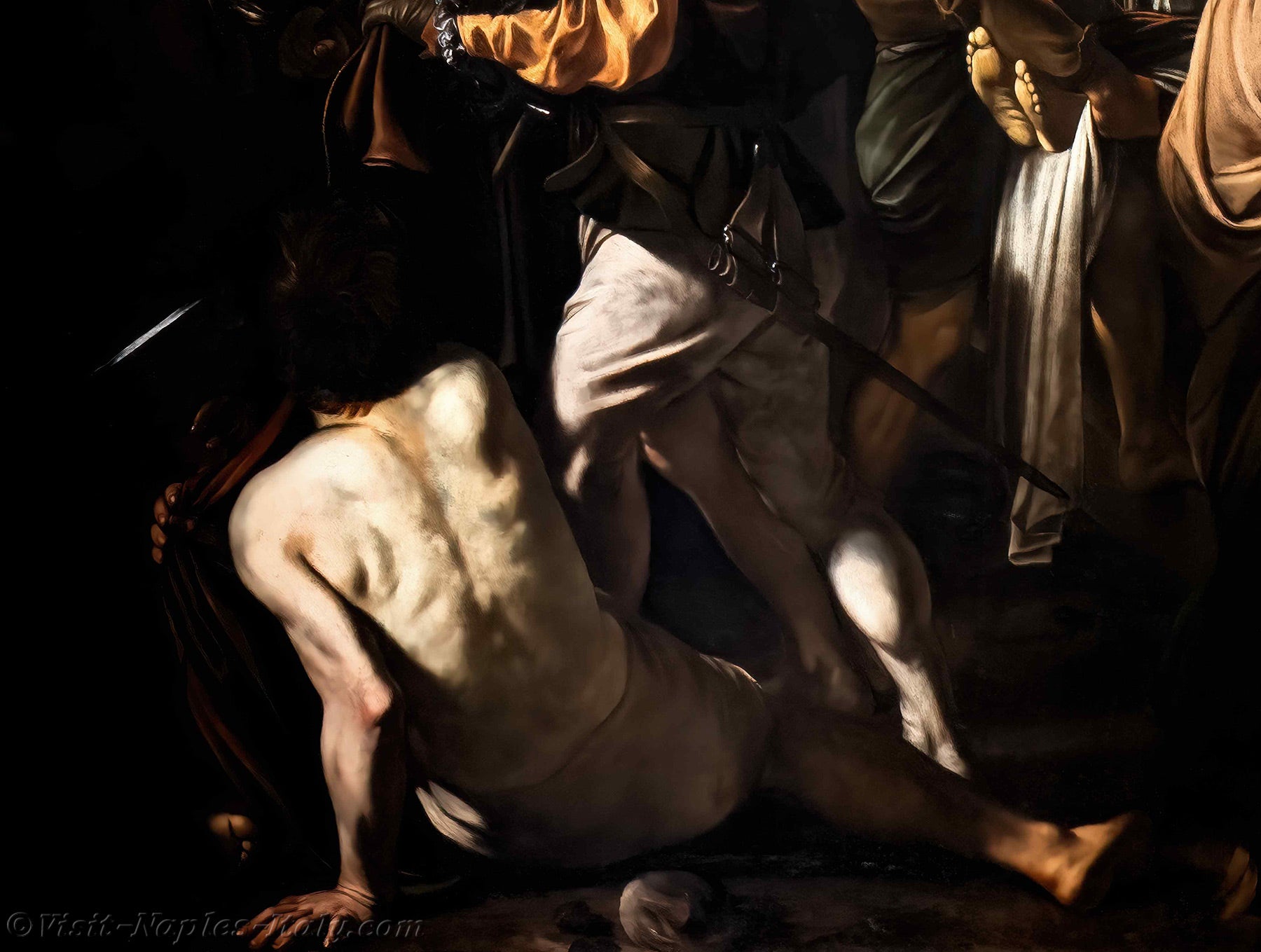
Seven Works of Mercy In the foreground, a beggar sitting on the ground is trying to get to his feet; his feet are bare and his pallid back reveals his spine and ribcage.
His nakedness and his posture are a sign of extreme distress, and now a richly dressed young man approaches him, looking at him with an expression of pity mingled with sadness, drawing his sword, its blade glinting in the darkness.
This noble young man, dressed in velvet and wearing leather gloves and a hat adorned with a large feather, is not indifferent to the distress and nakedness of this man who is begging, and his reaction is immediate.
Using his sword, he cuts his cloak in two and gives half to the beggar, whose outstretched hand is already clutching the fabric.
Caravaggio has depicted here the gesture of Saint Martin of Tours.
This depiction of Saint Martin, dressed as a nobleman of the time, is a direct allusion to the work of the seven young Neapolitan nobles who founded the Confraternity of Pio Monte della Misericordia.Welcome strangers and feed the hungry
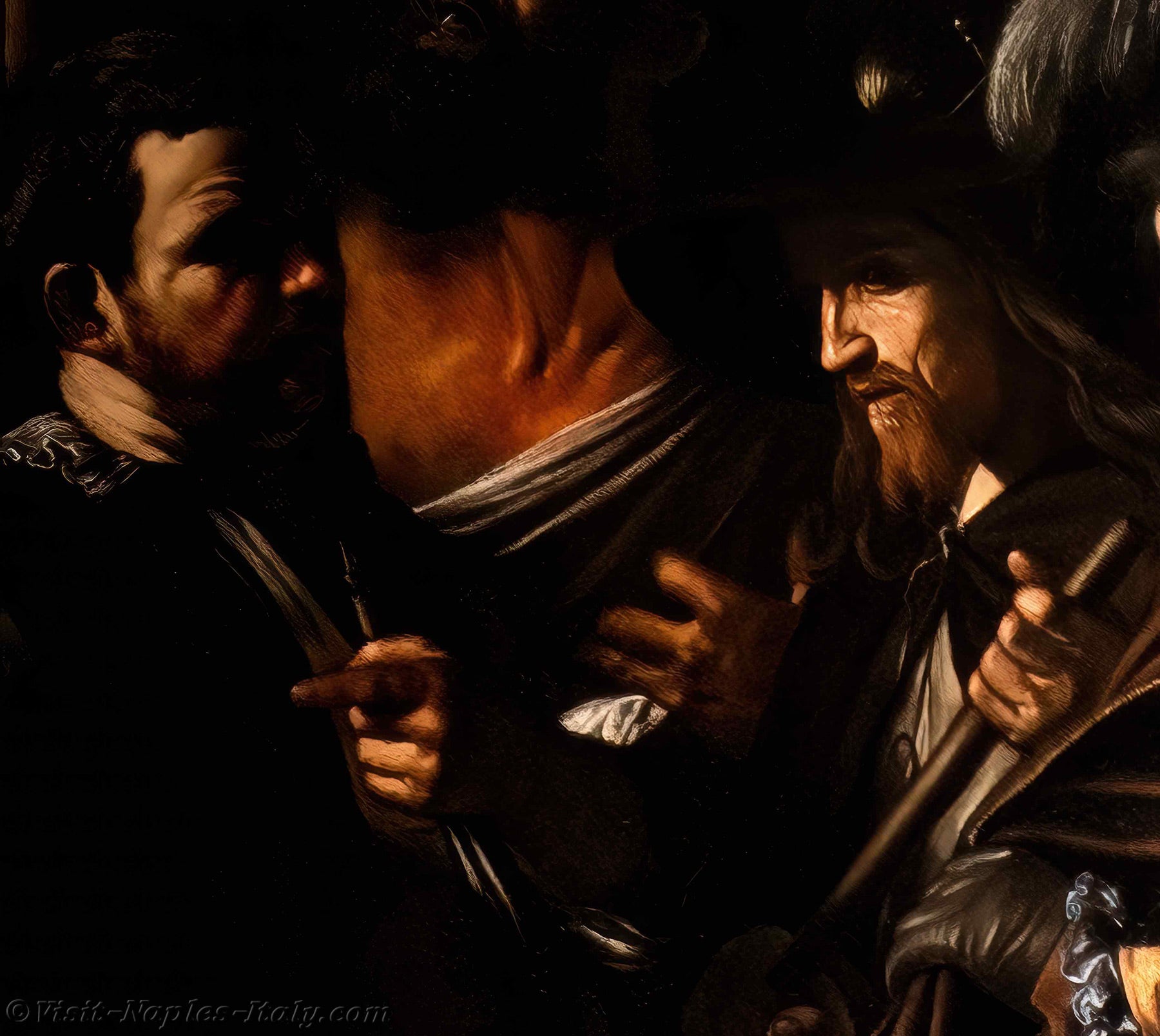
The Seven Works of Mercy Two men are depicted facing each other in front of Saint Martin; the one on the left wants to welcome the gaunt-faced man into his home so that he may come to rest and refresh himself, pointing towards his inn.
This man has haggard features and his head is bowed under the weight of fatigue.
He is holding a pilgrim’s staff and wearing a hat on which one can make out the scallop shell of the pilgrims travelling to Santiago de Compostela, exhausted by the long journey he undertook on foot to reach the end of his pilgrimage.
Here too, Caravaggio clearly alludes to Christ the Pilgrim.
Give drink to those who are thirsty
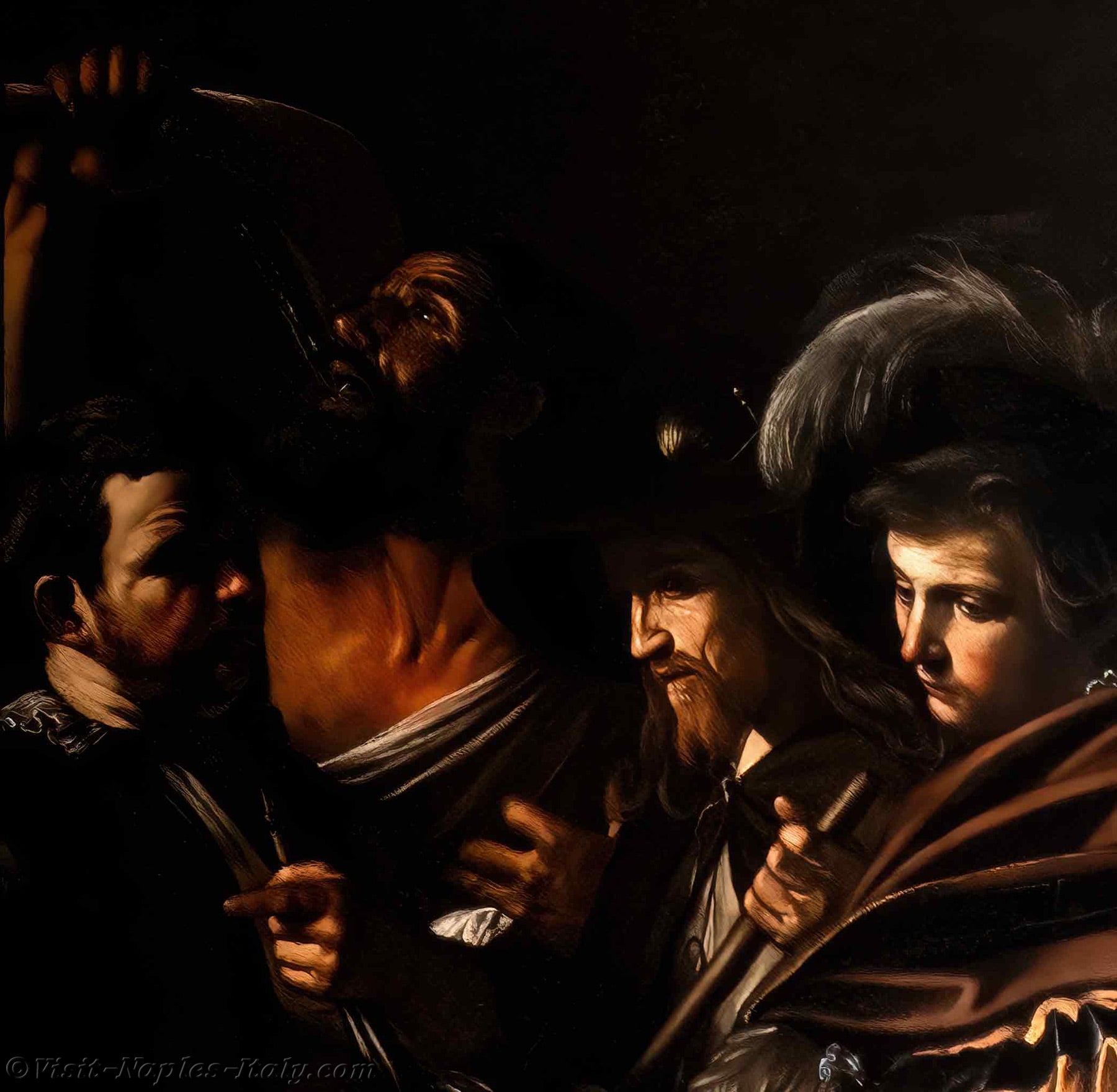
The Seven Works of Mercy Between the innkeeper and the pilgrim on the Way of St James, one can make out the head of a colossus dressed in ancient style, whose tanned skin on his half-naked torso is barely visible against the half-light; ; he raises his arm holding aloft the barely visible bone of a donkey’s jaw, from which water flows and which he drinks greedily, his mouth wide open.
Caravaggio has depicted Samson here to recall the biblical episode in which Samson kills the Philistines with a donkey’s jawbone.
Just as he was dying of thirst, God gave him something to drink by splitting a rock from which water gushed forth.
All the figures in this Neapolitan alleyway are dressed in the fashion of Caravaggio’s time, except for Samson, who is a heroic figure from the Old Testament.
Give the dead a proper burial
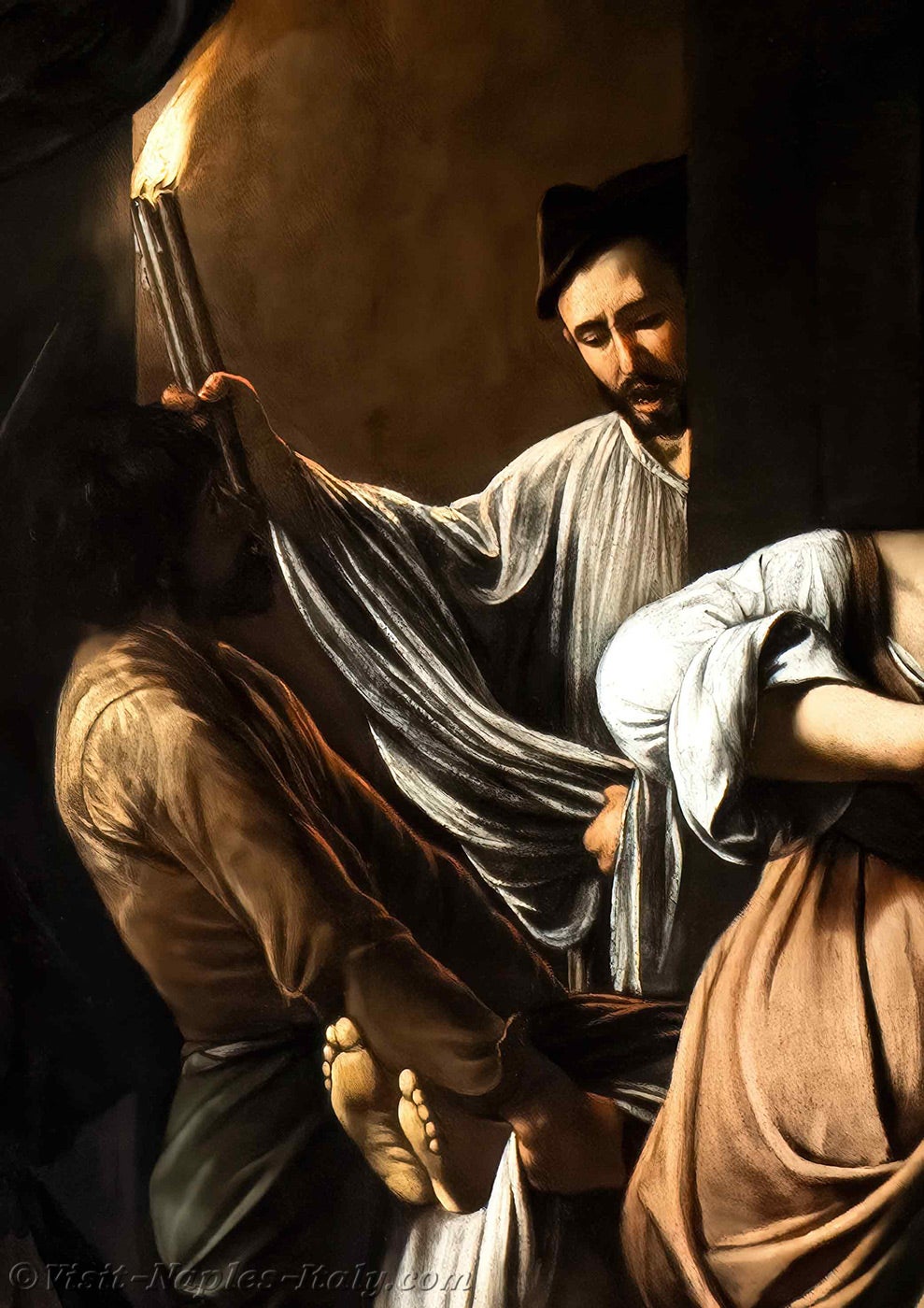
Seven Works of Mercy Behind Saint Martin stand two men.
The one on the left, whose face is barely lit but whose beard and hair are distinguishable, is dressed in a simple shirt and breeches that end above the knees.
With his upper body leaning slightly backwards and both arms outstretched in front of him, he is carrying a body by holding its legs.
The dead man’s two bare feet protrude from the white shroud that wraps around the body.
In front of this man, a priest illuminates the scene whilst holding two candles at arm’s length and gazes at the body whilst chanting a litany.
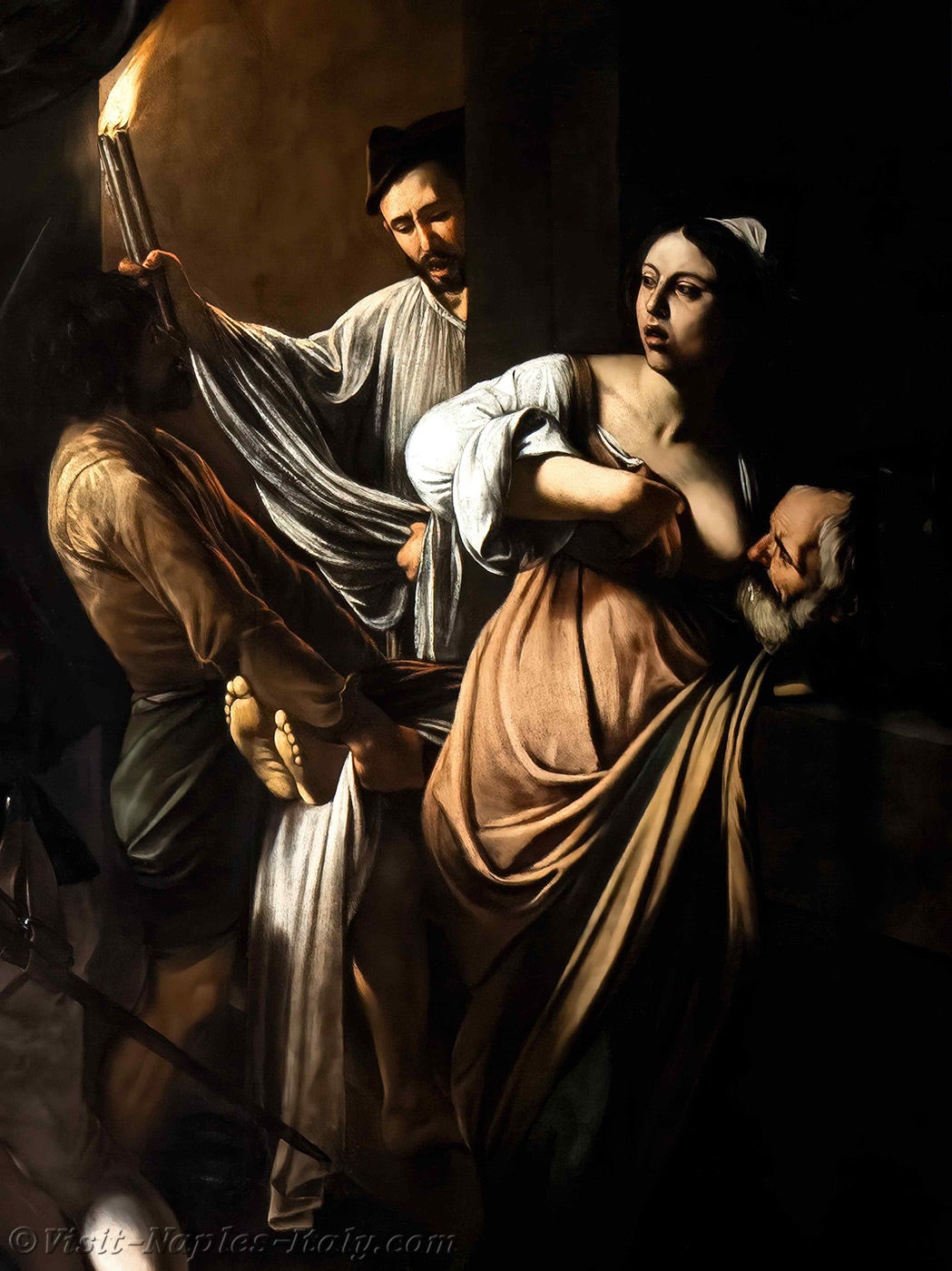
Seven Works of Mercy He is wearing simple white liturgical vestments and performs his duties with solemnity under the gaze of the angel who extends a protective arm over the whole scene.
All these figures, shrouded in the darkness of the alleyway, are made visible solely by the candles held aloft by the priest, who brings them this light that draws them out of the darkness of the earthly world represented by this alleyway.
Light conquers darkness as it descends from heaven from the Virgin, who gazes at the Baby Jesus, who gazes at the angel, who gazes at the priest and the young woman who is breastfeeding.
Visit the prisoners and care for the sick
Before the body of the deceased which is about to be buried stands a young woman, partly illuminated by the priest’s candles.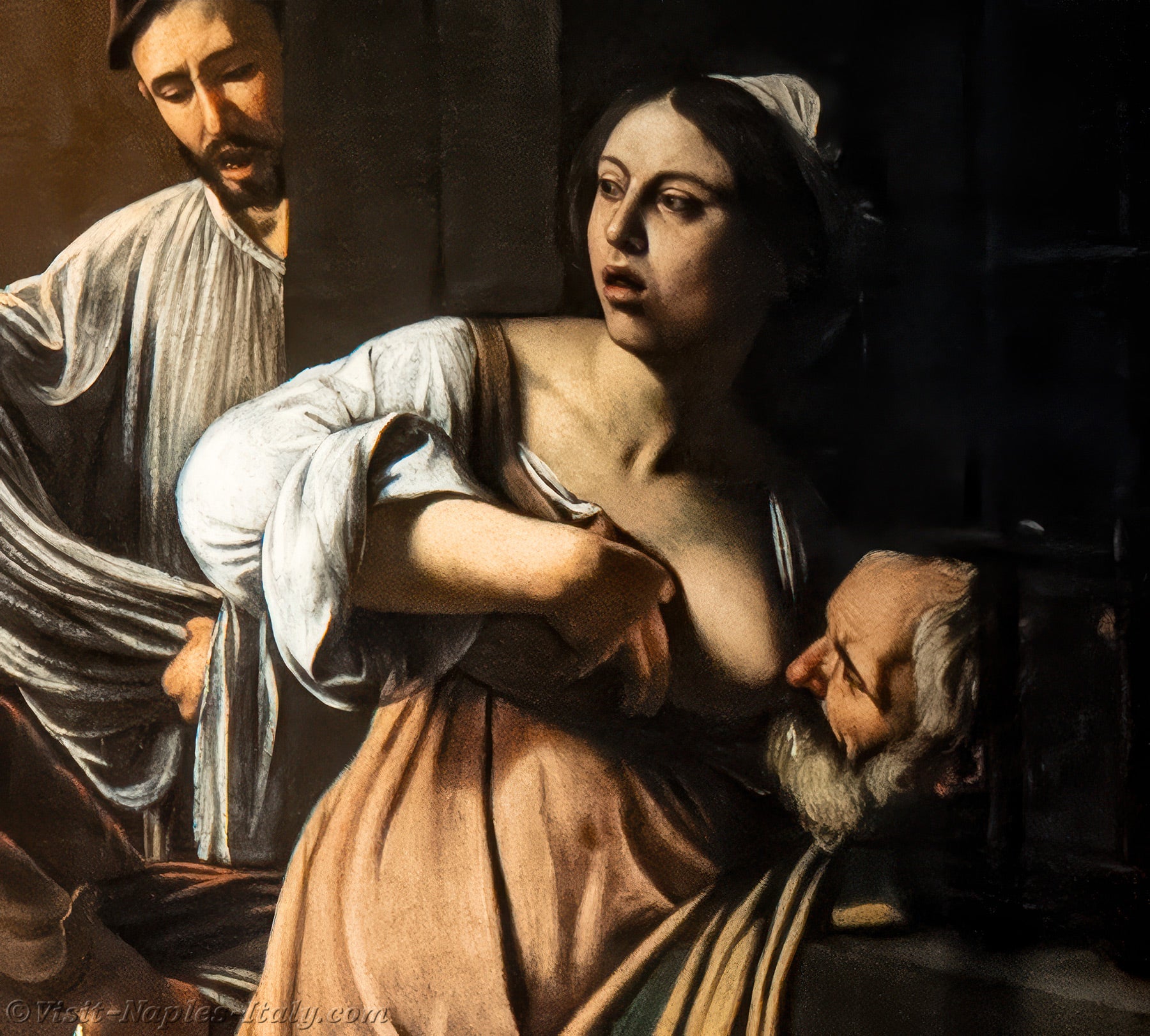
The Seven Works of Mercy At waist height, you can see a head peeking out from between the black bars of a grille.
She surreptitiously unfastened her blouse and exposed one of her breasts, which she offered to her father to suckle, hoping that the prison guards would not catch her.
This elderly man in prison has been visited by his daughter, who looks away for fear of being caught and punished for defying the ban on feeding the prisoner.
Those guarding him are deliberately letting him starve to death and this is the only way his daughter has found to keep him alive.
Two thick drops of milk fell onto the old man’s beard, whilst the open bodice of his daughter passes under his chin as if it were a bib for this unfortunate man reduced to a childlike state by his condition as a starving prisoner.
The Seven Works of Mercy To illustrate these works of mercy (visiting prisoners, caring for the sick, feeding the hungry), Caravaggio depicted the *Caritas Romana*, Roman charity.
This subject of Roman charity was popular in antiquity and several small statuettes have been discovered in Pompeii depicting a girl breastfeeding her father.
This young Roman woman, named Pero, was breastfeeding her father Cimone, who was starving to death in prison.
This act of charity was a precursor to the spirit of Christian charity.
The masterpiece of the seven works of mercy
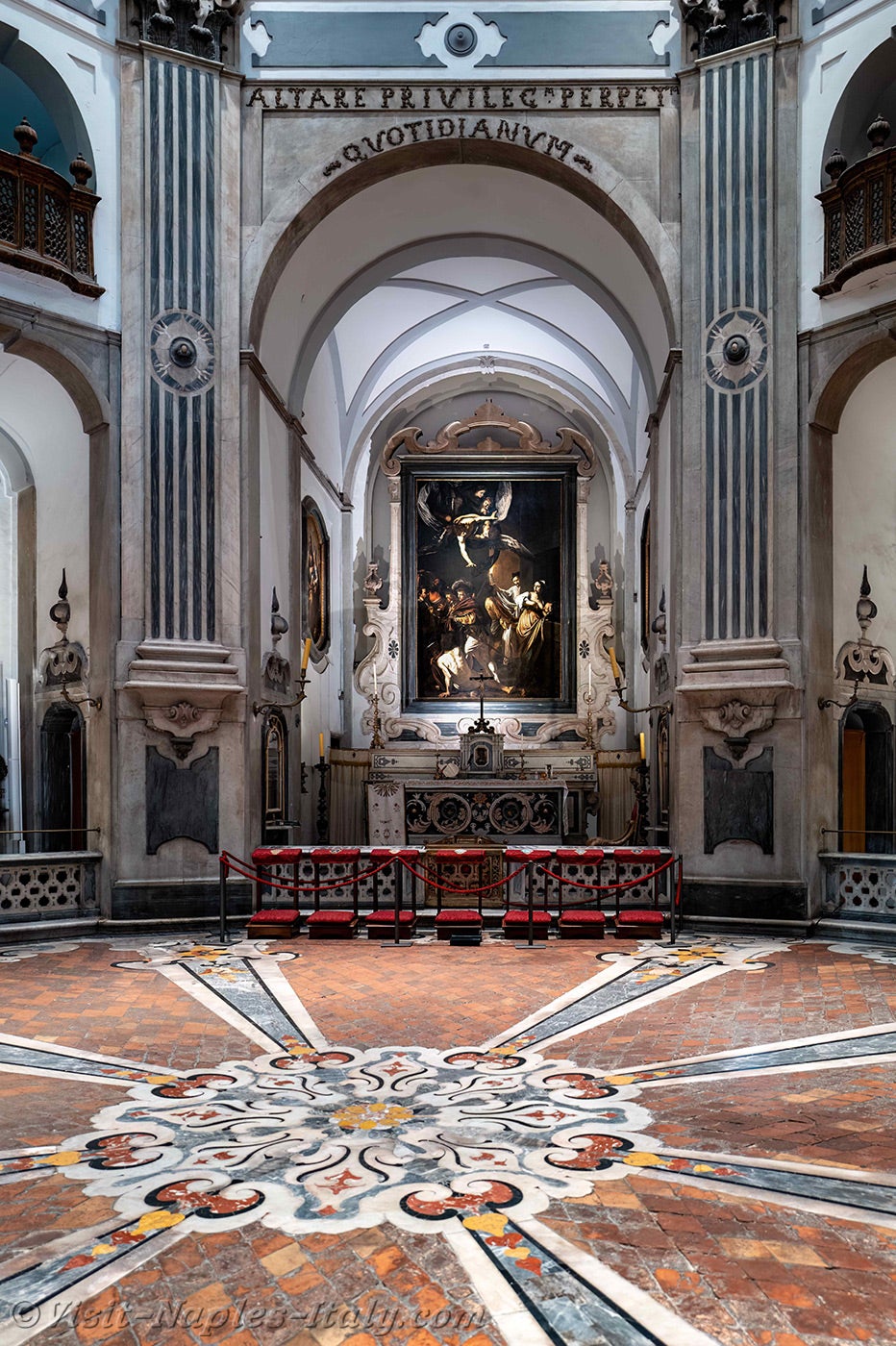
Seven Works of Mercy Caravaggio’s genius lay in his ability to depict the spiritual legacy of the Seven Works of Mercy by blending the New Testament with the Old Testament, and Roman antiquity with the Middle Ages, all condensed into this vision of human misery, at a time when Naples presented a stark image of abandonment and despair.
No sooner had it been installed on the high altar of the new church of Pio del Monte della Misericordia than this work by Caravaggio was swiftly regarded as the brotherhood’s most precious possession.
Several offers to purchase this masterpiece had already been made to the confraternity, for prices amounting to as much as five times the sum paid to the painter.
Consequently, a few years later, in 1613, it was stipulated in the confraternity’s statutes that this painting must never be sold, whatever the price offered or for whatever reason.
Pio Monte Caravaggio Schedule Tickets Location | Authorizations
Back to Top of Page