

Catacombs Art History Schedule Tickets Location | Authorizations
Art History History Catacombs | Frescoes
The 4th- and 5th-century frescoes in the Catacombs of San Gennaro in Naples
The frescoes in the Catacombs of San Gennaro are clearly of a religious nature, but also human, as these frescoes tell a story.Among these, the fresco in the tomb of the Theotechnus family, dating from the 5th century to the 6th century, is particularly moving.
The fresco of the Theotechnus family
The arcosolium decorated by this fresco was the venue for the burial of a family who must have been both wealthy and distinguished.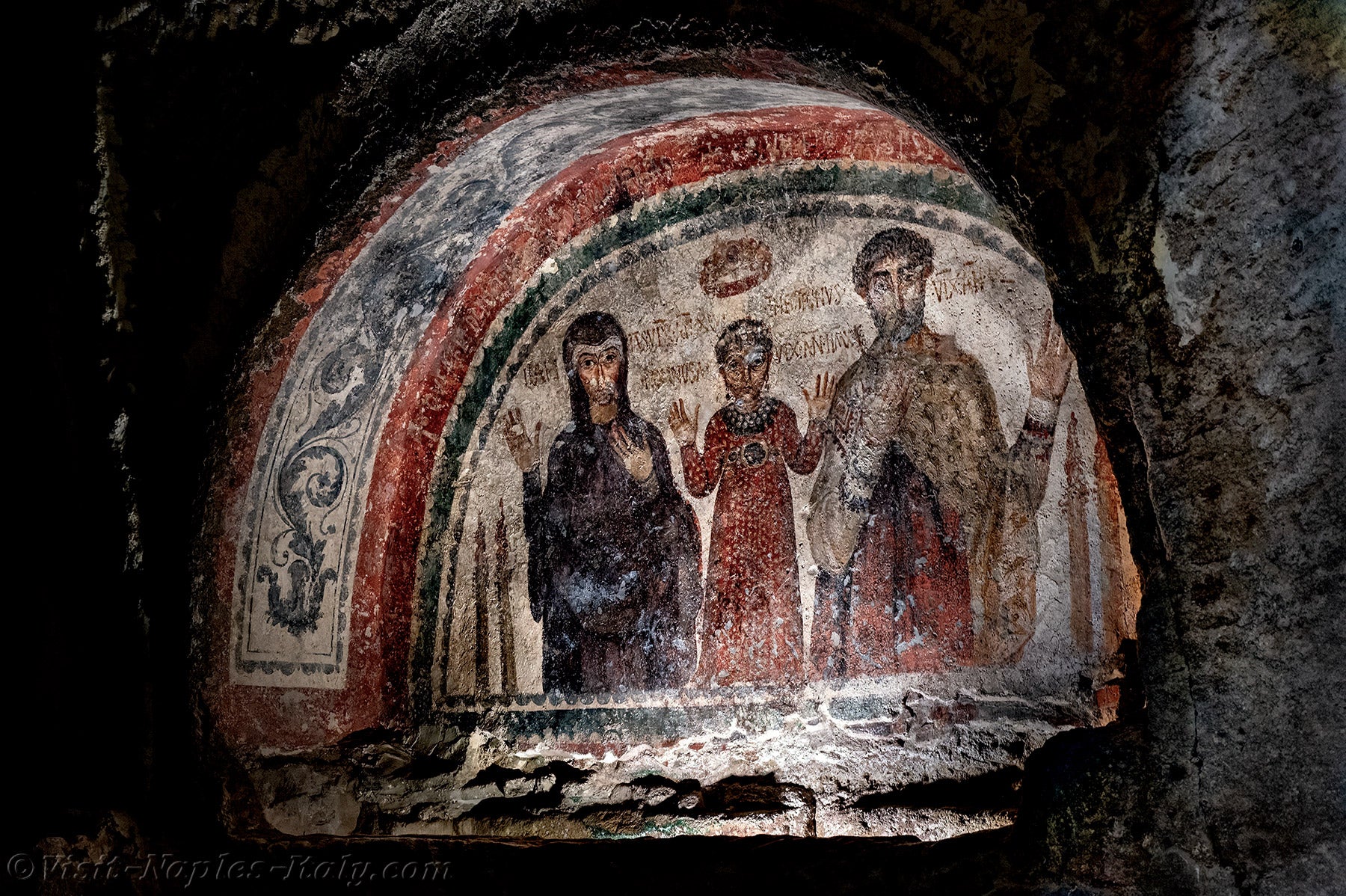
The tomb of Theotecnus At the centre of the fresco is Nonnosa, the little girl with earrings, who was only two years and ten months old at the time of her death.
This tomb had originally been created for her, as analyses of the fresco have shown that the layers of coating used to paint the mother and father had been added to the layer on which their daughter had previously been painted.
The mother, Hilaritas, joined her daughter at the age of forty-five, followed by the father, who died two days later; he was sixty years old.
All three are depicted between four lit candlesticks, symbols of Christ and eternal bliss.
Hilaritas has her head covered with a pallium; she prays with her hands raised, dressed simply in dark purple, the colour of mourning, and wears no jewellery.
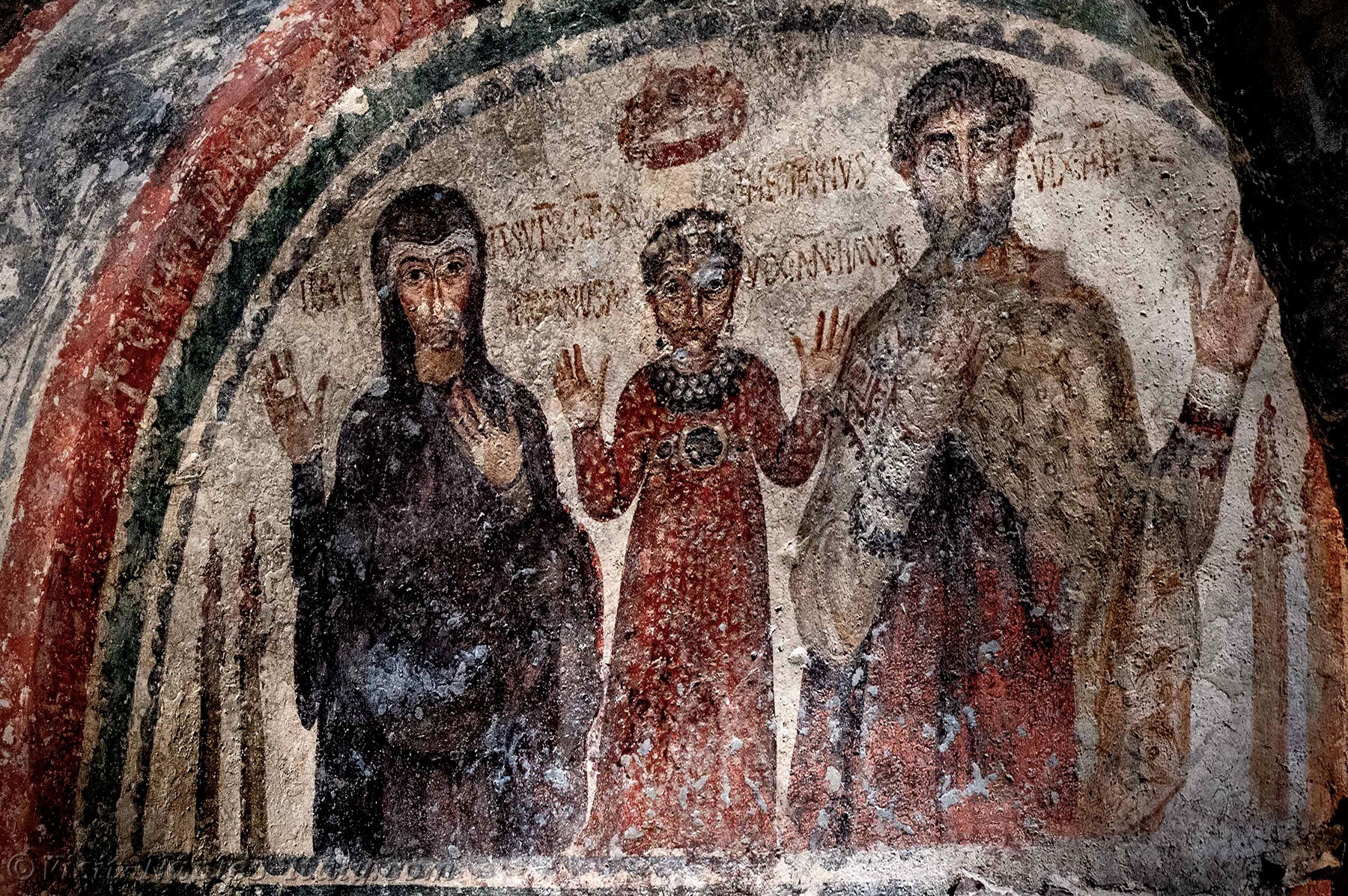
The tomb of Theotecnus Her name is painted on either side of her face: “ILARITAS VIX. AN. XLIV.”.
The father, Theotechnus, is, by contrast, richly dressed in a short-sleeved tunic covered by a white woolen dalmatic embroidered with antelopes, held in place by a precious fibula on his red tunic, which is also embroidered with motifs.
To the right of his face, the inscription reads: “THEOTECNVS VIX. AN. L.”
Between her parents stands the small, serious face of Nonnosa, praying with her arms outstretched, dressed in a pretty red dress adorned with a belt at the waist where three large precious stones sparkle, and a pearl necklace.
Above her is painted a laurel wreath symbolising her purity and virginity.
She wears earrings and a tiara in her hair; her name is written: “NONNOSA VIX. AN. II. M. X”.
The three look at us with their wide-open eyes and pray, their open hands turned towards us.
The oldest depiction of San Gennaro
This depiction of the saint is found in the arcosolium of Cominia and Nicatiola, her daughter.At the hour of their death, they called upon the intercession of San Gennaro.
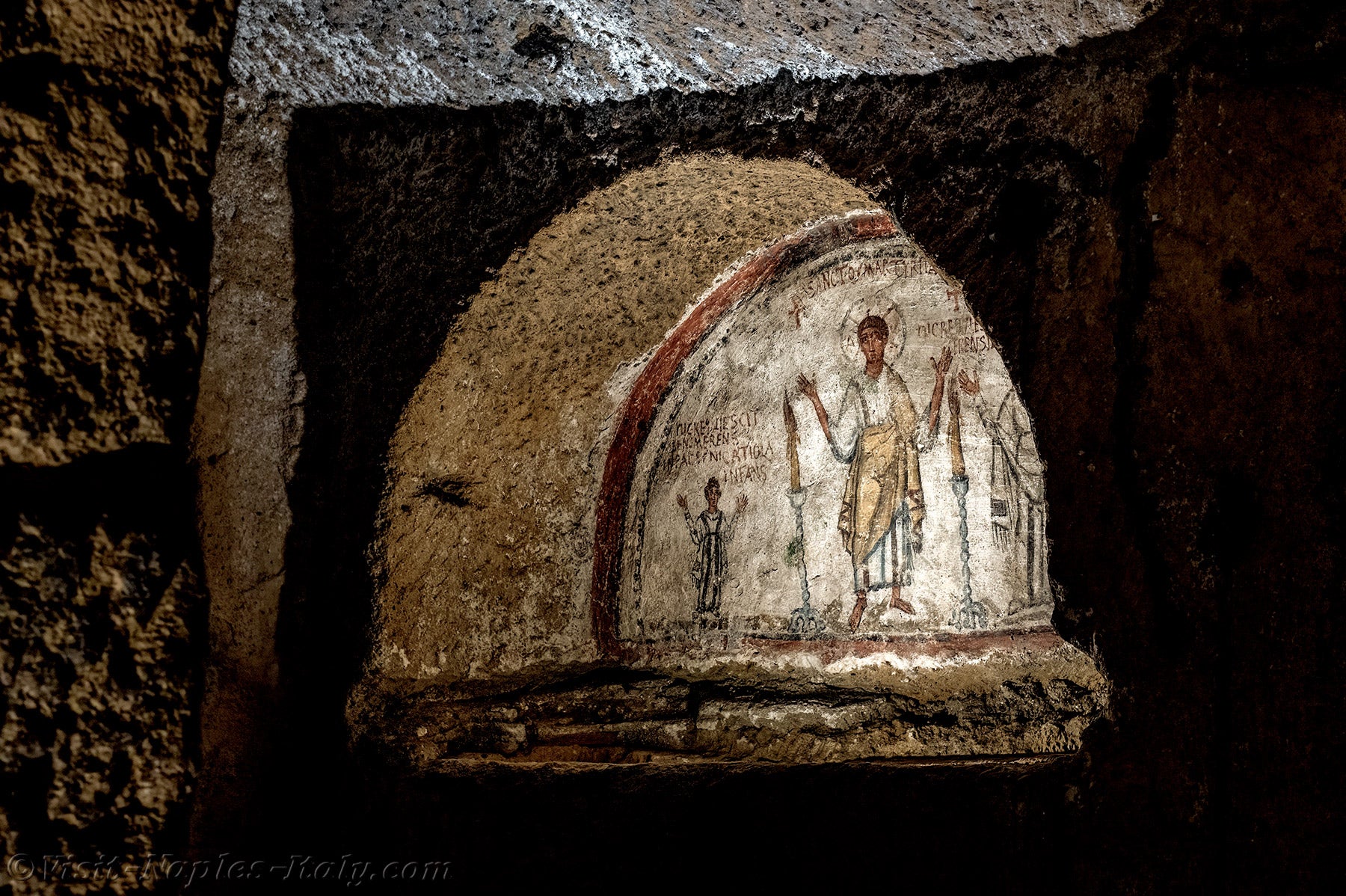
San Gennaro with Nicaziola and Cominia They are both depicted in prayer, standing on either side of the saint, who stands between two lit candelabra so that he may lead them to paradise.
San Gennaro is a young priest in prayer, dressed simply in ancient style, his head crowned with a halo bearing the monogram of Christ.
X and P are the first two letters of the Greek name of Christ; alpha is the first letter of the Greek alphabet, omega is the last, to remind us that Christ is the beginning and the end of all things.
This depiction of San Gennaro, in which a saint appears thus identified with Christ himself, is unique in the history of early Christian art.
Above his head and between two crosses, the inscription reads: “SANCTO MARTYRI IANUARIO”.
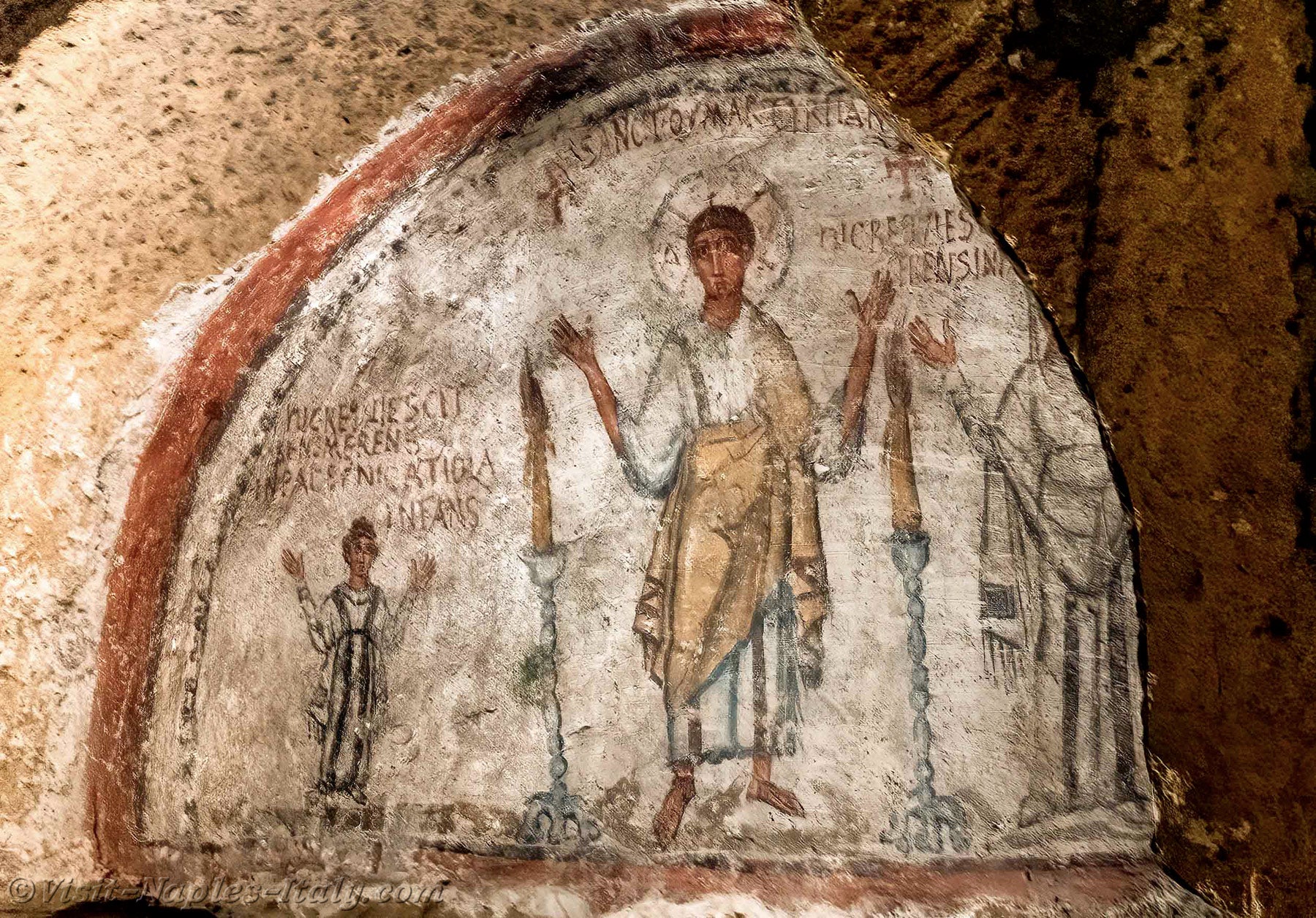
San Gennaro with Nicaziola and Cominia Little Nicatolia, daughter of Cominia, is standing to the right of San Gennaro, in accordance with the words of Christ announcing that only children and the innocent would be placed at his right hand in paradise.
She is dressed in a gown and a stole adorned with a monogrammed cross.
Above her, the inscription reads: “HIC REQUIESCIT BENEMERENS IN PACE NICATIOLA INFANS”.
To the left of San Gennaro, Cominia adopts the same posture of prayer with her arms outstretched and wears an outfit identical to that of her daughter.
Above her, the inscription reads: “HIC REQUIESCIT BENEMERENS IN PACE COMINIA”.
The fresco of Heleusinius’ tomb
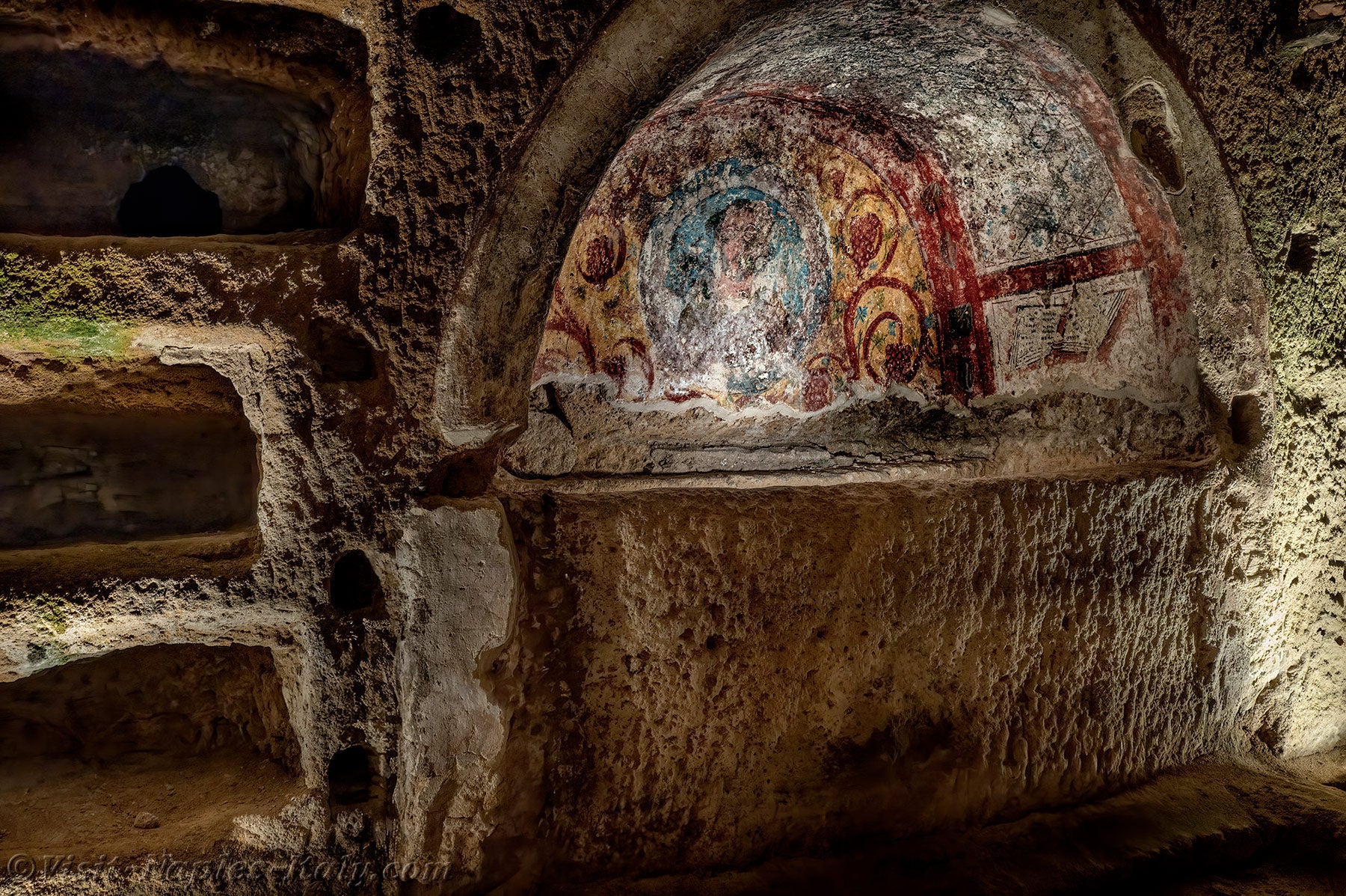
Fresco of Heleunisius Another arcosolium decorated with a fresco indicating the tomb of Heleusinius.
A medallion depicts the bust of a bearded man painted against a blue background, with the words: “SCE MEM HELEVSINIVS”.
As SCE MEM is the abbreviation for “sanctae memoriae”, this means that this man named Heleusinius was a member of the church.
The portrait of Heleusinus stands out against a semicircular yellow background, adorned with red vine shoots arranged in elegant scrolls bearing a beautiful bunch of grapes in their centre.
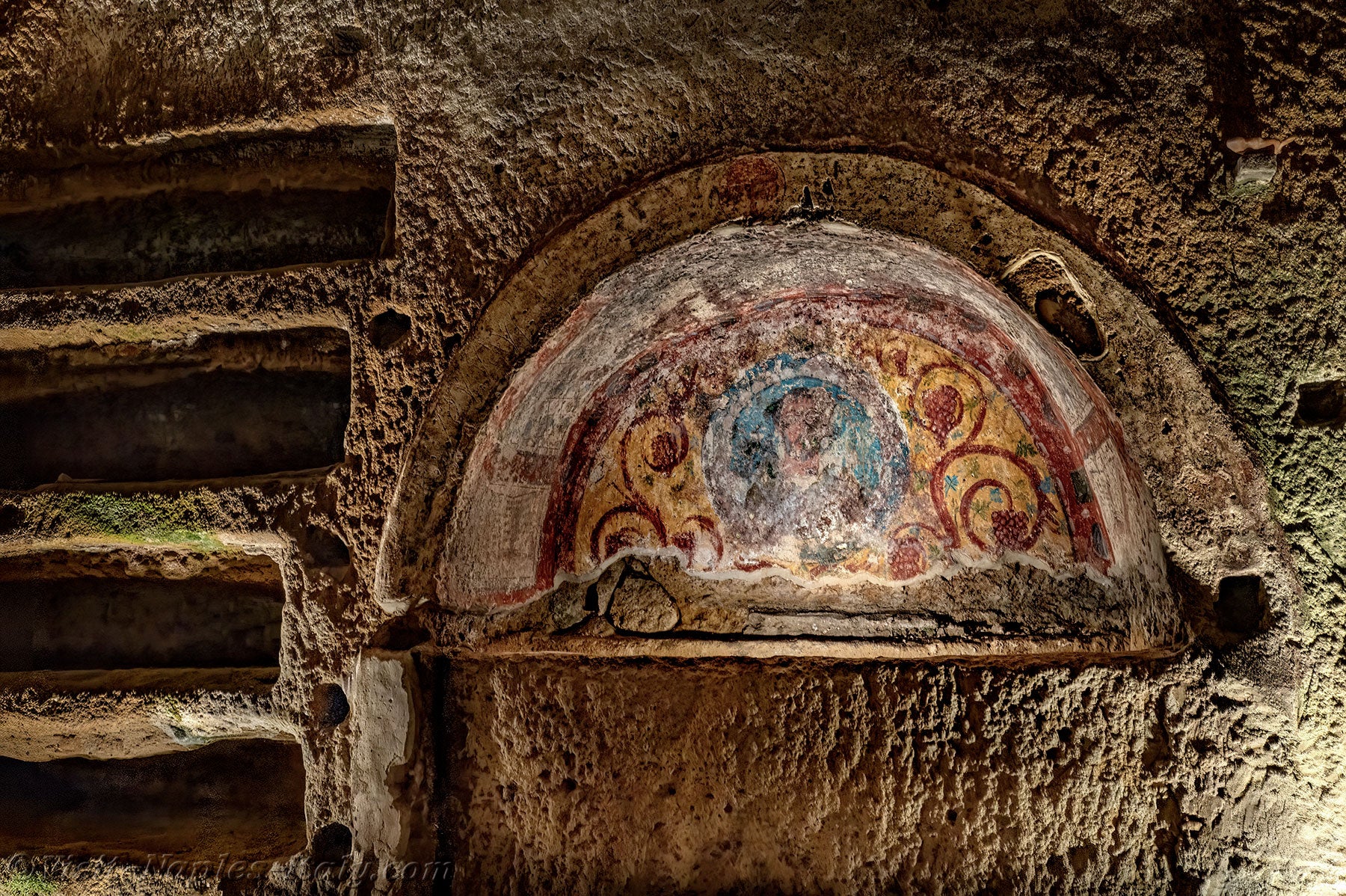
Fresco of Heleunisius The vault above the fresco is decorated with diamond shapes painted on a white background, and on either side at the base of this vault are depicted open holy books, probably the Old and New Testaments.
The Peacock Fresco
This fresco dating from the 4th century is one of the oldest frescoes still visible in the Catacombs of San Gennaro.A magnificent green peacock spreads its tail between two vases, walking on the flower-strewn ground of a paradisiacal garden.
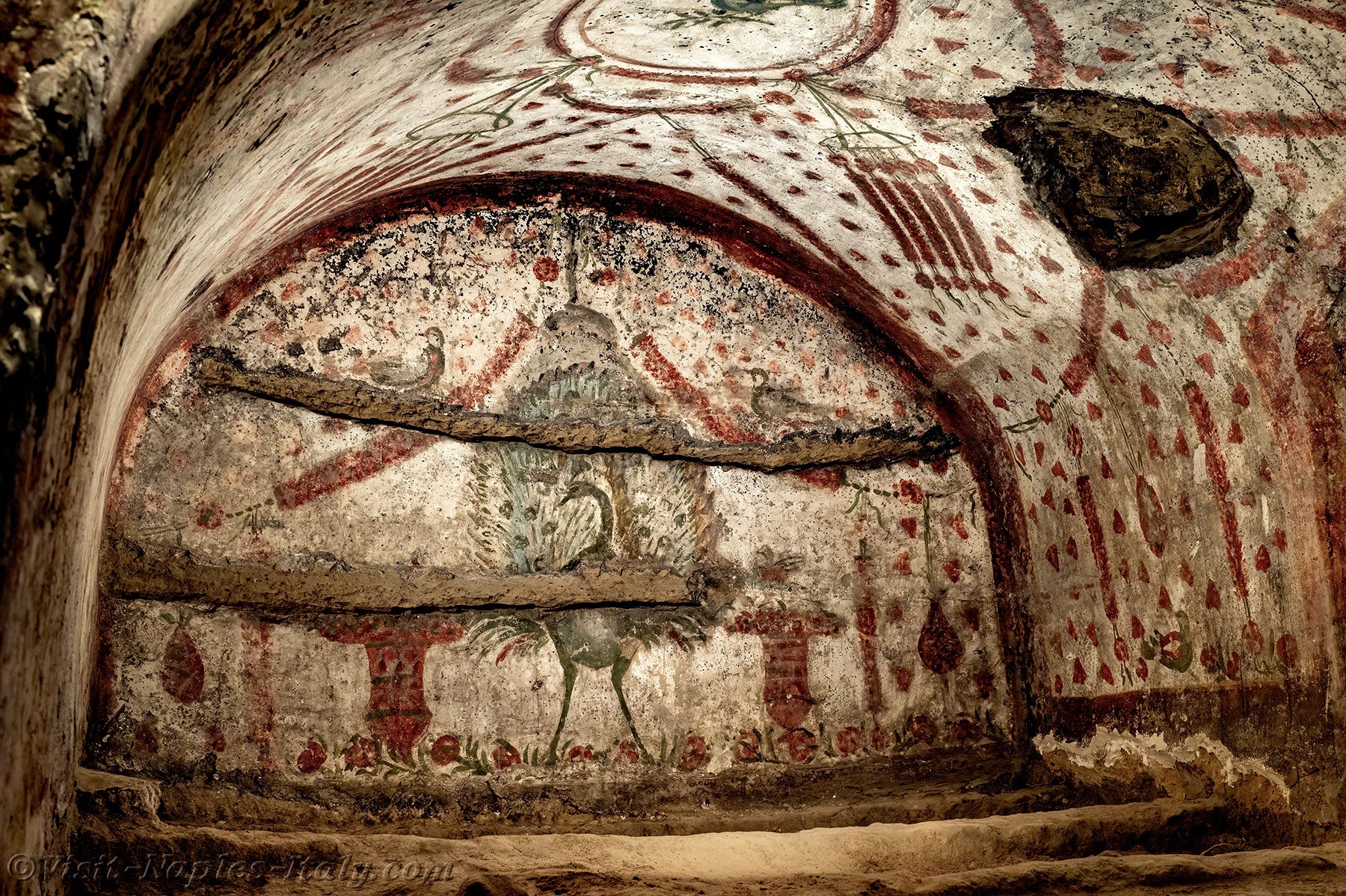
Peacock fresco He is surrounded by doves perched on the large vases and on the red garlands hanging above him.
In the early days of Christianity, the peacock was seen as a religious symbol.
It had become the symbol of spiritual rebirth and resurrection because every year it sheds its feathers, which grow back in spring.
The many eyes covering its tail feathers symbolised God’s omniscience.
The fresco on the vault is covered with motifs painted in bright red, like the flowers in the garden.
Art History History Catacombs | Frescoes
Catacombs Art History Schedule Tickets Location | Authorizations
Back to Top of Page