

MANN Artworks Schedule Tickets Location | Authorizations
Artworks Sculptures | Frescoes | Eroticism
Eroticism Erotic | Satyr | Brothel | Priapus | Phallus | Pan | Hermafroditus
The erect priapuses in the Erotic Cabinet of the Archaeological Museum of Naples in Italy
Mercury, shop sign, Pompeii
Fresco - Water-based pigments on Coating - AD 1-79The Romans transformed several Greek gods into Roman deities, including Mercury, who took over the legends and attributes of Hermes.
Mercury was the Roman god of trade and profit, so it's not surprisingant de le retrouver ici sur une enseigne de magasin.
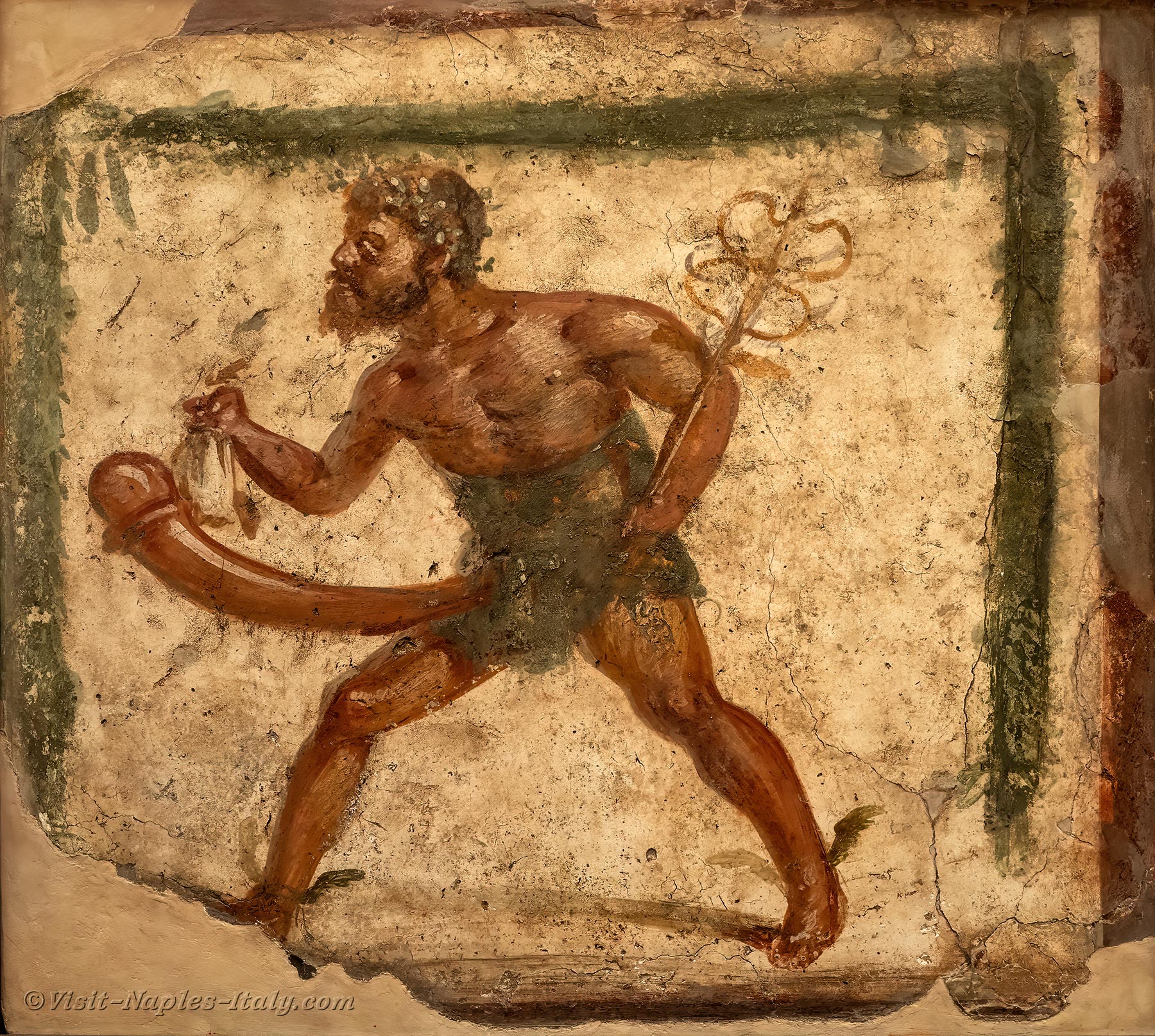
Mercury, shop sign Mercury had a temple and a sacred fountain in Rome, whose water was said to possess special powers.
On 25 May, the day of the god's feast day, merchants would sprinkle their wares and themselves with water from this spring, in the hope of making great profit.
In Greek mythology, Hermes is not just the god of orators and the inventors of music, the alphabet and astronomy.
He is also associated with commerce, as he is considered to be the inventor of systems of weights and measures.
His role as protector of travellers also made him invaluable to travelling merchants and the risks of being attacked and robbed on the way.
Like the Greek god Hermes, Mercury is depicted in this fresco discovered in Pompeii with a caduceus and his sandals are adorned with the small wings of the divine messenger.
However, the most striking feature of this Mercury, god of fertility, is undoubtedly the enormous erect phallus that characterises him.
“Hermæ”, phallic pillars surmounted by a head representing Hermes, were placed at crossroads, in rues as well as on the thresholds of houses as a good omen.
Priapus pouring an aphrodisiac liquid over his sex, Herculaneum
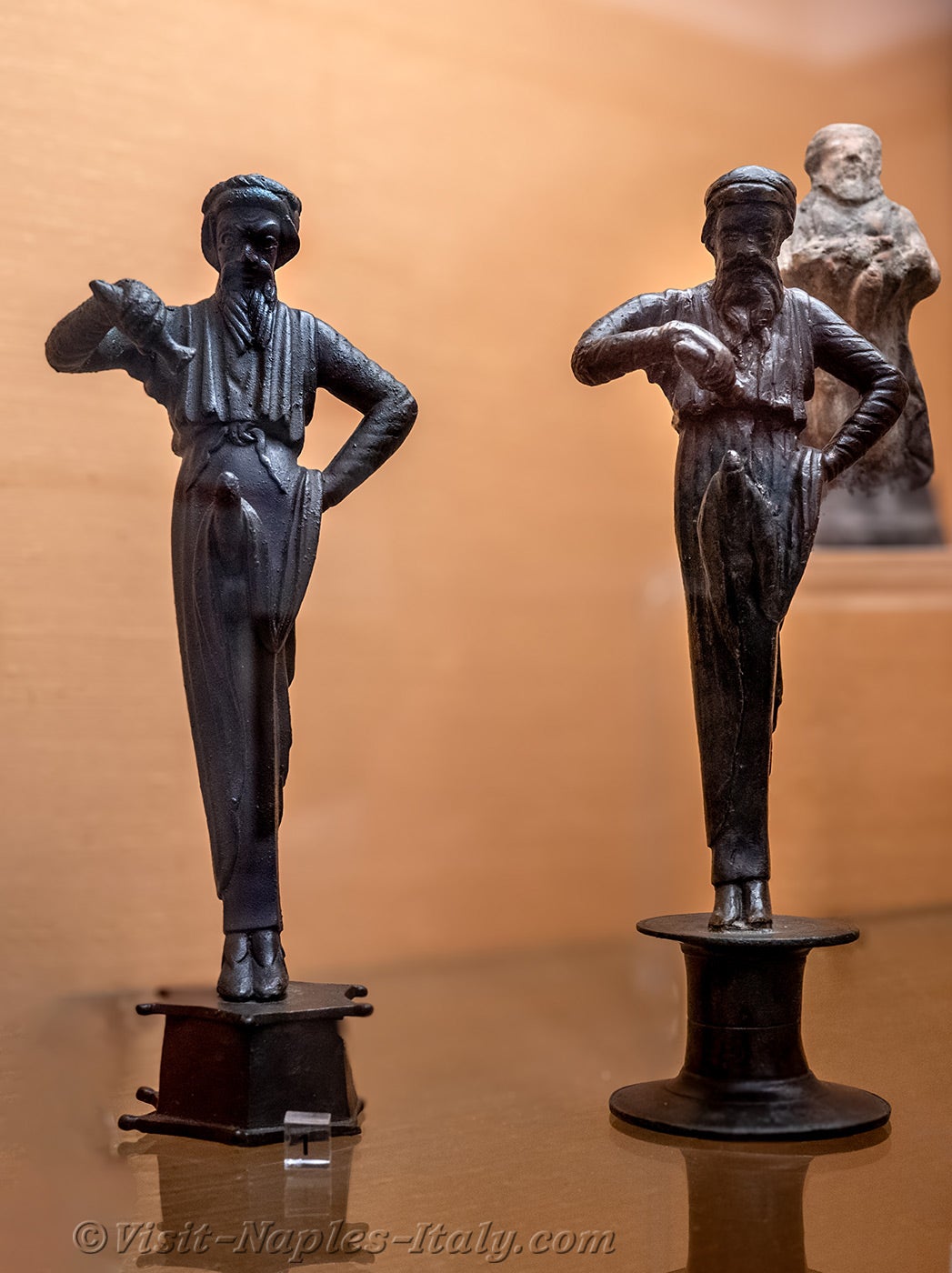
Priapus pours an aphrodisiac over his sex Sculpture - Bronze, AD 1-79
This statue in bronze, discovered in Herculaneum, almost certainly comes from a votive Chapel dedicated to the god Priapus.
The liquid, contained in an alabastron, which Priapus ostensibly pours over his erect sex, is used to give men their sexual vigour.
Theophrastus mentions potions and ointments used to stimulate erections.
According to him and other authors, the tubercules of Orchis-Hircina were used to make aphrodisiac potions by the sorceresses of Thessaly. Turbercules that they would dissolve in goat's milk.
The statue on the left is an original bronze version dating from the 1st century. The one on the right, of inferior quality, is a more recent copy discovered at Capodimonte.
Satirical statuette of a Cynic philosopher, Pompeii
Sculpture - Bronze - AD 1-79This satirical statuette, discovered in Pompeii, depicts a Cynic philosopher, dressed only in a half-cape that does not hide his sex.
Cynicism was a philosophical movement radically non-conformist, emphasising freedom, rejection of convention, return to nature and unfettered sexuality.
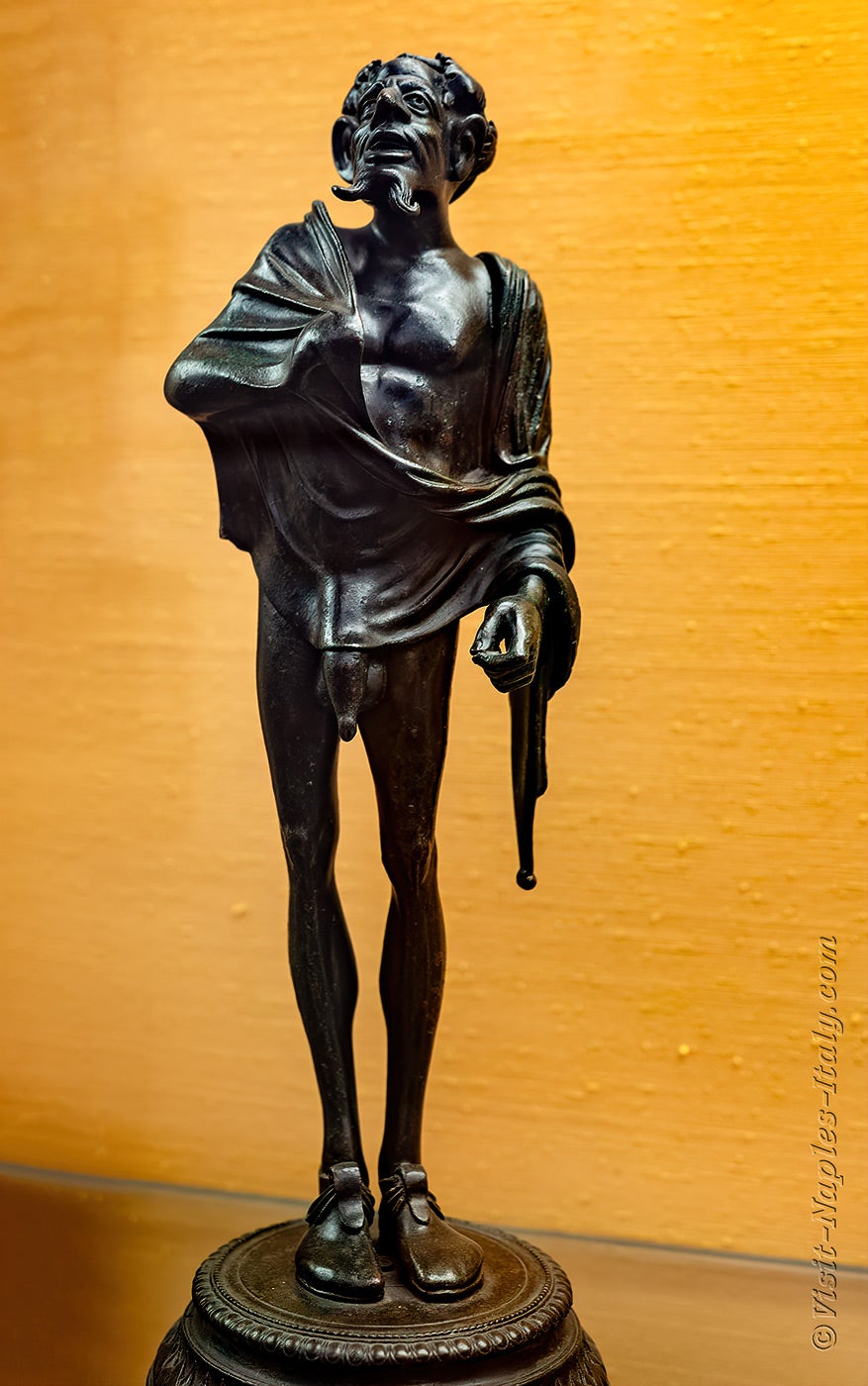
Cynic philosopher This movement emerged in Greece in the 4th century BC, with Antisthenes, a disciple of Socrates, and was then popularised by Diogenes of Sinope.
According to the Cynics, absolute freedom was necessary to achieve goodness and wisdom.
Cynics wore a simple cloak, worn out and full of holes, which served them in winter as well as in summer.
A cloak that only partially covered their bodies, which didn't bother them, because they despised modesty, which they saw as an artificial moral value created by society.
The wealthy Crates of Thebes, who became a disciple of Diogenes, abandoned all his possessions and became a cynic.
His future wife, Hipparchia, came from a wealthy family in Athens. Her parents, however, disapproved of the union and had to allow her to marry Cratès.
Like most cynics, they did not hesitate to have sexual relations in the street, in front of everyone.
Cynics were also fond of public masturbation.
Hipparchia was not only one of the first feminists, but also an educated woman who dared to venture into men's meetings.
Eroticism Erotic | Satyr | Brothel | Priapus | Phallus | Pan | Hermafroditus
Artworks Sculptures | Frescoes | Eroticism
MANN Artworks Schedule Tickets Location | Authorizations
Back to Top of Page