

MANN Artworks Schedule Tickets Location | Authorizations
Artworks Sculptures | Frescoes | Eroticism
Eroticism Erotic | Satyr | Brothel | Priapus | Phallus | Pan | Hermafroditus
Satyrs capturing nymphs, Bacchantes and Maenads from the Erotic Cabinet at the Archaeological Museum of Naples, Italy
Satyr surprising a young girl, Erotic Cabinet
Fresco - Water-based pigments on Coating - 45-79 AD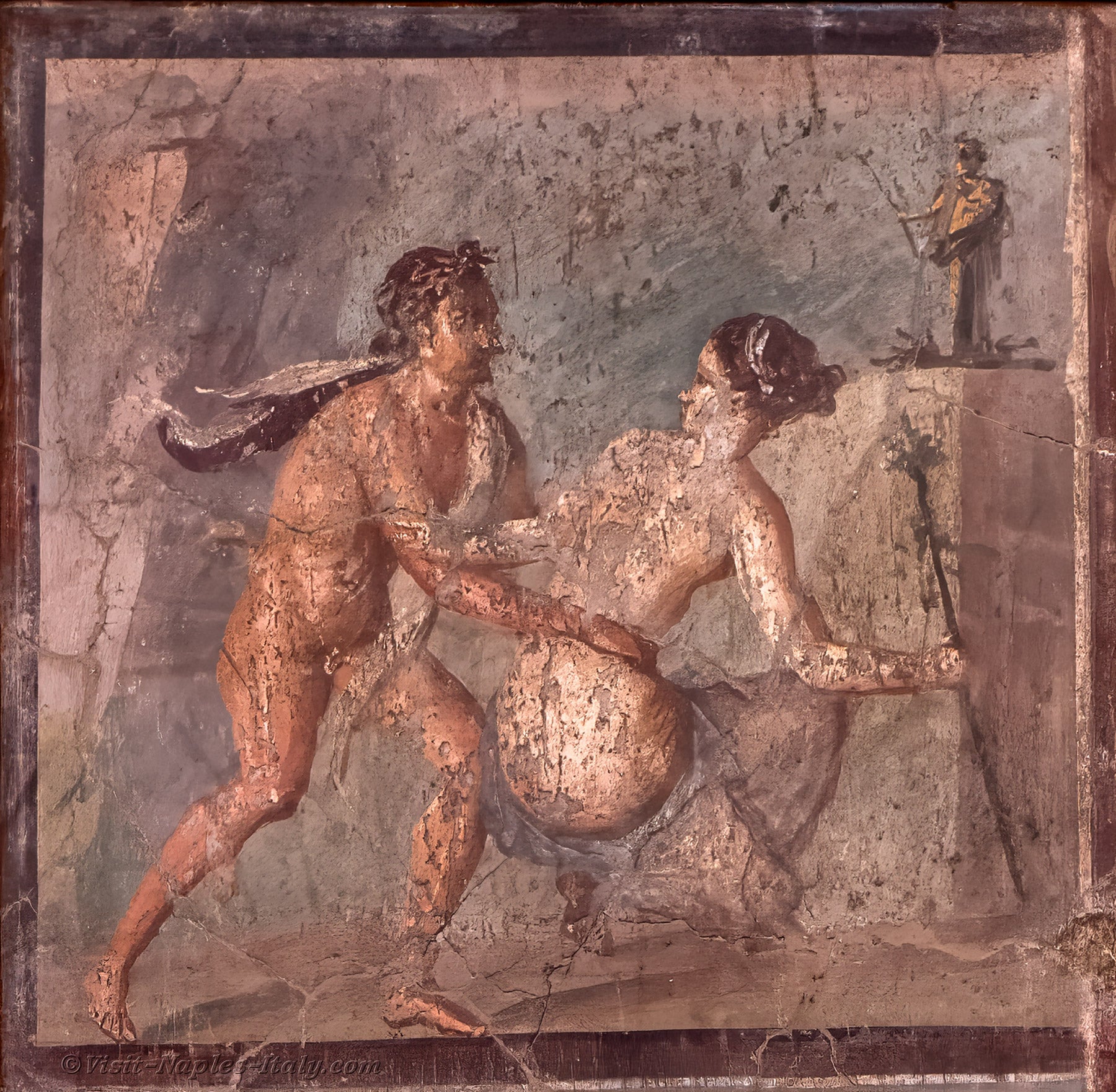
A satyr who catches a young girl In this scene, we can see a satyr attempting to grab a young girl by the hips as she stands before the statue of Minerva.
The young girl holds a thyrsus in one hand, whilst she tries to fend off the advances of the satyr with the other.
In an anecdote by Apuleius, this scene is given meaning:
“The beautiful Chromis, daughter of the shepherd Chrasias, went to a grove dedicated to Minerva on the eve of her marriage to the young Alcimedes.
Myrtil, whom she had rejected, raped her mercilessly at the feet of the goddess’s statue.
The rival, who had committed this sacrilege, had taken the form of a faun.
But his affront did not go unpunished: Myrtil never left the sacred grove, and Minerva restored the young girl’s virginity.”
Apuleius
Tripod with erect satyrs, Pompeii, Casa di Giulia Felice
Sculpture - Bronze (height 106 cm) 1st century AD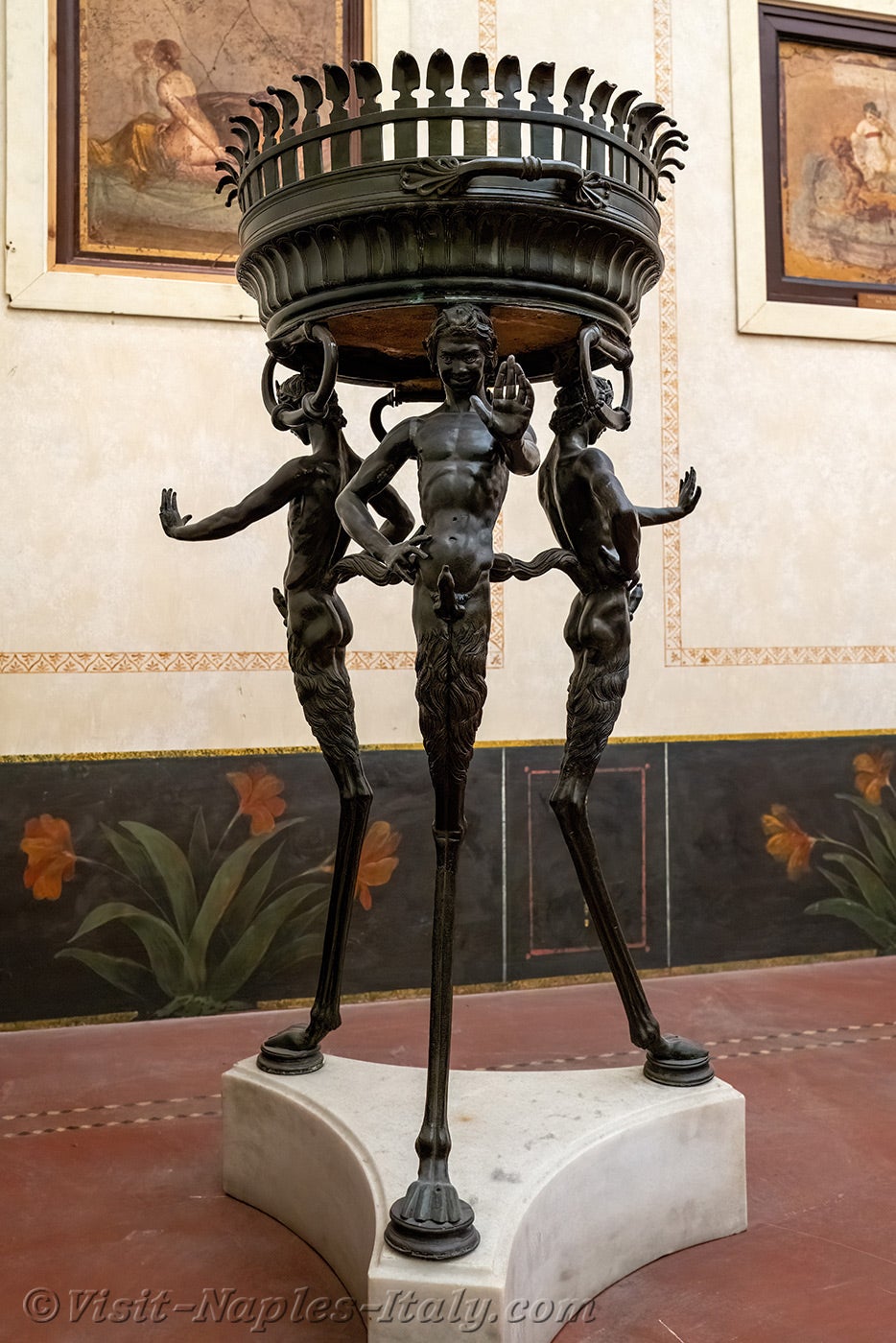
Tripod with erect satyrs Each of the legs of this magnificent bronze tripod depicts a satyr in a state of arousal.
The palms of the left hands of the three satyrs are outstretched in a gesture intended to repel and divert malevolent influences towards another person.
This gesture also serves to keep the uninitiated at bay, that is to say, those who are not initiated and have no right to witness the sacrifice.
Whilst the left hand of these satyrs protects, their right hand rests on their side.
It is important to note that their right ring finger is bent.
This bent finger symbolises silence.
Furthermore, the presence of an erection in these satyrs may come as a surprise.
However, it is important to remember that, in Roman antiquity, phalluses were regarded as protective amulets against earthly impurities.
Consequently, the erection so visible on these satyrs was therefore perceived as being beneficial!
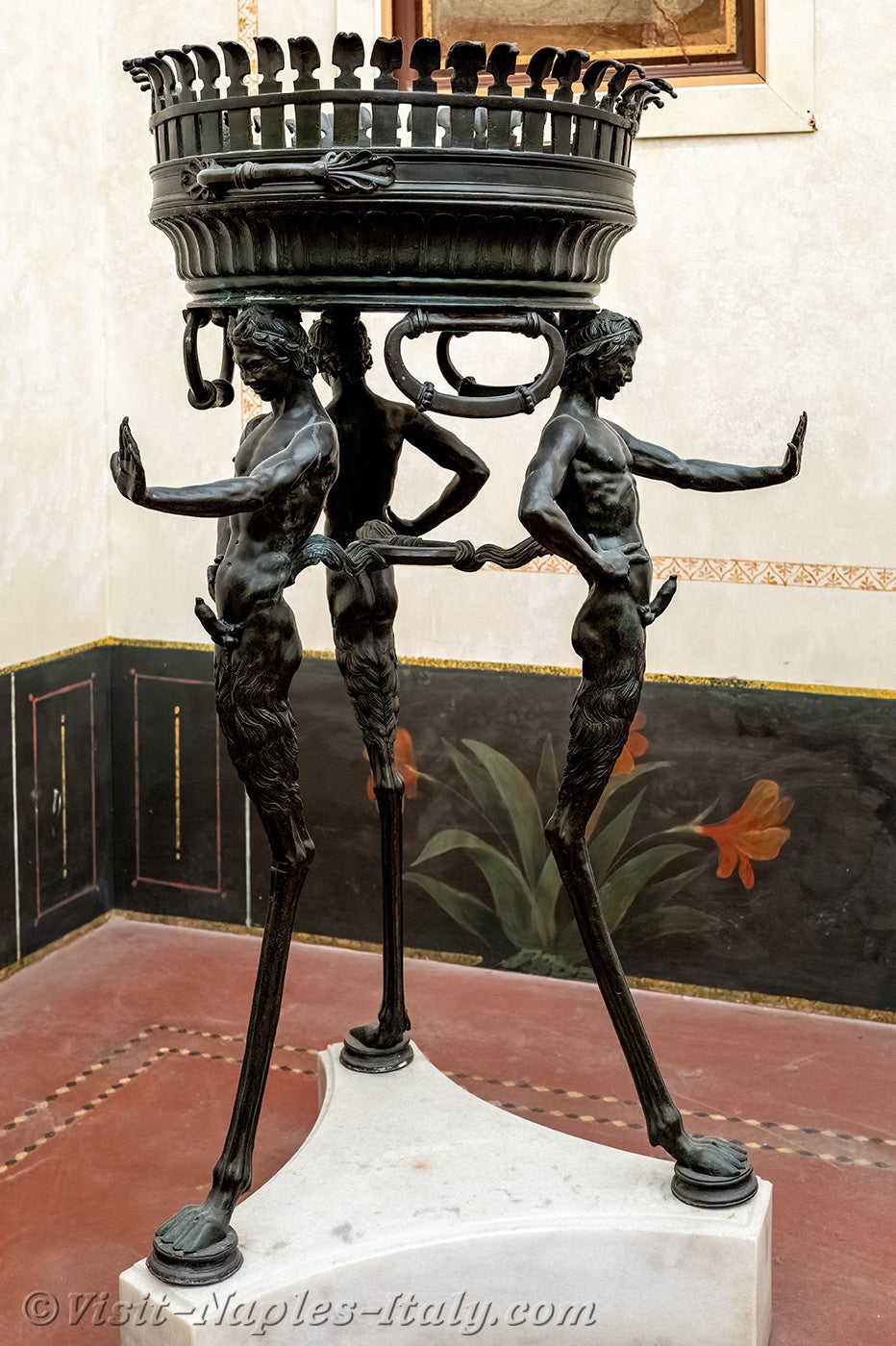
Tripod with erect satyrs The tails of the satyrs are wrapped around the central ring of the tripod to hold it in place in a particularly aesthetic manner.
Tripods were not merely useful and decorative objects; they often had a sacred function.
They could be found in various sanctuaries, such as those dedicated to Apollo, Dionysus, Venus, Priapus, Mercury and even Jupiter.
Their importance was such that initiates into the mysteries of Isis or Eleusis often offered a tripod to the temple to mark their devotion.
The number three also held great significance in antiquity.
Cerberus had three heads, the Fates were three in number, as were the Graces.
This significance of the number three is also found in the Holy Trinity of the Father, the Son and the Holy Spirit in the Christian religion.
Not to mention the three key words of the Kabbalah: Light, vibration and energy.
Satyr and Bacchante, Herculaneum
Fresco - Water-based pigments on Coating (44 x 41 cm) 1-50 ADThis fresco from Herculaneum depicts a satyr kissing a bacchante.
The satyr, kneeling, gently cradles the young woman’s head as he places a kiss upon her lips.
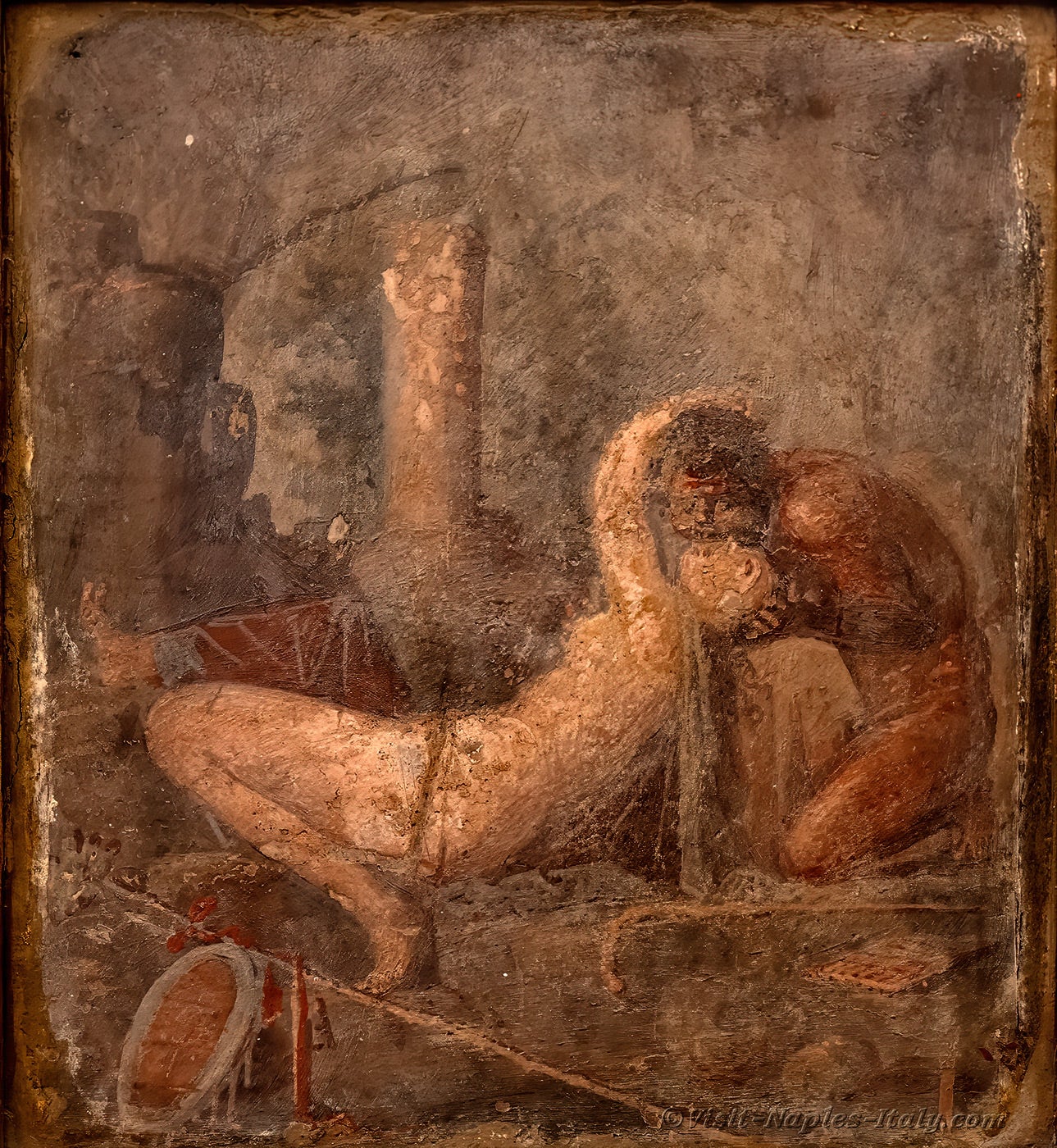
Satyr and Bacchante The young Bacchante gives herself over completely ; she surrenders to his kiss and even holds the satyr’s head to press him against her.
The satyr’s right hand rests on the breast of the beautiful, surrendered woman.
At the couple’s feet, one can see a shepherd’s crook, a pan flute and a tambourine.
The nymph’s thyrsus also lies on the ground, near the tambourine.
The young woman gives herself completely to love, as shown by her arm encircling the satyr’s head.
She shows her eagerness to continue the act by pulling him towards her.
The position of the bodies and their play of light and shadow demonstrate remarkable artistic mastery on the part of the artist who painted it.
Satyr and Nymph, Pompeii, Casa del Fauno
Mosaic - Enamels, Glass paste - 1-50 ADThis mosaic, discovered in the House of the Faun in Pompeii, is notable first and foremost for the finesse of its execution and its high artistic quality.
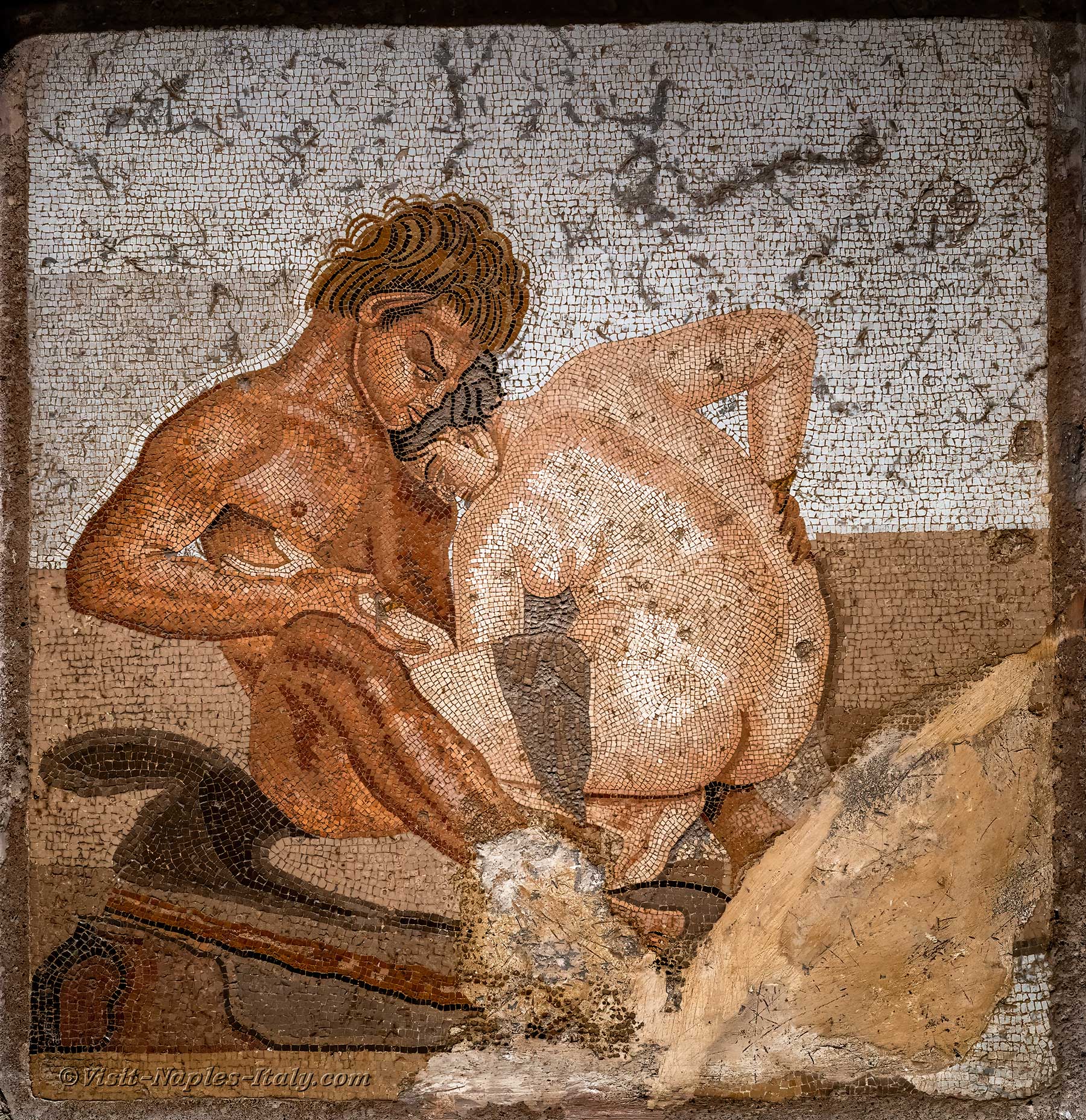
Satyr and Nymph The play of light and shadow on the bodies of the satyr and the nymph is rendered perfectly and gives depth to this mosaic.
The couple formed by the satyr and the nymph are naked, whilst she is kneeling between the satyr’s legs and looking at his penis, which appears to be erect.
They are entwined.
The nymph’s hand rests on the satyre’s muscular chest, whose right hand holds her arm.
His left hand, meanwhile, is on the beauty’s waist, as she offers herself to him.
One senses that they surrender themselves completely to one another, lost in physical ecstasy.
There is a certain tenderness between the lovers: she has rested her head on the neck of the handsome satyr, and he has rested his cheek in the hair of the woman he is about to possess.
Satyr and Maenad, Pompeii, Casa di Cecilio Giocondo
Fresco - Water-based pigments on Coating - 1-50 ADThis fresco depicts a Maenad in the arms of a satyr.
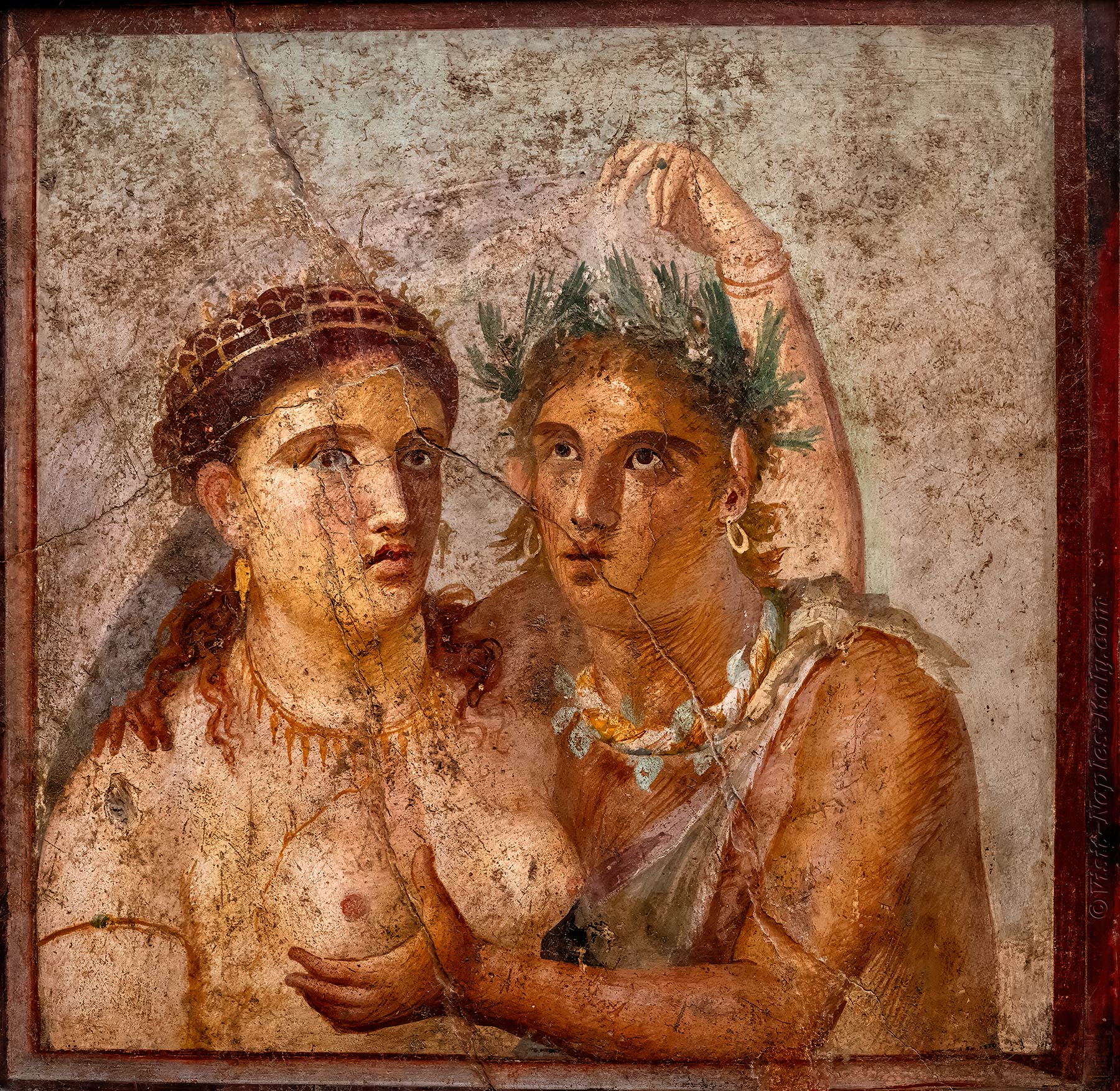
Satyr and Maenad The satyr wears a wreath resting on his pointed ears, adorned with gold earrings.
He also wears a braided necklace, resembling a garland.
The Maenad, for her part, is unclothed and adorned with numerous jewels.
A golden diadem sits in her hair, and she wears gold earrings.
She also wears a necklace and a bracelet, both made of gold.
Her bracelet depicts a two-headed snake, coiled around her wrist.
She has placed her arm on the shoulder of her lover to better offer him her breast. The satyr has grasped one of her breasts.
Nymph and Old Satyr, Herculaneum
Bas-relief - Marble - 1-79 ADThis magnificent marble bas-relief, discovered at Herculaneum, depicts a young nymph defending herself against the advances of an old satyr.
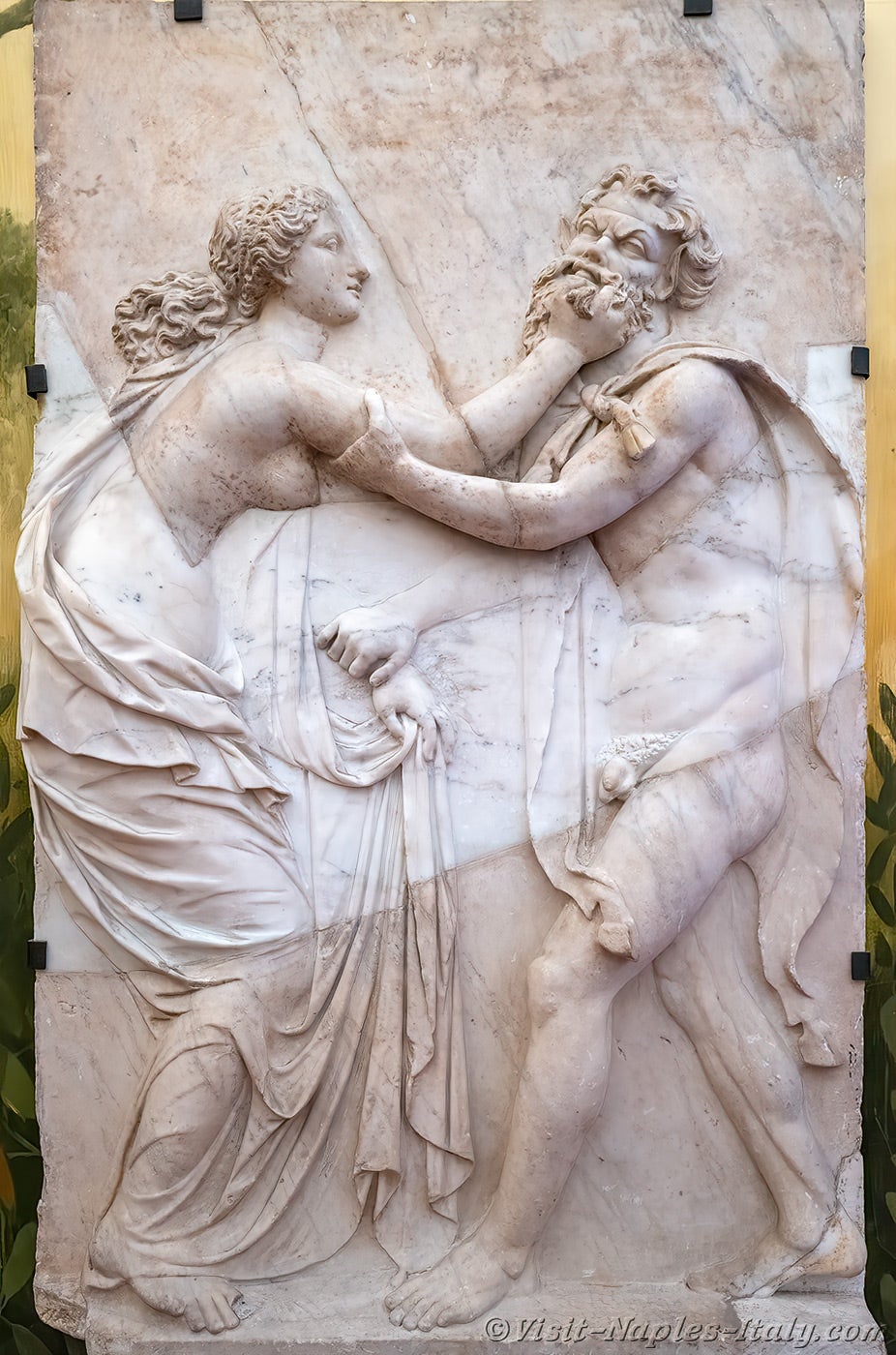
Nymph and Old Satyr Whilst the satyr has already grabbed one of the nymph’s wrists, she has seized his beard and managed to push her attacker’s head backwards.
The satyr tries hard to counter the nymph’s move by grabbing the arm of the hand that is firmly holding his beard.
Despite his advanced age, the satyr still possesses impressive musculature, which highlights the threat he poses to the young and graceful nymph.
Indeed, the position of the nymph’s legs shows that she is already in a precarious balance, whilst the old satyr is clearly more stable on his feet.
The face and body of the nymph, as well as her long, wavy hair, are beautifully sculpted.
The same mastery has been applied to the drape of the tunic covering her.
The satyr is equally well sculpted, with an expressive face, a thick beard and tousled hair.
Finally, both the satyr and the nymph are depicted in a highly dynamic manner, which brings the whole scene to life.
Satyr embracing a nymph, Pompeii
Fresco - Water-based pigments on Coating - 1-79 ADThe majority of frescoes discovered in Pompeii or Herculaneum depicting a satyr and a nymph appear to follow a specific pictorial convention.
According to this convention, the artist was required to depict the skin of the satyr and that of his prey in distinct flesh tones.
The satyr is generally depicted with dark skin, as if it were deeply tanned, whilst the nymph has very fair skin, thus symbolising purity as opposed to vice.
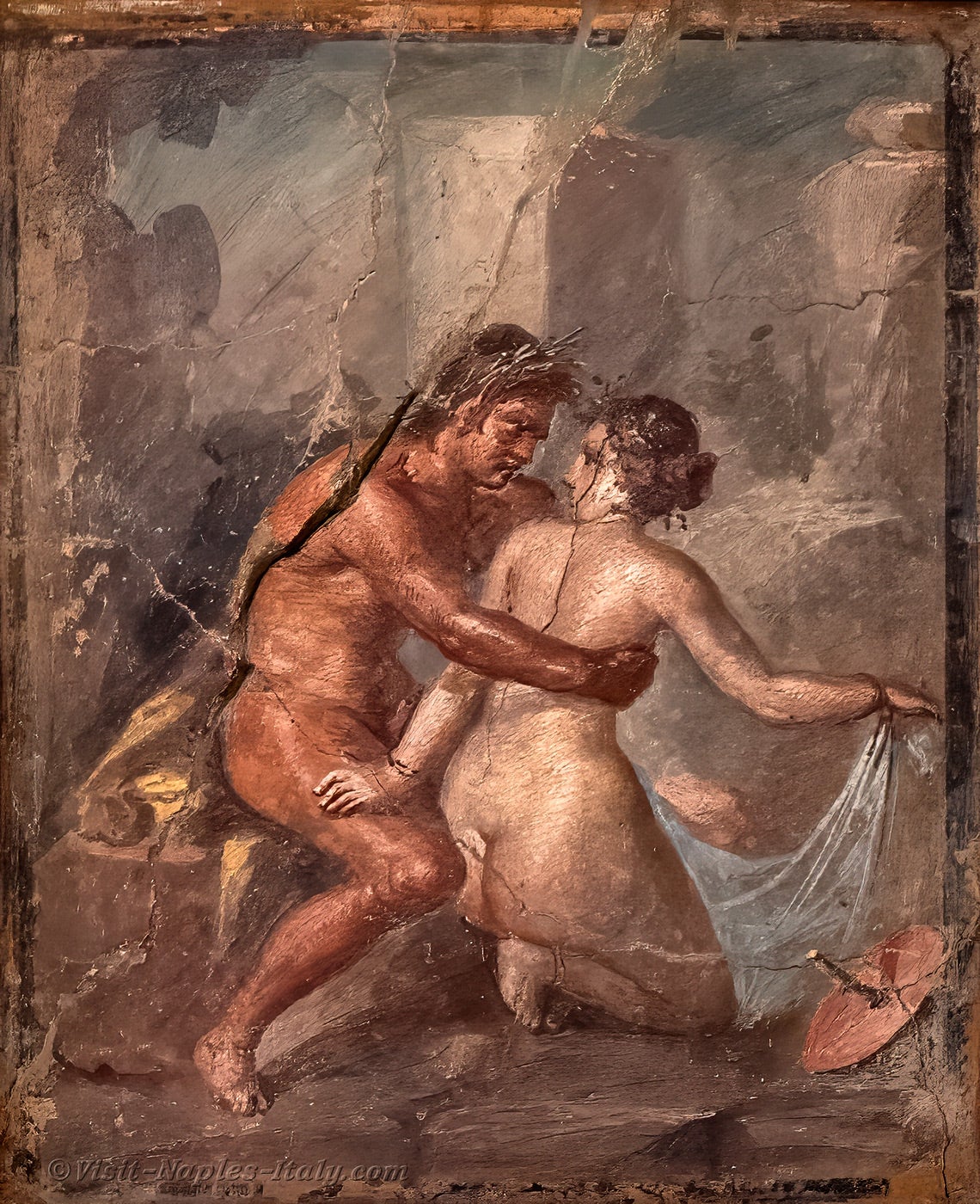
A satyr catching a nymph The artist who created this fresco discovered in Pompeii has not broken with convention.
The satyr, already erect, has firmly grasped the nymph by the waist.
She is on her knees and it seems she was taken by surprise just as she was about to bathe.
The two look into each other’s eyes.
The satyr, with a determined look, wants her to give in, and the young nymph, her eyes wide open with fear, tries to push the satyr away by pressing her hand against the thigh of her attacker.
Unfortunately for her, he is a young satyr who is particularly muscular and she has no chance of escaping.
Satyr ravishing a nymph, Pollena Trocchia
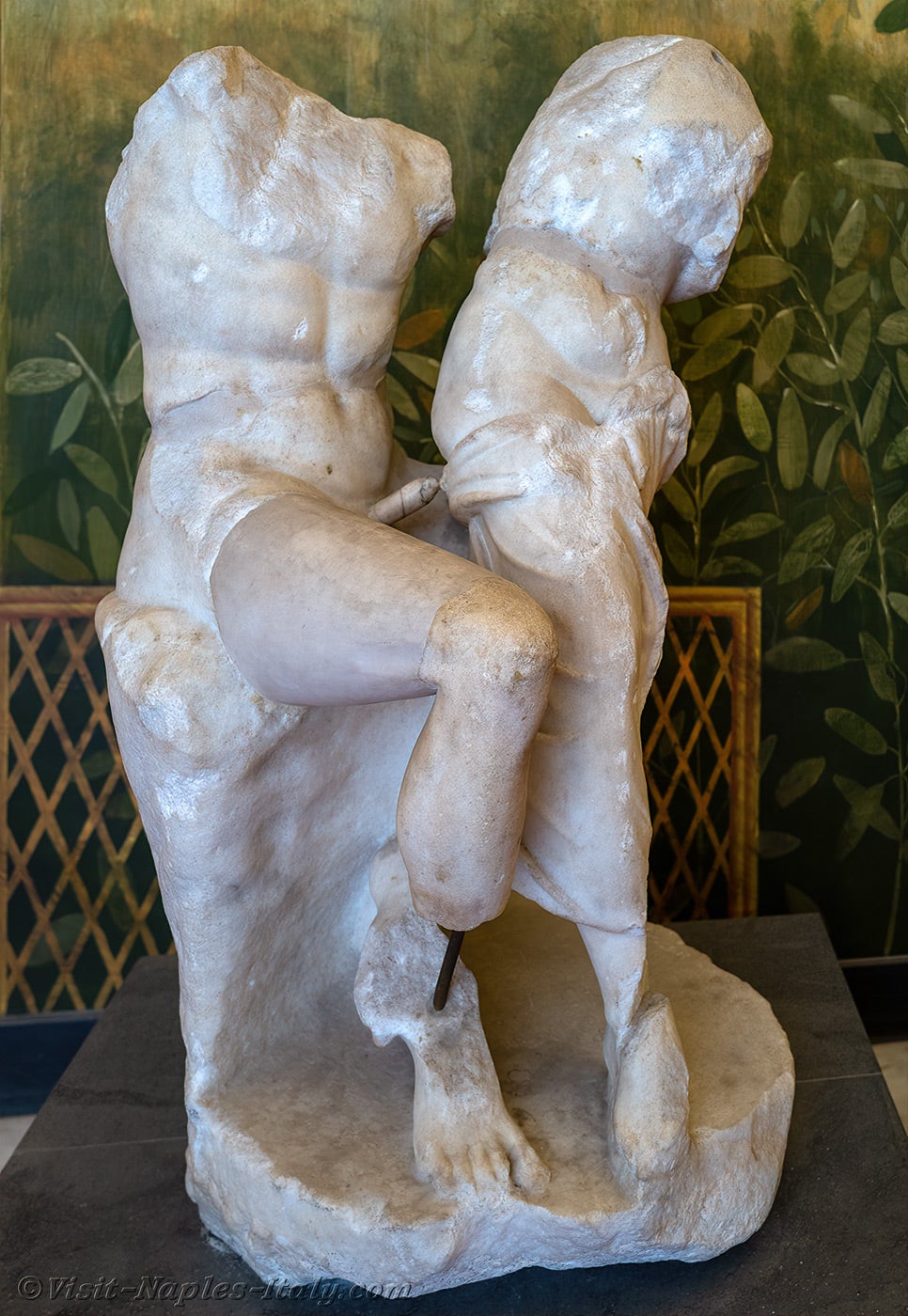
Satyr abducting a nymph Sculpture - Marble - 1-79 AD
This marble sculpture is unfortunately badly damaged.
Indeed, the arms and heads of the figures are missing.
This sculpture depicts a satyr and a nymph.
The satyr is seated, and he has already grasped the nymph by the waist.
Indeed, one can still make out the satyr’s wrist, as well as two fingers which are pressing against the left breast of the young nymph.
The satyr’s penis is erect and the nymph’s position in front of him, at the appropriate height, leaves no doubt as to what is about to happen.
The satyr is, moreover, very muscular.
It is difficult to imagine how this nymph, who is much smaller than him, could resist him.
Eroticism Erotic | Satyr | Brothel | Priapus | Phallus | Pan | Hermafroditus
Artworks Sculptures | Frescoes | Eroticism
MANN Artworks Schedule Tickets Location | Authorizations
Back to Top of Page