

Gallery Italy Artists Schedule Tickets Location | Authorizations
Artists Caravaggio | Gemito | Vanvitelli | Gentileschi | Aphrodite | Antique Vases | Esposito | Marble inlay
Ancient Greek Volute Kraters at the Galleria d’Italia in Naples
These Volute Kraters in the Galleria d’Italia, with red-figure decoration on a black background, are characteristic of a technique that emerged in Athens around 525 BC: first, the outlines of the figures were drawn before the background was painted, which turned black during firing.The decoration was then carefully executed with a brush down to the finest detail.
By the 4th century, the workshops of southern Italy had become the masters of painted pottery.
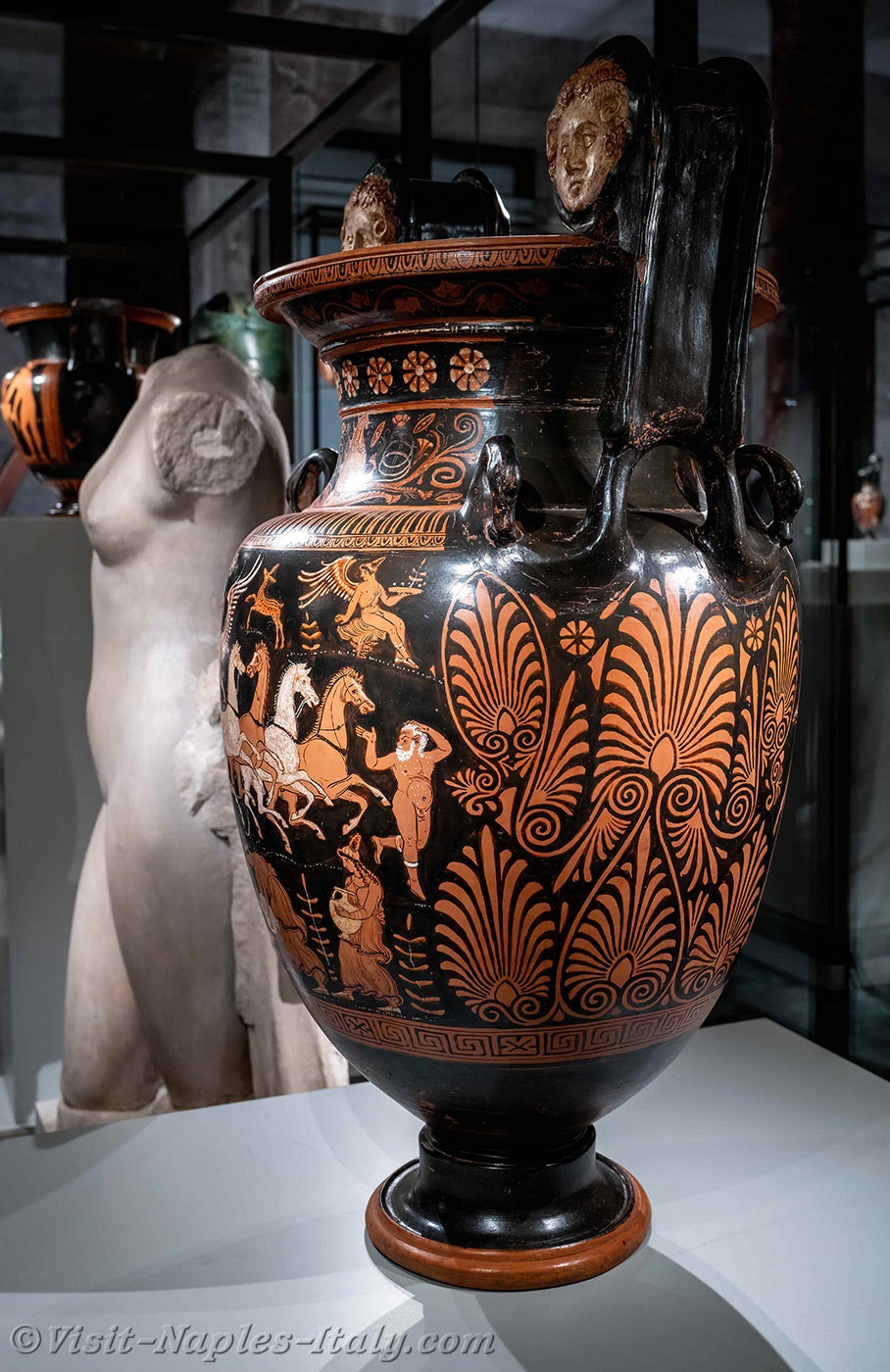
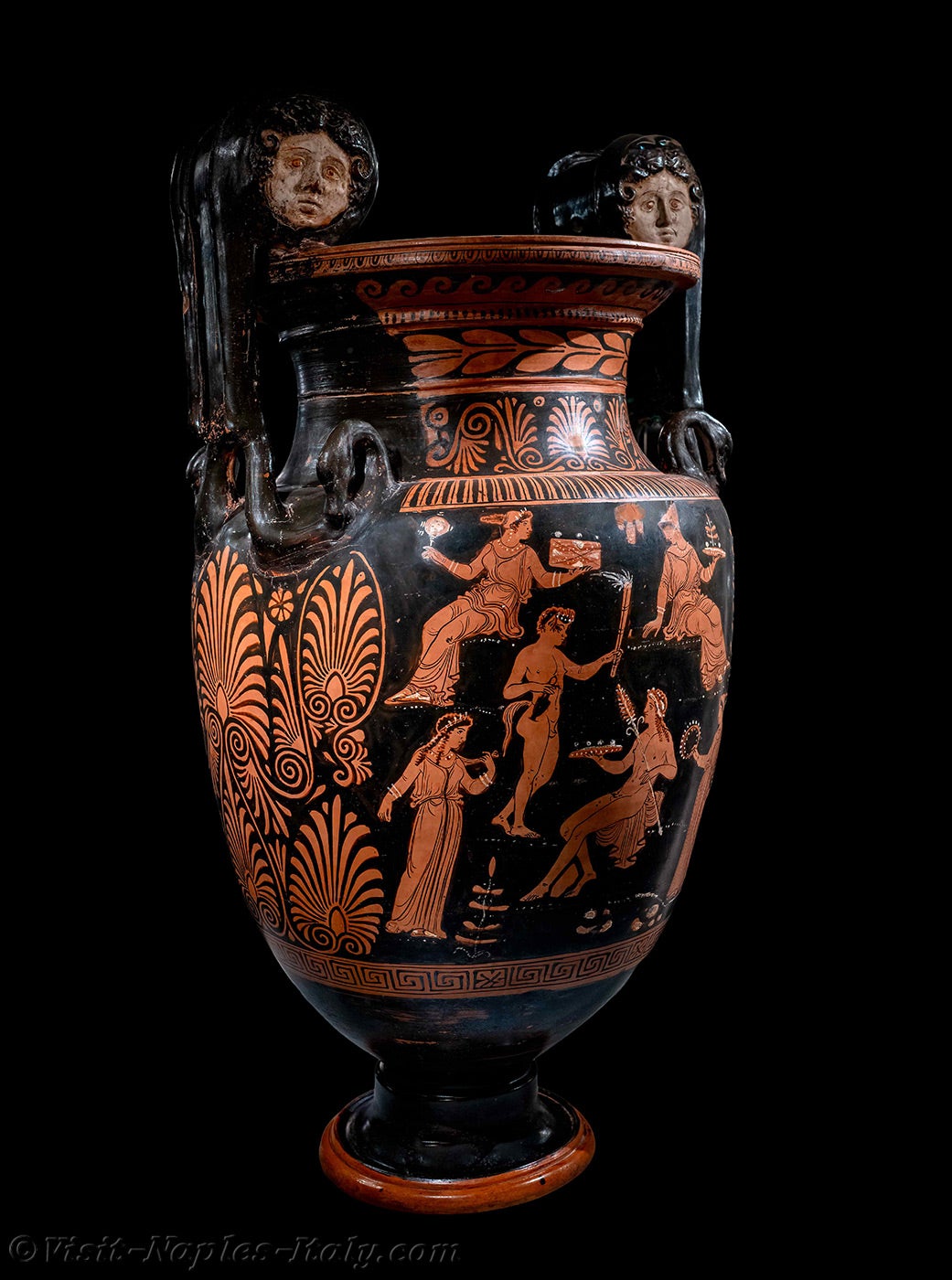
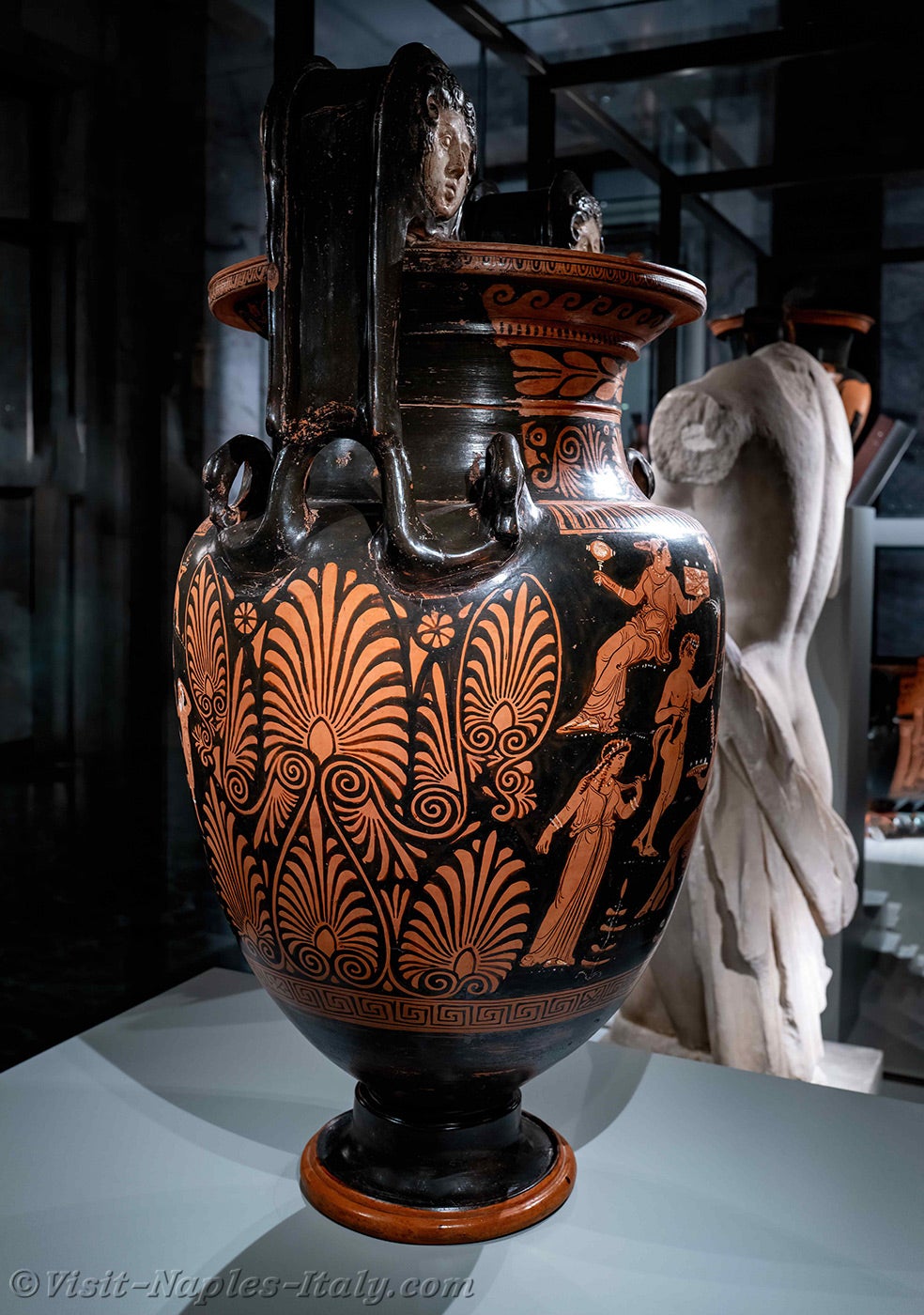
Painter of Lycurgus (4th century BC) “Apotheosis of Hercules, scene from a Dionysian komos”
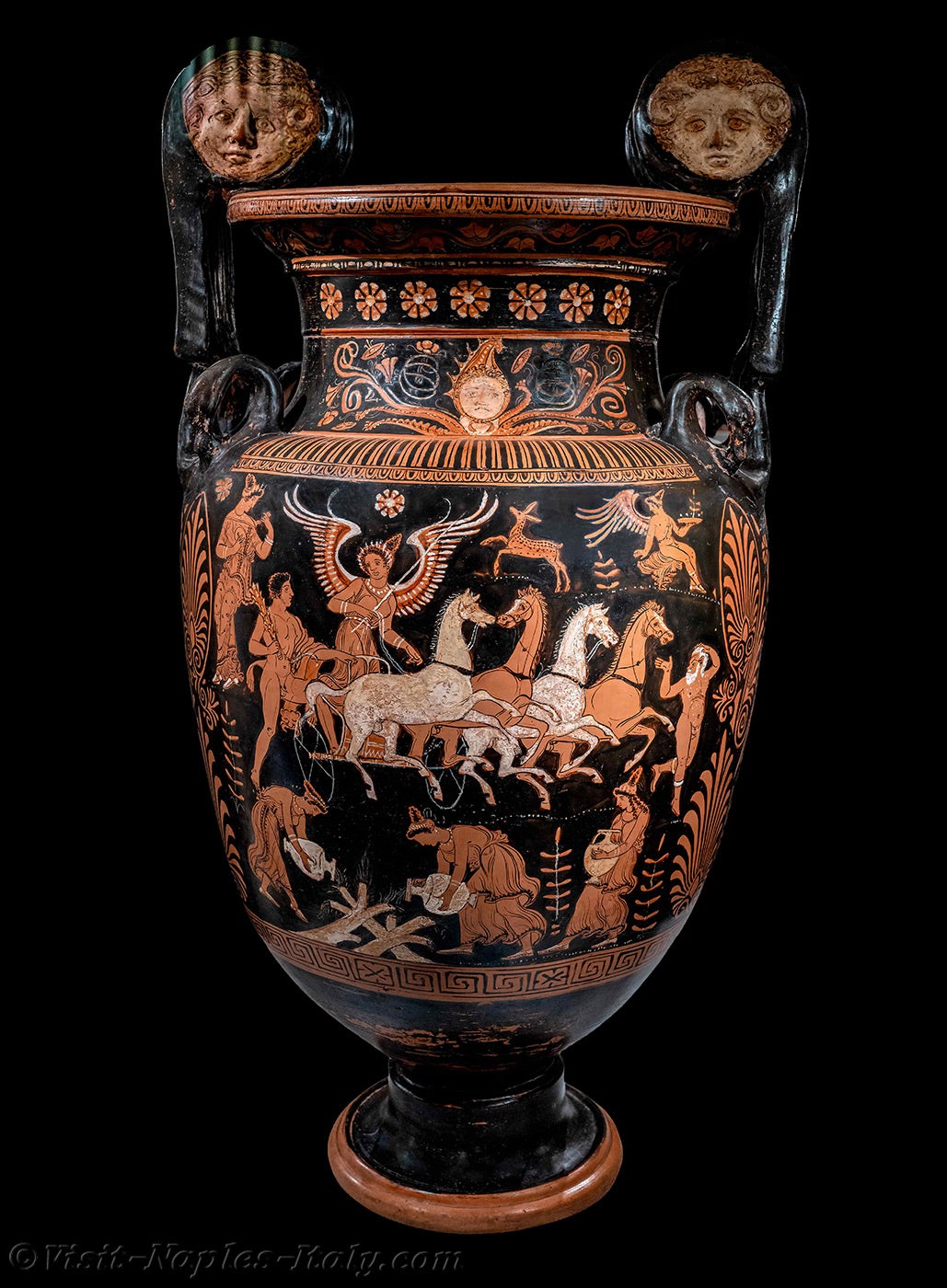
Apotheosis of Hercules Volute Krater – Apulian pottery (77 x 37 cm) 360–200 BC
“The Apotheosis of Hercules”
The lower section shows that Hercules’ body was consumed by the pyre he himself had prepared to end his suffering caused by Nessus’s poisoned tunic.The upper part depicts him as an immortal ascending the celestial chariot that will carry him to Zeus, his father.
According to Ovid:
“Hercules, freed from his mortal shell, comes back to life in the best part of himself; he reappears greater than ever and clothed in an august majesty that commands respect.
Dionysian komos The almighty Father carries him away on a chariot drawn by four horses and brings him into the company of the gods.”
Ovid – Metamorphosis
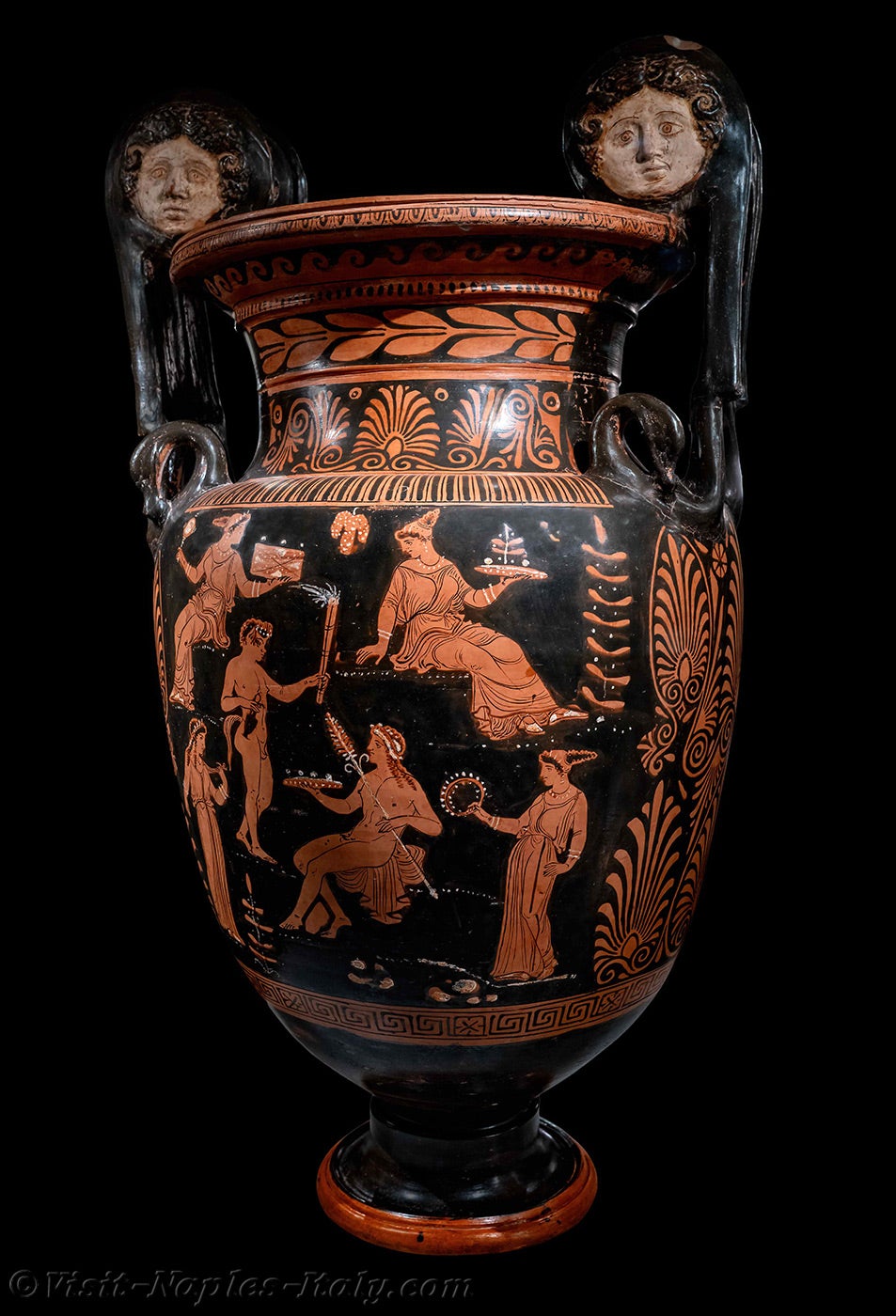
“Scene of a Dionysian komos”
This part of the vase perfectly depicts a komos, a ritual and festive procession in honour of the god of wine and vegetation, which paraded whilst singing and playing the flute and tambourine.Dionysus is seated holding his thyrsus topped with a pine cone, celebrated and surrounded by a satyr carrying a torch and musician Maenads.
Painter of Lycurgus (4th century BC) “Scene of worship before a funerary statue”
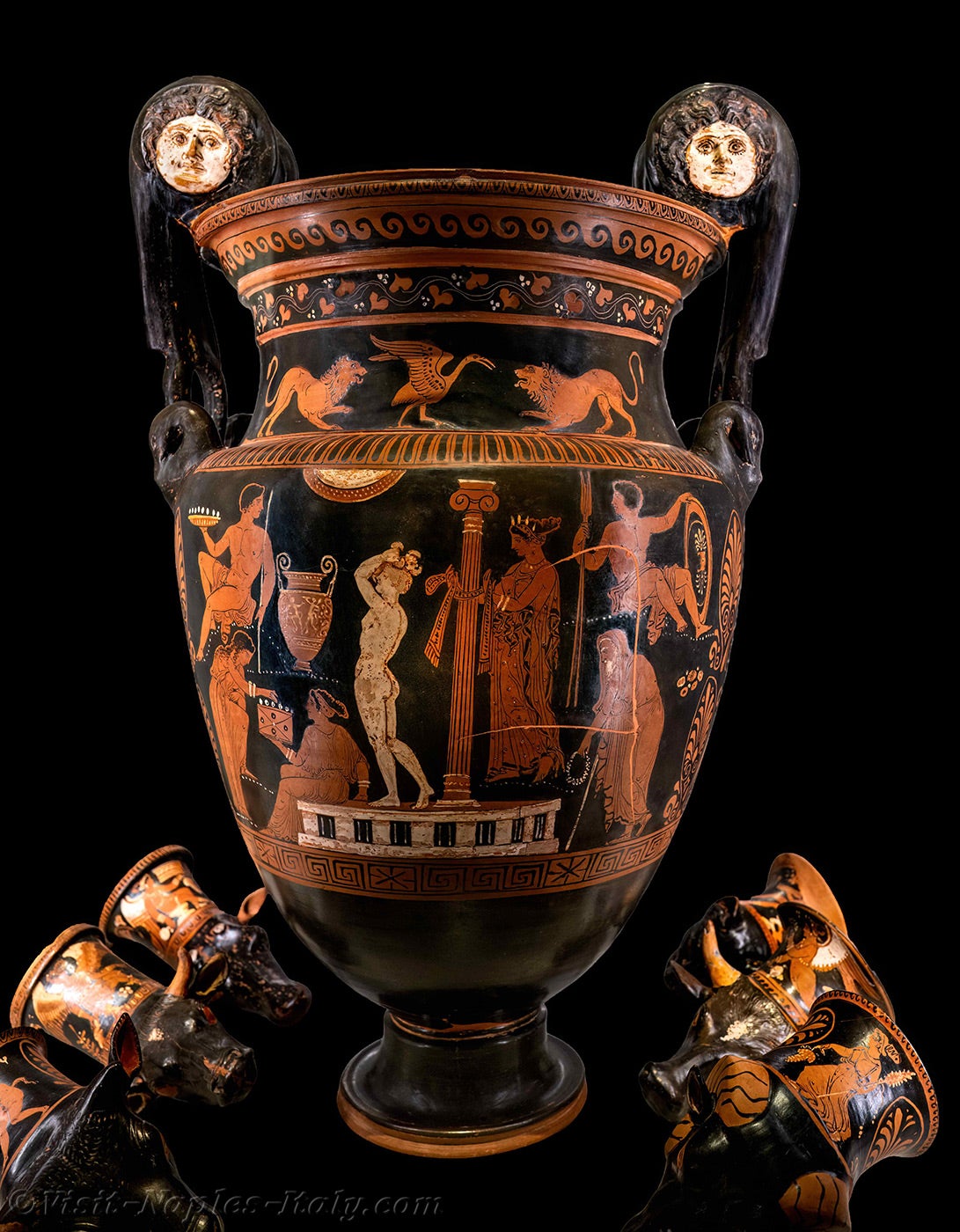
Cult scene Volute Krater – Apulian pottery (67.2 x 35 cm) 370–360 BC
The funerary statue, in a light, marble-like colour, depicts a young athlete lifting weights.
The spirits of the deceased young man are honoured by the figures in red bringing their offerings, which are received by the priestess seated at the foot of the statue.
An elderly man places a wreath of flowers whilst a richly dressed goddess, whose feet do not touch the ground, adorns the Ionic column with a banner inscribed with the merits of the deceased.
Painter of Lycurgus (4th century BC) “Orpheus enchants the Thracians with his music”
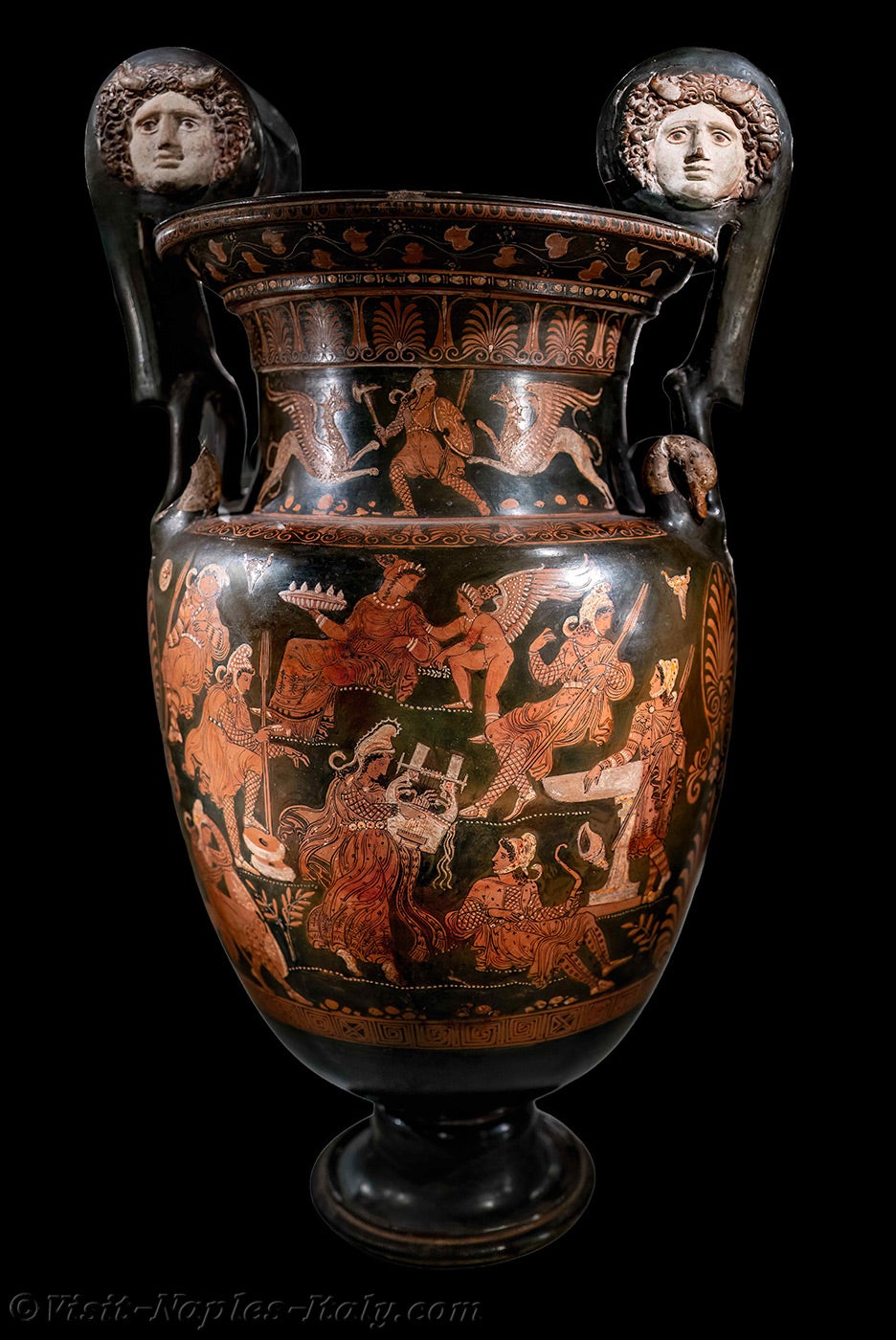
Orpheus Volute Krater – Apulian pottery (69 x 33 cm) 370–360 BC
Orpheus drew and gathered around him all the beings that inhabit the earth: stones, trees, animals and men were enchanted by his music and poetry.
Here the poet plays the lyre whilst singing of legendary passions and tales of forbidden love which charm his male audience, who no longer wish to leave him.
The women, cast aside, felt scorned and condemned the Apollonian poet to death: Orpheus was savagely murdered and torn to pieces by a procession of frenzied Maenads.
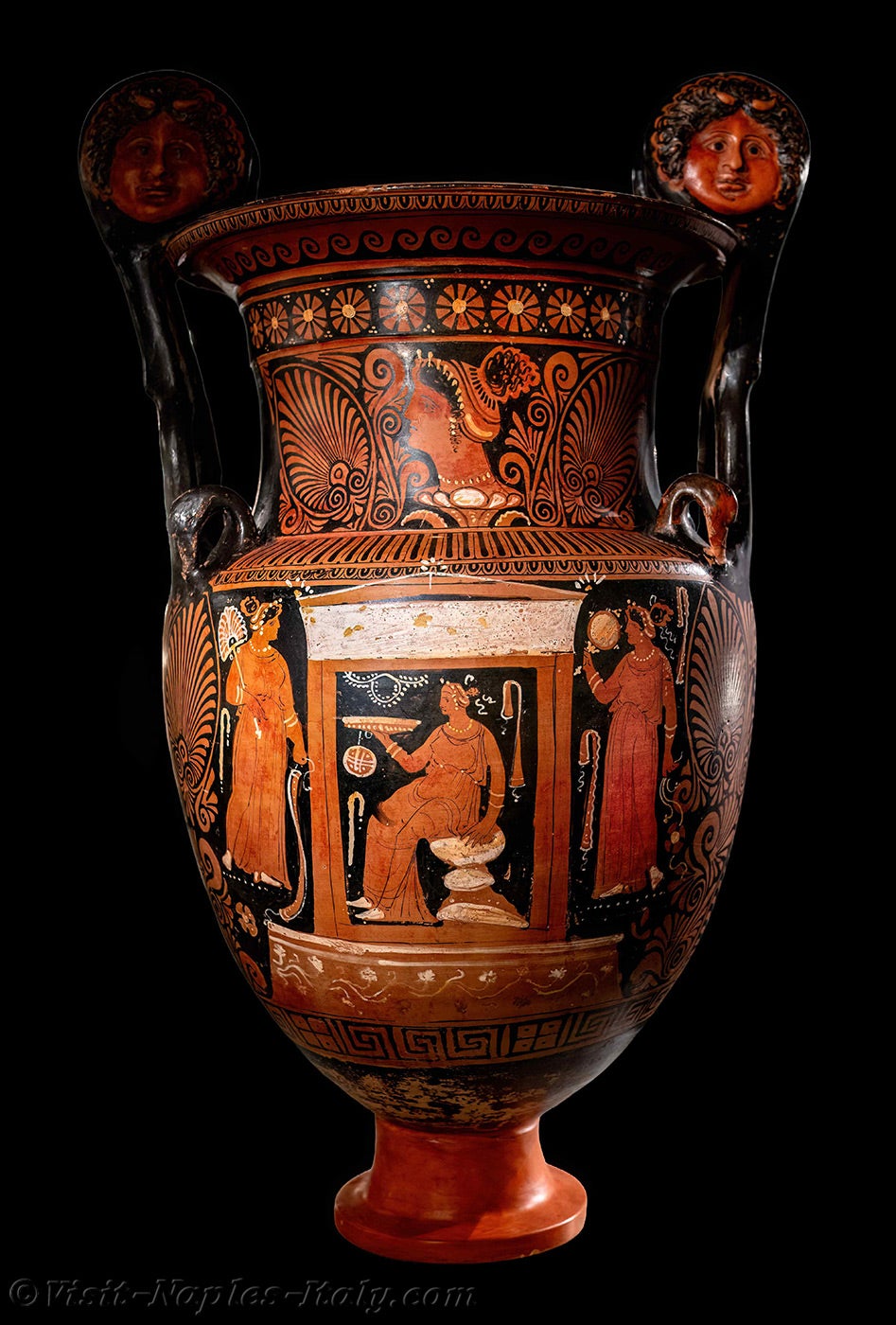
Painter of the Patera (4th century BC) “The deceased within the naiskos, flanked by worshippers and women on either side of a funerary stele”
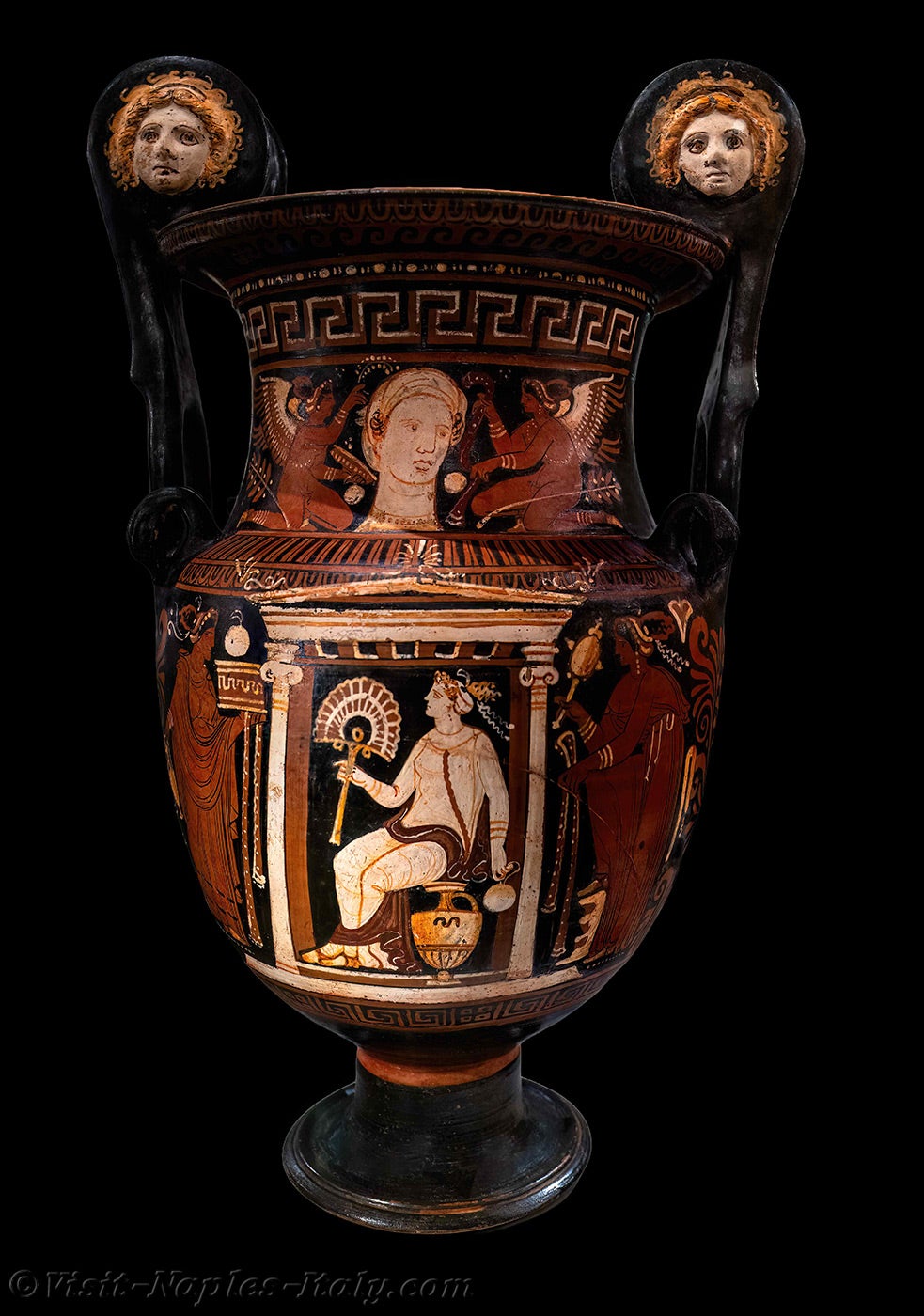
Deceased in the naiskos Volute Krater – Apulian pottery (54 x 28.5 cm)
340–320 BC
A naiskos was a small structure in the style of a classical Greek temple with columns and its characteristic pediment, which housed the statue of a god or a deceased person.
The vase depicts a naiskos housing a young blonde woman holding a fan, who is seated on a funerary urn.
Two women are depicted on either side of the naiskos, playing music and bearing offerings and banners in honour of the deceased.
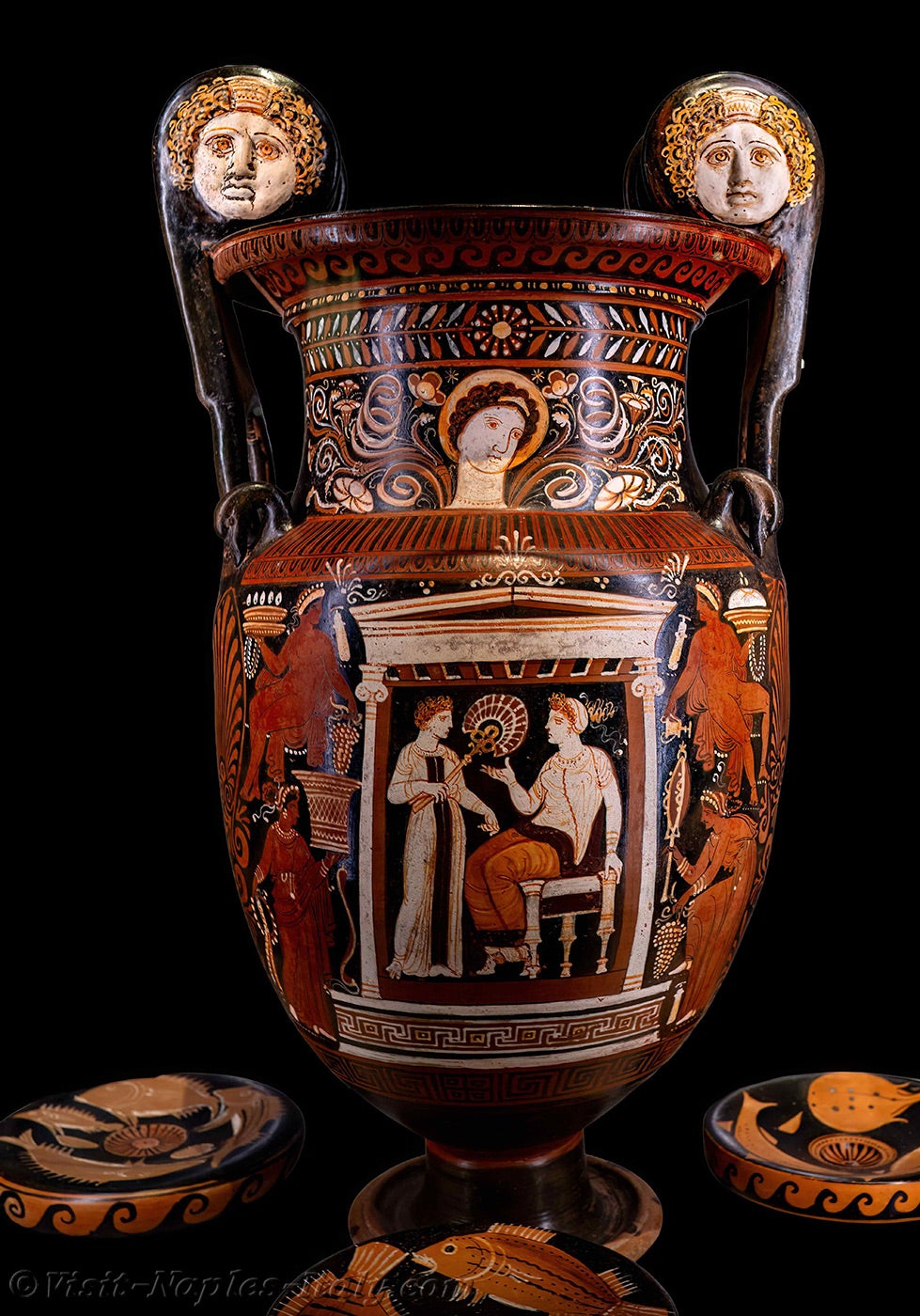
Baltimore Painter (4th century BC) “Deceased woman and servant in a naiskos”
Volute Krater – Apulian pottery (71 x 37.7 cm) 340–320 BCThe deceased is seated and appears to be conversing with her servant, who stands opposite her, waving a large fan to cool her.
The naiskos is surrounded by four figures crowned with flowers who honour the deceased with offerings and libations.
Painter from Baltimore (4th century BC) “Young Girls at the Fountain and the Battle of the Amazons”
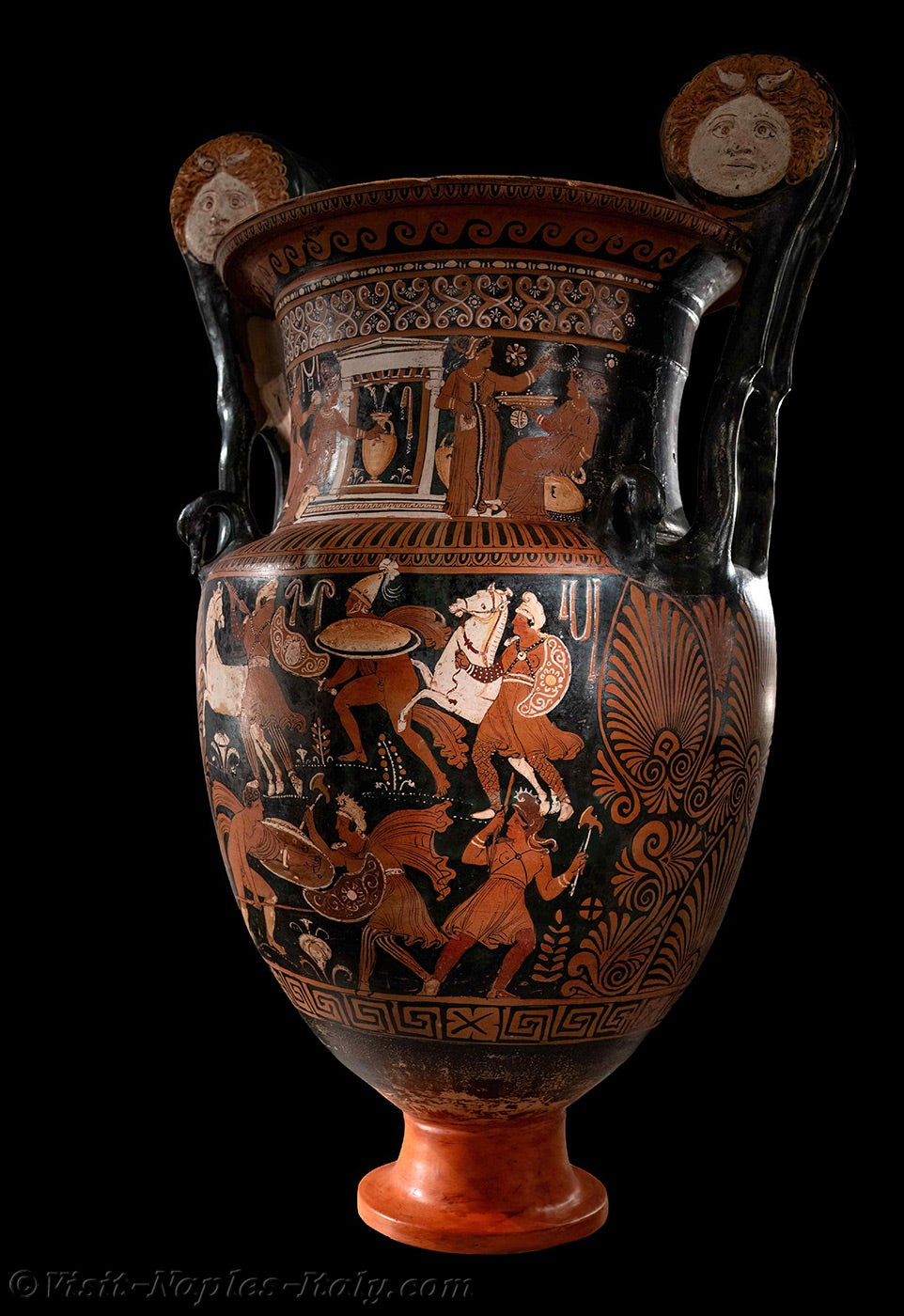
Girls and Amazons Volute Krater – Apulian pottery (73 x 35.5 cm) 330–310 BC
The Amazons were a people of female warriors who hunted and fought on horseback.
According to legend, these formidable descendants of the god of war Ares and the nymph Harmonia were exclusively commanded by a queen, with men relegated to subordinate roles.
Hercules, accompanied by Theseus, had been tasked with seizing the belt of the Queen of the Amazons, who was about to hand it over to him, when a revolt against him forced him to fight and kill their queen, Hippolytus.
Girls and Amazons Theseus had taken the opportunity to kidnap an Amazon named Antiope.
This abduction had sparked a war led by the Amazons, who had come to attack Athens.
The vase depicts the Amazons in short skirts armed with axes and crescent-shaped shields as they face off against naked Greek warriors armed with swords and round shields.
The young women at the fountain are the polar opposite of the Amazons: dressed in long gowns that reach down to their ankles, their demeanour expresses the calm and serenity of city life, sheltered from danger, where women and young girls are entrusted with domestic tasks.
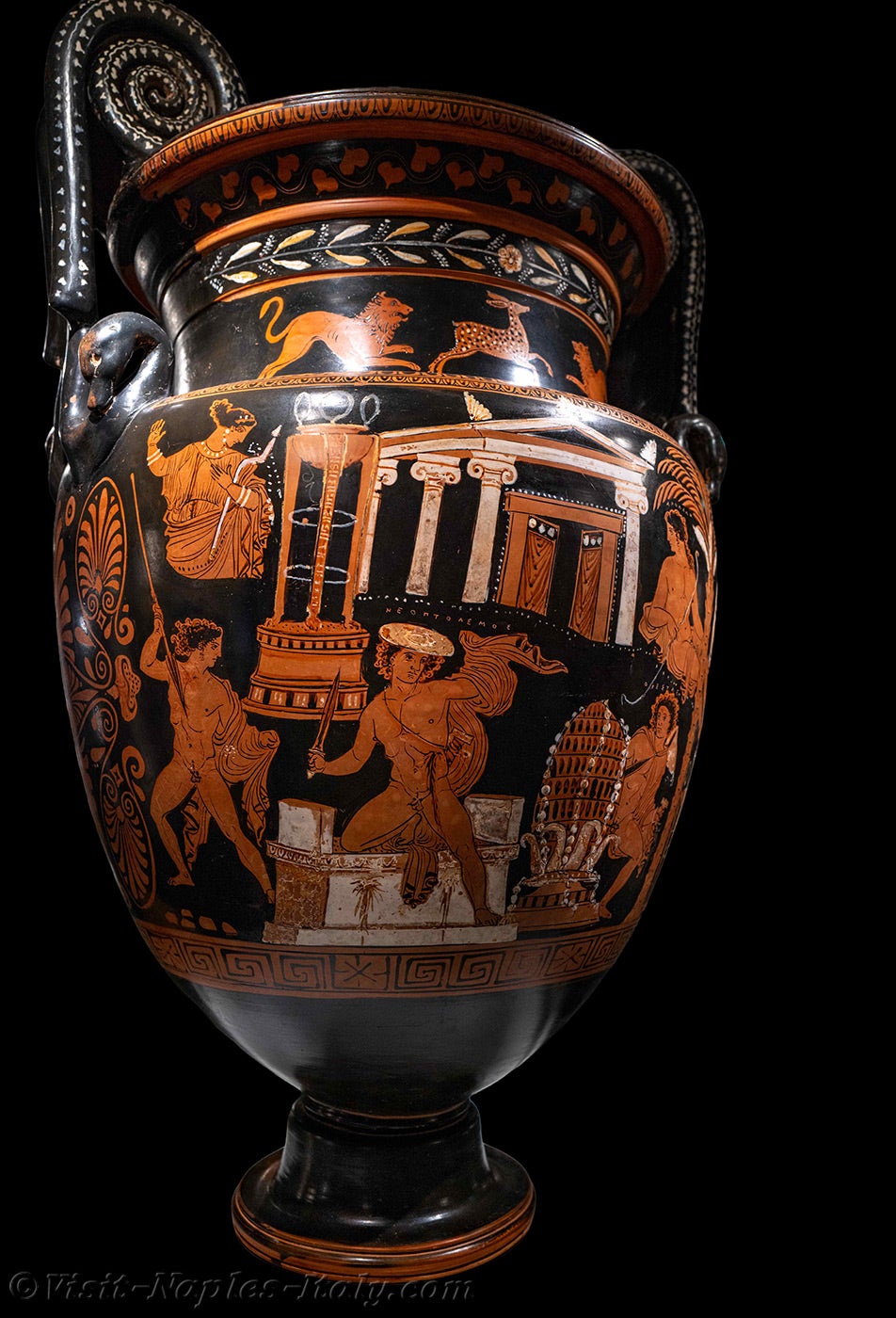
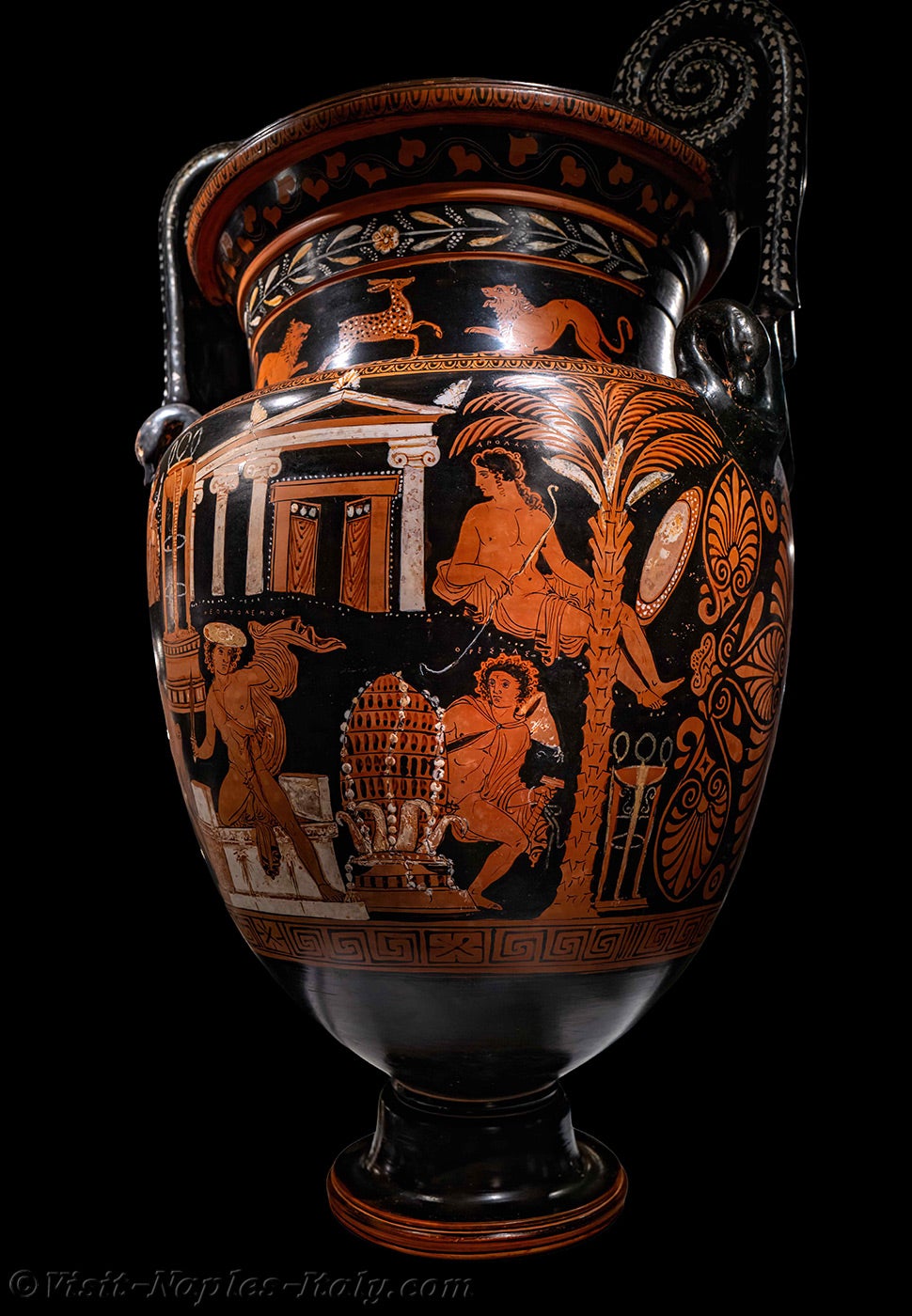
Painter of Lycurgus (4th century BC) “The Murder of Neoptolemus at Delphi”
Volute Krater – Apulian pottery (65 x 32.7 cm) 360–200 BCThe scene takes place in the Temple of Delphi, where Neoptolemus has come to consult Apollo, accusing him of having brought about the death of his father Achilles, who was killed beneath the walls of Troy.
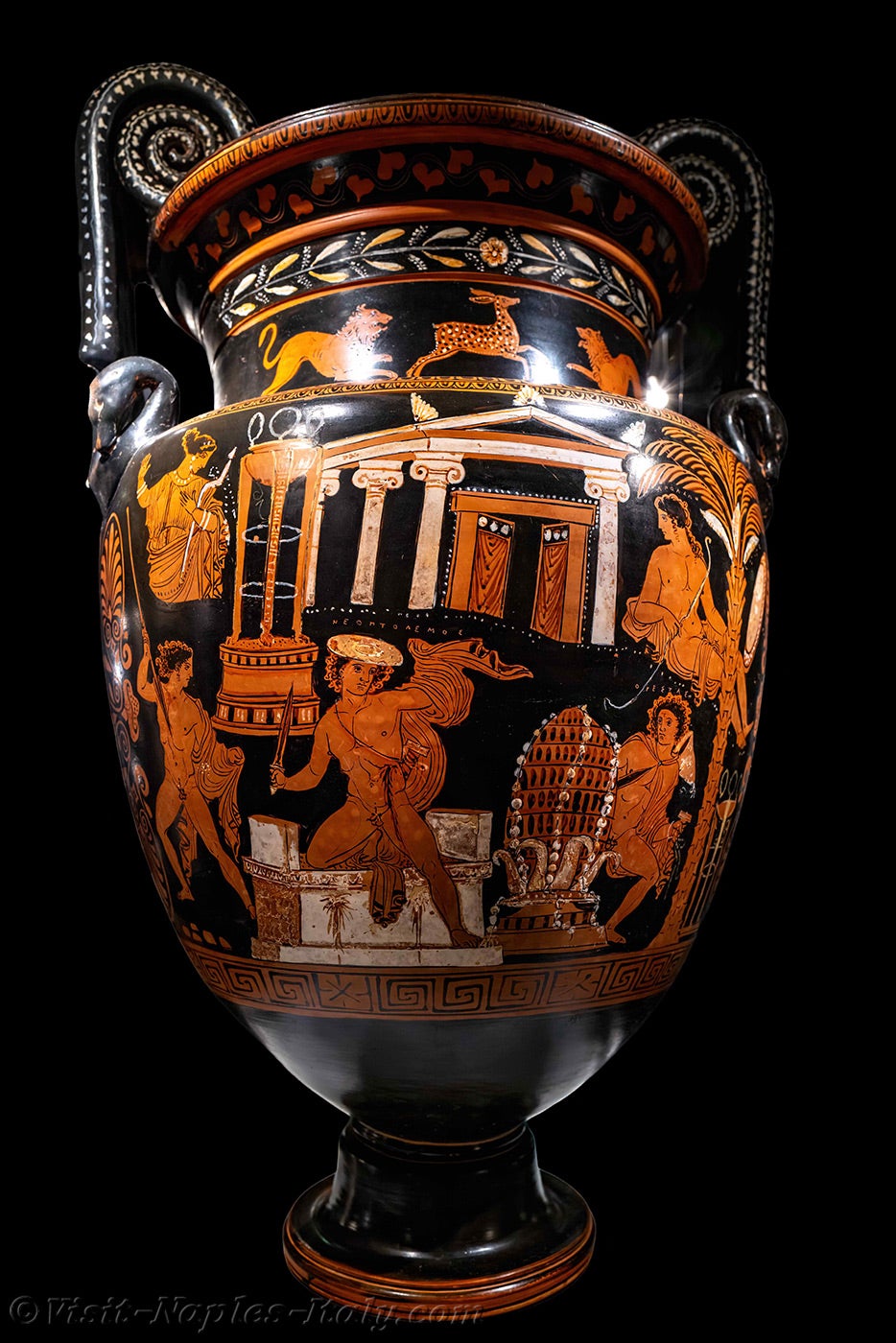
Murder of Neoptolemus Neoptolemus raises his sword once more, one knee resting on the marble altar, whilst blood flows copiously from his side, wounded by the spear of Orestes, who stands on the left, under the calm gaze of Apollo, seated high up on the right-hand side of the temple.
Orestes, son of Agamemnon, has come to kill Neoptolemus because he married Hermione, daughter of the beautiful Helen and Menelaus, who had been promised to him before the Trojan War.
Neoptolemus, the young warrior, had shown no mercy during the capture of Troy: he had slashed the throat of the old King Priam on the altar of Zeus, thrown Hector’s son Astyanax from the top of the walls of Troy, and sacrificed Priam’s daughter on Achilles’ tomb.
The ancients believed that justice had been done to the victims of his impious cruelty through the wrath of Orestes.
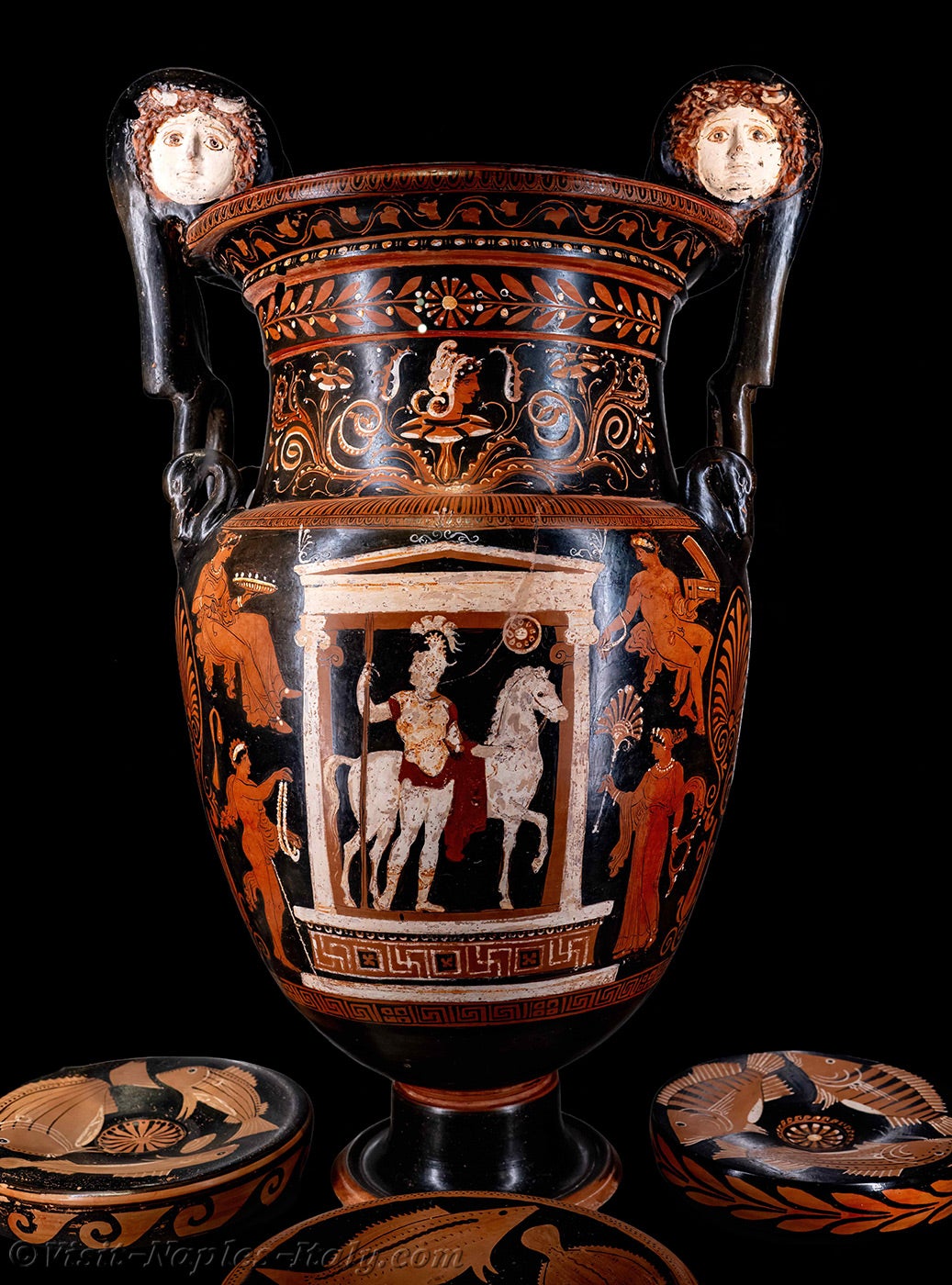
Painters of Gioia del Colle (4th century BC) “Deceased in a naiskos”
Volute Krater – Apulian pottery (71 x 39.5 cm) 200–340 BCThe naiskos houses the commemorative image of a Greek horseman in armour, killed in battle, standing beside his horse.
The hero is honoured by the offerings of the four figures surrounding his tomb.
Artists Caravaggio | Gemito | Vanvitelli | Gentileschi | Aphrodite | Antique Vases | Esposito | Marble inlay
Gallery Italy Artists Schedule Tickets Location | Authorizations
Back to Top of Page