

Gallery Italy Artists Schedule Tickets Location | Authorizations
Artists Caravaggio | Gemito | Vanvitelli | Gentileschi | Aphrodite | Antique Vases | Esposito | Marble inlay
Gaspar Adriaensz Van Wittel, known as Vanvitelli, Views of Naples and Rome, Galleria d’Italia in Naples
Vanvitelli (1653–1736) “View of Naples with the Chiaia district seen from Pizzofalcone”
Painting – Oil on canvas (73.5 x 172.5 cm) 1700Here, Vanvitelli shows us a view of Naples dating from 1700. Naples has changed enormously since then, particularly the Chiaia district.
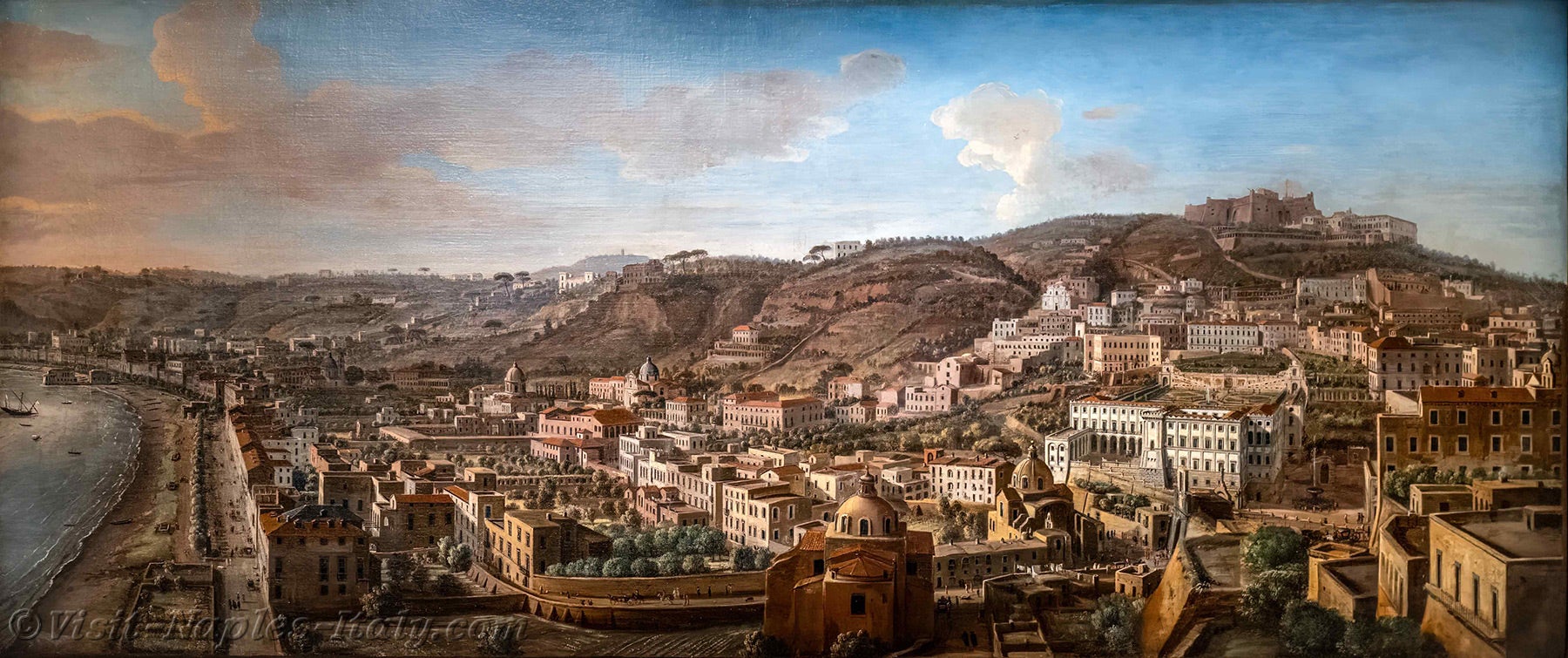
Vanvitelli, Chiaia district, Naples The seafront is the first thing that catches the eye.
It has since been significantly widened to incorporate green spaces and the pedestrian promenade so beloved by Neapolitans and tourists alike.
Today, the Chaia district is a chic area where you can find shops selling luxury goods.
However, looking at this view of Naples painted by Vanvitelli from the hill of Pizzofalcone, the mansions and villas stretching along the Bay of Naples were already the homes of wealthy people, and this remains the case today.
At the top right, you can see Castello Sant’Elmo and the Certosa di San Martino, which have remained unchanged since then.
Vanvitelli (1653–1736) “View of Naples with the Royal Palace, the Largo di Palazzo”
Painting – Oil on canvas (74.5 x 140 cm) 1706This view of the Royal Palace of Naples shows it before the architect Luigi Vanvitelli renovated it.
It should not be confused with the creator of this work, the Dutch painter Van Wittel, nicknamed Vanvitelli by the Italians.
Born in 1700 in Naples, the architect Luigi Vanvitelli was commissioned, at the request of Pope Leo XIII in 1754, to reinforce the façade of the Royal Palace, which was cracking in numerous places.
To achieve this, Luigi Vanvitelli bricked up every other arch on the ground floor of the palace whilst incorporating niches occupied by statues.
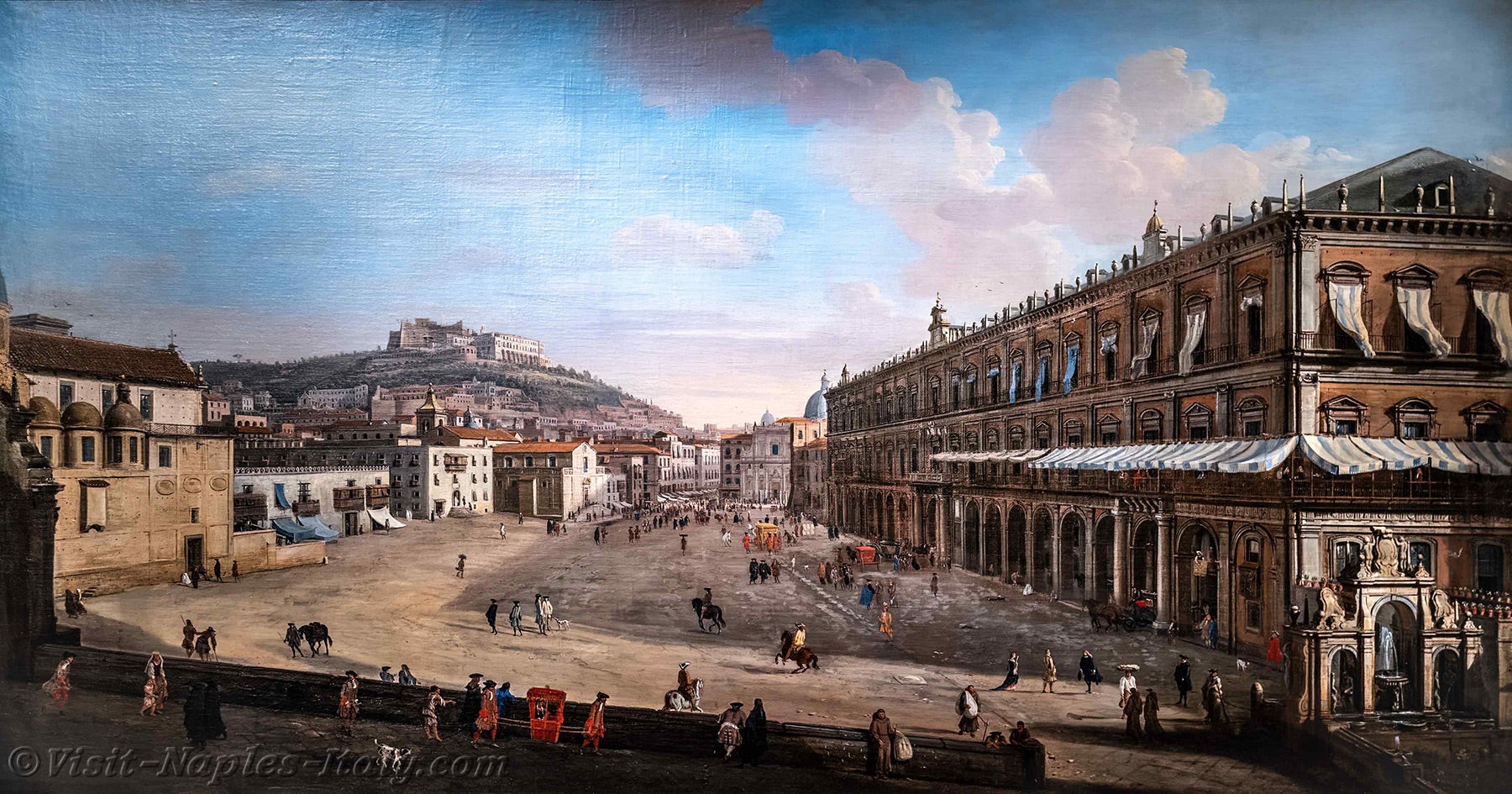
Vanvitelli, View of Naples and the Royal Palace Statues which, of course, cannot be seen in this view of the Royal Palace painted in 1706, long before these works took place.
Apart from the Royal Palace and its façade, which was subsequently altered, the most interesting part is the square that opens up in front of the palace, then known as “Largo di Palazzo” which has now become one of the main architectural symbols of Naples under the name “Piazza del Plebiscito”.
This view, painted by Vanvitelli, shows that the Largo di Palazzo, with its numerous irregular recesses and projections, was far from doing justice to the imposing façade of the royal palace.
It was Joachim Murat, Marshal of the Empire under Napoleon Bonaparte, whose sister Caroline Bonaparte he had married, and who became King of Naples in 1808, who decided to redesign the square in 1809.
His design was similar to the appearance of the current square, with the exception of the central building, which was originally intended for civic purposes.
However, after the Bourbons returned to power, a religious building was constructed in its place: the church of San Francesco da Paola.
At the top left, one can see Castel Sant’Elmo and the Certosa di San Martino.
Vanvitelli (1653–1736) “View of Rome with Piazza del Popolo”
Painting – Oil on canvas (56.5 x 109 cm) 1718This view of Piazza del Popolo, painted in 1718 by Vanvitelli, is almost identical to how it looks today in terms of its main architectural features.
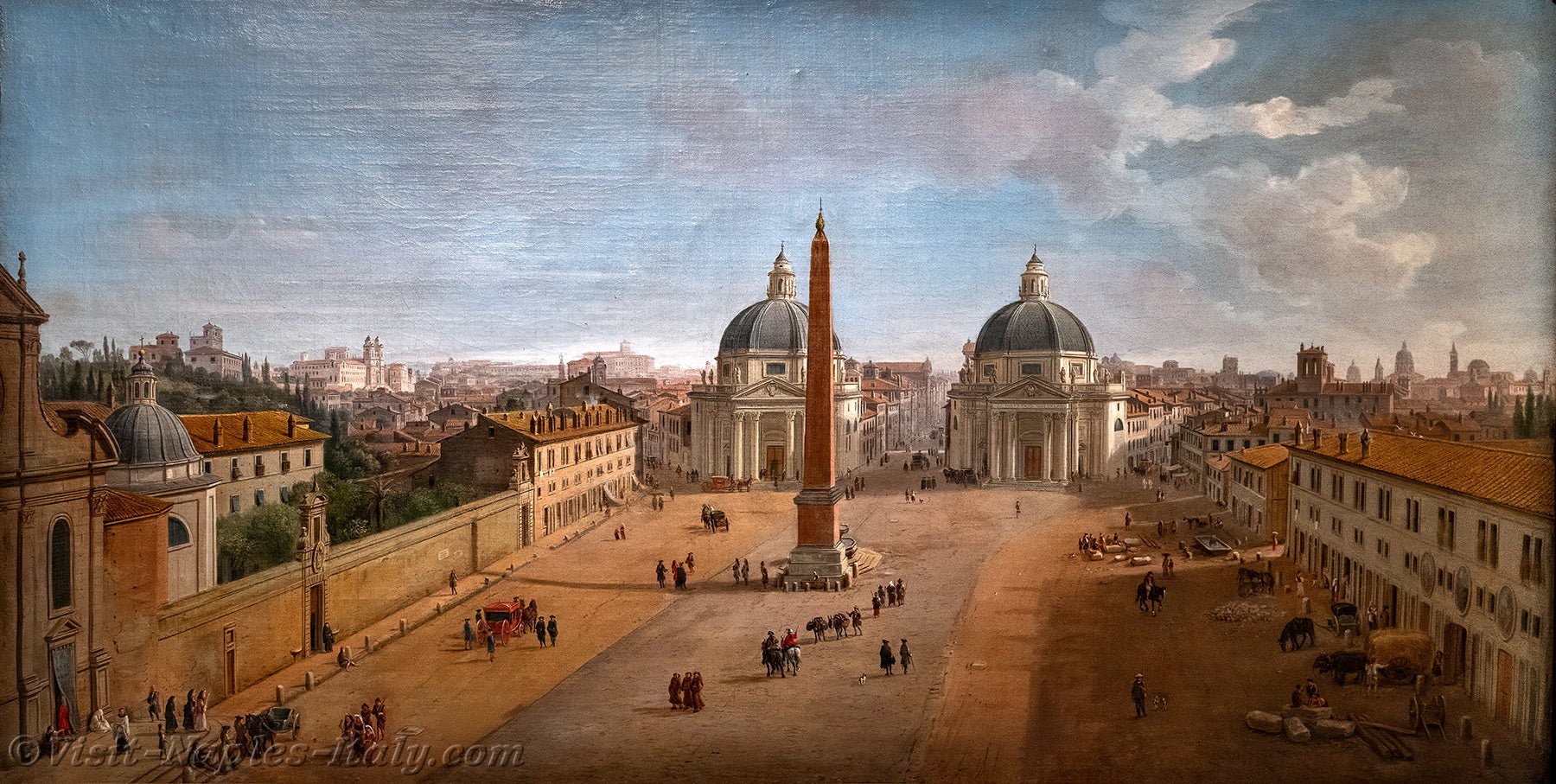
Vanvitelli, Rome and Piazza del Popolo It shows the 3,300-year-old obelisk, brought to Rome by Emperor Augustus, and the twin churches of Santa Maria Montesanto and Santa Maria Miracoli, which stand in the background and line the start of the Corso, a thoroughfare dating back to ancient Rome which stretches as far as Piazza Venezia.
This painting by Vanvitelli shows that the 24-metre-high obelisk does not yet bear the Christian cross, which was later installed at its summit by the papacy as an instrument of exorcism aimed at Satan.
The second observation that can be made regarding this view by Vanvitelli concerns the shape of the square.
It is depicted here as rectangular (though it was in fact trapezoidal), with the longest side facing us connecting the two churches.
In the 19th century, the Roman architect Giuseppe Valadier transformed the square by demolishing the buildings to the right and left of Vanvitelli’s painting, and by adding fountains on either side of the obelisk.
And the French architect Louis-Martin Berthault gave the square its current elliptical shape, by reversing the orientation of its longest side compared to the old square.
Vanvitelli (1653–1736) “View of Rome with Piazza Navona”
Painting – Oil on canvas (63 x 125.5 cm) 1688This view, painted by Vanvitelli in 1688, shows us a Piazza Navona that is exactly the same as the present-day square, with the exception of the façade of the Church of Our Lady of the Sacred Heart.
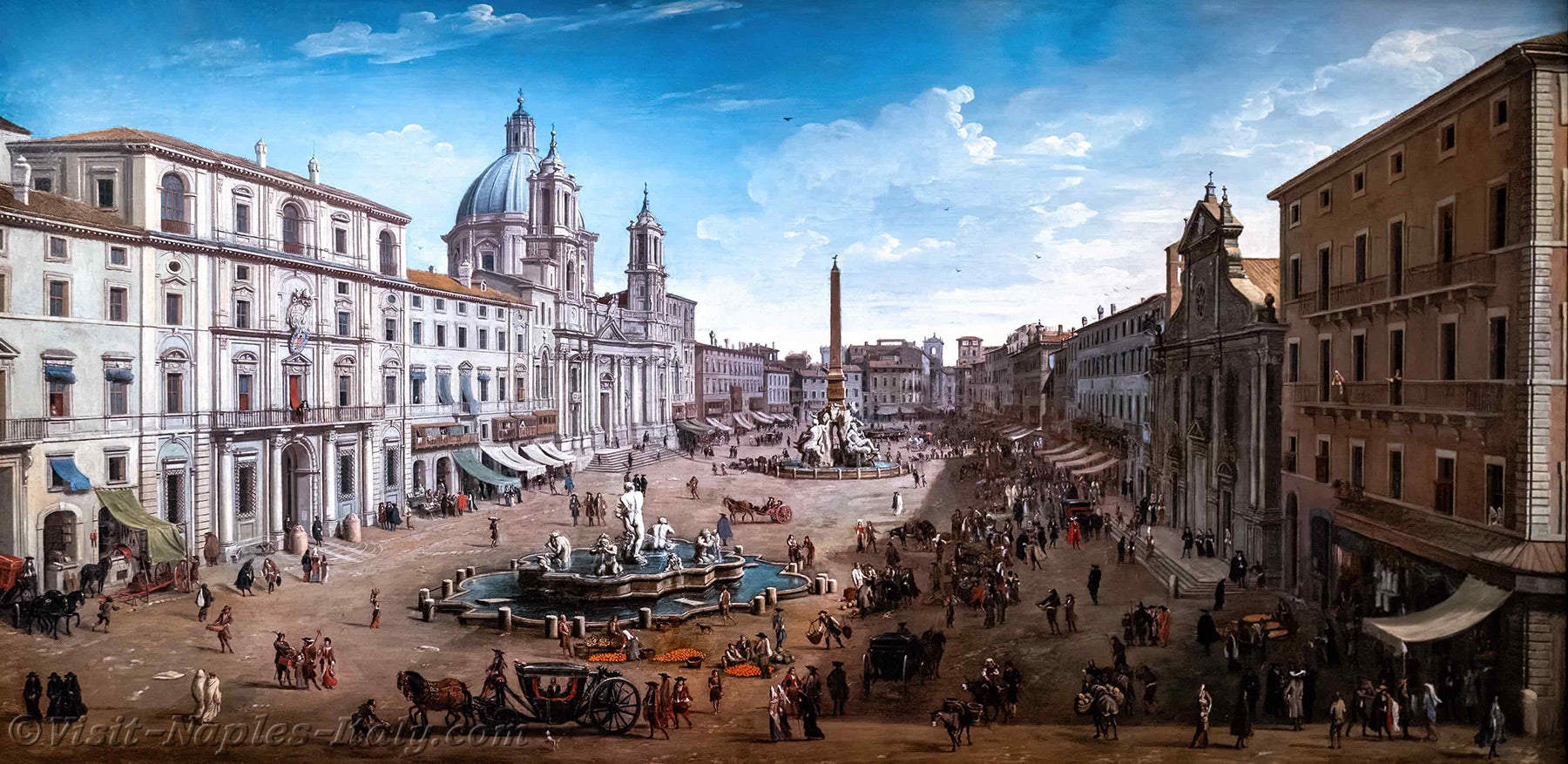
Vanvitelli, Rome and Piazza Navona The main façade of the church, overlooking Piazza Navona, was completely remodelled in the 19th century by the architect Luca Carmini, at the request of Pope Leo XIII.
Its three fountains, including the one by Gian Lorenzo Bernini which surrounds the obelisk in the centre of the square, have remained unchanged.
All the other buildings and churches lining the square have retained their original appearance, with the exception of minor alterations since Vanvitelli’s work was completed.
Apart from these minor architectural differences, the only elements that bear witness to the three centuries that separate us from this depiction of the square, are the clothes worn by the passers-by, as well as the carriages and horse-drawn carriages painted by Vanvitelli.
Artists Caravaggio | Gemito | Vanvitelli | Gentileschi | Aphrodite | Antique Vases | Esposito | Marble inlay
Gallery Italy Artists Schedule Tickets Location | Authorizations
Back to Top of Page