

MANN Artworks Schedule Tickets Location | Authorizations
Artworks Sculptures | Frescoes | Eroticism
Frescoes Mythology | Portraits | Life Leisure | Animals | Religion | Landscapes | Decoration
Decorative Frescoes from the Houses of Pompeii and Herculaneum at the Archaeological Museum of Naples, Italy
Naval Battle, Pompeii, Temple of Isis
Fresco - Water-based pigments on Coating - 45-79 ADThis fresco adorned the walls of the Temple of Isis in Pompeii.
The lower part of the fresco features a large and beautiful festoon painted on a black background.
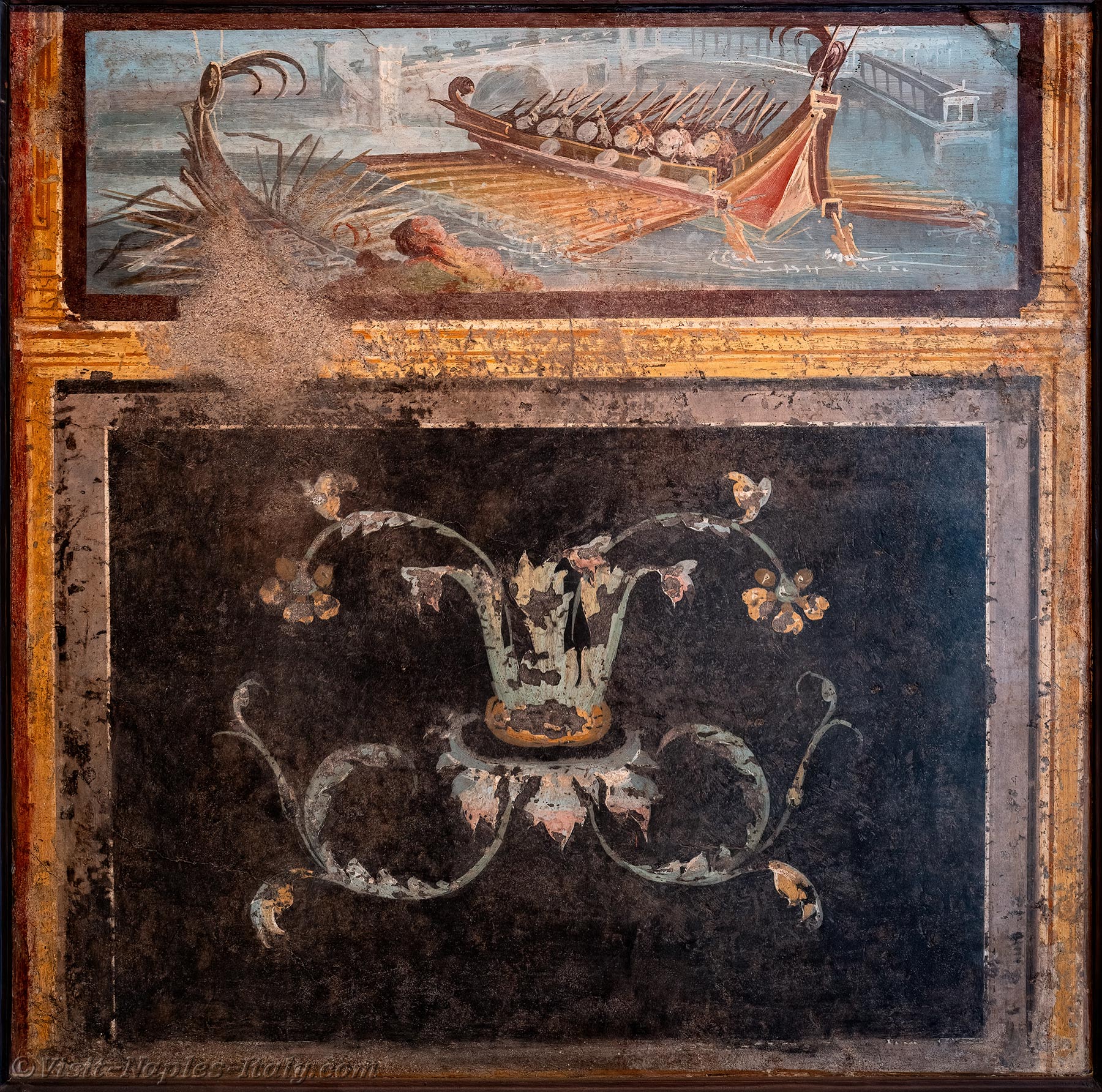
Battleship The upper part of the fresco depicts a naval battle. It is particularly interesting in this respect.
The battle took place at sea, in front of a large stone bridge and a long row of buildings built on the water.
On the left, we can see the ship of the vanquished, whose oars are broken and whose bow appears to be ablaze.
The ship of the victors moves forward by means of a large number of oars moving in perfect synchronisation.
We also note the presence of a bow spur at the front of the ship.
On its deck stand the victorious soldiers, wearing helmets and armed with spears and shields.
Finally, it is interesting to note that a double rudder was used to manoeuvre this warship.
Ship Prows, Pompeii, Insula Occidentalis
Fresco - Water-based pigments on plaster (73 × 102 cm) 50-1 BCThis fresco depicting ships was discovered in Pompeii in November 1763.
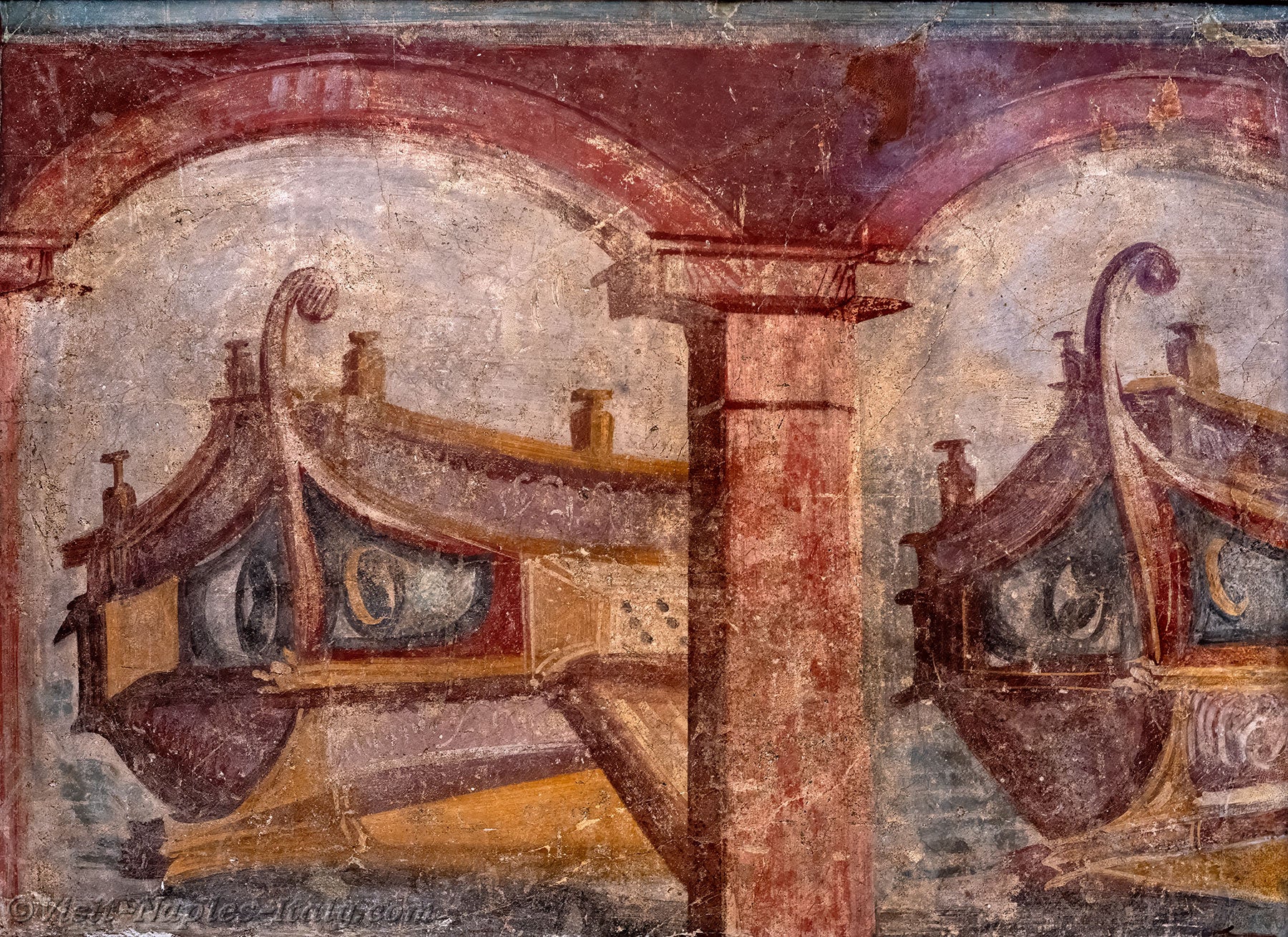
Ship Bows Two other paintings of ship prows were discovered at the same time as this one and in the same place.
These two ships are at anchor in a shipyard, the arches and pillars of which can be seen.
These are not only large ships for the time, but also ships equipped with a ram at the bow.
It would appear that these rams were made of metal, given their colour.
On the bow itself were painted two large apotropaic eyes, protective eyes intended to ward off evil influences.
Tragic masks and columns, Pompeii, Casa degli Scienziati
Fresco - Water-based pigments on plaster (134 × 133 cm) 60-40 BCThis wall decoration adorned the Casa degli Scienziati in Pompeii.
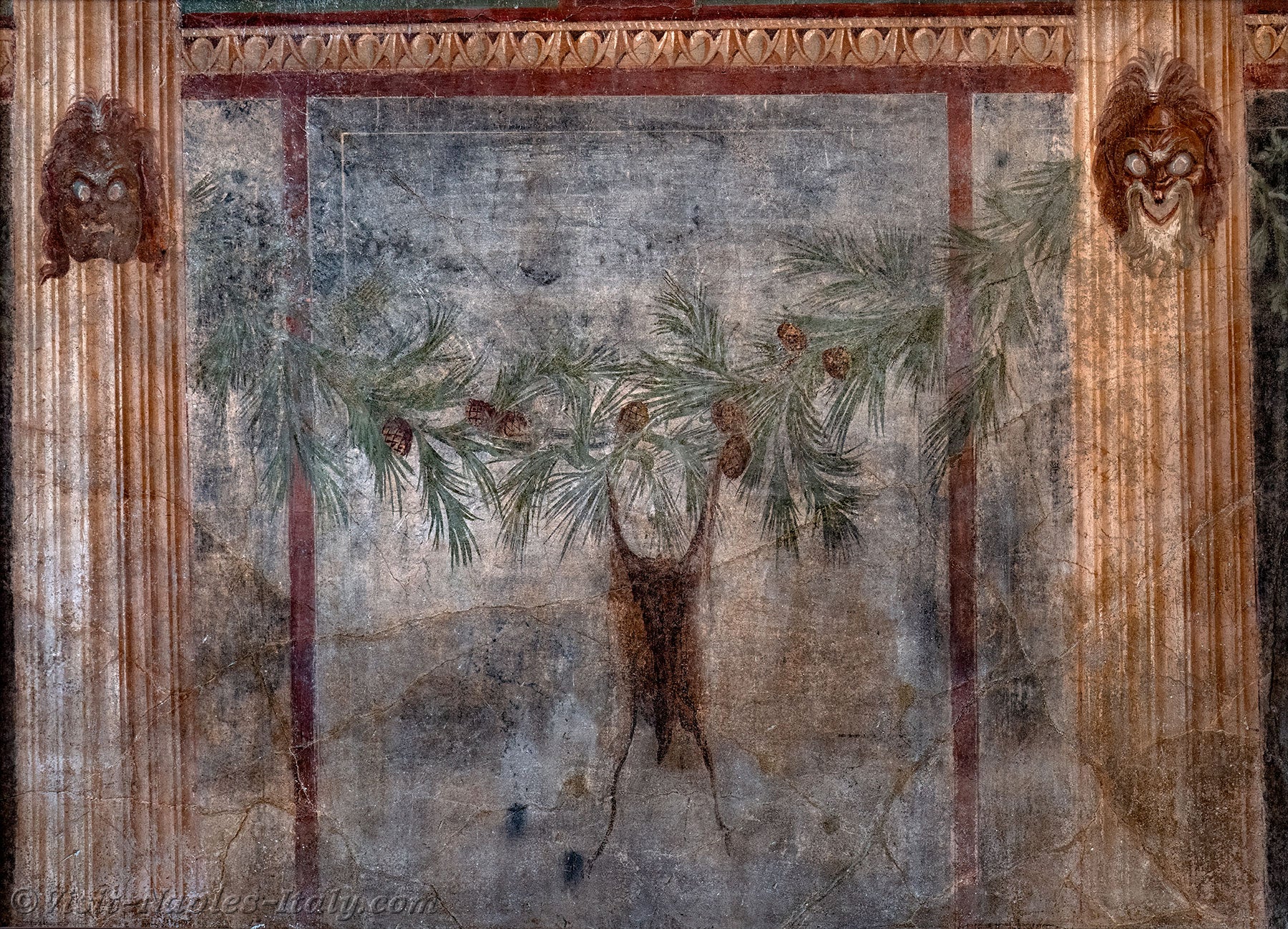
Tragic masks and columns The painting depicts a scene framed by columns, between which hangs a garland made up of two Aleppo pine branches and their characteristic oval pine cones.
This fresco, which is over two thousand years old and dates from half a century before Christ, bears witness to the already very high level of artistic refinement in Pompeii.
A kidskin hangs from the pine garland.
Finally, each column is adorned with a highly expressive tragic theatre mask.
Decorative fresco and still lifes, Pompeii, Praedia di Giulia Felice
Fresco - Water-based pigments on coating (298 × 447 cm) 62-79 AD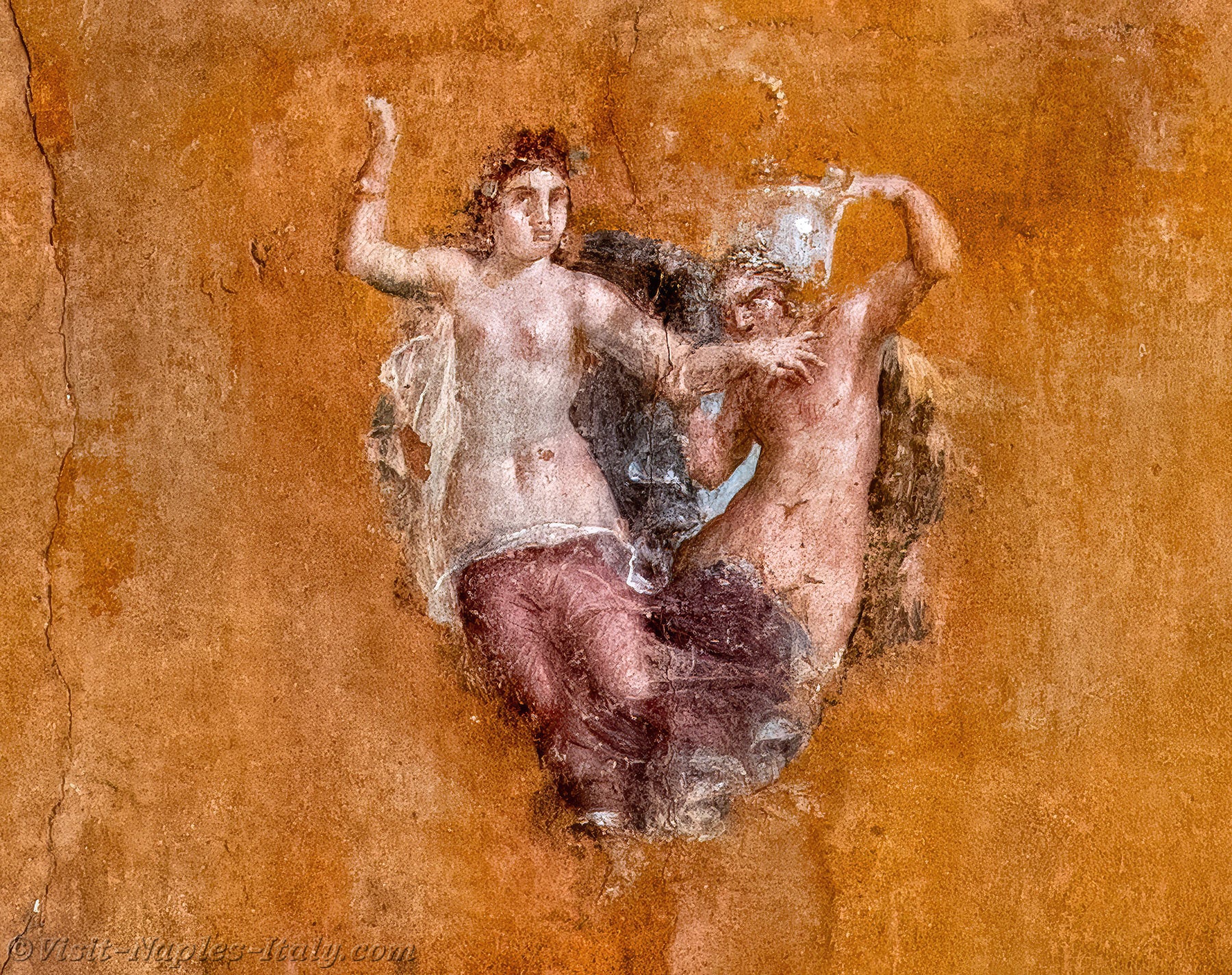
Decorative murals and still lifes In the centre of this very large decorative fresco, a half-naked Silenus and Maenad in flight are depicted.
The Maenad tries to flee, but the Silenus prevents her from leaving, clutching her arm firmly.
The upper part of the painting shows, on the left, various loaves of bread ready to be broken.
To the right of the section depicting the loaves, we can see different types of fish.
In the centre, two red mullets are situated just above a large moray eel.
One can also make out sea bream.
The third panel depicts, against a light blue background, a plate laden with eggs.
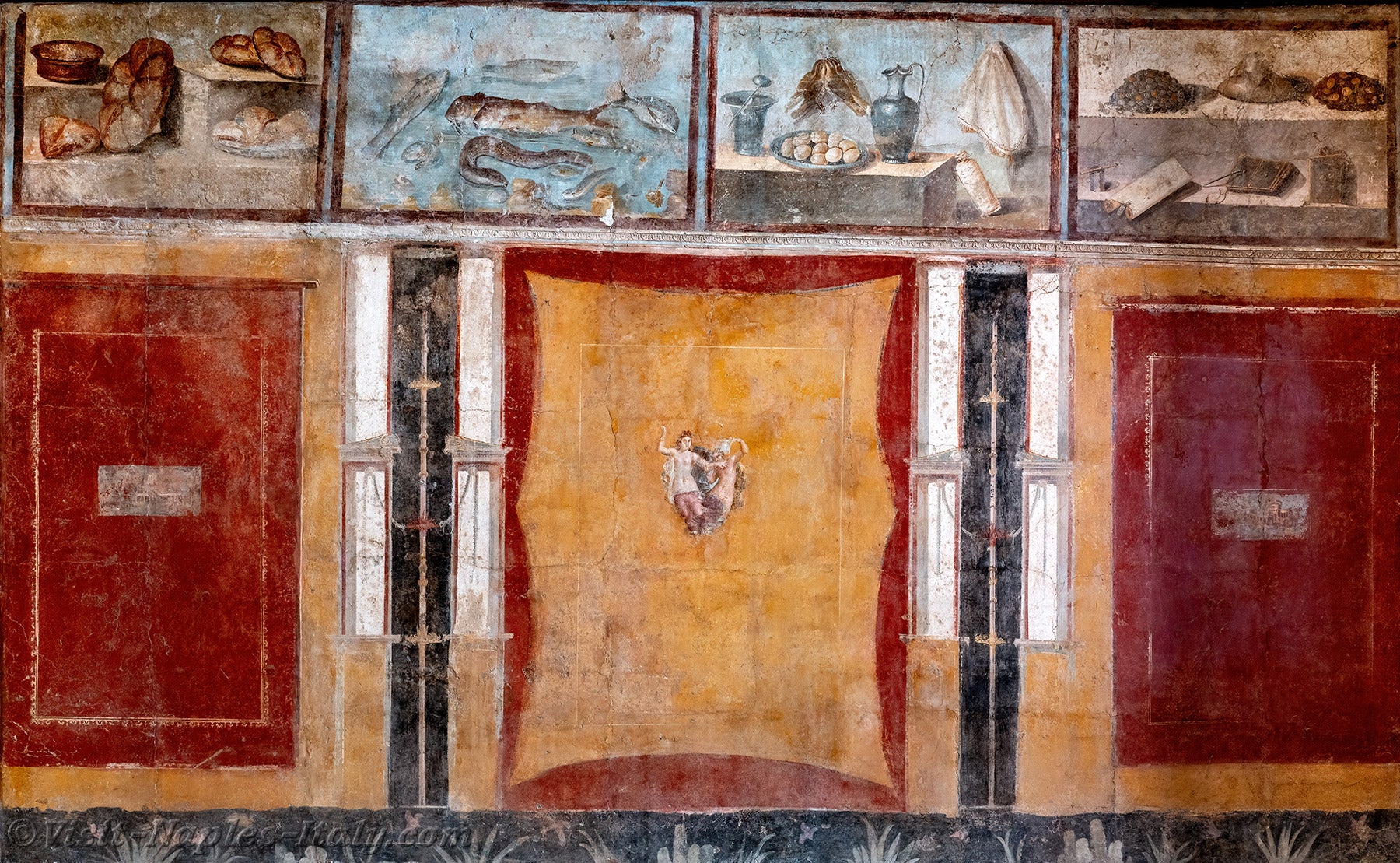
Decorative murals and still lifes To the left of this dish is a Kalathos, a silver vase on which rests a long-handled spoon, a Cochlearium, used specifically by the Romans for eating eggs.
Above the eggs, four quails are suspended from the wall by their beaks.
To the right of the quails is a silver wine jug, an oinochoe.
A napkin is hanging on the wall and, beneath it, a small white container.
After having eaten, it is time to attend to finances!
The last panel on the right shows, on a shelf, two piles of coins separated by a bag.
The bulge in the bag suggests that it also contains coins.
Below, there is a stylus, an inkwell, and a long, rolled-up papyrus scroll, known as “ Volumen”.
On the same shelf, there is also a polyptych consisting of several wax tablets with a stylus.
To its right, a wax tablet hangs from a nail.
Griffin, birds and scorpion, Stabiae, Villa di Arianna
Fresco - Water-based pigments on Coating (19 × 82 cm) 10-37 ADThis assembly of fresco fragments found in the Villa di Arianna at Stabiae was carried out in the late 18th century by those who had discovered them.
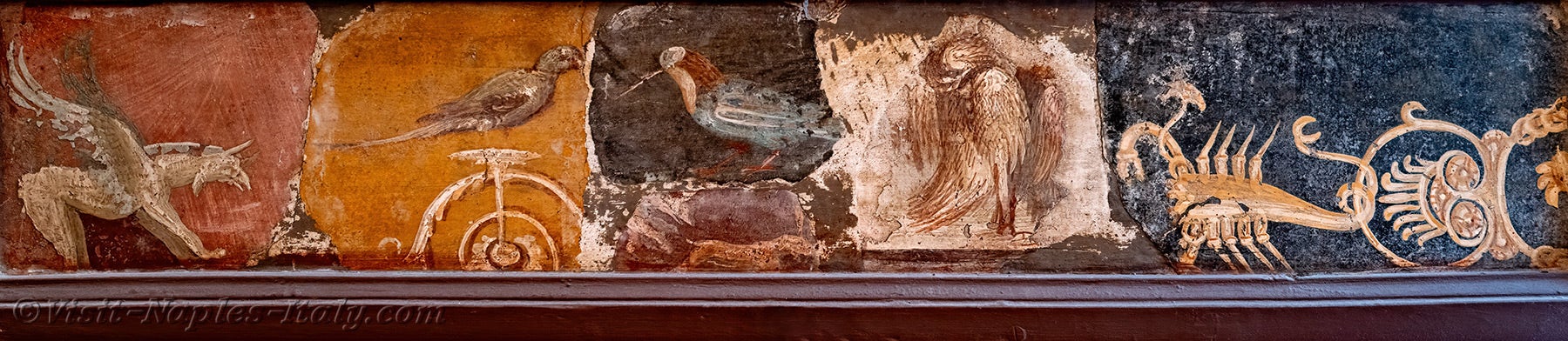
Griffin, birds and scorpion As each fragment was too small to stand alone as a work of art, the decision was made to combine them so that they could be displayed in the museum.
Here we have gathered a fragment of a fresco depicting a griffin, alongside which two other fragments depict birds, followed by an eagle with folded wings.
A stylised scorpion completes the ensemble.
Female faces and a Gorgon, Stabiae, Villa di Arianna
Fresco - Water-based pigments on Coating (12 × 54 cm) 10-37 ADIn this other collection of fragments of frescoes, also from the Villa di Arianna, female faces and busts have been brought together.
On the left, a fragment shows the face of a young woman.
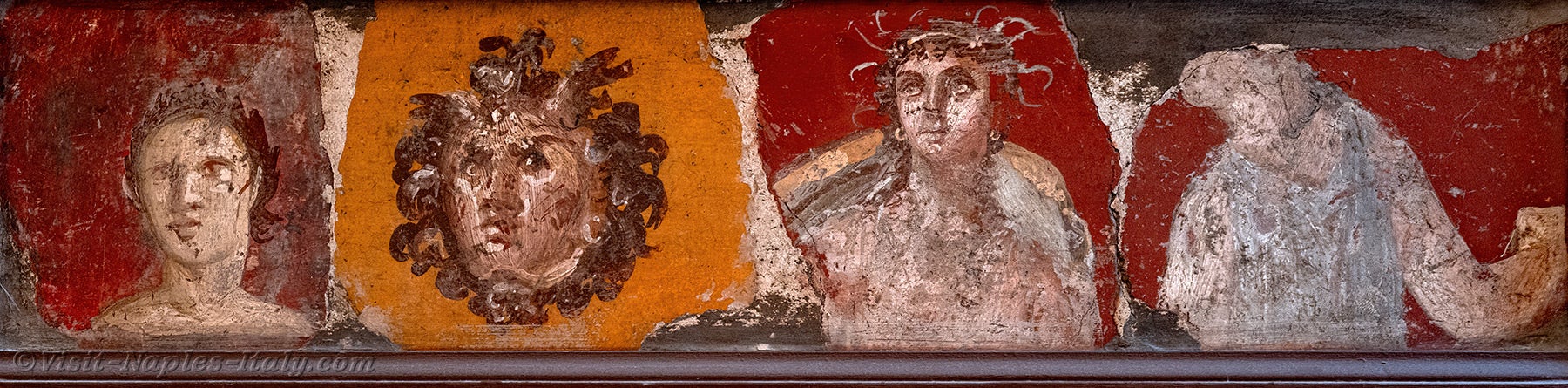
Female faces and the Gorgon Beside her is the head of a Gorgon, whose intertwined snakes form a mane, and whose terrifying gaze can turn us to stone.
On the right, against a dark red background, stands a young woman with a bare chest.
Her features are delicate and harmonious. She wears gold earrings.
A golden crown adorns her head whilst her long curly hair falls delicately over her shoulders.
To her right, a second bust, clad in a toga, is partially visible, but the upper part of the face is damaged, making it difficult to determine whether it is a man or a woman.
Flying Youth, Stabiae, Villa di Arianna
Fresco - Water-based pigments on plaster (35 × 27 cm) 10-37 ADIn this fresco found in the Villa di Arianna in Stabiae, a young man can be seen.
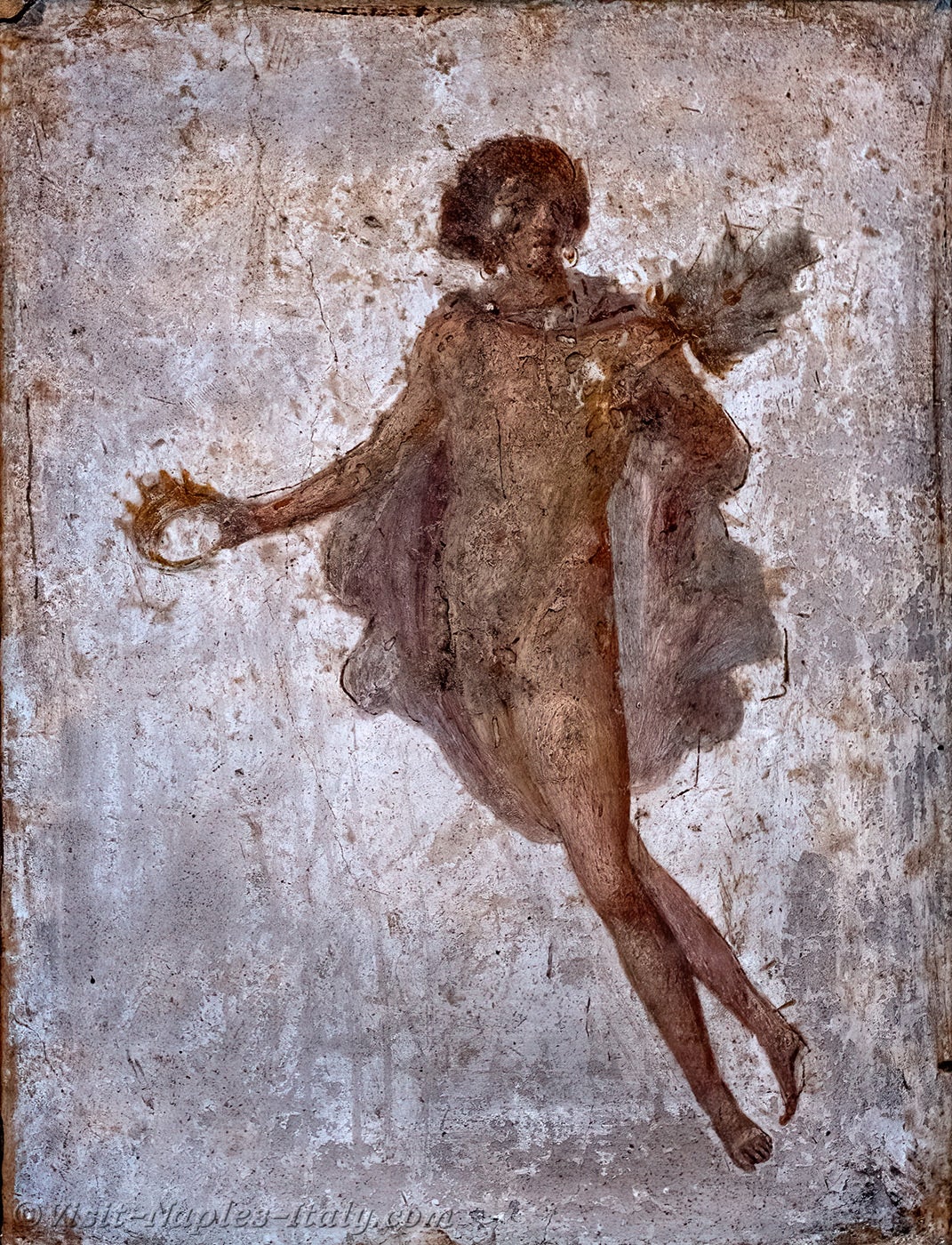
Flying young man He is depicted in mid-flight, with a leg movement of great elegance.
He is completely naked, except for a cape flowing around his body, which enhances the impression of movement.
Although he is male, he wears earrings.
In one hand, he holds a golden crown and, in the other, a palm frond or a fan made of feathers.
He looks over his shoulder.
Young man with a vase, Stabiae, Villa di Arianna
Fresco - Water-based pigments on Coating (34 × 26 cm) 10-37 AD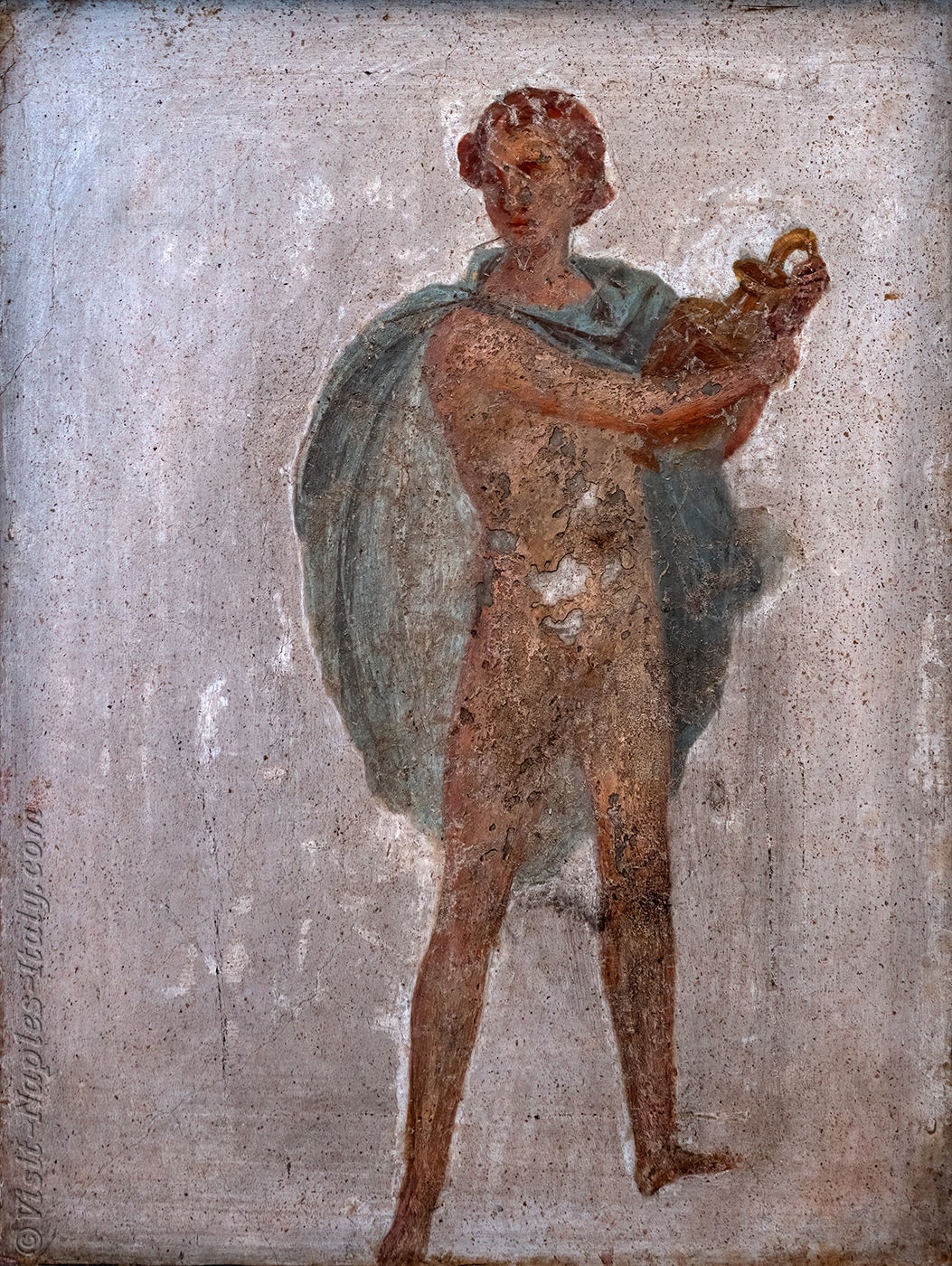
Young man with a vase In this second fresco discovered on the same wall as the previous one, in the Villa di Arianna in Stabiae, we can see another young man.
He is not flying, but his imposing presence is comparable to that of the previous figure.
He is completely naked, except for a cloak that drapes around his body.
He is holding a large vase in his hands.
It is interesting to note that the artist has used the same twisting of the body as before, with the arms on one side and the face on the other, in opposition to the pelvis, which creates a certain dynamism and brings the young man to life: he is turning his head towards us, just as we look at him.
Diamonds, Cupids, young men and women, Stabiae, Villa di Arianna
Fresco - Water-based pigments on coating (107 × 183 cm) 54-69 ADThis fresco depicts a so-called “carpet” decoration inspired by the coffered ceilings of the period.
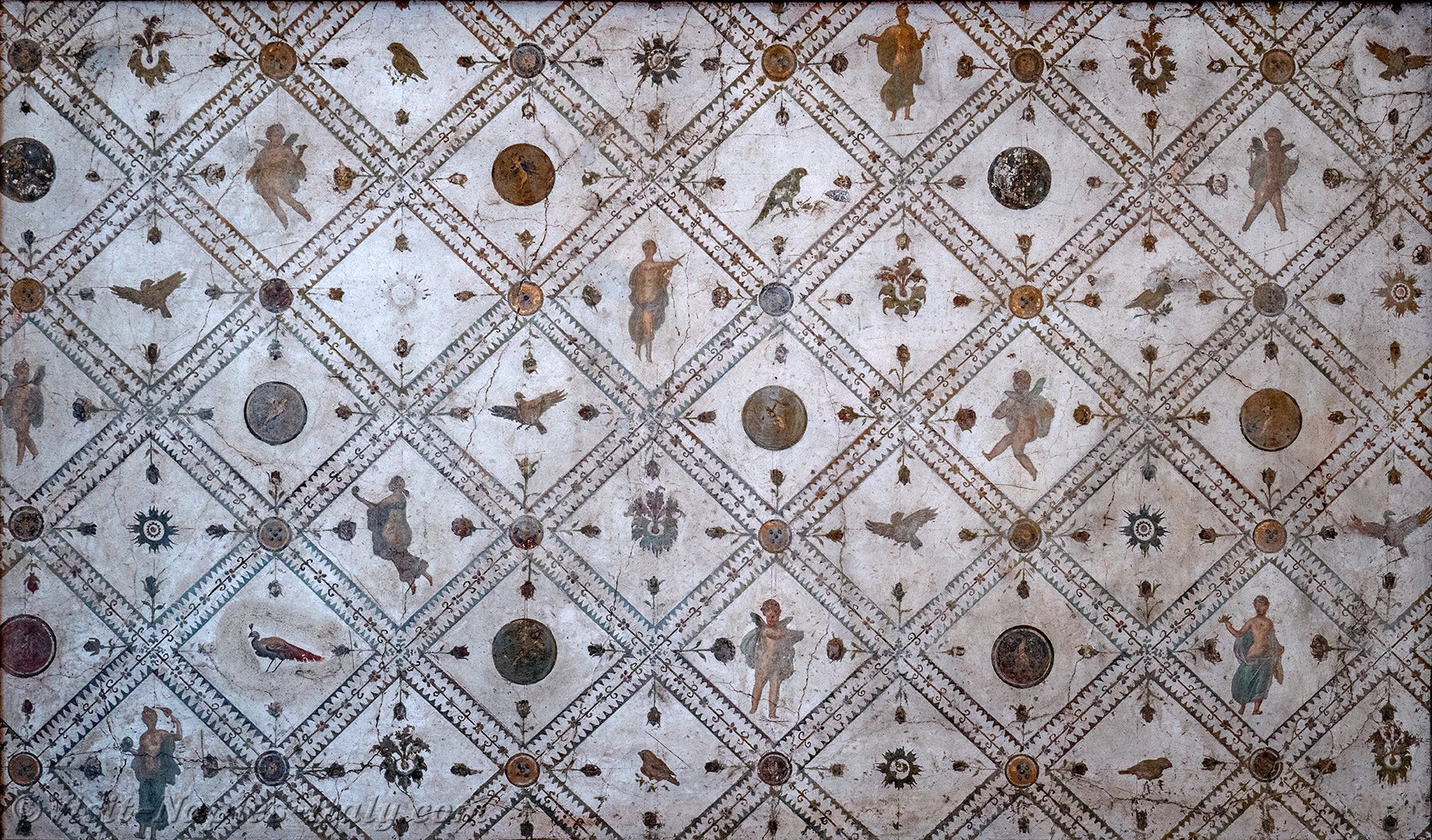
Hearts, Cupids, young men and women It uses repetitive motifs incorporated into each of the diamonds, much like some of our modern wallpapers.
This decorative style was particularly popular during the reign of Nero and is found mainly on the upper parts of the walls.
This fresco features a succession of round spheres, Cupids, young men and young women with bare breasts.
It also features birds, including a peacock, as well as birds of prey.
Winged horses and griffins, Herculaneum
Fresco - Water-based pigments on coating (90 × 180 cm) 45-79 AD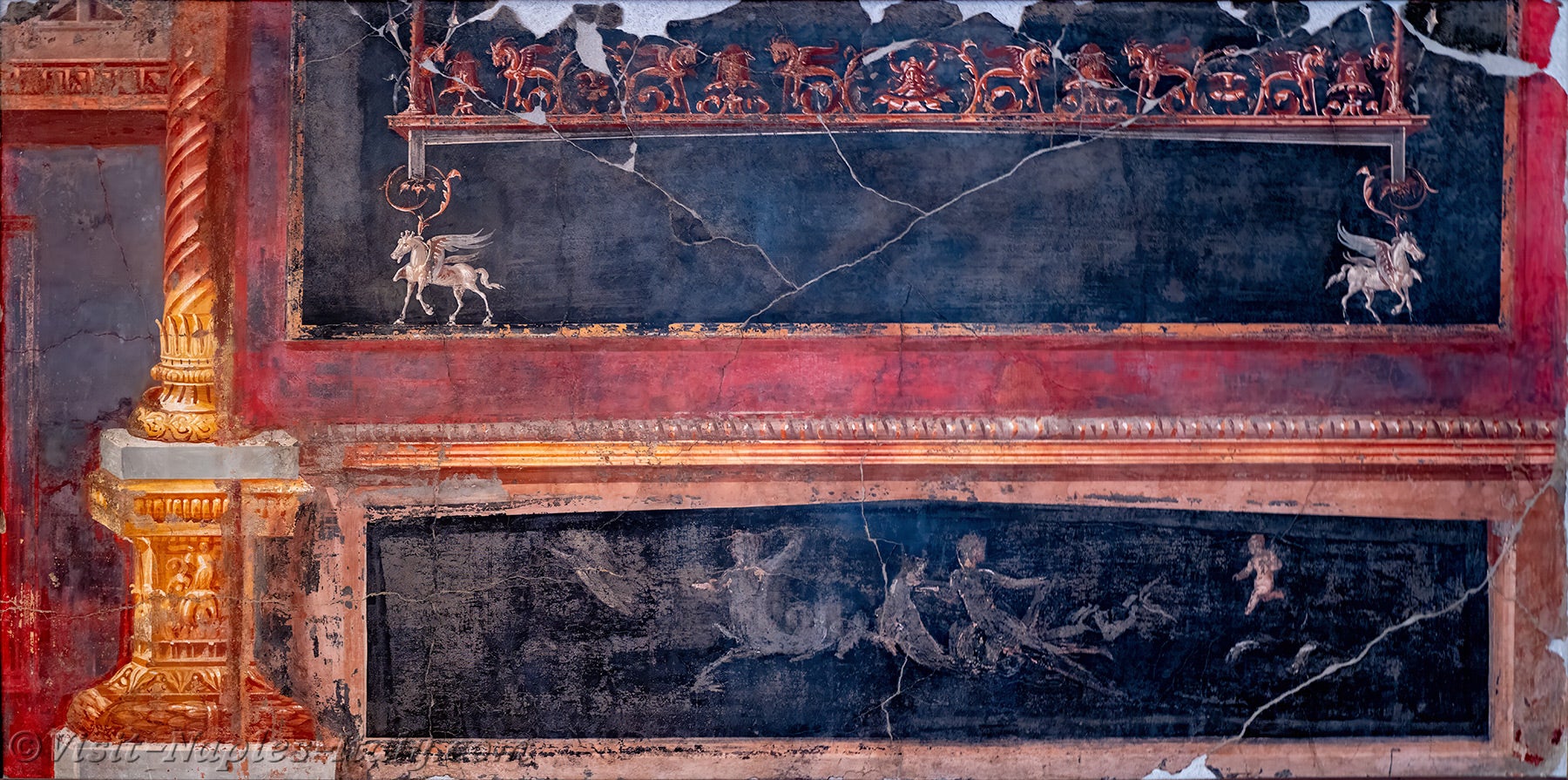
Winged horses and griffins In the lower centre of the fresco, one can see a centaur with a serpent’s tail holding a sea bull by the horns.
On the right, a little Cupid flies above the waters.
In the upper section, the artist has depicted a metal frieze adorned with tragic masks and griffins.
This frieze is supported at each end by two winged horses.
Finally, the whole is framed on the left by a twisted column resting on a carved pedestal, decorated with floral motifs.
Frescoes Mythology | Portraits | Life Leisure | Animals | Religion | Landscapes | Decoration
Artworks Sculptures | Frescoes | Eroticism
MANN Artworks Schedule Tickets Location | Authorizations
Back to Top of Page