

MANN Artworks Schedule Tickets Location | Authorizations
Artworks Sculptures | Frescoes | Eroticism
Frescoes Mythology | Portraits | Life Leisure | Animals | Religion | Landscapes | Decoration
Portrait Frescoes from the Archaeological Museum of Naples, Italy
The Poet Sappho, Pompeii, VI Insula Occidentalis
Fresco - Water-based pigments on Coating (37 × 38 cm) 55-79 ADThis beautiful fresco, depicting The Poet Sappho, symbolises creation.
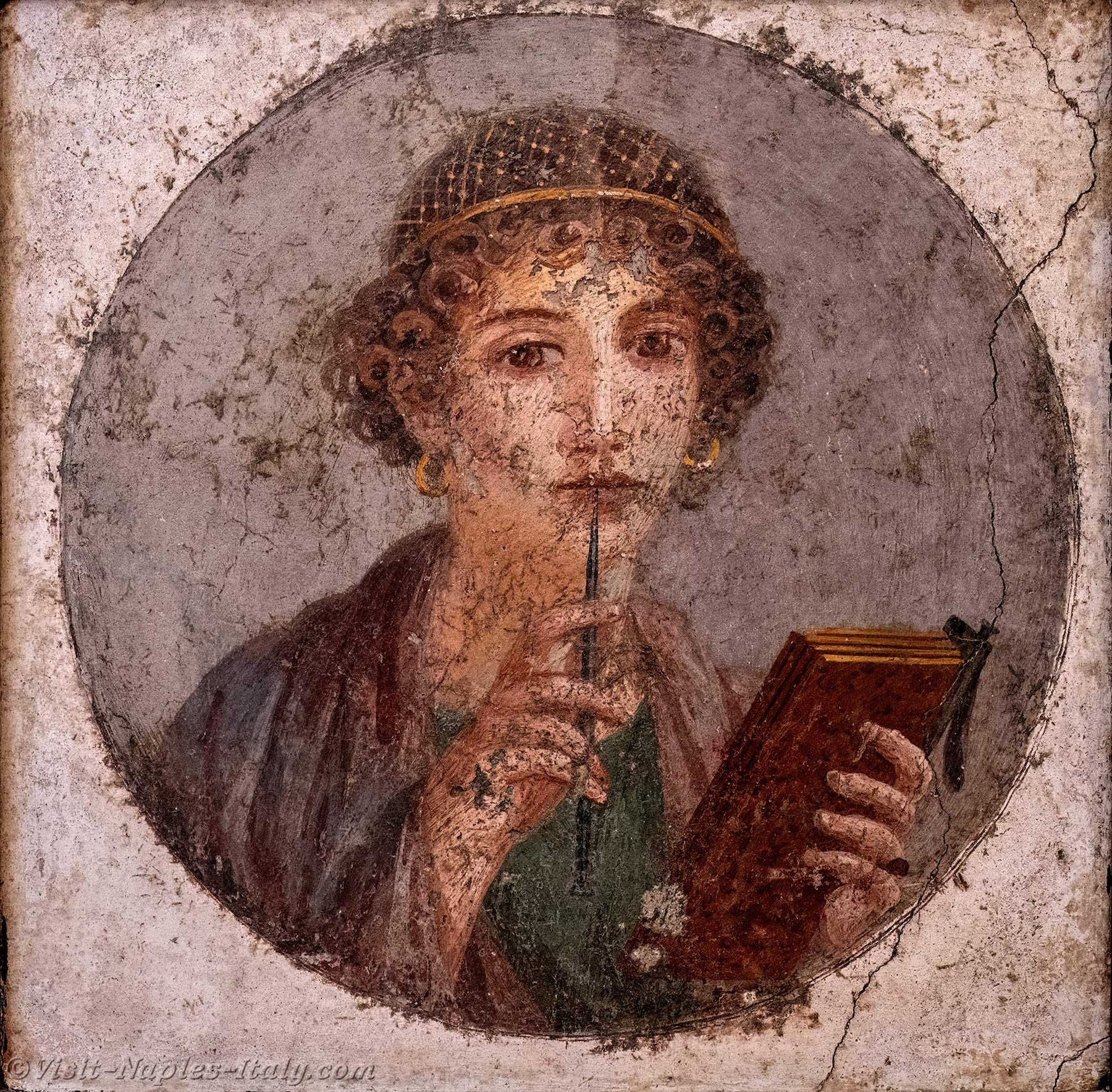
The Poet Sappho It shows the moment when the poet or writer, lost in thought, searches for the words that will best express them.
The next moment will be the birth of these words that will come to life on the wax tablet.
Does this portrait really resemble the famous poet Sappho?
We do not know, but it seems unlikely that this painting corresponds to the features of the famous Sappho.
The subject of this work is not Sappho, but rather the creative moment she embodies.
The young woman is depicted, her gaze lost in thought, in a gentle concentration emphasised by the presence of her stylus delicately resting against her lips.
The curly hairstyle and reticulum holding her hair in place, as was the fashion during the reign of Emperor Nero, as well as the gold earrings are there to emphasise the beauty of the young woman, but also her social status.
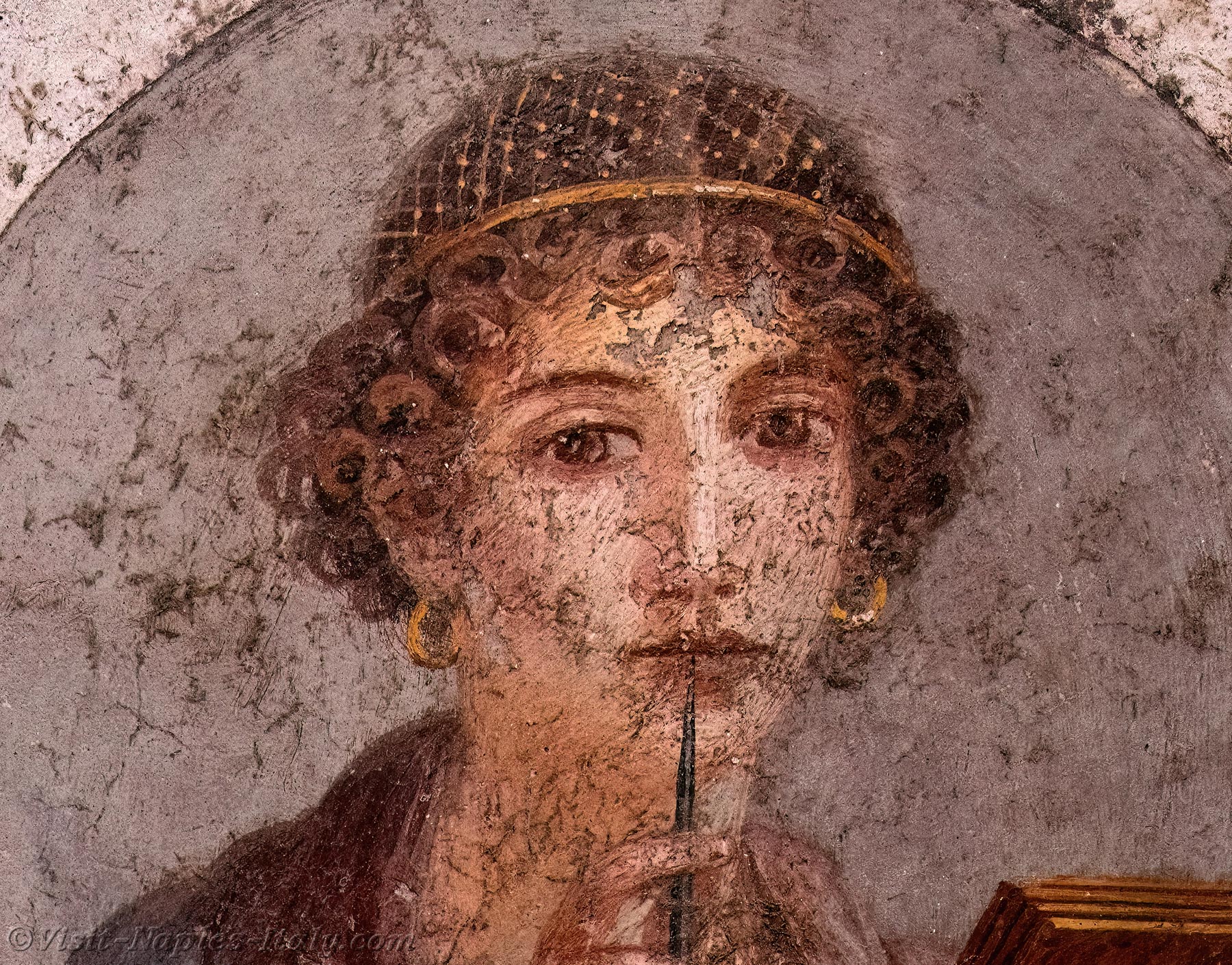
The Poet Sappho For her true beauty, the kind that can be sensed without being seen, is internal.
This type of representation of Sappho was very popular in the Roman world and served as a model for several other portraits.
It can also be seen in the two frescoes below, those of the two young girls, as well as in the famous portrait of Terentius Neo and his wife.
Indeed, the two frescoes show the young women in the same pose: wide-open eyes, a stylus resting on their lips, and a wax tablet in one hand.
In the case of Sappho, this is a tetraptych, composed of four tablets superimposed on top of each other.
Young girls, Herculaneum
Fresco - Water-based pigments on coating (36 × 40 cm) 45-79 ADThis fresco depicts two young girls.
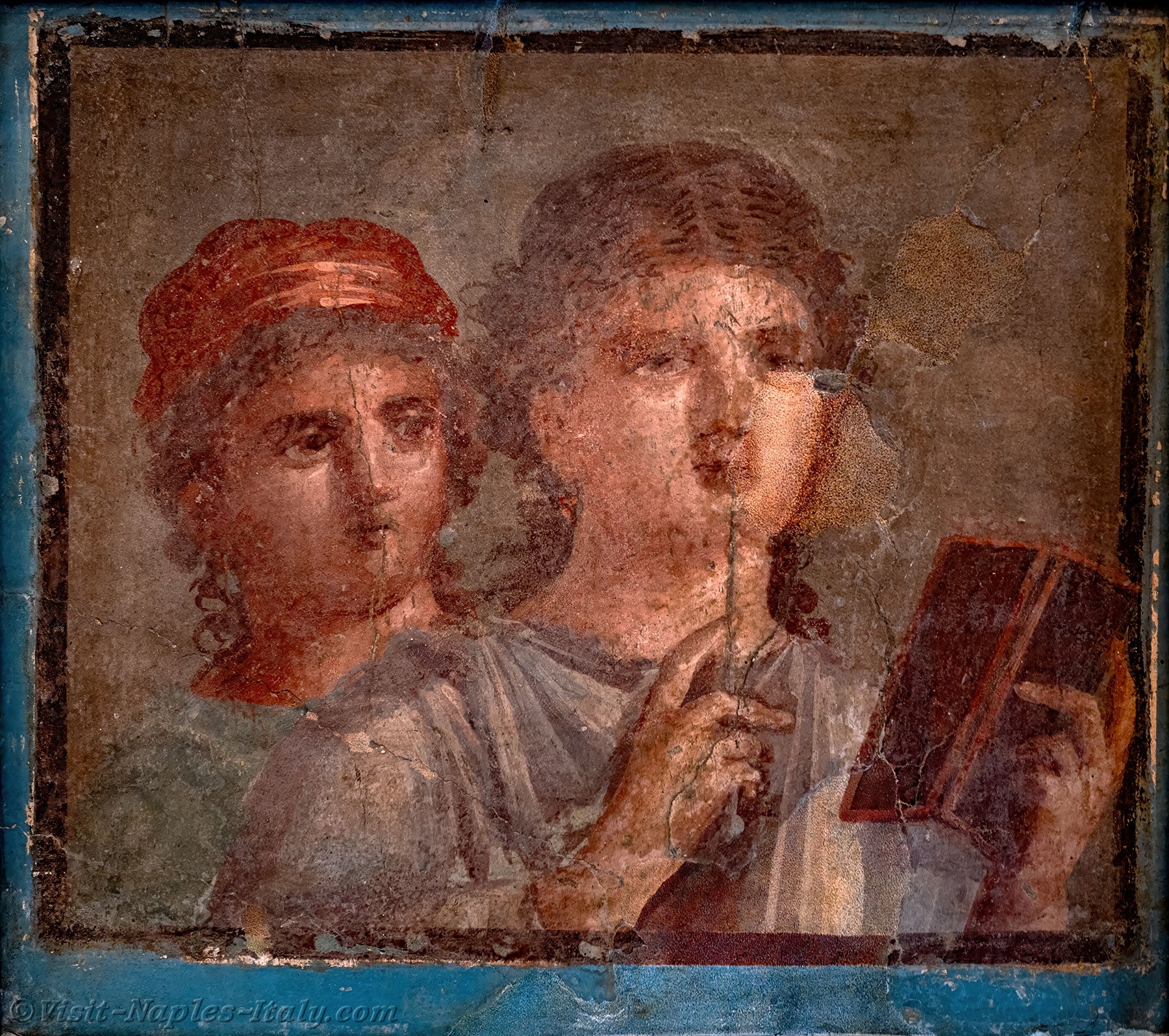
Young girls The one standing at the back is wearing a red headscarf and reading attentively what her friend is writing on her tablet.
The girl closest to us seems deeply absorbed, her stylus resting on her lips, thinking about what she is going to write after what she has already written on her wax tablet.
This scene evokes the fresco depicting the poet Sappho.
This painting depicts two young girls from the upper social class.
They are proficient not only in reading and writing, but they also have the leisure to devote themselves to writing, as suggested by the tablets they are holding.
This indicates that they do not need to work, unlike women from lower social classes.
Terentius Neo and his wife, Pompeii, Casa di Terentius Neo
Fresco - Water-based pigments on Coating (65 × 58 cm) 55-79 ADThis portrait of a couple of bakers from Pompeii was located at the back of their exedra, so that everyone passing through this room could admire it.
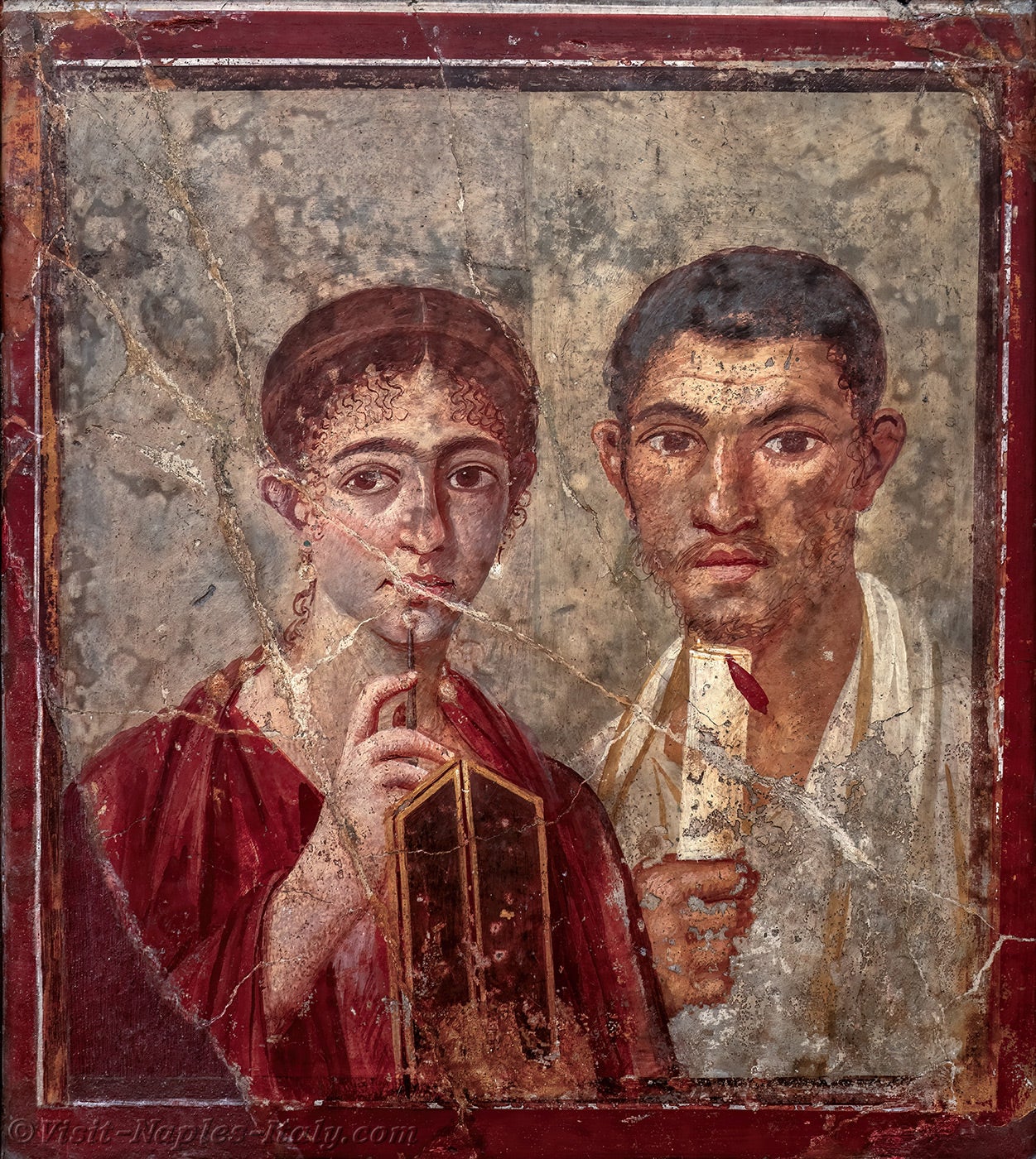
Terentius Neo It is one of the most famous portraits in Pompeii, but also in Roman painting.
The manner in which they are both depicted shows their desire to be assimilated into the refined Roman aristocracy.
The young woman, whose sophisticated hairstyle follows the trends of the time, wears earrings adorned with pearls.
Here we see the intellectual presentation of the poet Sappho, already seen in the previous portrait of the two young girls.
She is holding a stylus near her lips, while her other hand holds wax tablets to show that she can read, but also write, and is not just a baker's wife.
Her husband is depicted wearing the toga of magistrates and holding a papyrus scroll.
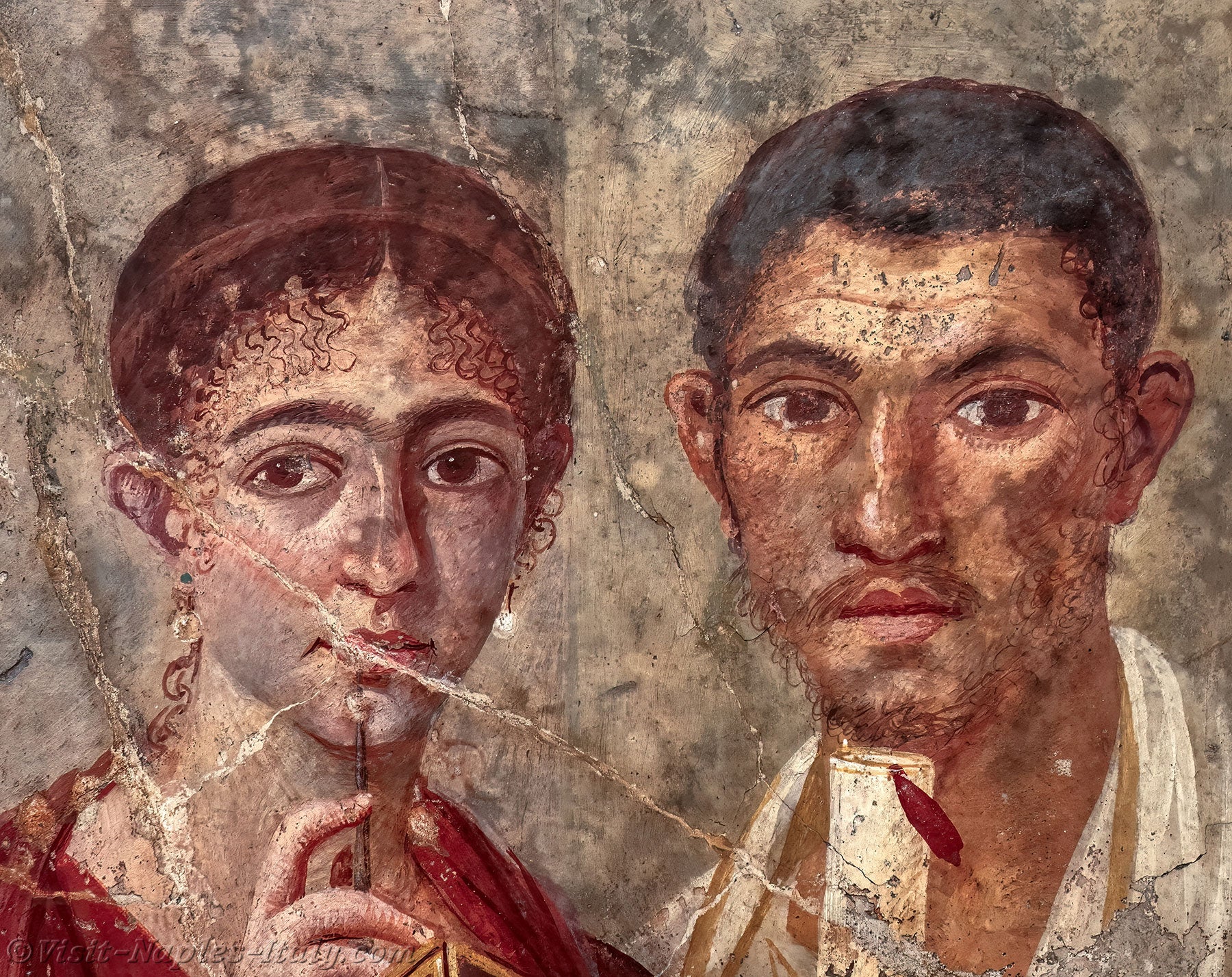
Terentius Neo The artist did not seek to embellish the features of the baker or his wife.
He depicted them as they were, that is to say, as ordinary inhabitants of Pompeii.
However, he gave them the intellectual and solemn appearance of members of the Roman senatorial class, the only concession made by the painter in this painting to embellish reality, probably at the request of Terentius Neo himself.
A couple of simple bakers who thus became aristocrats with a stroke of the brush.
A success nonetheless, as they were certainly far from imagining the fame of their portrait two thousand years later!
Woman and Landscape, Herculaneum
Fresco - Water-based pigments on Coating (50 × 31 cm) 45-79 ADThis fresco found in Herculaneum shows us both the portrait of a woman depicted in a medallion and, below her, a landscape.
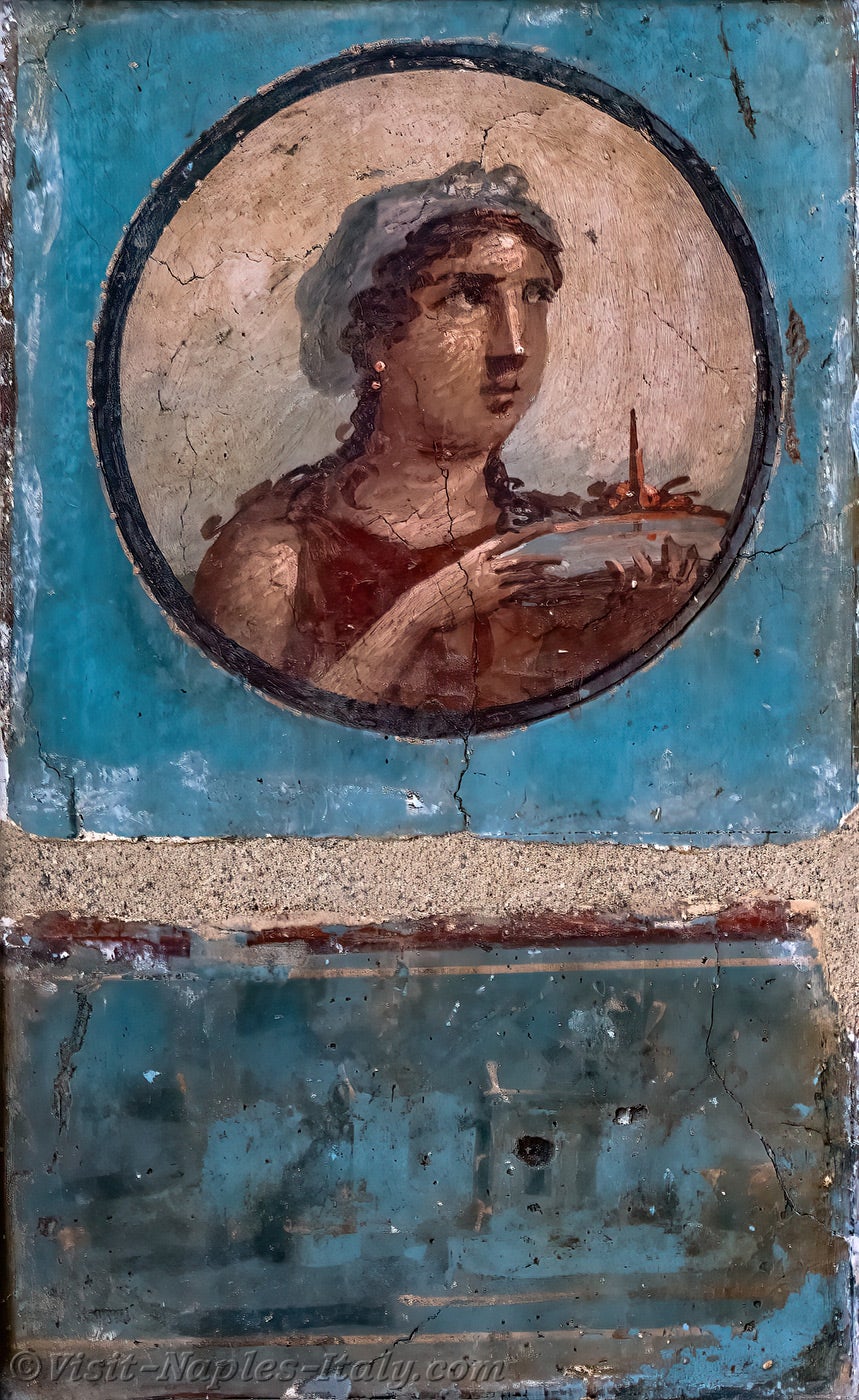
Landscape Medallion The lower part of the fresco is damaged, making it difficult to identify the landscape depicted. Nevertheless, we can make out a building that could be a house or even a sanctuary, given its large size, thus shedding light on the symbolism of the medallion. Indeed, the young woman depicted is holding a dish filled with fruit, which could evoke an offering to the deities.
Indeed, the young woman depicted is holding a dish filled with fruit, which could evoke an offering to the deities of the temple in question.
Some have suggested that she is a servant, given that she is holding a dish.
However, we find this theory unlikely.
Why depict a servant in a medallion above a landscape?
We believe it is more logical to consider that the fruit is an offering to the gods of the temple.
Seated Old Man, Stabiae, Villa di Arianna
Fresco - Water-based pigments on Coating (32 × 33 cm) 54-69 AD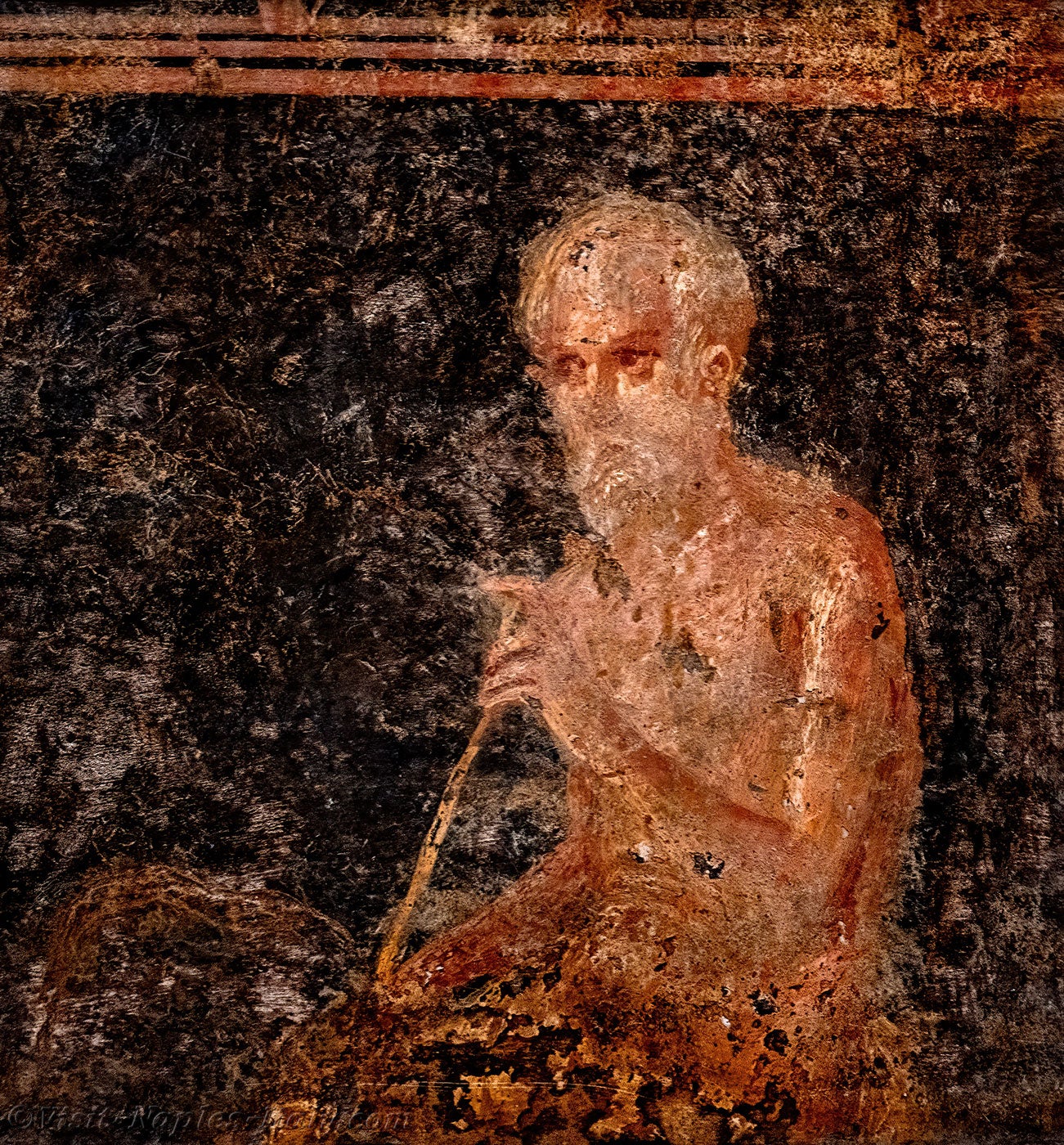
Old Man Sitting This fresco, found in the Villa di Arianna in Stabiae, about five kilometres from Pompeii, depicts an elderly man seated.
He is depicted bare-chested.
However, he does not appear to be completely naked, but the poor condition of the lower part of the fresco makes it impossible to distinguish the garment that might be covering his lower body.
His old age is attested to by the stick he holds in one hand, a stick that helps him walk.
His hair and white beard also emphasise his age.
His gaze seems lost in thought, unless he is looking at something in the distance.
This old man also brings to mind a philosopher.
Portrait of an old man, Pompeii, Casa del Citarista
Fresco - Water-based pigments on Coating (37 × 36 cm) 55-79 AD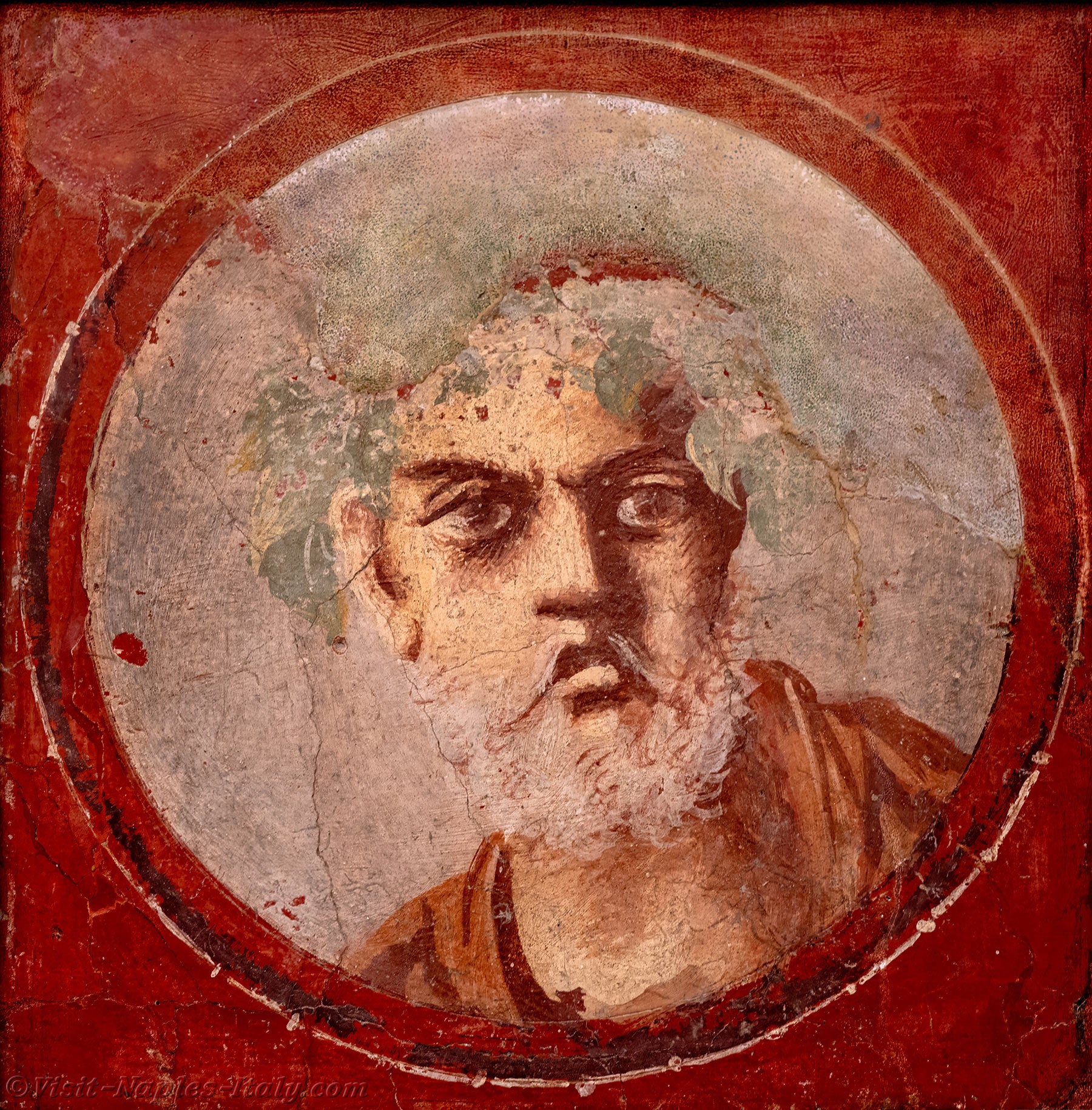
Portrait of an elderly man This portrait of an old man with a thick white beard could be that of a poet or a philosopher.
His draped garment, reminiscent of the himation of Ancient Greece, is worn next to the skin.
The presence of the ivy crown, in addition to the himation, suggests that he is a Greek poet or philosopher.
His gaze is piercing, looking straight ahead in a determined manner.
His mouth, far from smiling, also shows determination.
This Greek poet or philosopher is depicted in a medallion on a red background typical of Pompeii.
Portrait of a young man in profile, Pompeii, Villa di Cicerone
Fresco - Water-based pigments on plaster (25 × 25 cm) 50-79 ADThis fresco differs from other portraits found in Pompeii.
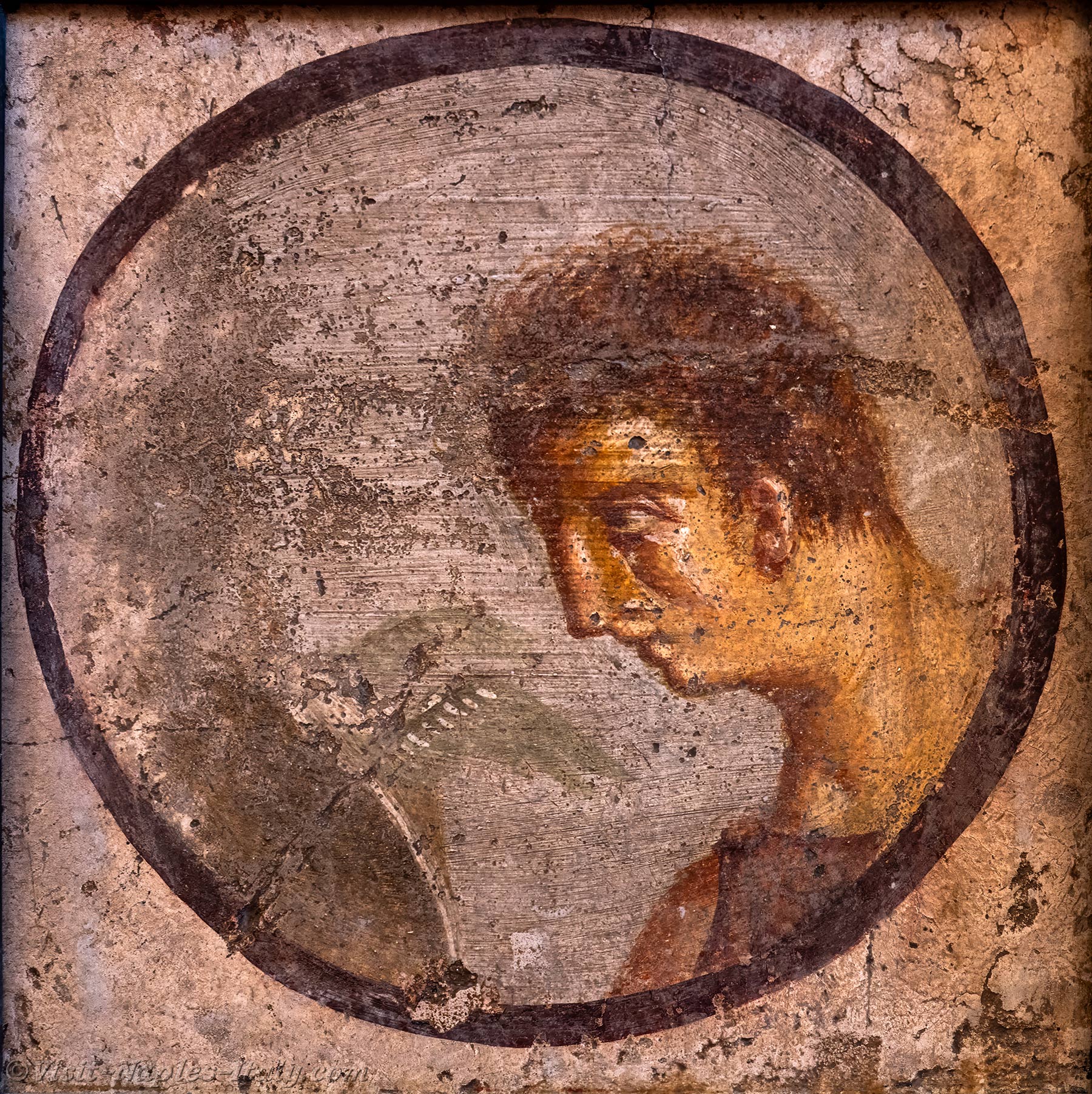
Portrait of a young man in profile The young man depicted in the painting is indeed shown in profile.
Furthermore, he is observing a small green bird just in front of him.
The crown around his head could refer to a poet, but given his youth, it could also be that of a young athlete recently crowned after a victory.
Note the play of light bathing his face.
The light illuminating the scene from the right of the medallion gives relief to the profile by highlighting his forehead, his nose and even his cheek.
This use of chiaroscuro is impressively modern for a fresco dating back nearly two thousand years.
Portrait of a crowned young man, Vesuvian Area
Fresco - Water-based pigments on coating (24 × 24 cm) 45-79 AD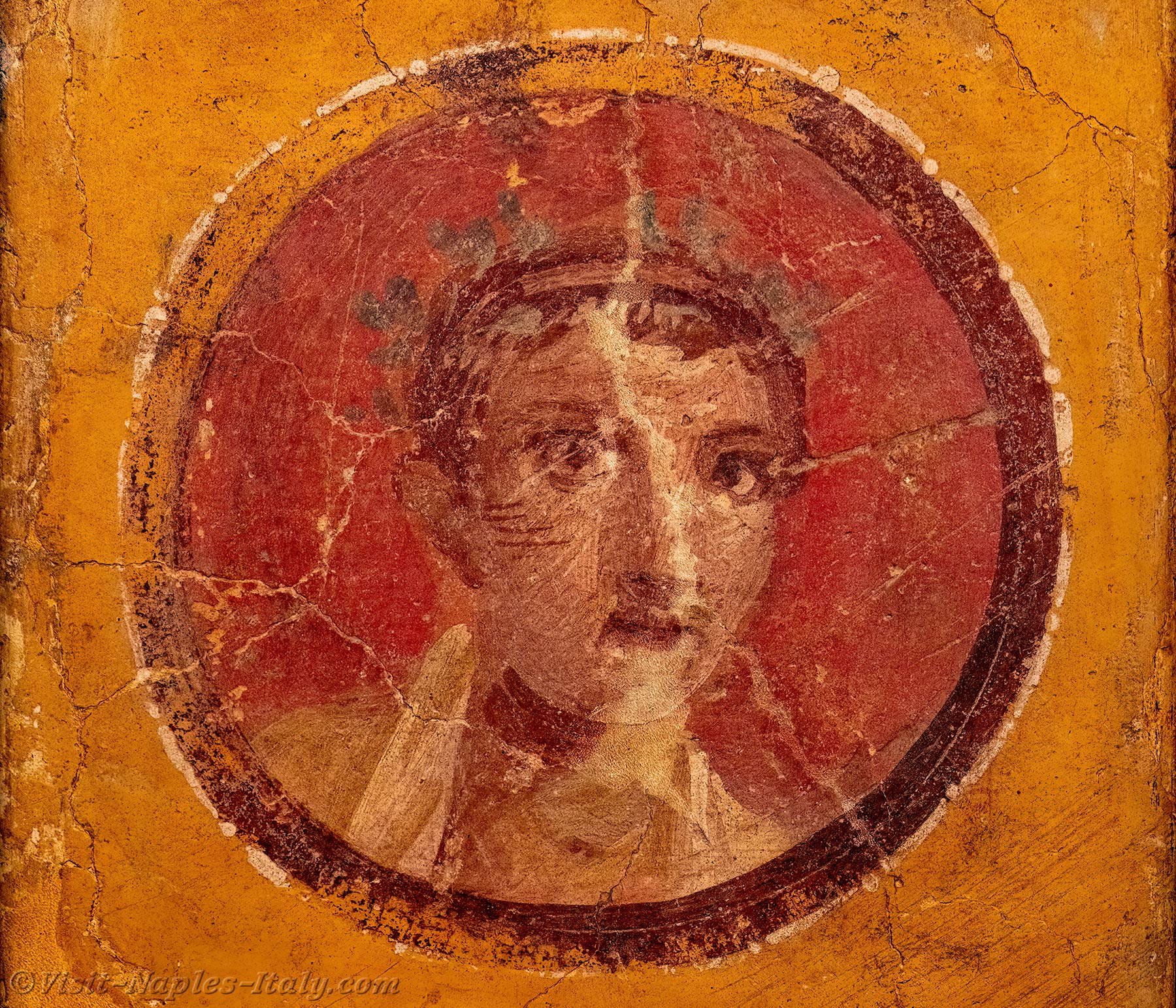
Portrait of a crowned young man This painting depicts a teenager wearing a wreath of laurel leaves.
This representation suggests either recent graduation or victory in a poetry competition.
His young age makes it unlikely that he is a representation of a triumphant athlete.
His wide-open eyes do not correspond to those of a recently crowned poet, but this should not be considered as a clue to the identity of this young boy.
The rough features of his face and his bulging eyes are likely due to the lack of skill of the painter who created this work.
Young man with a papyrus scroll, Pompeii, Casa del Cenacolo
Fresco - Water-based pigments on coating (18 × 13 cm) 50-79 AD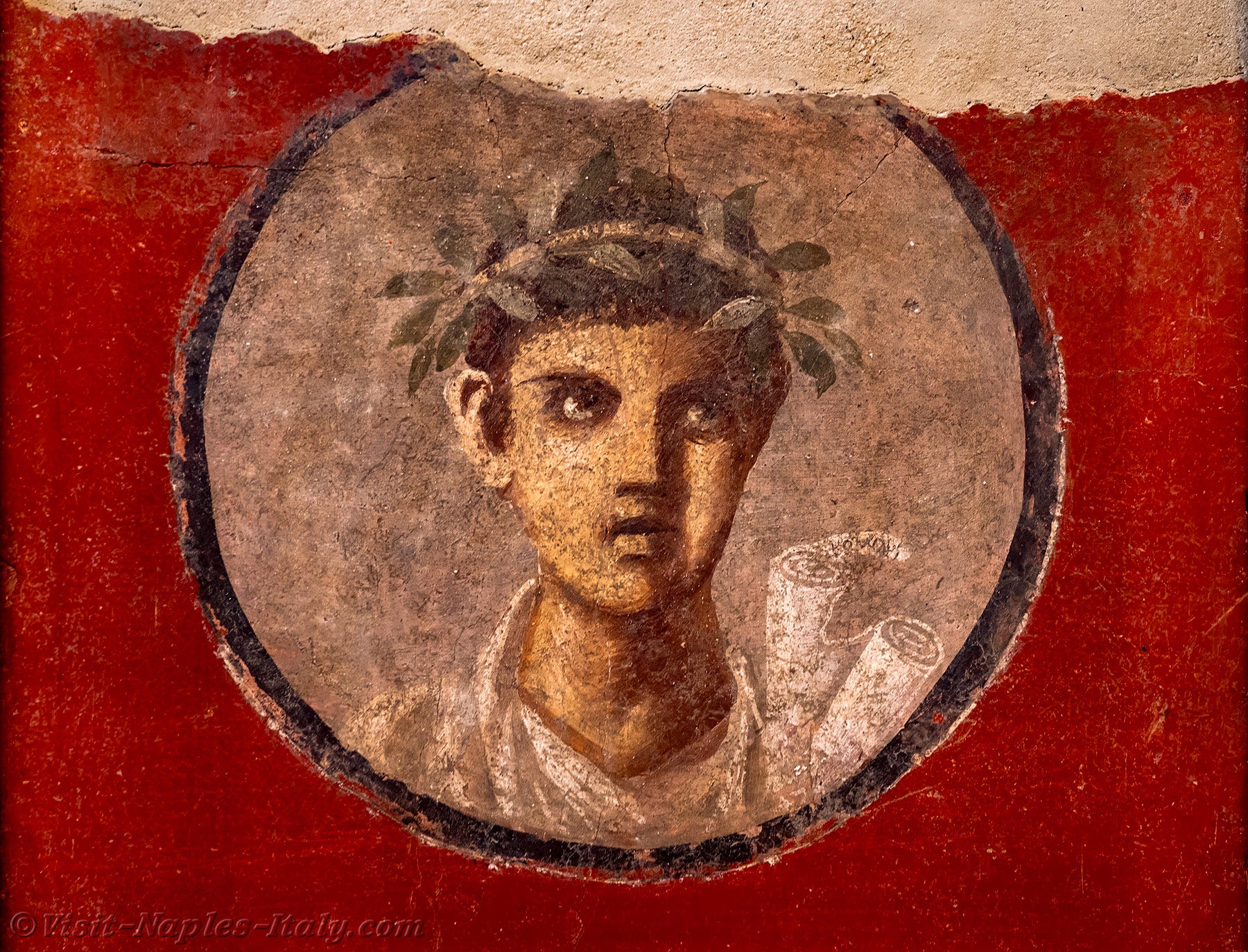
Young man with a papyrus scroll This painting depicts a teenager crowned with laurels, holding a papyrus scroll in his hand.
The importance of Greek culture in the Roman world at that time is reflected in this portrait of a young laureate.
His papyrus scroll bears the inscription ‘Plato’, which suggests that his degree was in philosophy.
Although small, this portrait demonstrates the artistic talent of its creator.
The use of chiaroscuro gives great depth and a strong presence to the face of this adolescent.
Young man with a papyrus scroll, Pompeii, Casa del Cenacolo
Fresco - Water-based pigments on Coating (10 × 8 cm) 50-79 AD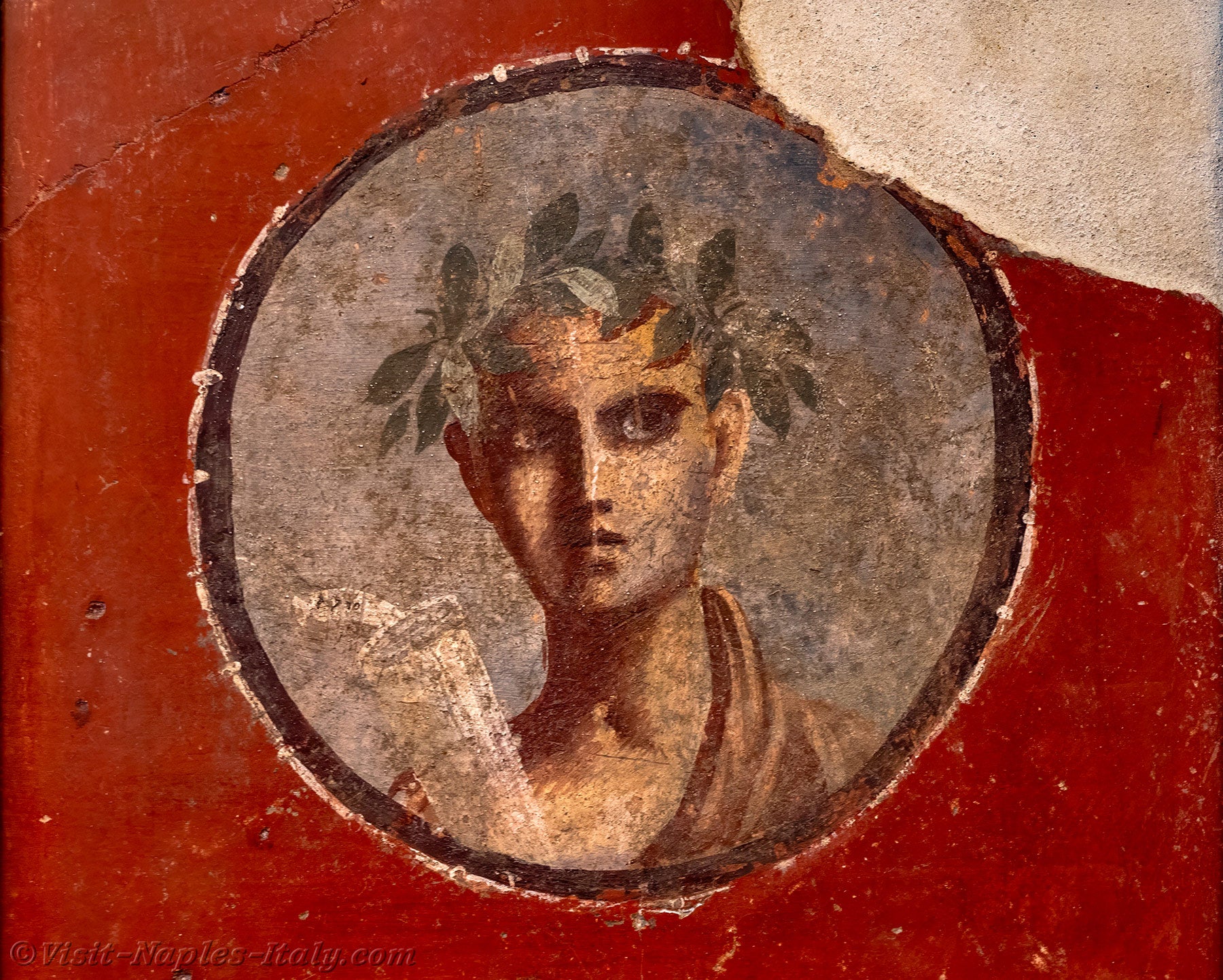
Young man with a papyrus scroll This small portrait, measuring approximately six centimetres in diameter for the central part of the medallion, demonstrates the talent of the artist who painted it.
His use of chiaroscuro is indeed perfect and effectively conveys the intensity of the young man's gaze.
This portrait was found in the same house, the Casa del Cenacolo, as the previous portrait of the young man crowned with laurels.
It is therefore thought that they could be brothers.
The same references to Greek culture can be found here.
Indeed, the name Homer can be read on his papyrus.
Young poet with a papyrus scroll, Pompeii, VI Insula Occidental
Fresco - Water-based pigments on Coating (40 × 40 cm) 55-79 ADThis portrait, discovered in Pompeii in 1760, was found on the same wall as the one depicting the poet Sappho, which you can see at the top of this page.
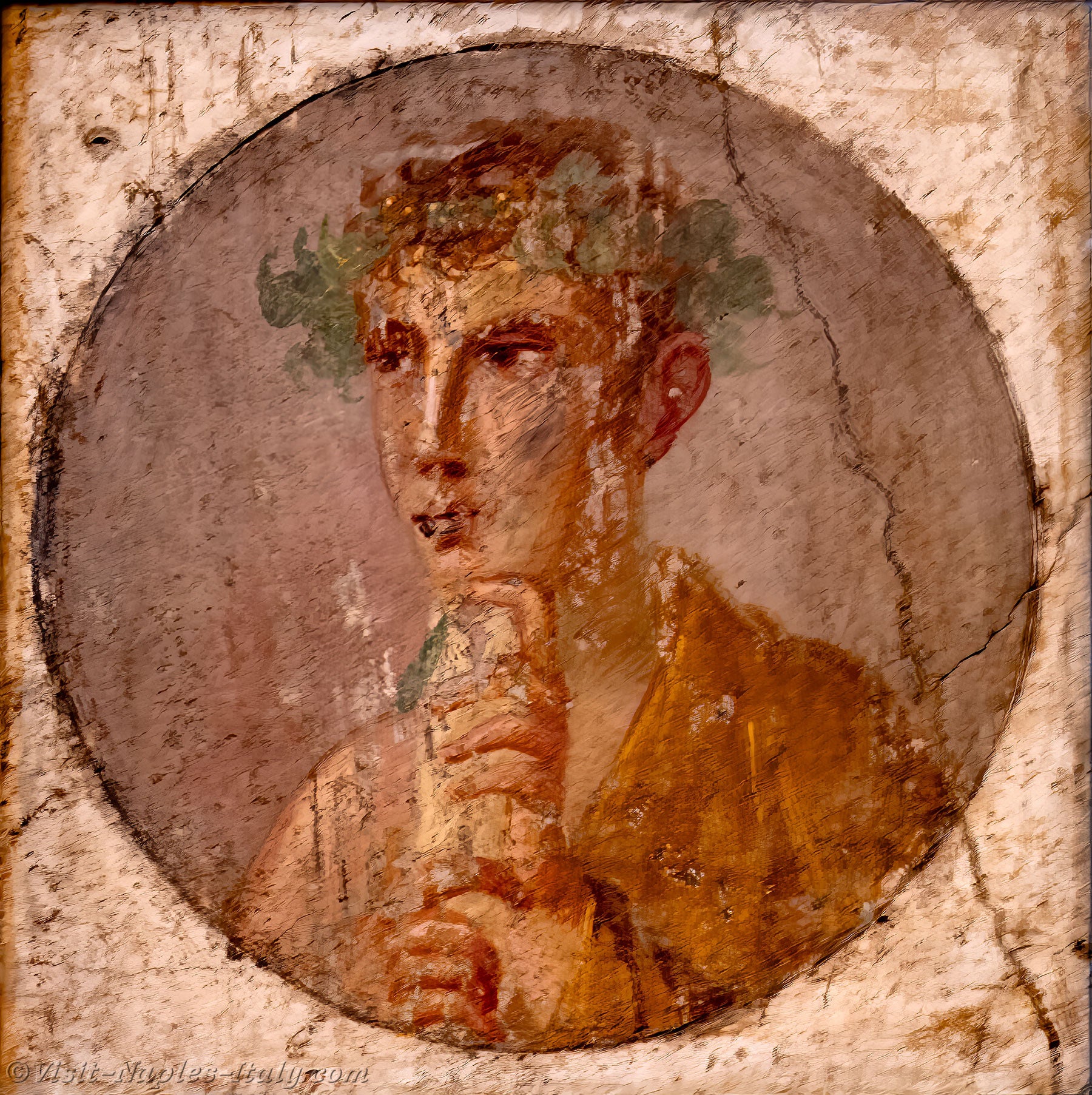
Young poet with a papyrus scroll Both were painted on a white background wall corresponding to the fourth pictorial style of the houses of Pompeii.
Like the previous portraits, this one depicts a young man wearing a crown, in this case made of ivy, and holding a papyrus scroll.
The subtle use of light and shadow brings his face to life.
It is thought that this was not a portrait, but rather a subject known as “genre” representing a laureate.
This hypothesis is reinforced by its proximity to the representation of the poet Sappho, who also appears to be a genre figure.
She holds a stylus near her lips, and in her other hand, wax tablets, to characterise the poetess.
Frescoes Mythology | Portraits | Life Leisure | Animals | Religion | Landscapes | Decoration
Artworks Sculptures | Frescoes | Eroticism
MANN Artworks Schedule Tickets Location | Authorizations
Back to Top of Page