

MANN Artworks Schedule Tickets Location | Authorizations
Artworks Sculptures | Frescoes | Eroticism
Frescoes Mythology | Portraits | Life Leisure | Animals | Religion | Landscapes | Decoration
Religion Dionysus | Isis
Frescoes of Religious Practices in Pompeii and Herculaneum at the Archaeological Museum of Naples in Italy
Cult of Dionysus ➤
Cult of Isis ➤
Jeune fille faisant une offrande, Stabiae
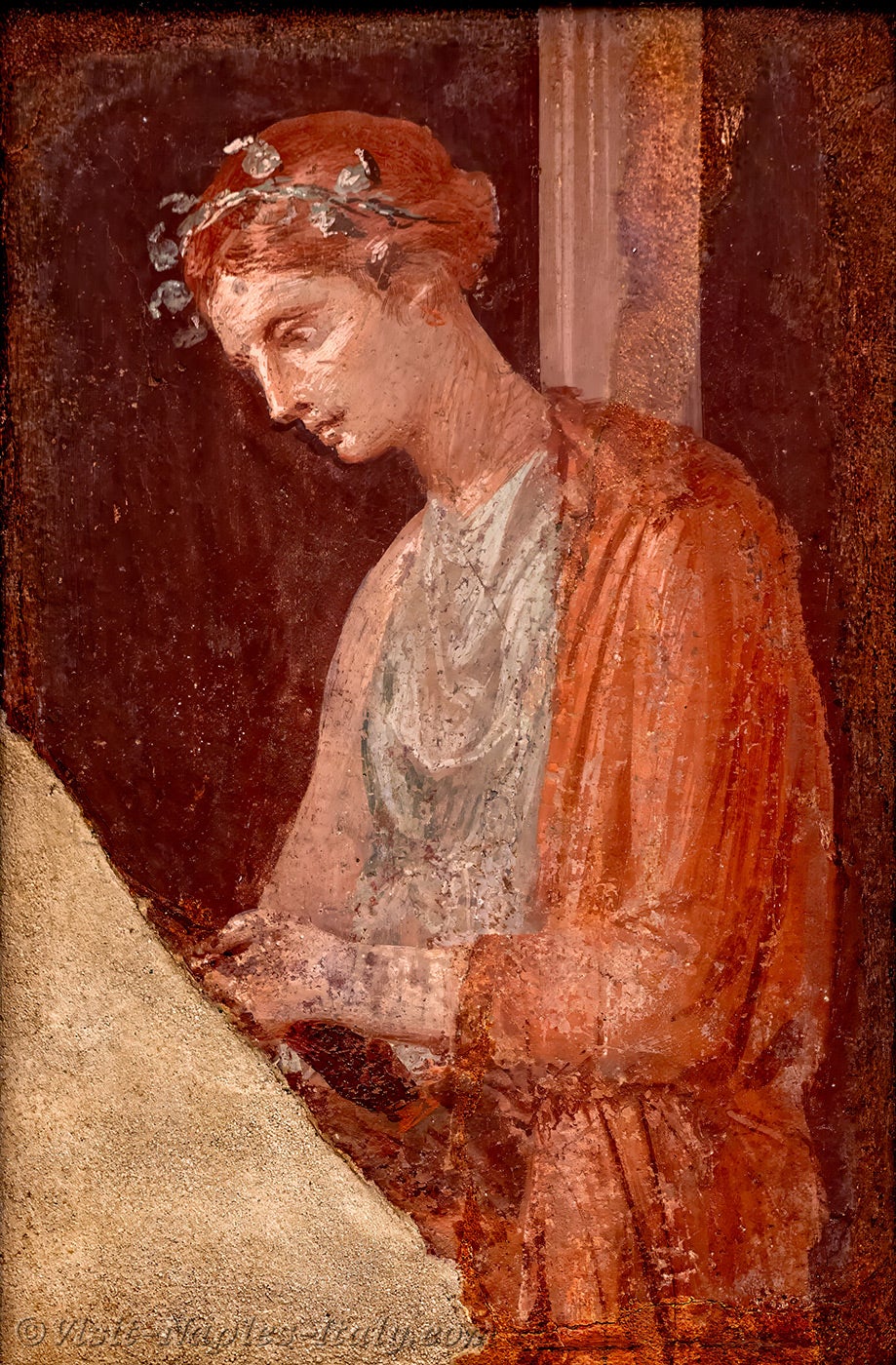
Young girl making an offering Fresco - Water-based pigments on Coating (56 × 38 cm) 55-79 AD
This fresco was found in Stabiae.
This young girl with delicate features wears a crown of ivy on her head.
She is about to lay an oblation in the sanctuary.
She looks at the offering she is bringing, which is in her hands.
It appears to be food, but it could just as easily be an object.
The table, in addition to its religious dimension, is also magnificently painted.
The quality of the rendering of the drapery as well as the care taken by the artist to render the light on the face of the young girl, but also on her clothes is remarkable when you think of the age of this fresco.
Tholos, Pompeii, Insula Occidentalis
Fresco - Water-based pigments on Coating (210 × 294 cm) 40-30 BCThis very large fresco, two metres high by three metres wide, was found in Pompeii, in the same place as the fresco « Mask of Satyr and Hare ».
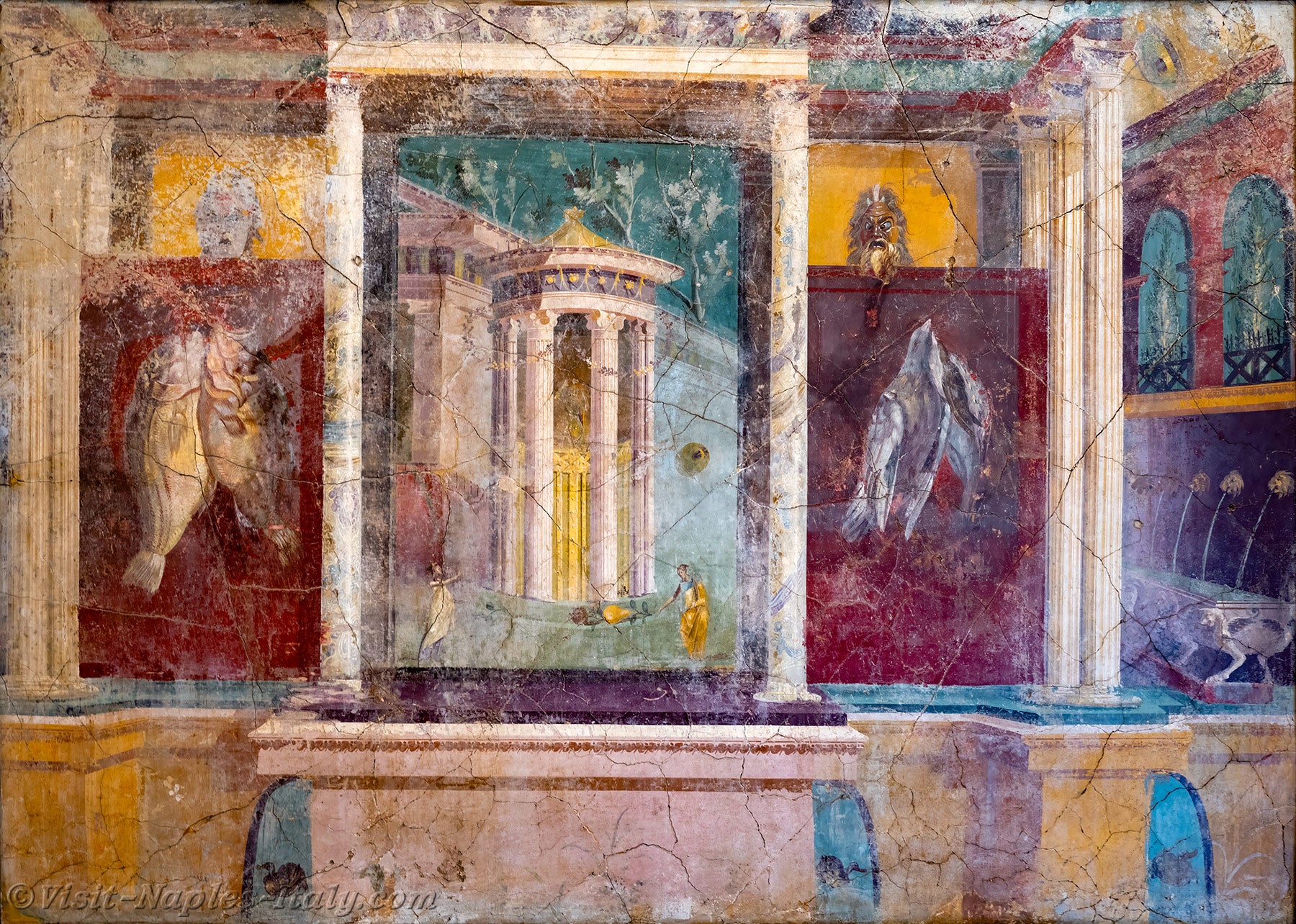
Tholos, Pompeii, Insula Occidentalis Here we find the masks of satyrs beneath which hang animals meant to serve as offerings to a divinity.
The hare in the other fresco is replaced here by two large fish on the left and three partridges on the right.
To the right of these partridges, the painter has depicted a red wall with two openings overlooking gardens with cypress trees.
Still on the right, the artist has depicted five fountains with lions' heads, whose water pours into a basin of marble supported by winged griffins.
But the main part of the fresco is in its centre.
Here we see a tholos, a circular temple with tall Doric columns and a conical roof.
Two women stand in front of the temple entrance and offer fruit and flowers to Venus.
Dressing of the priestess, Herculaneum, Palestra
Fresco - Water-based pigments on Coating (44 × 44 cm) 30-40 ADThis fresco, like the one called “The actor king” was one of the paintings detached and found in 1761 on the floor of the gymnasium at Herculaneum.
These third style frescoes had been detached so that they could be reintegrated into a new decoration corresponding to the fourth style, which was fashionable at the time.
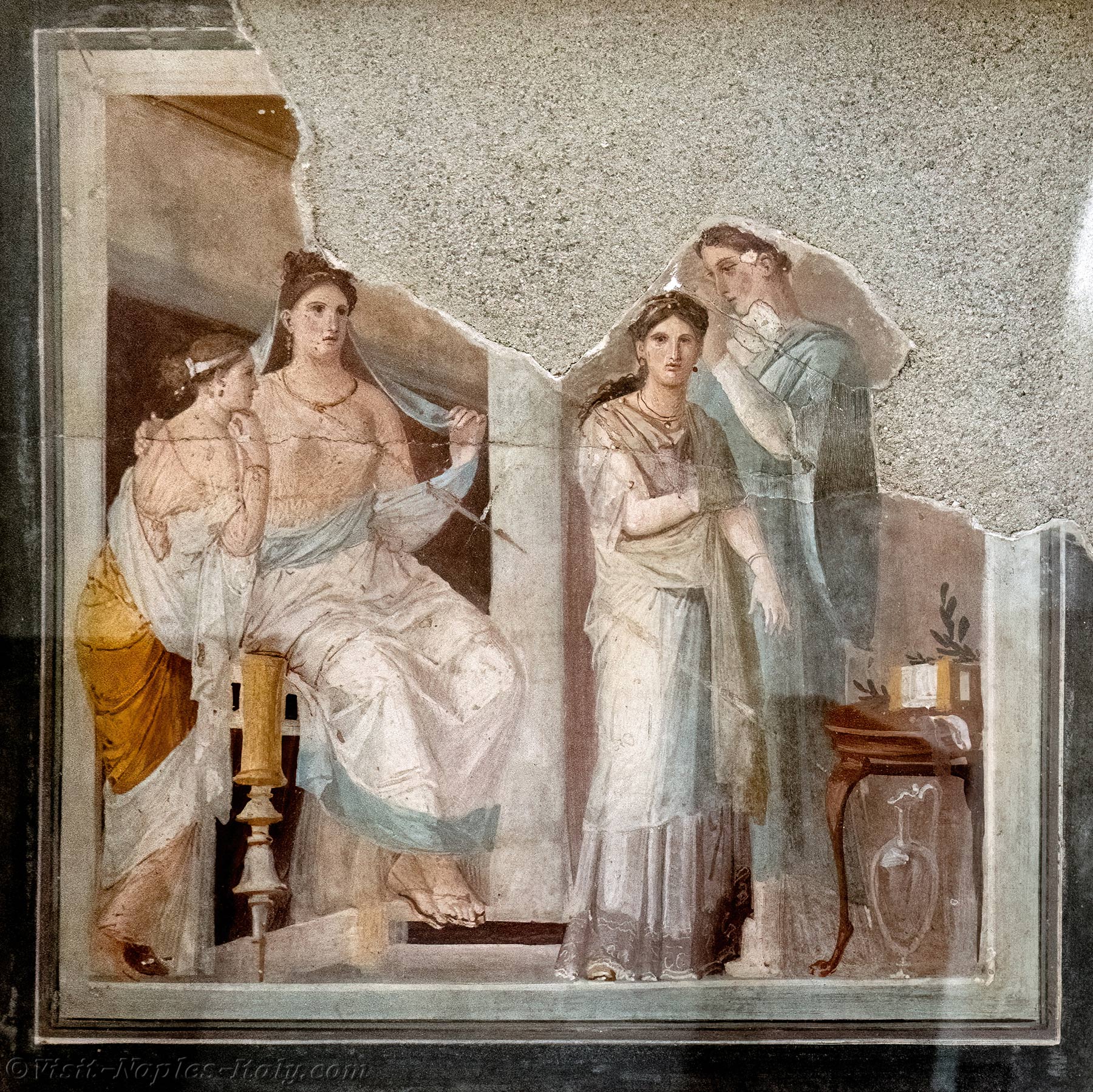
Dressing the priestess A woman, barefoot, is seated on a chair.
She delicately unzips her white garment edged in blue, revealing her breasts covered by a light transparent tunic.
A diadem adorns her hair and earrings, as does her necklace with a set stone emphasising her high social status.
Her right hand rests on the back of a young girl leaning over her seat, evoking the Greek muse of eloquence, Polymnia, her hand is placed under her chin.
She is dressed sumptuously.
In the centre, a young woman is looking at us, her long hair is adorned with a diadem and she is wearing a necklace with a stone as well as a two-stranded bracelet.
Idyllic and sacred landscape, Pompeii
Fresco - Water-based pigments on Coating (120 × 80 cm) 25-45 AD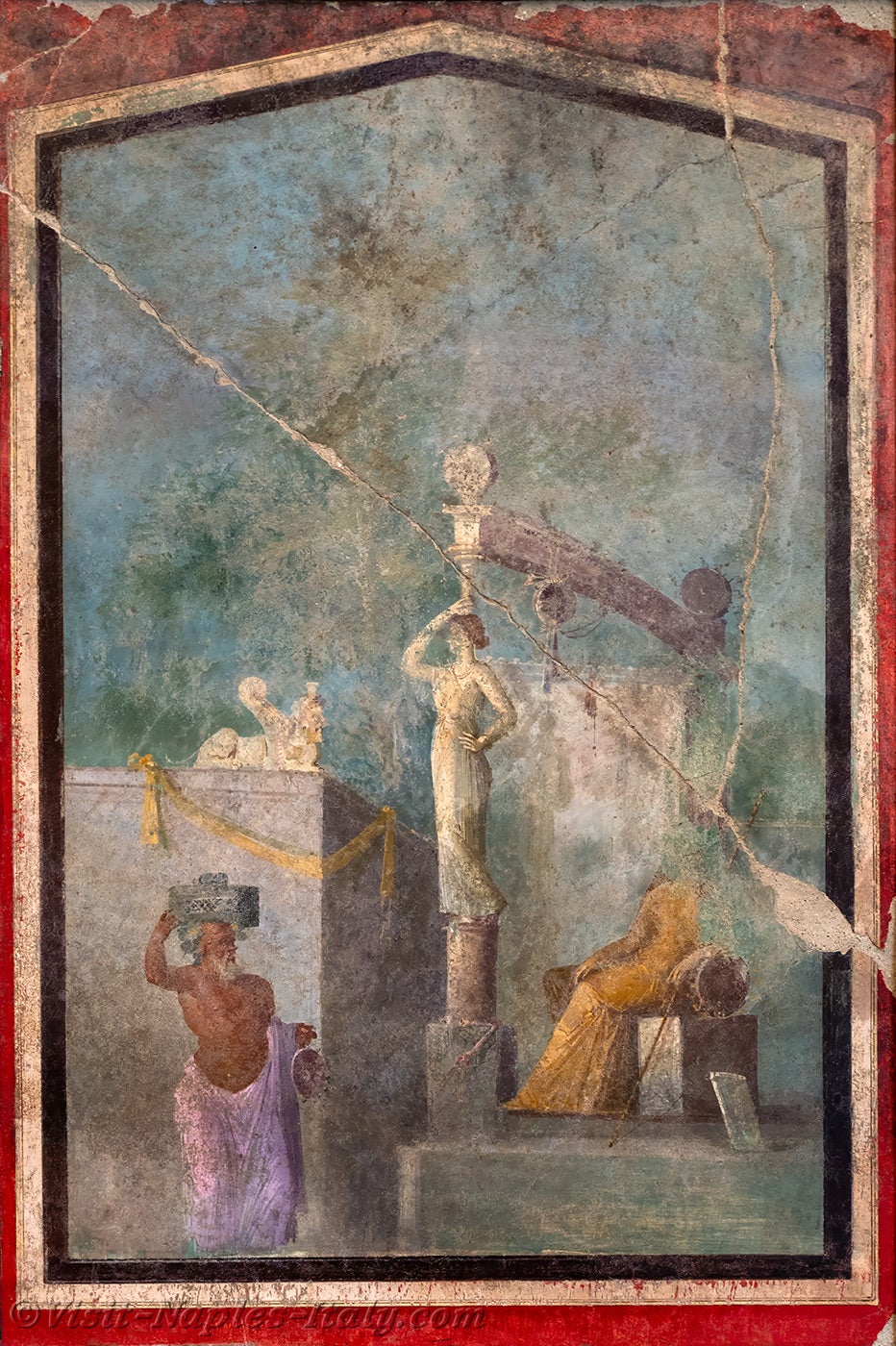
Idyllic and sacred landscape This idyllic and sacred scene represents a sanctuary seemingly dedicated to Cybele, the Great Mother, the Mother of the Gods or the Great Goddess.
Cybele was associated with nature and fertility, not only in human beings, but also in deities, animals and plants.
The goddess is seated on her throne, holding a sceptre in her left hand and clad in a yellow ochre chiton, the long tunic worn by the Greeks.
In front of her, a cariatid supports a column resting on her head with one hand, while the other is posed on her waist.
In front of this caryatid rises a sacred enclosure at the corner of which is a human-headed sphinx.
At the foot of this sacred enclosure, an old bearded Silenus carries a cist, a wicker basket, on his head.
This cist probably contains offerings that he is bringing to the goddess Cybele.
This Silenus is clad in a simple loincloth coloured light mauve.
The Judgement of Solomon, Pompeii, Casa del Medico
Fresco - Water-based pigments on Coating (55 × 164 cm) AD 55-79This fresco ironically parodies the biblical story of the “Judgement of Solomon”, taken from the Tanakh, the Hebrew Bible.
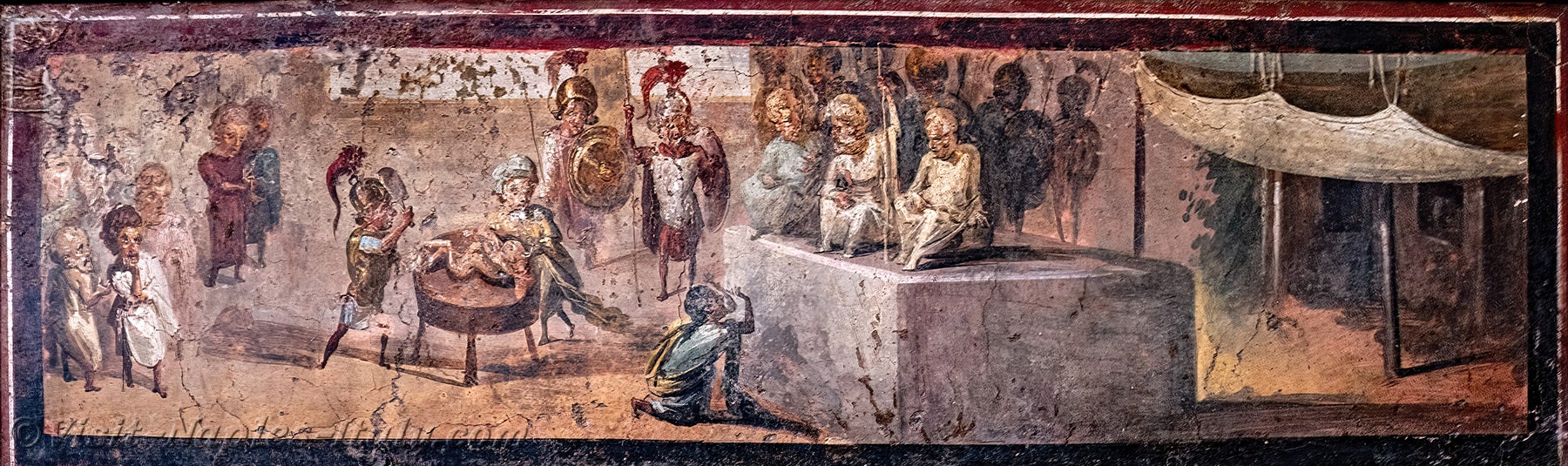
The Judgement of Solomon It is thought that this humorous interpretation was inspired by the Alexandrian culture, which opposed the predominance of the city's Jewish community at the same time.
At first glance, all the elements of the Judgement of Solomon are to be found here: Solomon is seated on a dais facing a round table on which is the child held by its presumed mother, and a Roman soldier is ready to cut it in two with a large cleaver.
But we also realise that the artist has completely revised the scene: he has replaced all the characters with pygmies !
Lares gods and snakes, Pompeii
Fresco - Water-based pigments on Coating (128 × 183 cm) 55-79 ADThe fresco is divided into two areas on top of each other.
The upper section shows, symmetrically two Lares gods, one at each end.
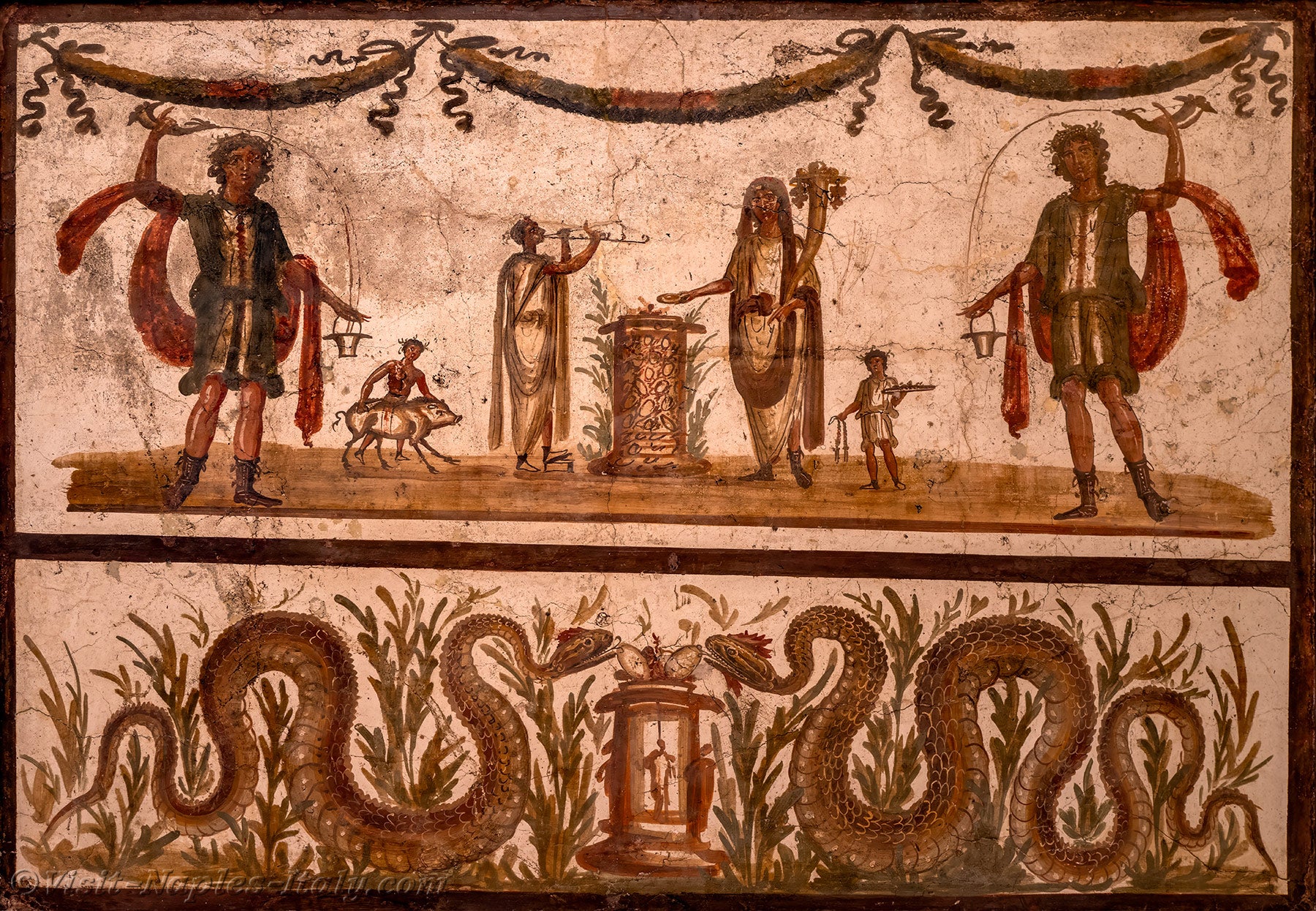
Lares and snakes They are clad in short tunics that show their legs and knees.
They both hold above their heads a wine rhyton, from which a stream flows into a small silver vessel, the Situla, which they hold in the other hand.
In the centre stands a marble column, the altar of sacrifice.
To the right of this altar is the genius of the family, holding a large horn of plenty in one hand and accomplishing a sacrifice with the other.
A pig is about to be sacrificed on the altar while a musician takes part in this sacred ceremony by playing a double flute.
In the lower section, we see two large snakes, which are the protective genies of the house where the fresco is located.
They frame an altar on which two eggs and wafers are placed in offering for their protection.
Sanctuary with caryatids, Herculaneum, Augusteum
Fresco - Water-based pigments on Coating - AD 45-79This fresco, discovered in the Augusteum at Herculaneum, depicts the top of the pediment of a sanctuary with caryatids.
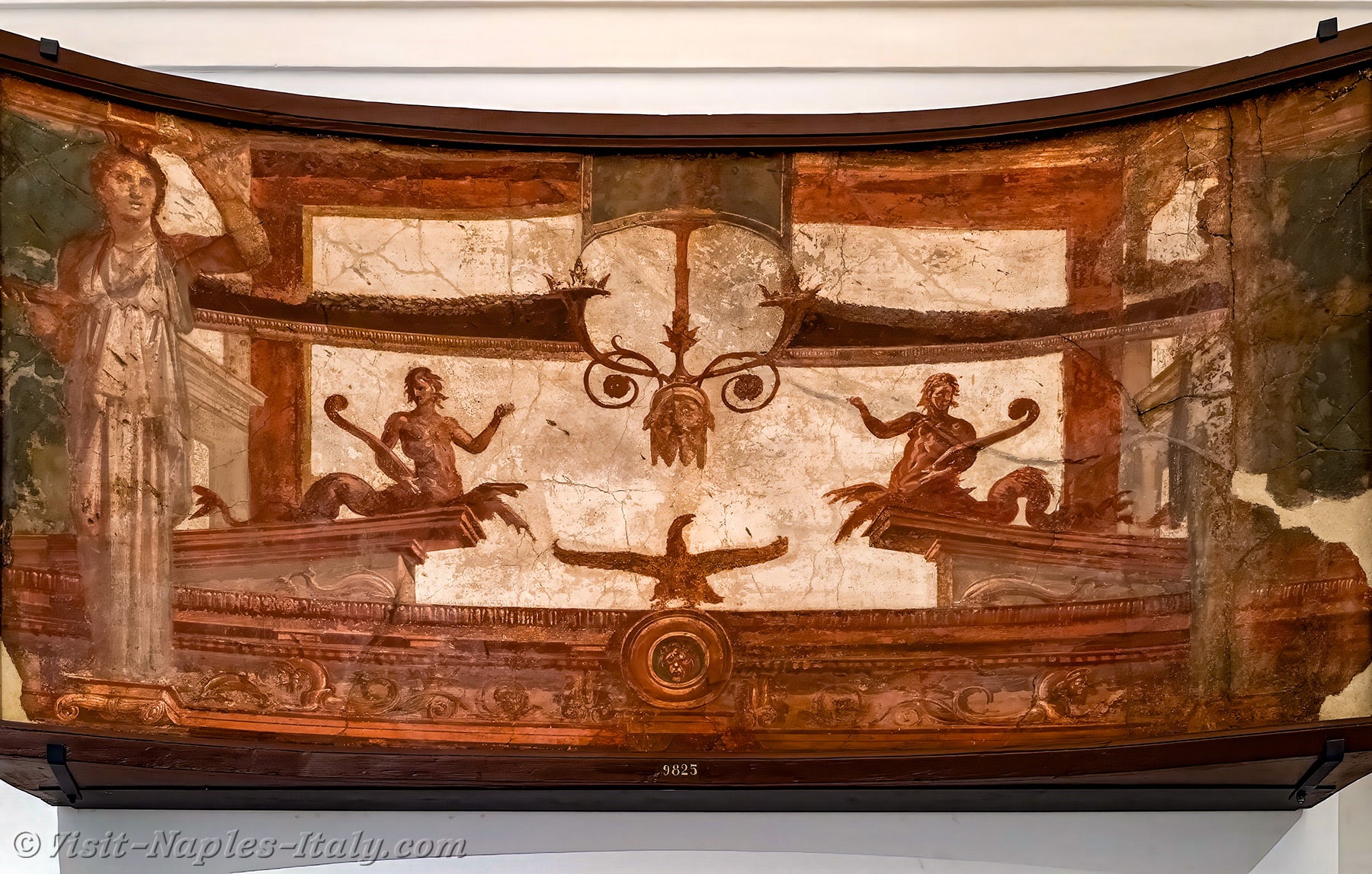
Sanctuary with caryatids Two caryatids each supporting a column on their heads stand on either side.
Although the caryatid on the right is barely visible, the one on the left is perfectly preserved.
She holds in one hand the column above her and, in the other holds a platter containing an offering.
In the centre of the fresco is the head of a bearded Silenus, and on either side of him are depicted river divinities.
Below them, resting on the top of the lower frieze, on which other river deities can be seen, is an eagle with outstretched wings.
Niche from the Sacrarium, Pompeii, Praedia di Giulia Felice
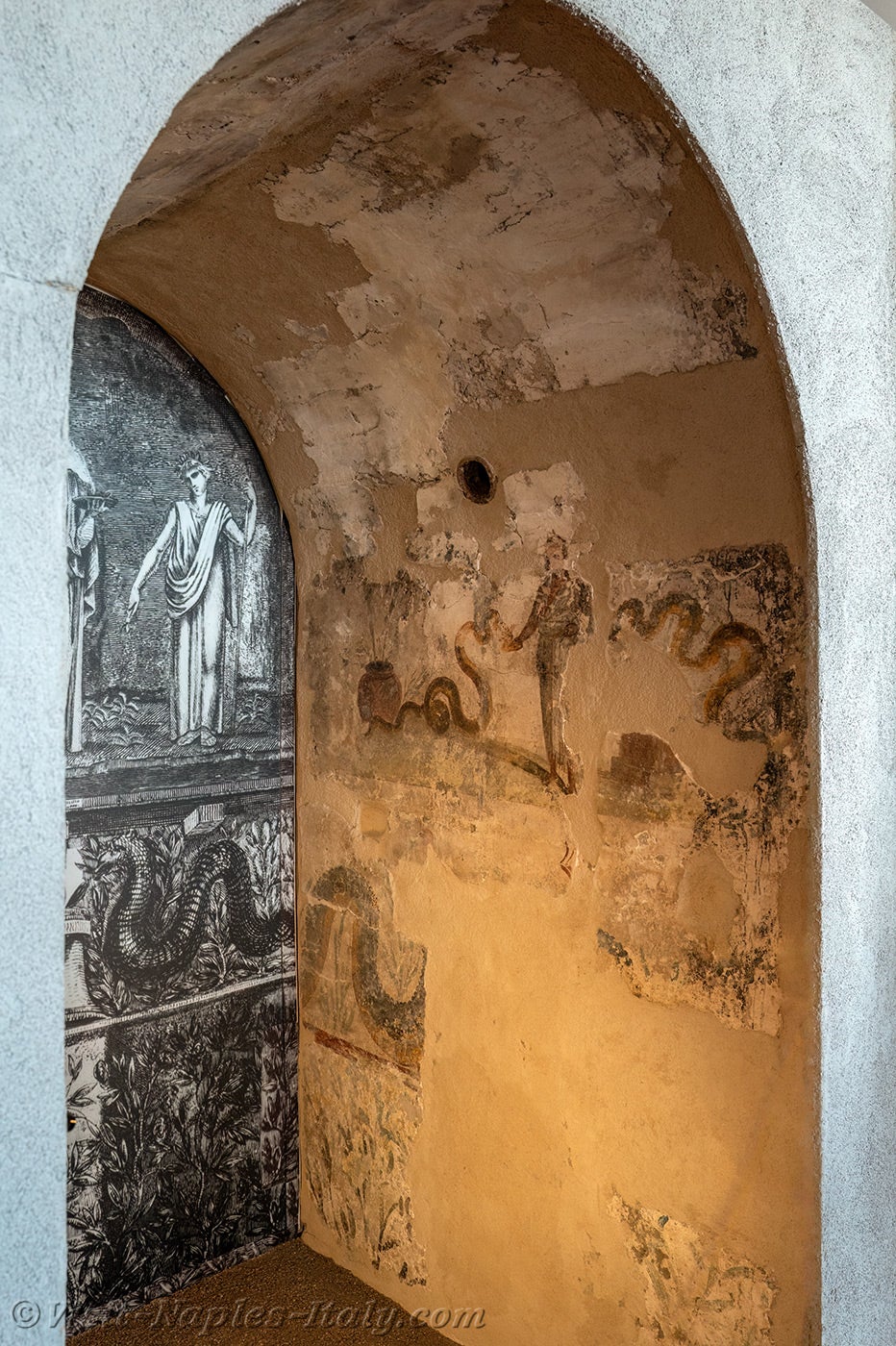
Sacrarium niche Fresco - Water-based pigments on Coating - 45-79 AD
The frescoes on these two walls were part of the Sacrarium of the Praedia di Giulia Felice in Pompeii.
As can be seen, this is a niche around two metres high in which the sacred vessels and objects of worship from the household were kept.
On the right wall is a god Lare surrounded by the family's protective genies, represented in the form of serpents.
Beneath this rather damaged part of the fresco, part of the body of another snake can be seen.
On the left wall, the serpent barely visible at the bottom of the previous fresco is clearly better preserved here.
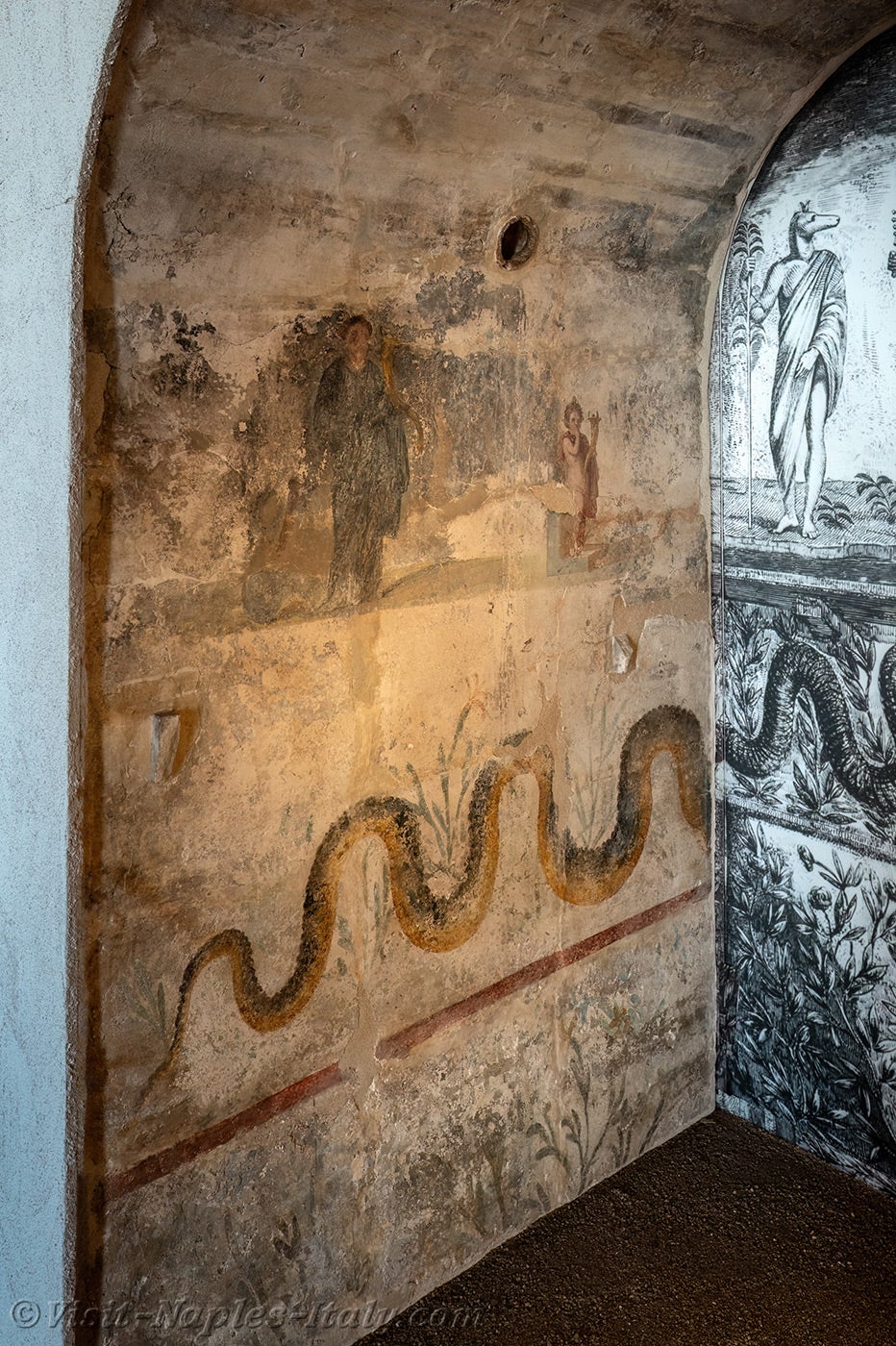
Sacrarium niche Which makes it clear that this visible part is only the beginning of its body, the head of said sacred snake appearing in the central wall at the back of the Sacrarium, here reproduced in black and white.
At the very bottom of this wall are represented roseaux or herbes hautes.
At the top is a god Lare.
He is holding a horn of plenty in his hand.
A little faun is depicted on the right.
He is also holding a cornucopia.
He is holding his right index finger to his lips.
Young Camillus, Herculaneum
Fresco - Water-based pigments on Coating - 45-79 AD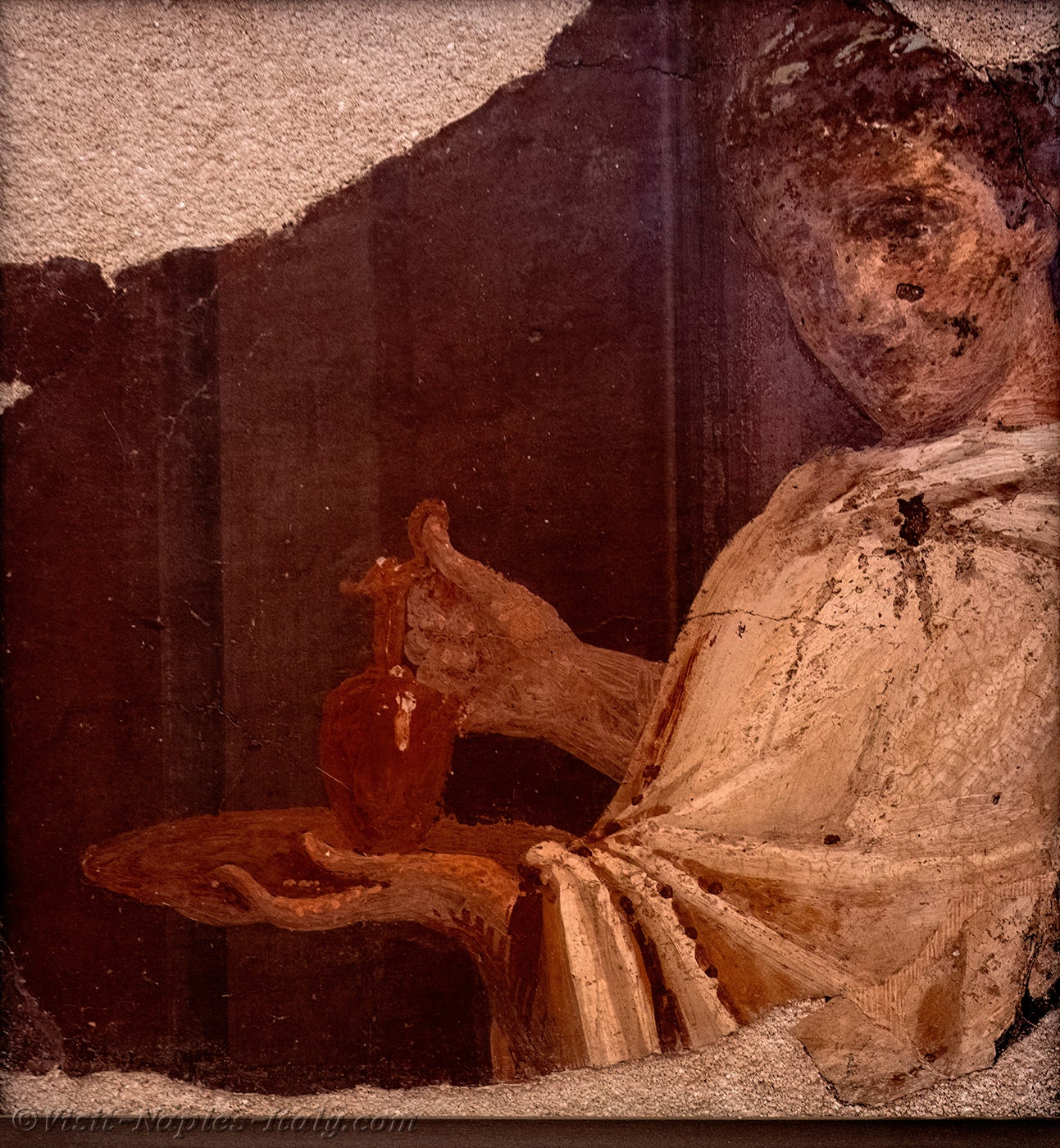
Young Camillus This fresco from Herculaneum depicts a young Camillus.
The Camillus (in Latin) was the young man who assisted the priest when making offerings to the divinity.
Camillus were chosen from among young men and women who had not yet reached puberty.
They were often the children of the priests themselves.
Finally, to be chosen as a Camillus, it was imperative to be beautiful or handsome.
The Camillus depicted in this fresco is holding a small jug placed on a platter intended for the priest.
On remarquera aussi qu’une couronne de lierre ceint sa chevelure.
Religion Dionysus | Isis
Frescoes Mythology | Portraits | Life Leisure | Animals | Religion | Landscapes | Decoration
Artworks Sculptures | Frescoes | Eroticism
MANN Artworks Schedule Tickets Location | Authorizations
Back to Top of Page