

Royal Artworks Schedule Tickets Location | Authorizations
Art History | Staircase | Ambassadors | Captain | Anterooms | Bedrooms | Flemish | Throne | Halls | Murat | Chapel | Theatre | Nativity
HHistory of the Royal Palace of Naples in Italy
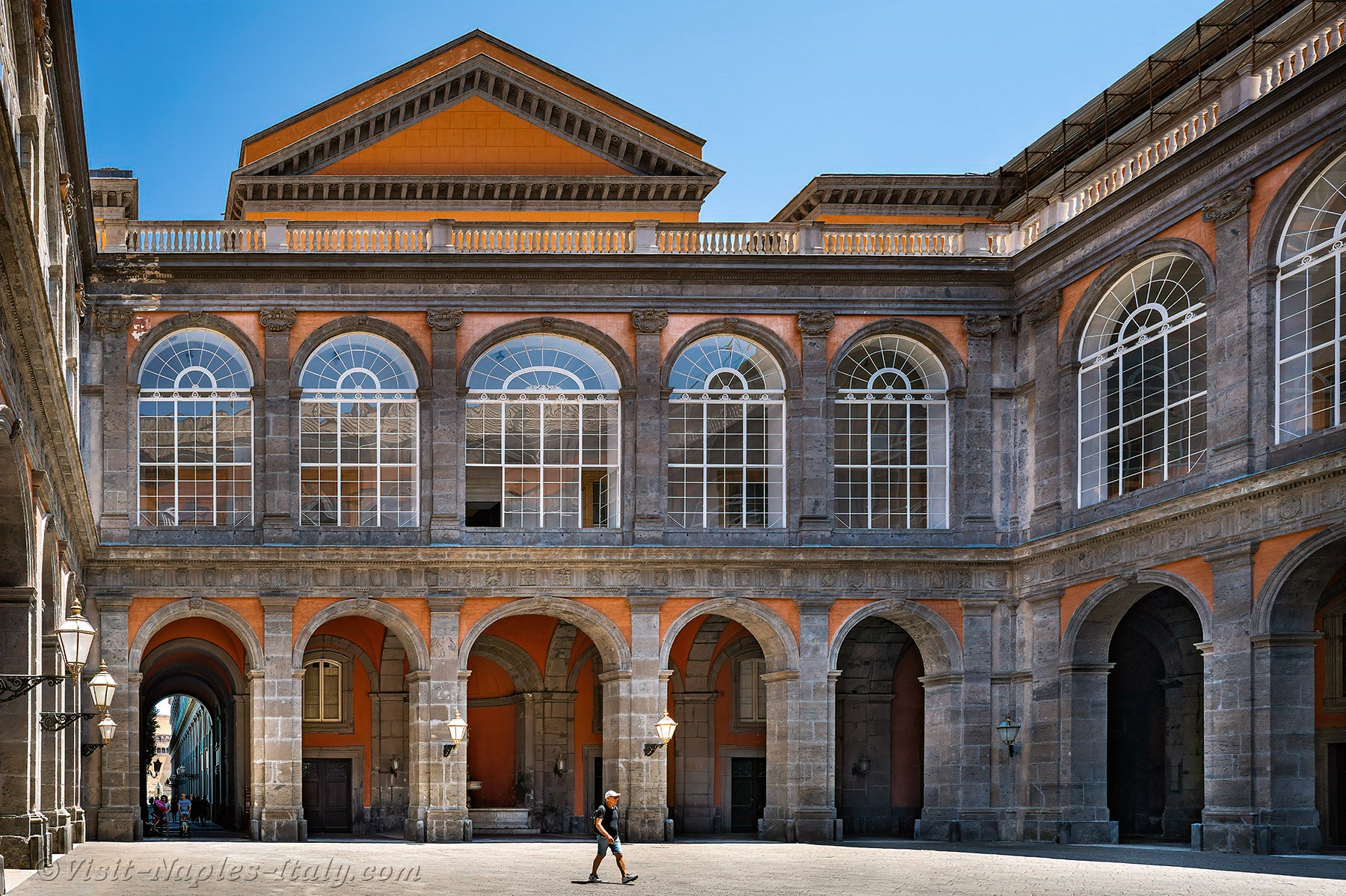
Inner courtyard of the Palais Royal In 1600, the viceroy Don Ferrante Fernando Ruiz de Castro y Andrada commissioned the Roman architect Domenico Fontana to design the current royal palace.
By 1612, the king’s nephew, Filiberto of Savoy, was already able to stay in this new palace during his visit to Naples.
In 1616, the top floor was ready for occupation and the palace was completed in 1631.
In 1644, work began on the construction of the magnificent royal Chapel.
Finally, the construction of the impressive grand staircase of the palace began in 1651 and was completed in 1666.
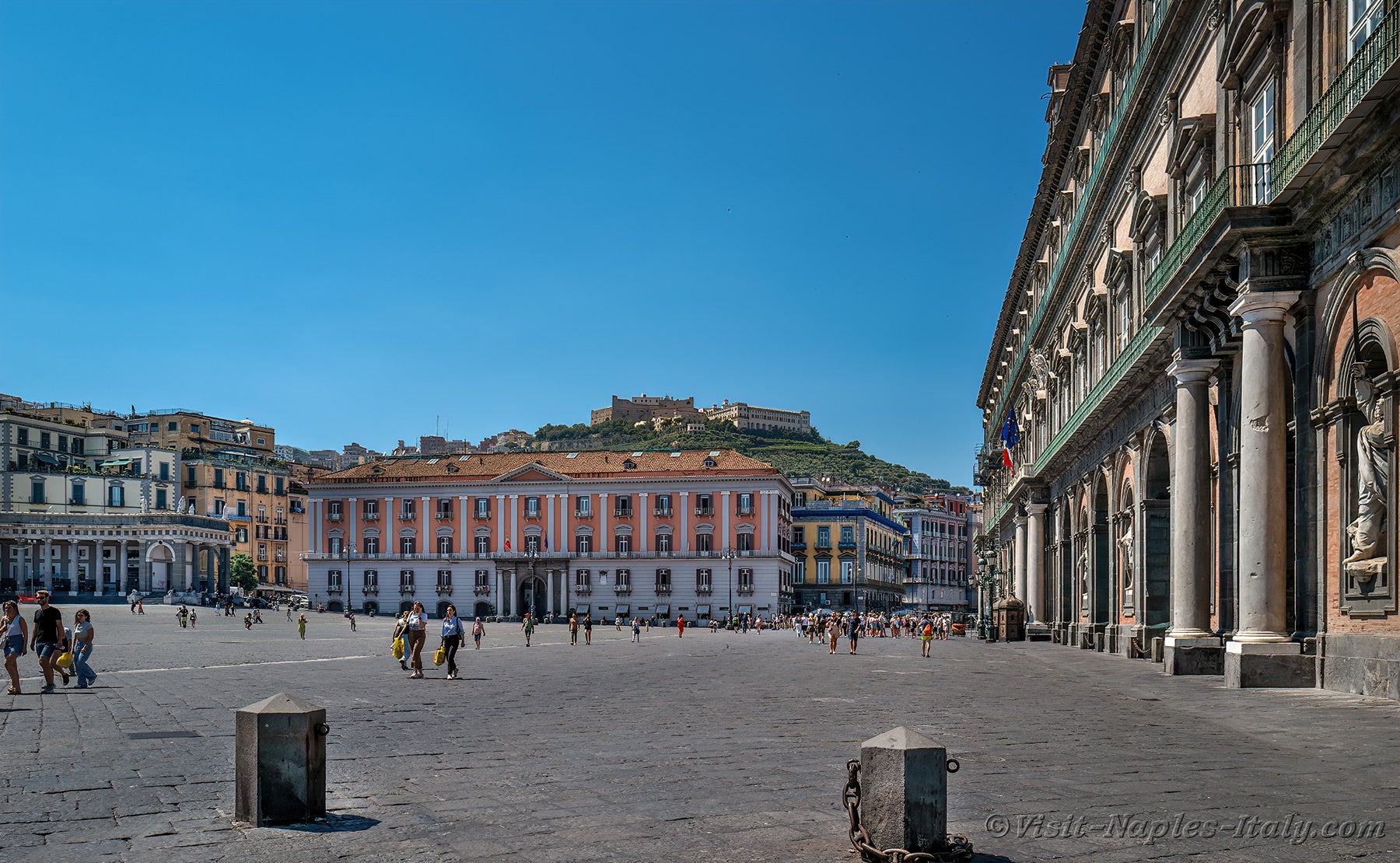
Plebiscito Square and the Royal Palace The Spanish were driven out in July 1707 following the victory of the Austrian Imperial Army led by Count Daun, who thus became the first Austrian viceroy of Naples.
Naples remained Austrian for some thirty years.
On 10 May 1734, the Austrians were in turn driven out by Charles of Bourbon, who chose Naples as the capital of the Kingdom of Naples and Sicily.
On his arrival in Naples, Charles of Bourbon found the royal residence in a state of near-abandonment and wished to restore it, whilst planning to build a new palace on the hill of Capodimonte, which has since become the Capodimonte Art Museum in Naples.
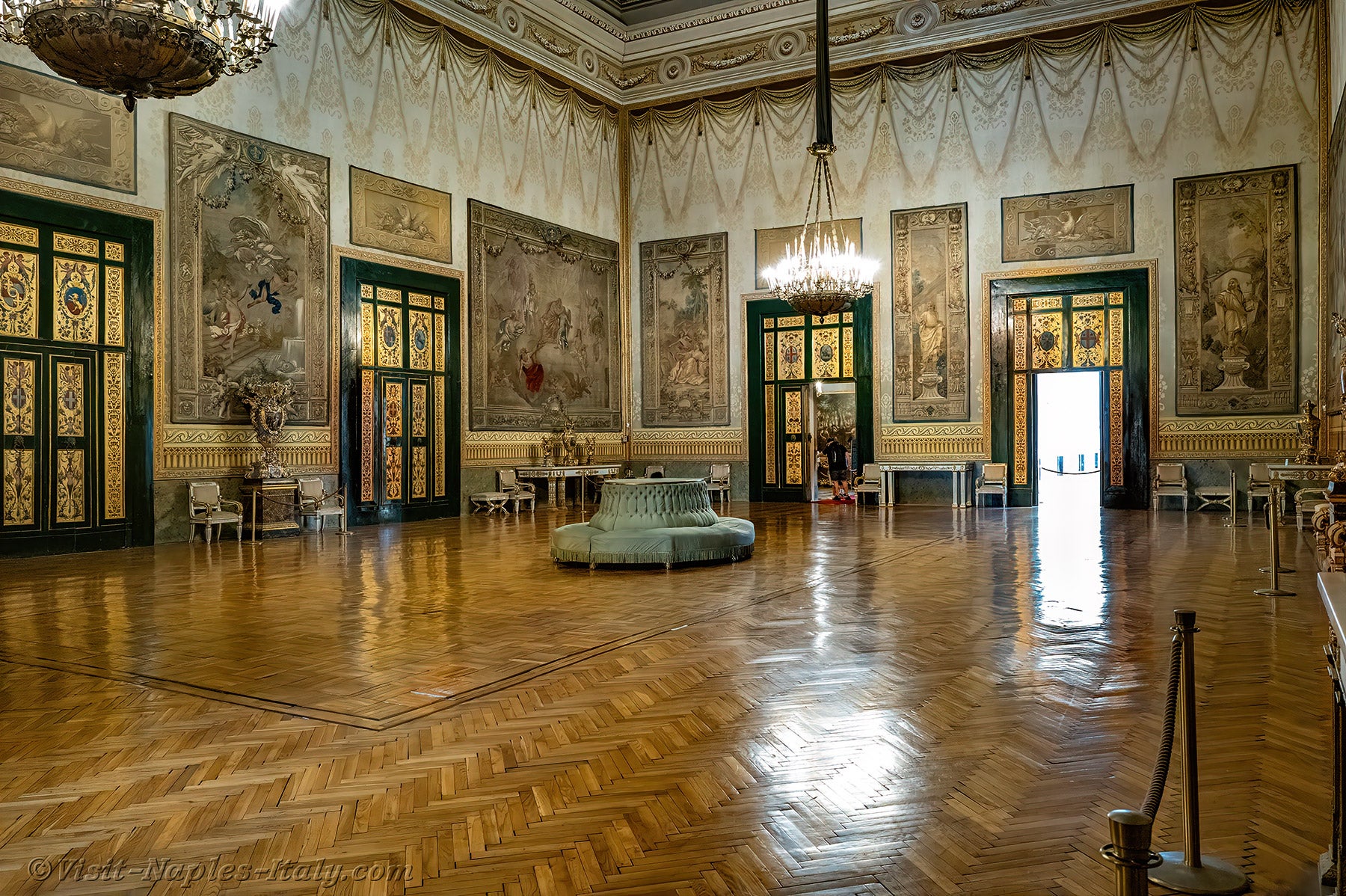
Hercules' Hall This was because Charles of Bourbon wanted a palace surrounded by gardens, like that of Versailles, which was unfortunately impossible in the urban setting of the royal palace built in 1600.
In 1754, the façade of the Royal Palace in Naples developed alarming cracks, and the architect Luigi Vanvitelli was commissioned to reinforce it.
The structural cracks in the façade of the Royal Palace in Naples were so severe that Vanvitelli decided to wall up some of the arches on the ground floor of the palace to avoid having to rebuild the entire façade, which he believed was in danger of collapsing.
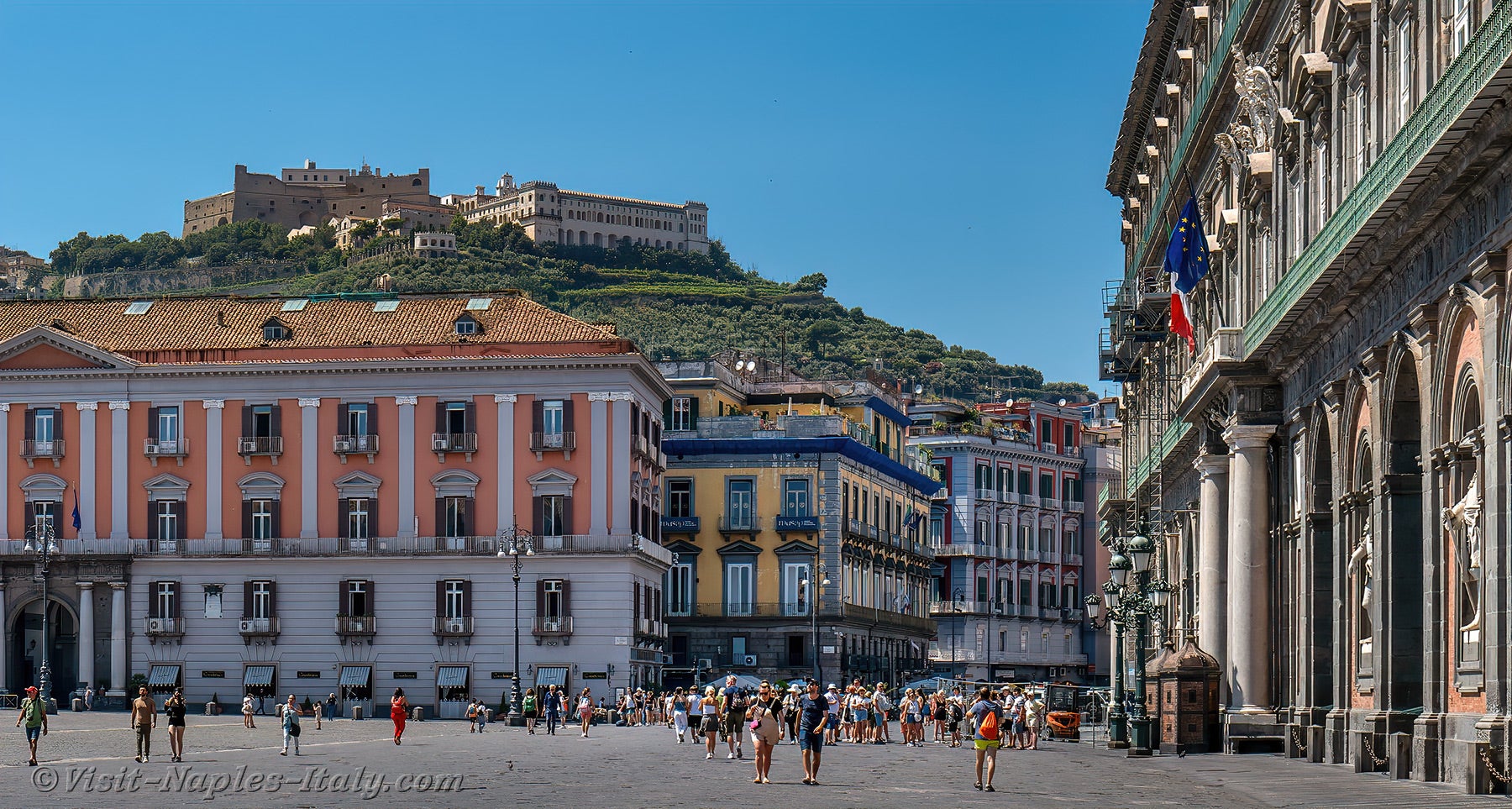
Plebiscito Square and the Royal Palace To prevent the ground floor from appearing too bulky, Luigi Vanvitelli decided to brick up every other arch, creating a niche at the same time to house a statue.
The arches that were not bricked up were instead closed off by high railings for security reasons.
Charles of Bourbon mistrusted the Neapolitan crowd; at the same time as the arches were bricked up and the grilles installed, he banned all festive and popular gatherings in the square situated in front of the palace.
The square was now used solely for military drills and parades.
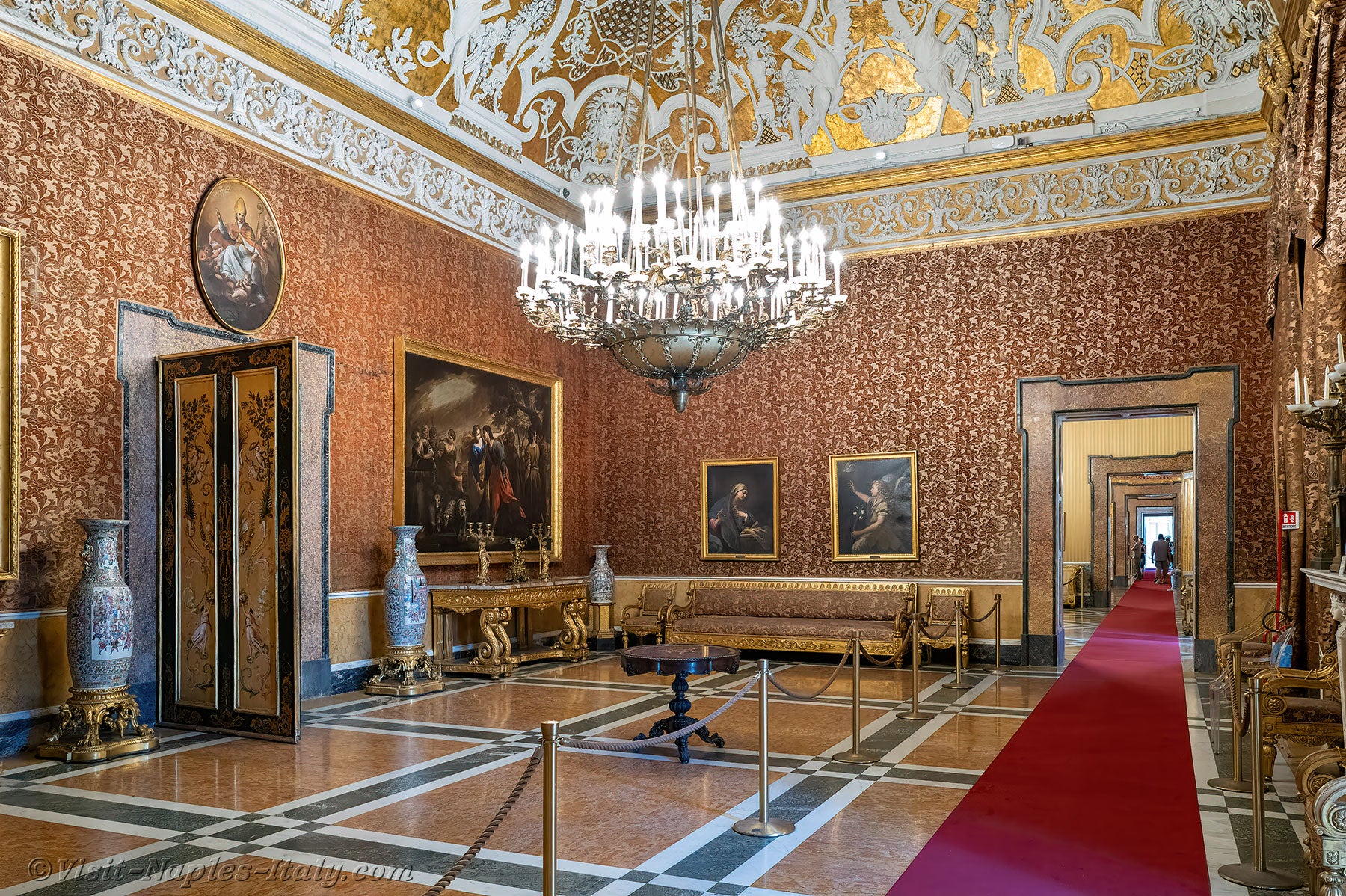
The Queen's Bedroom In February 1806, the Bourbon reign over Naples came to an end with the arrival of Napoleon’s troops, who had become King of Italy.
Napoleon appointed his brother Joseph Bonaparte as King of Naples; by 1808, Joseph had become the new King of Spain, leaving the throne to Joachim Murat, who thus became King of Naples until 1815.
Joachim Murat and his wife Caroline Bonaparte, Napoleon I’s youngest sister, decided to redecorate the interiors of a large part of the palace in the Neoclassical style, in keeping with the tastes of the time.
To complete this new décor, they had furniture and decorative objects brought over from the Tuileries.
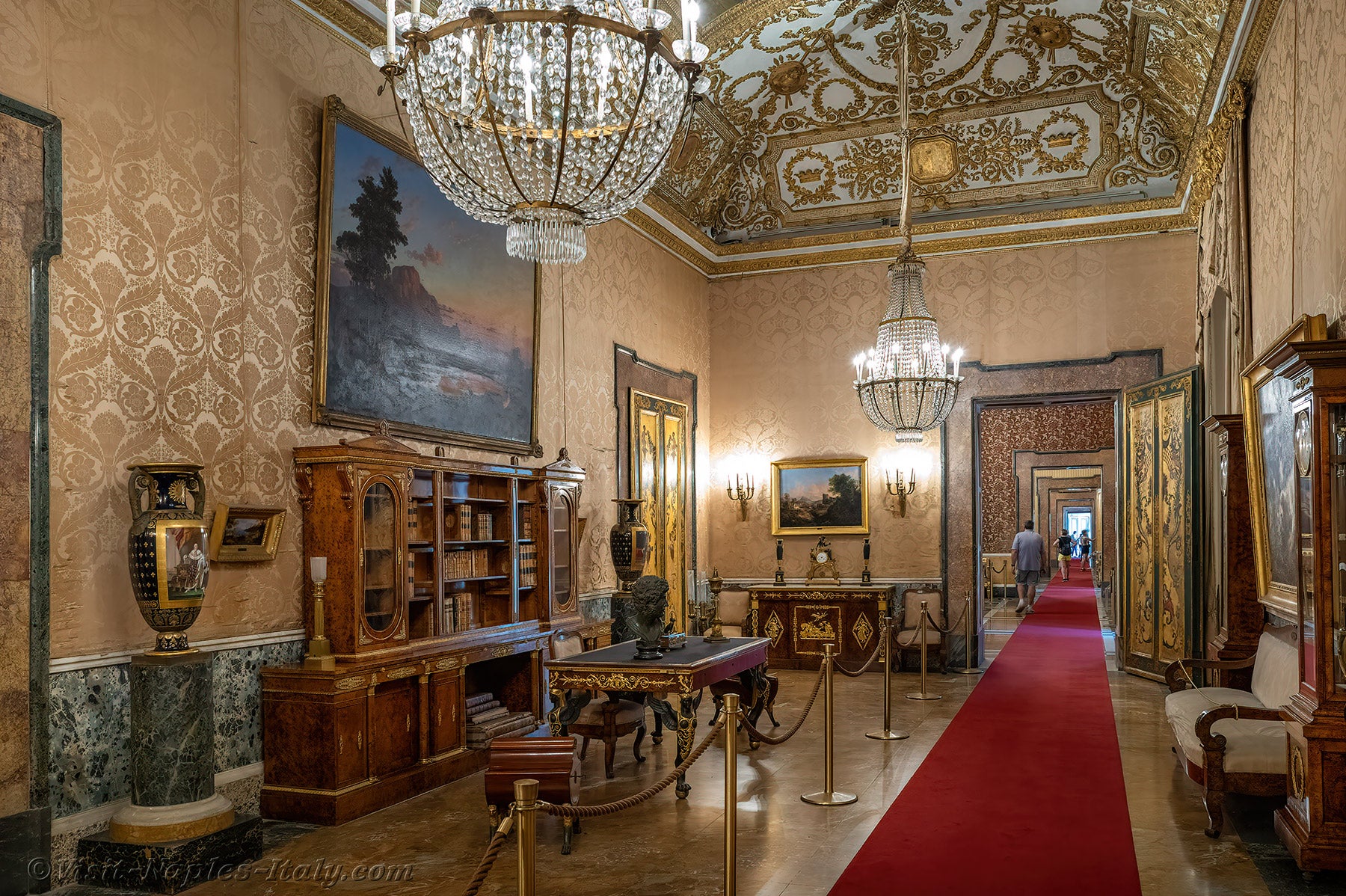
King Joachim Murat’s office In 1809, Joachim Murat planned to redevelop the large square in front of the royal palace.
Work on the square’s redevelopment had barely begun when the Bourbons regained power in 1815 and captured Murat, who was sentenced to death and shot in October 1815.
Ferdinand of Bourbon returned to the throne with the title of King of the Two Sicilies.
He had been King of Naples from 1759 to January 1799, then from June 1799 to January 1806 before becoming king again.
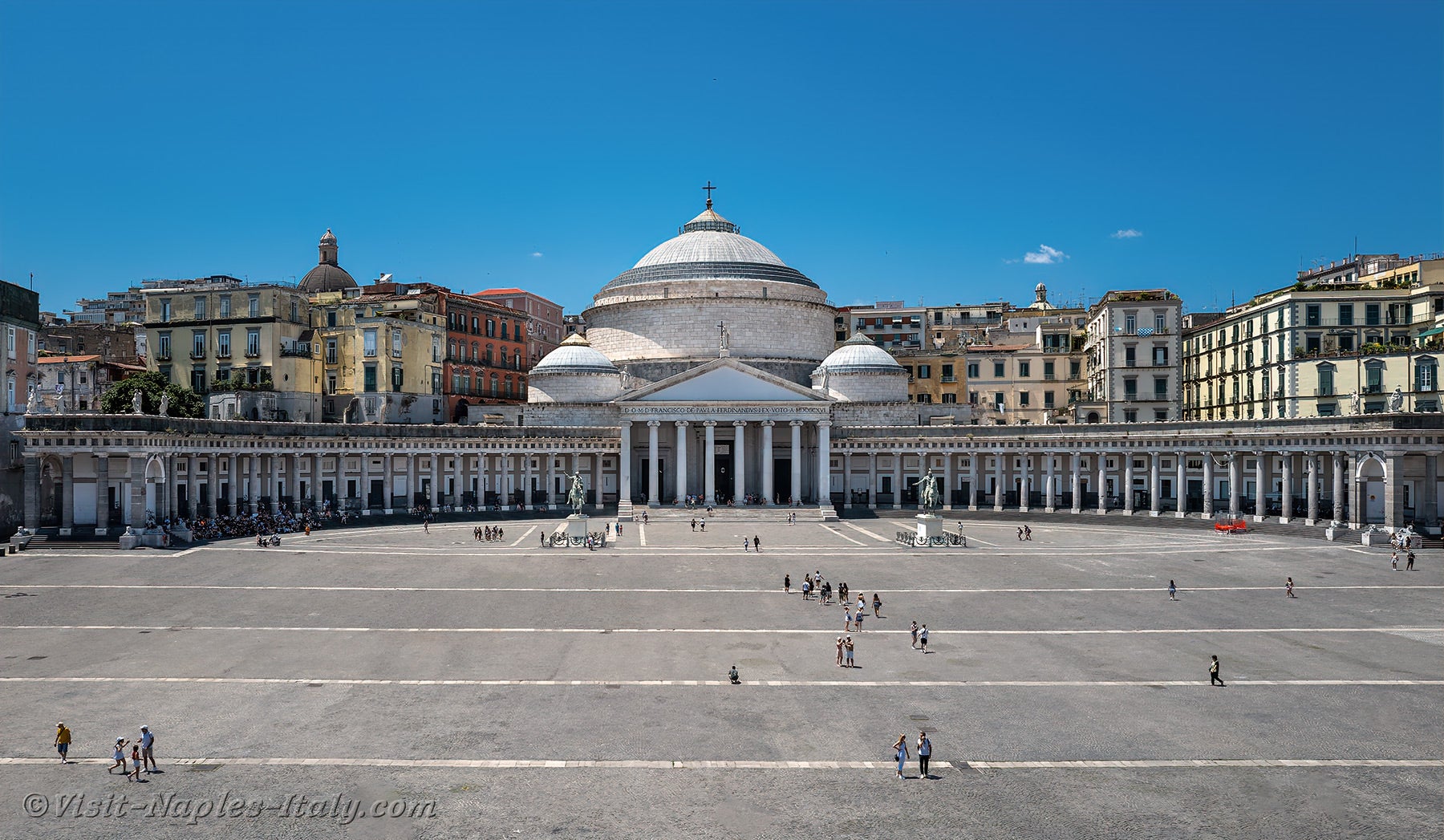
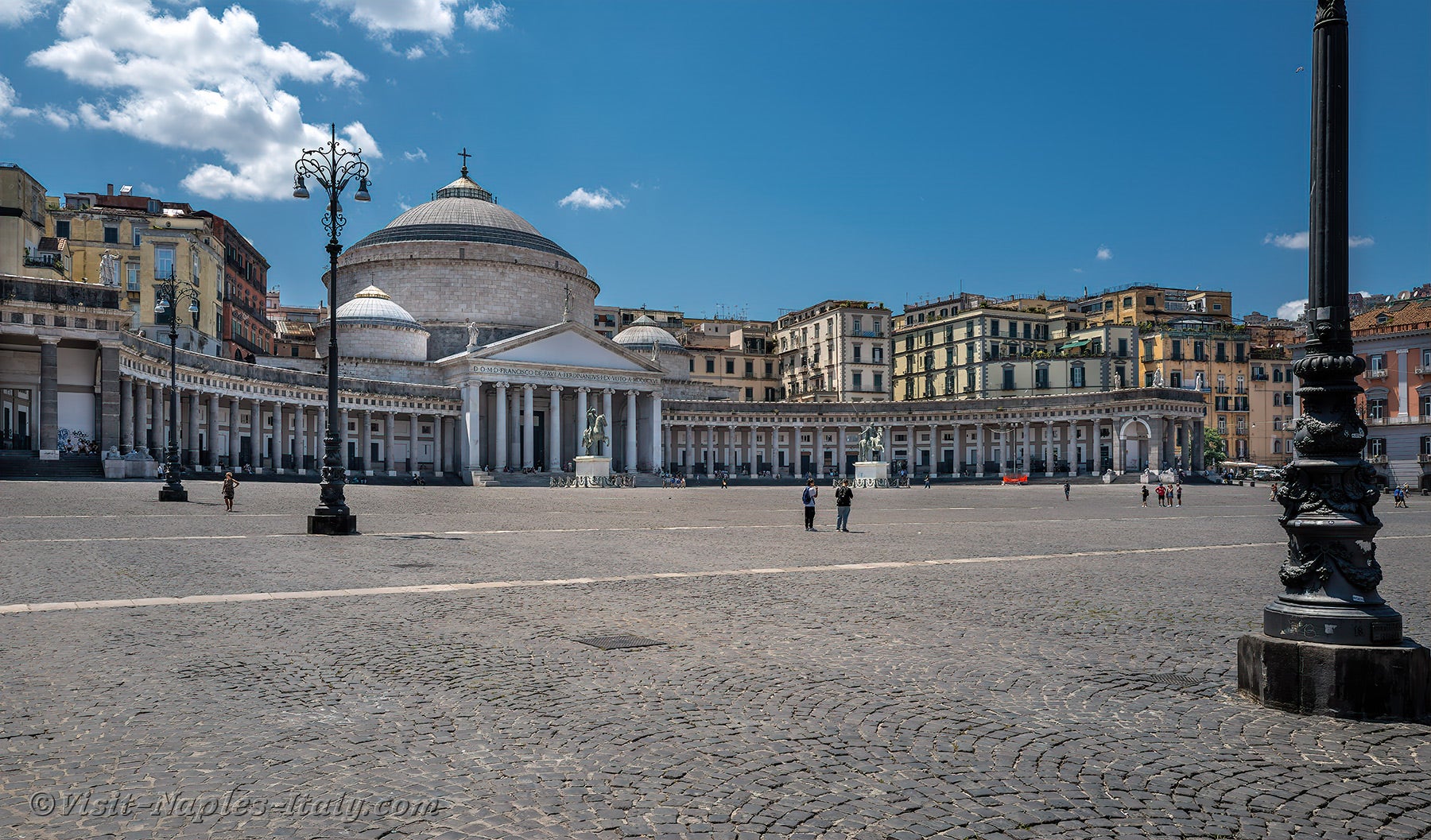
Plebiscito Square in Naples He did, however, adopt Joachim Murat’s idea of building a new square, but replaced the central, secular building that was to face the palace with a church, that of San Francesco di Paola.
The architect Pietro Bianchi was commissioned to build this church and the square.
Bianchi drew inspiration from Gian Lorenzo Bernini’s design for St Peter’s Square in Rome by positioning the Church of San Francesco di Paola at the centre of a semicircle bordered by a row of 42 tall columns, to which are added the six columns of the pronaos of the church.
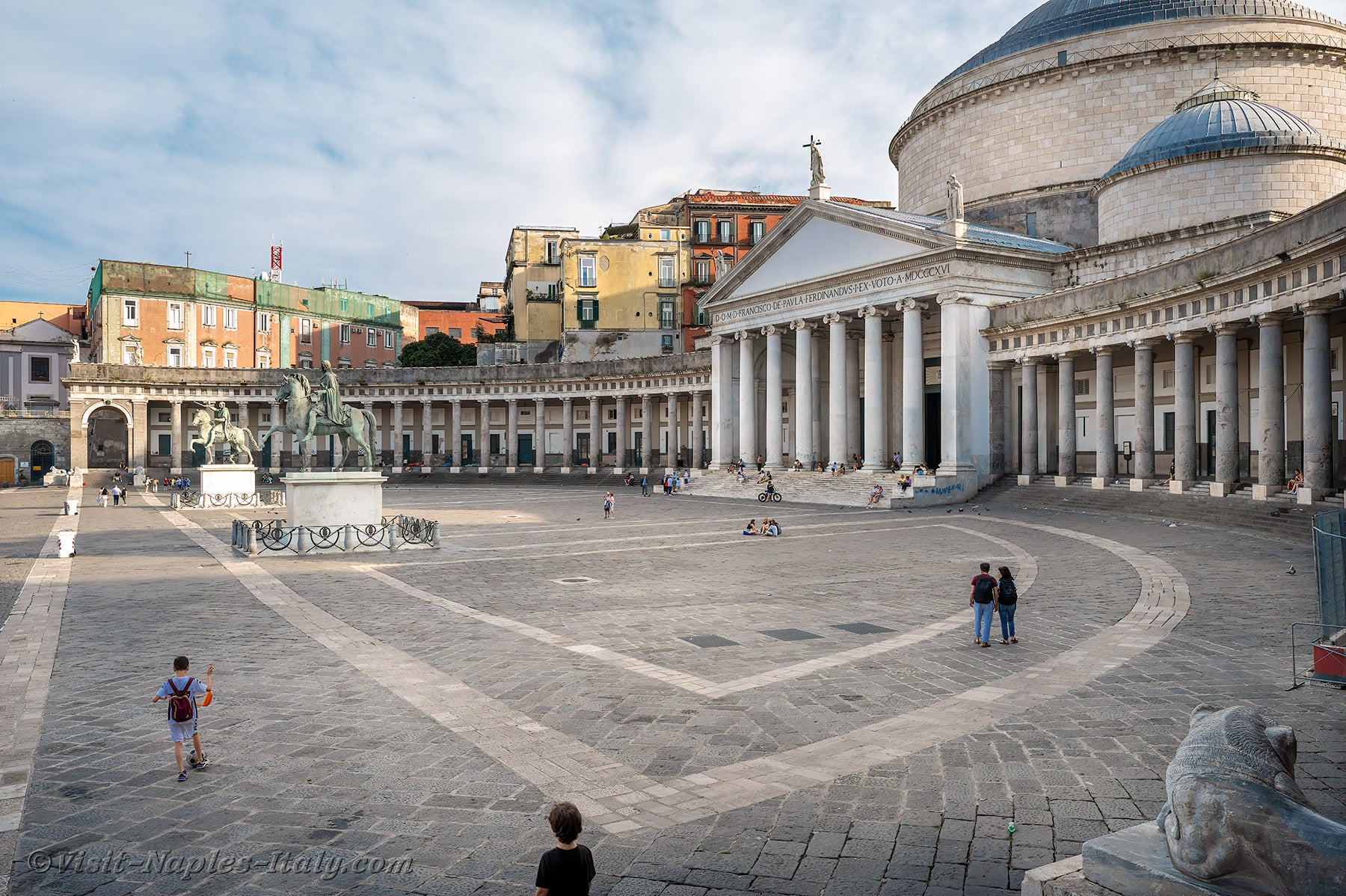
Plebiscito Square in Naples This square offers a magnificent view, covering an area of 25,000 square metres!
It was a magnificent architectural achievement by Bianchi; today, it is known as “Plebiscito Square” and is one of Naples’s landmarks, just as the Rialto Bridge is in Venice.
In 1888, King Umberto I of Italy decided to have eight marble statues of the most important kings of Naples installed in each of the niches on the ground floor of the façade, designed by Vanvitelli.
Plebiscito Square in Naples From left to right, the statue of Roger II of Hauteville (1095-1154), Norman King of Sicily, sculpted by Emilio Franceschi; that of Frederick II Hohenstaufen of Swabia (1194-1250) by Emmanuele Caggiano, the statue of Charles I of Anjou (1227-1285) by Tommaso Solari, that of Alfonso V of Aragon (1396-1458) sculpted by Achille d’Orsi, the statue of Charles II of Spain and also King of Naples under the title Charles V (1661-1700) sculpted to a design by Vincenzo Gemito, that of Charles III of Bourbon (1716-1788) by Raffaele Belliazzi, the statue of Joachim Murat (1767-1815) by Giambattista Amendola, and finally that of Victor Emmanuel II of Savoy (1820-1878) sculpted by Francesco Jerace.
King Victor Emmanuel III of Italy was born in this palace.
Art History | Staircase | Ambassadors | Captain | Anterooms | Bedrooms | Flemish | Throne | Halls | Murat | Chapel | Theatre | Nativity
Royal Artworks Schedule Tickets Location | Authorizations
Back to Top of Page