

MANN Artworks Schedule Tickets Location | Authorizations
Artworks Sculptures | Frescoes | Eroticism
Frescoes Mythology | Portraits | Life Leisure | Animals | Religion | Landscapes | Decoration
Religion Dionysus | Isis
The Religious Frescoes of the Cult of Dionysus at the Archaeological Museum of Naples in Italy
The cult of Dionysus is linked to wine and drunkenness, and Pompeii, where the culture of the vine was an important part of its prosperity, could only be indebted to this god.
The Greek god, Dionysus, was rechristened Bacchus among the Romans.
The drunkenness and pleasures that went with it meant that Dionysus was assimilated with feasting and games.
Add to this the bacchantes, the Silenus and the flute players who surround Dionysus in frenzied dances, and everything was in place to make him the god of debauchery and pleasure in all its forms.
Symbols of the cult of Dionysus, Pompeii, Praedia di Giulia Felice
Fresco - Water-based pigments on Coating (46 × 46 cm) 65-79 AD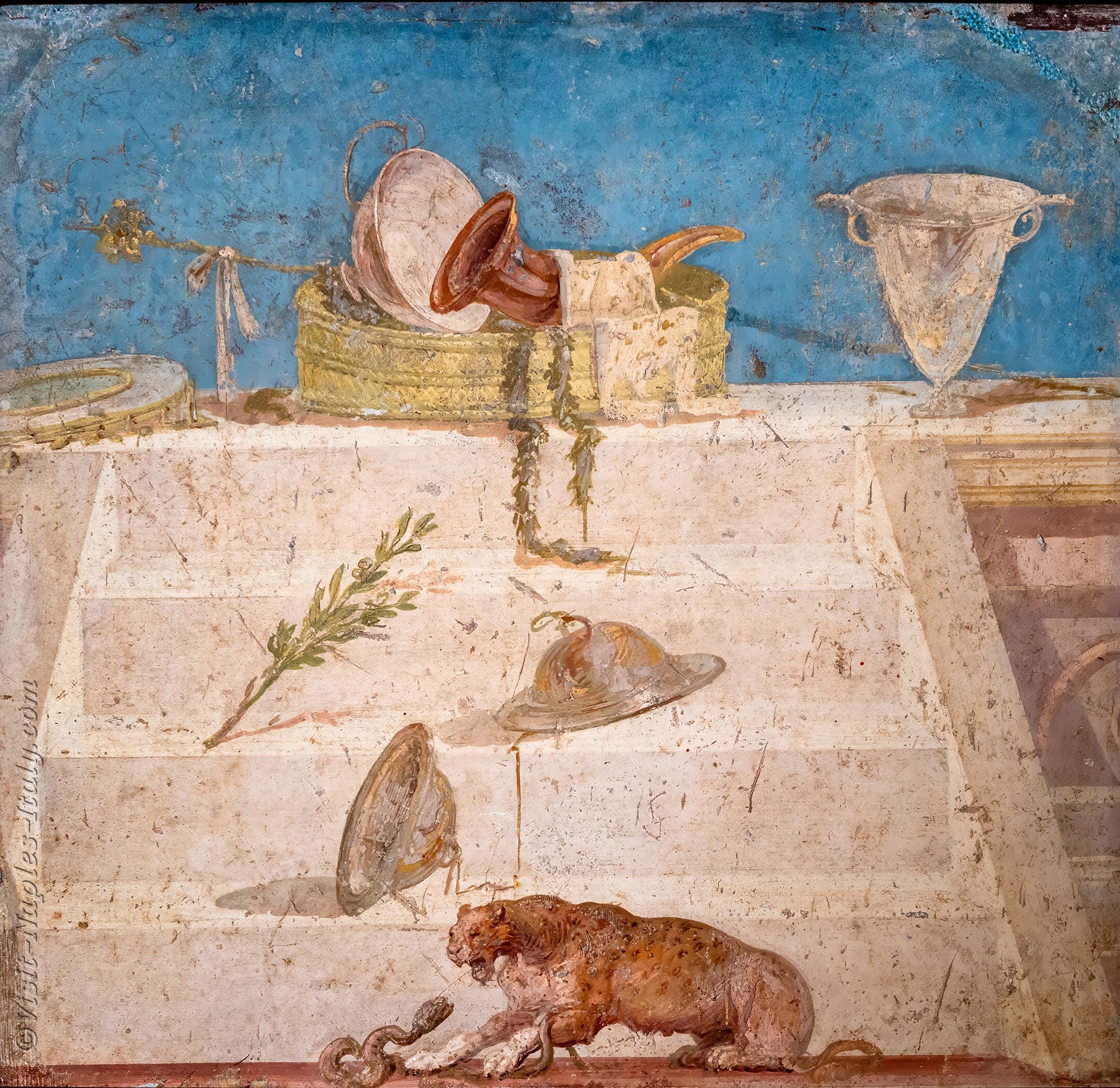
Symbols of the cult of Dionysus When this fresco was discovered, it was not built into the wall, but hooked onto it with an iron hook.
. This means that there had not yet been time to insert it into this wall at the time of the tragedy of Pompeii.
The most important element for its size is a small staircase with four steps at the top of which are the Symbols of the cult of Dionysus.
Firstly, the tambourine. First of all, the tambourine, which recalls the Dionysian dances.
At the centre is the cistus, a symbol of the cult of Dionysus. In the centre is the cist, a wicker basket in which we can see a second element referring to music and dance, a cornet with a panther skin, another Dionysian symbol.
Appropriately, and placed askew, there is also a wine goblet in the cist.
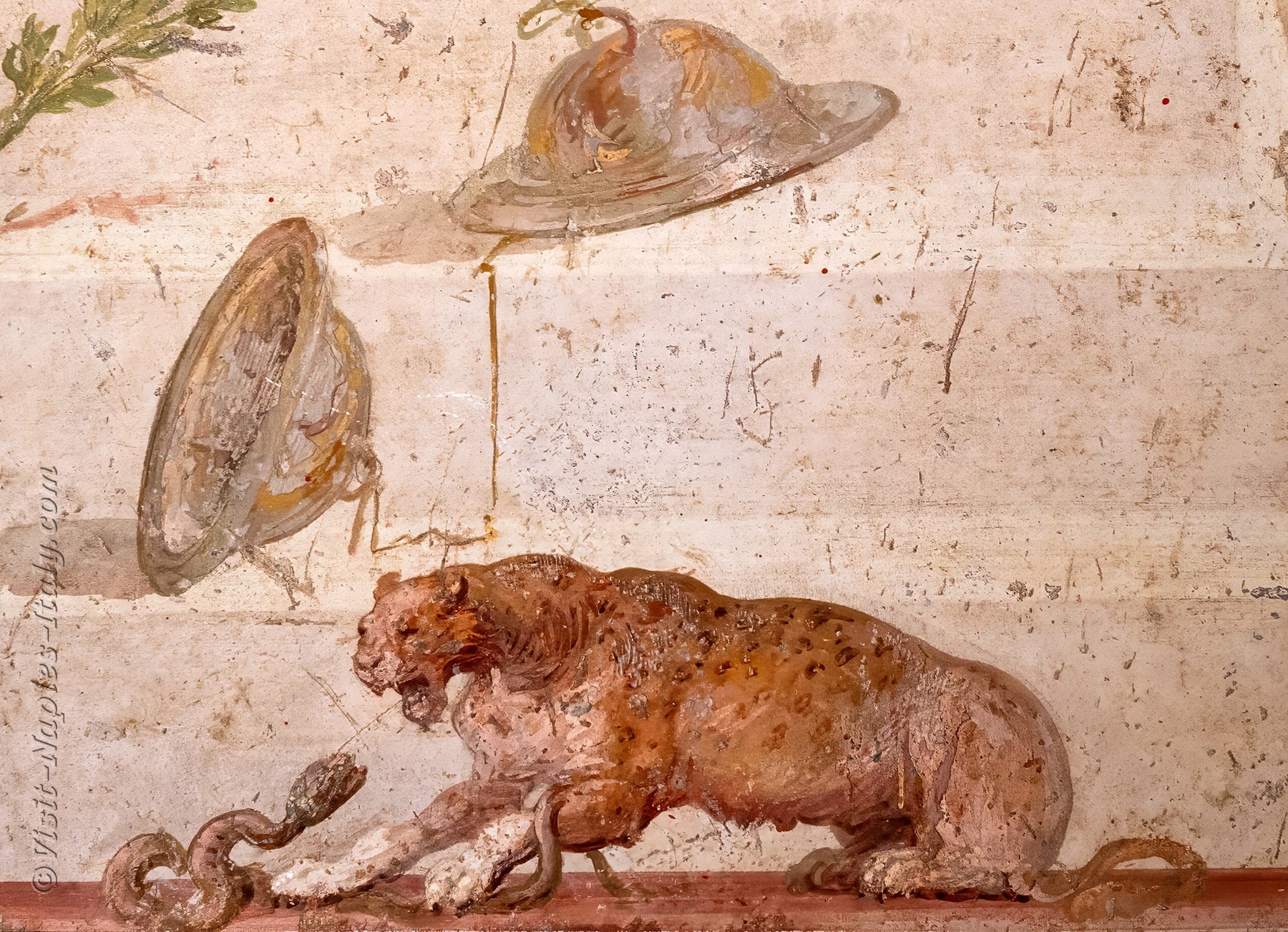
Symbols of the cult of Dionysus A long thyrsus, the attribute of Dionysus, ending in a pine cone sits on top of this basket and runs across the entire image to the right-hand edge of it.
Ribbons have been attached to the thyrsus.
A silver drinking glass, a skyphos, particularly tall, sits to the right of the cist.
On the steps, there is a laurel frame as well as a pair of cymbals, another reference to music.
Finally, at the very bottom of the staircase, the sacred animal of Dionysus, the panther, is attacking a snake, with its two legs holding the reptile.
Situla Dionysian vase, Boscoreale
Fresco - Water-based pigments on Coating (77 × 41 cm) 60 BC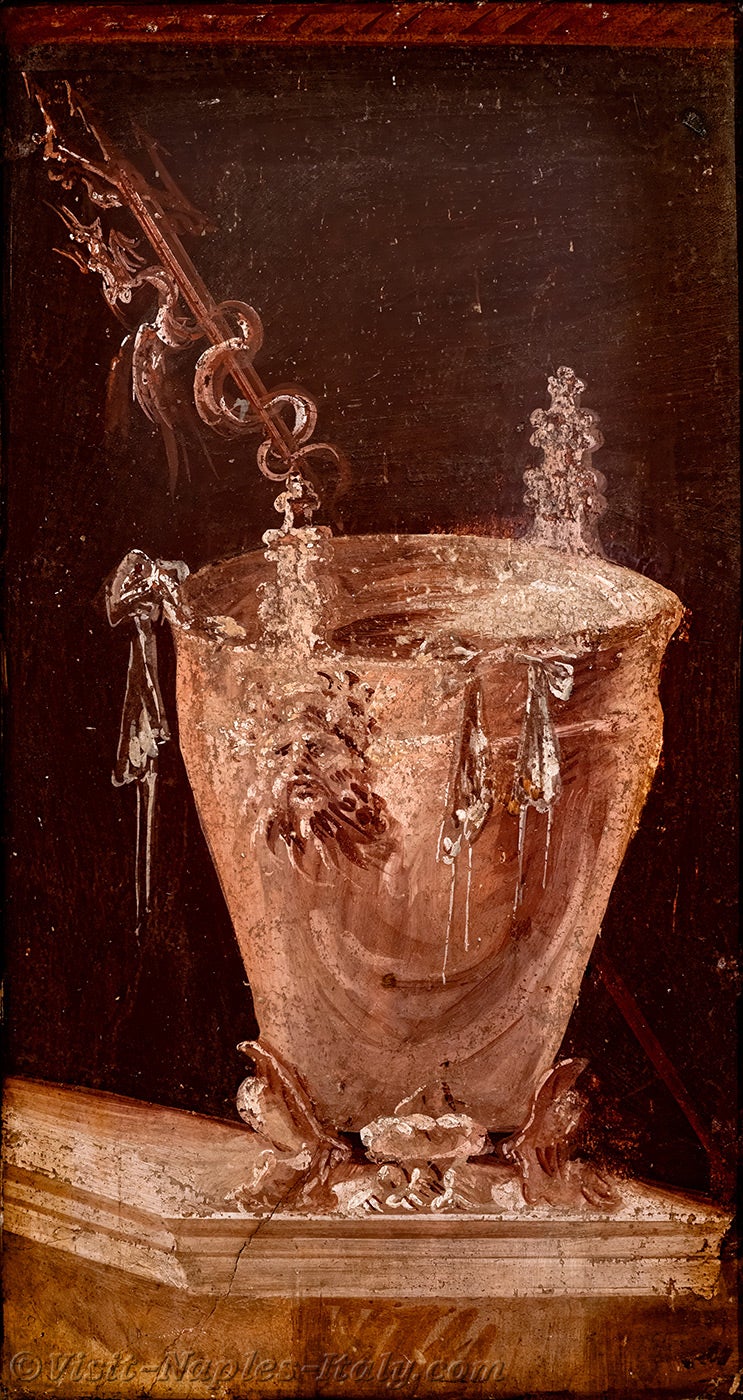
Situla Dionysian vase The fresco found at Boscoreale depicts a Situla, a vase forming part of the instruments of sacrifice in both the cult of Isis and that of Dionysus.
The Situla was also one of the attributes of the Bacchae and the Silenus.
This one is special in that it is not an element of worship, but one of the trophies that were offered as rewards to the winning athletes in sporting competitions.
The destination of this Situla is confirmed by the fact that it is represented on a podium, ready to be presented to the winner.
The feet of the Situla are made of panthers' paws.
. Bearded Silenus heads in relief decorate the handles of the vase.
The bandages of the victor have been hung on the rim of the Situla.
Behind the vase is a trident decorated with a fantastic animal reminiscent of a Draco, a dragon with the body of a snake.
Sacrifice to Dionysus, Pompeii, Insula Occidentalis
Fresco - Water-based pigments on Coating (81 × 62 cm) 40-30 BCThis fresco, discovered in Pompeii, depicts a cult scene dedicated to Dionysus.
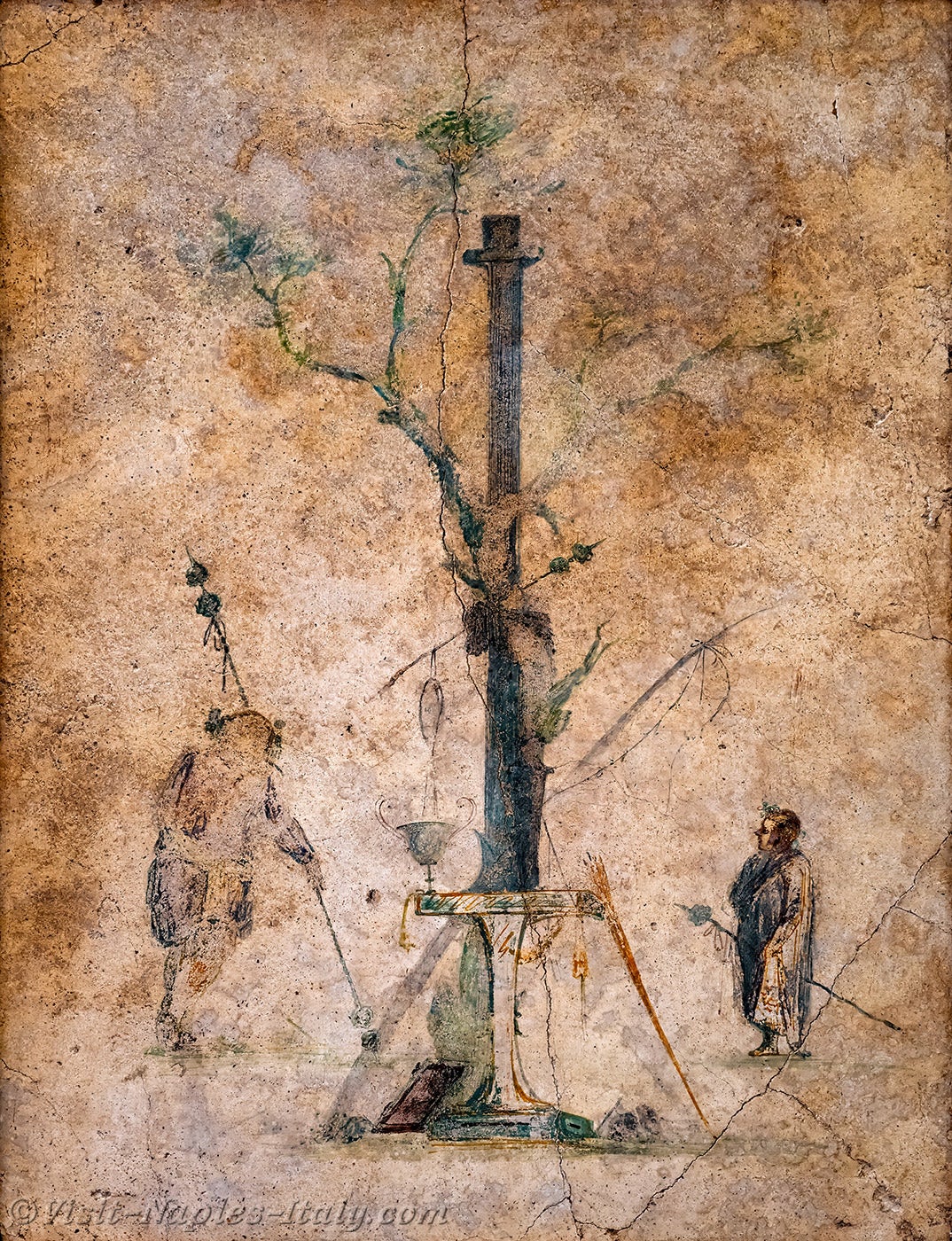
Sacrifice to Dionysus In the centre is a small altar behind which grows a sacred tree on which have been hung a thyrsus and a tambourine.
Behind the tree and against its trunk is a fluted wooden column. Behind the tree and against its trunk rises a fluted wooden column.
A canthara, a sacred vessel A canthar, a sacred vessel with long handles, stands on the altar.
The canthar is a large vase sacred containing wine.
On the right of the altar is a palm branch.
Two worshippers are depicted around the tree and column.
On the left, the taller of the two is wearing a long thyrsus and a knee-length tunic.
On the right, the second worshipper is a child. On the right the second worshipper is a child wearing an ivy crown and a long toga.
He is also holding a thyrse. He is also holding a thyrsus.
Religion Dionysus | Isis
Frescoes Mythology | Portraits | Life Leisure | Animals | Religion | Landscapes | Decoration
Artworks Sculptures | Frescoes | Eroticism
MANN Artworks Schedule Tickets Location | Authorizations
Back to Top of Page