

MANN Artworks Schedule Tickets Location | Authorizations
Artworks Sculptures | Frescoes | Eroticism
Frescoes Mythology | Portraits | Life Leisure | Animals | Religion | Landscapes | Decoration
Religion Dionysus | Isis
Religious Frescoes from the Cult of Isis in Pompeii and Herculaneum at the Archaeological Museum of Naples, Italy
Priests and Priestesses of Isis, Stabiae, Villa di Arianna
Fresco - Water-based pigments on coating (21 × 57 cm) 1-50 ADThese five small panels depict two Isiac priestesses and three Isiac priests wearing long beards.
The foreheads of the five officiants are encircled by a gold diadem with a frontal Uræus.
The Uræus was originally associated with the pharaohs, symbolising their protective power.
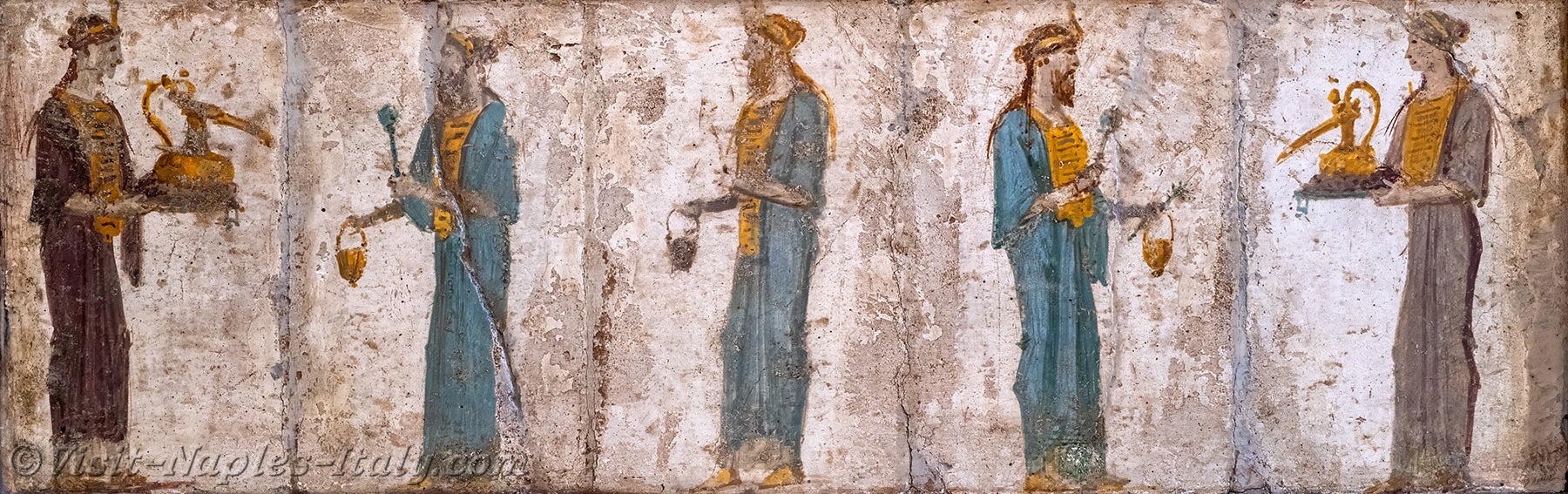
Isiac Priests and Priestesses It was incorporated into the cult of Isis, where the goddess herself becomes a serpent, protecting the sun god Ra from Apophis.
The priests’ robes are turquoise in colour and reach down to their feet.
Those of the priestesses, the hierodules, wear mauve-coloured garments.
The three priests and the two priestesses wear large, long pectorals adorned with precious stones.
Each priest holds a censer and a small Situla. In the cult of Isis, the Situla is a vessel containing the divine principle and refers to both the waters of the Nile and Osiris.
It is therefore a source of life and occupies the foremost place in Isis-related ceremonies.
Each priestess holds a tray with a crown of roses upon which rests a golden hydria. The hydria is a water vessel and, in the cult of Isis, its place is as sacred as that of the Situla.
The Mystery of the Sacred Dance, Herculaneum
Fresco - Water-based pigments on Coating - 45-79 ADThe Egyptian god and pharaoh, Osiris, who symbolises the Sun, was murdered by his brother, Seth, and then cut into 14 pieces.
However, thanks to the ingenuity and perseverance of his sister-wife, Isis, symbolising the Moon, Osiris was brought back to life.
However, he was unable to resume his throne amongst men and he reigned over the underworld of the dead.
This fresco depicts the ceremony of the mysteries of Osiris, known as “Inventio Osiris” and more specifically “The mystery of the sacred dance”.
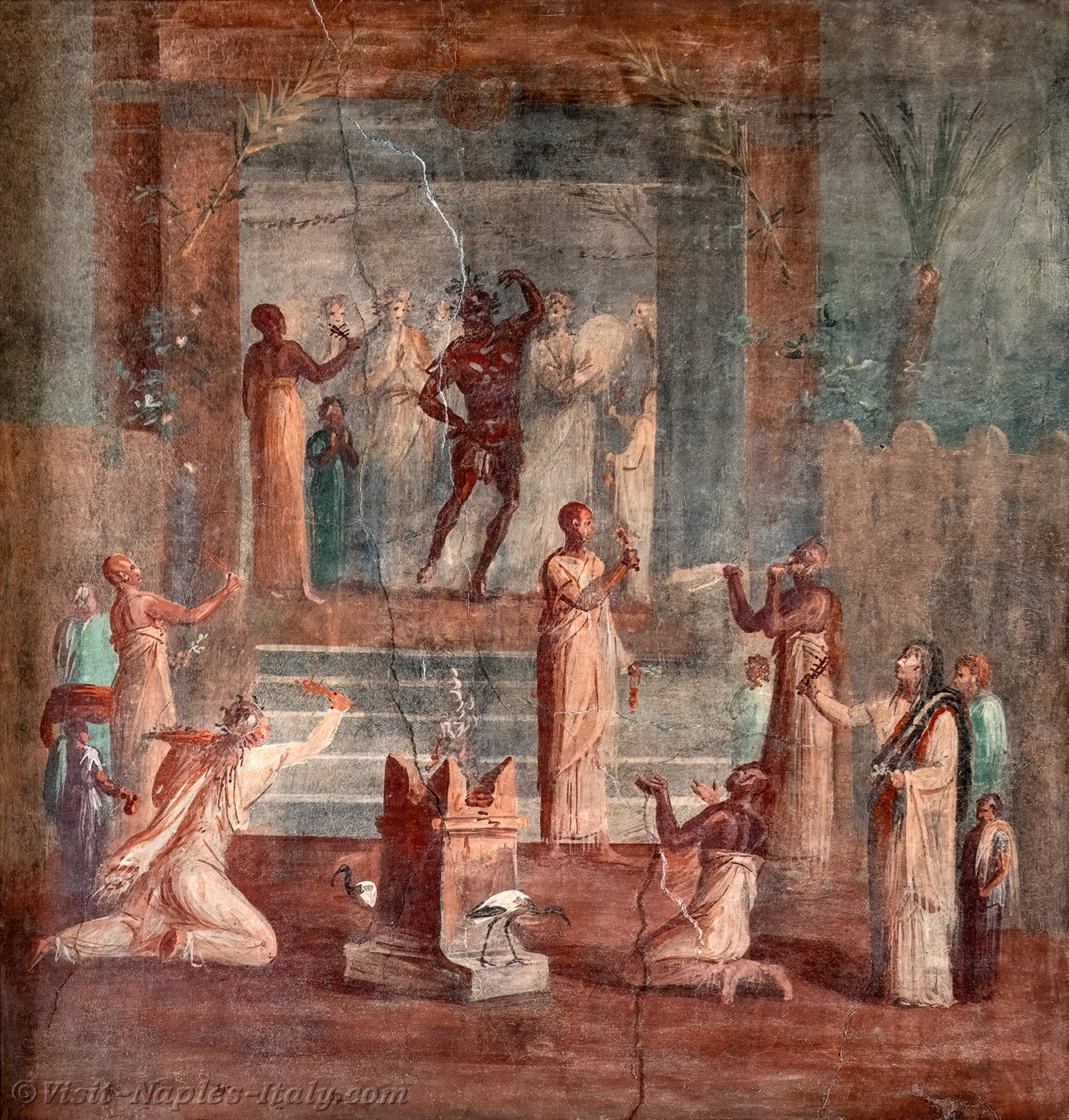
The Mystery of the Sacred Dance The worshippers, men, women and children taking part in the ceremony, sing and dance.
A priest plays the double flute whilst others accompany him by shaking their sistrums.
The sistrum was a musical instrument used in the worship of Isis.
It consisted of a frame with three metal rods onto which metal discs or fruit shells were strung. These produced a sound as they struck one another.
A priest is kneeling and praying, his arms outstretched towards the sky, whilst another, also kneeling, carries a tray filled with offerings.
An altar where these offerings are burned stands in the centre of the courtyard, and at its foot are two sacred Nile ibises.
The main figure of the ceremony is the black dancer, likely of Ethiopian origin.
He stands at the top of the steps, surrounded by the faithful, and dances.
He wears a wreath of leaves and a mask.
Cat tails are attached to his arms, in homage to Isis, who is often depicted accompanied by black cats.
This dancer embodies the god Bes, who dances in honour of Osiris.
His initiatory dance, imbued with magic and spirituality, possesses a purifying power that wards off evil spirits.
The Cult of Sacred Water, Herculaneum
Fresco - Water-based pigments on coating - 45-79 ADThe scene depicts an Isis ceremony, which corresponds to the cult of sacred water.
We can see dozens of worshippers gathered on either side of the staircase leading to the temple’s naos.
In the foreground, on the right, a man is seated and playing the double flute.
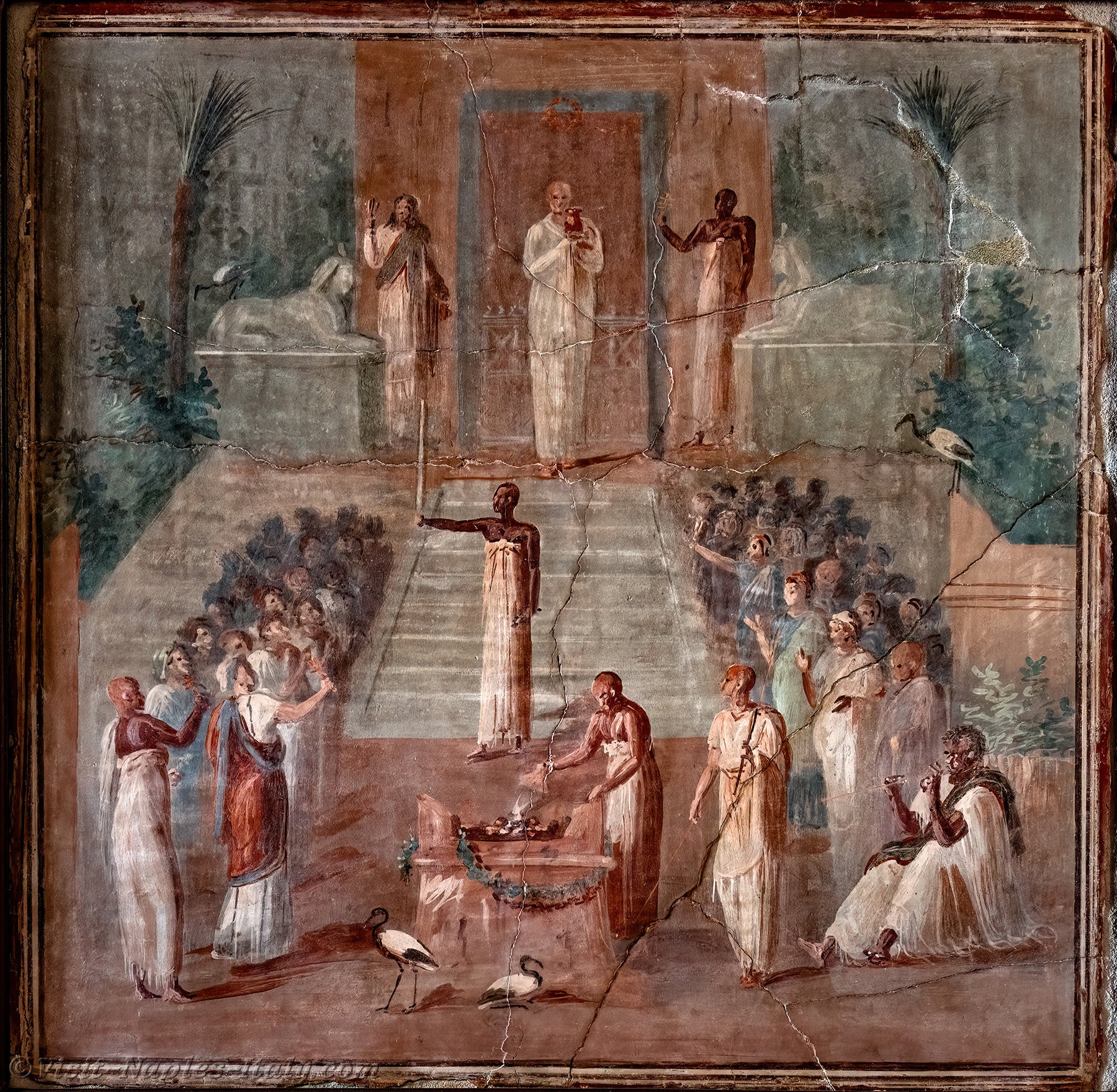
The Cult of Holy Water On the left, a priest and a priestess are standing, each waving a sistrum to accompany the melody of the flute.
Two sacred Nile ibises stand at the foot of an altar where a priest burns offerings. On the right, another ibis is perched on a wall.
On either side of the entrance to the Naos, two sphinxes face each other. Between the sphinxes and on either side of the priest stand two other officiants, each carrying a sistrum.
The most important officiant is the priest standing in front of the entrance to the Naos. He is dressed in white and his shoulders and arms are wrapped in a white veil.
He holds in his hands, at chest height, a golden vase resting on a wreath of flowers. It is in this vase that the sacred water is found.
For the Egyptians, but also in other religions, water is the principle of the Universe and the symbol of fertility.
The Egyptian god Osiris, husband and brother of Isis, is identified with the River Nile, symbolising the life-giving force that purifies the soul and the body.
The vase carried by the priest and venerated by the faithful, as shown in this image, embodies both Osiris and Isis.
Temple dedicated to Isis, Pompeii, Temple of Isis, Ekklesiasterion
Fresco - Water-based pigments on Coating - 45-79 ADThis fresco, discovered in Pompeii in the Ekklesiasterion, the sacred precinct of the Temple of Isis, depicts a sanctuary dedicated to the goddess.
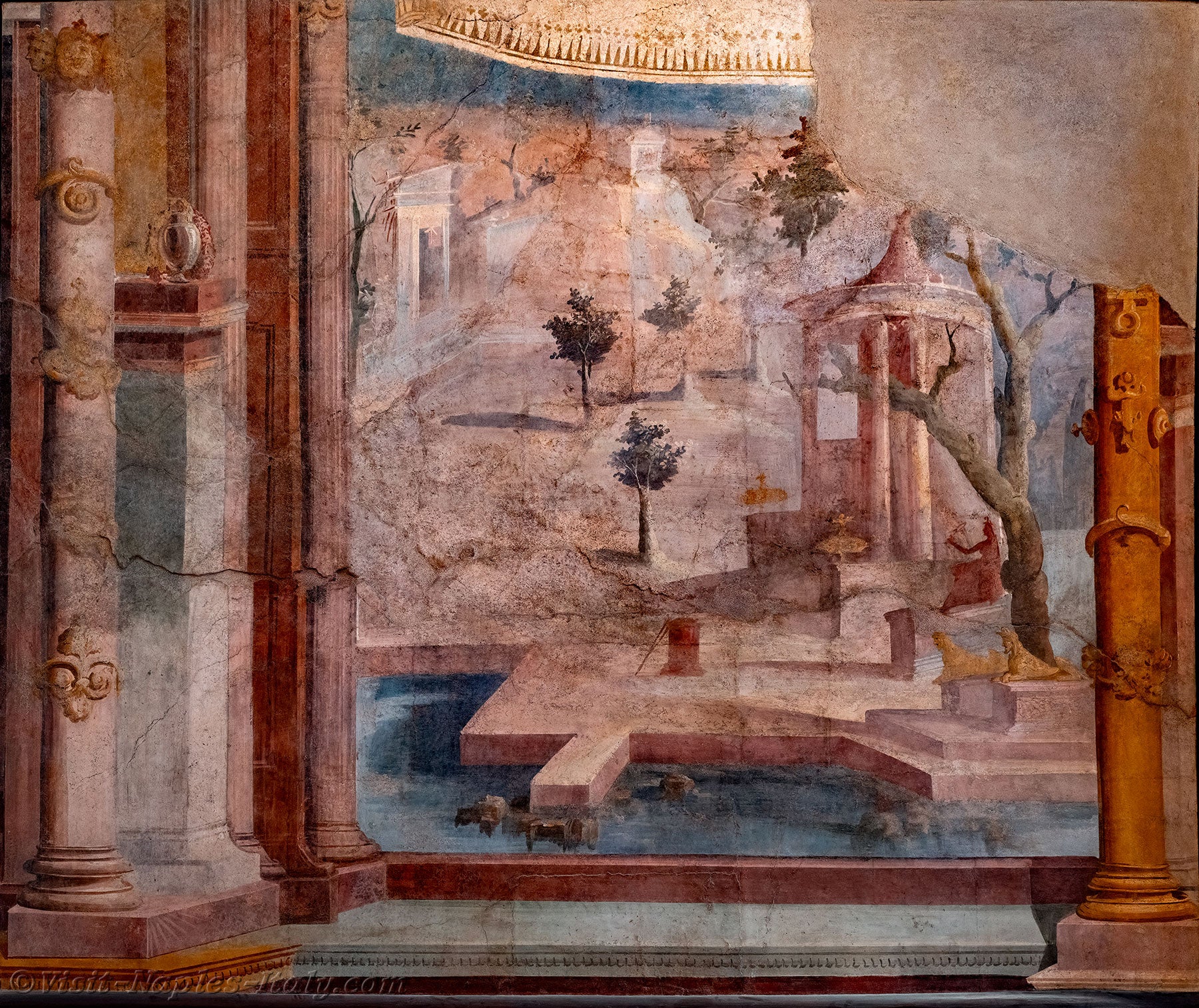
Temple dedicated to Isis The sacred scene is set within a frame flanked on either side by columns adorned with Isiac symbols.
The temple lies beyond a river.
On the left, one can see a rising street with sacred buildings on either side.
In the foreground stands a sacred tree, flanked by low walls on which stand two gold-covered sphinxes with human heads.
Behind them and in front of the circular temple, one can make out a statue of Isis, seated and holding a sistrum. A diadem adorned with an Uræus sits upon her forehead.
A conical roof covers the summit of the temple. One of the branches of the sacred tree passes between the columns of the temple and emerges through one of its windows.
Offering to the statue of Harpocrates, Pompeii, Temple of Isis, Porticus
Fresco - Water-based pigments on Coating - 45-79 ADThis fresco adorned one of the walls of the Porticus of the Temple of Isis in Pompeii.
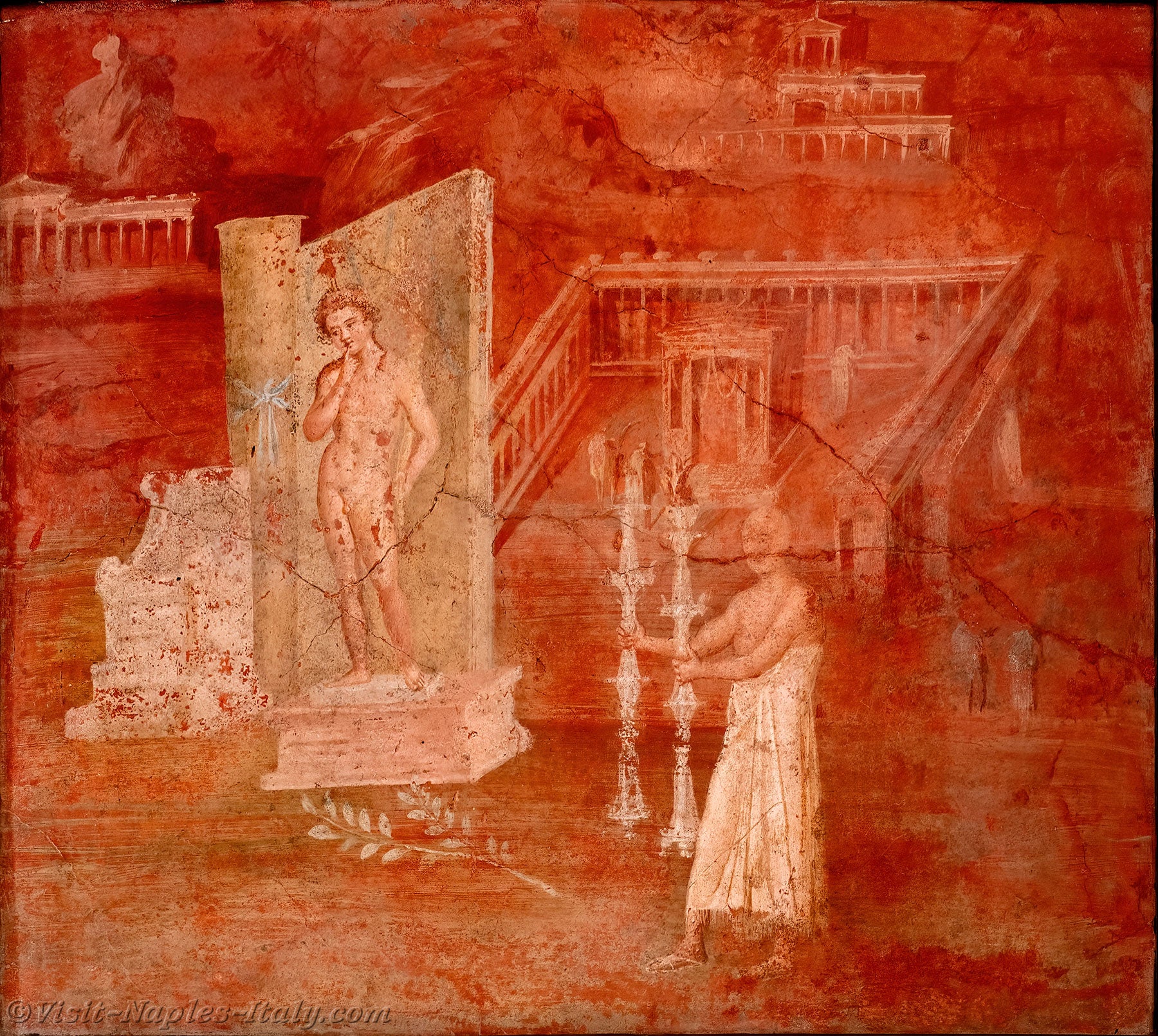
Offering to the statue of Harpocrates To the right of Harpocrates and above the worshipper stands the Temple of Isis, majestically erected at the centre of a vast courtyard surrounded by a colonnaded enclosure.
Harpocrates embodies Horus in his youthful form.
It is to distinguish him from his adult form that he is depicted as a naked young boy, with his finger to his lips.
A lock of hair hangs down on the left side of his neck.
In this fresco, he stands near a column on which a piece of cloth is tied.
Next to the column stands a throne, symbolising the importance of Harpocrates, despite his youthful appearance.
As a descendant of Isis and Osiris, he embodies the legacy of his divine parents.
A palm frond has been placed as an offering at the foot of his statue.
The worshipper approaching him holds two large candlesticks.
Ceremony in honour of Osiris, Pompeii, Temple of Isis
Fresco - Water-based pigments on Coating - 45-79 ADIn this other fresco discovered in the Temple of Isis at Pompeii, one can observe the typical elements of ceremonies in honour of Osiris, husband and brother of Isis, who was murdered and then cut into fourteen pieces by his brother Seth.
On the right, we see a large column adorned with animal heads serving as a frame for the sacred scene.
In the background, we can make out a hill in front of which stands a circular temple.
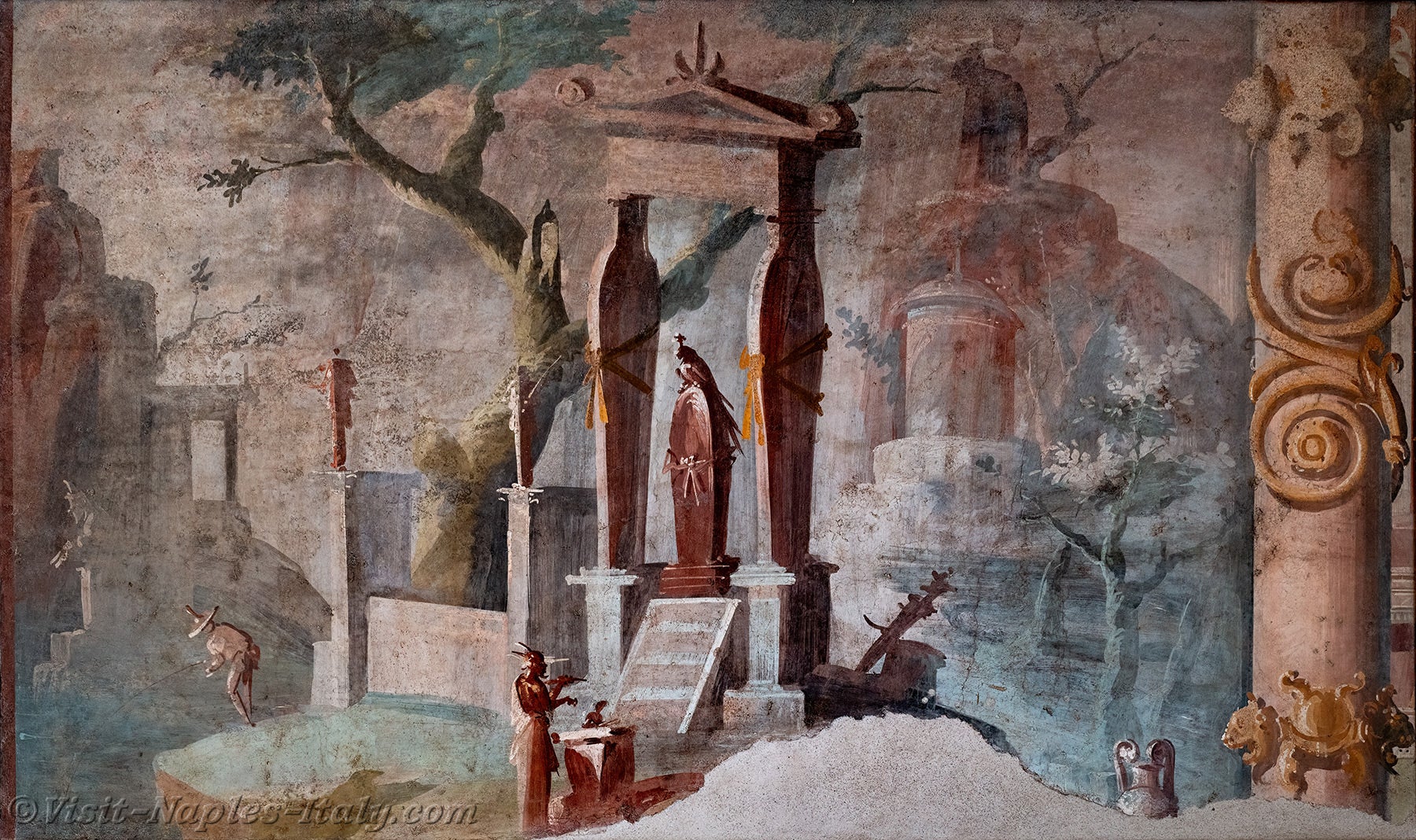
Ceremony in honour of Osiris On the left, you can see a human-headed sphinx.
The sanctuary in the foreground is surrounded by water, and a man wearing a wide-brimmed hat can be seen fishing on the left-hand side of the bank.
In the centre of the scene stands a fairly simple temple, consisting of two columns shaped like mummies, topped by a triangular lintel.
At the top of the triangle are cow’s horns, a symbol of divinity and fertility, associated with the goddess Isis.
Between the columns adorned with sacred ribbons stands an altar upon which is erected a mummy-shaped stele.
At the top of this stele stands a bird of prey, symbolising Isis transformed into a kite to protect the mummy of Osiris.
At the foot of the steps, in front of a small altar, an Isis priest is making offerings in honour of Osiris.
Finally, to the left of the temple, surrounded by walls, stands a sacred tree, a sycamore or a tamarisk.
Officiant with a lamp These trees are symbols of the resurrection of Osiris in the cult of Isis.
Priest with a lamp, Pompeii, Temple of Isis
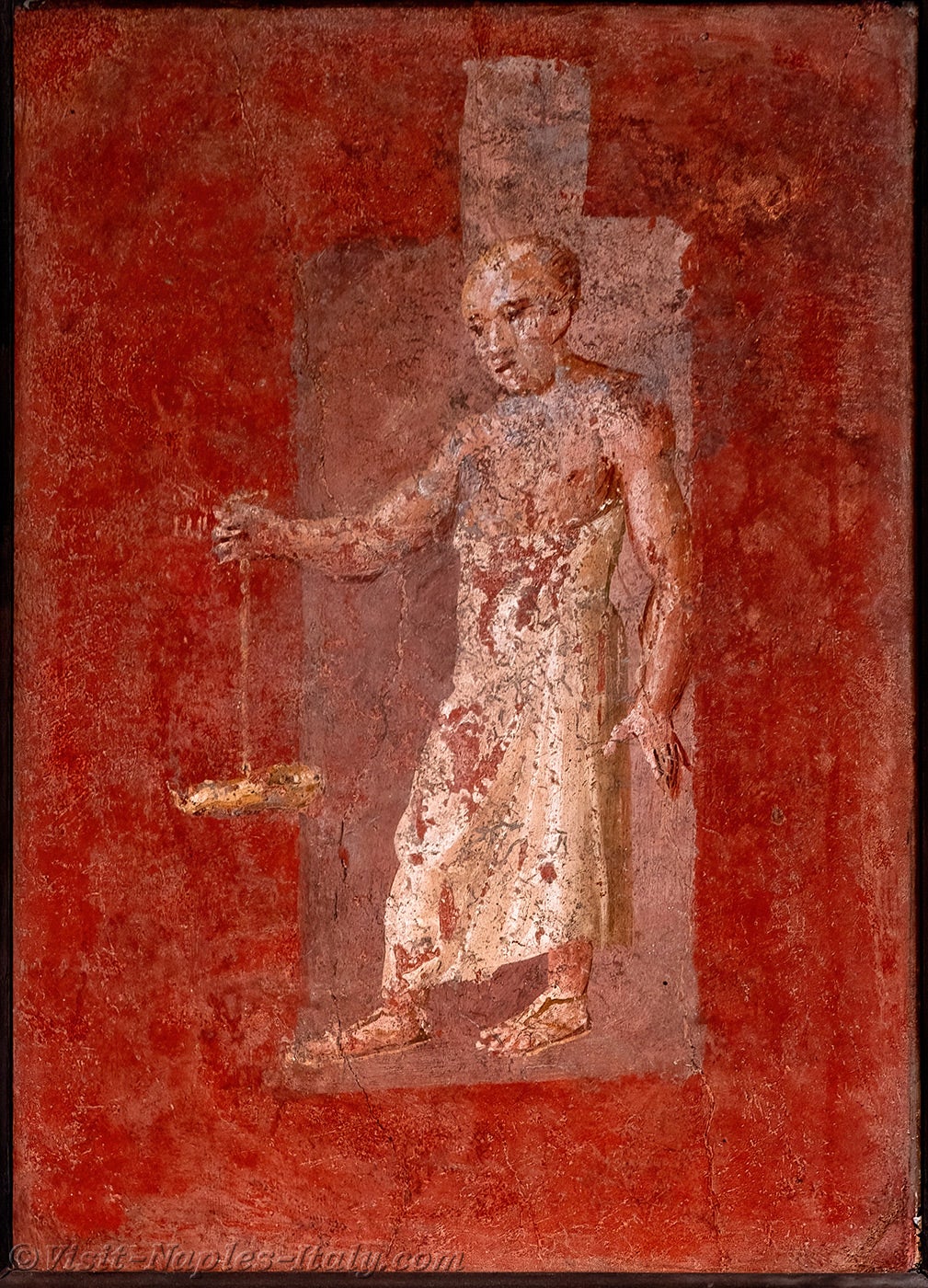
Fresco - Water-based pigments on Coating - 45-79 ADThis fresco, discovered in the Temple of Isis in Pompeii, depicts an Isis priest.
He is depicted against a red background, typical of the dark red used in Pompeii’s wall decorations.
He holds an oil lamp in his hand, suspended from a chain.
He is dressed in a white tunic that reaches just below his chest.
He wears sandals on his feet, similar to those still available today.
It is therefore likely that he is a celebrant rather than a priest of the Temple of Isis, given the simplicity of his attire.
Religion Dionysus | Isis
Frescoes Mythology | Portraits | Life Leisure | Animals | Religion | Landscapes | Decoration
Artworks Sculptures | Frescoes | Eroticism
MANN Artworks Schedule Tickets Location | Authorizations
Back to Top of Page