

MANN Artworks Schedule Tickets Location | Authorizations
Artworks Sculptures | Frescoes | Eroticism
Sculptures Mythology | Persons | Animals | Bas-relief
The allegorical bas-reliefs at the Archaeological Museum of Naples, Italy
Bas-relief depicting the allegories of virtue and sensual pleasure, Farnese collection
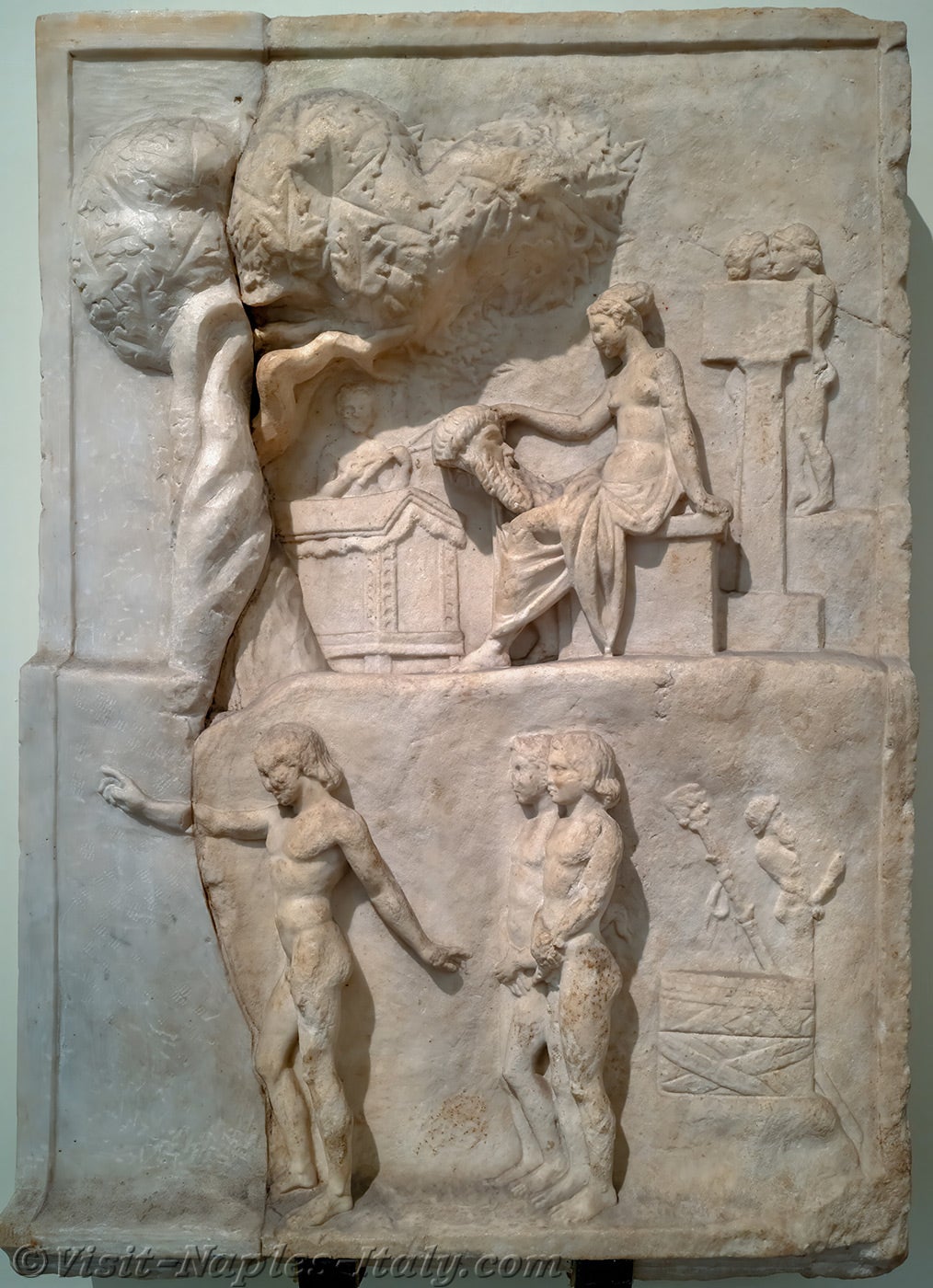
Virtue and Pleasure Bas-relief - Marble (67 x 48 cm) 2nd century
The upper section is an allegory of pleasure (voluptas) in the form of a woman seated before the sanctuary of a faun in the shade of a tree.
She contemplates a theatre mask depicting a handsome male figure which she holds before her, whilst a loving couple are kissing behind her back.
The lower section depicts virtue (virtus) in the form of a couple who prefer to follow the direction indicated by the young man walking ahead of them, and turn their backs on the excesses associated with the cult of Dionysus.
The thyrsus, the staff covered in ivy and vine leaves, represented the sceptre of Dionysus as the god of wine and pleasures, of fertility and vegetation.
The couple’s modest demeanour contrasts with that of Dionysus, depicted here in the same state as his son Priapus, the phallic god.
Tiberius’s pedestal featuring 14 cities of Asia Minor
Sculpture - Marble (Height 122 cm, width 130 cm, length 170 cm) Second quarter of the 1st centuryThis pedestal was commissioned to commemorate the earthquakes that had severely damaged several cities in Asia Minor between 17 and 30 AD.
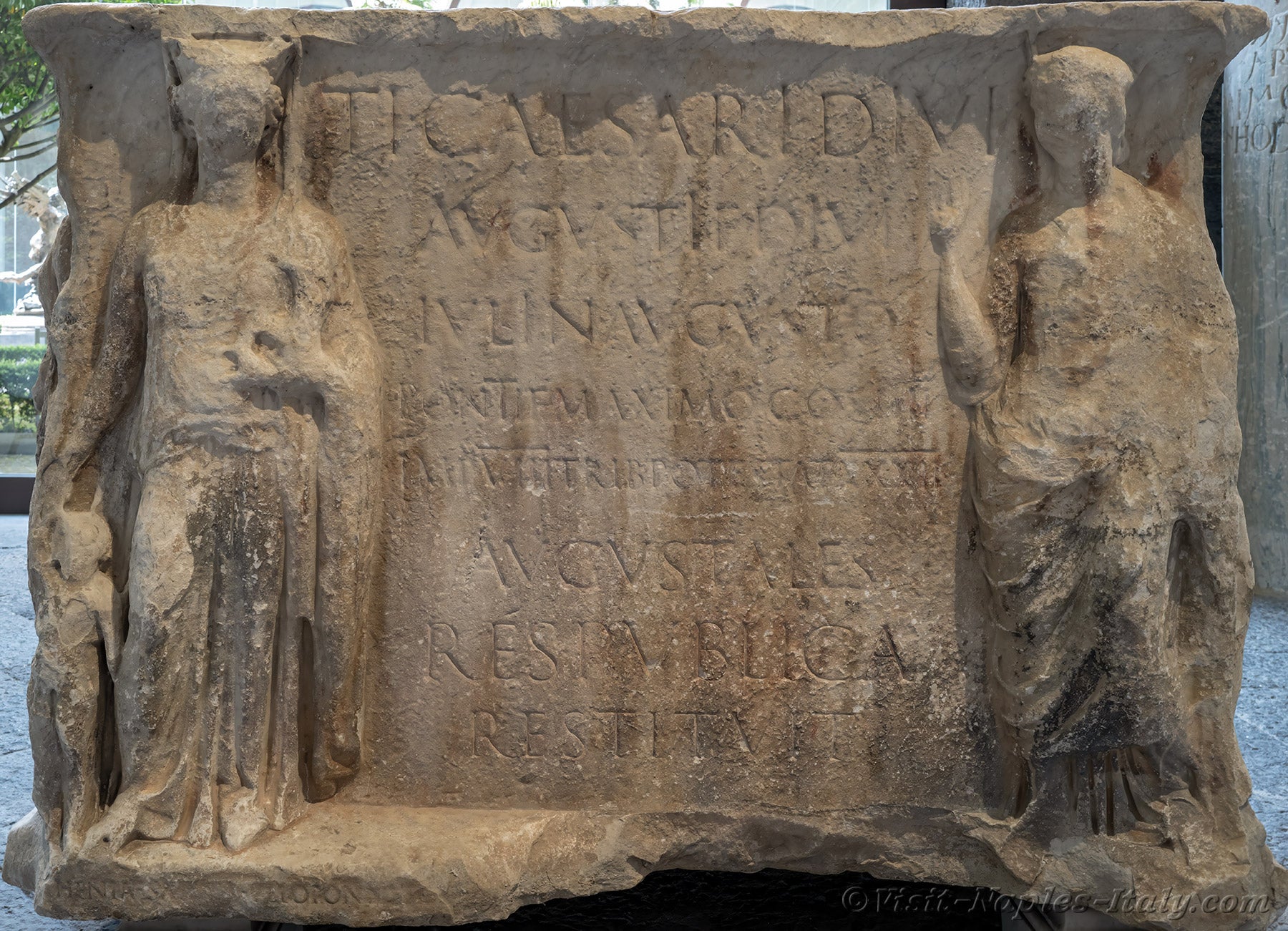
Cities of Sardis and Magnesia This marble plinth was intended to support a statue of Emperor Tiberius. Fourteen cities are depicted here in the form of male and female figures.
On the pediment, in the centre, is an inscription stating that this pedestal was dedicated by the priests of Augustus to the city of Pozzuoli in 30 BC, and subsequently restored by the colony.
This inscription is flanked by two female figures. On the left, the city of Sardis and that of Magnesia on the right.
Sardis is dressed in a peplos and holds a cornucopia in her left hand. Her right hand is placed in a gesture of protection over a naked child.
The statue of Magnesia depicts a woman wearing a sleeved chiton and a himation.
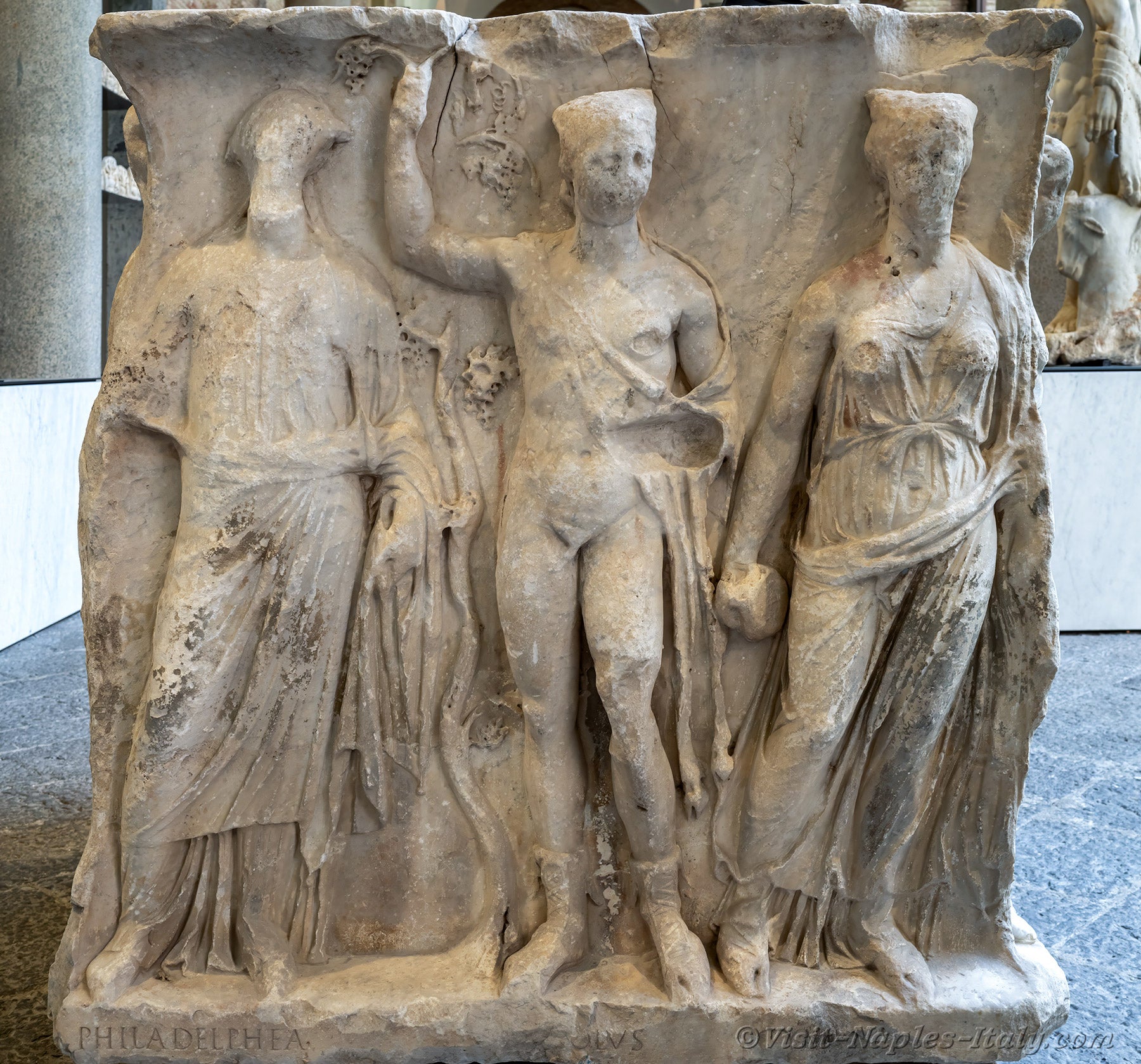
Philadelphia, Tmolus and Cyme The right side of the pedestal depicts three cities: Philadelphia, Tmolus and Cyme.
On the left,Philadelphia is dressed in a chiton and a himation draped over her left forearm. She leans on her left leg, which gives her a priestly appearance. She represents Little Athens, a sacred city.
In the centre, the city of Tmolos, associated with a mountain deity, is represented by a naked young man holding a vine shoot in his right hand, in the image of Dionysus.
To the right of Tmolos, Kyme wears a chiton draped loosely over her right shoulder, and a transparent himation clinging to her nakedness.
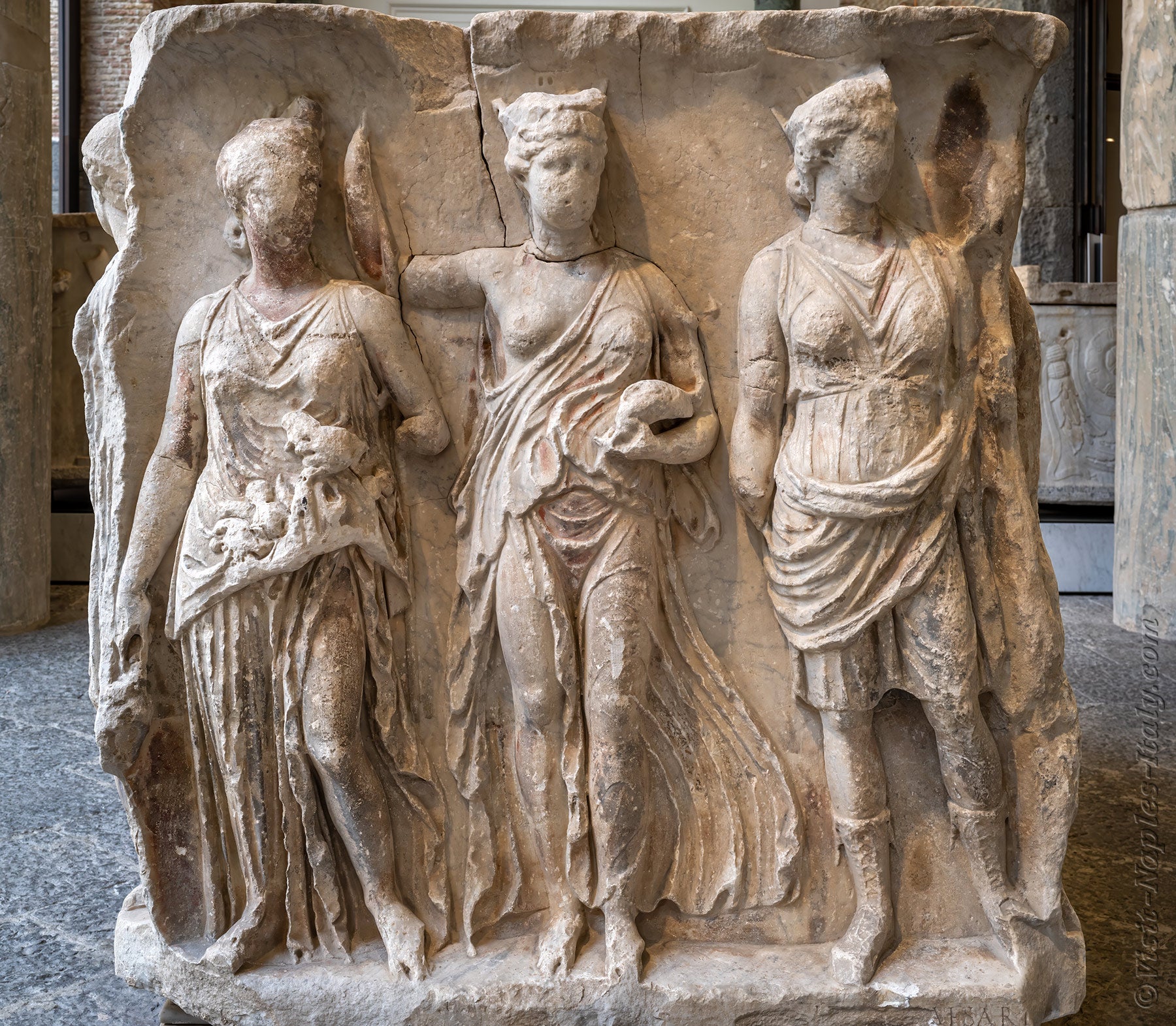
Mosten, Aegae and Hierokaisareia The left side of the pedestal features three women, symbolising the cities of Moste, Aegae and Hierokaisareia.
Moste is dressed in a peplos with a long kolpos and an apoptygma. She leans on her right leg while lifting a corner of her apoptygma, which is filled with fruit and flowers.
In the centre, Aegae resembles a sea goddess with her dolphin resting on her left arm and her trident in her right hand.
Her peplos, tied only over her left shoulder, leaves her right breast exposed.
It is important to note that Aegae was a place of worship dedicated to Poseidon, the god who, by stirring up the sea and the earth, caused the earthquakes that struck the city.
Finally, Hiérokaisaria is dressed as an Amazon, wearing a short chiton and boots. She wears a turreted crown on her head.
The reverse side of the plinth features six other cities: Temnos, Kibyra, Myrina, Ephesos, Apollonidea and Hyrkania.
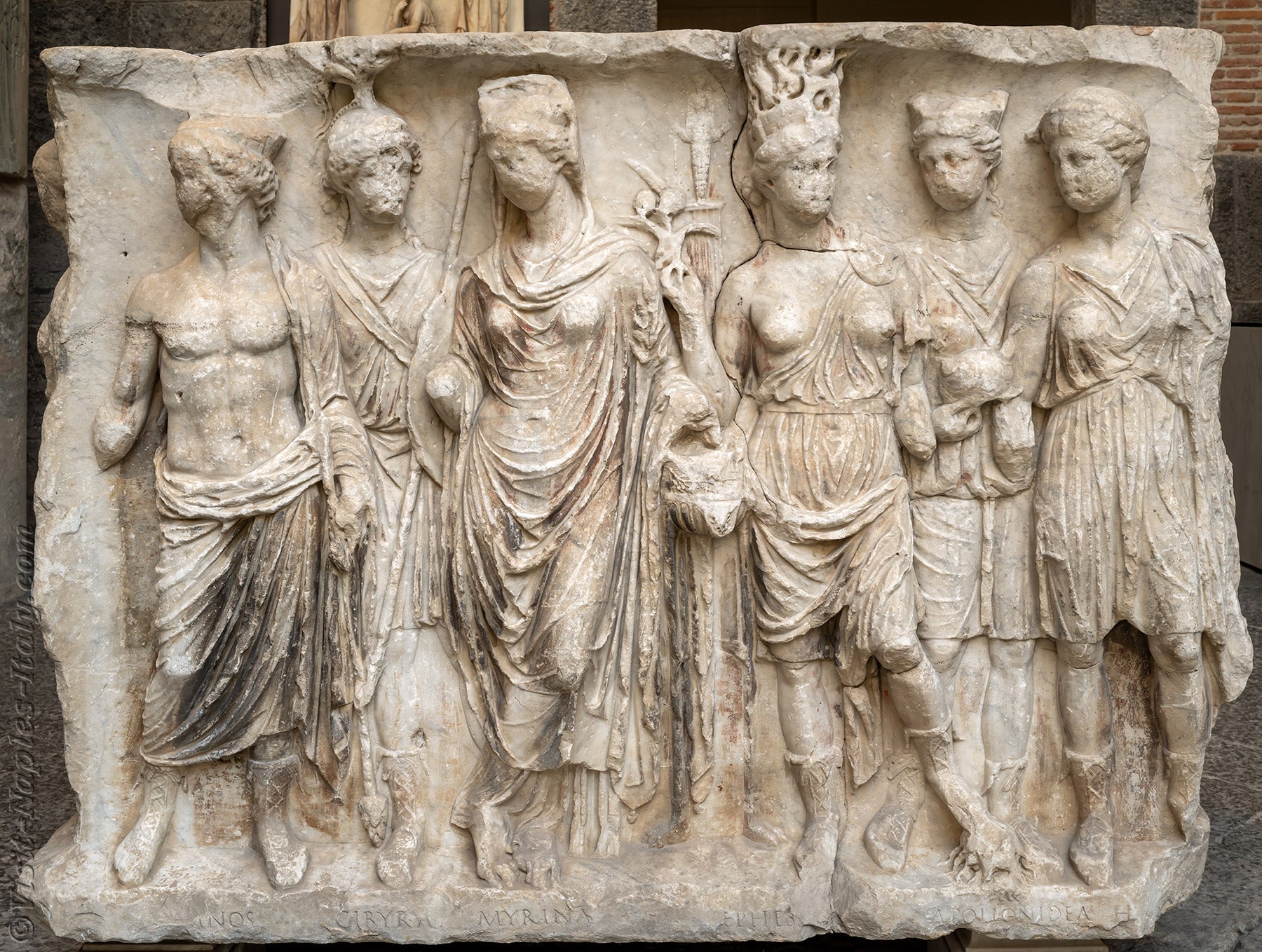
Temnos, Kibyra, Myrina, Ephesus, Apollonidea, Hyrcania Temnos is depicted as a male figure brandishing a thyrsus. He is clad in a himation that covers only the lower half of his body. He wears a crown.
To his right, but slightly set back, lies the city of Kibyra, symbolised by an Amazon armed with a helmet, a spear and a shield.
The city of Myrina is represented by a beautiful woman wearing a chiton whose head is crowned with a diadem. Her graceful posture echoes the cult of Apollo, which was practised in this city at that time.
The city of Ephesus is depicted by a female figure wearing a chiton loosened over her right shoulder, which covers only her left breast. She holds a sheaf of wheat in her right hand.
Flames are shooting out of her crown, perhaps evoking the earthquake that struck the region.
To her right stands a statue of Artemis set upon a column, a reminder of the cult of Artemis and the Amazons in the city of Ephesus.
The city of Apollonidea is depicted in the background dressed as an Amazon.
Finally, the city of Hyrkania, dressed in Macedonian style and wearing a fur cap and laced boots, is also symbolised by a woman.
Two cupids sacrificing bulls, Farnese Collection
Sculpture - Marble (107 x 161 cm) Early 2nd century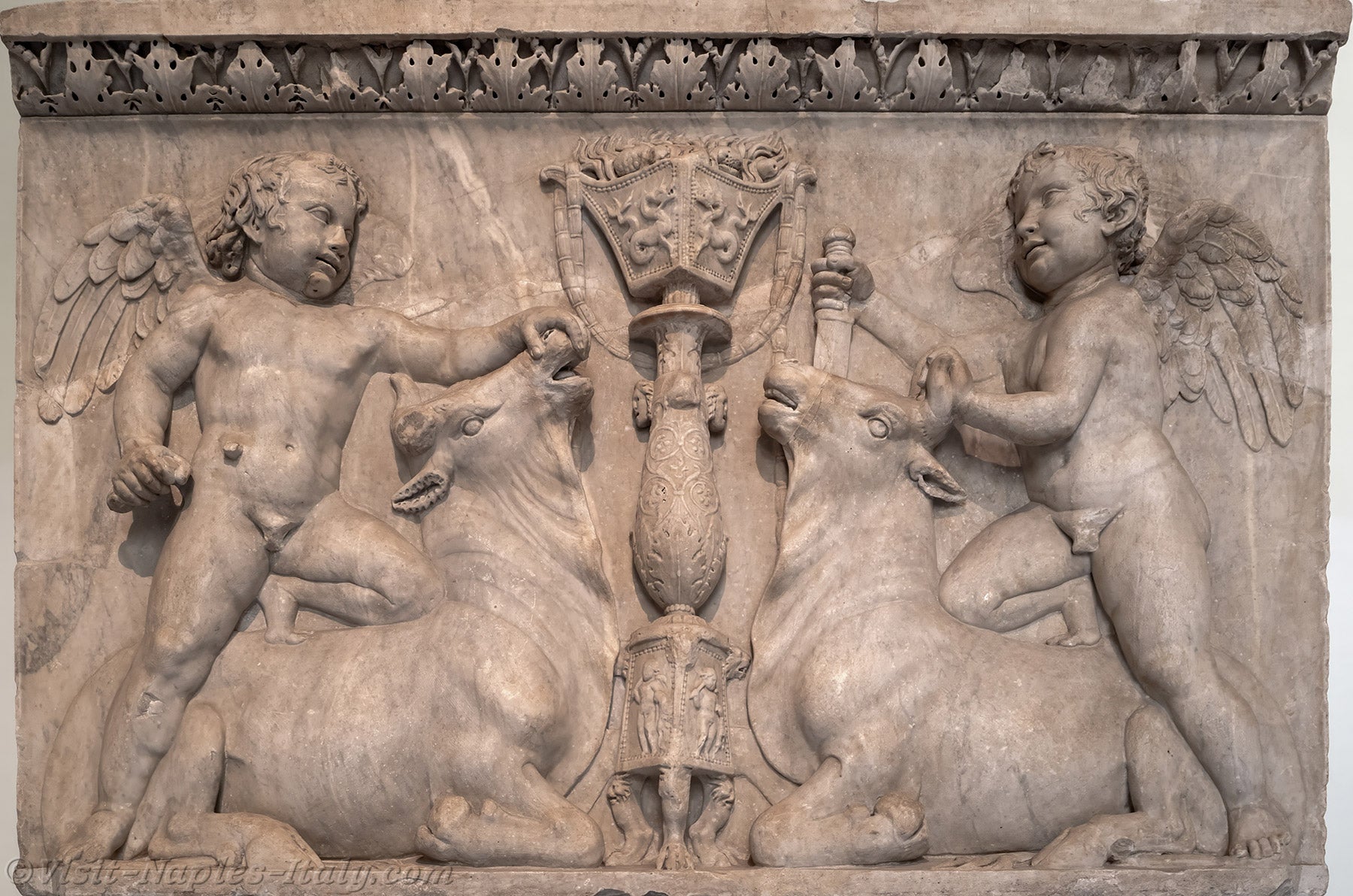
Two Cupids sacrificing bulls Two winged cupids are depicted in the pose of the god Mithras, whilst they sacrifice bulls on either side of a sumptuous candelabra adorned with garlands.
Their postures and faces reveal their strength and their determination.
They rest a knee on the bull’s neck whilst pulling its head back with one hand to pierce it with a sword thrust.
The figure on the left holds a sword whose blade is broken at the hilt.
In contrast, the sword of the figure on the right is clearly visible and deeply embedded in the bull’s head.
Dionysus with a panther, Herculaneum
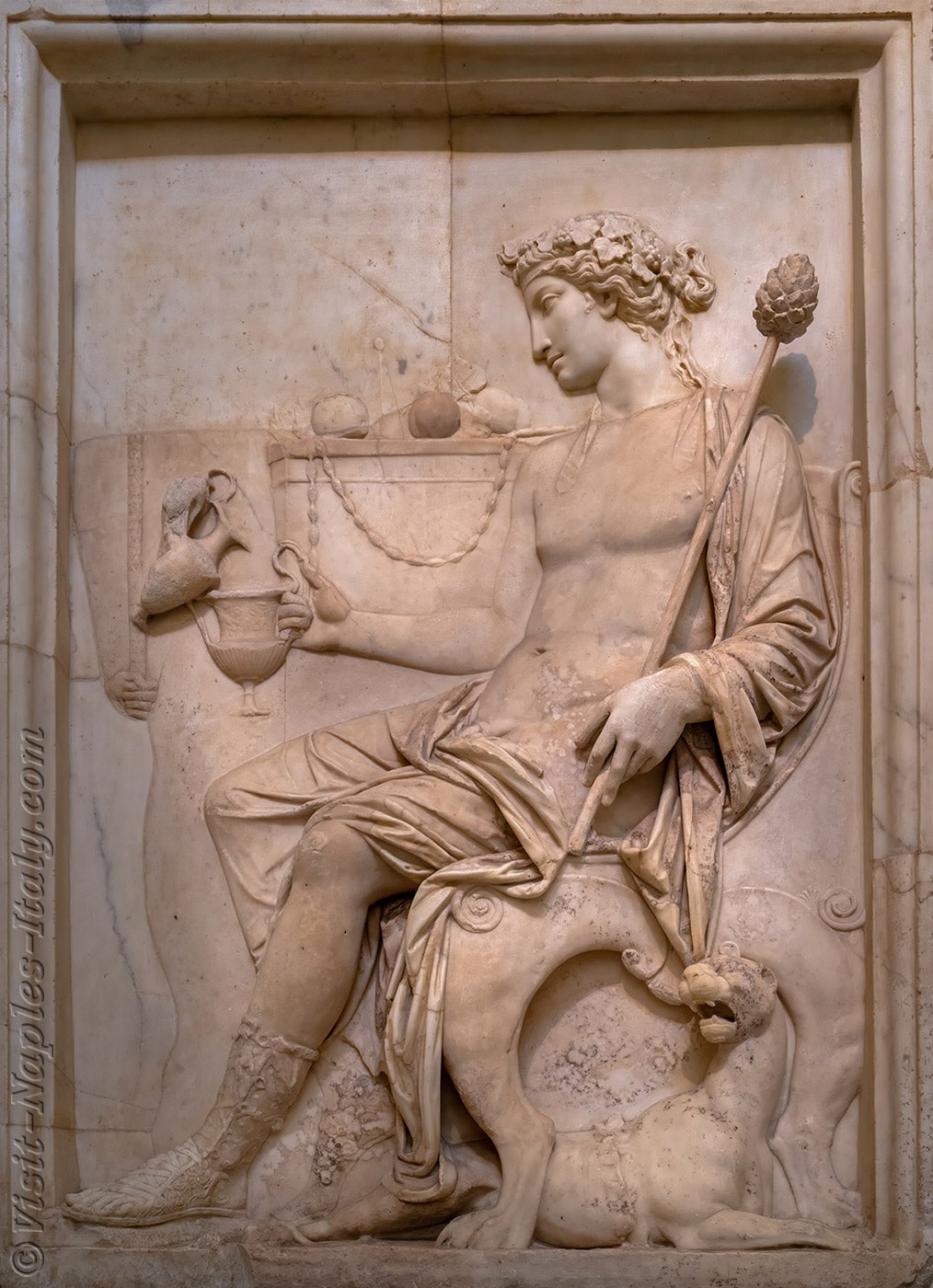
Dionysus and a panther Sculpture - Marble (140 x 97 cm) Early 1st century
Dionysus is depicted here as a young sovereign god, holding his thyrsus by the tips of his fingers, resting it on his left shoulder.
He is seated on a Diphros, a four-legged folding chair with a backrest.
A panther lies beneath this seat carved to resemble a throne.
The god of wine stands before an altar upon which offerings are placed.
He holds out his kantharos, a two-handled vase that is one of his attributes, to a figure in the background so that he may pour him wine.
Hercules’ Initiation into the Eleusinian Mysteries, Farnese Collection
Sculpture - Marble (49 x 56 cm) Late 1st century BC, early 1st centuryThis bas-relief depicts Hercules’ initiation into the Eleusinian Mysteries.
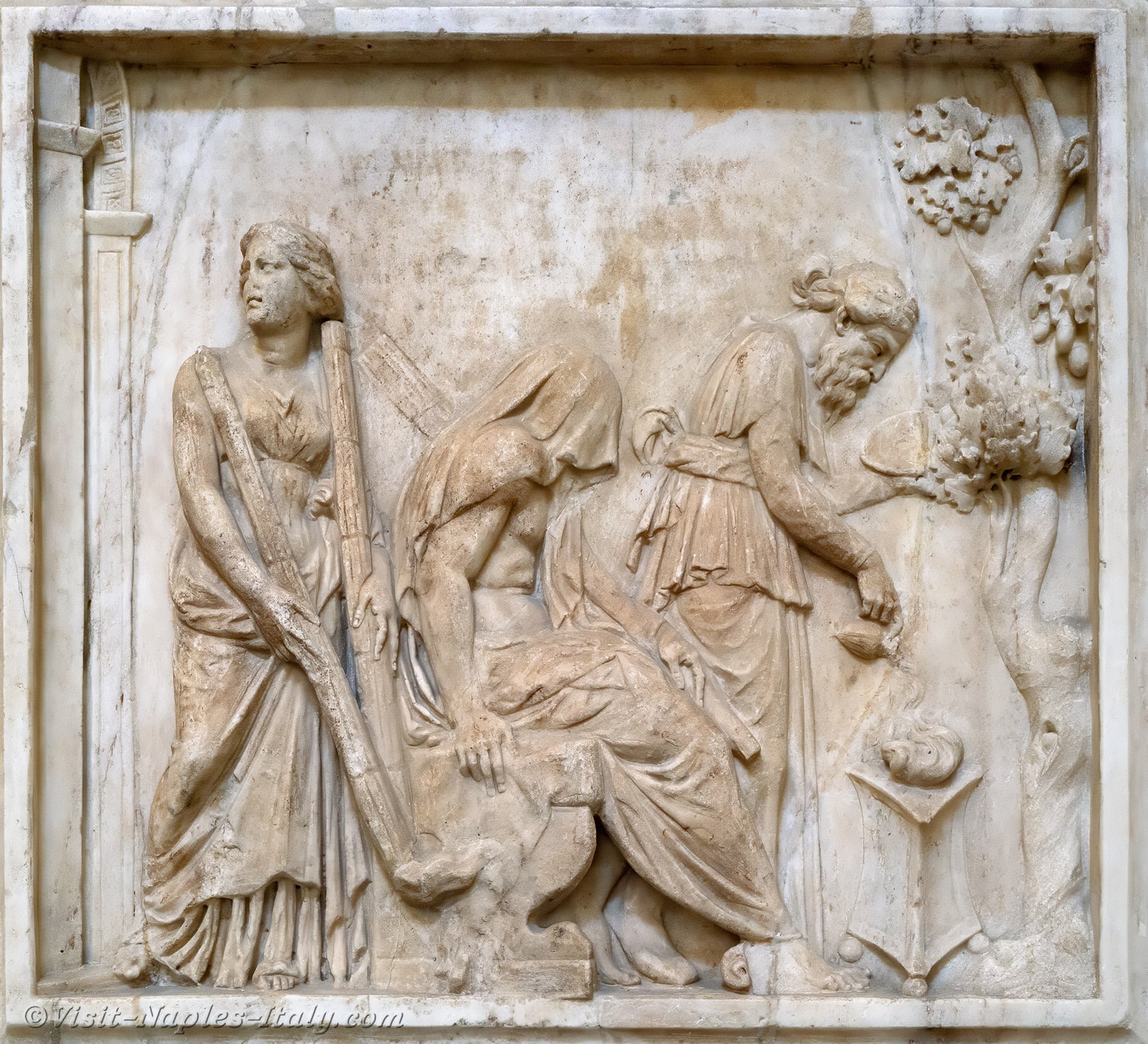
Hercules’ Initiation into the Eleusinian Mysteries Hercules is seated, his head completely covered by a veil, awaiting the revelation of the mysteries at the conclusion of his initiation ceremony.
Behind him stands Persephone, also known as Proserpina to the Romans. She was the daughter of Demeter.
Proserpina and Demeter, in the Eleusinian Mysteries, form the central myth of their legend and constitute a pair known as “the goddesses”, hence Proserpina’s presence in this scene.
Proserpina holds two lit torches, pointing towards the ground.
A priest stands before Hercules, performing a libation before an oak tree by pouring a liquid onto an altar from which a flame rises.
Mithras sacrificing a bull, Capri
Sculpture - Marble (78 x 99 cm) 3rd centuryThe Romans adopted, adapting it, the cult of Mithra, the Persian god of the Sun and the Moon who can be seen depicted in the upper corners of this work.
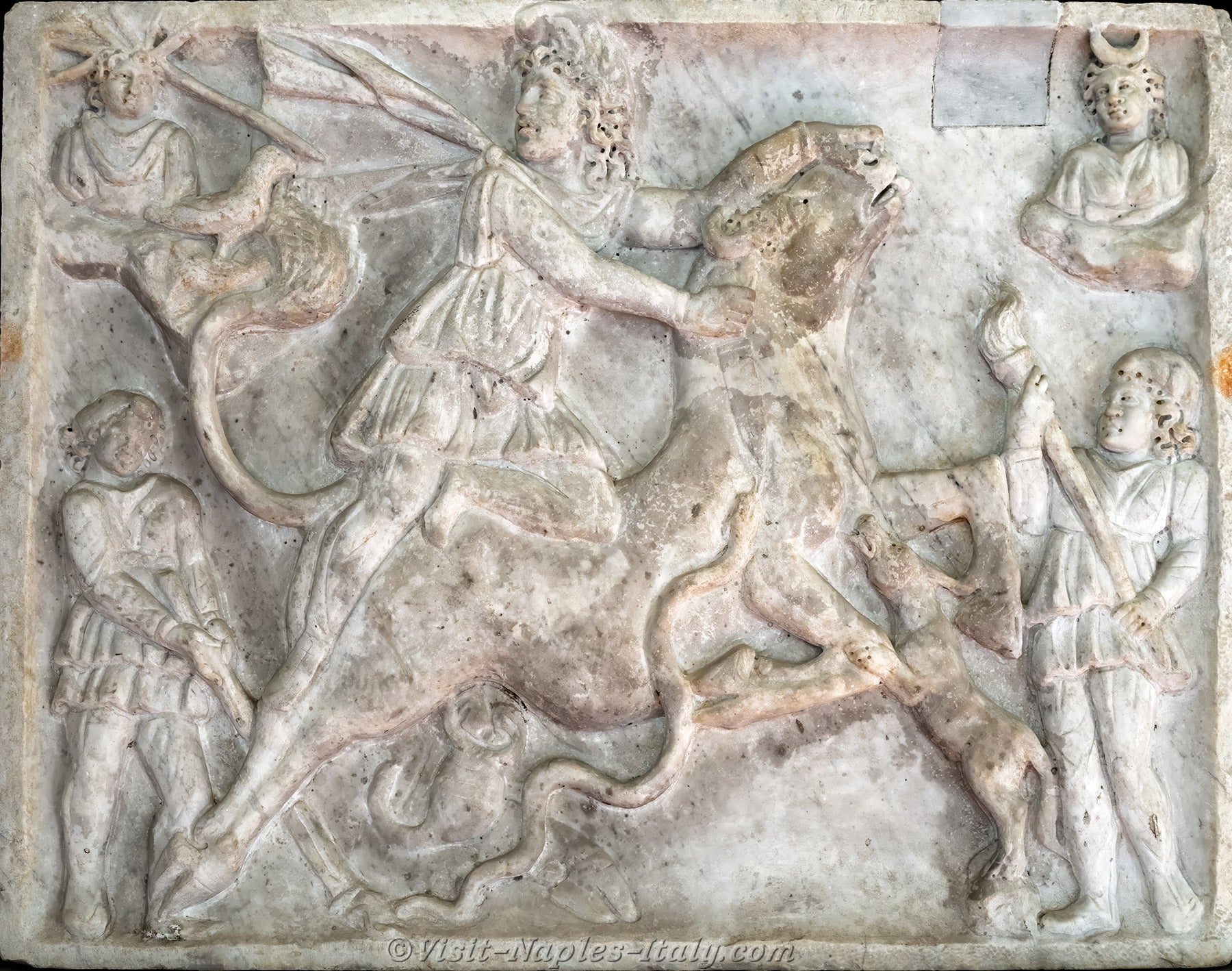
Mithras sacrificing a bull In Roman mythology, the god Mithra is depicted sacrificing a bull, an act that enables the rebirth of the world.
The Mithraic deities Hesperus and Phosphorus are engraved in the lower section. Hesperus represents the evening star, whilst Phosphorus symbolises the morning star, bringing the light of day.
Mithra is piercing the bull’s neck, just as the sun penetrates the earth.
The bull’s tail ends in ears of wheat, thus evoking abundance.
Finally, in the myth of Mithra, the bull’s blood is intended to nourish the lower creation, represented here by a scorpion, a snake and a dog.
The myth of Telephus, Casa del Rilievo, Herculaneum
Sculpture - Marble - 1st century BCTelephus was the son of Hercules. He defended Mysia and killed many Greeks.
However, when Achilles came before him, he was afraid and fled. As he ran, he tripped over a vine stock and fell. Achilles then wounded him with a spear thrust to the thigh.
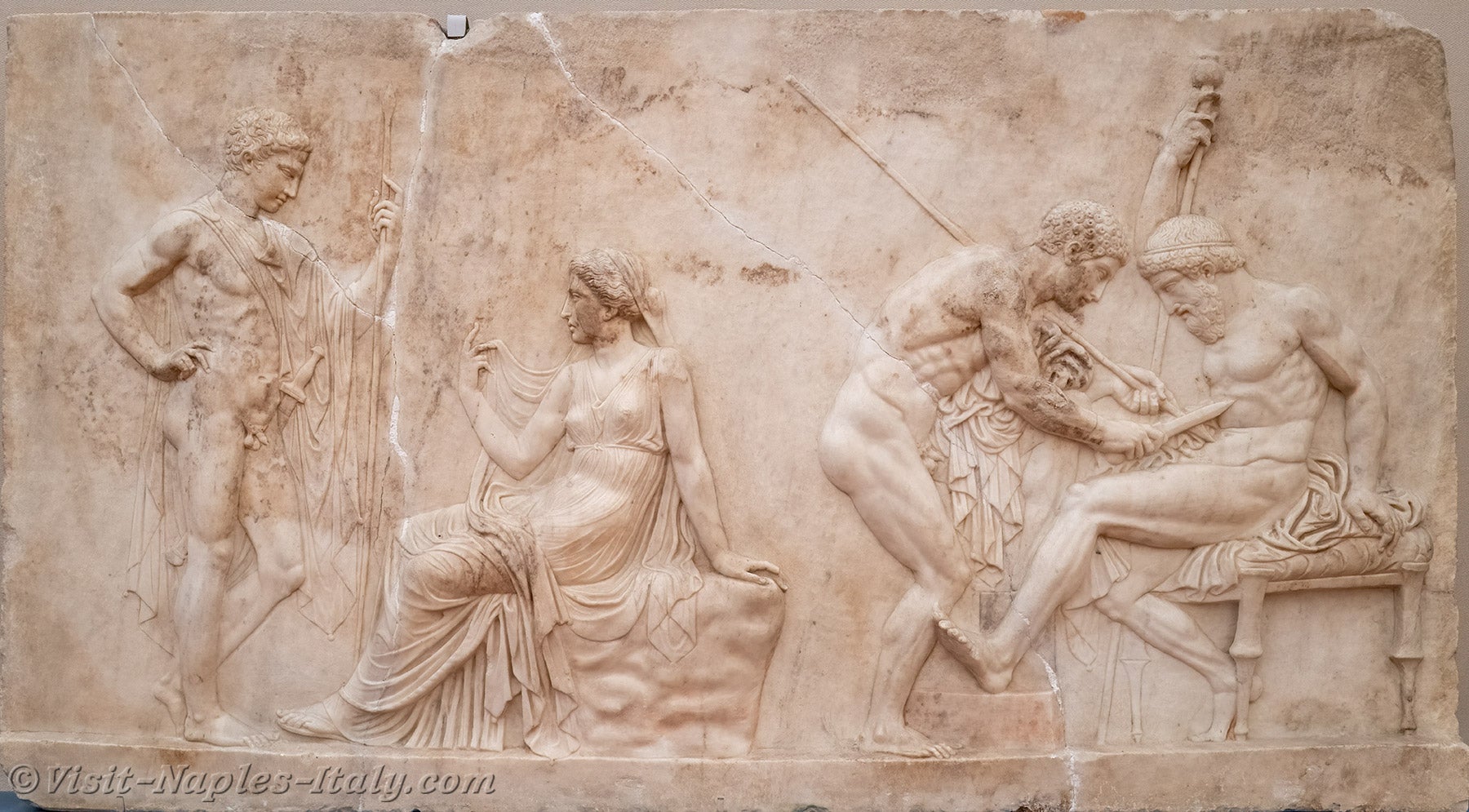
The Myth of Telephus Later, Telephus’s wound still would not heal, but Apollo had foretold him that the one who had wounded him would heal him.
And so Telephus presented himself to the Greeks and promised to show them the way to Troy, but only if Achilles would heal him.
Having been informed by Odysseus of the meaning of the oracle, Achilles agreed to heal Telephus with the rust that was on his spear. Telephus was healed and led the fleet to Troy.
The bas-relief consists of two sections: on the left, Achilles stands before the oracle, and on the right, he is seen treating Telephus.
Orpheus, Eurydice and Hermes, Herculaneum
Sculpture - Marble (118 x 100 cm) 1st century BC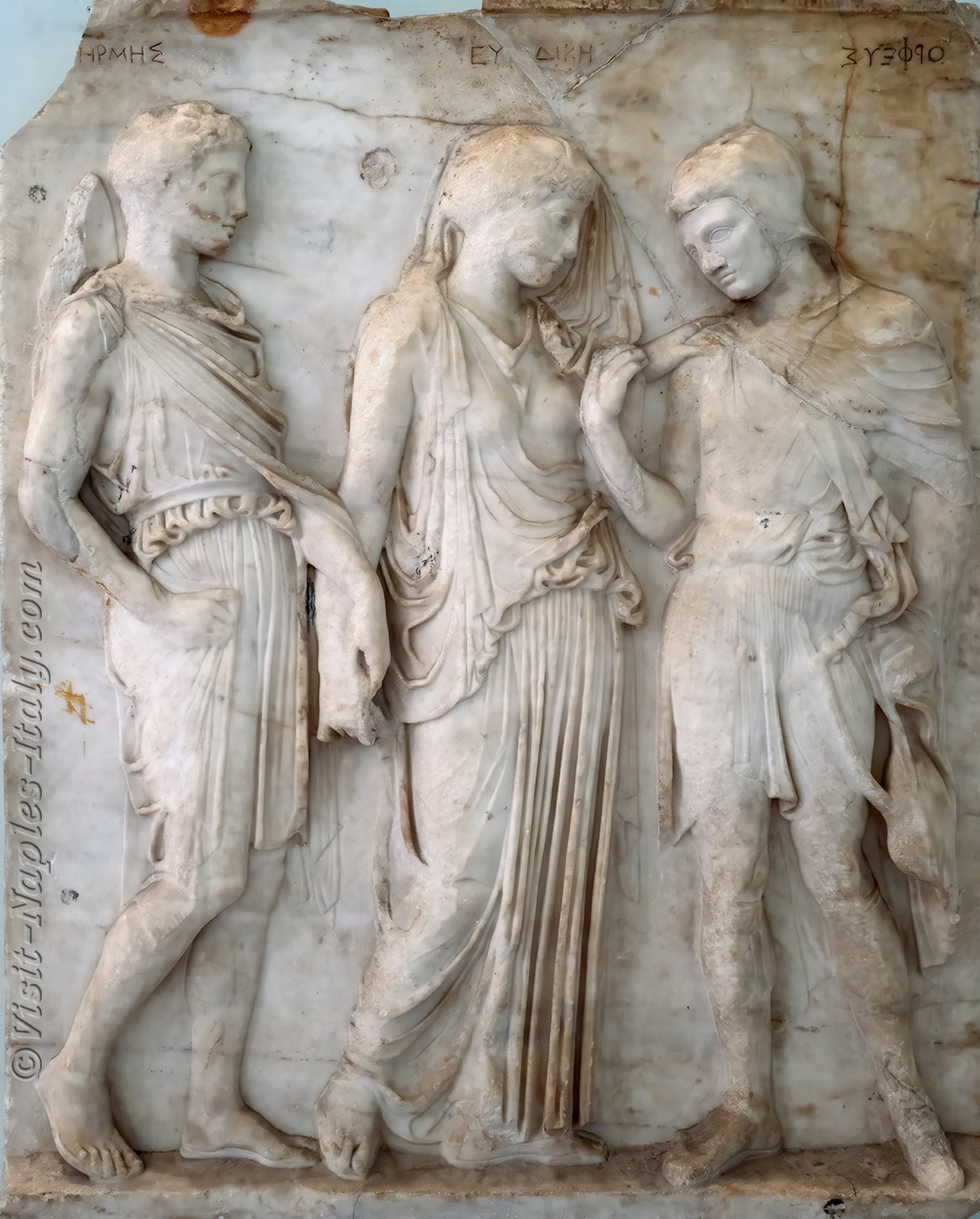
Orpheus, Eurydice and Herm In this bas-relief, the young and beautiful Eurydice is depicted in three-quarter profile, between Orpheus on the right and Hermes on the left.
She rests her hand on the right shoulder of her husband Orpheus, whilst Hermes prepares to seize her wrist.
Orpheus leans towards Eurydice, bowing his head in a sad expression.
He reaches out towards his beloved.
This is the moment when he has just disobeyed the instructions of Hades and Persephone, who had ordered him not to turn round to look at her before leaving their realm, on pain of causing her death a second time.
Hermes looks at Orpheus, his hand outstretched to reluctantly hold back Eurydice and take her back to the underworld.
Eurydice seems to forgive Orpheus, whose love was stronger than his reason, and who disobeyed the orders of Hades and Persephone.
Perseus rescues Andromeda, Temple of Isis, Pompeii
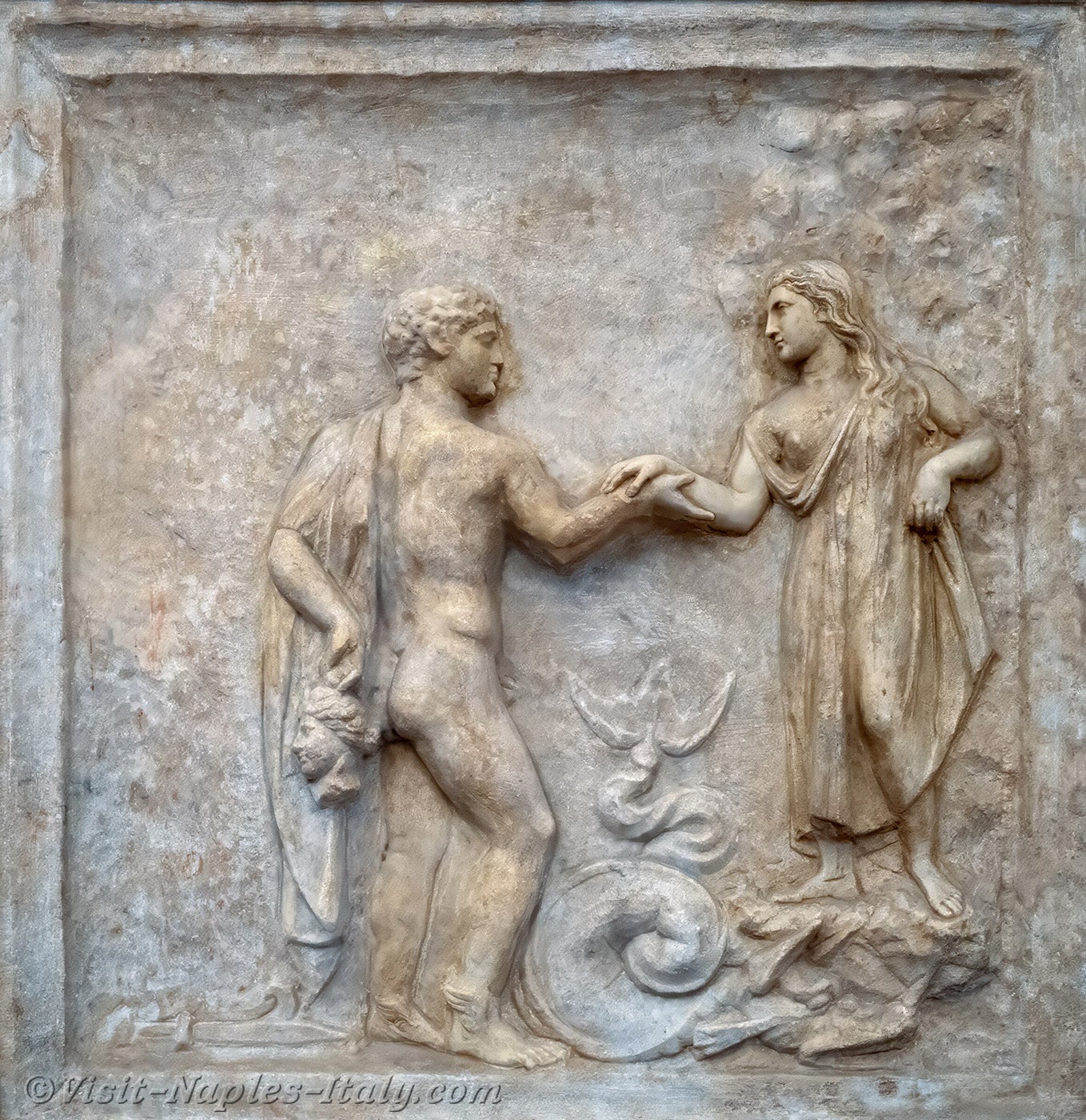
Sculpture - Marble (60 x 58 cm) 1st centuryPerseus stands before Andromeda and helps her down from the rock. He holds the head of Medusa behind him. The dead sea monster lies on the ground, along with Perseus’s sword.
Games in the amphitheatre, Necropolis of the Stabian Gate, Pompeii
Sculpture - Marble (145 x 420 cm) 70 BCThis bas-relief, discovered in the Necropolis of the Stabian Gate in Pompeii, adorned the tomb of Alleius Nigidius Maius.
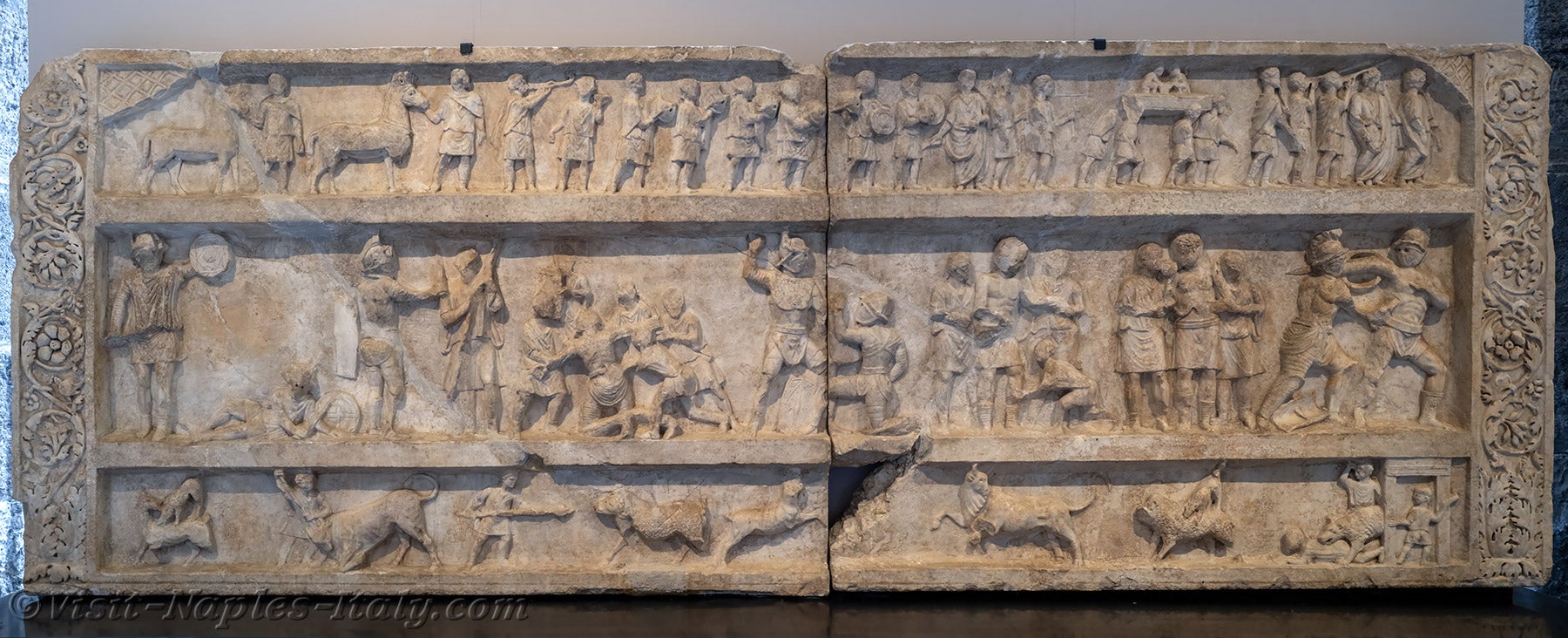
Games in the amphitheatre The circus games are depicted on three levels.
At the top is the procession that opened the games; here we can see musicians, as well as gladiators carrying their shields and helmets.
In the middle we can see gladiatorial combats as well as wounded gladiators being treated.
Finally, at the bottom, there are depictions ofscenes of hunting wild animalscaptured for use in the arena.
Sacrifice scene in honour of Aphrodite, Pompeii
Sculpture - Marble (45 x 62 cm) Late 5th century to early 4th century BC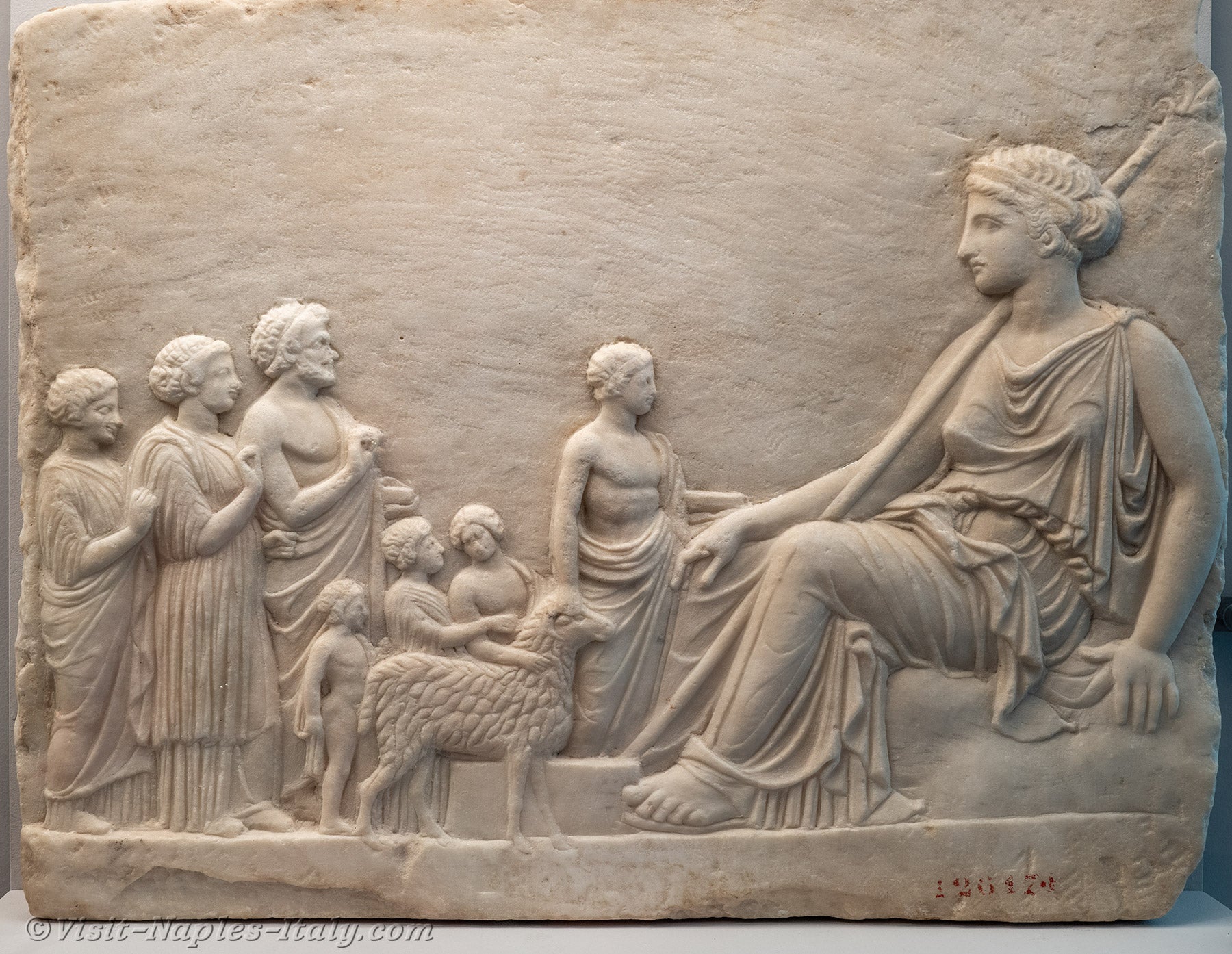
Sacrifice in honour of Aphrodite This votive bas-relief, discovered in Pompeii, depicts a scene of a sacrifice in honour of Aphrodite.
The goddess is seated on the right, depicted as significantly larger than her worshippers.
She is clad in a peplos and a himation and wears sandals on her feet.
Before her stands a couple of worshippers accompanied by a young girl.
At the centre of the scene, a young man followed by three children, two girls and a young boy, leads a ram to offer it as a sacrifice to Aphrodite.
Grape Harvest and Satyrs, Puteoli
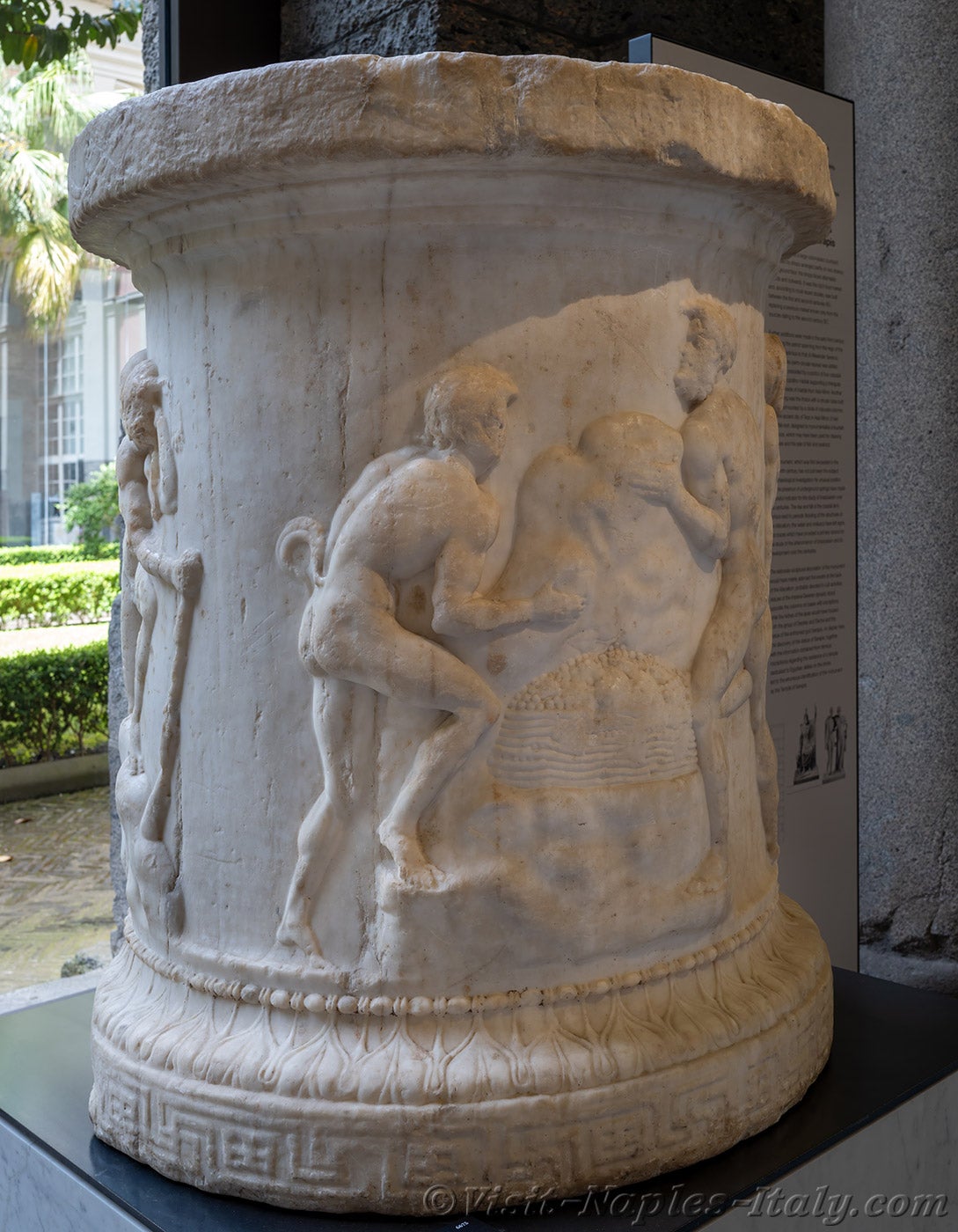
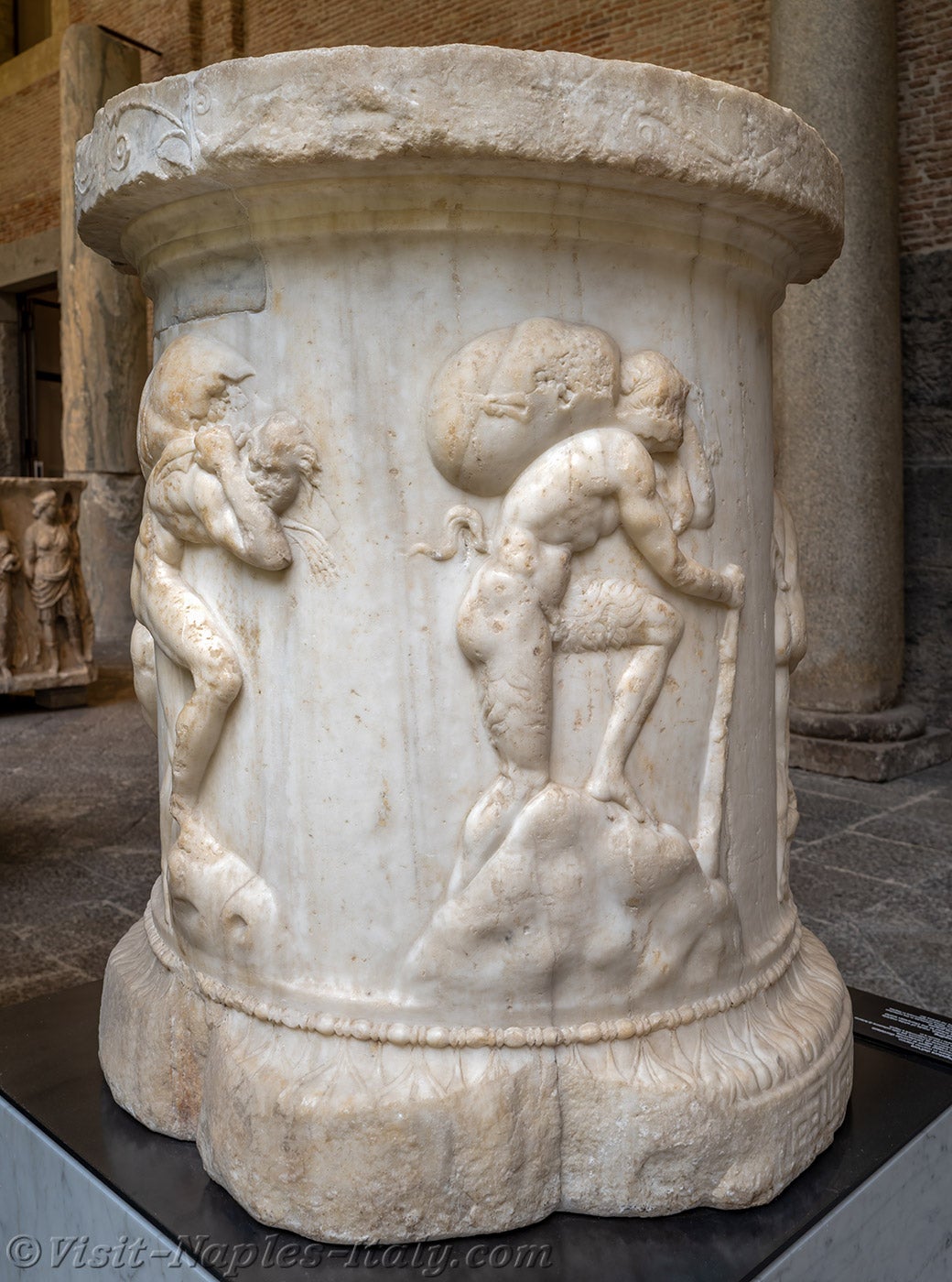
Sculpted Well - Marble (98 x 82 cm) 1st centuryA scene of the grape harvest carried out by satyrs adorns this marble well.
Two satyrs carry on their backs sacks filled with grapes, whilst the other two lift a large stone to press the grapes contained in the basket.
Sculptures Mythology | Persons | Animals | Bas-relief
Artworks Sculptures | Frescoes | Eroticism
MANN Artworks Schedule Tickets Location | Authorizations
Back to Top of Page