

MANN Artworks Schedule Tickets Location | Authorizations
Artworks Sculptures | Frescoes | Eroticism
Frescoes Mythology | Portraits | Life Leisure | Animals | Religion | Landscapes | Decoration
Life Leisure Arts | Food | Young Women | Daily Life | Commerce | Sport
Frescoes of Still Lifes and Food Consumed in Pompeii and Herculaneum at the Archaeological Museum of Naples
Mask of Satyr and Hare, Pompeii, Insula Occidentalis
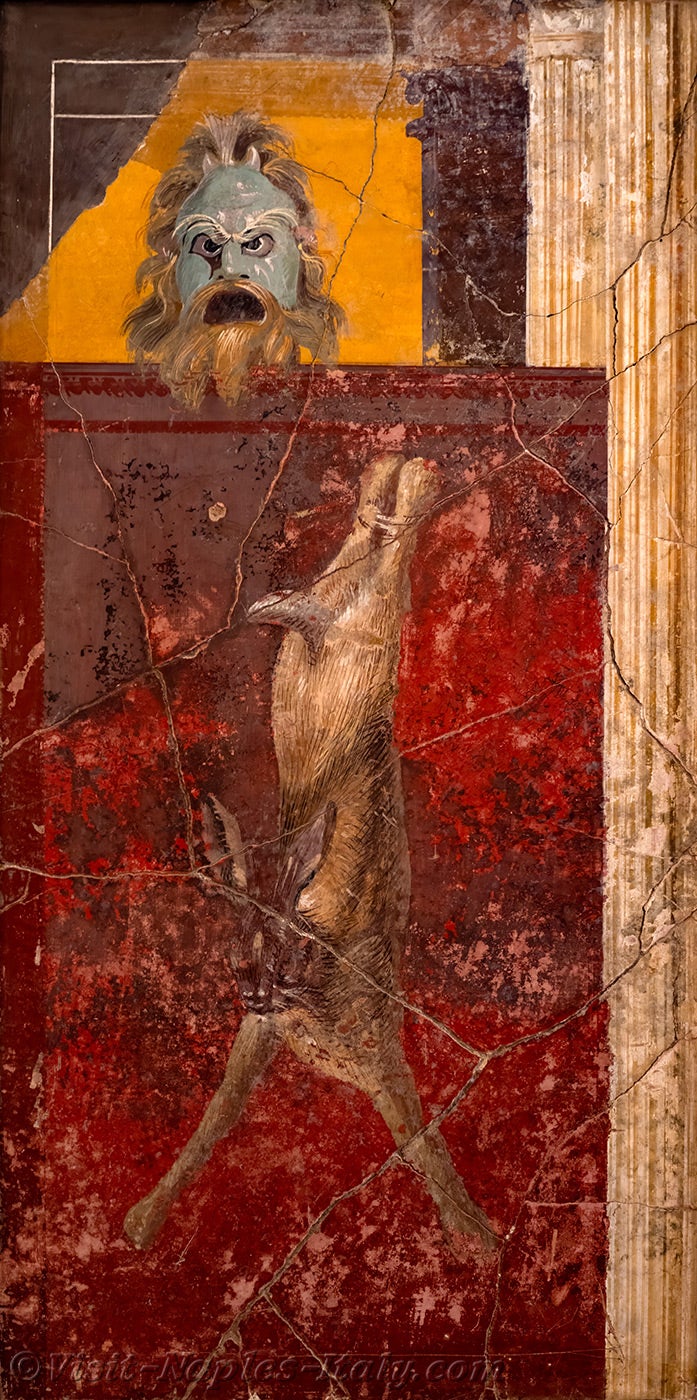
Satyr and Hare Mask Fresco - Water-based pigments on coating (118 × 60 cm) 40-30 BC
This fresco discovered in Pompeii shows a hare suspended as an offering to a deity on a red background.
This offering is relatively modest.
Above the hare is a satyr mask with thick hair and beard and a threatening expression.
Two fluted columns are depicted on the right, helping to give depth to the scene.
It is thought that to the left of this fragment of fresco stood two smooth columns adorned with a Corinthian capital.
This missing section would certainly have framed the scene.
Still Life, Pompeii, Praeda di Giulia Felice
Fresco - Water-based pigments on Coating (100 × 234 cm) 65-79 ADThis fresco was located on a wall of the “tablinum” of the Praedia of Giulia Felice.
In Roman houses, the “tablinum” was a room located between the atrium and the garden or peristyle.
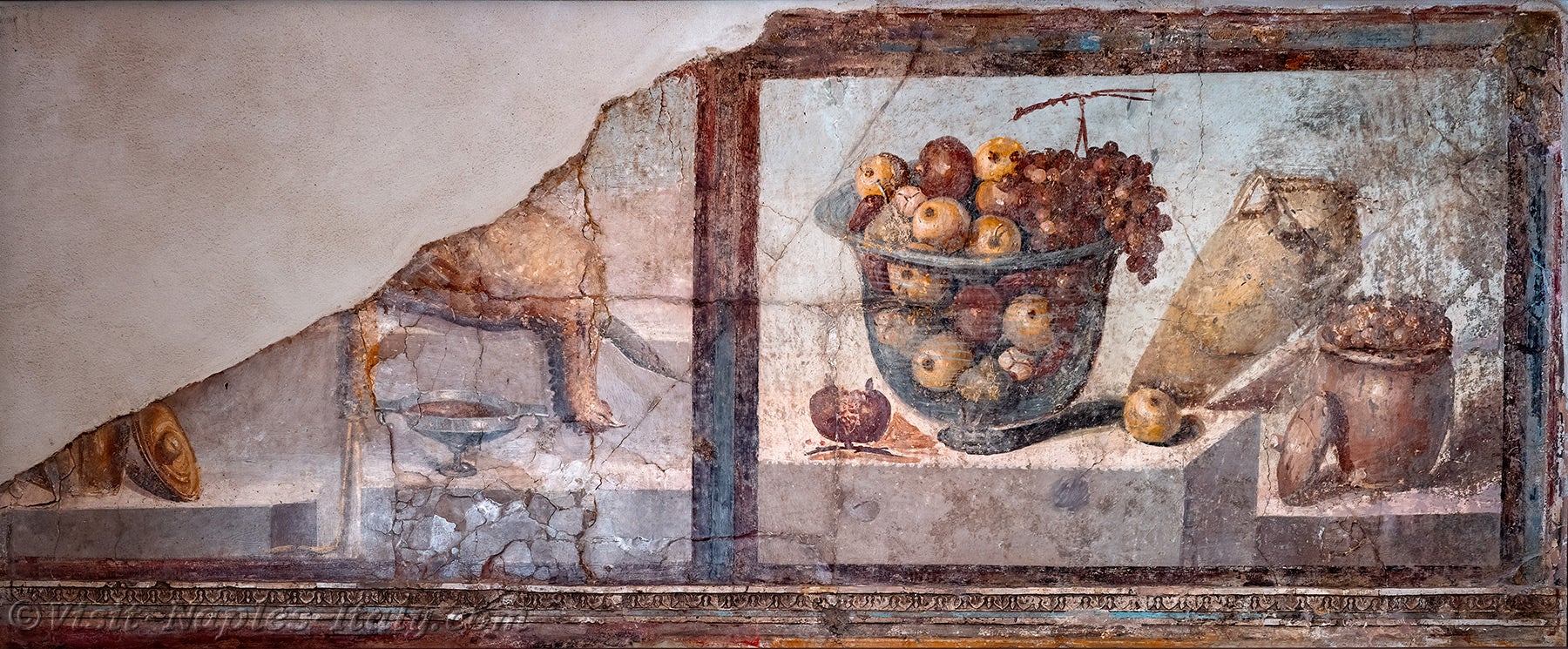
Still Life This room was used as an office and reception room, and clients were also received there.
This fresco allowed the hostess to show guests what was symbolically offered to them when they entered this room.
On the left, we can see a bird and a silver cup filled with wine.
On the right, we can see a crater, a glass vase filled with yellow and red apples, and a bunch of grapes.
At the bottom of the crater, we can see an open pomegranate with its seeds spilling out.
To the right of the vase, there is a closed amphora and a terracotta pot containing dried fruit.
Still Life, The Table of the Romans, Herculaneum, Casa dei Cervi
Fresco - Water-based pigments on Coating (41 × 129 cm) 62-79 ADThis mural illustrates what wealthy Romans ate during the time of Herculaneum and Pompeii.
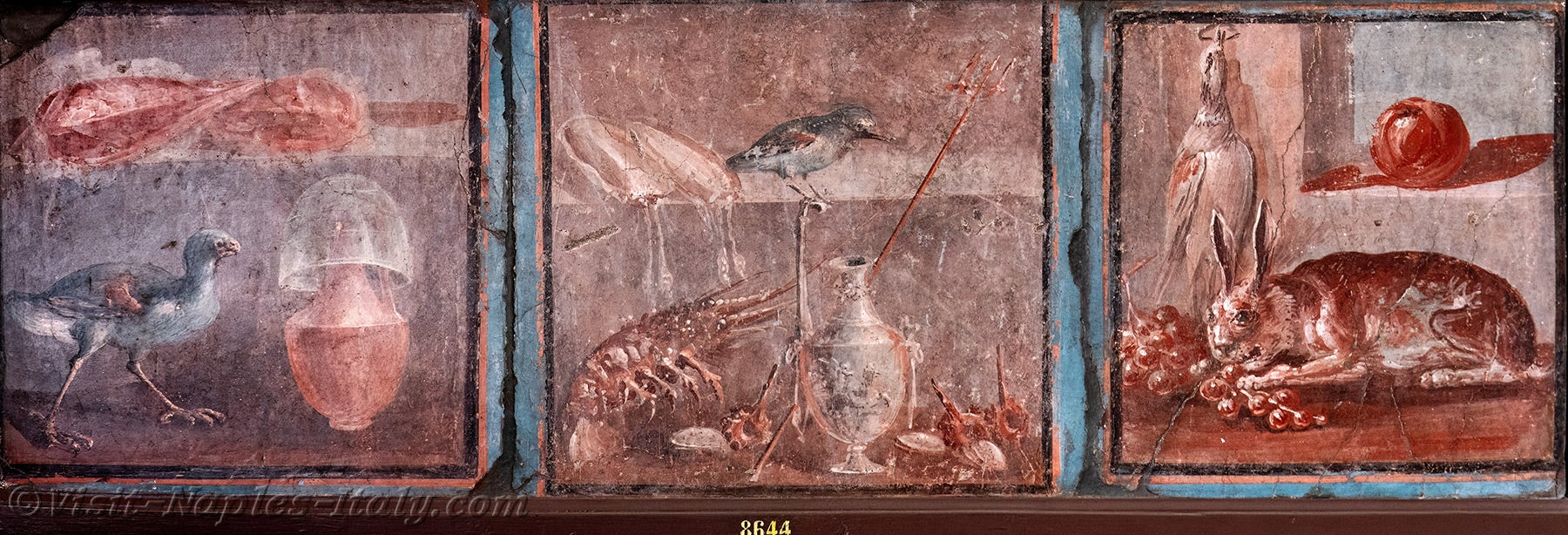
Still life, The Romans’ table It is interesting from a historical perspective, but also from an artistic one.
On the left-hand side, the artist has depicted two hams. The Romans ate them with honey and spices.
Below the hams, we can see a sultan hen approaching a terracotta jug covered with a glass bowl.
In the centre of the scene are two cuttlefish placed on a shelf, beneath which we can see murexes, clams and a lobster.
On the right, a partridge is suspended by its beak, while a rabbit feasts on a bunch of grapes placed on a table.
Still Life, The Roman Banquet, Herculaneum, Casa dei Cervi
Fresco - Water-based pigments on coating (40 × 168 cm) 45-79 ADLike the previous one, this fresco was located in the House of the Deer in Herculaneum.
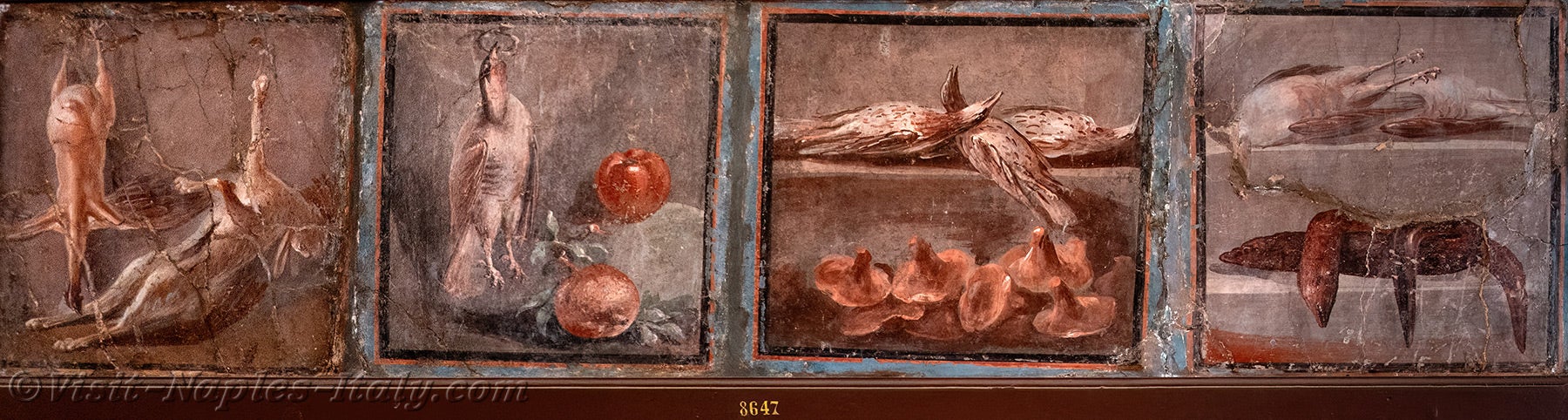
Still Life, Roman Banquet It completes the list of the Romans' favourite foods of that period.
In the left-hand panel, a plucked chicken hangs from a nail. Next to it, a hare, already gutted, hangs by one leg.
In the next frame, a partridge is suspended from a ring. An apple and a pomegranate can also be seen.
In the following frame, three thrushes are placed on a shelf under which there are mushrooms.
Finally, in the last frame, on the top shelf, we can see two partridges. Below them are several moray eels.
Peaches, dates, figs and gold and silver coins, Herculaneum, Casa dei Cervi
Fresco - Water-based pigments on plaster (40 × 119 cm) 45-79 ADThis fresco was found with the two previous frescoes in the House of the Deer in Herculaneum.
On the left, we see peaches and a glass water jug. These peaches are also depicted in the same way in the right-hand panel.
In the centre, a silver dish contains figs, plums and dates.
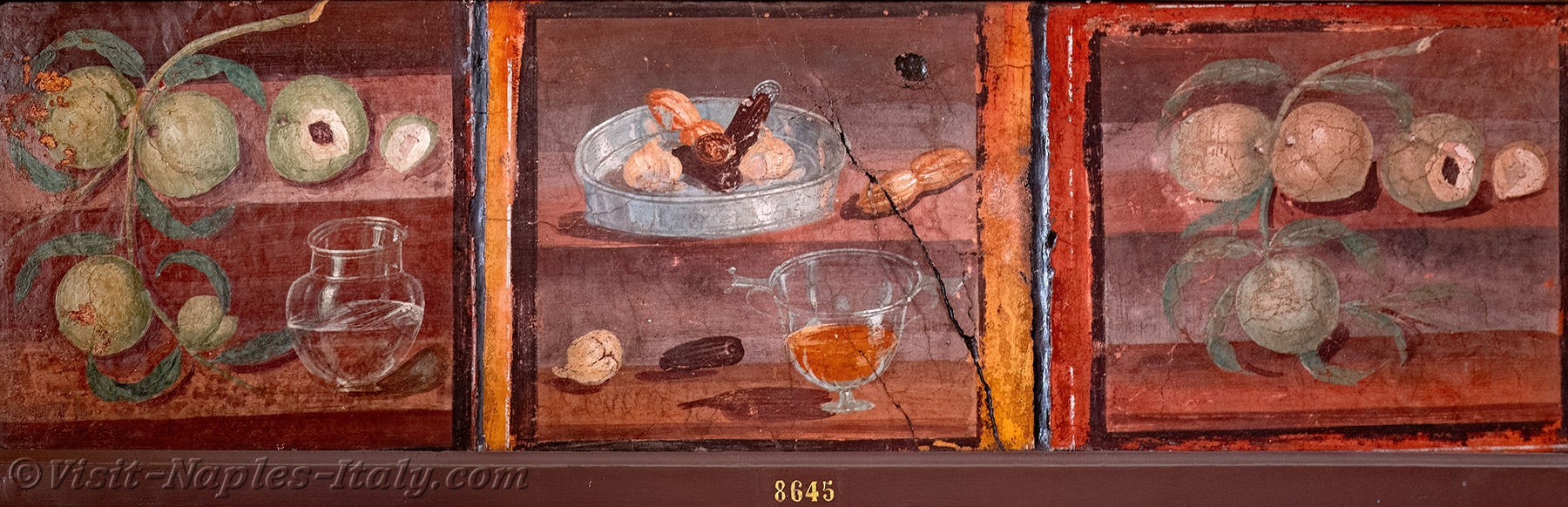
Peaches, dates, figs and gold coins It is important to note that a silver coin is embedded in one of the dates, and a gold coin in the other.
These coins stuck in the dates refer to the New Year and the gifts that were given on this occasion.
On this date, the calends of January were celebrated in honour of Janus, the Roman god of beginnings and endings.
Originally, these were small, simple gifts that were meant to ensure that the coming year would be a good one, hence the gift of figs, dates and honey.
Then, among the wealthiest Romans, these gifts were considered too humble and added to the dried fruit were 45-79 AD and silver, as in this fresco.
Ovid refers to this by having the god Janus say that money is even sweeter than honey!
Pigeons and olives, Pompeii
Fresco - Water-based pigments on Coating (37 × 37 cm) 45-79 AD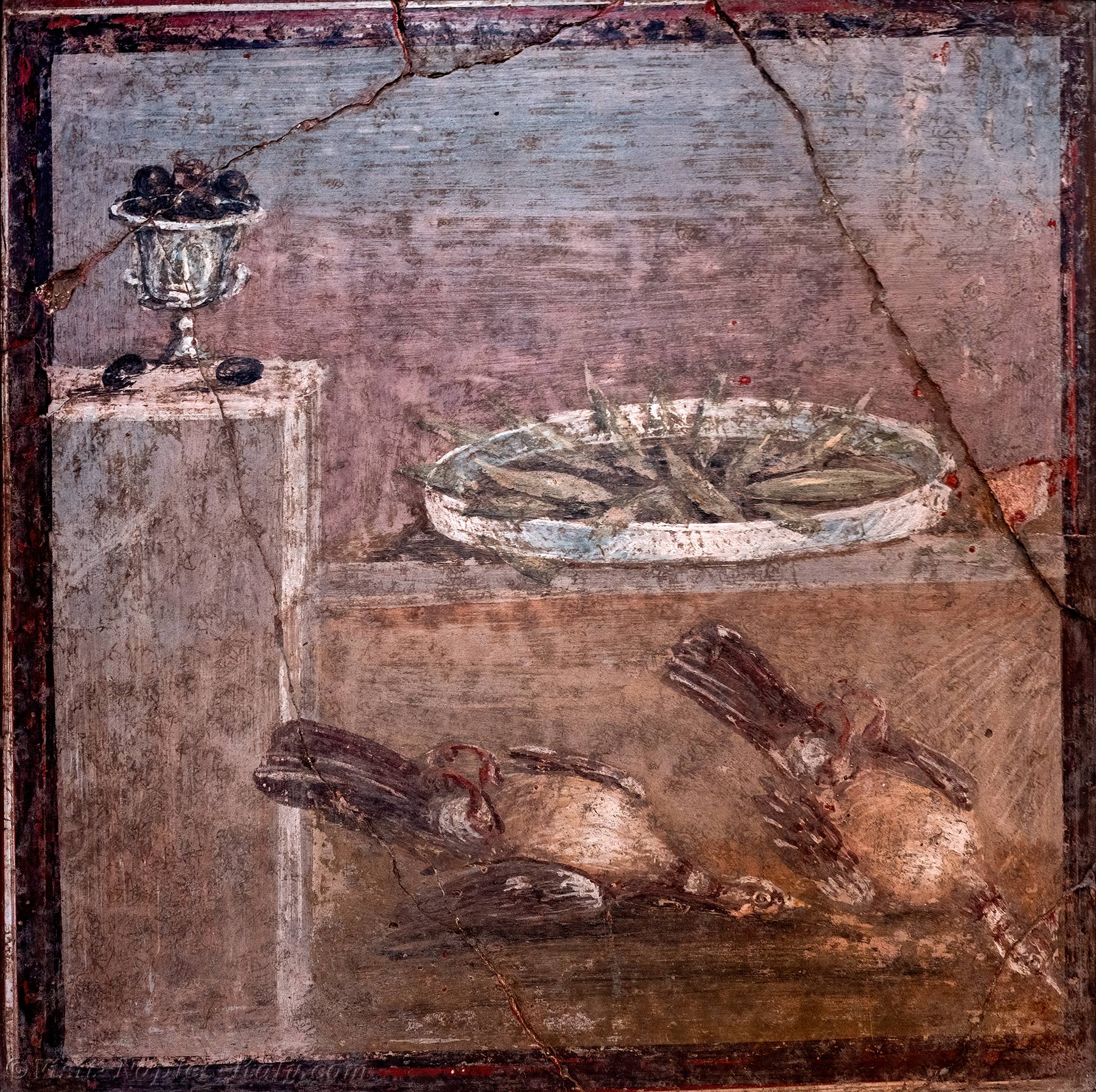
Pigeons et olives In this still life from Pompeii, we can see one of the Romans' favourite dishes at the time: partridge.
Two of them are depicted in this small painting.
Above them, in a silver dish, are small fish, which could be sardines.
However, some specialists in antiquity believe that these are beans and not fish.
Finally, on the left, we can see a small silver cup with two handles.
It is overflowing with black olives to such an extent that two of them have fallen at the foot of the cup.
Rabbit and Figs, Pompeii
Fresco - Water-based pigments on Coating (35 × 42 cm) 45-79 AD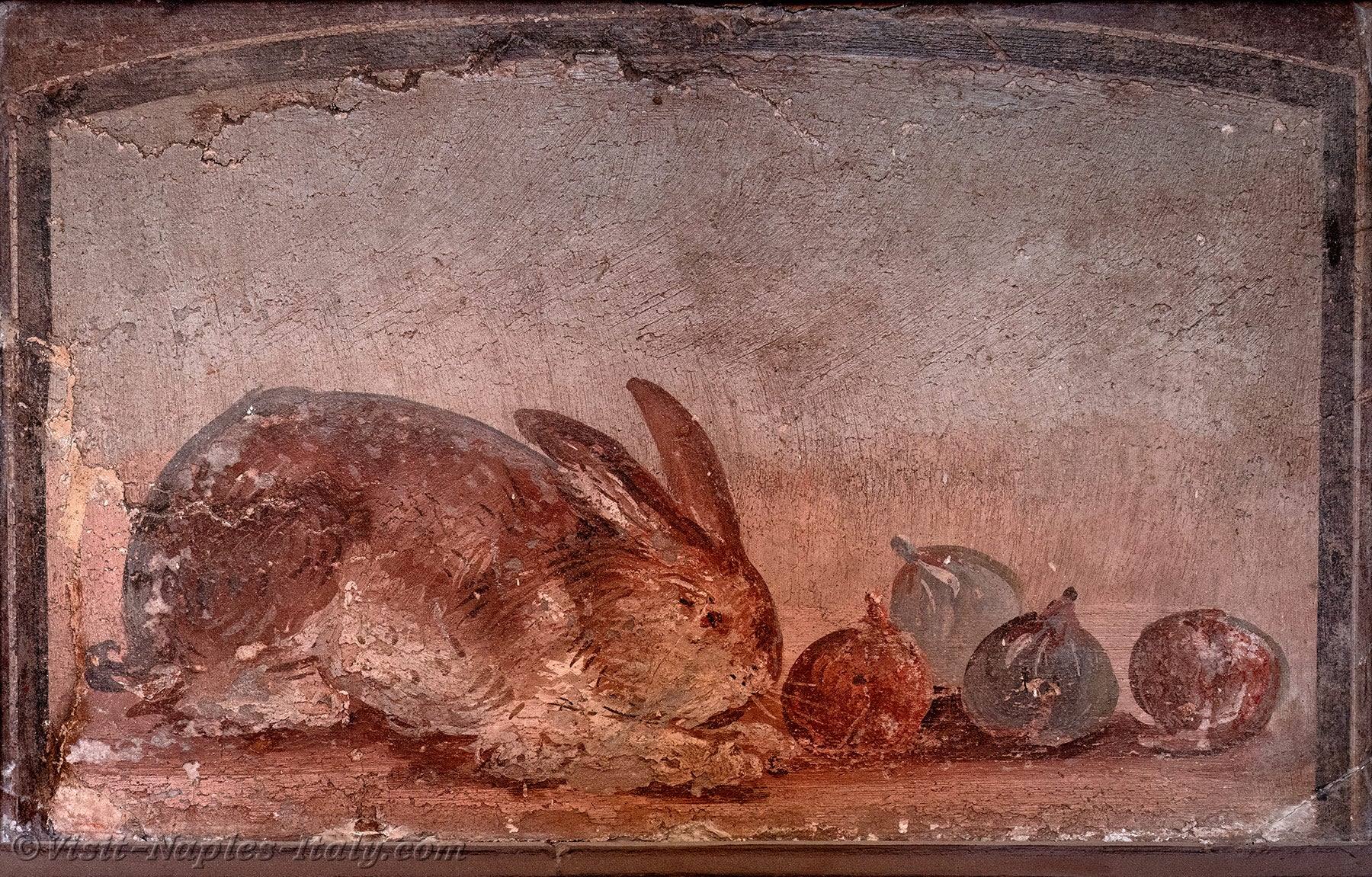
Rabbit and Figs This scene, discovered in Pompeii, is imbued with irony.
It depicts a rabbit, an animal prized for its meat, which is feasting on figs before becoming itself a delicious dish.
This is a nod that we have already seen in one of the previous frescoes, discovered in Herculaneum in the House of the Deer, where we saw a rabbit eating grapes.
From an artistic point of view, both the rabbit and the figs in front of it are beautifully painted, making it a small painting full of life.
Bread and Figs, Herculaneum
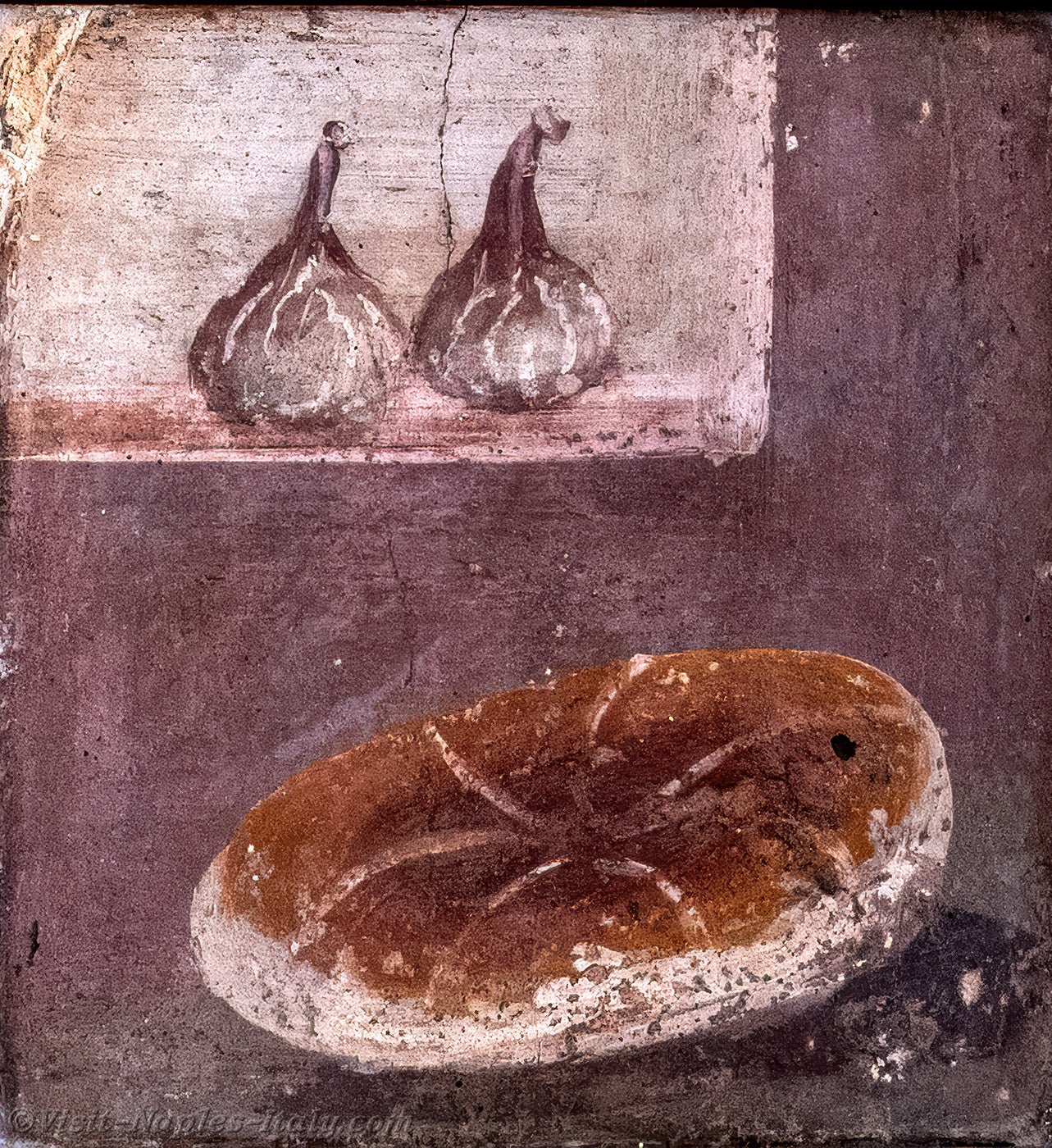
Bread and Figs Fresco - Water-based pigments on plaster
(23 × 23 cm) 45-79 AD
This small fresco discovered in Herculaneum shows us two figs.
They are placed on a window sill.
Below them, on the table, we can see a loaf of bread prepared to be broken into seven pieces.
Meals consisting solely of bread and figs were common among the poor and slaves.
However, we cannot be certain that this is the deeper meaning of this small still life.
Life Leisure Arts | Food | Young Women | Daily Life | Commerce | Sport
Frescoes Mythology | Portraits | Life Leisure | Animals | Religion | Landscapes | Decoration
Artworks Sculptures | Frescoes | Eroticism
MANN Artworks Schedule Tickets Location | Authorizations
Back to Top of Page