

MANN Artworks Schedule Tickets Location | Authorizations
Artworks Sculptures | Frescoes | Eroticism
Frescoes Mythology | Portraits | Life Leisure | Animals | Religion | Landscapes | Decoration
Life Leisure Arts | Food | Young Women | Daily Life | Commerce | Sport
Frescoes depicting artistic leisure activities in Pompeii and Herculaneum at the Archaeological Museum of Naples, Italy
Woman painter, Pompeii, Casa del Chirurgo
Fresco - Water-based pigments on coating (45 × 45 cm) 50-79 AD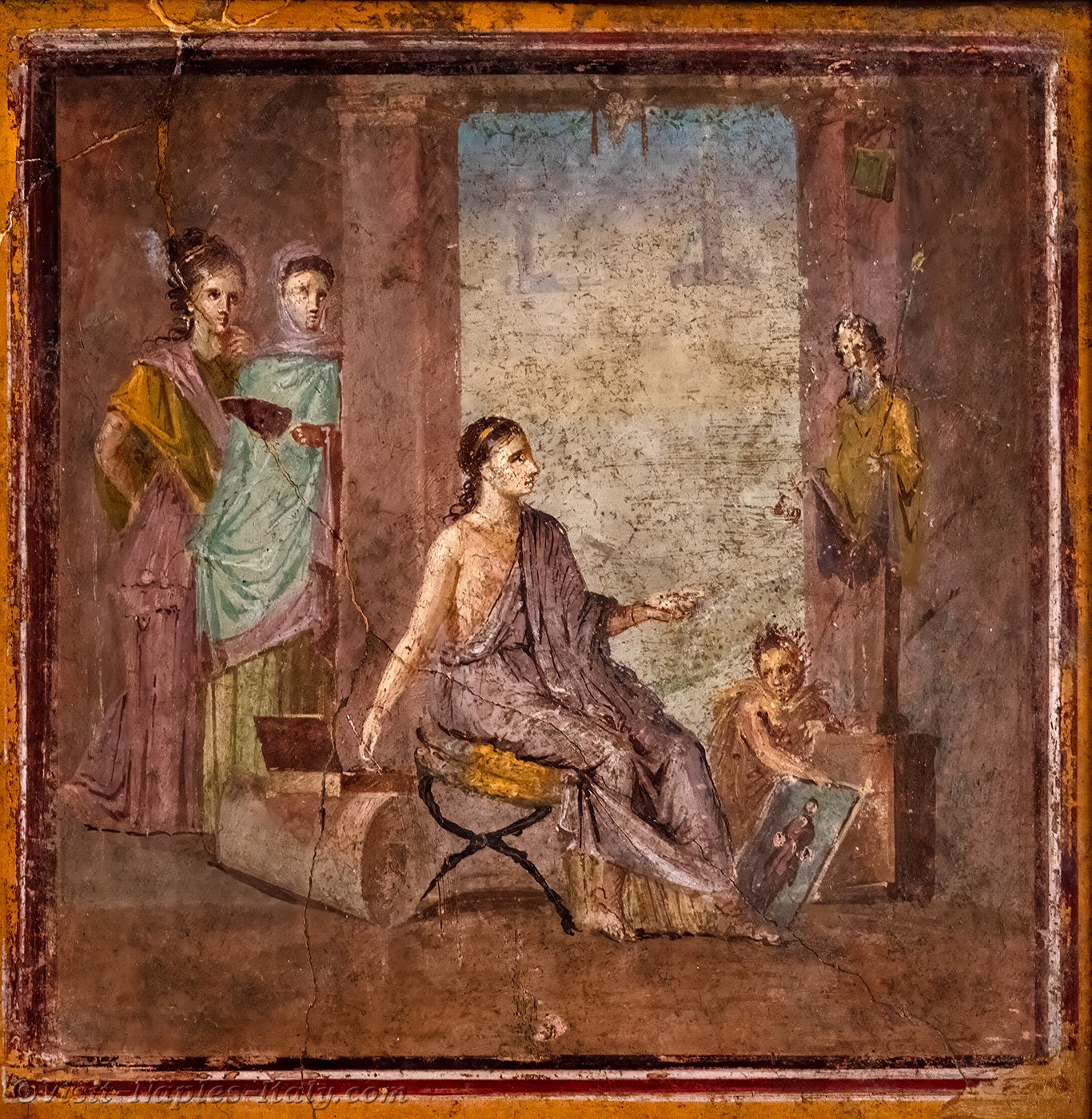
Female painter This scene « of genre » shows us a female painter in her studio.
She is seated on a stool and focuses her gaze on her subject: a sculpture representing Dionysus or perhaps Priapus.
A young boy, wearing a crown, is kneeling in front of her and holding her painting.
The artist holds a paintbrush in her right hand, which she dips into the paint box next to her.
Two women, standing behind her, observe the progress of her work.
One of them is holding a fan.
Female painter, Pompeii
Fresco - Water-based pigments on Coating (50 × 49 cm) 50-79 AD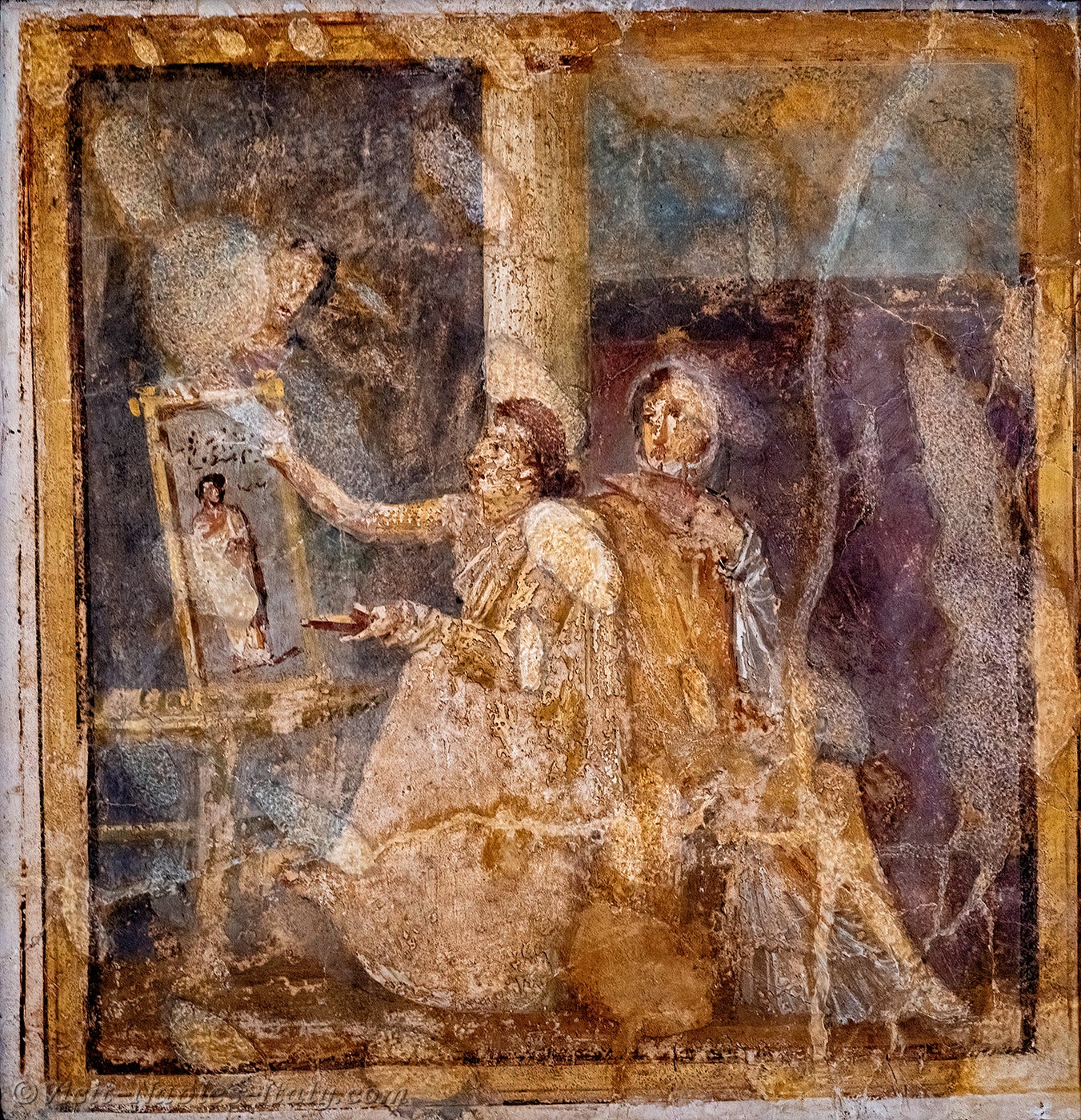
Female painter This fresco, which is a genre subject, depicts a painter in her studio.
Seated in front of a column, the artist is putting the finishing touches to her work, which is almost complete.
She is holding a small palette in her left hand and a paintbrush in her right hand.
The subject of the painting is an individual, male or female, wrapped in a cloak or toga.
Right next to the artist, a woman sits, captivated by the work in progress.
She holds a fan in her left hand.
One might wonder if she is not herself the subject of the painting she is looking at, as her hair is the same colour as that of the figure depicted.
Maenads and Dancers, Pompeii, Villa di Cicerone
Fresco - Water-based pigments on Coating (30.5 x 161.5) 1-37 AD
Maenads and Dancers Elegance, lightness, grace and beauty are found in this fresco depicting Maenads and dancers in Cicero's villa in Pompeii.
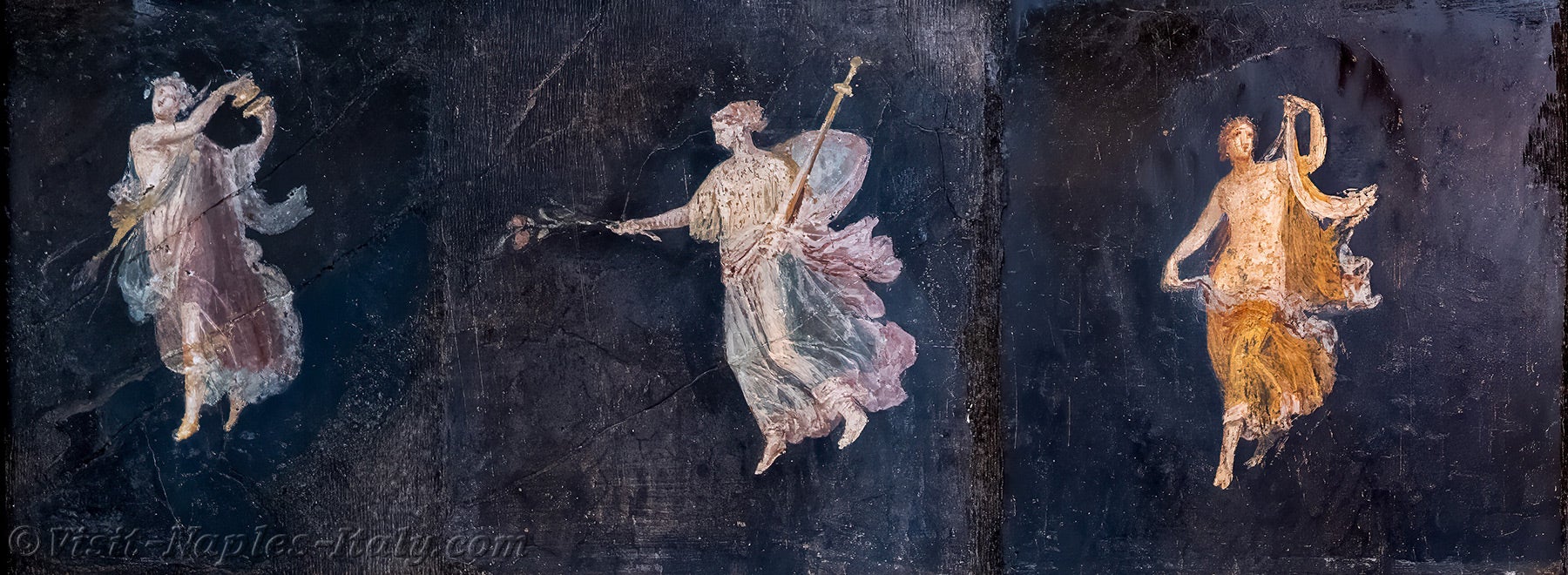
Maenads and Dancers This fresco is also interesting because it shows us part of life and leisure activities in Pompeii.
It should be noted that the young woman on the right is not dancing, but is carrying a dish in one hand and a small amphora containing what is certainly wine in the other.
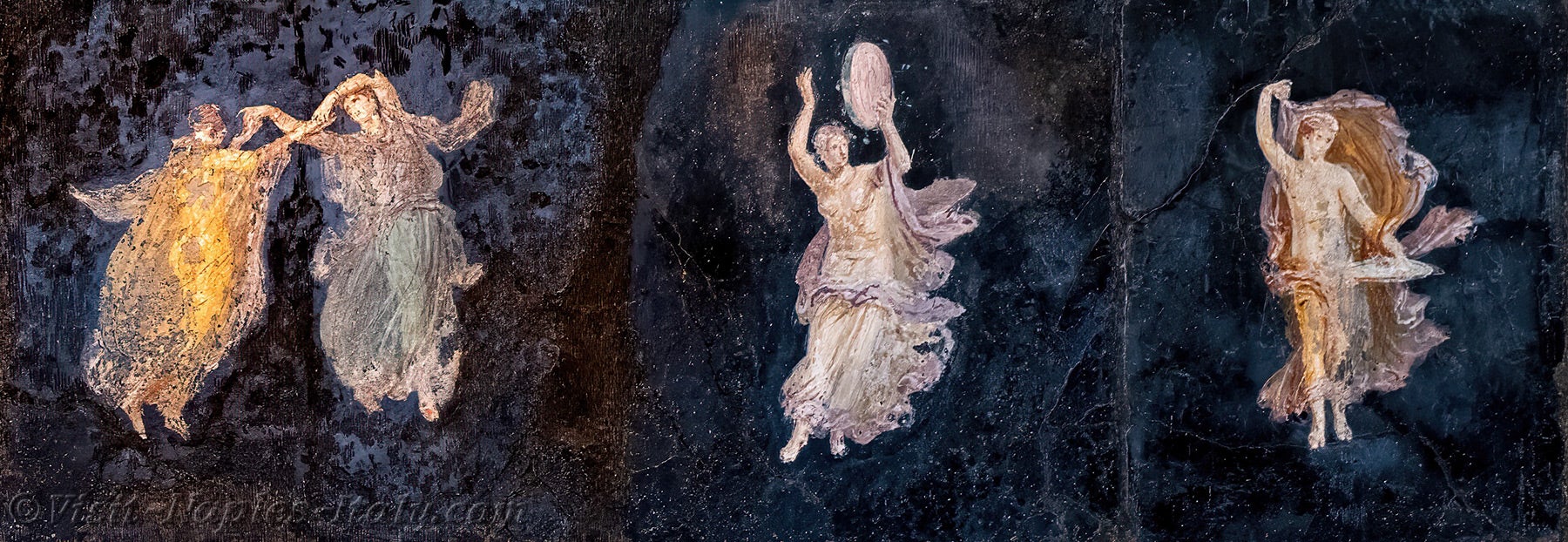
Maenads and Dancers This meant that the dancers were also admired while people were eating.
It should also be noted that one of them plays the tambourine while she dances.
Another dancer strikes two small metal cymbals.
Dancers, Pompeii, Villa di Cicerone
Fresco - Water-based pigments on Coating (27 × 71.2 cm) 1-37 ADThis second fresco, depicting dancers in Cicero's villa in Pompeii, is equally remarkable for its beauty and vitality.
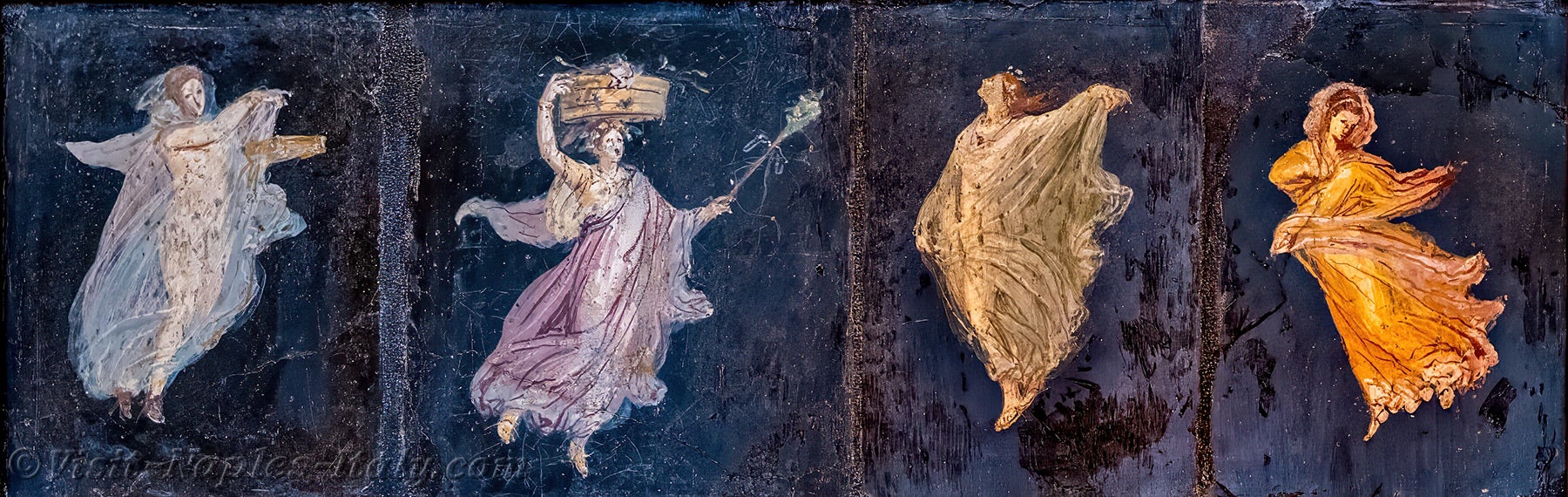
Dancers, Pompeii These dancers seem to float gracefully through the air, their light, transparent dresses and tunics billowing gently around them.
These veils reveal glimpses of their naked bodies, adding to their charm and elegance.
These beautiful dancers, who enjoyed immense success in Europe after their discovery in the 18th century, have been the subject of numerous copies and reinterpretations.
Actor and zither player, Herculaneum, Basilica-Teatro
Fresco - Water-based pigments on Coating (46 × 46 cm) 45-79 ADThis fresco, which is a genre scene, shows an actor and a zither player.
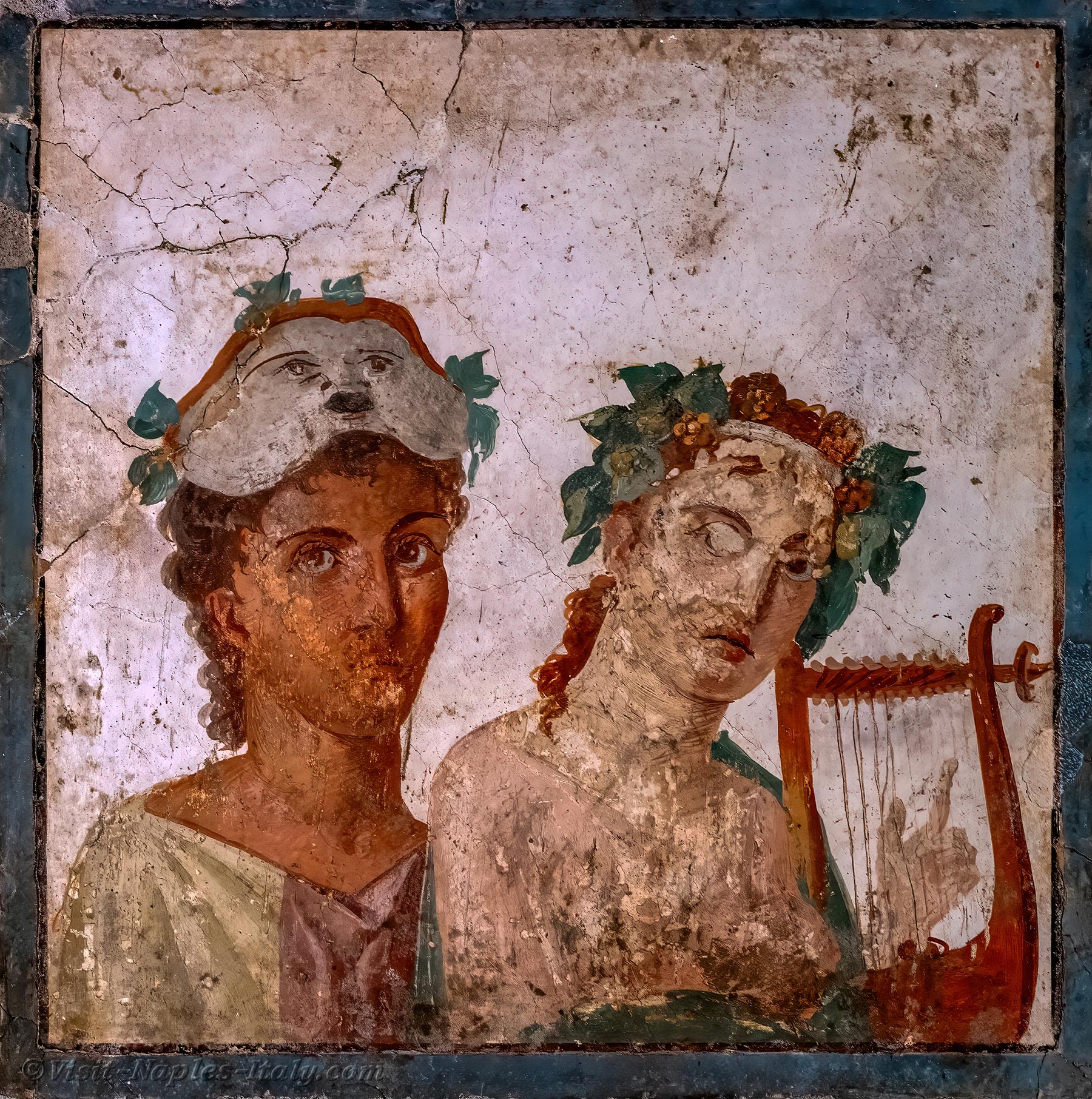
Actor and zither player Their busts are positioned in three-quarter view, in accordance with the artistic conventions of the period for this type of representation.
The masks they wear are those found in the plays of the «Commedia Nuova».
They are decorated with ivy, as well as flowers for the musician's mask.
The theatrical performance has just ended and the young man has already lifted his mask.
The zither player has kept her mask on and her index finger is still resting on the strings of her zither.
They are both looking straight at us, which reinforces their presence.
Musician and actress, Pompeii
Fresco - Water-based pigments on Coating (56 × 60 cm) 30-40 ADThe scene shows the preparation for a concert performance.
A musician, seated, is tuning her harp with a five-string zither, placed on her lap and held in her left hand.
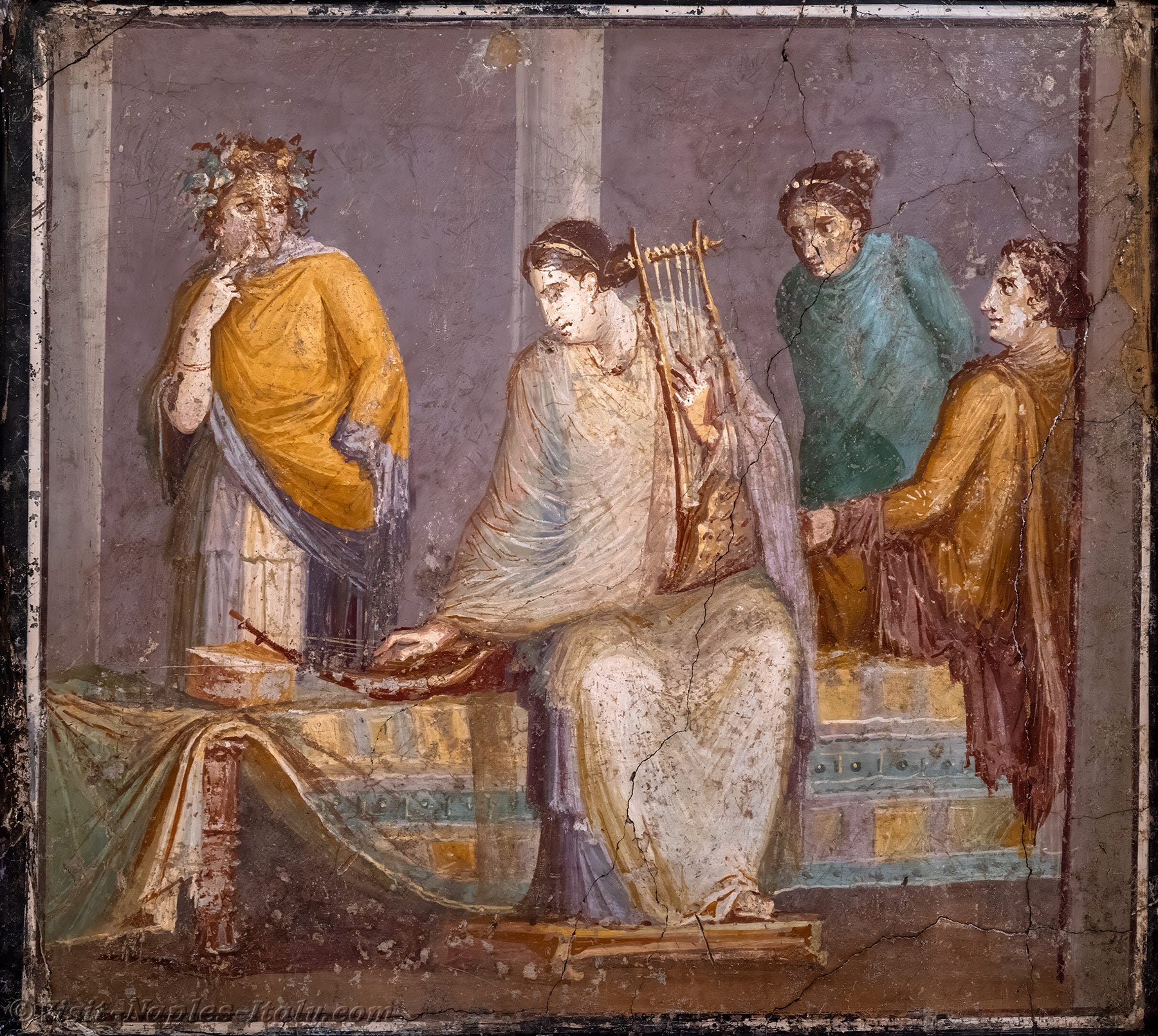
Musician and actress At the time, the lyre was mainly used by amateurs, while the zither, which was more complex but offered a wider range of sounds, was the instrument of choice for artists.
Another woman is seated to her right. Her gaze meets that of the actress, who is standing on the left.
The actress, dressed in a yellow dress and a white tunic, wears a crown of ivy, a symbol of actors, but also evoking the god Dionysus.
A second woman, whose hair is styled in a chignon and who wears a tiara or a string of pearls, watches attentively as the musician tunes her instruments.
This scene was reproduced in Pompeian style in the bedroom of Francesco I and Maria Isabella of Bourbon in Capodimonte.
Concert Fresco, Herculaneum, Palestra, Insula Orientalis, Archaeological Museum of Naples
Fresco - Water-based pigments on coating (44 × 44 cm) 30-40 ADWhen this painting was discovered in 1761 on the floor of the gymnasium in Herculaneum along with others, it was believed to be Greek originals.
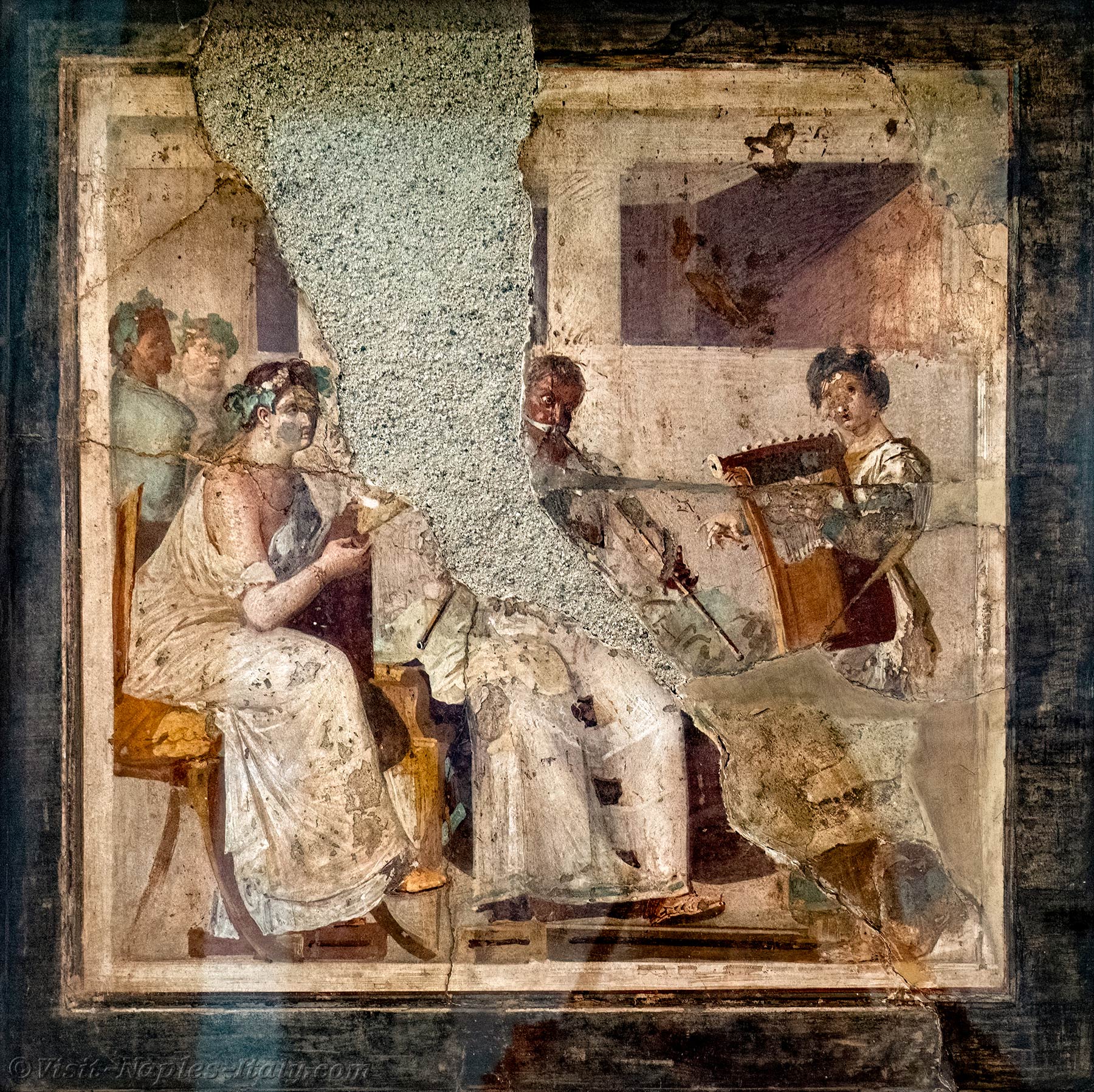
Concert in Herculaneum In reality, these were frescoes of the third style that had been detached from their wall to be reintegrated into a new decorative ensemble corresponding to the fourth style, which was then in vogue.
Seated on the left, crowned with ivy and wearing jewellery, a woman holds a tablet and appears to be setting the rhythm for the two musicians in front of her.
In the centre, a man with puffed cheeks blows into a double flute.
This flute is directly attached to his mouth with a «Phorbeia». The Phorbeia was a leather strap pierced with two holes for the reeds of the flute.
It was attached to the back of the musician's head, helping him to hold the instrument against his mouth while he blew.
On the right of the fresco, a young musician plays the lyre by plucking the strings with a plectrum.
The actor king, Herculaneum, Palestra, Insula Orientalis
Fresco - Water-based pigments on coating (39 × 39 cm) 30-40 AD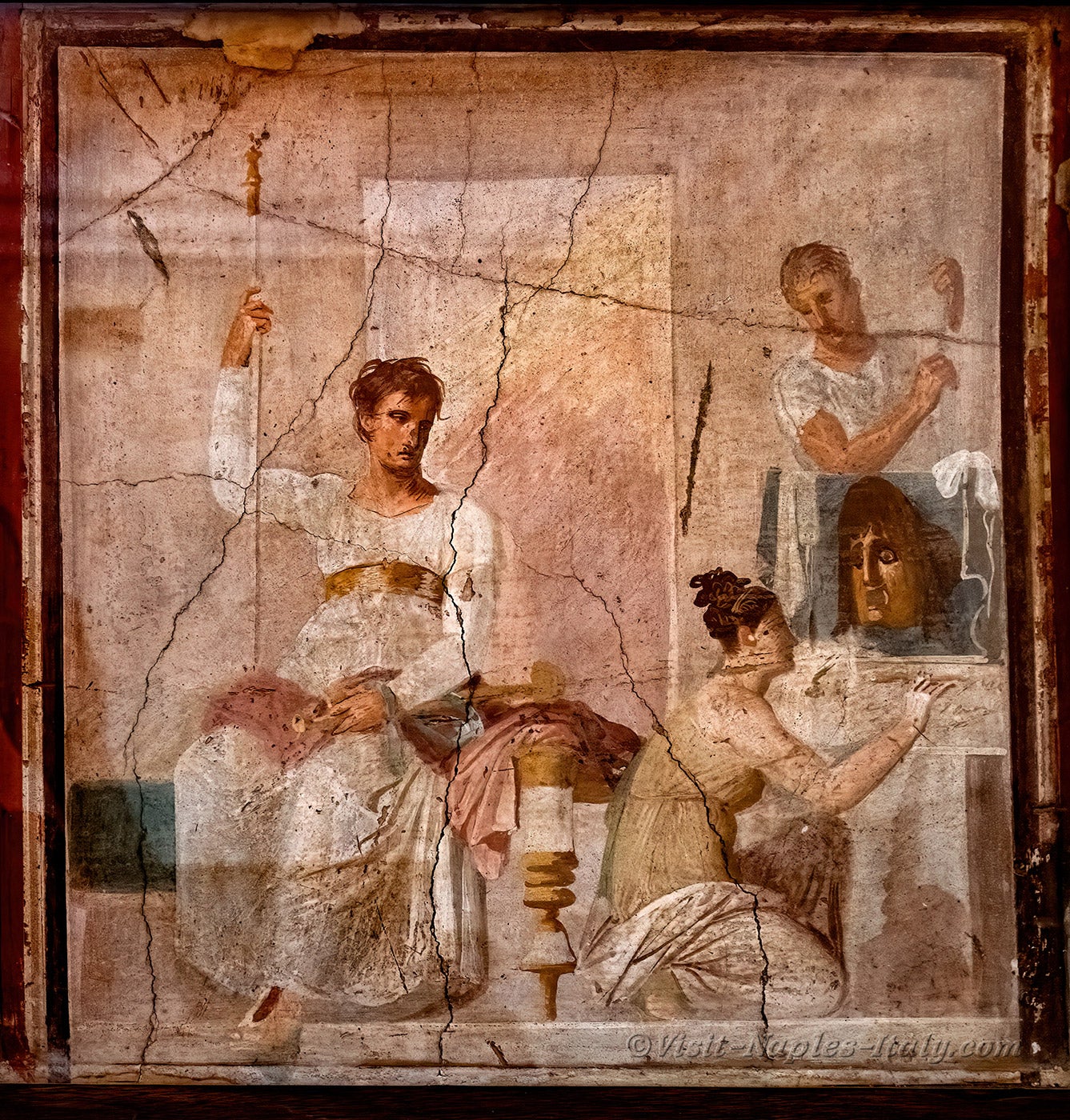
The King Actor This mural, like the previous fresco from the concert, was one of a series of detached paintings found in 1761 on the floor of the gymnasium in Herculaneum.
It depicts an actor dressed like a king holding a sceptre and a sword at his waist.
In front of him, a woman kneeling, wearing a chignon, is writing a text, perhaps a dedication, under a painting depicting a tragic theatre mask.
A man is standing behind the painting showing the tragic mask.
He appears to be undressing, as if the theatrical performance had just ended.
Tragic mask, Pompeii, Insula Orientalis
Fresco - Water-based pigments on coating (34 × 32 cm) 50-99 BC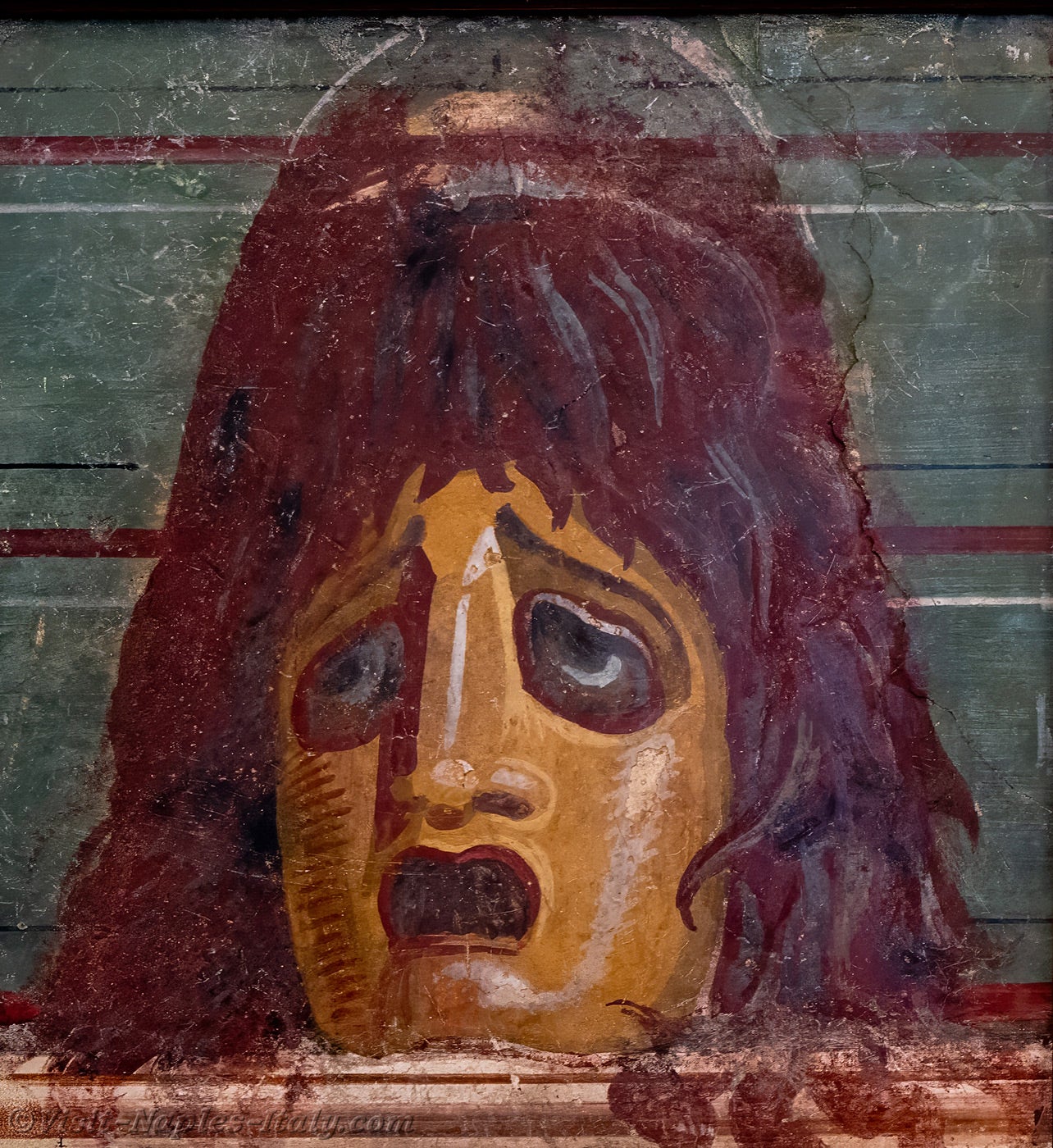
Tragic mask This fresco, discovered in Pompeii, depicts a tragic theatre mask.
This tragic mask features abundant hair, descending to the lower edge of the frame, creating an illusion of depth.
This is an artistic technique that is frequently found in frescoes depicting tragic masks in Pompeii and Herculaneum.
For the same purpose, the artist painted white lines on the green background to accentuate the relief effect, as if the background were bumpy.
Tragic mask, Pompeii, Insula Orientalis
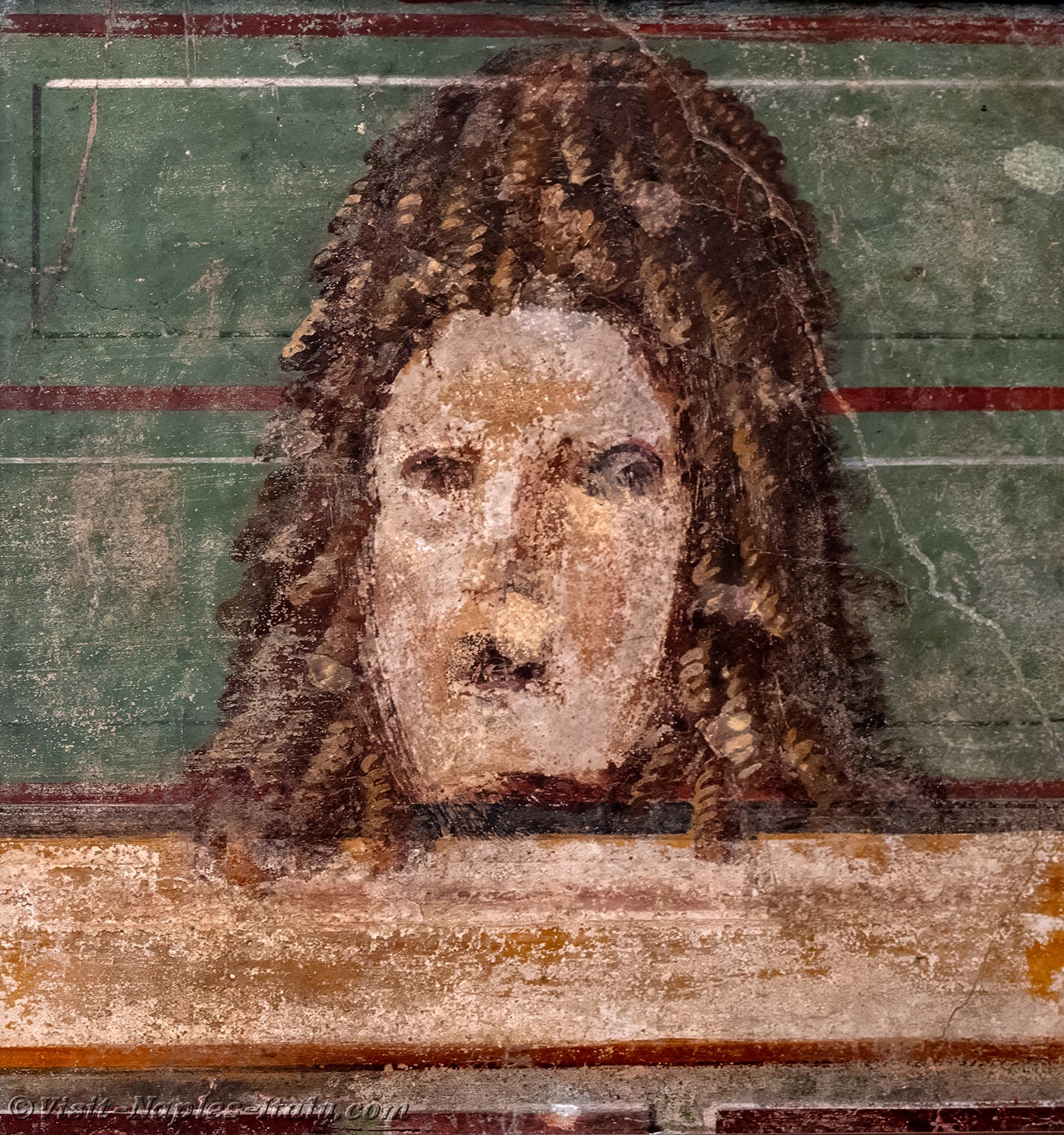
Tragic mask Fresco - Water-based pigments on coating (38 × 38 cm) 50-99 BC
This second painting, also depicting a tragic mask, was discovered in Pompeii, in the same place as the previous one.
This tragic mask has a thick, curly hairstyle that spills over the bottom of the frame, creating an illusion of depth, just like in the previous painting.
Here we also find white lines painted on the green background to give the impression that the wall is bumpy.
Tragedy Scene, Pompeii, Casa dei Dioskouros
Fresco - Water-based pigments on coating (66 × 57 cm) 62-79 AD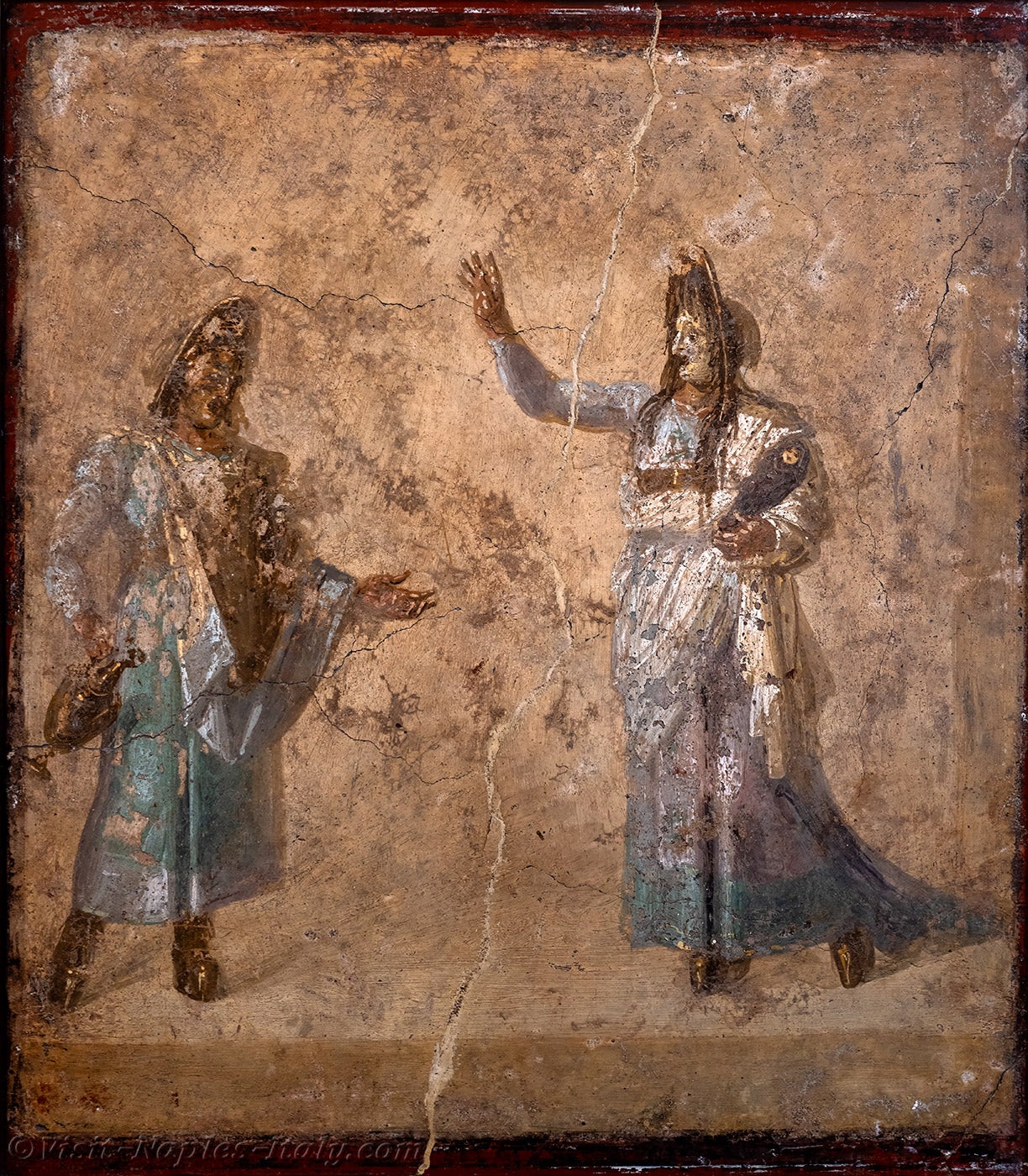
Scene from a Tragedy This fresco discovered in the Casa dei Dioscuri in Pompeii depicts a tragic theatre scene.
The woman on the right wears a mask similar to those worn by tragic actors of the time.
She and the actor in front of her both wear high cothurnus shoes.
Cothurnus were thick-soled shoes worn by actors in ancient times.
The woman is holding a doll in her arms, symbolising a child.
Her presence is probably related to the subject of the play.
Opposite her, the man is holding a wine jug and responding to her.
He is also wearing a tragic mask.
Life Leisure Arts | Food | Young Women | Daily Life | Commerce | Sport
Frescoes Mythology | Portraits | Life Leisure | Animals | Religion | Landscapes | Decoration
Artworks Sculptures | Frescoes | Eroticism
MANN Artworks Schedule Tickets Location | Authorizations
Back to Top of Page