

Capodimonte Artists Schedule Tickets Location | Authorizations
Artists Palace Gardens | Bellini | Botticelli | Bronzino | Brueghel | Canova | Caravaggio | Gentileschi | Giambologna | Giordano | Greco | Lotto | Luini | Mantegna | Masaccio | Masolino | Michelangelo | Palma | Parmigianino | Porta | Raphael | Reni | Titian | Van Dyck | Warhol
Pieter Brueghel the Elder (1527-1569) The Parable of the Blind Men and the Misanthrope, at the Capodimonte Museum in Naples
Pieter Brueghel the Elder “The Parable of the Blind”
Painting - Tempera on canvas (85.5 x 154 cm) 1568Jesus described the spiritual wretchedness of the Pharisees in the form of a parable, saying: “They are the blind leading the blind.
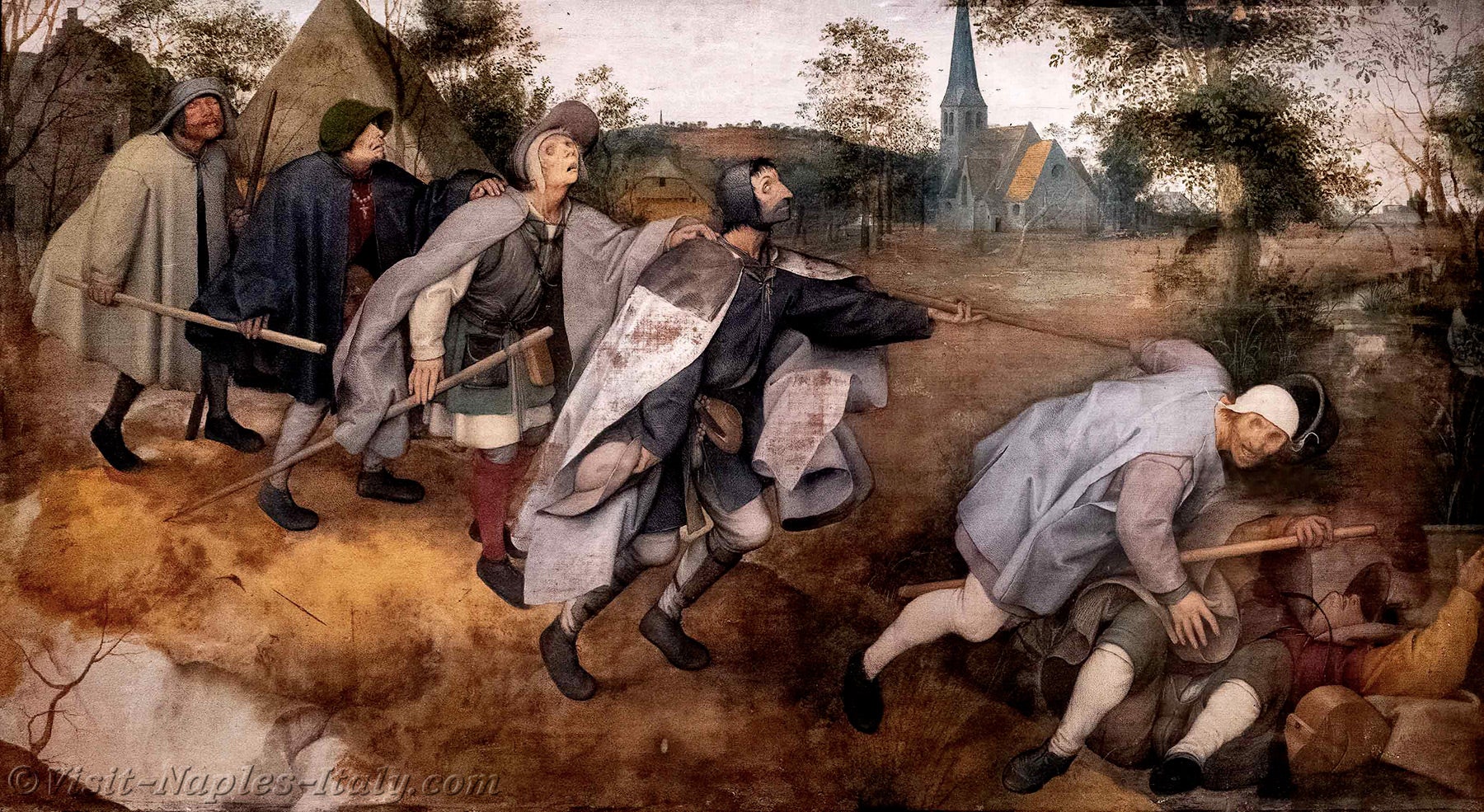
Brueghel, The Parable of the Blind However, if a blind man leads a blind man, both will fall into a hole.”
Pieter Brueghel the Elder did not fail to illustrate the famous parable in this painting, by ridiculing the stubborn rejection of the truth that characterises spiritual blindness with this tragicomic image of these men, victims of their collective physical blindness, deprived of a guide to save them.
We see six blind men in single file, each holding on to the cane of the one in front of them.
The first of the blind men has just fallen into the hole and the next one is stumbling to join him, dragging along with him the one following behind in complete confidence, unaware of what awaits him.
And one smiles, realising that they will all fall in, every last one of them.
Pieter Brueghel the Elder “The Misanthrope”
Painting - Tempera on canvas (86 x 85 cm) 1568Pieter Brueghel shows us an elderly man with a white beard. His bitterness is written all over his face. He is dressed in black, in mourning, his fingers interlaced.
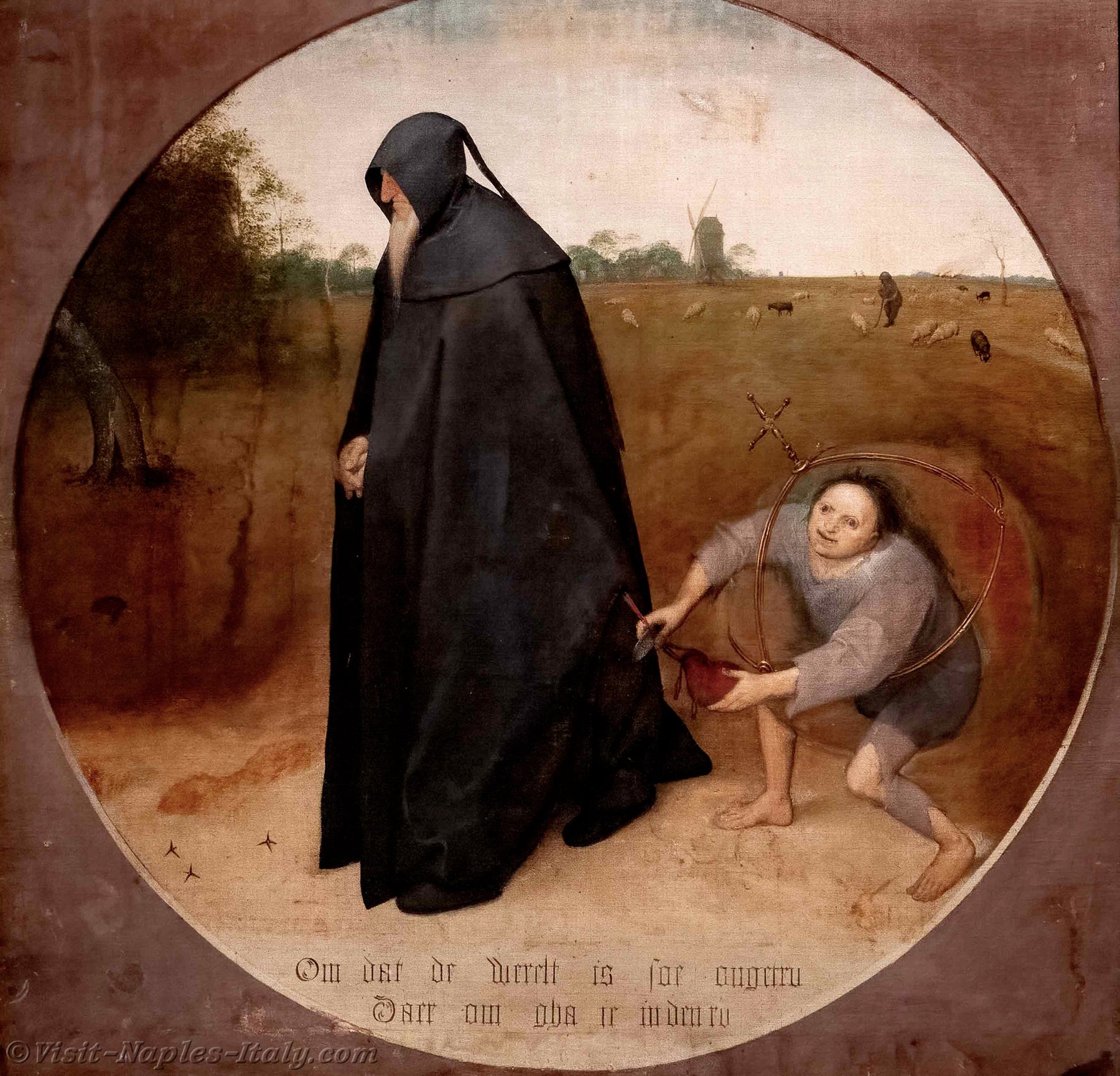
Brueghel, The Misanthrope The hood of his coat completely covers his head and barely allows him to see in front of him.
He is not only bitter, he is also in mourning, mourning the world he rejects. Brueghel wrote at the bottom of the painting: “Since the world is so treacherous, I am in mourning.”
But Brueghel’s distinctive humour adds to the bitterness of this man who rejects the world, the presence of this world, whether he likes it or not.
He is oblivious to the landscape, in which we can see a shepherd quietly tending his sheep, whilst a young thief takes advantage of his mental distraction to steal his purse—the cord of which he is in the process of cutting, without realising it.
And we already know that the man’s suffering will not end there when he catches sight of the three four-pronged metal spikes upon which he is about to step.
In fact, the misanthrope is above all a victim of his own wilful blindness; he could easily protect himself and guard against the dangers and misfortunes that lie in wait for him, provided he makes the effort. Too bad for him.
Artists Palace Gardens | Bellini | Botticelli | Bronzino | Brueghel | Canova | Caravaggio | Gentileschi | Giambologna | Giordano | Greco | Lotto | Luini | Mantegna | Masaccio | Masolino | Michelangelo | Palma | Parmigianino | Porta | Raphael | Reni | Titian | Van Dyck | Warhol
Capodimonte Artists Schedule Tickets Location | Authorizations
Back to Top of Page