

Capodimonte Artists Schedule Tickets Location | Authorizations
Artists Palace Gardens | Bellini | Botticelli | Bronzino | Brueghel | Canova | Caravaggio | Gentileschi | Giambologna | Giordano | Greco | Lotto | Luini | Mantegna | Masaccio | Masolino | Michelangelo | Palma | Parmigianino | Porta | Raphael | Reni | Titian | Van Dyck | Warhol
Artemisia Gentileschi (1593-1656) Judith Beheading Holofernes and The Annunciation, at the Capodimonte Museum in Naples
Artemisia Gentileschi “Judith Beheading Holofernes”
Painting - Oil on canvas (159 x 126 cm) 1612-1613The painting depicts the harrowing moment when Judith cuts off the head of the Assyrian general Holofernes.
Whilst her faithful maid Abra holds Holofernes’ left arm with both hands, Judith cuts off his head.
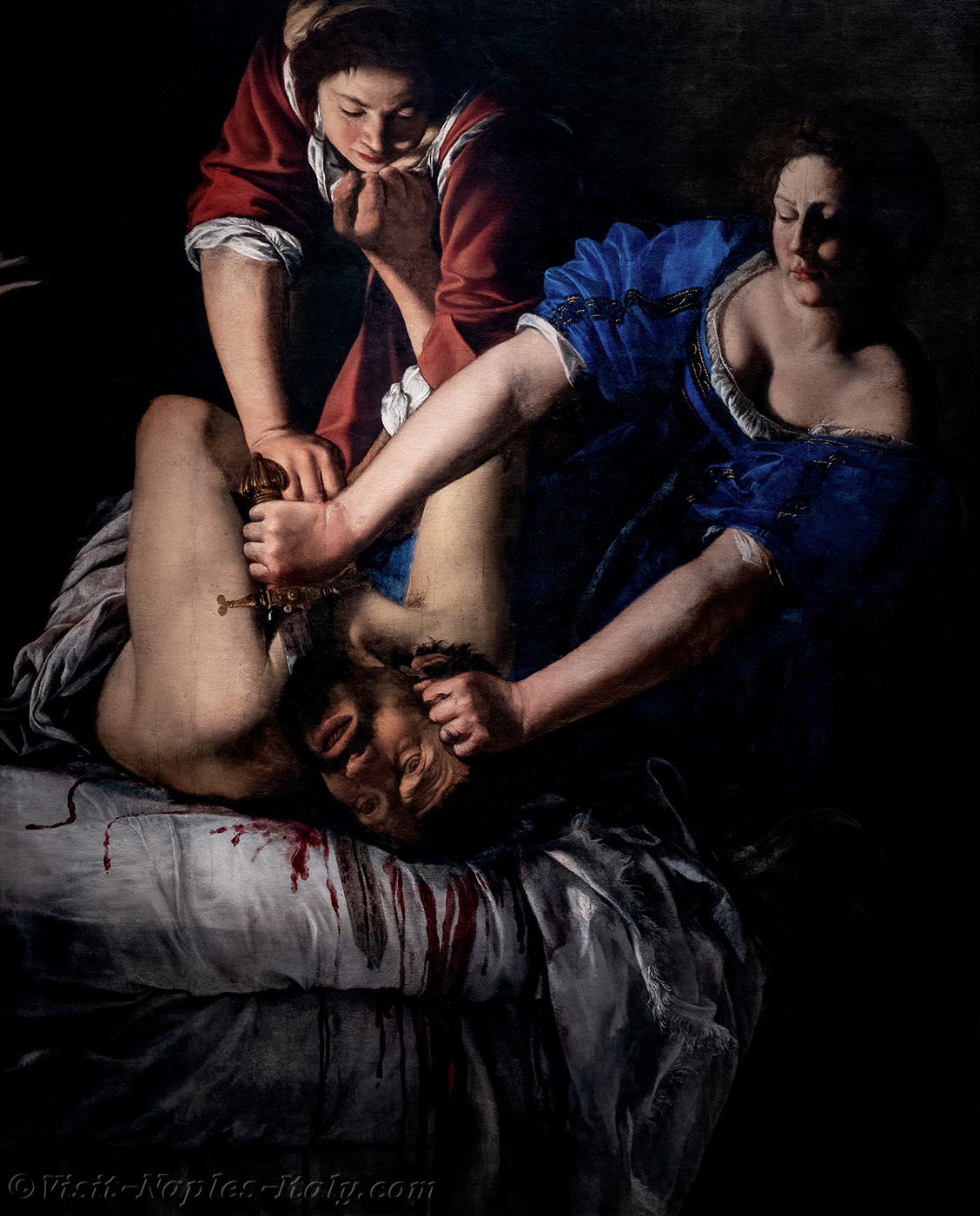
Judith and Holofernes Holofernes reacted by clutching the neckline of Abra’s shirt in his right hand, but he is already unable to push her away and his hand simply remains clenched on the edge of the garment whilst his gaze clouds over and fades.
The faces of Abra and Judith express their shared determination to carry out their mission without the slightest hesitation, and without fear of the blood spurting from Holofernes’ neck.
Judith clutches Holofernes’ hair in her left fist whilst holding his head firmly pressed against the bed.
With her right hand, in a bold and confident gesture, she cleaves her enemy’s head clean off without wavering, as shown by the way she grips the hilt of the deadly sword firmly.
The beauty and serenity of the two women dressed in red and blue contrast with the horror of the scene.
An effect reinforced by superb chiaroscuro in the style of Caravaggio, executed by Artemisia Gentileschi.
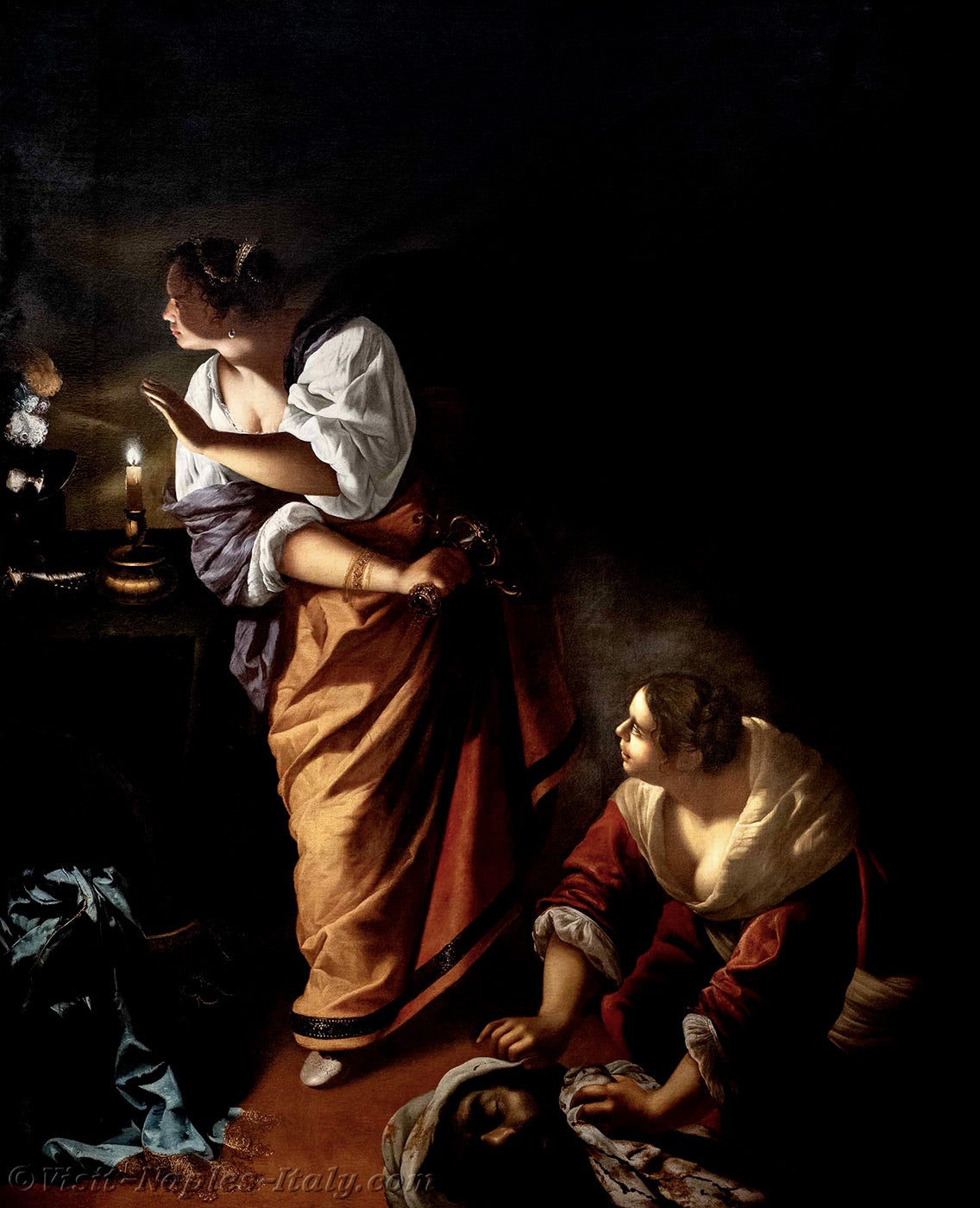
Artemisia Gentileschi “Judith and her Maidservant with the Head of Holofernes”
Painting - Oil on canvas (272 x 221 cm) 1645-1650Judith and her maid Abra have just murdered General Holofernes by beheading him.
They must now leave the enemy’s military camp as quickly as possible to return to Bethulia and announce the good news to its inhabitants. But before that, they want to take with them their trophy: the general’s head.
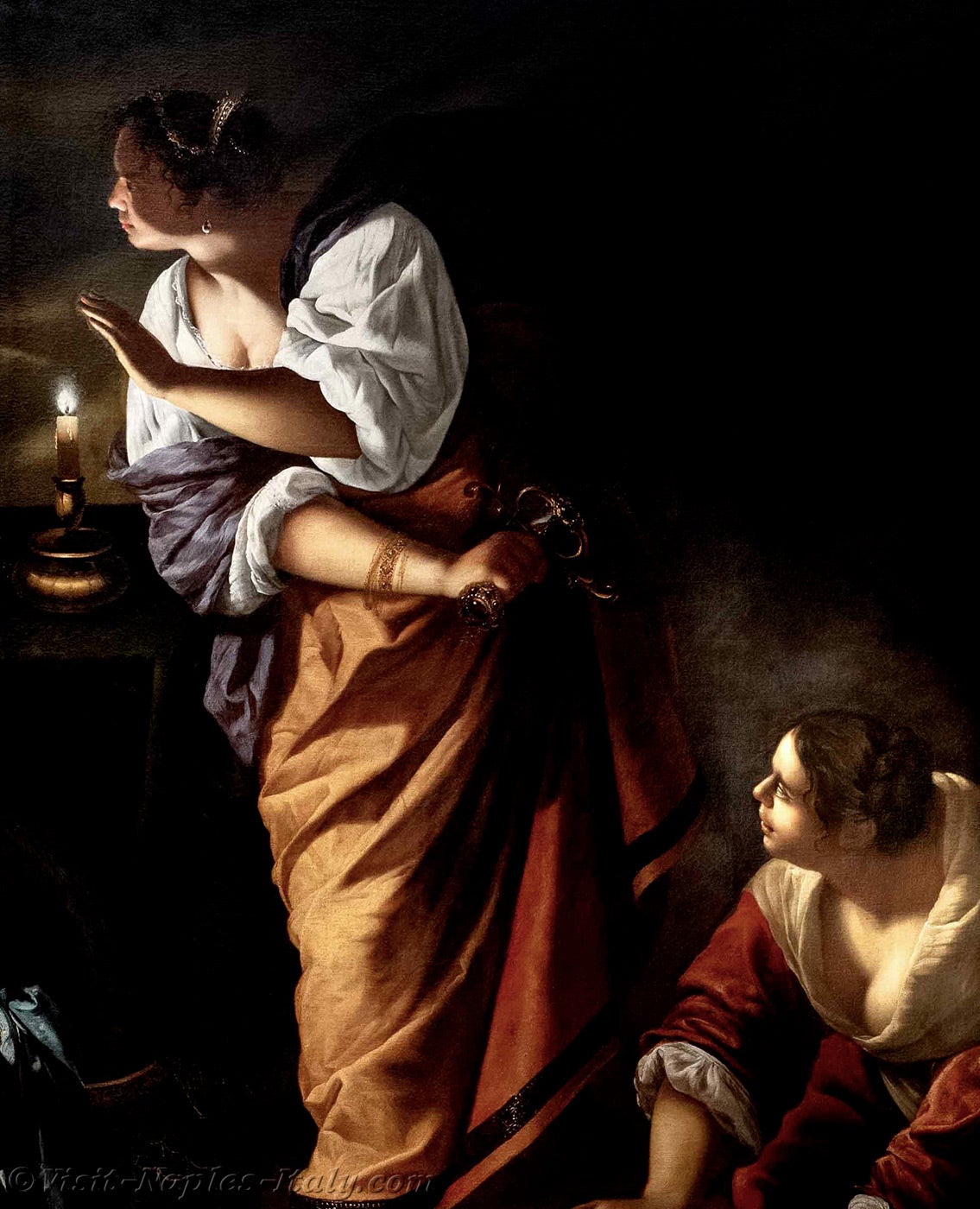
Abra is on her knees, wrapping Holofernes’ head in a cloth, whilst Judith, still holding the sword with which she severed their enemy’s head, prepares to blow out the candle that is lighting their way.
The glow of the candle brightly illuminates half of Judith’s face and upper body, whilst Abra is bathed in the same light, which sculpts their bodies and highlights the folds of their clothing to perfection.
As in her painting depicting Judith beheading Holofernes, Artemisia Gentileschi has once again masterfully employed chiaroscuro to convey the emotional power of the scene.
Artemisia Gentileschi’s ‘Annunciation’
Painting - Oil on canvas (257 x 179 cm) 1630This Annunciation by Artemisia Gentileschi depicts Mary standing before the angel kneeling at her feet, as in Botticelli’s Cestello Annunciation and that by Leonardo da Vinci, both on display at the Ufizzi Gallery in Florence.
Only Tintoretto’s Annunciation, painted for the Scuola Grande San Rocco in Venice, depicts the angel still in flight above Mary.
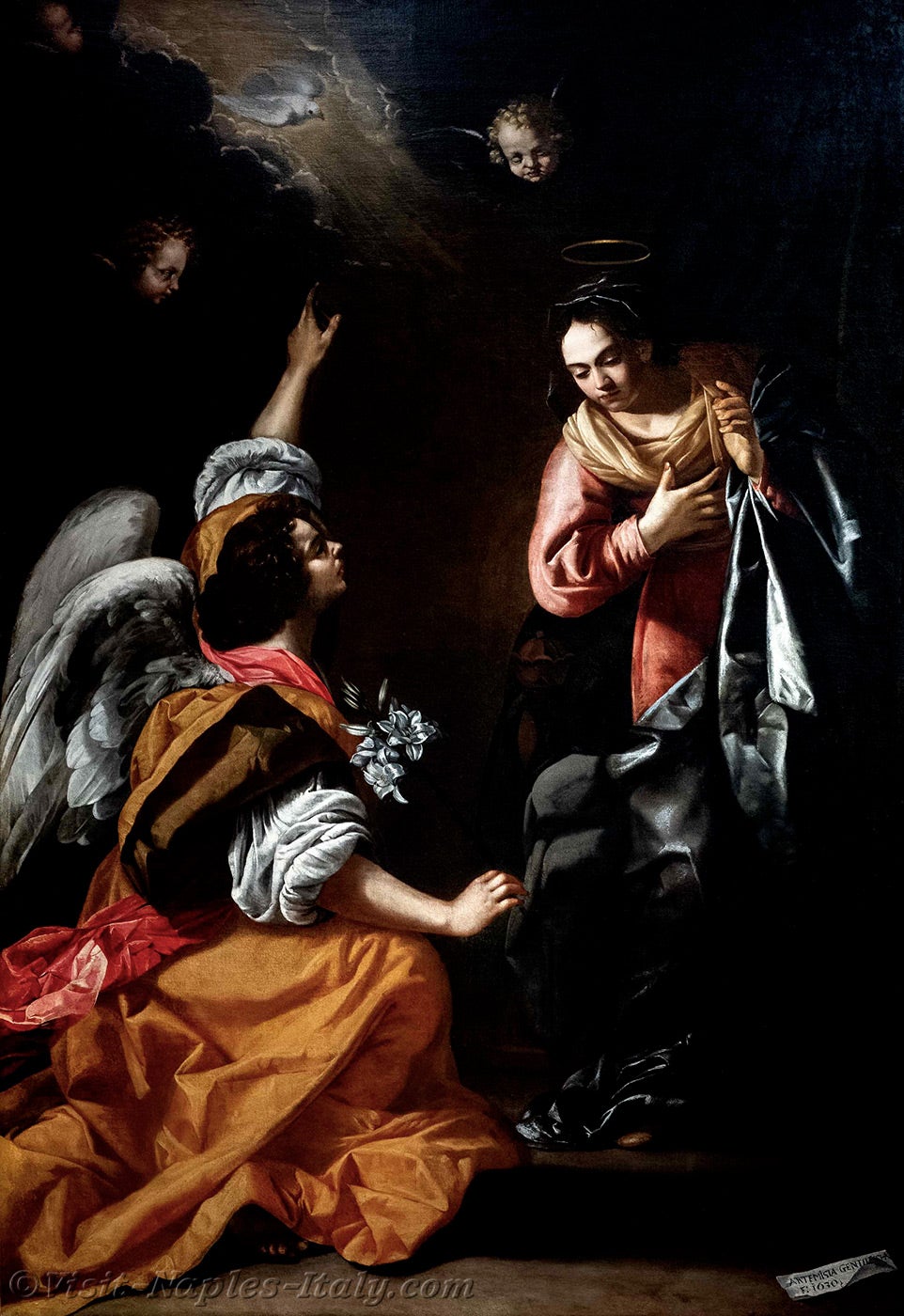
Gentileschi, Annunciation This Annunciation shows us that Mary is no longer a mere mortal at this solemn moment when she is chosen to give birth to the Baby Jesus: she becomes one of God’s chosen ones, with a halo above her head.
The angel Gabriel, at her feet, holds a bouquet of white lilies and reassures her, saying: “Do not be afraid, Mary, for you have found favour with God.“
With his left hand, he shows her the divine light that illuminates them, whilst his right hand makes a soothing gesture as he announces to her that she has been chosen to give birth to the Son of God.
Mary bows respectfully with her right hand close to her heart, lowering her eyelids to receive the divine child; she is suddenly no longer just a young girl, she will be the mother of Jesus Christ.
Only the movements of her hands betray her deep emotion upon hearing this news, one hand open in a gesture of astonishment and the other resting against her chest as a sign of love.
God, who is present in the form of the dove and the light that illuminates the Angel and the Virgin against the dark background of the scene.
Artists Palace Gardens | Bellini | Botticelli | Bronzino | Brueghel | Canova | Caravaggio | Gentileschi | Giambologna | Giordano | Greco | Lotto | Luini | Mantegna | Masaccio | Masolino | Michelangelo | Palma | Parmigianino | Porta | Raphael | Reni | Titian | Van Dyck | Warhol
Capodimonte Artists Schedule Tickets Location | Authorizations
Back to Top of Page