

Capodimonte Artists Schedule Tickets Location | Authorizations
Artists Palace Gardens | Bellini | Botticelli | Bronzino | Brueghel | Canova | Caravaggio | Gentileschi | Giambologna | Giordano | Greco | Lotto | Luini | Mantegna | Masaccio | Masolino | Michelangelo | Palma | Parmigianino | Porta | Raphael | Reni | Titian | Van Dyck | Warhol
Guido Reni (1575-1542) Atalanta and Hippomenes, The Four Seasons, at the Capodimonte Museum in Naples
Guido Reni “Atalanta and Hippomenes”
Painting - Oil on canvas (192 x 264 cm) 1620The story of Atalanta and Hippomenes is recounted by Ovid in his Metamorphoses (Book X):
“There was a woman, of whom you may have heard, who outran even the most agile of men.
What is said of her is no fable; it is true that she outstripped them all; one could not say what one admired most about her, the speed of her feet or the splendour of her beauty.”
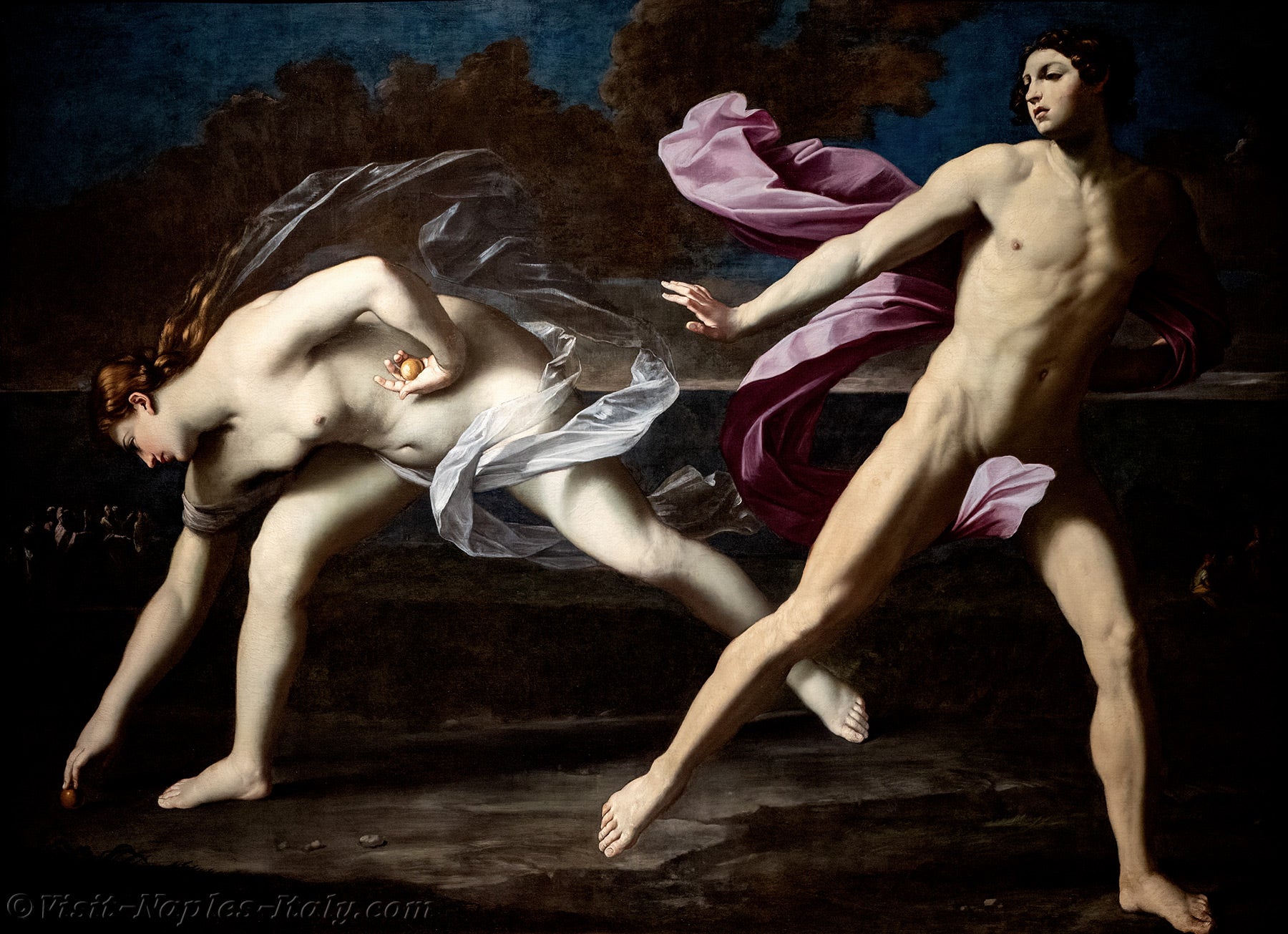
Guido Reni, Atalanta and Hippomenes After seeing Atalanta run, Hippomenes falls madly in love with her; to win her hand, he proposes a race with her, knowing that if he loses, he will die like all those who have previously challenged her, without success.
Atalanta accepted Hippomenes’ challenge, but she was struck by his beauty, just as he had fallen in love with hers.
According to Ovid, Venus recounts how Hippomenes addressed her before the race:
“Hippomenes calls upon me with an anxious voice: ‘May the goddess of Cythera, I beseech her, assist me in my endeavour and protect the flame she has kindled in my heart! [...]
Holding in my hand three golden apples that I had picked, and invisible to all but Hippomenes, I approached him and told him what he was to do with them.’ [...]
Oh! How many times, when she (Atalanta) could have gone first, did she linger to gaze upon that dear face and only take her eyes off him with regret!
But fatigue is beginning to parch the mouth of the panting Hippomenes, and the finish line is still far away; so at last, the descendant of Neptune hurls one of the three fruits from my tree.
The young girl, startled yet drawn to the gleaming apple, turns away mid-stride and picks up the gold that had rolled to the ground.
Hippomenes overtakes her; applause rings out across the arena.
Atalanta, with a swift leap, makes up the time she lost during that pause and, once more, leaves the young man behind her; delayed yet again by a second apple thrown in her path, she catches up with him and overtakes him once more.
All that remained was to cover the final stretch of the course: ‘Now is the time to help me,’ he cried, ‘O goddess to whom I owe this gift,’ and from one side of the arena, to delay his opponent’s return all the more, he hurled the glittering gold diagonally with all the strength of his youth.
The young girl seemed to wonder whether she should go and fetch it: ‘I (Venus) compelled her to pick it up; I added to its weight that of the apple she had seized, and ensured that she was burdened both by her load and by the time she had lost’ finally, lest my tale should be even slower than her race itself, the maiden was left behind, and the victor married the one who was the prize of the contest.”
Ovid, Metamorphoses (Book X)
Guido Reni has captured here the moment when Atalanta hurries to pick up the second golden apple thrown by Hippomenes.
The young man is still in full flight, but Atalanta picks up the golden apple with such a swift movement that the veil covering her flies through the air.
A painting full of dynamism, which does justice to Ovid’s story.
Guido Reni “The Four Seasons”
Painting - Oil on canvas (175 x 230 cm) 1615-1620The Hours, or the Seasons, are the daughters of Zeus and Themis.
There were three of them: Eunomia, Dice and Eirene.
Their respective names meant: Discipline, Justice and Peace.
But the Athenians renamed them Thallo, Auxo and Carpo, names which evoked the idea of sprouting, growing and bearing fruit.
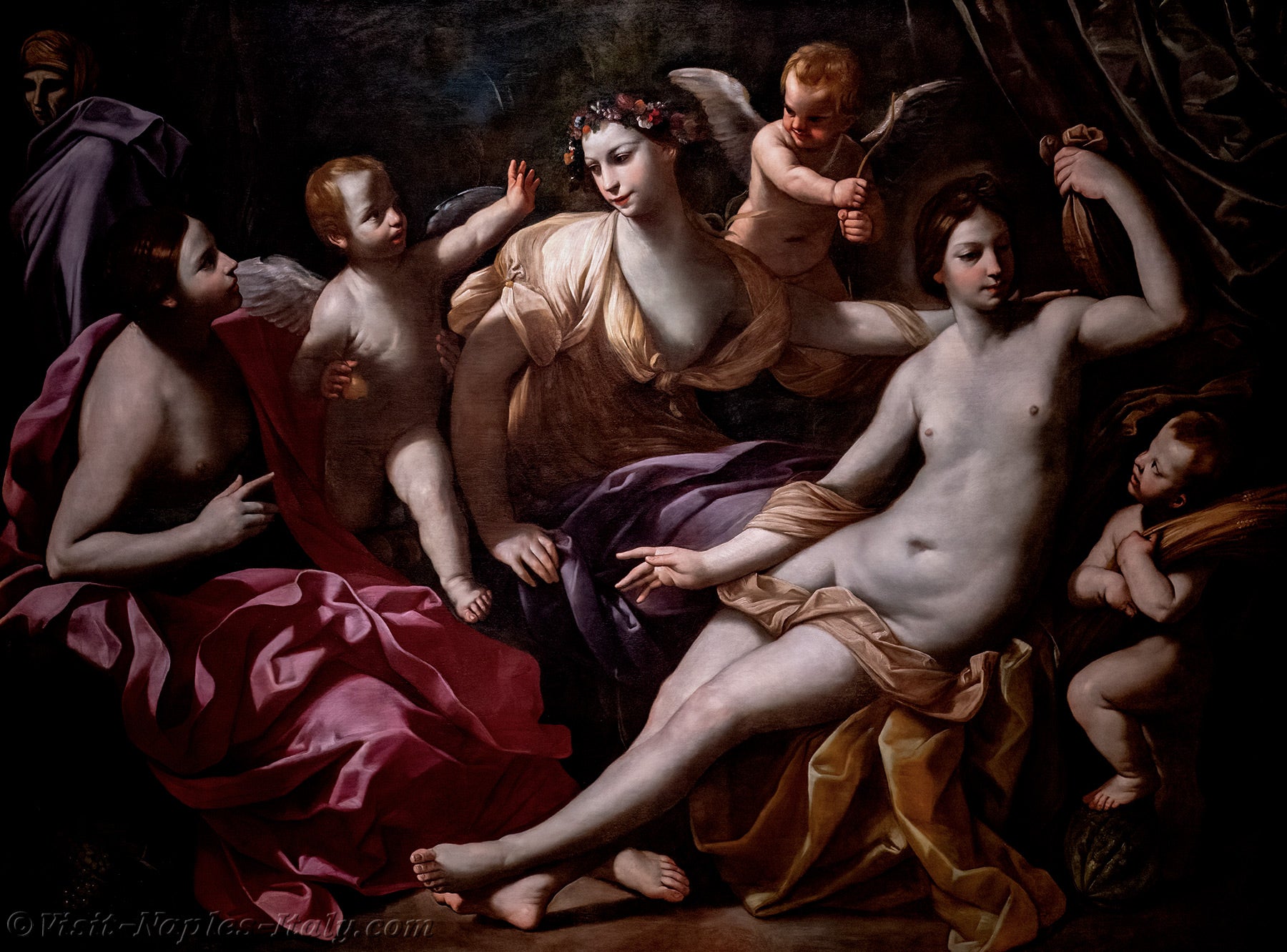
Guido Reni, The Four Seasons This is how the Seasons became the deities of Nature, presiding over the cycles of vegetation.
In fact, they are often depicted as three young girls holding flowers or plants in their hands.
Thallô, goddess of spring, Auxô, goddess of summer, and Carpô, goddess of autumn, are the three seasons that Guido Reni sought to depict in his painting.
This charming painting depicts all three of them conversing with one another in Nature’s drawing room: on the left, Autumn Carpô is draped in a magnificent red cloak, with a bunch of grapes at her feet; in the centre, Spring (Thallô), crowned with flowers, is admired by the little Cupids, whilst Summer (Auxô), at the height of her beauty, stands naked and gazes at the child carrying a sheaf of ripe wheat.
Behind these three splendid young women, on the left, the sad face of a woman clad in a purple cloak, her hair covered by a brown veil: this is Winter, separated from the living world.
Artists Palace Gardens | Bellini | Botticelli | Bronzino | Brueghel | Canova | Caravaggio | Gentileschi | Giambologna | Giordano | Greco | Lotto | Luini | Mantegna | Masaccio | Masolino | Michelangelo | Palma | Parmigianino | Porta | Raphael | Reni | Titian | Van Dyck | Warhol
Capodimonte Artists Schedule Tickets Location | Authorizations
Back to Top of Page