

Capodimonte Artists Schedule Tickets Location | Authorizations
Artists Palace Gardens | Bellini | Botticelli | Bronzino | Brueghel | Canova | Caravaggio | Gentileschi | Giambologna | Giordano | Greco | Lotto | Luini | Mantegna | Masaccio | Masolino | Michelangelo | Palma | Parmigianino | Porta | Raphael | Reni | Titian | Van Dyck | Warhol
Masaccio (1401-1428) Crucifixion, Capodimonte Museum, Naples, Italy
Masaccio “Crucifixion, the Virgin with Saint John and Mary Magdalene”
Painting - Oil on canvas (83 x 63.5 cm) 1426This painting by Masaccio was part of a polyptych located in a Chapel of the Church of the Carmine in Pisa.
Christ is crucified and his skin appears even greyer against the painting’s golden background.
Christ’s head is sunk between his shoulders, as Masaccio sought to create a perspective effect here, as if we were standing at the foot of the cross.
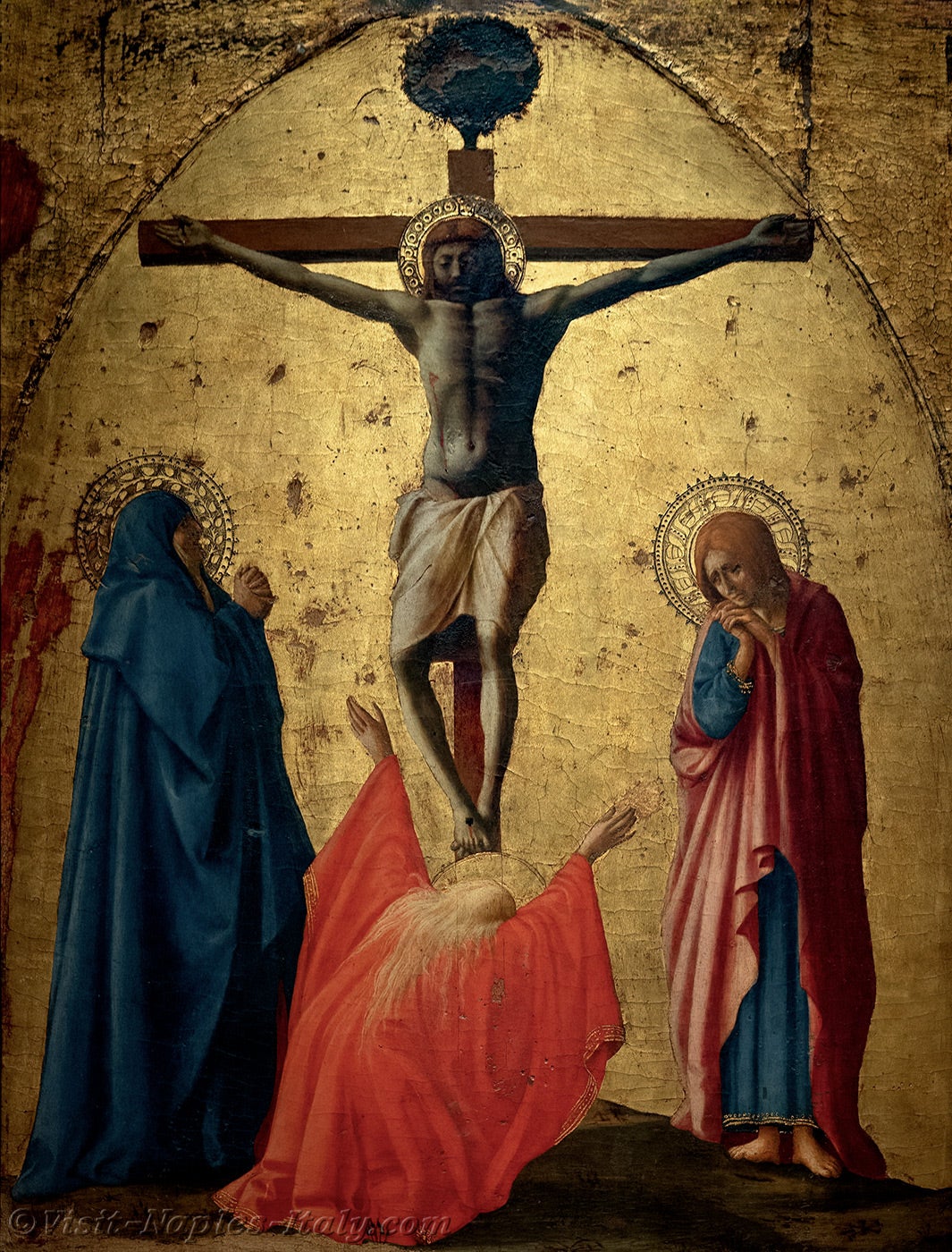
Masaccio, The Crucifixion All the sorrow of the Virgin, entirely shrouded in her long blue cloak, is expressed in her clasped, clenched hands.
At Christ’s feet, the sorrow and despondency of Saint John are just as poignant: he laments, kneeling, his back bent and his head bowed before the cross, with his arms outstretched towards the heavens.
The positioning and posture of Saint John as depicted by Masaccio are particularly precise and carefully considered.
The bright red colour of his cloak catches the eye and contrasts sharply with the clothing of the two women.
Christ’s legs act as leading lines: giving the impression that his feet are connected to the luminous halo of Saint John, who is kneeling before him, to emphasise their close proximity.
Saint John’s central position, the angle of his arms and his outstretched hands are also of great importance in the composition of the painting.
His arms and hands connect him to the two weeping women whilst Christ’s feet, like the cross, are centred on his bowed head as a sign of respect and obedience to the word, as quoted in the Gospel of John:
“When Jesus saw his mother and, standing beside her, the disciple whom he loved, he said to his mother: ‘Woman, here is your son’; then he said to the disciple: ‘Here is your mother’; and from that hour the disciple took her into his own home.”
They are all linked to one another and their halos form a second cross.
The direction of their gazes is also significant.
The Virgin looks at her son, who is looking at Saint John, just as Mary Magdalene wrings her hands in despair whilst looking, in turn, at Saint John before her.
This powerful composition, perfectly framed within the pointed arch surrounding the figures, heightens the intensity of the drama unfolding before us and the emotion it evokes.
Artists Palace Gardens | Bellini | Botticelli | Bronzino | Brueghel | Canova | Caravaggio | Gentileschi | Giambologna | Giordano | Greco | Lotto | Luini | Mantegna | Masaccio | Masolino | Michelangelo | Palma | Parmigianino | Porta | Raphael | Reni | Titian | Van Dyck | Warhol
Capodimonte Artists Schedule Tickets Location | Authorizations
Back to Top of Page