

Capodimonte Artists Schedule Tickets Location | Authorizations
Artists Palace Gardens | Bellini | Botticelli | Bronzino | Brueghel | Canova | Caravaggio | Gentileschi | Giambologna | Giordano | Greco | Lotto | Luini | Mantegna | Masaccio | Masolino | Michelangelo | Palma | Parmigianino | Porta | Raphael | Reni | Titian | Van Dyck | Warhol
Giordano Mythological Works | Religious Works
Luca Giordano (1634-1705) Legends and Mythologies, at the Capodimonte Museum in Naples, Italy
Luca Giordano “Apollo and Marsyas”
Painting - Oil on canvas (205 x 259 cm) 1657-1659Luca Giordano depicted the martyrdom of Marsyas, who is bound upside down whilst Apollo flays him alive.
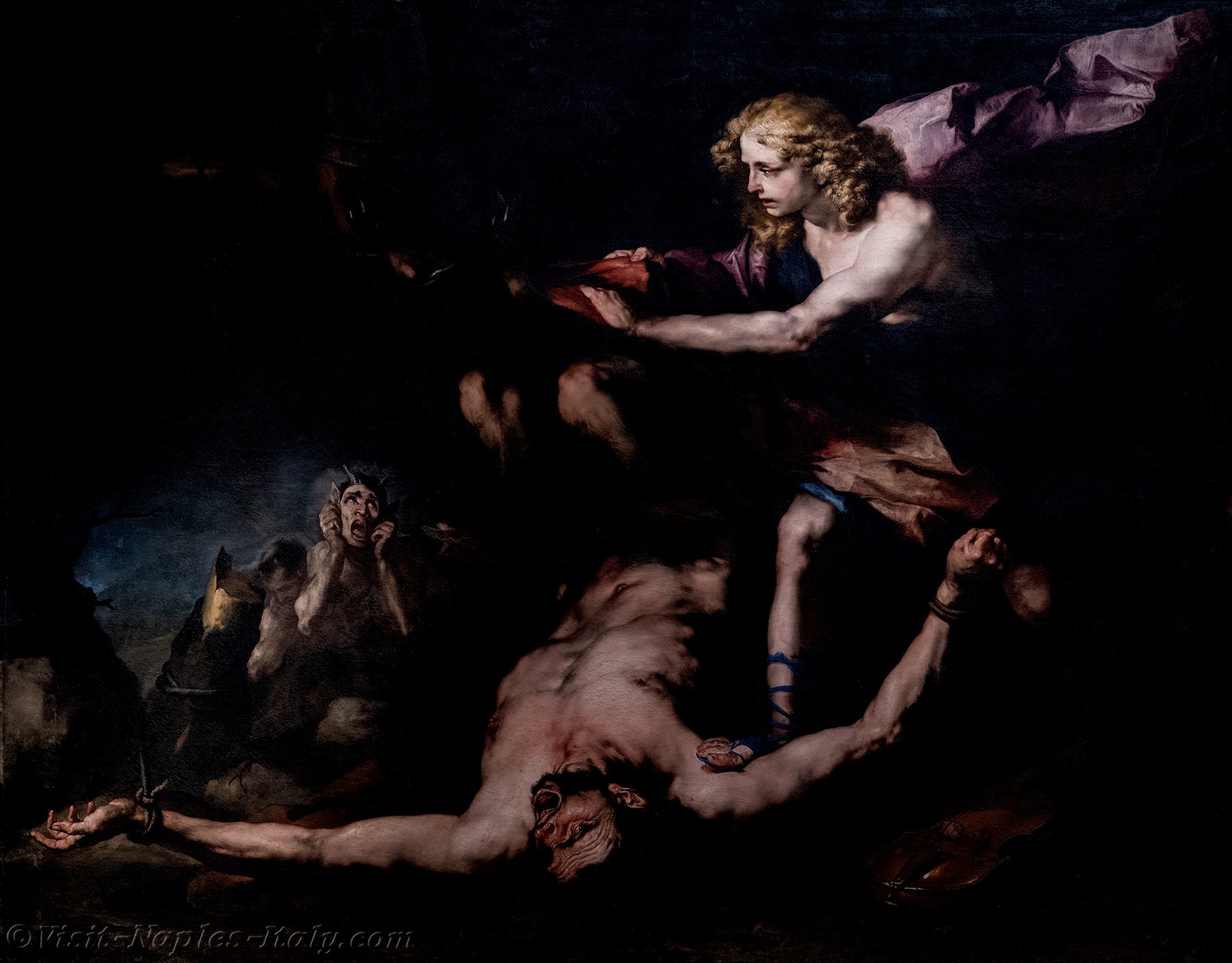
Luca Giordano, Apollo and Marsyas Poor Marsyas screams in agony as he tries in vain to free himself, whilst Apollo flays him by placing his foot on his right shoulder to pin him to the ground.
In the background, a satyr covers his ears and lets out a cry of horror.
This is how Apollo came to take such extreme measures.
The Silenus Marsyas had dared to challenge Apollo by telling him that the pastoral music played on his flute was more beautiful than that played by Apollo on his lyre.
Apollo accepted the challenge, on condition that the victor might punish the vanquished as he saw fit.
After an initial performance, they were declared to be a draw.
Apollo then challenged Marsyas to play his flute upside down, saying that he would do the same with his lyre; they did so, and Apollo was then declared the winner.
Apollo’s anger at Marsyas’s pretensions was such that he took his revenge by tying him by his feet to a tree to flay him alive.
Legend has it that the god subsequently showed his remorse by breaking his lyre and transforming Marsyas into a river.
Ovid, in the Metamorphoses, described Marsyas’s torment by putting words into his mouth:
“ 'Why are you tearing me away from myself?', he asked. And he cried out: 'Alas! What is my repentance! Alas! A flute is not worth such a high price!'
Despite his cries, the skin is torn from his entire body; he is now nothing but a wound; his blood flows from every part; his muscles, laid bare, are exposed; a convulsive movement makes his veins, stripped of their skin, quiver; one could count his throbbing entrails and the fibres that the light reveals within his chest.
The rustic Fauns, deities of the woods; the Satyrs, his brothers; Olympus, which was still dear to him even at that moment; and the nymphs wept for him, as did all the shepherds who, on these mountains, tended their sheep and herds of cattle.
As their tears fell, they bathed the fertile earth, which gathered them into its bosom and drank them in to the very depths of its veins then, having transformed them into water, it sent them back into the open spaces of the air.
Thus was born a river which, flowing between the slopes of its banks, empties into the stormy sea; it is the one called the Marsyas, the clearest in Phrygia.”
Ovid, Metamorphoses, VI, 385
Luca Giordano “Diana Killing Niobe”
Painting - Oil on canvas (136 x 250 cm) 1670-1675Luca Giordano condensed and reinterpreted the legend in his painting depicting Diana killing Niobe with an arrow.
Homer recounts that Queen Niobe boasted of being superior to Leto, as she had borne twelve children, six sons and six daughters, whilst Leto had borne only two, a son and a daughter.
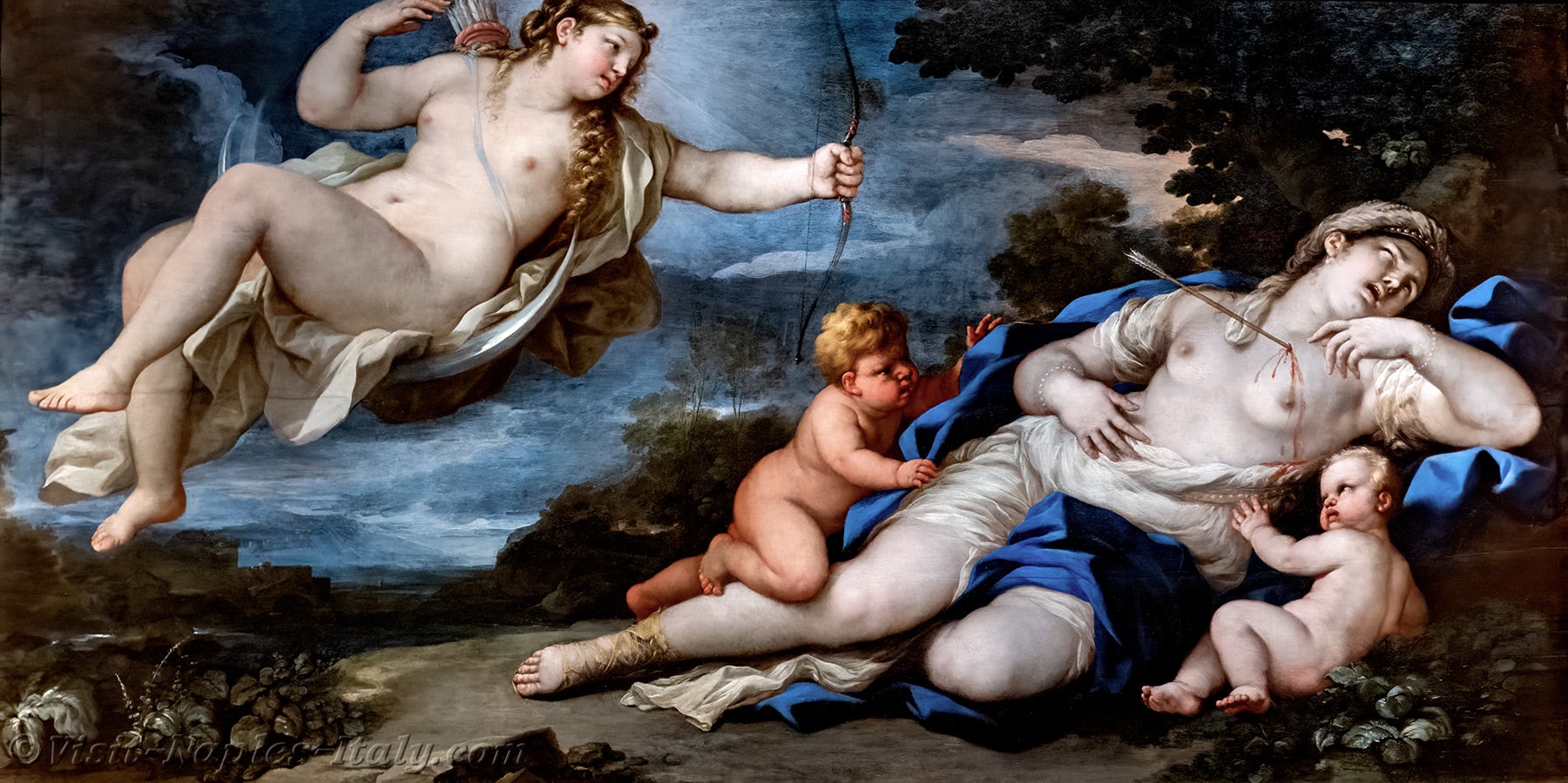
Luca Giordano, Diana Slaying Niobe To avenge this affront, Leto ordered her children, Apollo and Artemis (Diana to the Romans) to kill Niobe’s children.
Diana was tasked with killing the girls, whilst Apollo was to kill the boys.
After the murder of her children, Niobe was herself turned into a rock by the gods, and it was said that her ceaseless weeping had given rise to a spring gushing from the rock.
Luca Giordano omitted the murder of Niobe’s children, choosing instead to depict her pierced by an arrow shot by Diana, goddess of the hunt.
Luca Giordano “Hercules and Omphale”
Painting - Oil on canvas (115 x 132 cm) 1675This painting by Luca Giordano depicting Hercules and Omphale shows us the hero, clearly happy and drunk, spinning wool.
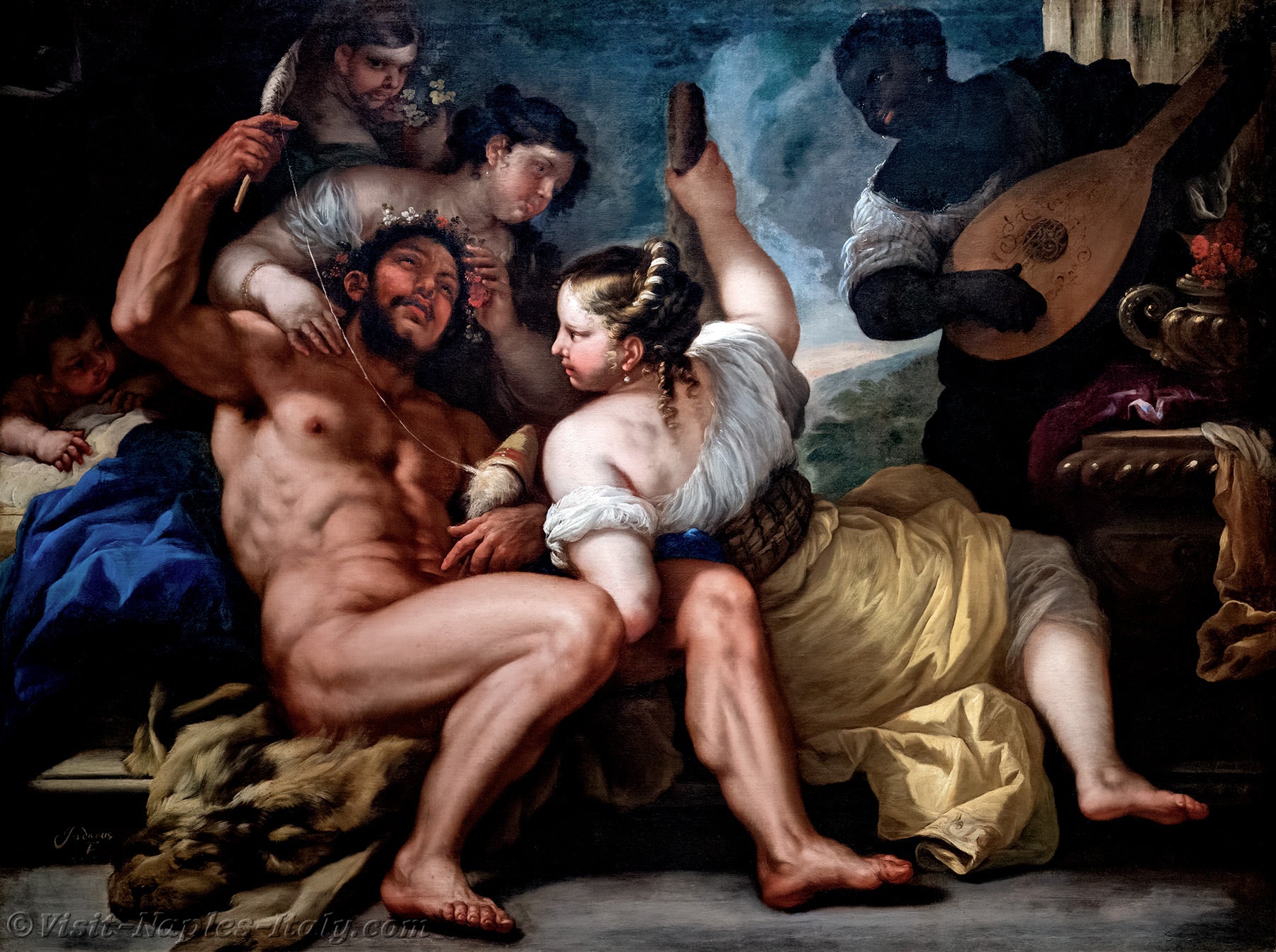
Luca Giordano, Hercules and Omphale He is naked, whilst the women surrounding him and looking after him are dressed.
His head, with his eyes barely half-open, rests against the young woman behind him, who is stroking his shoulder and placing a crown of delicate flowers on his head - the sort of crown worn by young girls.
Queen Omphale is seated beside Hercules and looks at him whilst leaning against him; she is the one holding the hero’s club to clearly show that he has become her obedient slave, subject to her whims.
The amused gaze of the musician playing the lute adds a touch of merriment to the scene, in which the mighty Hercules is, above all, a slave to pleasure.
Luca Giordano “Leda and the Swan”
Painting - Oil on canvas (127 x 155 cm) 1670In this painting, a far cry from the religious works painted by Luca Giordano, Leda is naked save for a sheer tunic tied around her waist.
She wears a pearl necklace and a tiara in her blonde hair, adorned with flowers.
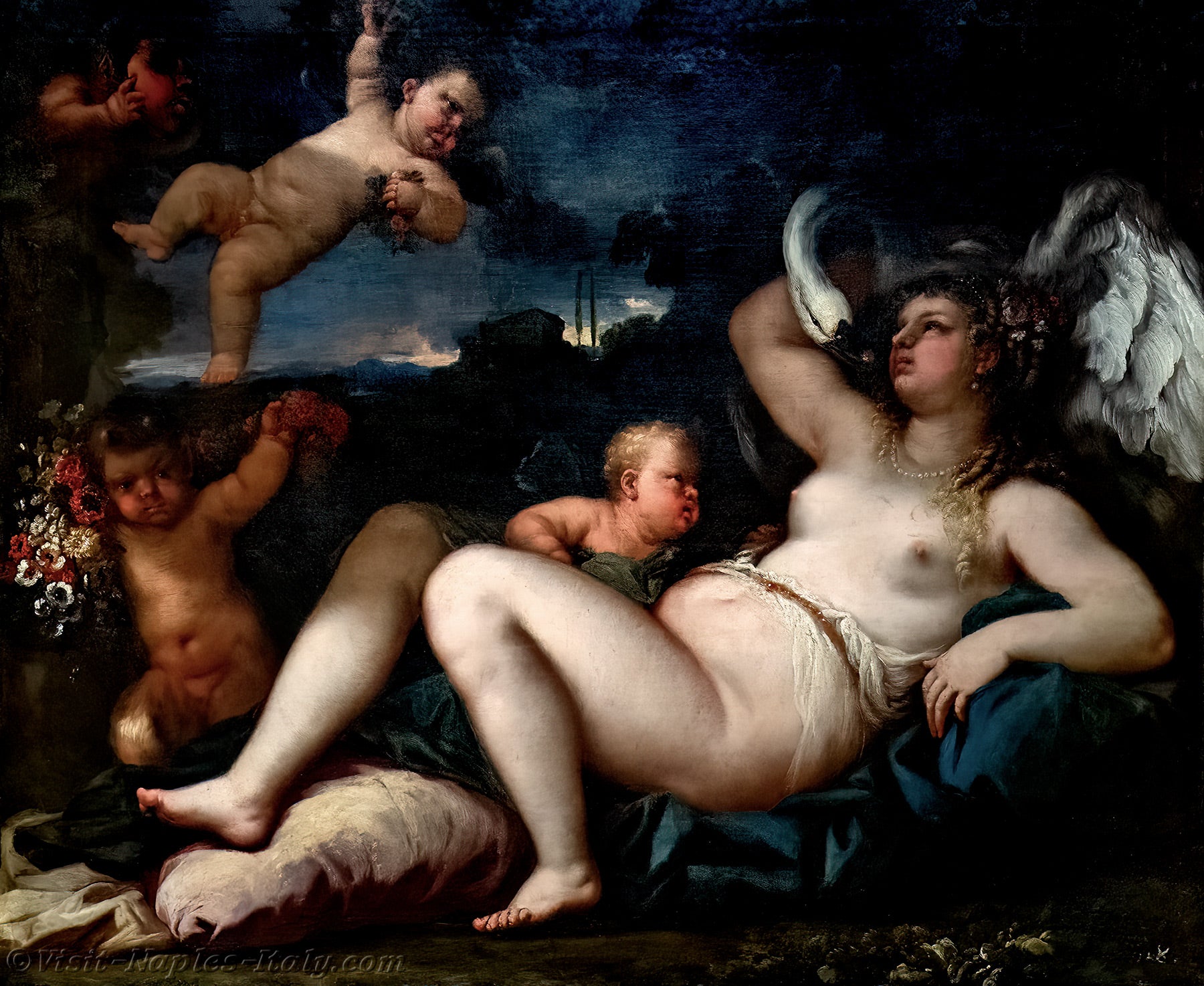
Luca Giordano, Leda and the Swan She is lying on her back and surrendering herself to the swan who approaches from behind her wrapping his arm around her neck to invite her to kiss him.
The beauty’s head rests between the swan’s wings, its beak drawing close to her mouth.
They are surrounded by little cupids carrying flowers.
It should be noted that this swan was none other than Zeus himself, who had taken this animal form to seduce the young woman.
According to legend, after making love to Zeus, Leda is said to have laid an egg from which emerged Pollux and Clytemnestra, as well as Helen and Castor.
Another legend states that Leda found an egg from which Nemesis was born following her lovemaking with Zeus, who had transformed himself into a swan; Leda took in this egg, from which Helen emerged, and passed her off as her own daughter.
Luca Giordano “Lucretia and Tarquinius”
Painting - Oil on canvas (138 x 187 cm) 1678Here, Luca Giordano depicts the text by Livia (History of Rome, I, 57), which recounts Sextus Tarquin’s attempt to seduce Lucretia, the wife of Collatinus.
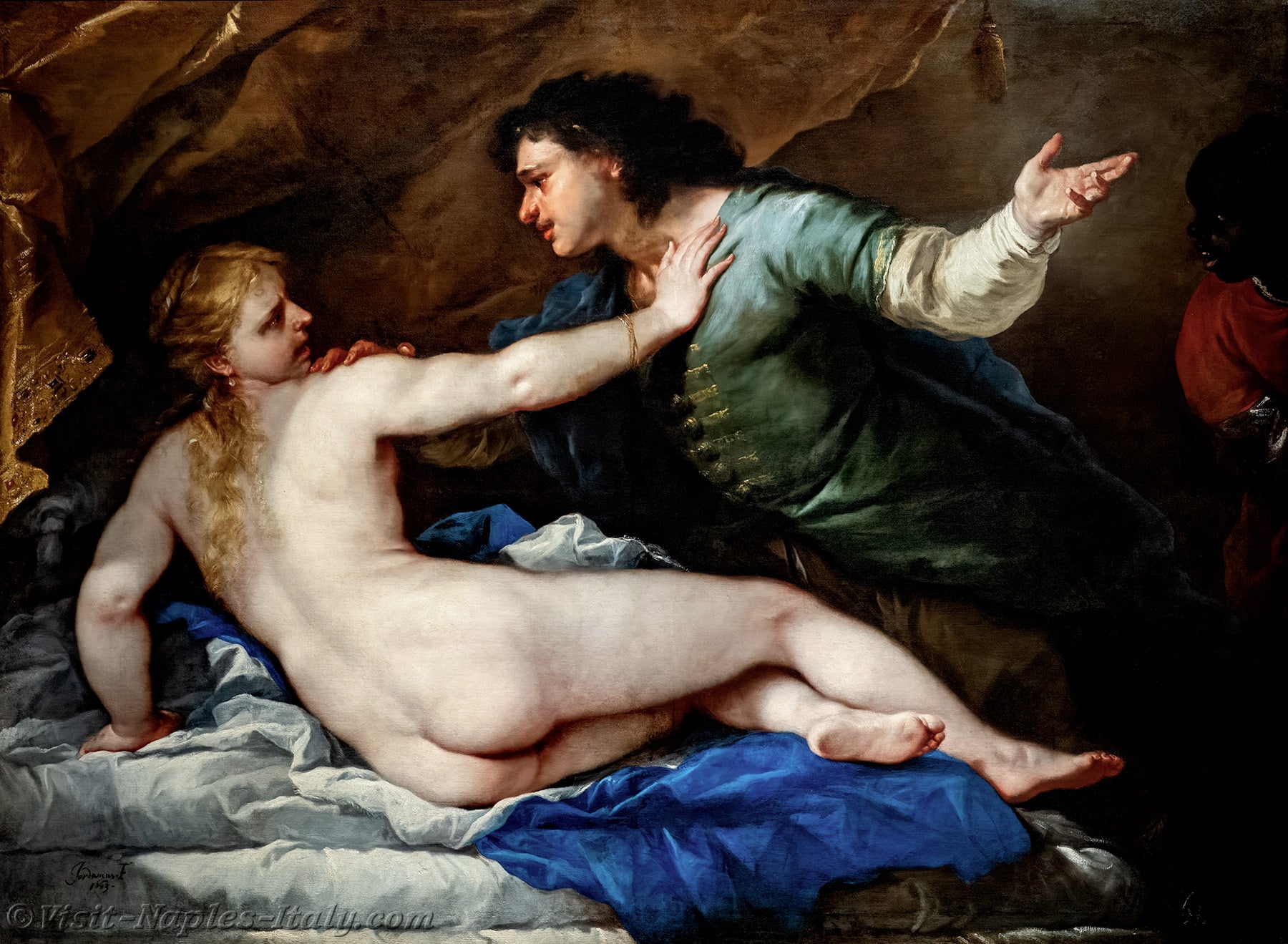
Luca Giordano, Lucretia and Tarquinius It all begins during a banquet where the wine flowed freely at Sextus Tarquin’s house, where the conversation turns to the virtue of women and Collatinus extols the merits and virtue of his wife Lucretia.
Giordano’s painting depicts a tipsy Tarquin with a red nose arriving at Lucretia’s house to take up the challenge and overcome by an irresistible desire at the sight of the young woman’s beauty.
But Lucretia is a faithful wife who rejects his advances, and Tarquin, realising he will not get his way, does not hesitate to rape her.
Dishonoured by this rape, Lucretia took her own life.
Luca Giordano “The Sleeping Venus and Cupid”
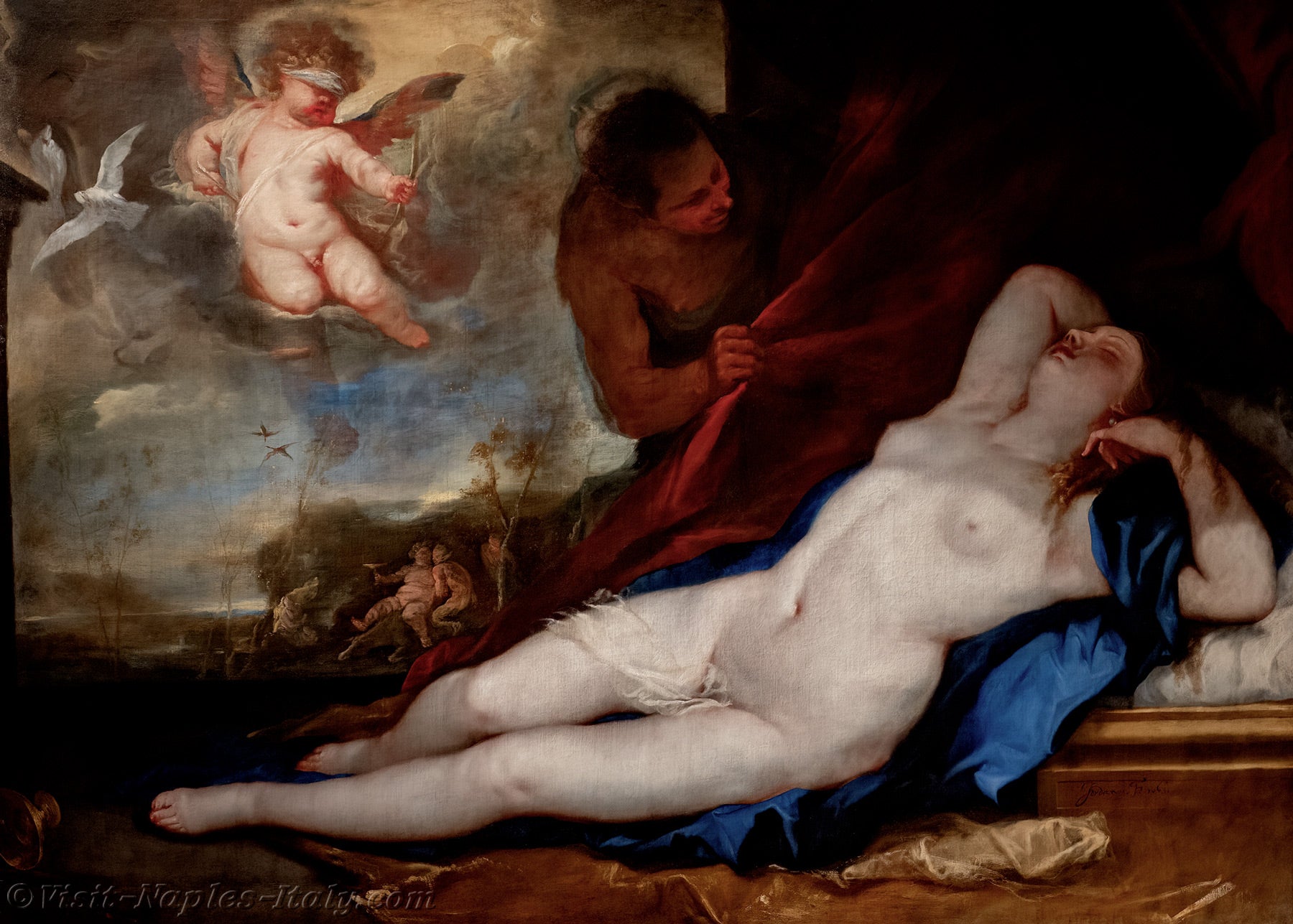
Luca Giordano, Sleeping Venus and Cupid Painting - Oil on canvas (137 x 190 cm) 1663
Luca Giordano depicted Venus asleep and exposed on her bed, gazing at what appears to be a satyr who has lifted the curtain covering her to admire her completely naked body.
Cupid appears fluttering about, blindfolded at the top of the painting and seems to have shot an arrow at his mother by mistake, blindly, thus causing her to surrender completely to the gaze, and of course to love.
In the distance, a Silenus raises his cup of wine, seated alongside a satyr on a donkey which has collapsed to the ground under their weight.
Luca Giordano “Perseus and Medusa”
Painting - Oil on canvas (225 x 307 cm) 1675-1699This painting by Luca Giordano depicts the epic battle of Perseus, who is about to sever Medusa’s head in a particularly dynamic manner; we witness the action as we see the raised sword and Medusa’s terror, as she senses that her end is near.
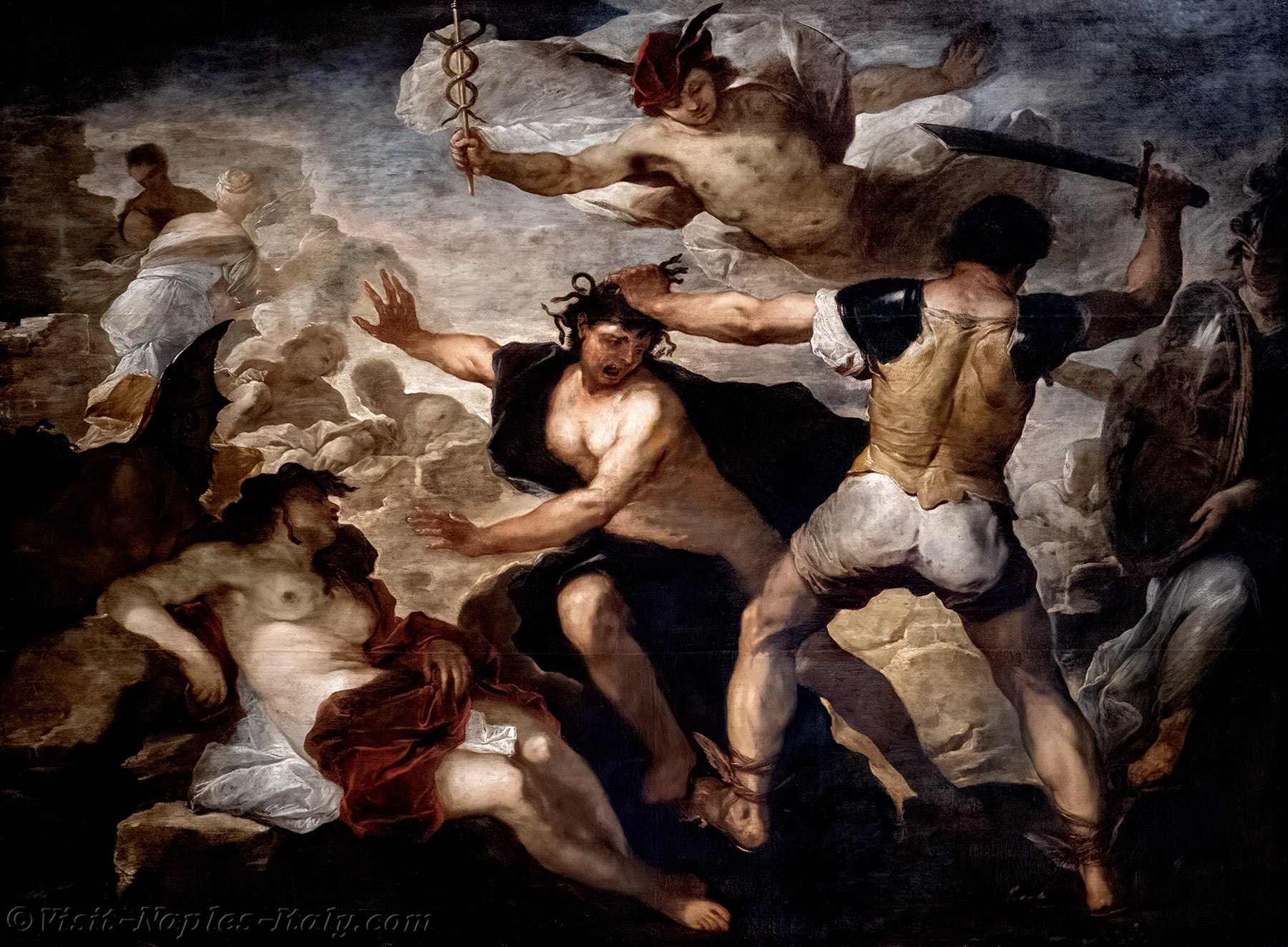
Luca Giordano, Perseus and Medusa Perseus has donned the winged sandals given to him by Hermes, who flies above the scene with his caduceus to witness the slaying of the Gorgon.
To avoid looking at Medusa’s hideous face—which could turn him to stone—Perseus acted by looking at his reflection in the polished shield that served as a mirrorheld by Athena.
From Medusa’s severed neck emerged the two beings sired by Poseidon, the winged horse Pegasus and Chrysaor.
Athena seized Medusa’s severed head and placed it at the centre of her aegis so that her enemies would freeze in fear upon seeing it.
Luca Giordano “Polyphemus and Galatea”
Painting - Oil on canvas (127 x 250 cm) 1674-1675Luca Giordano painted Galatea according to Ovid’s description, but he significantly embellished the cyclops Polyphemus.
He even gave him a likeable air, despite his reputation for violence and cruelty towards sailors passing off his coast.
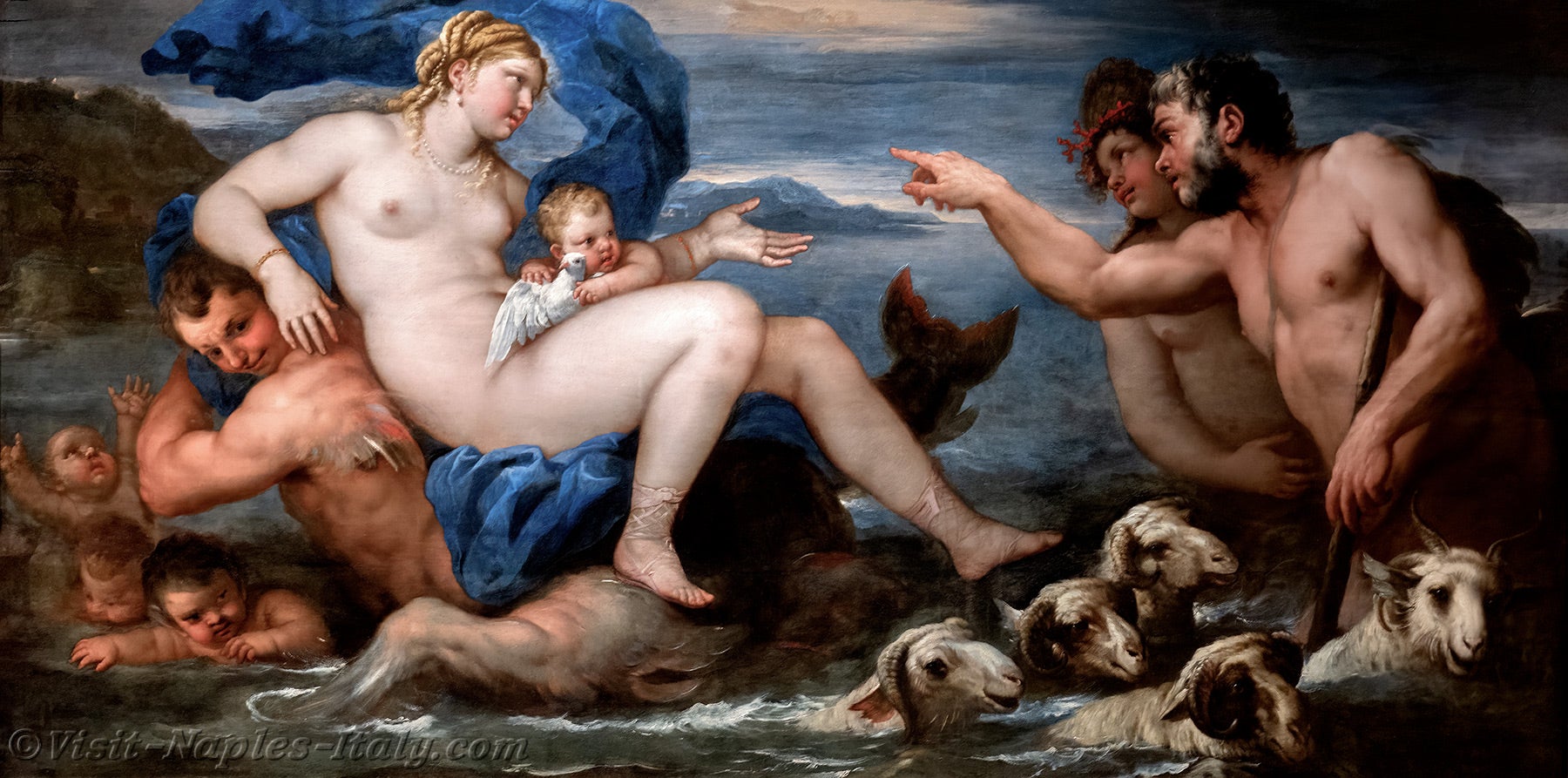
Luca Giordano, Polyphemus and Galatea The Odyssey tells how he killed Odysseus’s companions, but Odysseus managed to avenge them and escape by gouging out his one eye.
Galatea loved Acis and rejected Polyphemus’s advances; he was driven mad by jealousy and rage and ended up killing the unfortunate young man!
This is therefore a rather gentle version of Polyphemus’s encounter with Galatea depicted here, a far cry from Ovid’s text below, in which Galatea recounts the Cyclops’s attempt at seduction:
“You are whiter, Galatea, than the snow-white petals of the privet, more flower-like than the meadows, more slender than the alder, more brilliant than crystal, more playful than a kid, smoother than a shell polished ceaselessly by the waves, more delightful than the sun in winter and the shade in summer, more exquisite than fruit, more majestic than the haughty plane tree, more resplendent than ice, sweeter than ripe grapes, more delicate than a swan’s down and curdled milk; and, were it not for your fleeing from me, you would be more beautiful than a well-watered garden.
[...] Though my body is bristling with stiff, bushy hair, do not think it is ugly; it is ugly for a tree to have no leaves, ugly for a horse to have no mane to cover its dark neck; birds are clad in feathers; wool serves as adornment for sheep; as for men, nothing suits them quite like a beard and the hair that stands on end across their bodies.
I have but one eye in the middle of my forehead, yet it resembles a great shield.
[...] the monster spots me with Acis: ‘I see you,’ he shouts at us, ‘I shall ensure that this tryst of love is your last.’
His voice was as terrifying as one might expect from an enraged Cyclops; that cry made Mount Etna tremble.
[...] The Cyclops gave chase; he tore a chunk of rock from the mountain and hurled it forward; though only one end struck Acis, he was crushed entirely. [...] Beneath the enormous mass, crimson blood flowed.”
Ovid, Metamorphoses, XIII, 766
Giordano Mythological Works | Religious Works
Artists Palace Gardens | Bellini | Botticelli | Bronzino | Brueghel | Canova | Caravaggio | Gentileschi | Giambologna | Giordano | Greco | Lotto | Luini | Mantegna | Masaccio | Masolino | Michelangelo | Palma | Parmigianino | Porta | Raphael | Reni | Titian | Van Dyck | Warhol
Capodimonte Artists Schedule Tickets Location | Authorizations
Back to Top of Page