

Capodimonte Artists Schedule Tickets Location | Authorizations
Artists Palace Gardens | Bellini | Botticelli | Bronzino | Brueghel | Canova | Caravaggio | Gentileschi | Giambologna | Giordano | Greco | Lotto | Luini | Mantegna | Masaccio | Masolino | Michelangelo | Palma | Parmigianino | Porta | Raphael | Reni | Titian | Van Dyck | Warhol
Parmigianino (1503-1540) Lucretia, Antea, Galeazzo Sanvitale and the Holy Family, at the Capodimonte Museum in Naples
Parmigianino “Lucretia”
Painting - Oil on wood (67 x 51 cm) 1540Parmigianino depicted Lucretia at the moment of her suicide, the dagger plunged beneath her breast from which her blood flows.
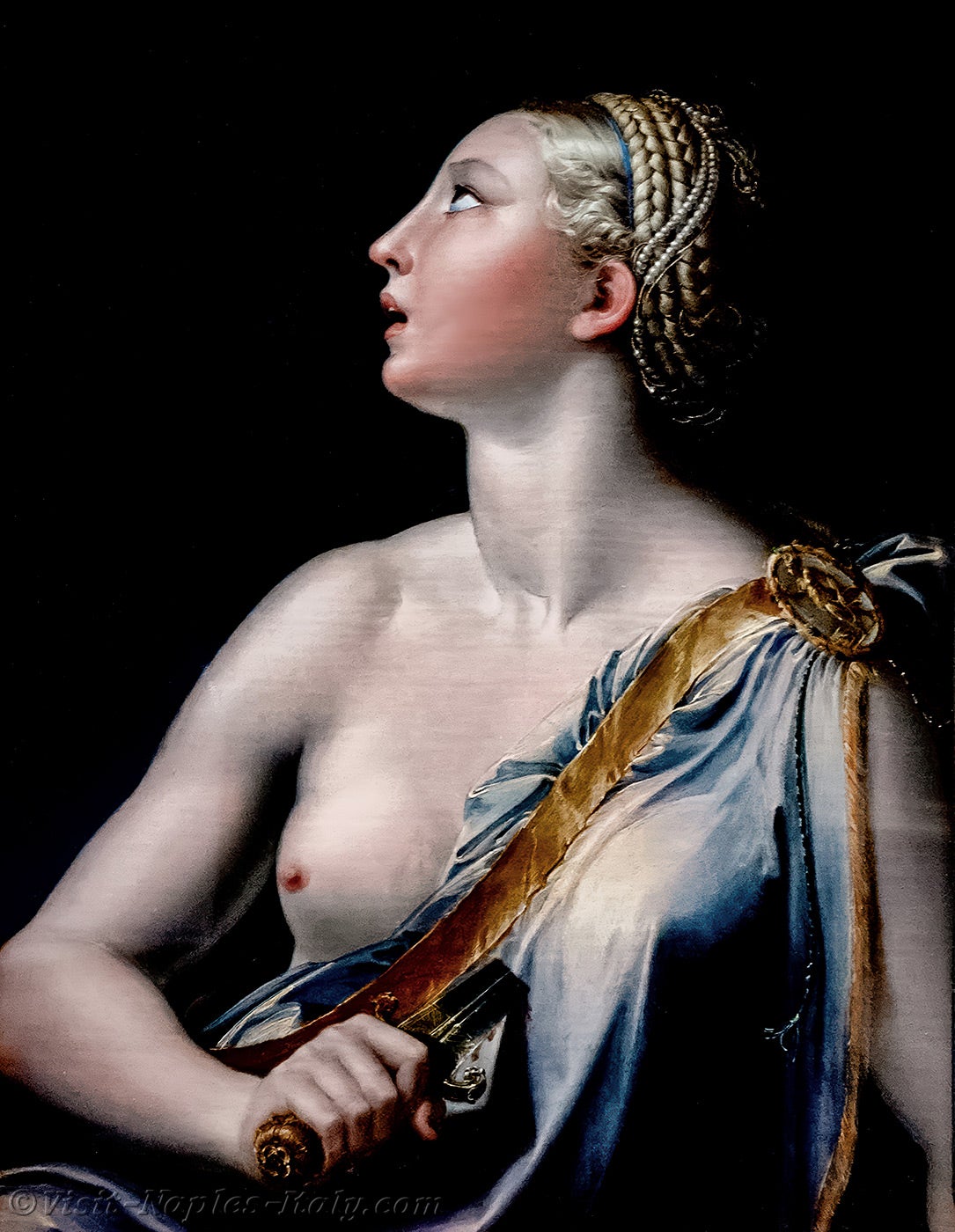
Parmigianino, Lucretia Her pearl-adorned hairstyle and the delicate flesh-toned hues of her body and face are superbly painted, yet one cannot help but feel that they will soon be replaced by a deathly pallor, and this thought makes the tragedy all the more difficult to bear.
Her tunic, which covers the left side of her torso, is fastened by a brooch in the shape of a medallion depicting Diana, the goddess of chastity, to symbolise Lucretia’s purity before her rape at the hands of Prince Sextus Tarquin.
The young woman takes her own life to save her honour, which had been defiled by Tarquin in an era when machismo prevailed; a rape that made her an adulteress, an act of violence that drove her to this final act.
The beautiful Lucretia stabs herself in the heart without hesitation, raising her eyes to the gods to call them as witnesses to her violated chastity.
Legend has it that her suicide sparked the rebellion against the monarchy which gave rise to the Roman Republic in 509 BC
Parmigianino - “Portrait of a Young Woman Known as Antea”
Painting - Oil on canvas (136 x 86 cm) 1535This beautiful portrait shows us a young woman richly dressed, allowing Parmigianino to showcase his full talent in rendering the folds and the silk of her garment.
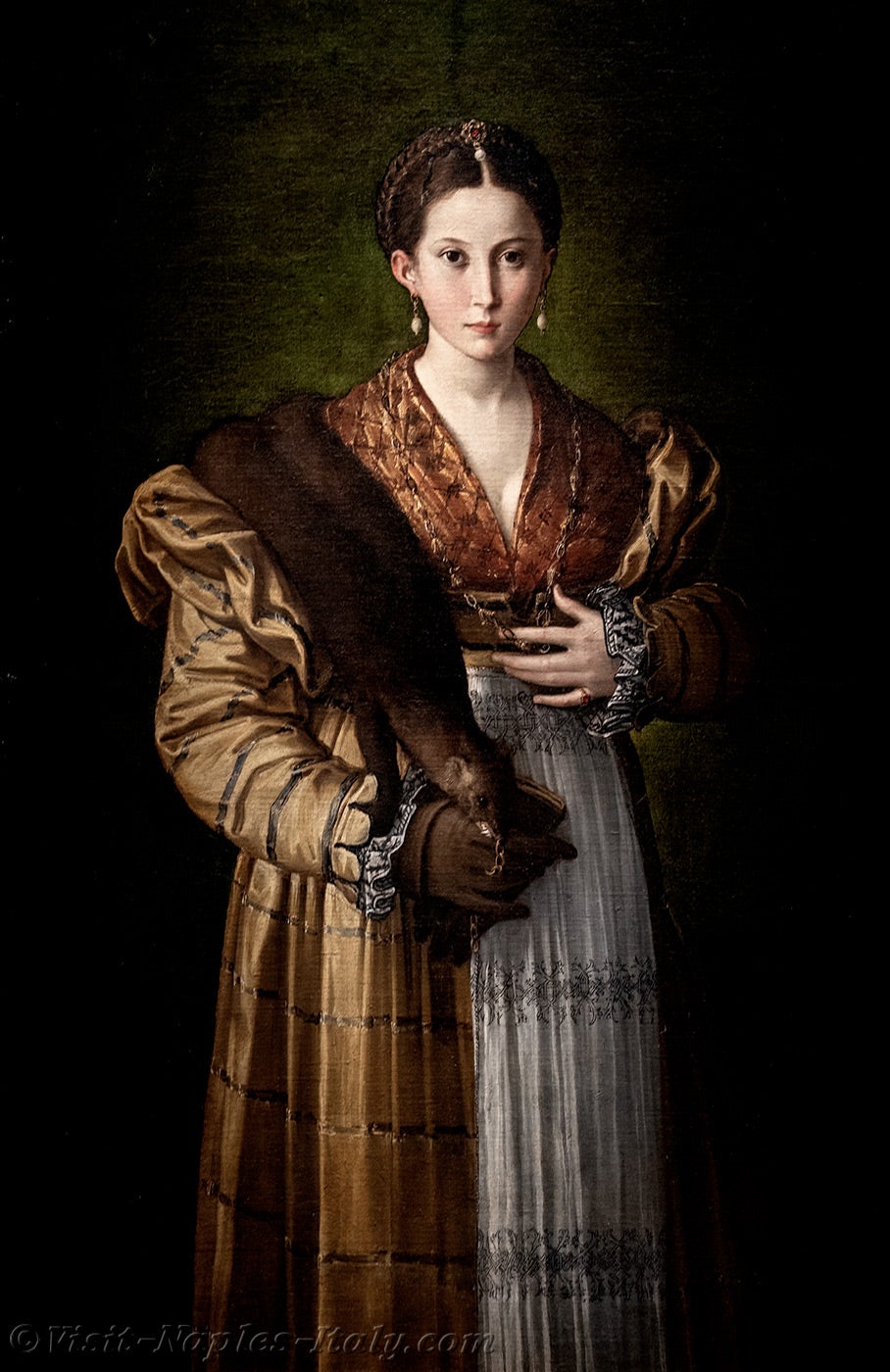
Parmigianino, Antea She is wearing a white apron over her silk dress, an accessory that was fashionable amongst the nobility of northern Italy at the time.
Her hairstyle is just as immaculate as her clothes and her two plaits are held in place at the top of her head by a hair clip adorned with a pearl.
A sable or marten skin with its teeth showing is draped over her right shoulder and hangs down to her gloved hand.
The face of the young woman is stunning and her gaze seems alive.
It should be noted that to paint this portrait, Parmigianino used a particular technique.
He placed a convex mirror in front of his model, which distorts by magnifying the parts of the body closest to the mirror, so that the sleeve of her right arm appears more prominent and enhances the overall sense of depth.
It is thought that this young woman is Antea, the young woman with whom Parmigianino had fallen in love during his stay in Rome.
Parmigianino“Portrait of Galeazzo Sanvitale”
Painting - Oil on wood (108 x 80 cm) 1524This superb portrait of the nobleman Galeazzo Sanvitale shows him from the front, with his torso twisted whilst seated in a chair positioned in profile, which explains the offset position of his arms.
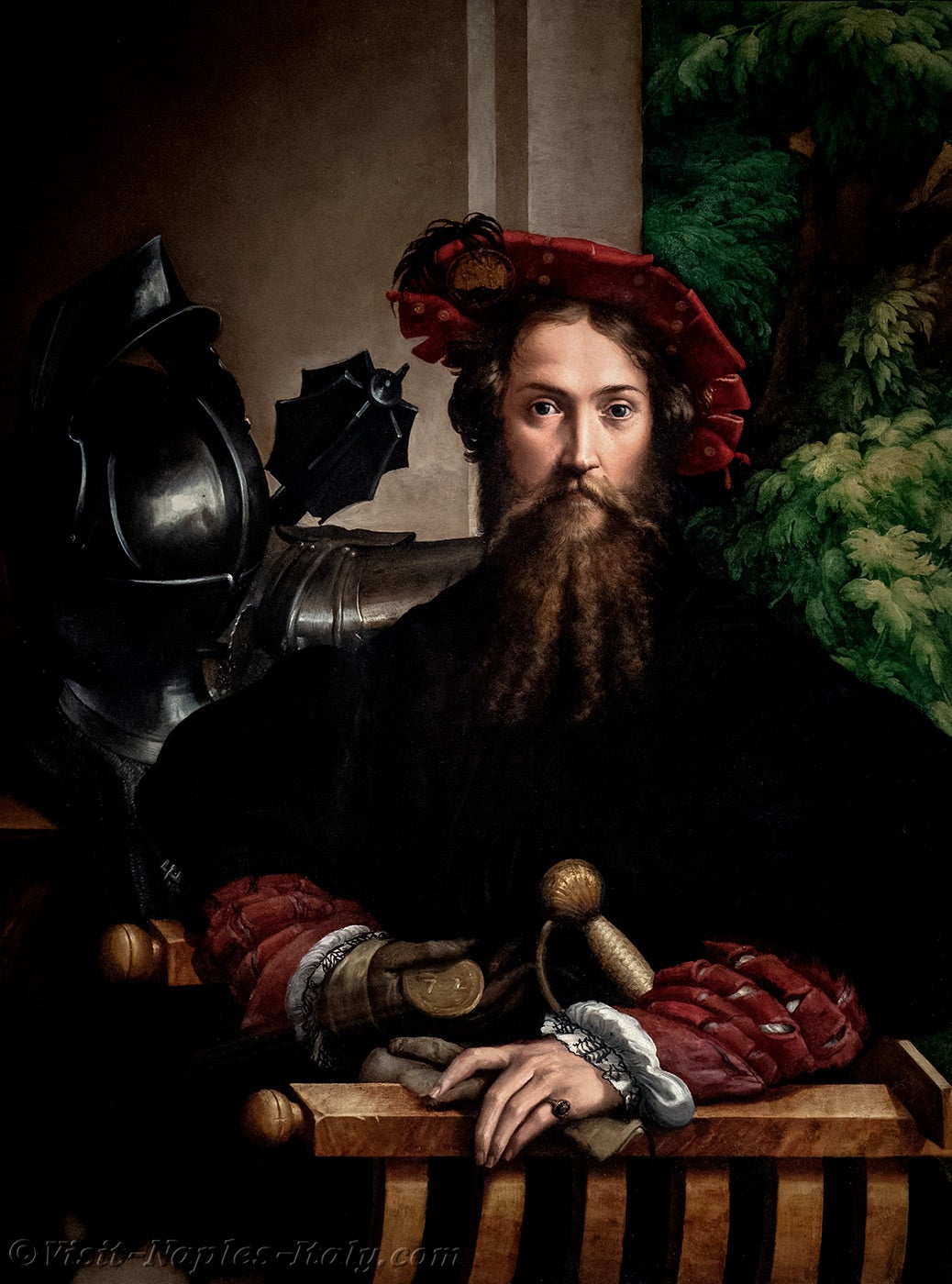
Parmigianino, Sanvitale This is a technique used by Parmigianino to enhance the sense of perspective between the different planes of the painting, from the helmet, armour and mace in the background, following the diagonal line to the prominent armrest of the chair in the foreground.
The presence of the armour indicates the military status of Galeazzo Sanvitale.
In his right hand, Galeazzo Sanvitale holds a medal inscribed with the number 72.
To understand the significance of this element, it is worth recalling here that Parmigianino was passionate about esoteric culture and interested in alchemy.
Based on this aspect of Parmigianino’s personality, some critics have interpreted the number 72 as a reference to the conjunction of the Sun and the Moon, which would make it a symbol of the marital union between Galeazzo Sanvitale and Paola Gonzaga.
From a purely artistic perspective, the beauty of the flesh tones, the modelling of the hand and face with a gaze of striking realism, make it a masterpiece of the period’s painting.
One can admire with equal interest the details of this man’s clothing, such as his headdress or his puffed sleeves.
Finally, the same quality is evident in his hair and beard, which are rendered magnificently.
Parmigianino “The Holy Family with Saint John the Baptist”
Painting - Tempera on canvas (158 x 103 cm) 1524-1527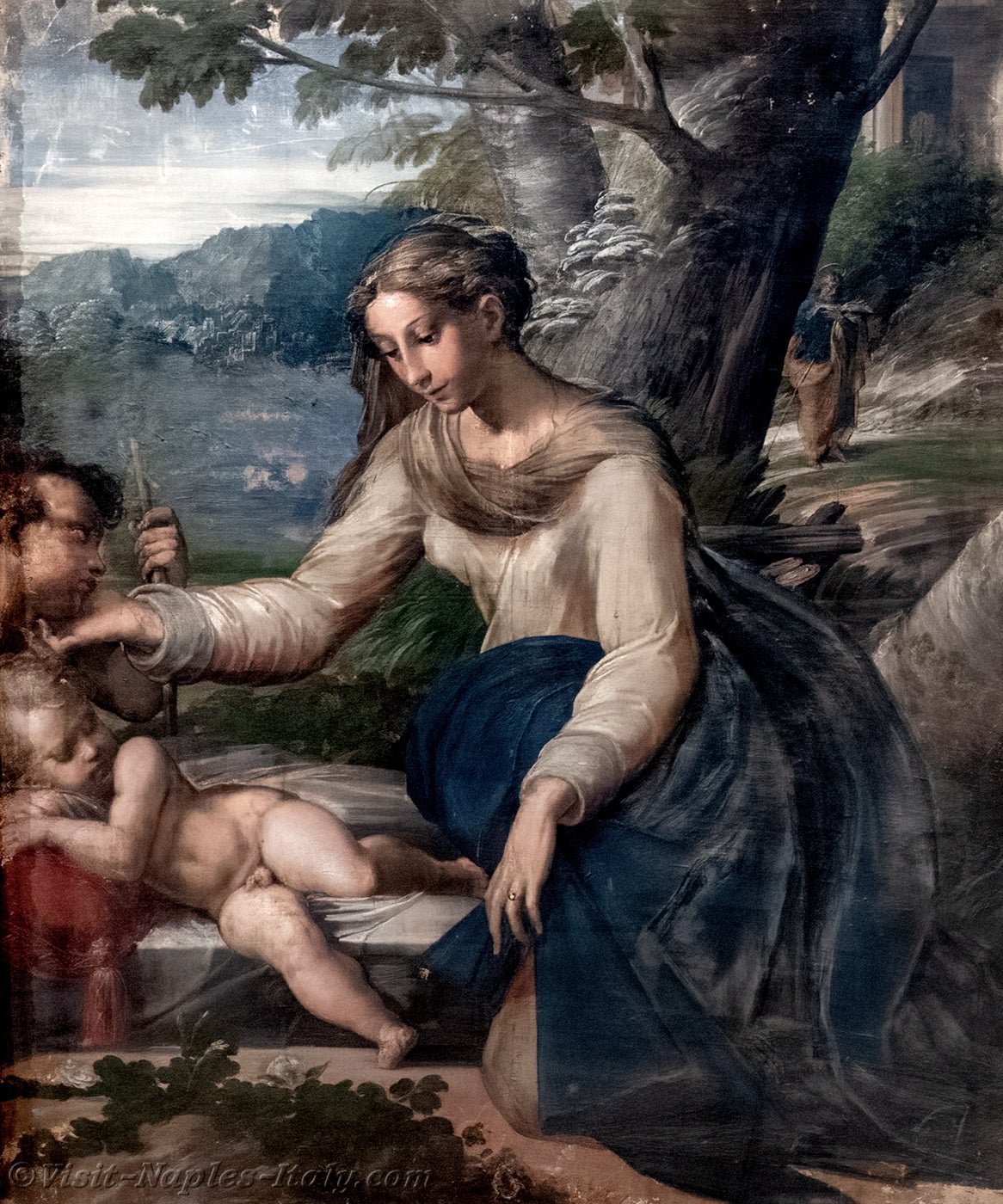
The Holy Family The Virgin and the Infant Jesus are depicted in a rural landscape.
The Virgin is kneeling and looking at the Infant Jesus, who has fallen asleep whilst clutching a cushion to his chest.
Her beautiful face reflects her maternal love and affection as she strokes the chin of Saint John the Baptist, who stands beside Jesus.
The Virgin’s demeanour reflects a supernatural serenity in harmony with Joseph, who walks peacefully in the background reading the Holy Book.
From a technical point of view, Vasari believed that Parmigianino had painted this work in tempera using broad, long brushstrokes to lend fluidity and movement to the figures, a technique that creates an effect of both transparency and presence.
Artists Palace Gardens | Bellini | Botticelli | Bronzino | Brueghel | Canova | Caravaggio | Gentileschi | Giambologna | Giordano | Greco | Lotto | Luini | Mantegna | Masaccio | Masolino | Michelangelo | Palma | Parmigianino | Porta | Raphael | Reni | Titian | Van Dyck | Warhol
Capodimonte Artists Schedule Tickets Location | Authorizations
Back to Top of Page