

Capodimonte Artists Schedule Tickets Location | Authorizations
Artists Palace Gardens | Bellini | Botticelli | Bronzino | Brueghel | Canova | Caravaggio | Gentileschi | Giambologna | Giordano | Greco | Lotto | Luini | Mantegna | Masaccio | Masolino | Michelangelo | Palma | Parmigianino | Porta | Raphael | Reni | Titian | Van Dyck | Warhol
Titian (1488-1576) portraits of popes and cardinals, The Annunciation, Danaë, at the Capodimonte Museum in Naples
Titian “Danaë”
Painting - Oil on canvas (118.5 x 170 cm) 1544-1545Acrisius, King of Argos, had learnt from an oracle that his daughter Danaë would bear a son who would kill him.
Terrified by the oracle and wishing to prevent it from coming true, Acrisios built an underground bronze chamber and locked Danaë inside it.
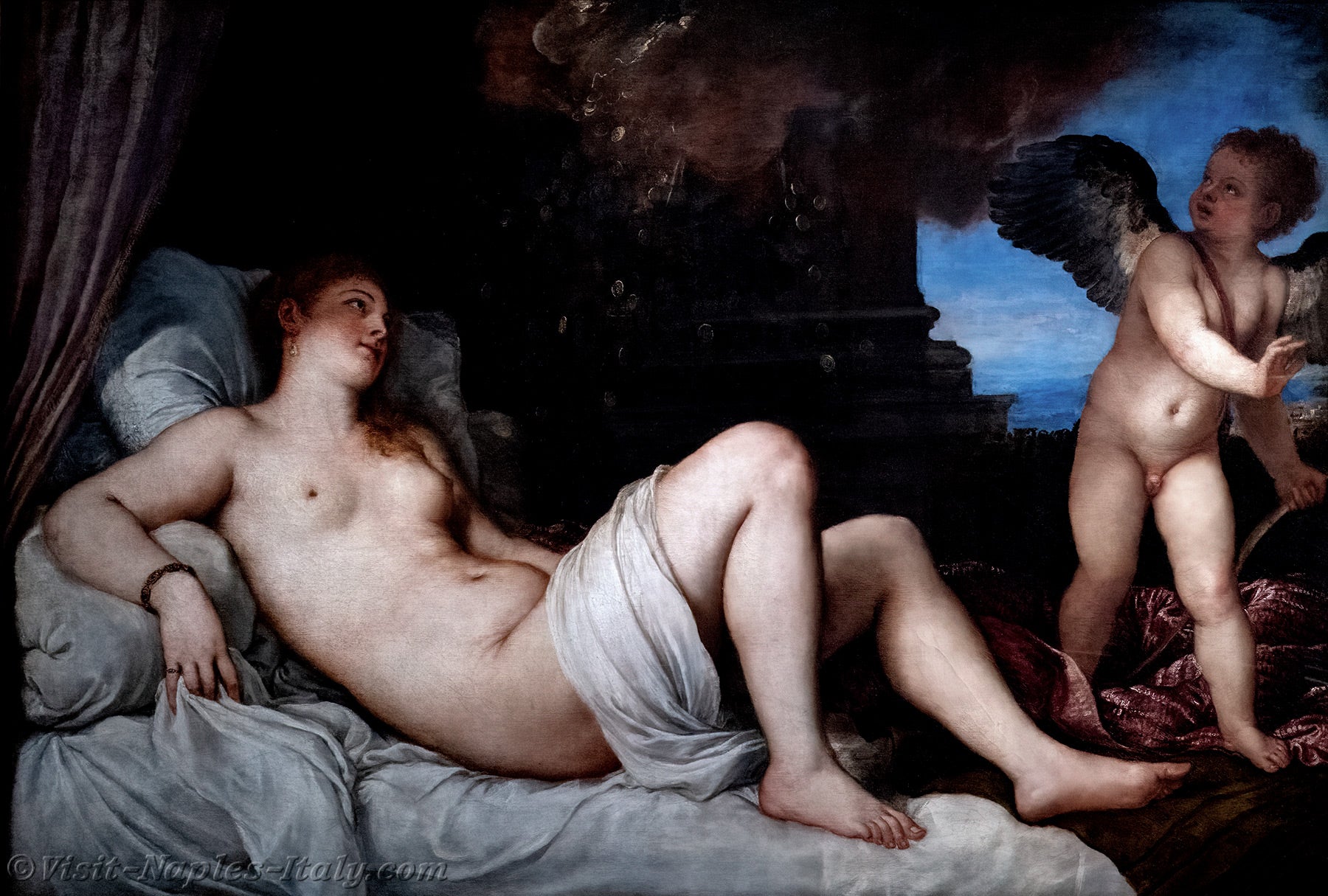
Titian, Danaë But Zeus had noticed the young girl’s beauty; he managed to seduce her by transforming himself into a shower of gold which entered through a crack in the roof, and impregnated her, resulting in the birth of Perseus.
This version of the myth symbolises the omnipotence of money in seducing hearts and opening even the most heavily guarded doors.
Titian depicts only part of this story here.
Zeus is indeed represented by the shower of gold falling upon Danaë, but the presence of Cupid indicates that Danaë will give herself first and foremost out of love.
Danaë’s face is indeed that of a woman in love, not a greedy woman.
Cupid watches the gold coins fall, clearly without understanding what is happening.
Danaë is naked, reclining lasciviously on her couch, offered up to the love of Zeus who will impregnate her.
From their union, Perseus will be born, who will later slay the Gorgon.
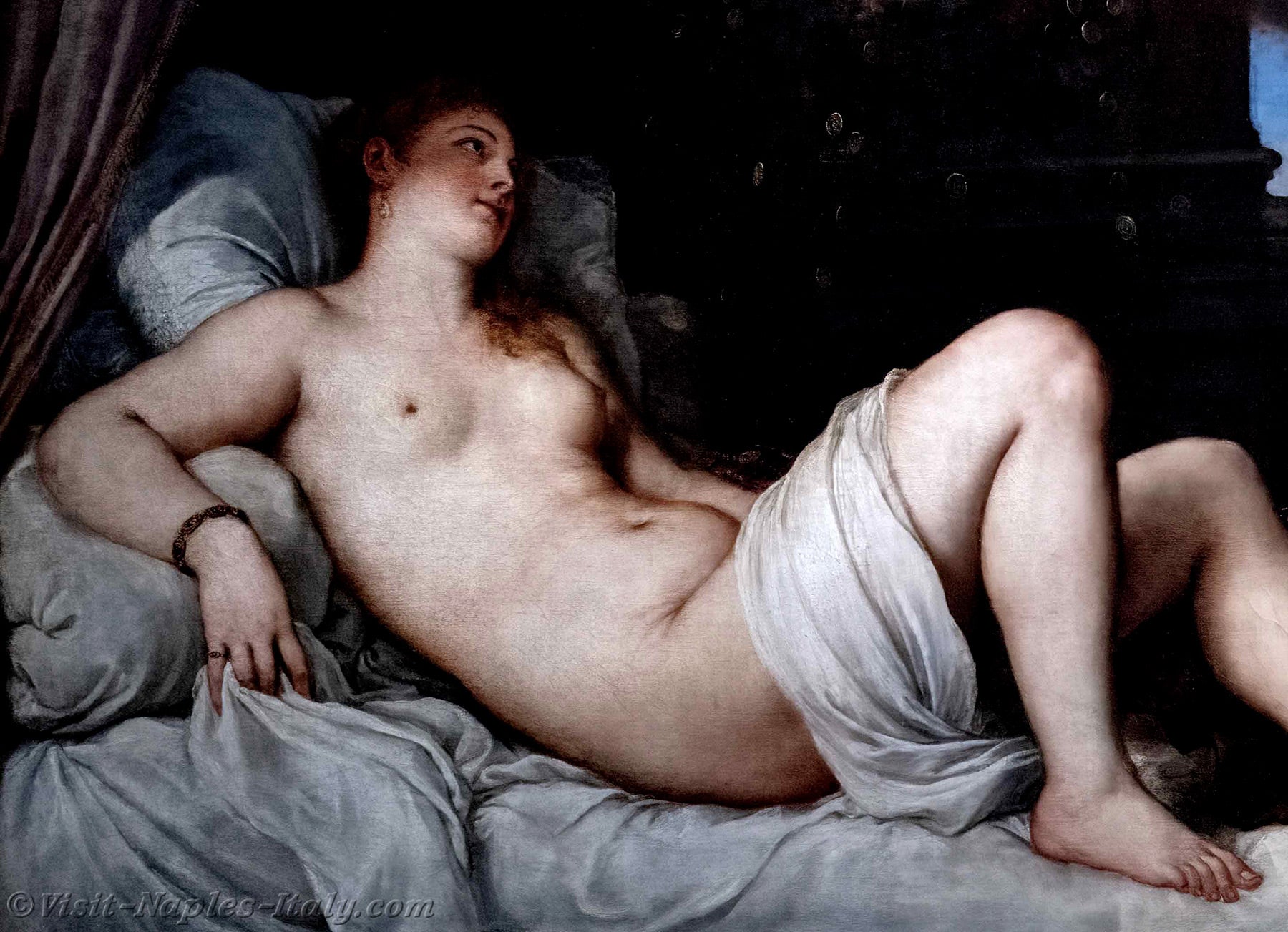
Titian, Danaë One cannot help but admire Titian’s talent for capturing the beauty of this young woman, whose name was Angela.
Angela was the mistress of Cardinal Alexander Farnese, grandson of Pope Paul III.
Just like his grandfather, Cardinal Alessandro Farnese was a patron of the arts who loved art, and above all women - a womaniser.
When Michelangelo saw this painting, he praised Titian for the beauty of the colours, whilst pointing out to him that, in his opinion, the drawing was weak.
When we look at this painting today - which was originally in the private apartments of Cardinal Alexandre Farnese - we do not find much in it that is shocking.
But when this painting was transferred to Naples in 1815 to be exhibited at the Royal Museum of Capodimonte, it was censored and ended up in the gallery of so-called obscene paintings, that is to say, works with indecent subjects.
Titian “Portrait of a Young Girl”
Painting - Oil on canvas (84.5 x 73 cm) 1545This portrait of a young girl was also commissioned by Cardinal Alessandro Farnese from Titian.
A young girl who has never been identified.
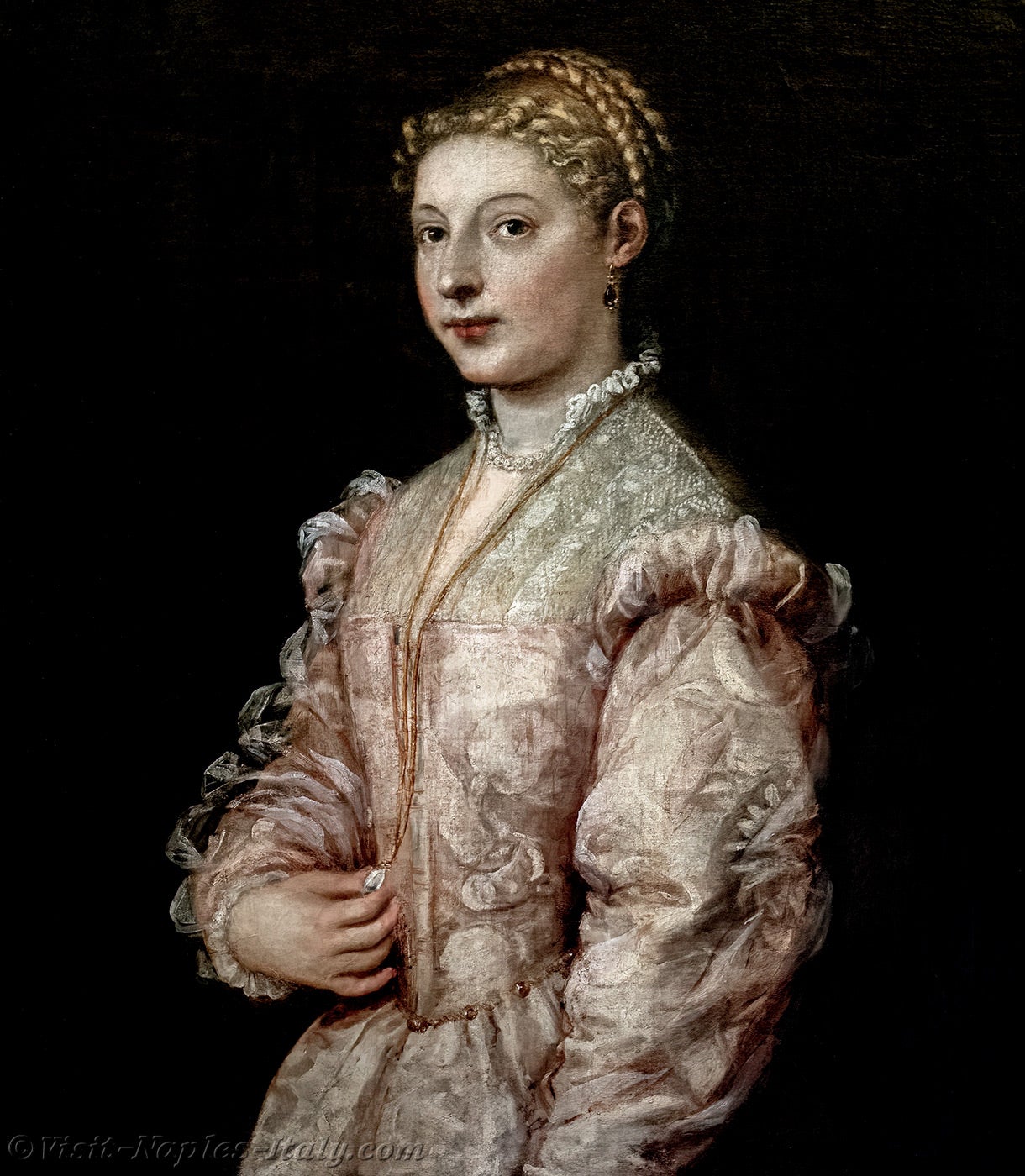
Titian, Young Woman However, given that this portrait was painted in the same year as “Danaë”, that the two young women look very much alike and that they are both wearing the same earrings, it is assumed that this must be Angela, Cardinal Farnese’s mistress.
Admittedly, on this occasion, the young woman is magnificently dressed, but her smile and her gaze are so similar to those of the beautiful Danaë that, whilst there is no historical certainty to confirm it, there is a strong likelihood that this is indeed the same Angela.
Her face and her beautiful blonde hair are magnificently painted, and her gaze is particularly striking.
One cannot help but admire Titian’s talent for the way he has rendered the details of the dress’s thick brocade as well as the transparency of the veil around her right sleeve.
Between the fingers of her right hand, the young woman delicately holds the precious stone set at the end of her long necklace, which draws the eye to her waist.
Titian “Mary Magdalene”
Painting - Oil on canvas (122 x 94 cm) 1567Titian painted numerous penitent Mary Magdalenes.
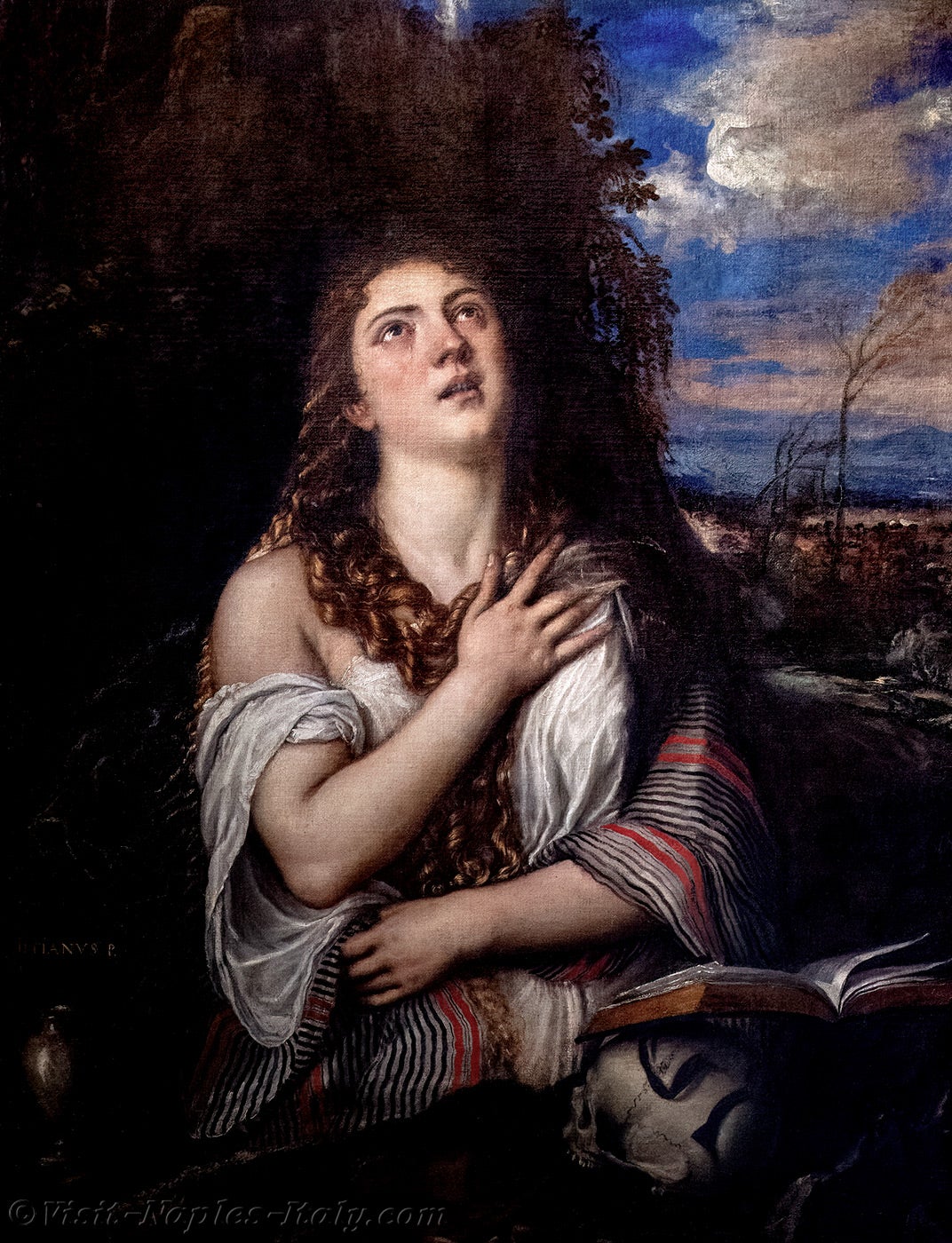
Mary Magdalene He always took the opportunity to depict them nude, whilst covering their breasts with a profusion of hair, which must have pleased him - known for his attraction to women - as much as it did his clients.
But after having painted all these saints in a particularly erotic manner, the one in the Capodimonte Museum in Naples is an exception.
This one was painted in 1567, that is, after the Council of Trent, which had laid down new rules for religious representation.
Compared to his earlier depictions of Mary Magdalene, in order to comply with the new rules, Titian therefore added a skull upon which the Holy Book rests, and the white robe of the young woman completely covers her breasts.
Mary Magdalene’s ecstatic gaze and the modelling of her face are worthy of Titian’s finest depictions of Mary Magdalene, as is her splendid curly hair, which falls over her shoulders down to her waist.
Titian’s ‘Annunciation’
Painting - Oil on canvas (281.5 x 193.5 cm) 1557This Annunciation by Titian was painted in 1557 for the Church of San Domenico Maggiore in Naples.
The Gospel of Saint Luke (1:26-38) is the only one that describes the Annunciation, the announcement made to Mary of the birth of her son.
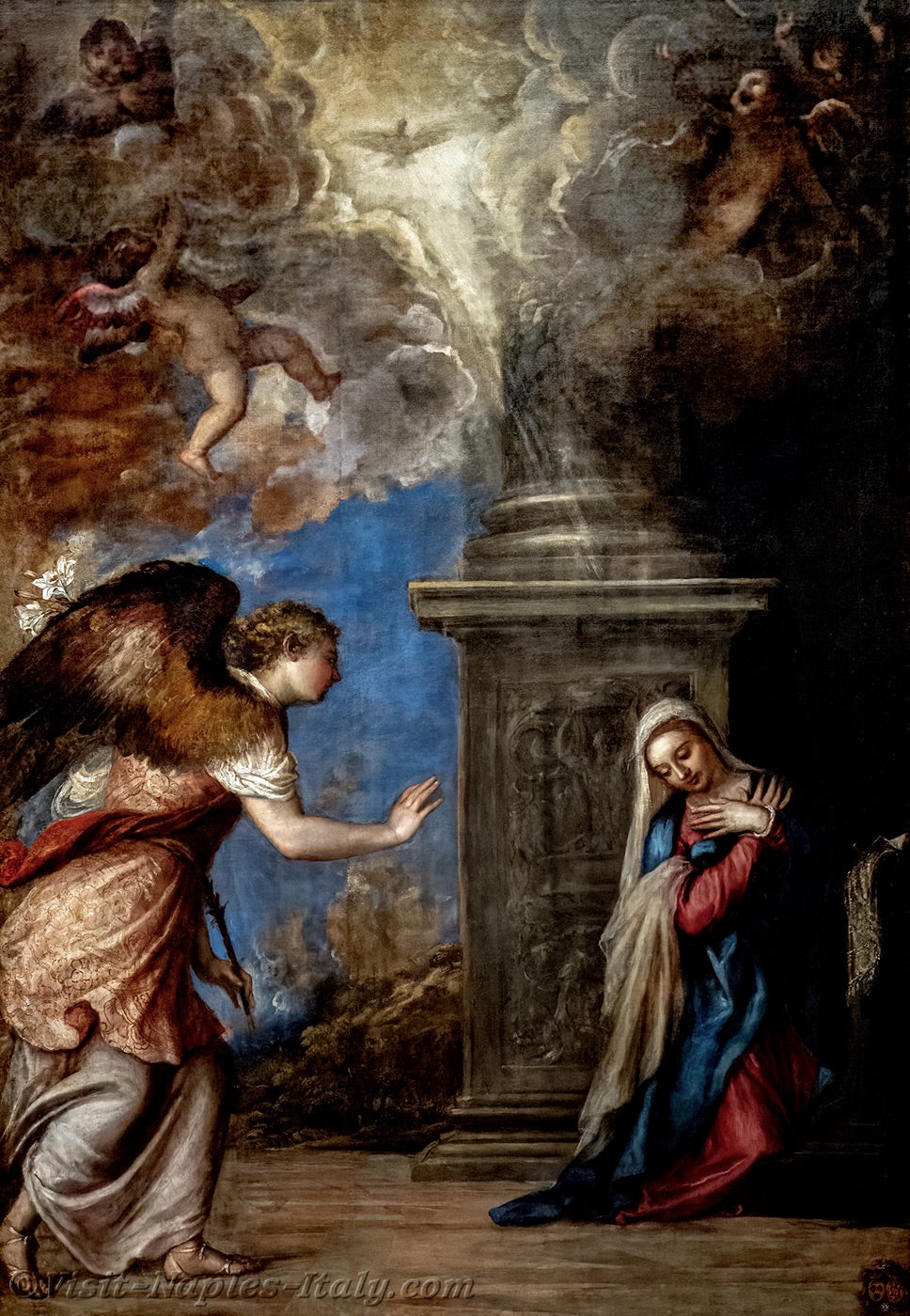
Titian, The Annunciation Titian’s Annunciation is partly in keeping with traditional depictions of this subject.
Mary is depicted in her bedroom, kneeling, beside her bed on which lies an open Bible.
The Virgin is dressed in red and blue, with a humble and submissive demeanour, her head slightly bowed and her arms crossed over her chest as a sign of acceptance.
As in most depictions of the Annunciation, Mary is placed on the right and the angel Gabriel on the left.
Between the Virgin and the angel stands a tall column separating the supernatural world from the natural or earthly world.
A supernatural and heavenly world from which the rays of divine light descend towards Mary to make her conceive.
The angel Gabriel holds a stem of white lilies symbolising Mary’s virginal purity.
The complete absence of depth of field and perspective marks the significant difference between this Annunciation by Titian and traditional Annunciations, including those he had painted previously.
This depiction of the Annunciation, which breaks with traditional iconography, is the result of Titian’s profound reflection on this theme.
For Titian, divine power does not need the aid of human geometry to express itself.
Titian considered that the architectural venue of the encounter between the angel Gabriel and Mary became secondary; he preferred to use the interplay of light and shadow combined with colour contrasts.
We can thus see that this Annunciation depicts cherubs and the Paraclete within the great cloud that eliminates any sense of perspective by completely covering the upper half of the painting.
For Titian, the most important element, the one that must be most visible to express the divine, is the light amidst the clouds.
Titian was one of the pioneers who dared to abandon perspective in his Annunciations; this painting is one of the high points of this new style of representation.
Titian “Pier Luigi Farnese”
Painting - Oil on canvas (111 x 87 cm) 1543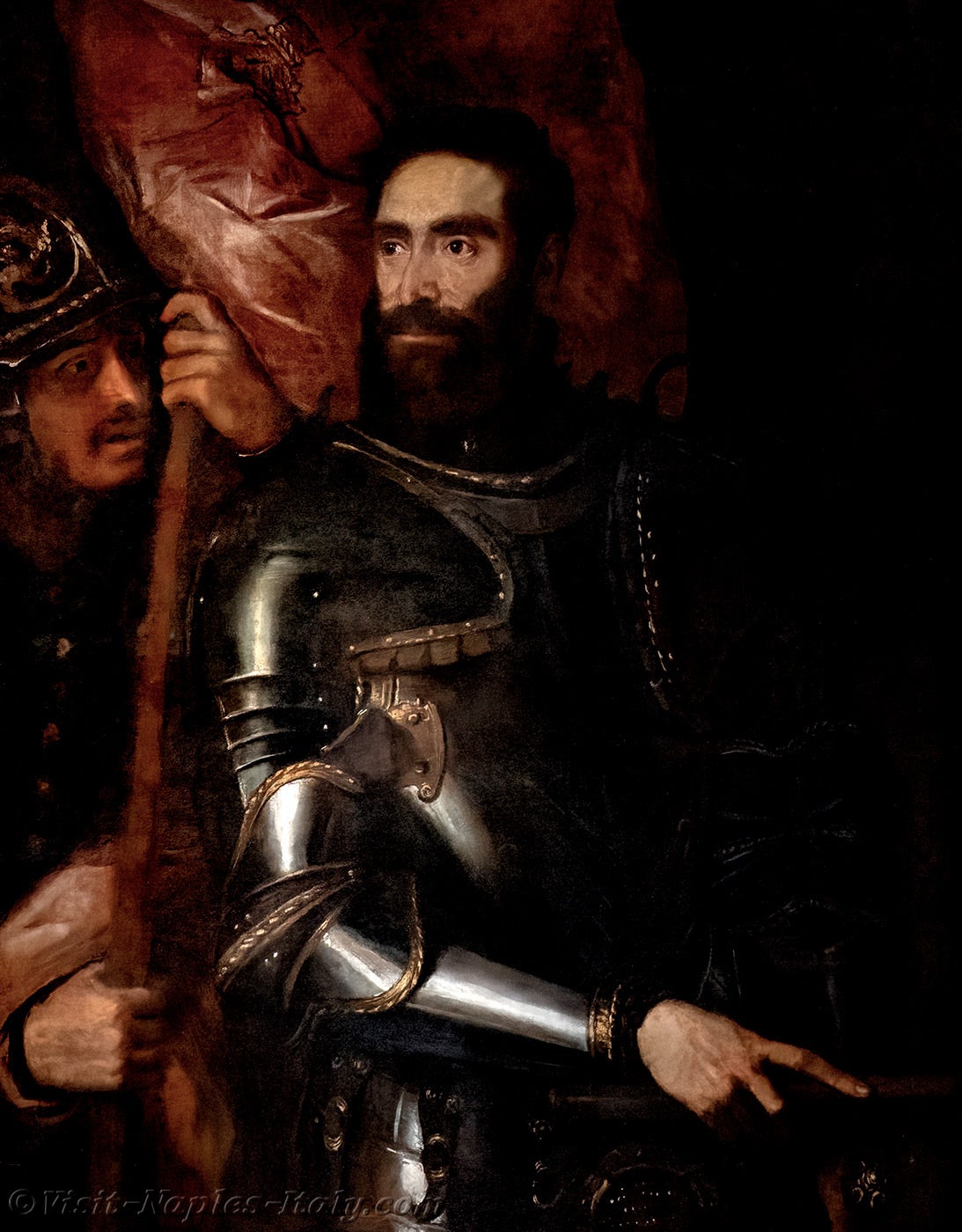
Pier Luigi Farnese Pier Luigi Farnese, born in 1503, was the eldest son of Pope Paul III, whom he had with Silvia Ruffini, a Roman woman who bore him four children.
Pier Luigi Farnese and his brother Paolo were legitimised by Pope Julius II, whilst the other two were legitimised by Pope Leo X.
Titian skilfully captured the character of Pier Luigi Farnese as he posed proudly in his gleaming armour as a military commander.
In 1545, he became Duke of Parma and Piacenza, but only for a short time.
He was, in fact, assassinated in 1547 following a conspiracy led by Don Ferrante with the consent of Charles V.
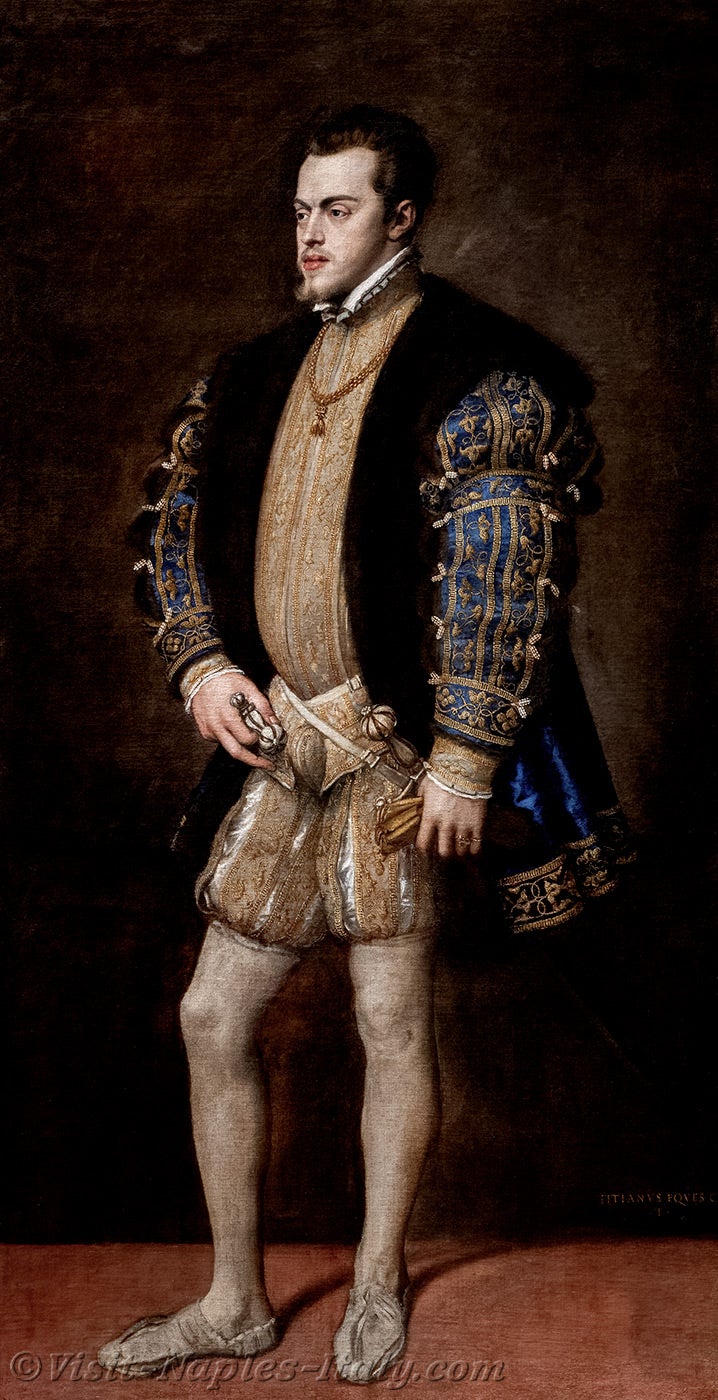
Titian, Philip II
Titian “Philip II, King of Spain”
Painting - Oil on canvas (187 x 98.5 cm) 1554
Titian painted King Philip II of Spain standing, in a truly regal pose expressing the qualities of a sovereign, both stern and calm.
He is wearing the necklace of the Order of the Golden Fleece.
One cannot help but admire the superb quality of Titian’s depiction of the king’s sumptuous garments.
In particular, the fur and the blue sheen of the velvet on the jacket.
Titian “Pope Paul III Bareheaded”
Painting - Oil on canvas (113.7 x 88.8 cm) 1543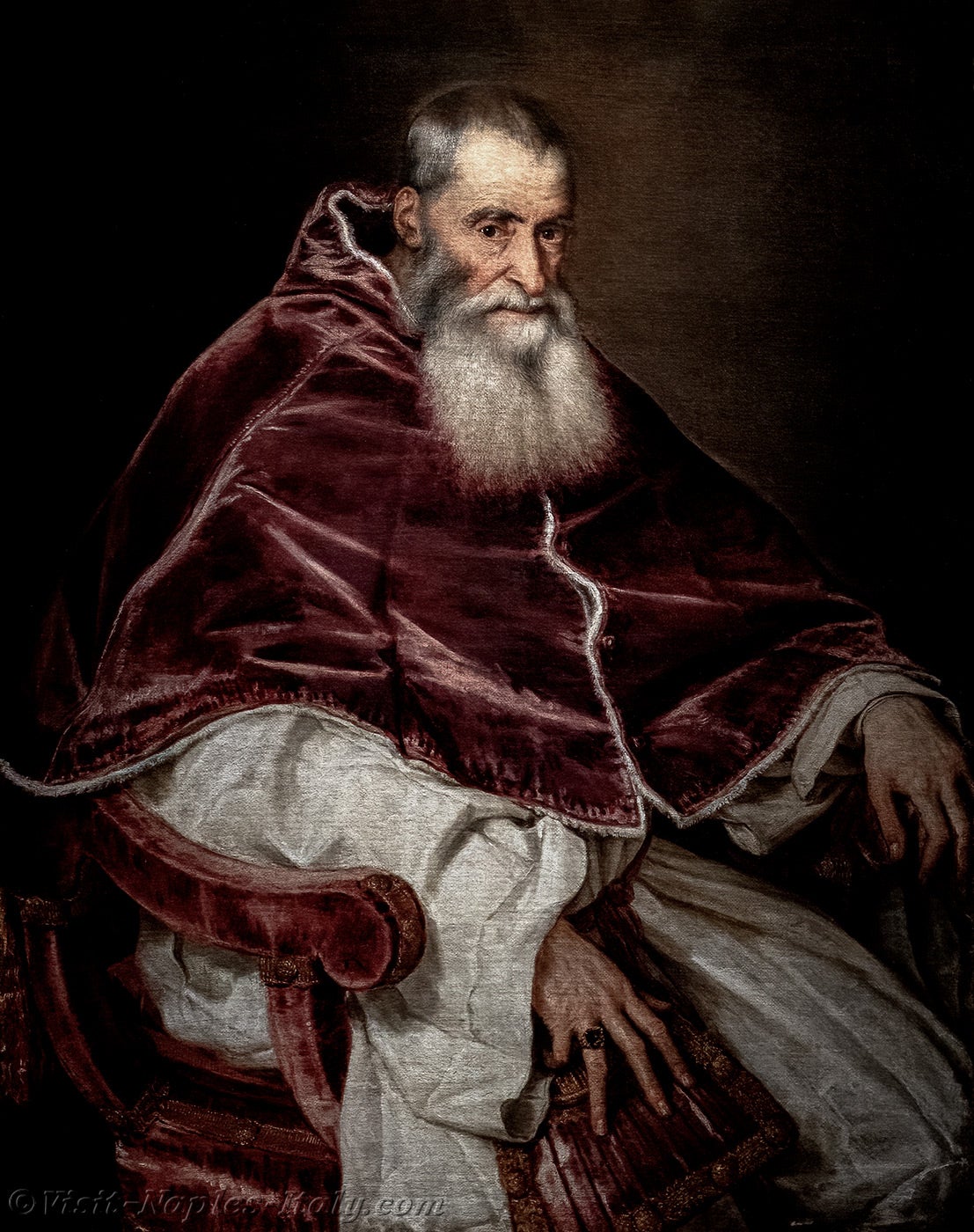
Titian, Paul III Head Bare This magnificent portrait of Pope Paul III was painted by Titian to mark his meeting with Emperor Charles V, which took place in Bologna in 1543.
Pope Paul III is seated, depicted in three-quarter profile, and gazes intently, whilst his mouth forms a faint smile.
Intelligence, but also caution, even mistrust, can be read on the face of this man who must not have been easy to persuade.
The fact that he is not wearing his papal cap in this portrait could be interpreted as a sign of humility; however, he ostentatiously displays his right hand, adorned with the ring symbolising his papal power, resting flat on a pouch he wears at his belt.
Titian “Pope Paul III with his nephews Alexander and Octavian Farnese”
Painting - Oil on canvas (202 x 176 cm) 1545-1546Titian has magnificently captured the mischievous look on the face of the elderly Pope Paul III, whose right hand grips the armrest of his chair and highlights the ring used to affix the seal of papal authority to official documents.
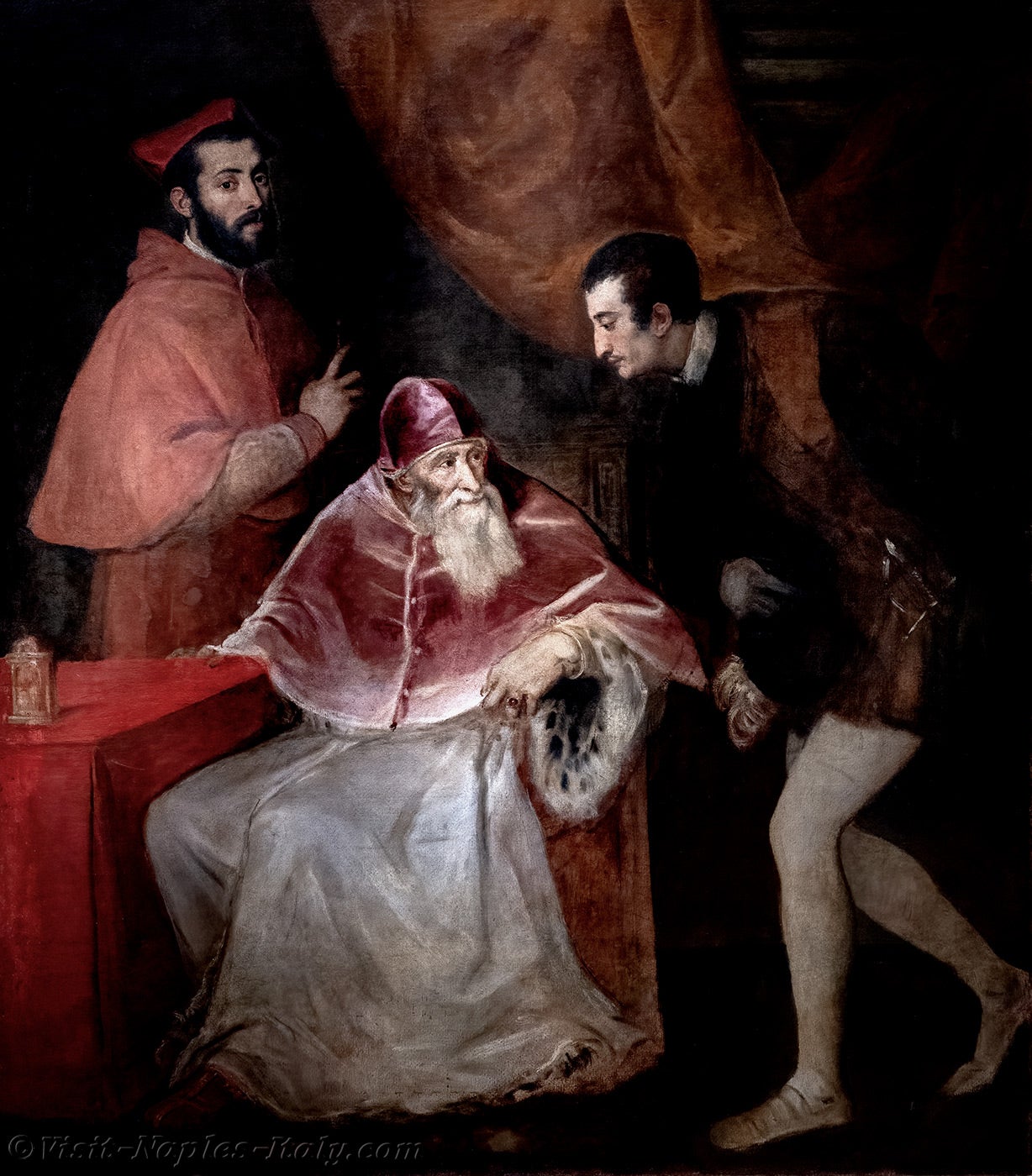
Paul III and his nephews Cardinal Alessandro Farnese is standing and looking at us with a serious expression whilst holding the knob of the Pope’s chair, as if to affirm his papal ambitions.
In contrast, Octave Farnese bows humbly to Paul III, who looks at him mischievously, guessing the reasons for his eagerness to kiss the papal ring.
He hopes to become Duke of Parma and Piacenza following in his father’s footsteps, as his future is uncertain.
The composition of the painting is essentially based on the interplay of light and shadow as well as on colour contrasts, in order to guide the viewer’s gaze towards the main subject: the Pope.
Titian’s talent as a portraitist successfully captures the characters of the three figures: a cunning old man aware of his power, surrounded by his ambitious descendants.
Alexander hopes to take his turn on the papal throne, whilst Octavian wants to reclaim the duchy of his father, Pier Luigi.
Paul III wearing his papal cap
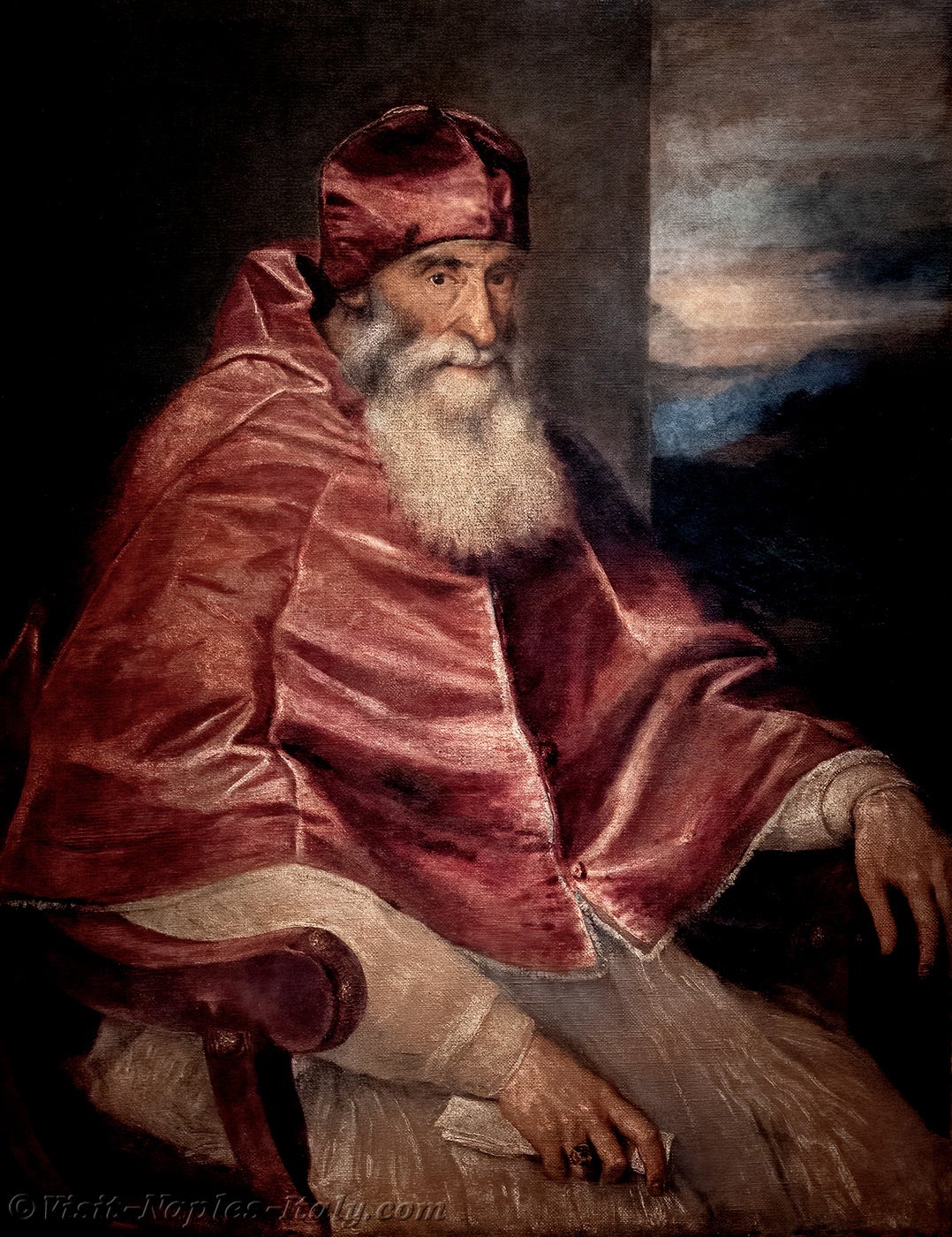
Titian “Pope Paul III with his papal cap”
Painting - Oil on canvas (105 x 80.8 cm) 1545-1546Wit and intelligence are evident on Pope Paul III’s face in this superb painting by Titian.
As in his other portraits painted by Titian, the Pope is careful to show us his right hand, on which rests the papal ring.
His age is revealed only by his white beard and the fact that he is slightly stooped, for the liveliness of his gaze, perfectly captured by Titian, is still that of a young man.
Titian “Cardinal Alessandro Farnese”
Painting - Oil on canvas (97 x 73 cm) 1545-1546Alessandro Farnese was the eldest son of Pier Luigi Farnese, who was himself the eldest of Pope Paul III’s four children.
Alexander was elevated to the rank of cardinal by his grandfather at the age of 14. When everything stays in the family, anything is possible!
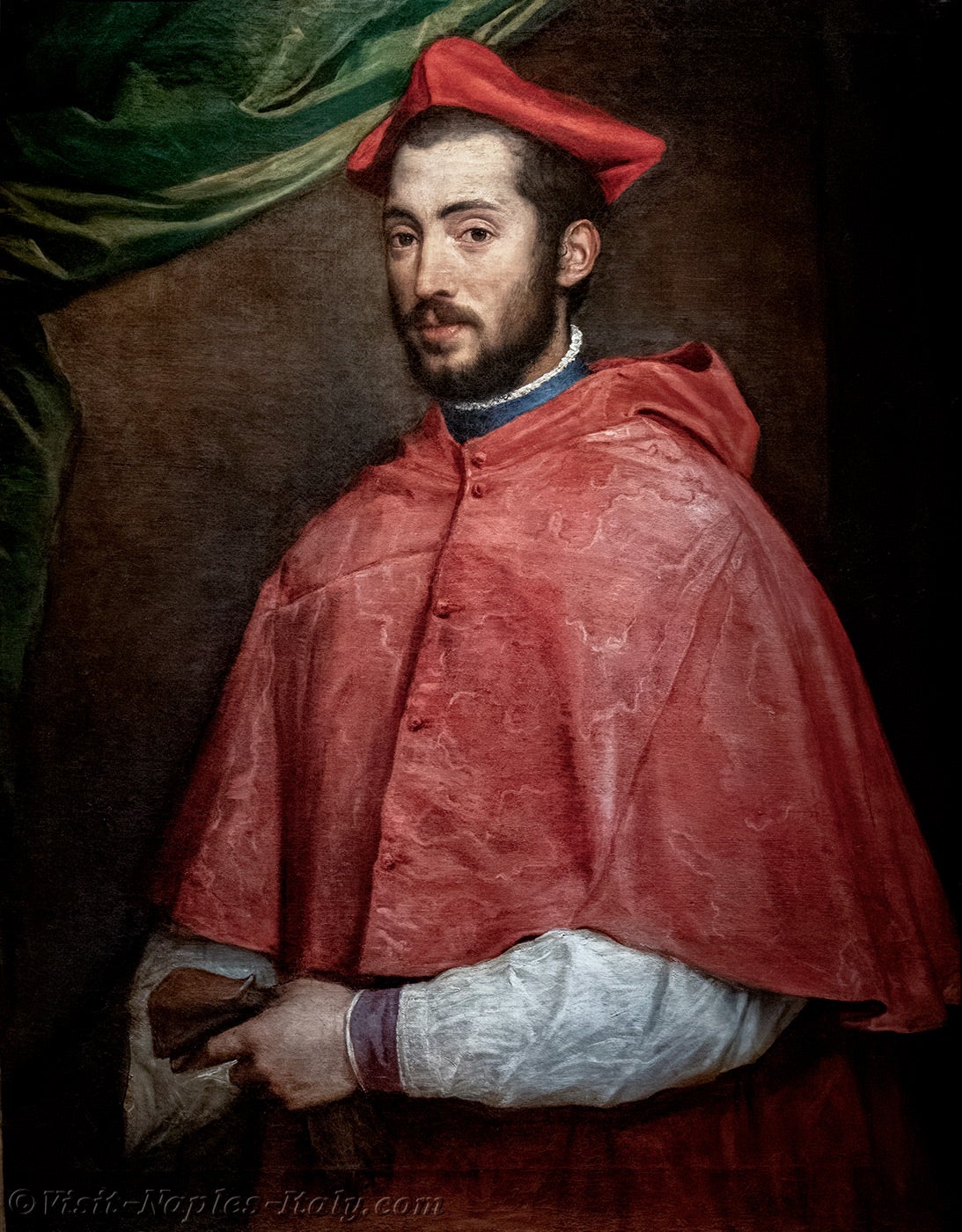
Alexander Farnese His diplomatic skills earned him the nickname ‘the Grand Cardinal’.
Among other things, he succeeded in negotiating peace between Charles V and Francis I.
He is holding a pair of brown leather gloves which are not those of the cardinal, but those of the man who manages the affairs of the world: his demeanour is both civil and religious.
Religion having served him above all to consolidate his power and increase his fortune.
Intelligence is evident on his face, and Titian has perfectly captured the liveliness of his observant gaze.
As for the rest, his reputation as a great lover of beautiful women is confirmed by the painting of “Danaë” which he commissioned from Titian, since the completely nude model for Danaë was none other than his mistress, the courtesan Angela.
To his credit, however, it should be added that he was a great patron of the arts, just like his grandfather, who was behind the fabulous Farnese collection which makes up a large part of the paintings on display at the Capodimonte Royal Museum.
Titian “Portrait of Cardinal Pietro Bembo”
Painting - Oil on canvas (114 x 97 cm) 1545-1546When Titian painted this portrait of Cardinal Pietro Bembo, the latter was already 74 years old, two years before his death.
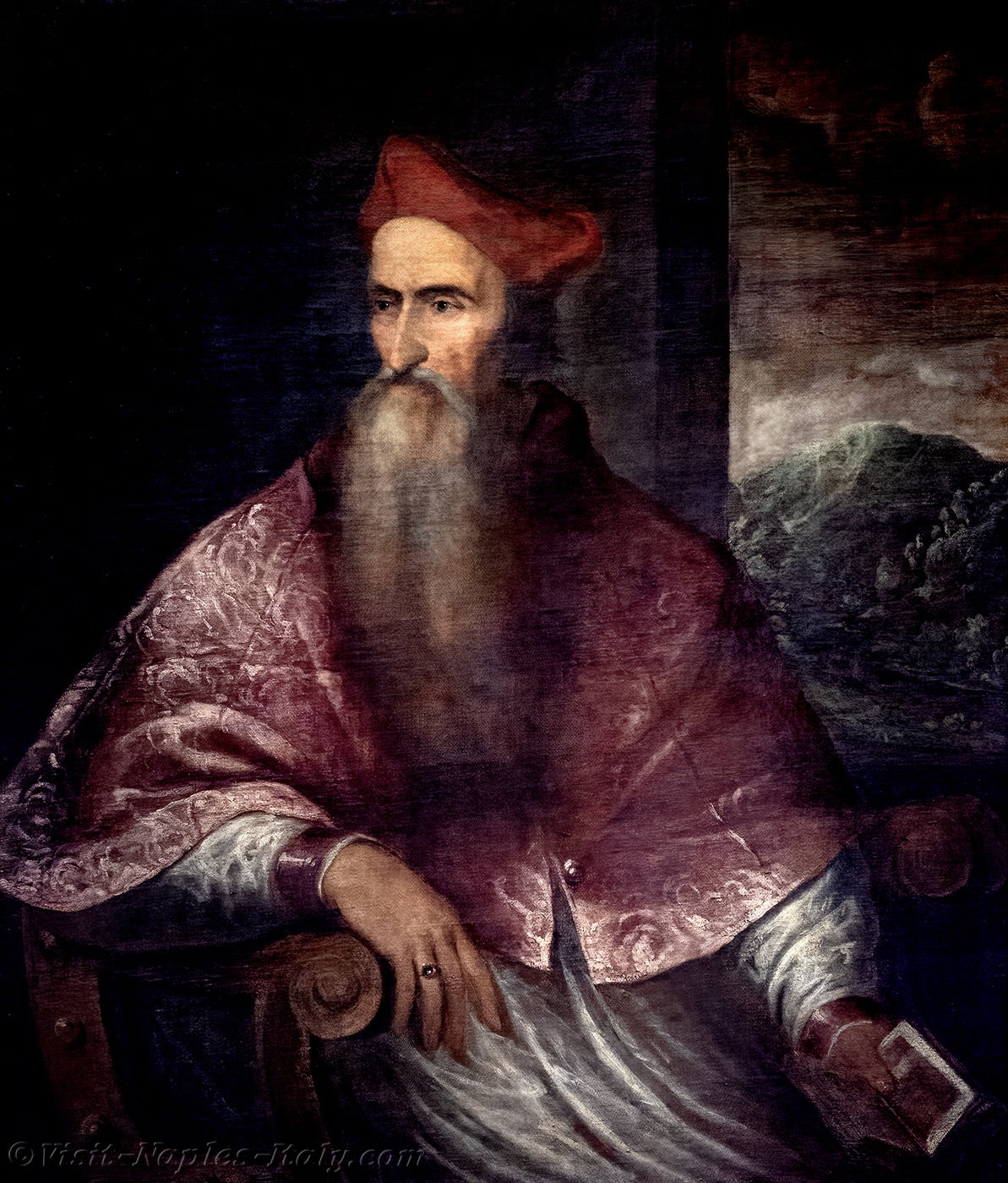
Cardinal Pietro Bembo Bembo was a man of letters and a poet; he was the son of a Venetian senator sent to Florence, where he had associated with Lorenzo the Magnificent, Angelo Politian and Pico della Mirandola.
He was appointed cardinal by Pope Paul III in 1539.
Titian painted him seated before a distant landscape, an open book in his left hand and his right forearm resting on the armrest of his chair.
His right hand hangs elegantly from the end of the armrest revealing his cardinal’s ring.
His gaunt face betrays his age, but his gaze is that of a thinker who has retained all his intellectual faculties.
Pietro Bembo’s posture in his chair is typical of Titian’s portraits; here, too, he makes use of chiaroscuro to show his subject to the best advantage.
Titian “Portrait of Charles V with the Golden Fleece”
Painting - Oil on canvas (98 x 71 cm) 1549Emperor Charles V is here depicted by Titian, dressed in the simplest manner possible.
He is clad in black velvet accented with a simple white ruff, a far cry from the magnificent brocades of classical portraits of kings and emperors, he who reigned over a vast empire ‘where the sun never set’.
His rank is merely suggested by the necklace of the Order of the Golden Fleece which he wears around his neck.
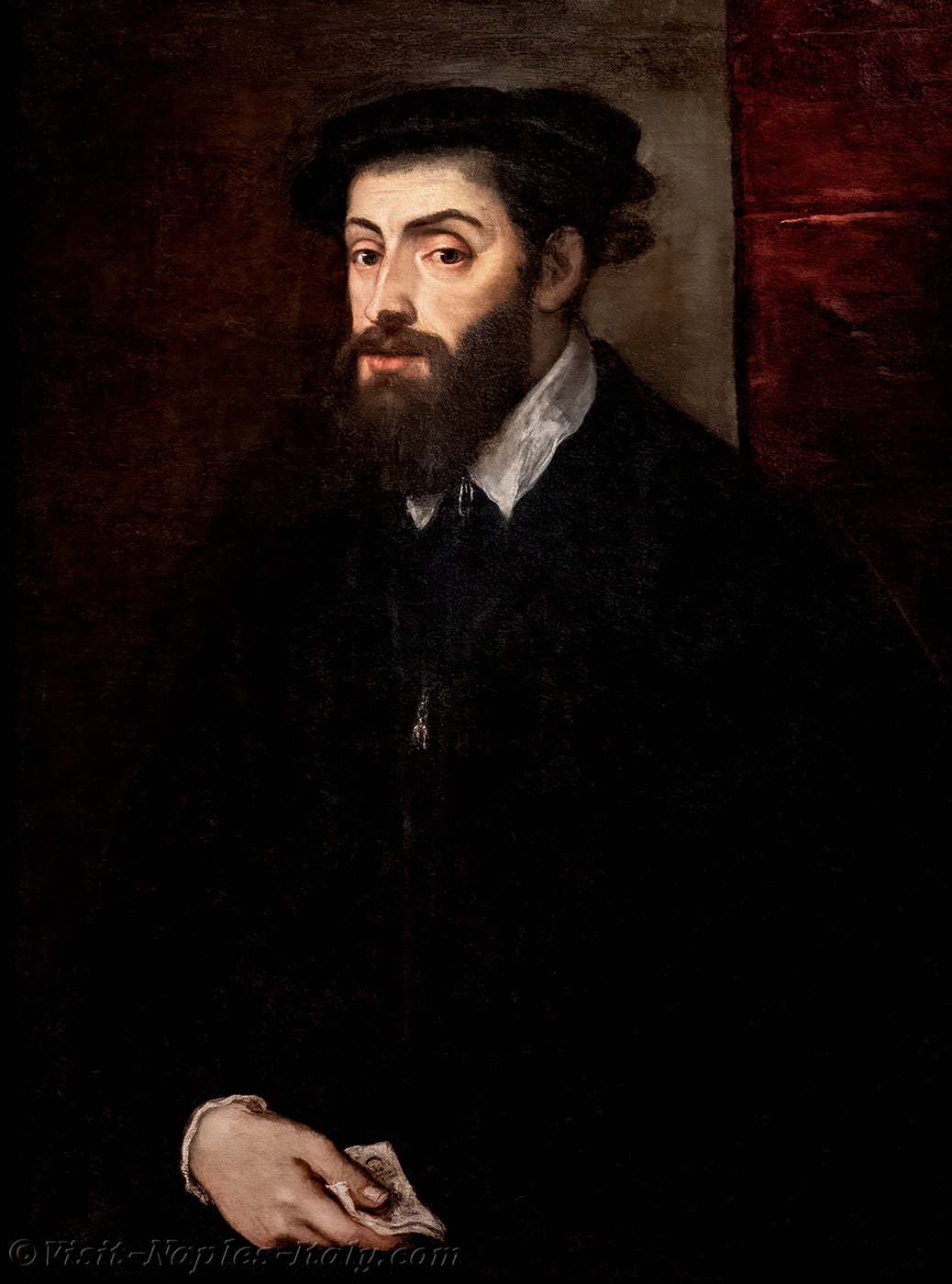
Titian, Charles V His face is gentle and he looks like a quiet man, almost ordinary, even though he spent most of his life at war.
But he eventually grew weary, disillusioned and jaded by his failures, including his war against France and his inability to combat Lutheranism, even though he had always dreamt of creating an empire at the head of a united Christendom.
A loss of interest in his office, which is already apparent in this portrait where, even though he is looking at us, he seems absent, elsewhere.
So much so that a little over six years after this portrait by Titian, his disinterest would be such that he would abdicate of his own accord in favour of his brother, Ferdinand I.
A painting in which Titian admirably captured the personality of Charles V, turning it into an almost prophetic portrait of his abdication in favour of his brother and son, and of his retreat to a Spanish monastery to live out his days.
Artists Palace Gardens | Bellini | Botticelli | Bronzino | Brueghel | Canova | Caravaggio | Gentileschi | Giambologna | Giordano | Greco | Lotto | Luini | Mantegna | Masaccio | Masolino | Michelangelo | Palma | Parmigianino | Porta | Raphael | Reni | Titian | Van Dyck | Warhol
Capodimonte Artists Schedule Tickets Location | Authorizations
Back to Top of Page