

MANN Artworks Schedule Tickets Location | Authorizations
Artworks Sculptures | Frescoes | Eroticism
Frescoes Mythology | Portraits | Life Leisure | Animals | Religion | Landscapes | Decoration
Life Leisure Arts | Food | Young Women | Daily Life | Commerce | Sport
Frescoes depicting the lives of young women in Pompeii and Herculaneum at the Archaeological Museum of Naples, Italy
Women at the Door and on the Balcony, Pompeii, Casa di Meleagro
Fresco and Stucco - Water-based pigments on Coating (167 × 180 cm) 62-79 AD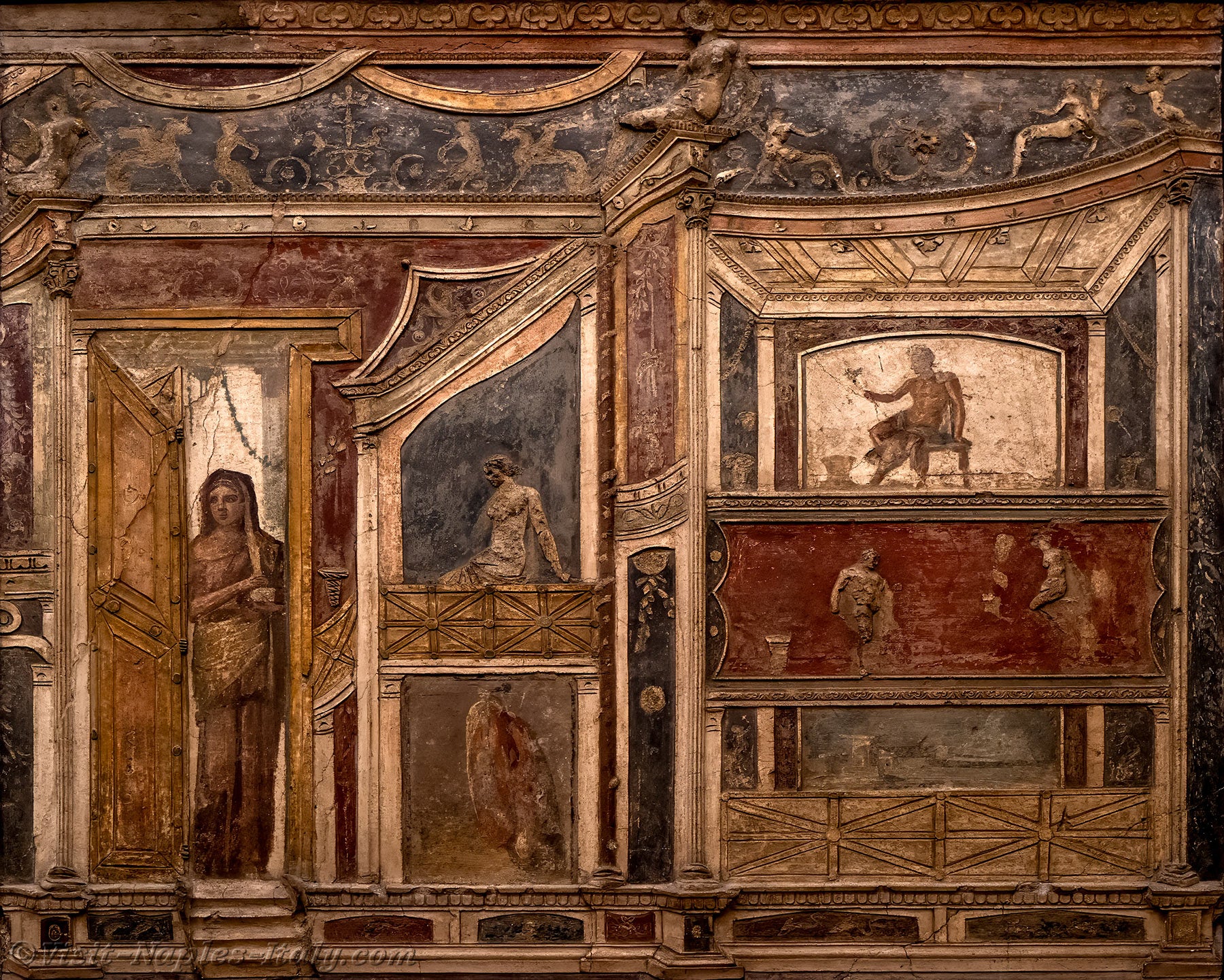
Woman at her doorstep The frescoes adorning the north and south walls of the Casa di Meleagro in Pompeii are not only remarkable for their beauty, but they are also unique compared to other houses in Pompeii.
In addition to the fresco painting typical of Pompeii, they have the distinctive feature of incorporating stucco elements to add relief.
Stucco was mainly used for decorating the baths.
It was also found on their vaults to create coffers.
In this fresco, the use of stucco for door and window frames creates a perspective effect.
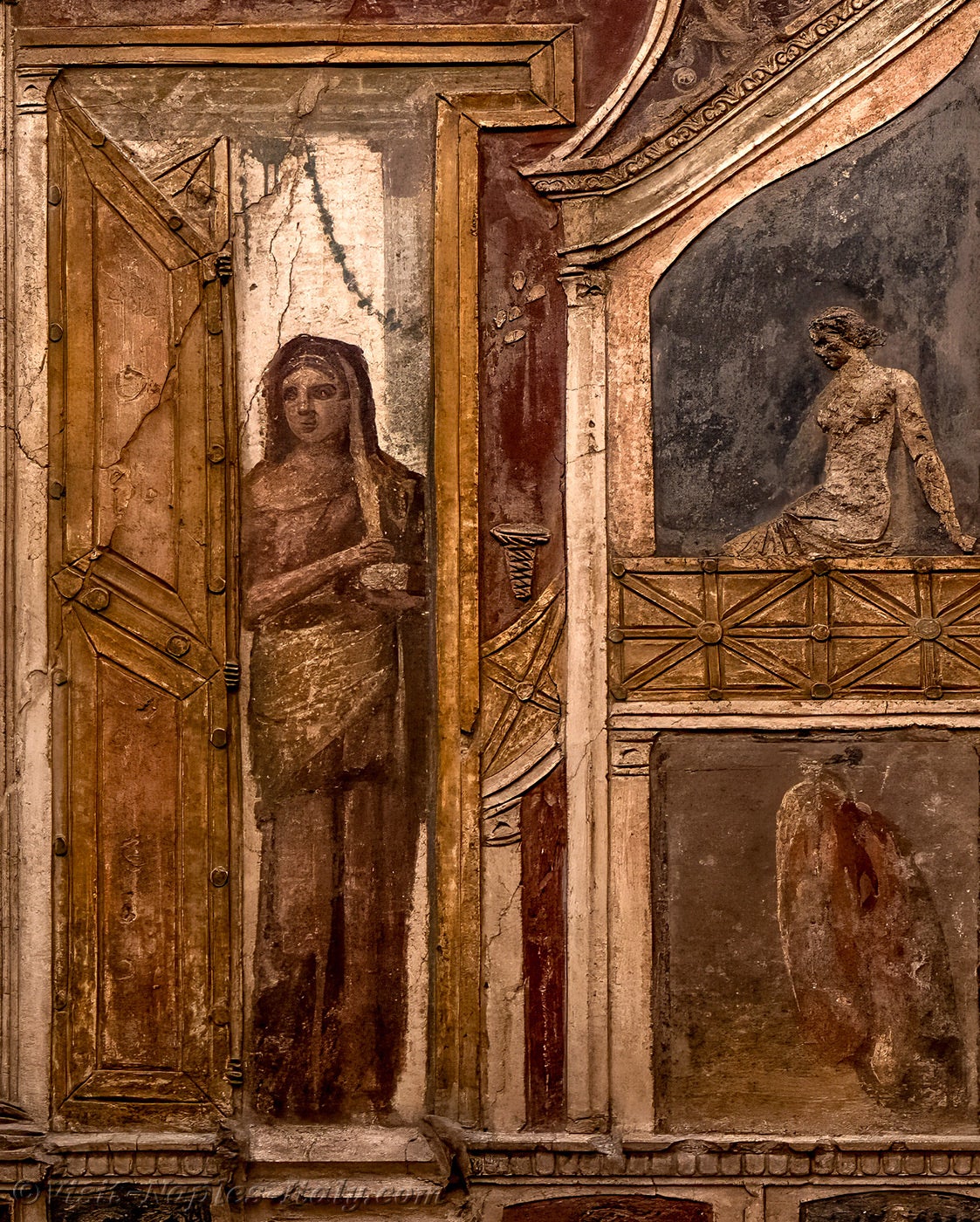
Woman at her doorstep This effect was enhanced by painting the stucco itself, for example on the door or the front of the balcony.
At the top of the fresco, a frieze depicts centaurs on either side of a central wall on which a woman stands.
In the doorway on the left is a woman wearing a cloak and carrying a small box.
To her right, a woman, depicted in stucco and relief, is seated on the balustrade of a balcony.
Beneath this balcony, the artist has painted a still life, possibly depicting fish.
On the other side of the central partition and to the right, a man is seated holding a branch.
He is depicted beneath a coffered ceiling in stucco, with vanishing lines that demonstrate the artist's mastery of perspective.
Beneath this man, depicted in stucco on a red background, stands out the silhouette of Hercules. Below him is painted a landscape.
Woman with Mirror, Stabiae, Villa di Arianna
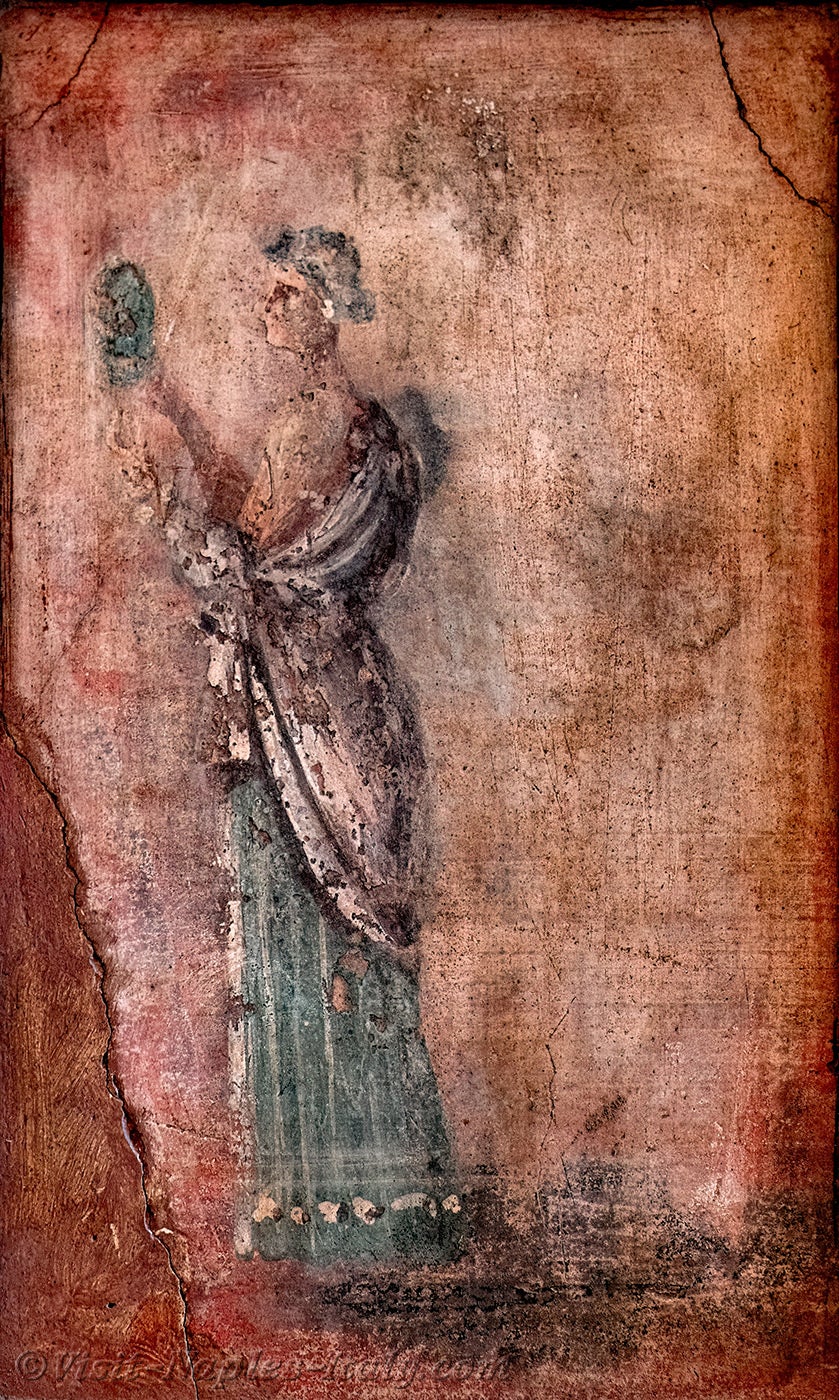
Woman at the Mirror Fresco - Water-based pigments on coating (23 × 15 cm) 10-37
This fresco comes from the Villa di Arianna in Stabiae.
It depicts a young woman with a graceful, slender figure, dressed in a long green gown in a refined style.
A large, light-coloured shawl is tied at her waist and covers her shoulders and hips.
She is turned to the left and holds a mirror in which she admires herself.
One almost feels as if one is entering her private world.
This small scene on the wall captures the essence of Roman life at that time, like a snapshot.
Young girl with a mirror combing her hair, Stabiae, Villa di Arianna
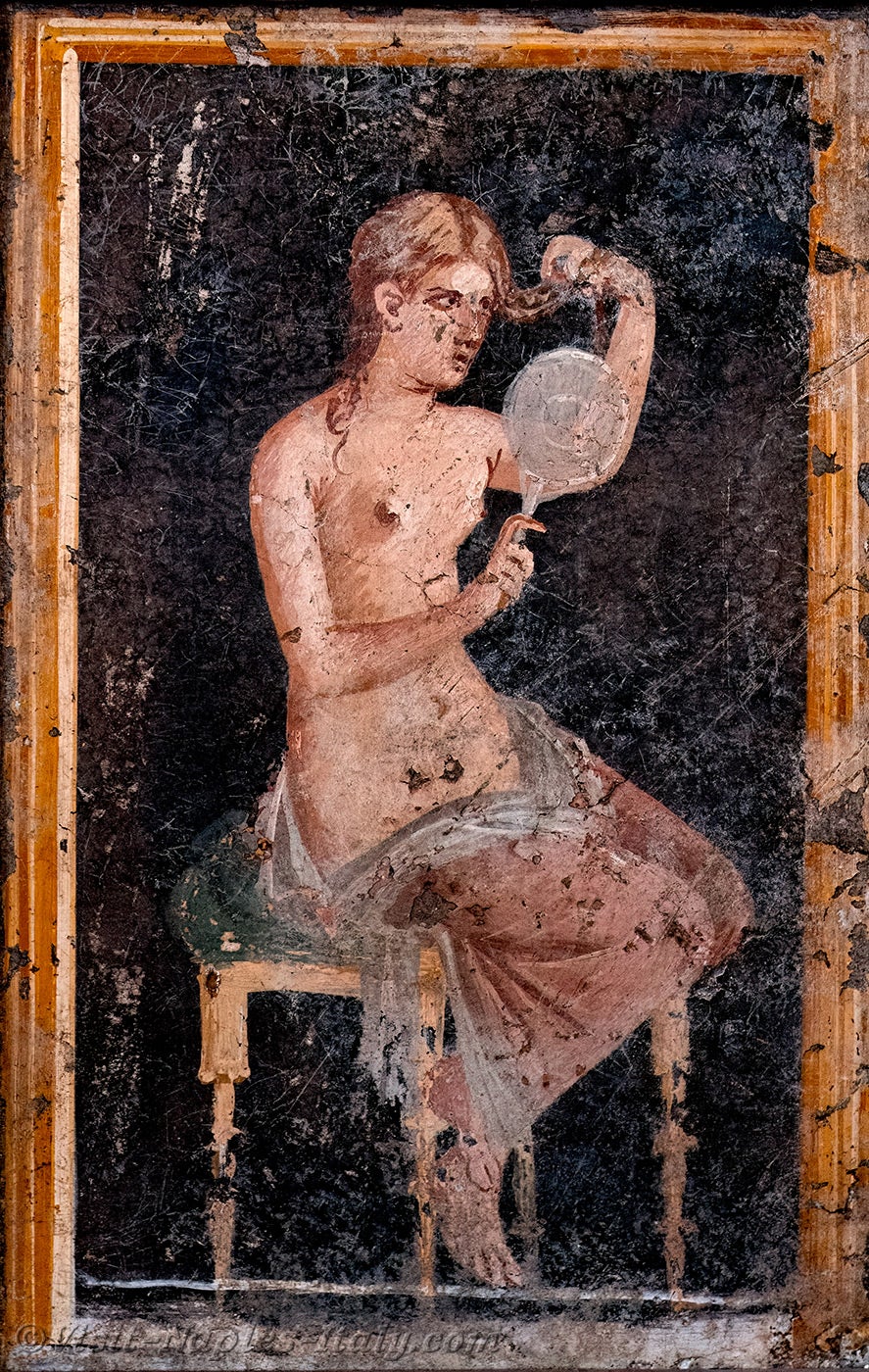
Young girl in the mirror Fresco - Water-based pigments on coating (50 × 33 cm) 54-69 AD
This fresco, discovered at the Villa di Arianna in Stabiae, is a bit like a photographic snapshot.
It feels like we are witnessing live the moment when this young girl concentrates on her strand of hair.
As she combs her hair, she carefully adjusts the final aesthetic touch to her hairstyle, looking at her reflection in the mirror.
Her pose is as natural as her near-nudity.
Even the way her feet are placed on the stool seems natural and authentic.
Although this scene seems authentic to us, the girl's pose is borrowed from Apelles' painting of Aphrodite Anadyomene, in which she holds a lock of her hair.
Several statues of Venus Anadyomene have been found in Pompeii; they can be seen combing their hair or, more precisely, wringing out their hair after coming out of the sea.
Fresco of a woman sitting and meditating, Stabiae, Villa di Arianna, Archaeological Museum of Naples
Fresco - Water-based pigments on coating (50 × 45 cm) 54-69 AD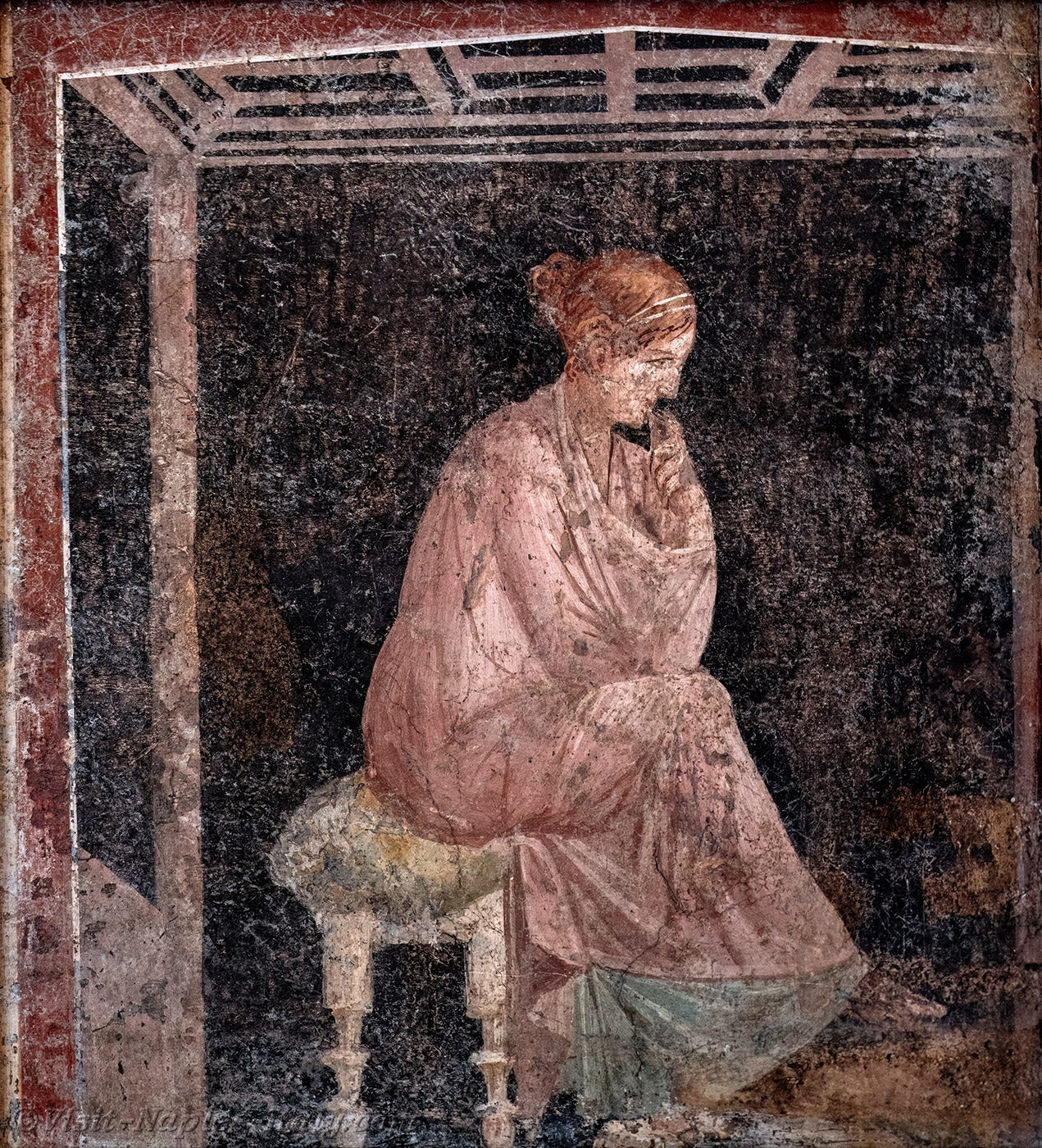
Woman sitting and meditating In this other fresco, also discovered at the Villa di Arianna in Stabiae, we enter the private world of a woman in a small aedicule.
She is seated on a stool, under a coffered ceiling.
Her right foot rests on a footrest.
Her curly brown hair is held back by a thin diadem and gathered into a bun on top of her head.
She appears pensive.
Her thoughtful attitude is perfectly expressed by her hand touching her lips and her elbow resting on her thigh.
As in the previous fresco, the artist has captured a scene with authenticity and spontaneity.
Young woman seated with a fan, Stabiae, Villa di Arianna
Fresco - Water-based pigments on Coating (47 × 38 cm) 54-69 AD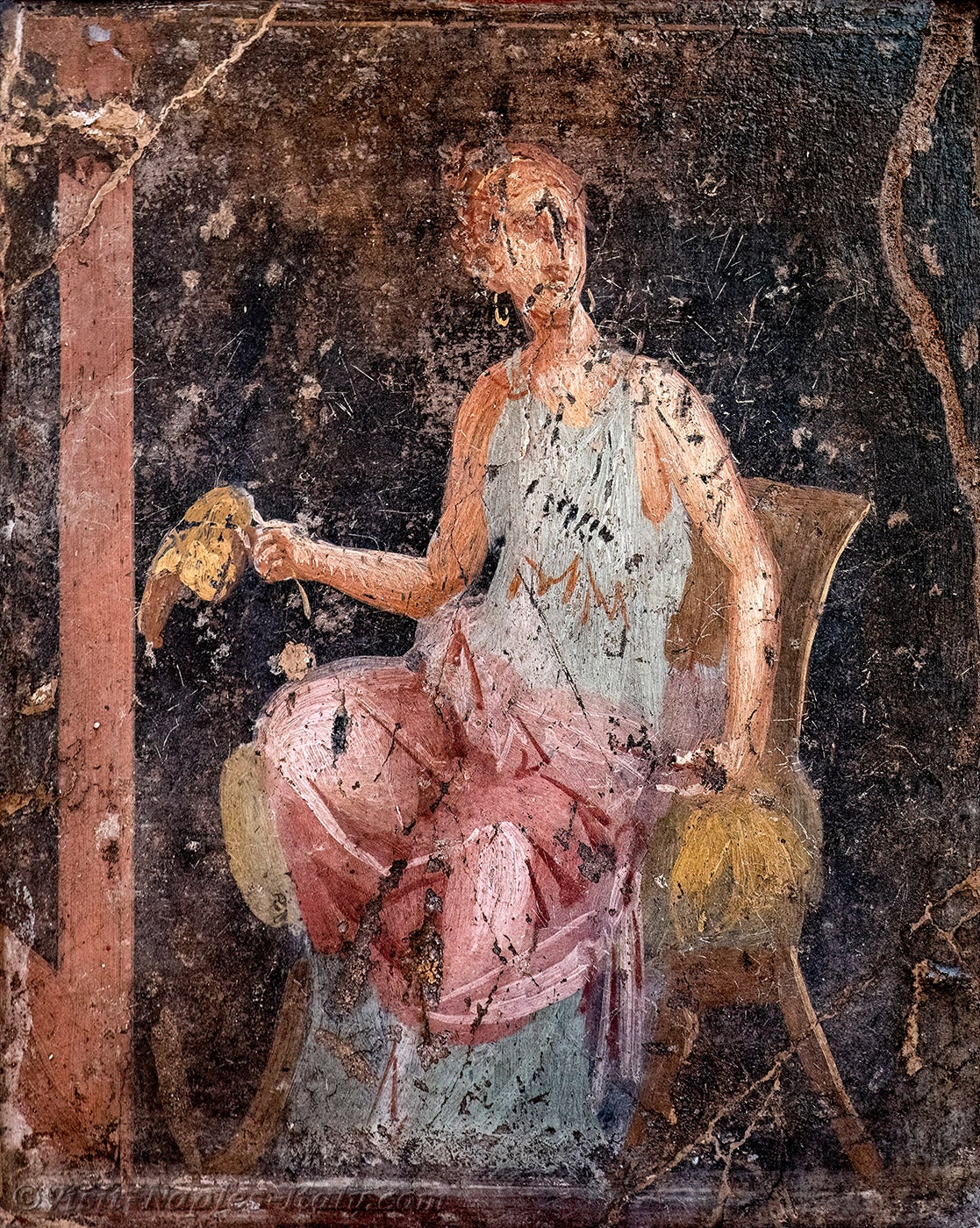
Young woman seated with a fan A young woman is seated on a chair with a curved backrest that follows the shape of her back.
The curved legs of the chair also attest to the artistic refinement of the craftsmen of the time, highlighting their attention to detail and their quest for perfection.
This shows us the remarkable degree of evolution of Roman furniture two thousand years ago.
The young woman is depicted in three-quarter profile, her hands holding a flabellum in the shape of leaves.
The flabellum was a fan used in ancient times, particularly in Egypt, where it was also a symbol of power.
However, this is simply a classic fan used to combat the summer heat of the Vesuvius region.
The young woman's tunic is made of a light green fabric.
Her chiton, which is very low-cut, is held up by thin straps.
The young woman's curly hair is held back by a gold tiara. She also wears gold earrings.
Seated woman with a silver vase, Stabiae, Villa di Arianna
Fresco - Water-based pigments on Coating (47 × 38 cm) 54-69 AD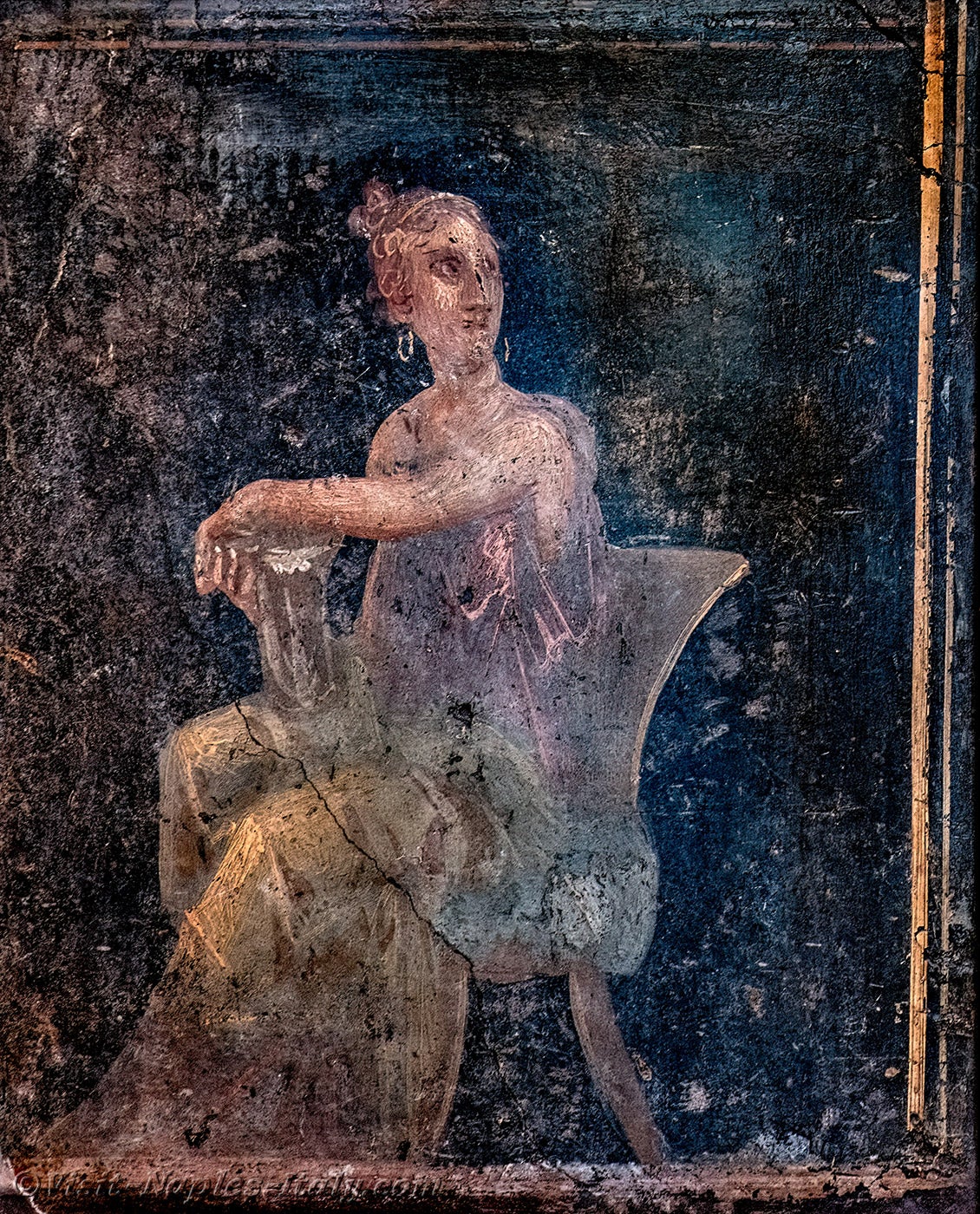
Woman seated with a silver vase This fresco, also from the Villa di Arianna in Stabiae, seems to depict almost the same scene as the previous one, with the same young woman.
We see a person seated in three-quarter profile, looking to the right.
Her chair, with a curved backrest, is identical.
The portrait shows an oval face with soft features, framed by wavy locks gathered into an elegant bun held in place by a gold headband.
Even her earrings are identical.
At this point, one might question the nature of the portrait: is it a genre painting or a portrait? It is difficult to understand why the painter chose to depict the same young woman, but with a few differences.
The only variation is the silver vase she is holding in her hands, replacing the fans in the previous painting.
Reclining Young Woman, Stabiae, Villa di Arianna
Fresco - Water-based pigments on Coating (27 × 47 cm) 54-69 ADThis small painting was located on the same wall as the previous fresco in the Triclinium of the Villa di Arianna in Stabiae.
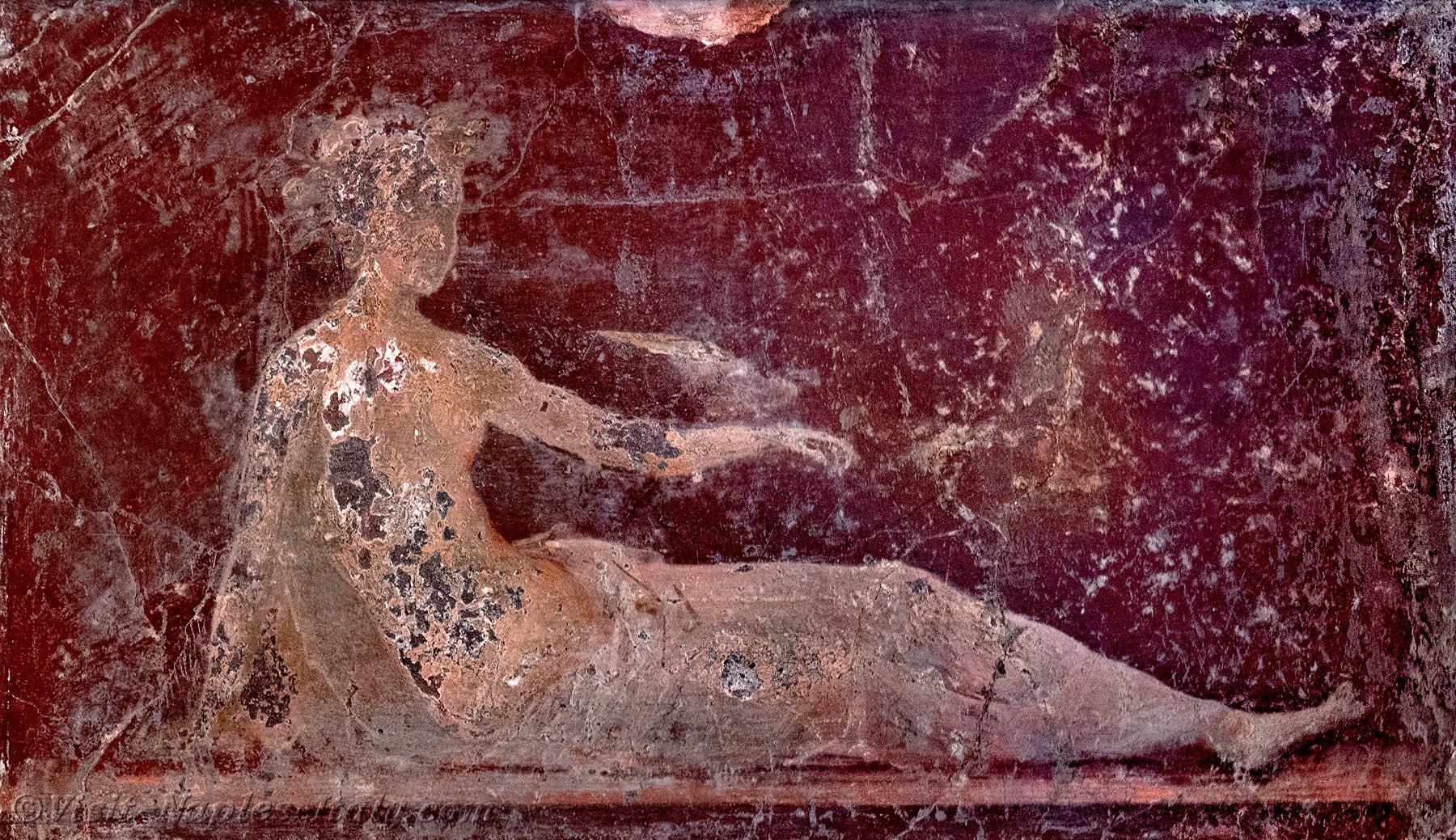
Young woman lying down The fresco depicts a young naked woman, except for a light, transparent fabric covering her thighs and legs.
The thinness of the fabric suggests that she has crossed her legs.
Her feet are also bare.
She is half-reclining on a couch and leaning on her right hand.
A bird perched on her left arm appears to be tame.
Life Leisure Arts | Food | Young Women | Daily Life | Commerce | Sport
Frescoes Mythology | Portraits | Life Leisure | Animals | Religion | Landscapes | Decoration
Artworks Sculptures | Frescoes | Eroticism
MANN Artworks Schedule Tickets Location | Authorizations
Back to Top of Page