

MANN Artworks Schedule Tickets Location | Authorizations
Artworks Sculptures | Frescoes | Eroticism
Frescoes Mythology | Portraits | Life Leisure | Animals | Religion | Landscapes | Decoration
Life Leisure Arts | Food | Young Women | Daily Life | Commerce | Sport
Frescoes of Daily Life in Pompeii and Herculaneum at the Archaeological Museum of Naples in Italy
Punishment of a pupil, Pompeii, Praedia di Giulia Felice
Fresco - Water-based pigments on coating (50 × 68 cm) 62-79 ADThis scene takes place in a school in Pompeii. It shows the punishment inflicted on a pupil.
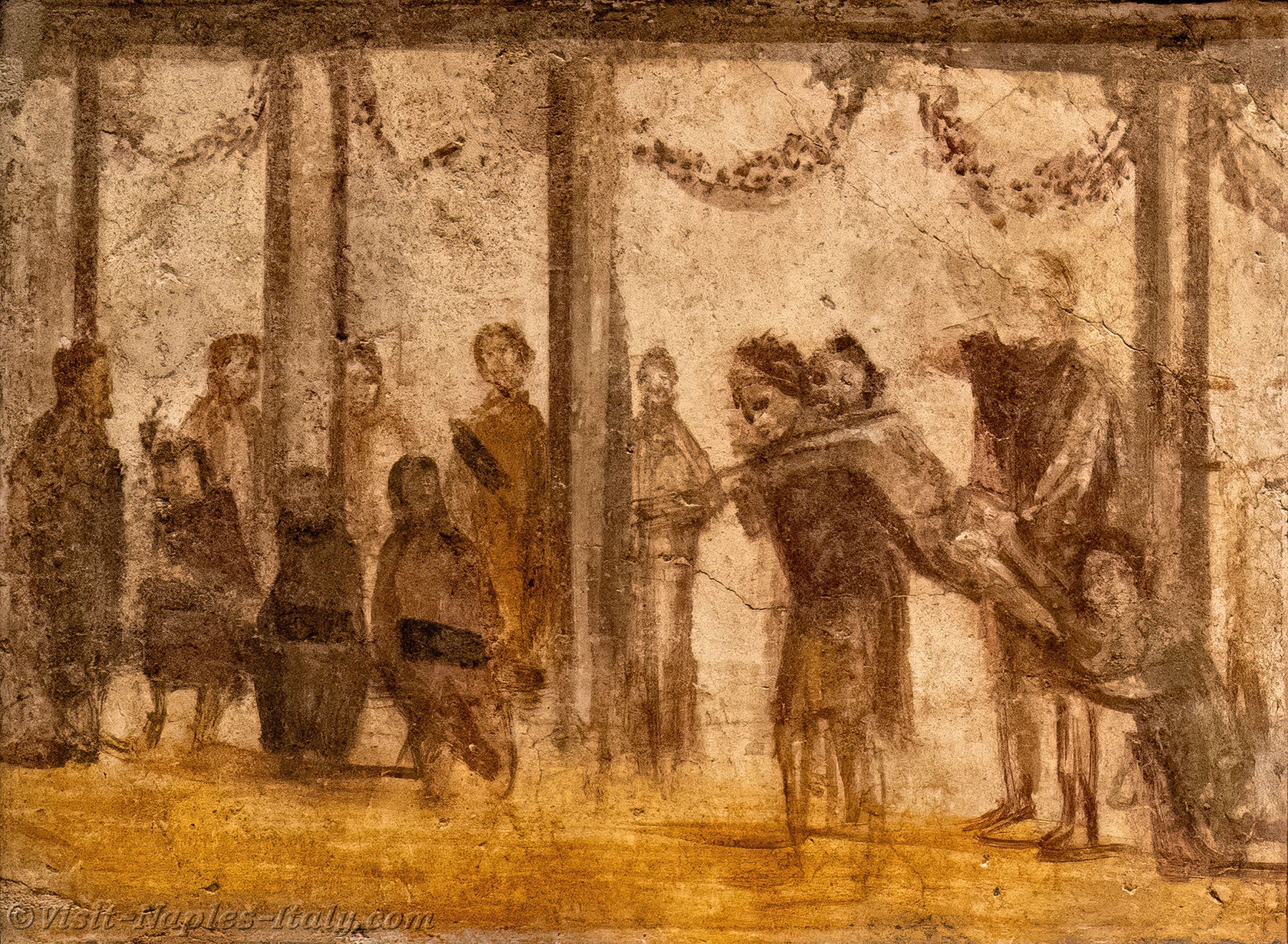
Punishment of a pupil The school is located under a portico with columns decorated with garlands of plants.
On the left, a teacher stands in front of three seated pupils, holding their wax tablets on their knees. Four other pupils are standing behind the columns.
They are all turning their heads towards the scene taking place on the right, to watch one of their number being punished by the schoolmaster.
The young pupil is completely naked and held firmly by the arms by a classmate, who is holding him on his back, while another pupil, kneeling, holds his legs to prevent him from moving.
This is a very severe punishment, as the teacher hits him with a whip on his back and buttocks.
Chariot with mules, Pompeii, Praedia di Giulia Felice
Fresco - Water-based pigments on plaster (34 × 84 cm) 62-79 ADTwo fragments of the frieze discovered in the Praedia di Giulia Felice establishment in Pompeii have been combined into a single painting.
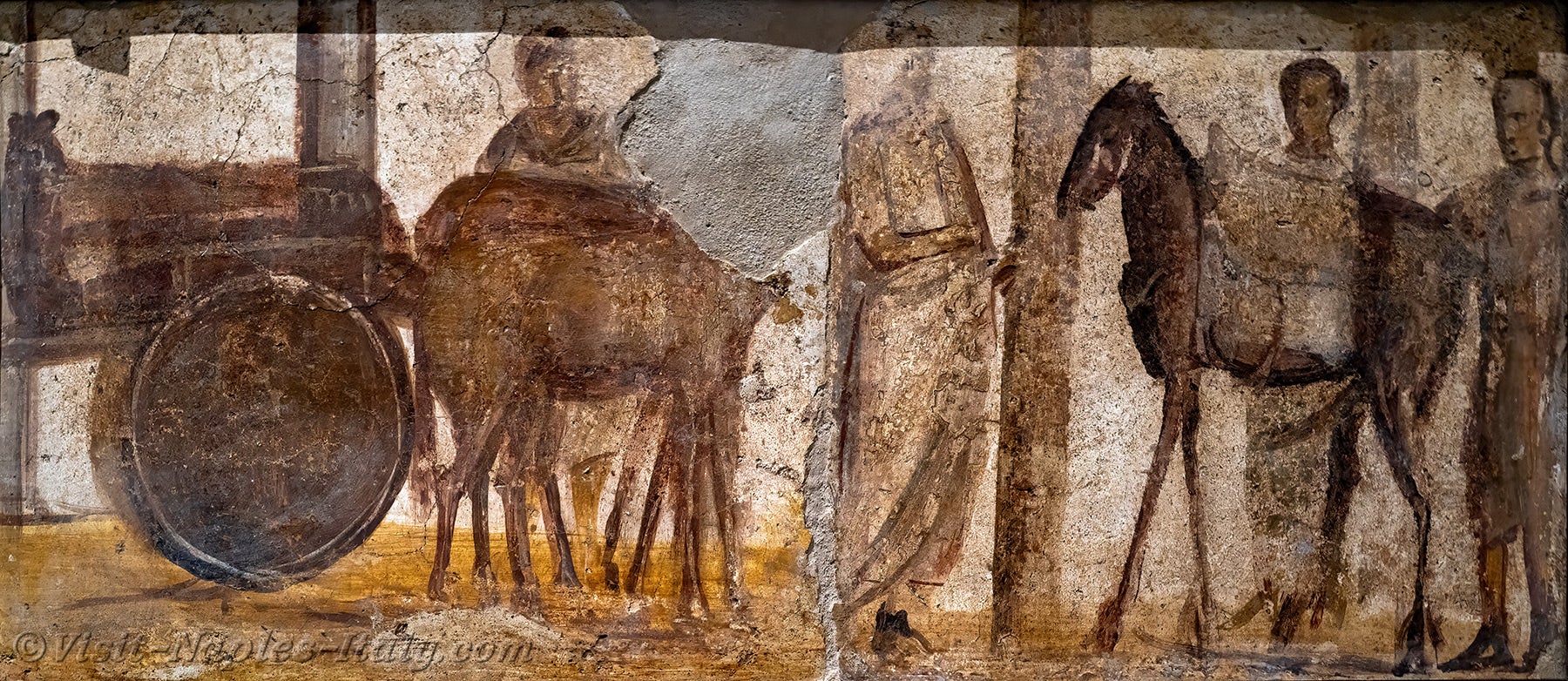
Cart with mules On the left, we can see a “Plaustrum”, a cart with solid wheels pulled by two mules, used in the countryside, particularly during the grape harvest, as well as for transporting heavy goods throughout the year.
The second fragment of the frieze shows three men observing an ithyphallic mule, i.e. one with an erection!
Meeting between perfumers, Pompeii, Praedia di Giulia Felice
Fresco - Water-based pigments on Coating (60 × 60 cm) 62-79 ADThis scene takes place in the forum of Pompeii, which served as a market for the inhabitants of the city, but was also a venue for meetings for professionals.
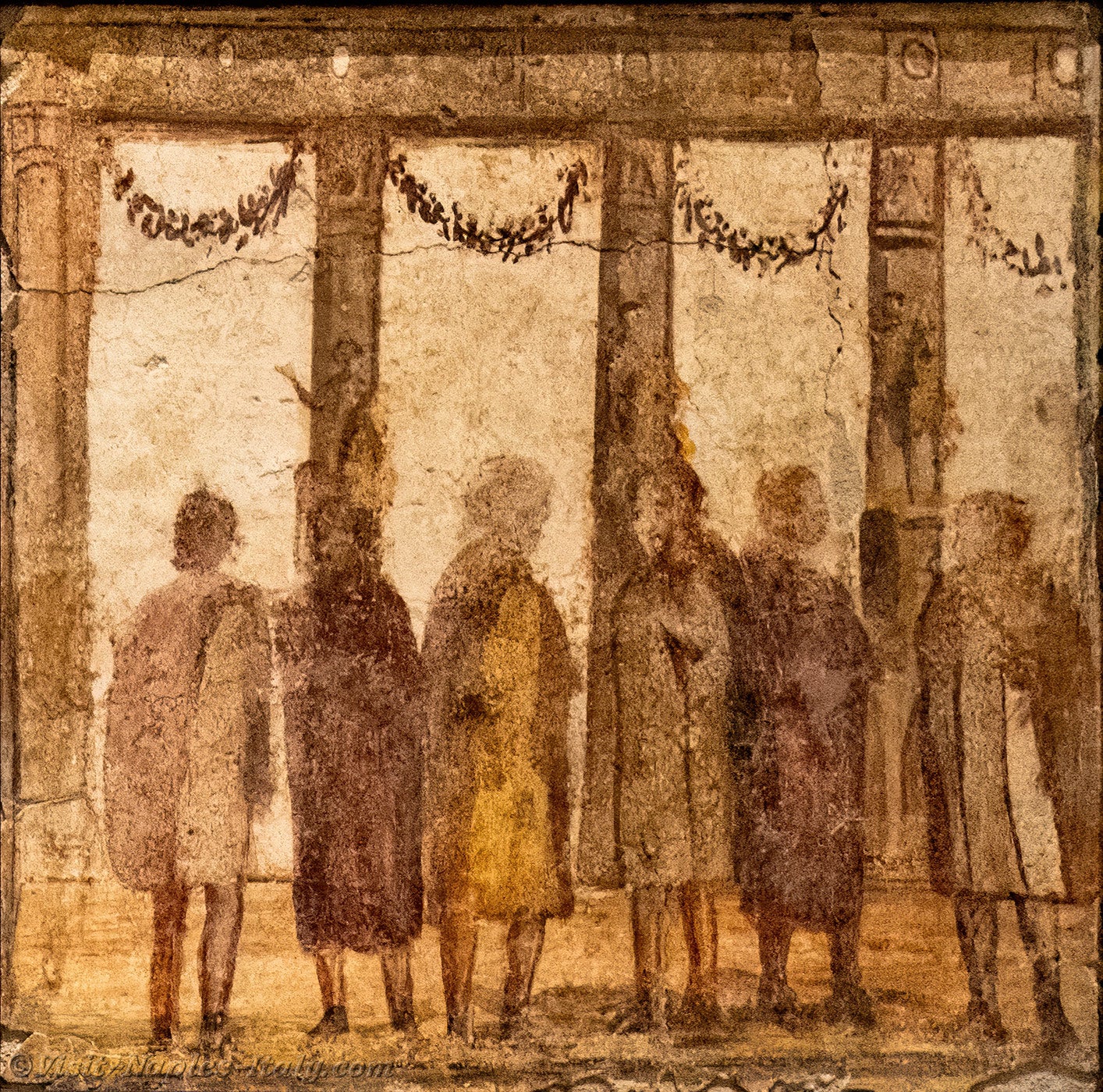
Meeting between perfumers Equestrian statues are erected on pedestals in front of the columns of the forum.
Six men are depicted in lively and serious conversation, holding “balsamari” in their hands.
The “balsamari” were vials containing perfume.
One of them brings a bottle of perfume to his face to smell it.
On the far right of the fresco, another man brings his hand to his face to smell the drops of perfume he has just applied.
Perfumery was a very important commercial activity in this region at that time, especially in Capua.
Reading an edict, Pompeii, Praedia di Giulia Felice
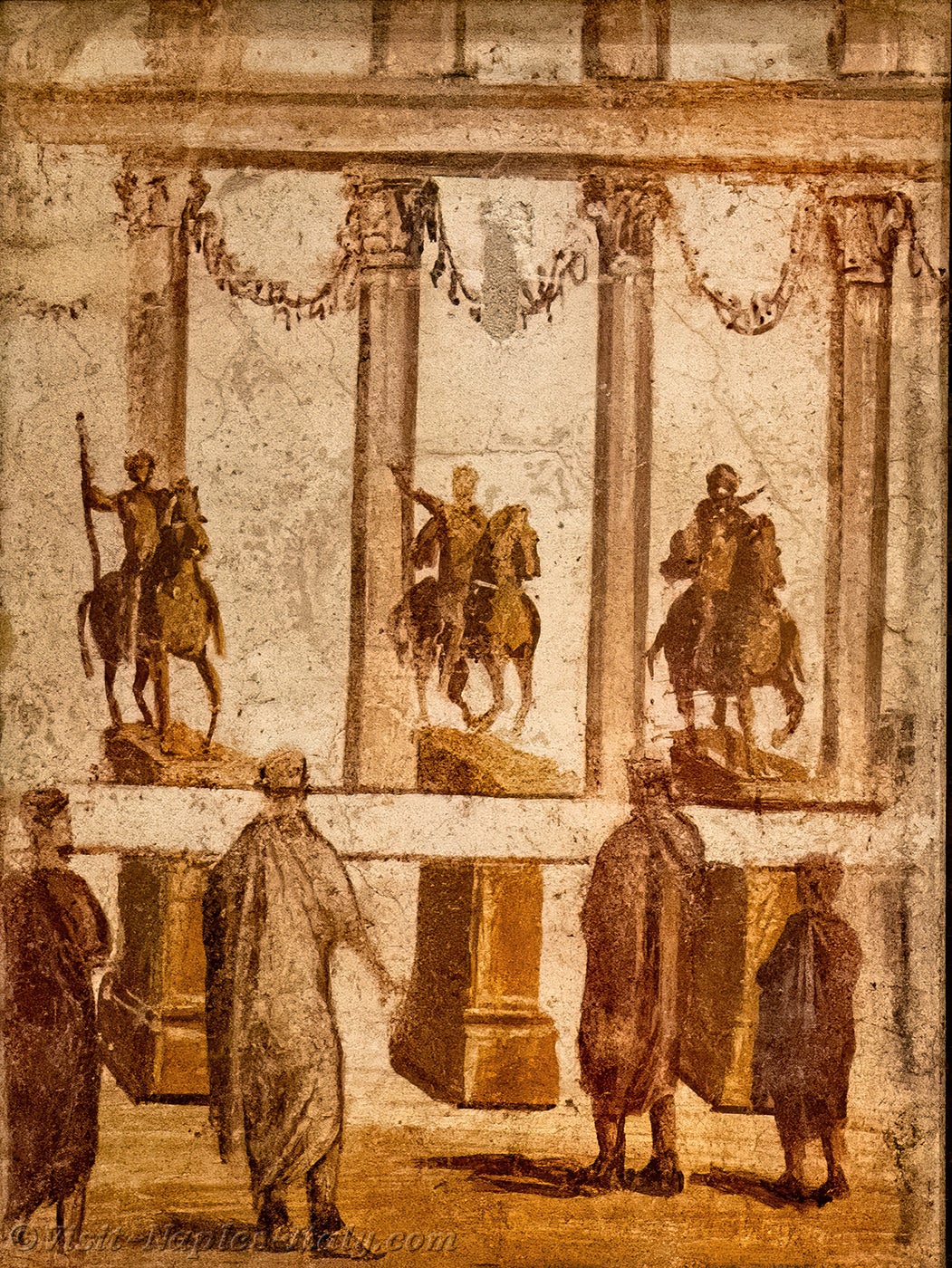
Reading of an edict Fresco - Water-based pigments on coating (64 × 48 cm) 62-79 AD
Three men in togas and a young boy stand in front of a large portico.
The Corinthian columns of this portico are decorated with garlands of plants.
Three equestrian statues stand on tall marble pedestals in front of these columns.
The horseman on the left holds a lance in his hand and brandishes it.
The statue of the horseman in the centre extends his right arm in a Roman salute.
The horse of the rider on the right appears to be galloping.
The large, clear horizontal line in front of the statue pedestals is actually an edict written on a long papyrus scroll and affixed there for citizens to read.
Women and a beggar, Pompeii, Praedia di Giulia Felice
Fresco - Water-based pigments on coating (31 × 83 cm) 62-79 AD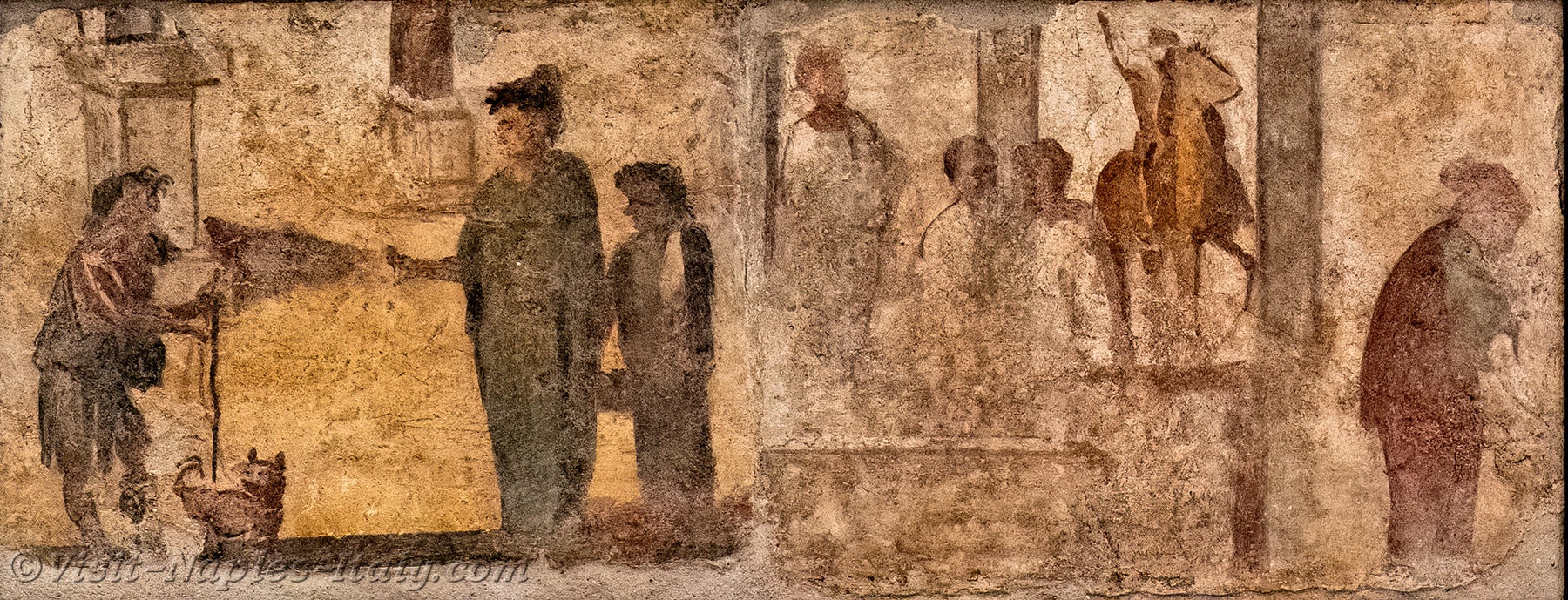
Women and a beggar This painting was also created by combining two fragments of the frieze discovered in the Praedia di Giulia Felice establishment in Pompeii.
On the left, a woman, accompanied by her servant, distributes alms to an old beggar, dressed in rags and leaning on a long stick, while his dog watches him.
On the right, three men stand in front of columns between which stands an equestrian statue.
Young girl before the magistrates, Pompeii, Praedia di Giulia Felice
Fresco - Water-based pigments on Coating (44 × 60 cm) 62-79 AD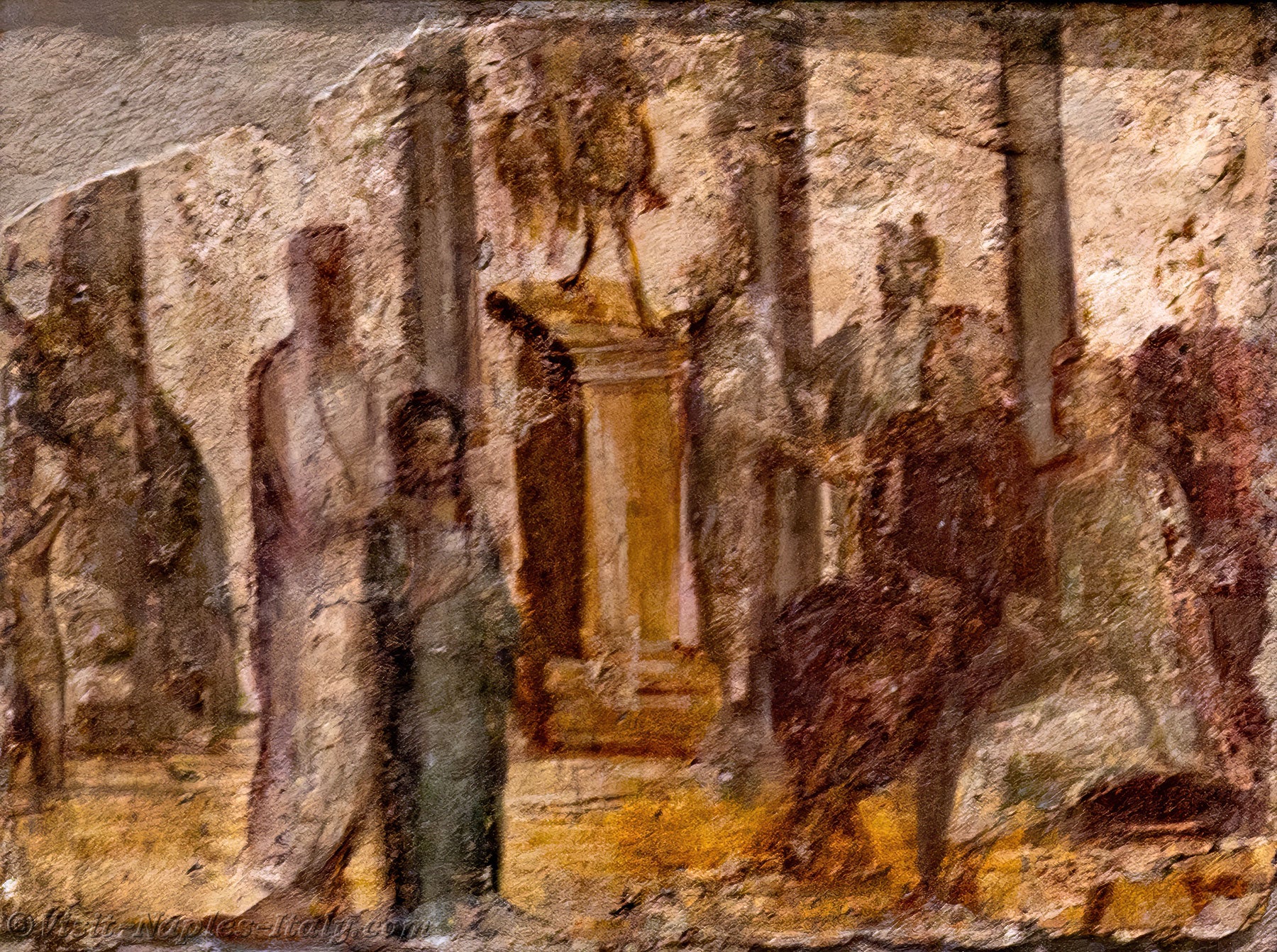
Young girl before the magistrates Under a portico with columns, between which stands an equestrian statue, a woman and a young girl face magistrates.
The young girl, dressed in a green toga, holds a wax tablet.
Two magistrates stand before them, one in a red toga and the other in a pale green toga.
This illustration suggests that this may be a court hearing.
The distance and respectful posture of the lady and the young girl, who are standing, while the magistrates are seated, highlight the importance and role of these officers of justice.
Ithyphallic mule and quadriga, Pompeii, Praedia di Giulia Felice
Fresco - Water-based pigments on Coating ( cm) 62-79 ADThis painting is also the result of the reunion of two fragments of a frieze from the Praedia di Giulia Felice establishment in Pompeii.
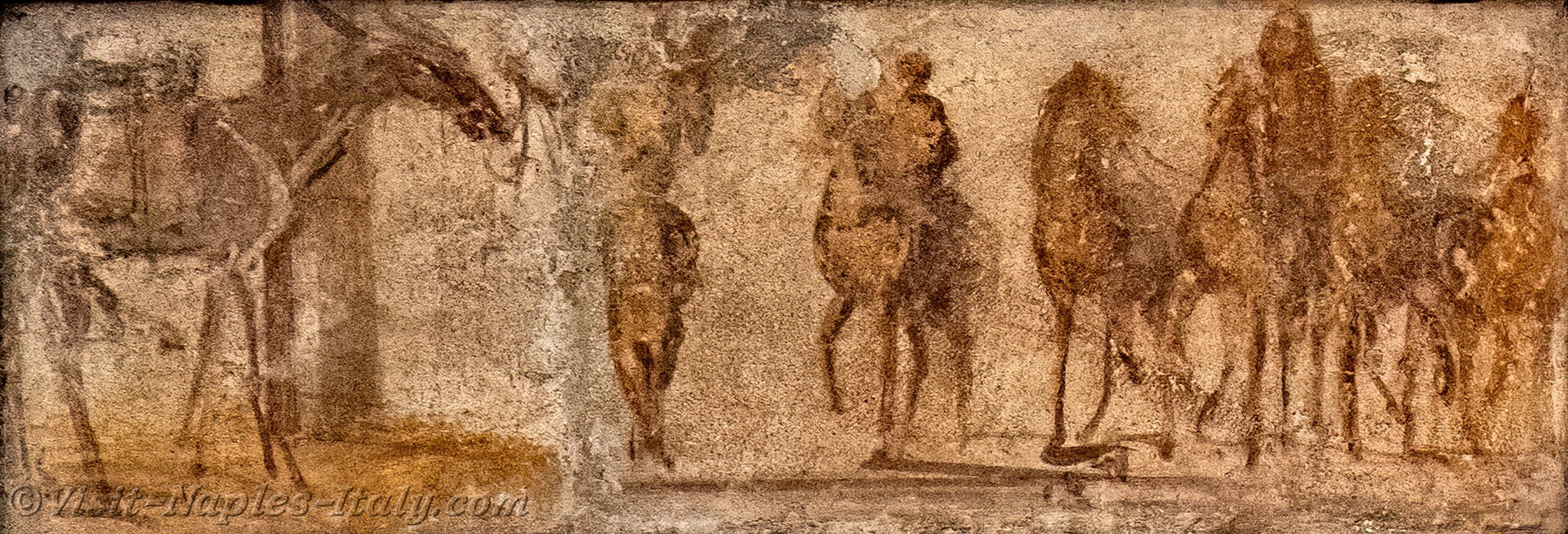
Ithyphallic mule and quadriga On the left is depicted an ithyphallic mule, i.e. with an erection, like the mules ridden by Bacchus or a satyr in the frescoes of the period.
The mule is carrying goods on its back.
In the fragment on the right, a man, seen from behind, looks at a horseman approaching.
Next to them, we can see a quadriga with galloping horses.
Writing and accounting instruments, Pompeii
Fresco - Water-based pigments on plaster (25 × 49 cm) 45-79 ADThis fresco depicts various elements related to accounting in Pompeii at the time.
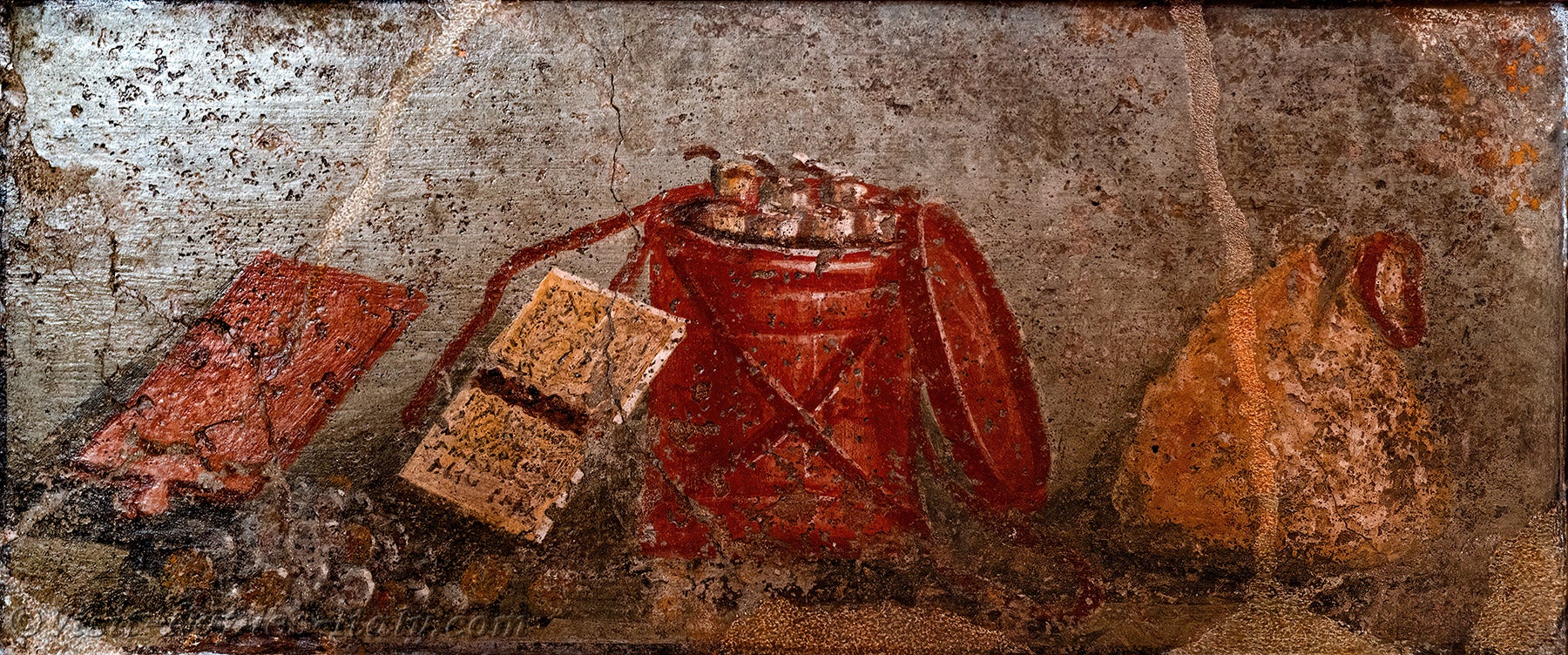
Writing instruments and accounting On the left is a red wax tablet, placed on top of a pile of coins.
In the centre, a diptych with blank pages that have already been filled in is placed against an open “scrinium”.
The latter is a round red leather box that contained papyrus scrolls for transporting them without damaging them.
To the right of the ‘scrinium’ is a closed bag, whose shape suggests that it contains coins.
Life Leisure Arts | Food | Young Women | Daily Life | Commerce | Sport
Frescoes Mythology | Portraits | Life Leisure | Animals | Religion | Landscapes | Decoration
Artworks Sculptures | Frescoes | Eroticism
MANN Artworks Schedule Tickets Location | Authorizations
Back to Top of Page