

MANN Artworks Schedule Tickets Location | Authorizations
Artworks Sculptures | Frescoes | Eroticism
Frescoes Mythology | Portraits | Life Leisure | Animals | Religion | Landscapes | Decoration
Life Leisure Arts | Food | Young Women | Daily Life | Commerce | Sport
Frescoes of Sporting Activities in Pompeii and Herculaneum at the Archaeological Museum of Naples in Italy
Apobate chariot race, Herculaneum
Painting - Wax on marble (48 × 53 cm) 20 BC-37 ADThis wax painting on marble, discovered in Herculaneum, depicts a chariot race.
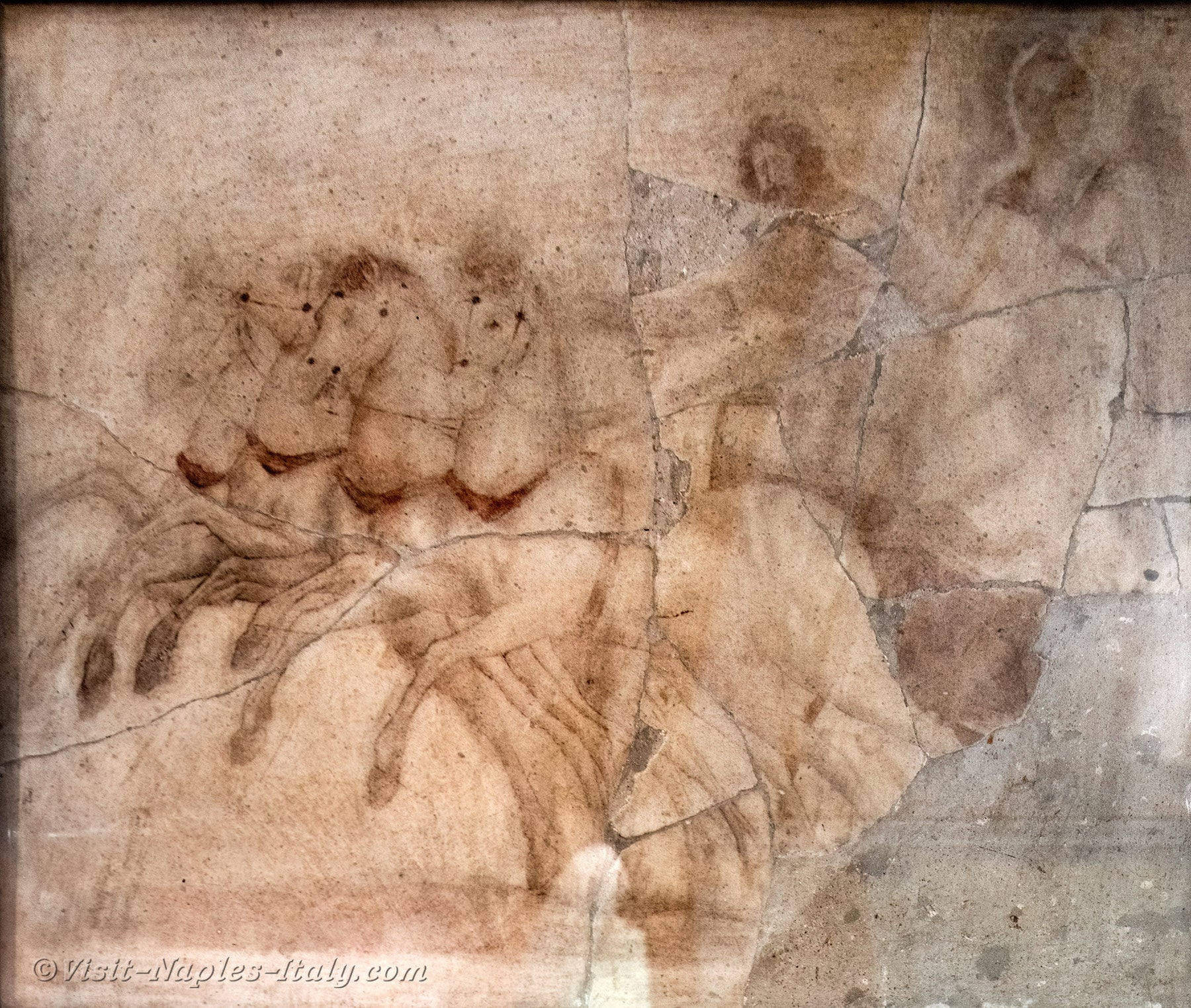
Apobate chariot race The chariot depicted is a quadriga, drawn by four horses galloping at full speed.
On the left, we can see the chariot driver, bearded, his hair blowing in the wind, his arms stretched forward, holding the reins of the horses' harnesses.
On the right, a man wearing a helmet with a crest and a sword at his hip is preparing to jump out of the chariot, as shown by the position of his legs. One of his feet is already outside the chariot.
This man wearing a helmet is an apobate.
He was an accomplished athlete capable of jumping from one chariot to another during the race, which aroused the admiration of the spectators.
Trophies from sporting competitions, Boscoreale
Fresco - Water-based pigments on Coating (123 × 222 cm) 60 BC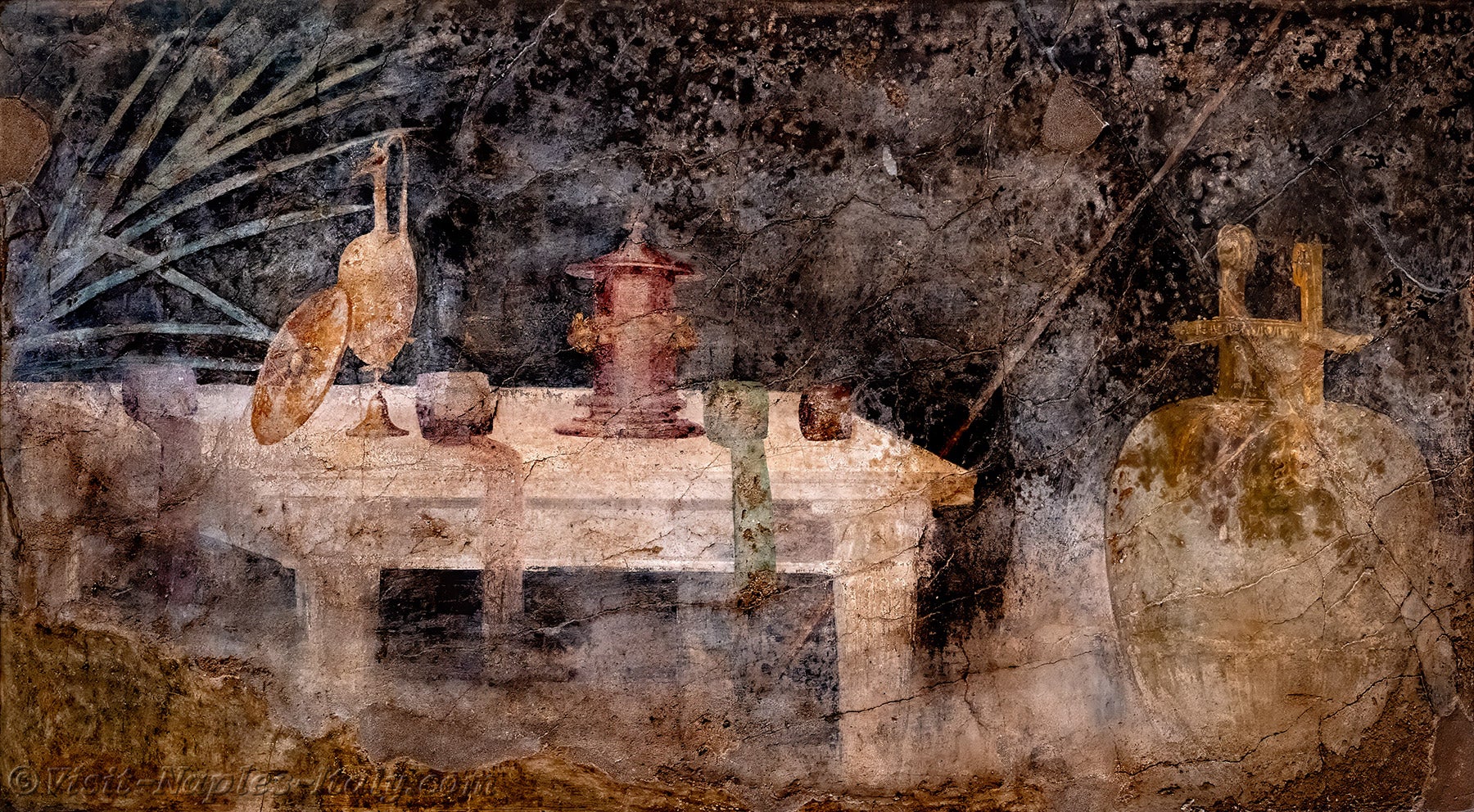
Sports competition trophies This fresco, discovered in the villa of Fannius Synistor in Boscoreale, depicts a marble table decorated with trophies that were to be awarded to athletes who won a sporting competition.
It shows a Phiale Aurea, a flat, round golden phiale, placed against a tall, large vase called an oenochoe, also made of gold, which contained wine.
Two rolls of ribbon, partially unrolled, are visible, one red and the other green, which would be awarded to the winners according to their ranking in the events.
On the right, in the foreground, we can see a large krater, the large vases of antiquity.
Discobolus, Stabiae, Villa di Arianna
Fresco - Water-based pigments on Coating (57 × 68 cm) 54-68 AD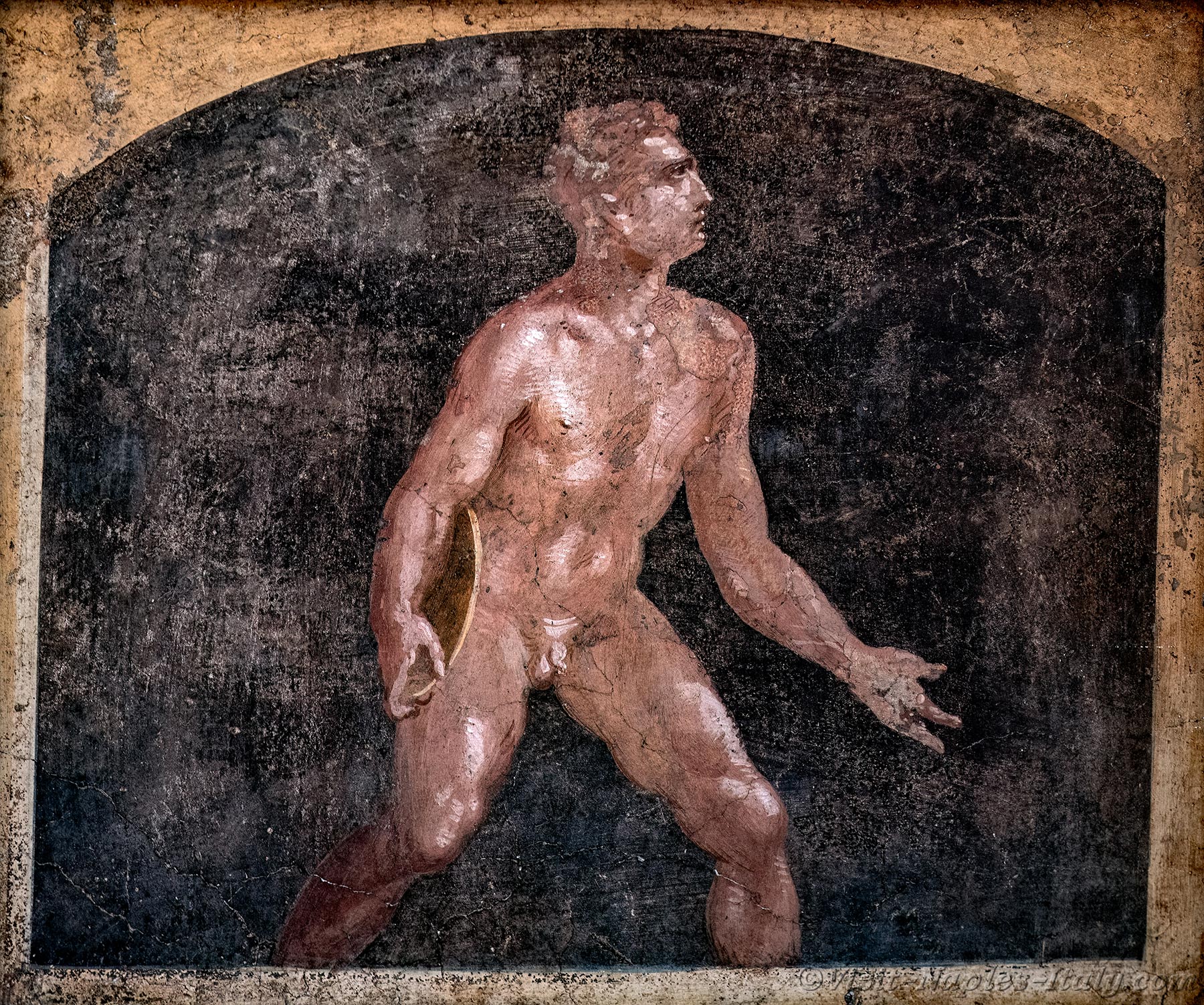
Discobolus This fresco discovered in the Villa di Arianna in Stabiae depicts a Discobolus.
The athlete is naked and preparing to throw the discus he is holding in his right hand.
His musculature is remarkable, hinting at his power.
One can sense the concentration in his gaze before he throws.
Some art critics believe that this fresco was not a representation of a Roman athlete, but rather a painted reproduction of a statue by the sculptor Myron, one of the most famous Greek sculptors of the 5th century BC.
Bloody brawl in the amphitheatre, Pompeii, Casa della Rissa nell'Anfiteatro
Fresco - Water-based pigments on coating (170 × 185 cm) 59-79 ADThis fresco depicts a bloody brawl that actually took place in Pompeii in 59 AD.
The episode is reported in detail by Tacitus in his annals.
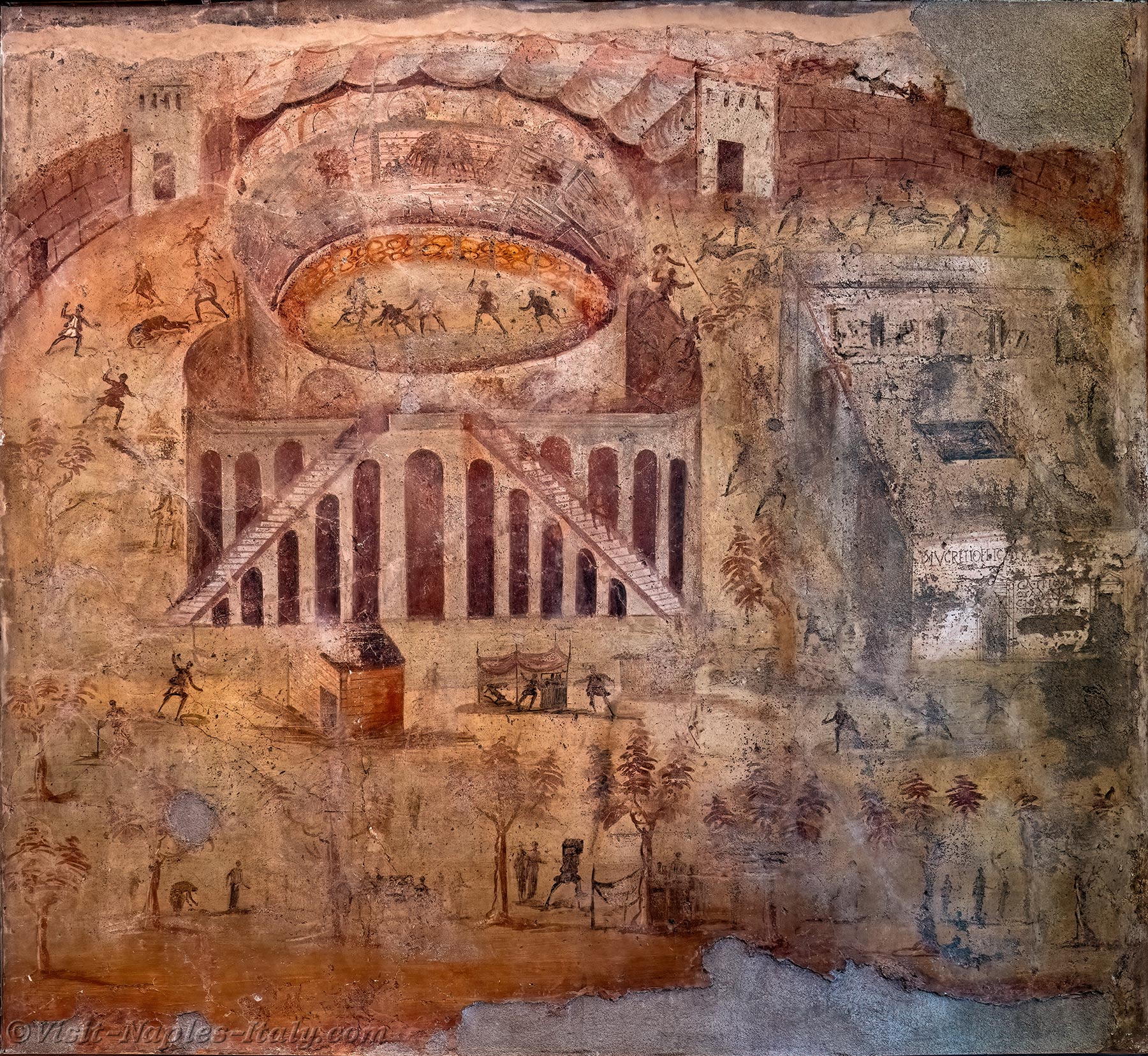
Bloody brawl in the amphitheatre
“Around the same time, a minor incident sparked a serious brawl between residents of the colonies of Nuceria and Pompeii during a gladiatorial show presented by Livineius Regulus.
During an exchange of taunts, typical of the impertinence of provincial towns, they resorted to insults, then stones, and finally weapons; the inhabitants of Pompeii, where the show was taking place, had the upper hand.
As a result, many Nucerians were transported, maimed and wounded to the capital, while a great many mourned the death of children or parents.
The judgement of the case was delegated by the Emperor to the Senate, then by the Senate to the consuls.
When the matter was brought before the members again, the Pompeians as a community were forbidden from holding any similar assemblies for ten years, and the associations they had formed illegally were dissolved.
Livineius and the other instigators of the riot were punished with exile.”
Tacitus - Annals, XIV, 17
At the centre of the fresco stands the amphitheatre where men fight each other in the arena, but also in the stands.
All around the amphitheatre, bloody battles continue in the streets. We can see men lying on the ground and others trying to escape.
Gladiator Weapons, Pompeii, Caserna dei Gladiatori
Fresco - Water-based pigments on coating - 45-79 ADThis fresco was found on one of the walls of the gladiator barracks in Pompeii.
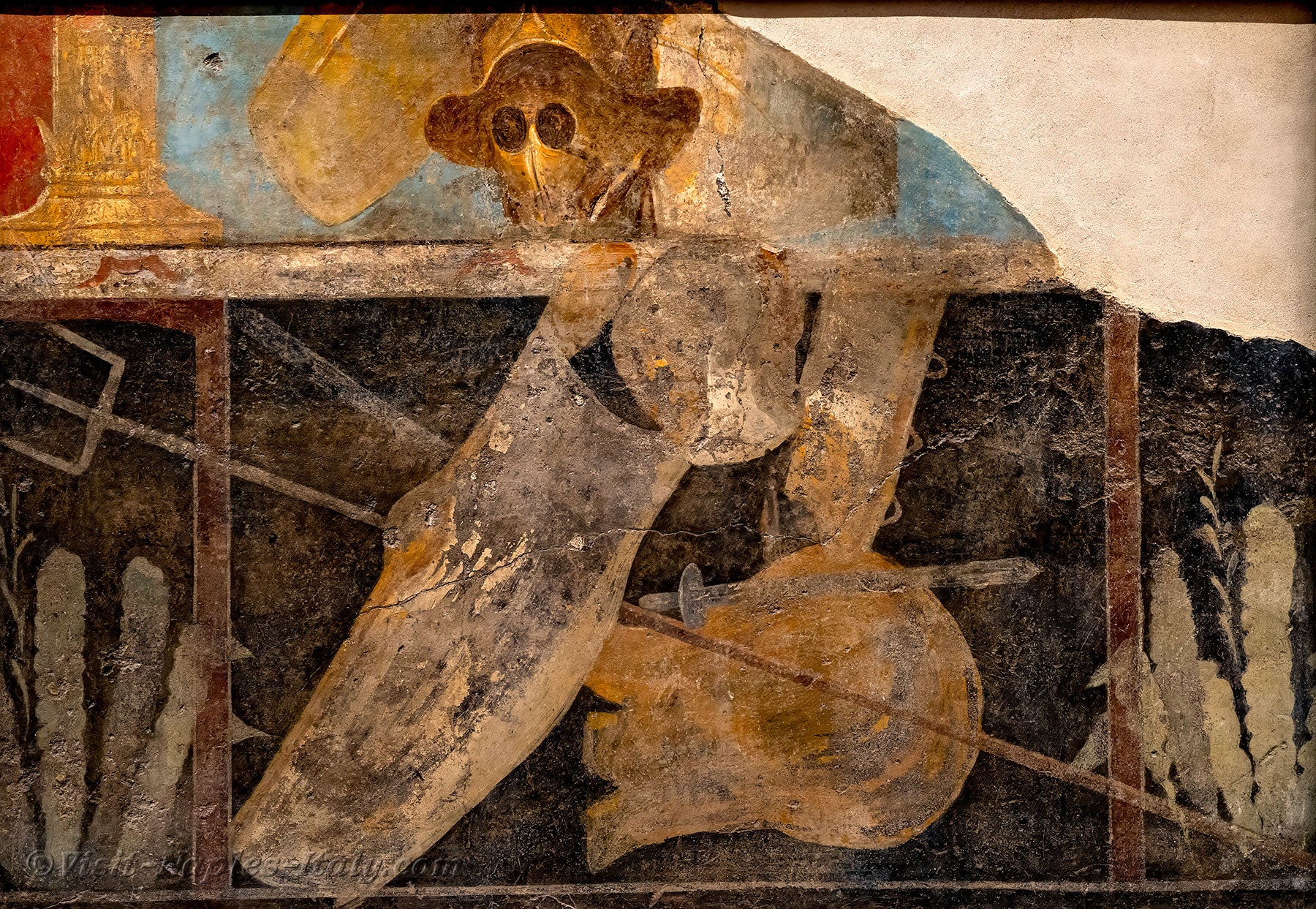
Gladiator Weapons On a shelf, we can see a mirmillo helmet.
Mirmillos were gladiators who carried a short sword (gladius) and a large shield.
Below the shelf, we can see a sword of the same type as that of the mirmillan, as well as a large shield, placed diagonally under the gladiator's helmet.
A greave decorated with a face and fitted with three loops for attaching the support straps is located just above the sword.
Finally, a long trident is also depicted diagonally in the lower part.
Life Leisure Arts | Food | Young Women | Daily Life | Commerce | Sport
Frescoes Mythology | Portraits | Life Leisure | Animals | Religion | Landscapes | Decoration
Artworks Sculptures | Frescoes | Eroticism
MANN Artworks Schedule Tickets Location | Authorizations
Back to Top of Page