

MANN Artworks Schedule Tickets Location | Authorizations
Artworks Sculptures | Frescoes | Eroticism
Frescoes Mythology | Portraits | Life Leisure | Animals | Religion | Landscapes | Decoration
Life Leisure Arts | Food | Young Women | Daily Life | Commerce | Sport
Frescoes of Commercial Life in Pompeii and Herculaneum at the Archaeological Museum of Naples in Italy
Shop signs and electoral inscriptions, Pompeii
Fresco - Water-based pigments on Coating (121 × 151 cm) 70-79 ADThe walls of houses in Pompeii were used as election posters to highlight the qualities of the candidate and encourage people to vote for them.
This is the case with the two inscriptions in large letters at the top of this fresco and on either side of the central figures.
On the left, we can see two structures with a small dome topped by a sacred owl in reference to Athena, the protective goddess of craftsmen.
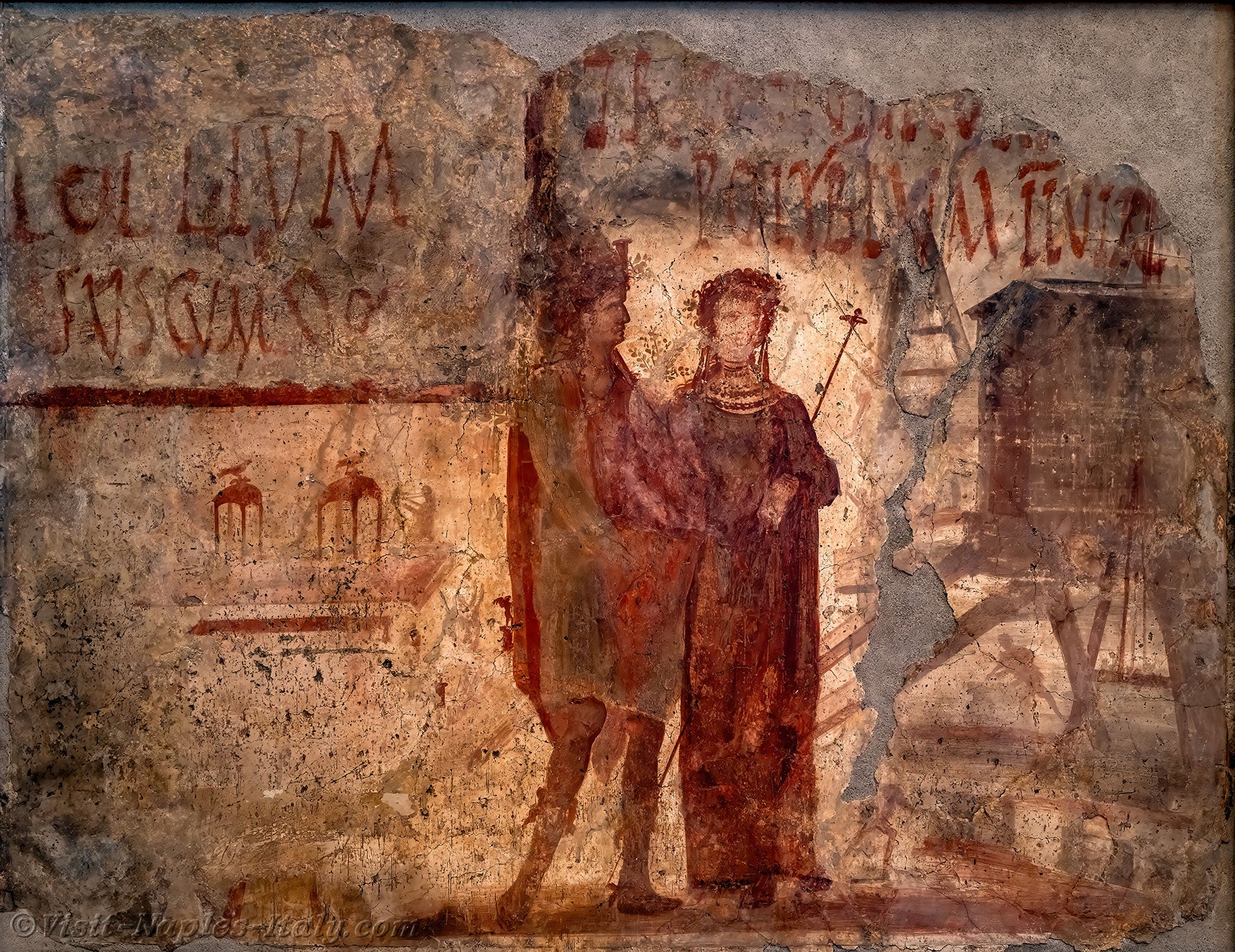
Shop signs, electoral inscriptions We can also see a man kneeling playing a double flute.
A little lower down and to the right, we can see the silhouette of a small winged statue of Eros.
These structures were used to dry the fabric, which was then worked by fullers, workers who trampled the fabric to make felt or cloth.
This section of the fresco therefore probably corresponded to a weaving shop.
The other sign is to the right of the two figures.
We see a building under construction, perhaps a temple, with workers labouring on the timber frame and using pulleys and a crane to handle beams.
This sign indicated the presence of a carpentry workshop.
In the centre of the fresco, Mythology are depicted, clearly painted over the signs, as are the electoral inscriptions.
The male deity wears a crown with small towers. His tunic is green and he wears boots.
He could be Bacchus, represented as Liber Pater, in which case the goddess would be Libera.
She holds a long sceptre in one hand and a branch in the other.
She wears a crown and a multi-row necklace, as well as earrings.
Shoe seller, scribe and statue, Pompeii, Praedia di Giulia Felice
Fresco - Water-based pigments on coating (44 × 74 cm) 62-79 ADThese two frescoes depicting commercial activities in Pompeii have been combined into a single painting.
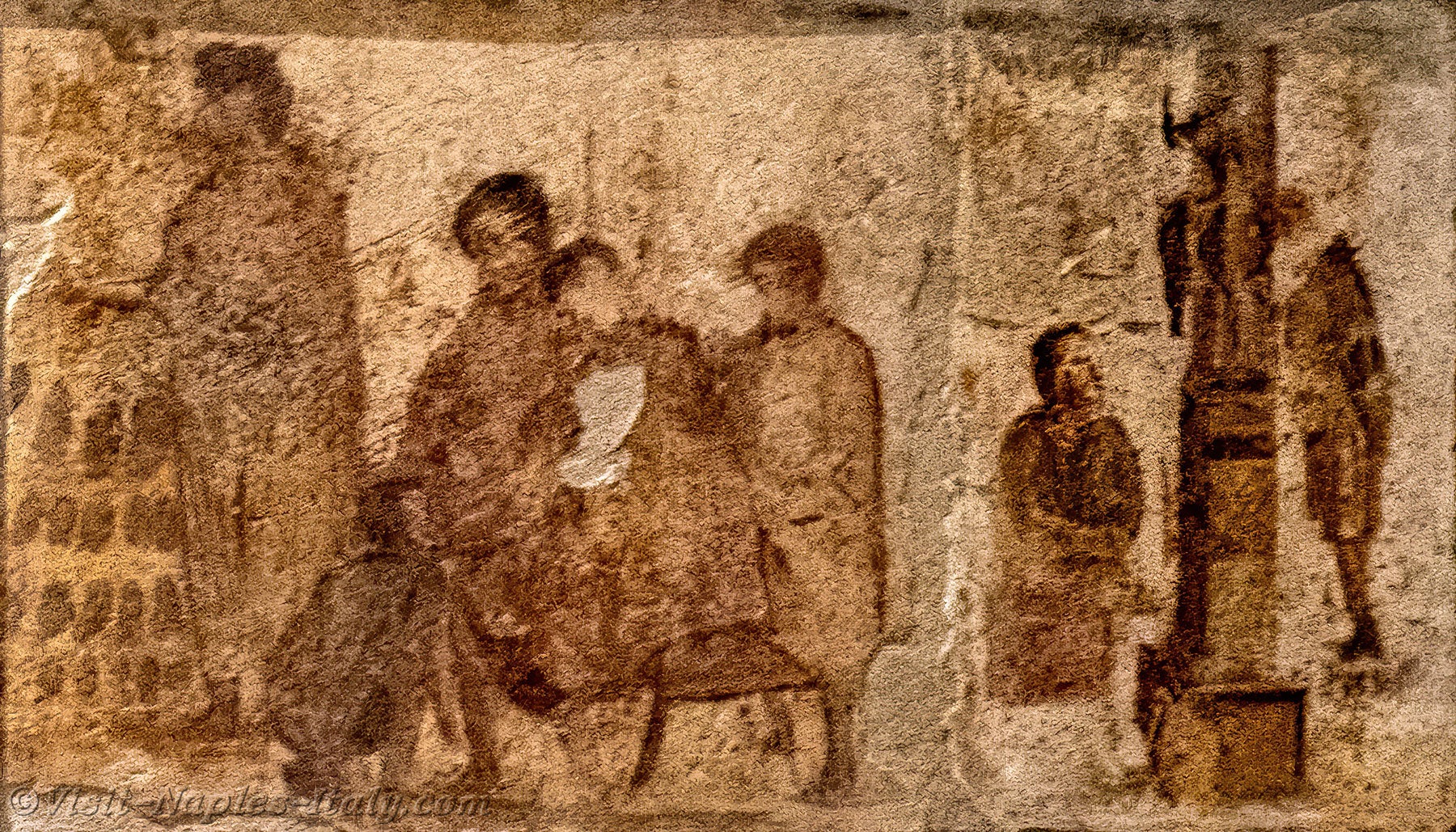
Sale of shoes, scribe and statue On the left is a shoe shop, where we can see a scene similar to one that still occurs today.
A man is kneeling in front of another, who is sitting on a bench, so that he can measure his feet.
To his left, we can see a display containing shoes neatly arranged on shelves.
The fresco on the right, which has been joined to this one, depicts a scribe with a tablet on his lap and his client to his right, partly hidden by an equestrian statue, who is dictating the text to be written.
Sale of fabrics, Pompeii, Praedia di Giulia Felice
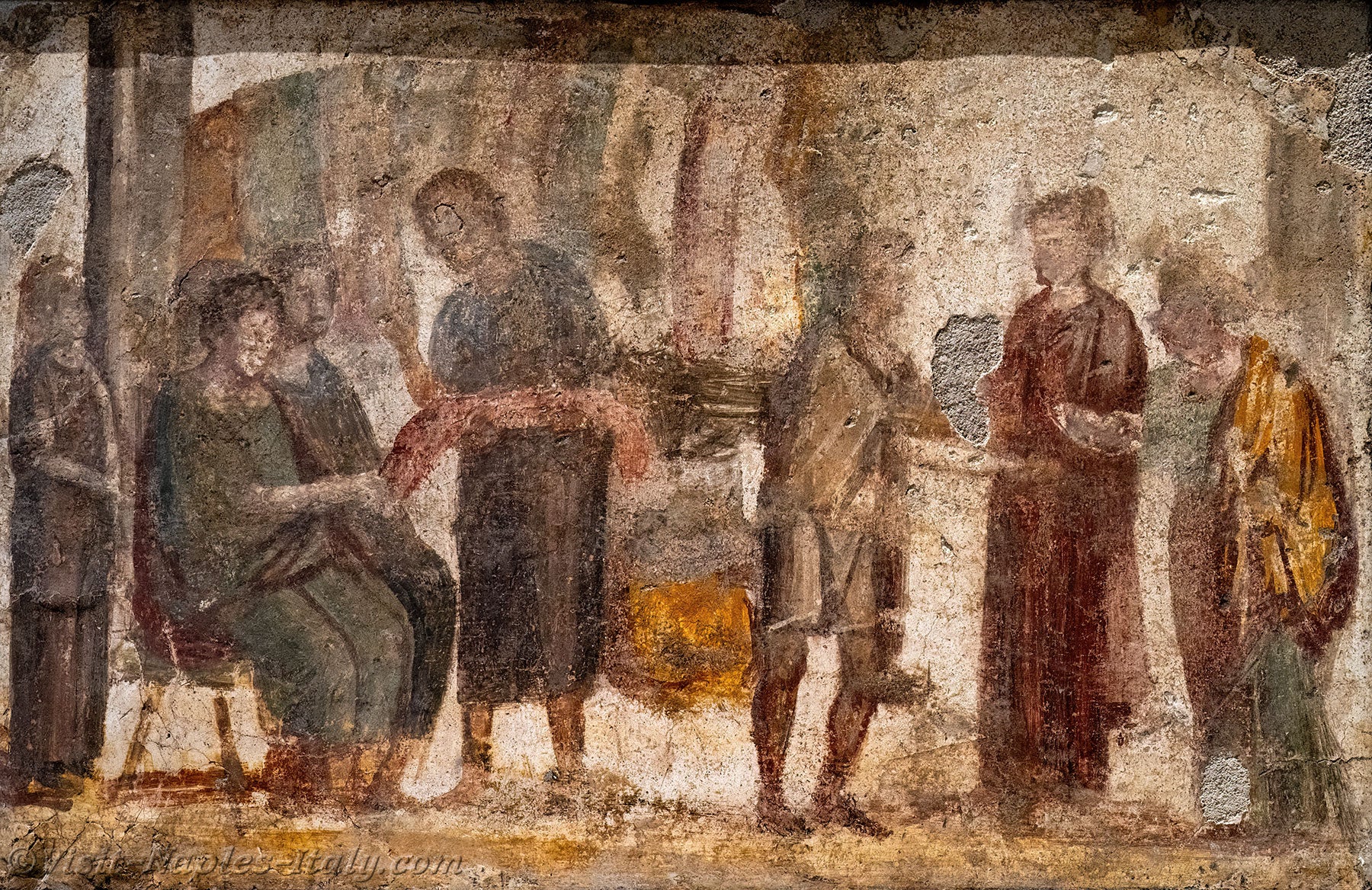
Fabric sale Fresco - Water-based pigments on coating (51 × 74 cm) 62-79 AD
Here is another scene from daily life in Pompeii in the shop of a cloth merchant.
On the left side of the fresco, two ladies are seated while a salesman, standing in front of them, promotes a red fabric.
A servant stands behind the two customers.
A second vendor attempts to convince two other women on the right side of the fresco.
Sale of kitchen utensils and shoes in Pompeii, Praedia di Giulia Felice
Fresco - Water-based pigments on coating - 62-79 ADThis scene, in the forum of Pompeii, shows a shoe seller on the right and a kitchen utensil seller on the left.
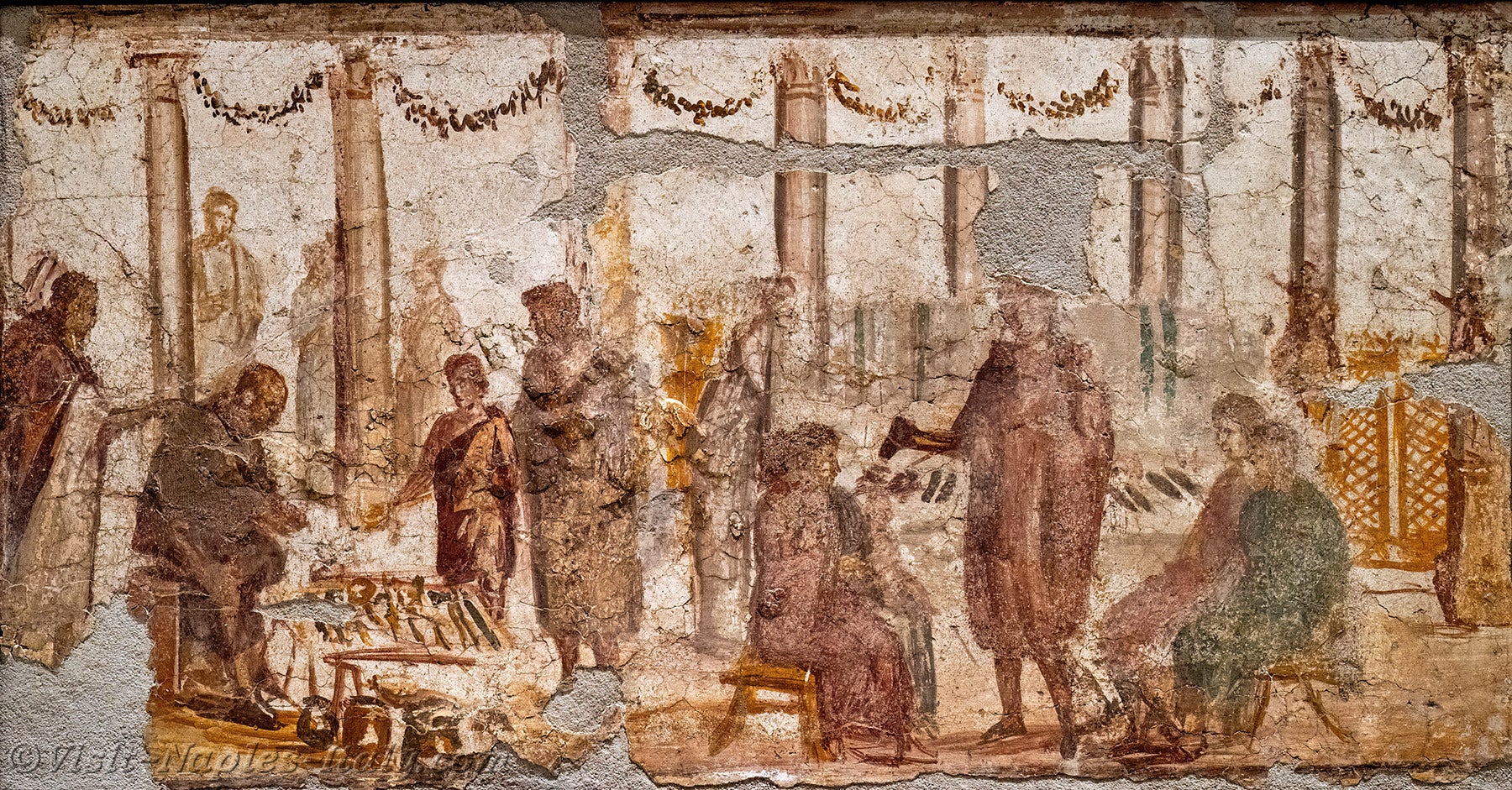
Sale of kitchen utensils and shoes The kitchen utensils on sale appear to be made of metal, suggesting that this seller is a metalworker.
Ladles, knives and other sharp utensils are displayed on a mat.
In the foreground are bronze pots and jugs.
The shoe seller, who must also be a shoemaker, shows a model of shoes to the customer sitting in front of him. She is accompanied by a child.
Two other customers wait their turn on the other bench.
Sale of fabrics, pots, pans and bread, Pompeii, Praedia di Giulia Felice
Fresco - Water-based pigments on Coating - 62-79 ADThis other market scene also takes place in the forum of Pompeii.
From left to right, we can see a fabric merchant showing his customer a piece of white cloth.
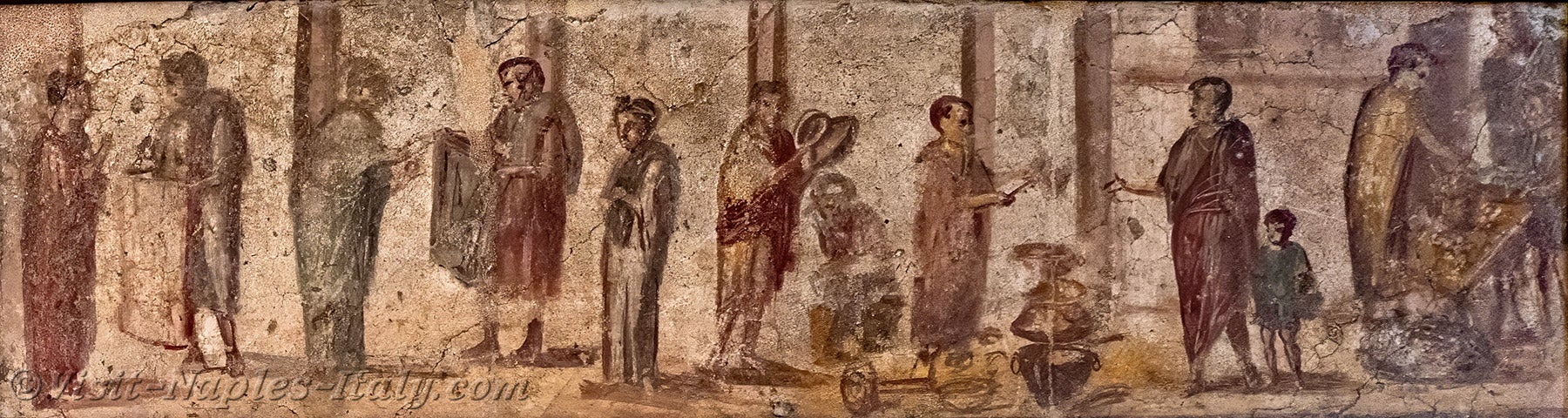
Sale of fabrics, pots, pans and bread Behind him, a lady, accompanied by a maid, reaches out to touch the fabric presented by a vendor.
A little further to the right, a man holds a large pot, which he examines carefully before purchasing it.
A customer or a merchant is seated behind him, between two columns.
A blacksmith is probably discussing the price of the pots lined up at his feet with a customer accompanied by a child.
Finally, on the far right, we see a baker with his loaves of bread spread out in front of him.
Life Leisure Arts | Food | Young Women | Daily Life | Commerce | Sport
Frescoes Mythology | Portraits | Life Leisure | Animals | Religion | Landscapes | Decoration
Artworks Sculptures | Frescoes | Eroticism
MANN Artworks Schedule Tickets Location | Authorizations
Back to Top of Page