

Capodimonte Artists Schedule Tickets Location | Authorizations
Artists Palace Gardens | Bellini | Botticelli | Bronzino | Brueghel | Canova | Caravaggio | Gentileschi | Giambologna | Giordano | Greco | Lotto | Luini | Mantegna | Masaccio | Masolino | Michelangelo | Palma | Parmigianino | Porta | Raphael | Reni | Titian | Van Dyck | Warhol
Giordano Mythological Works | Religious Works
Luca Giordano (1634-1705) Religious works at the Capodimonte Museum in Naples, Italy
Luca Giordano “The Virgin of the Baldachin”
Painting - Oil on canvas (430 x 240 cm) 1685The Virgin, dressed entirely in immaculate white, holds a rosary between her fingertips, which she extends towards the saints and the faithful kneeling at her feet.
The Infant Jesus, seated on his mother’s lap, spreads his little arms, holding a rosary intended for Saint Catherine, whose forehead is encircled by a crown of thorns.
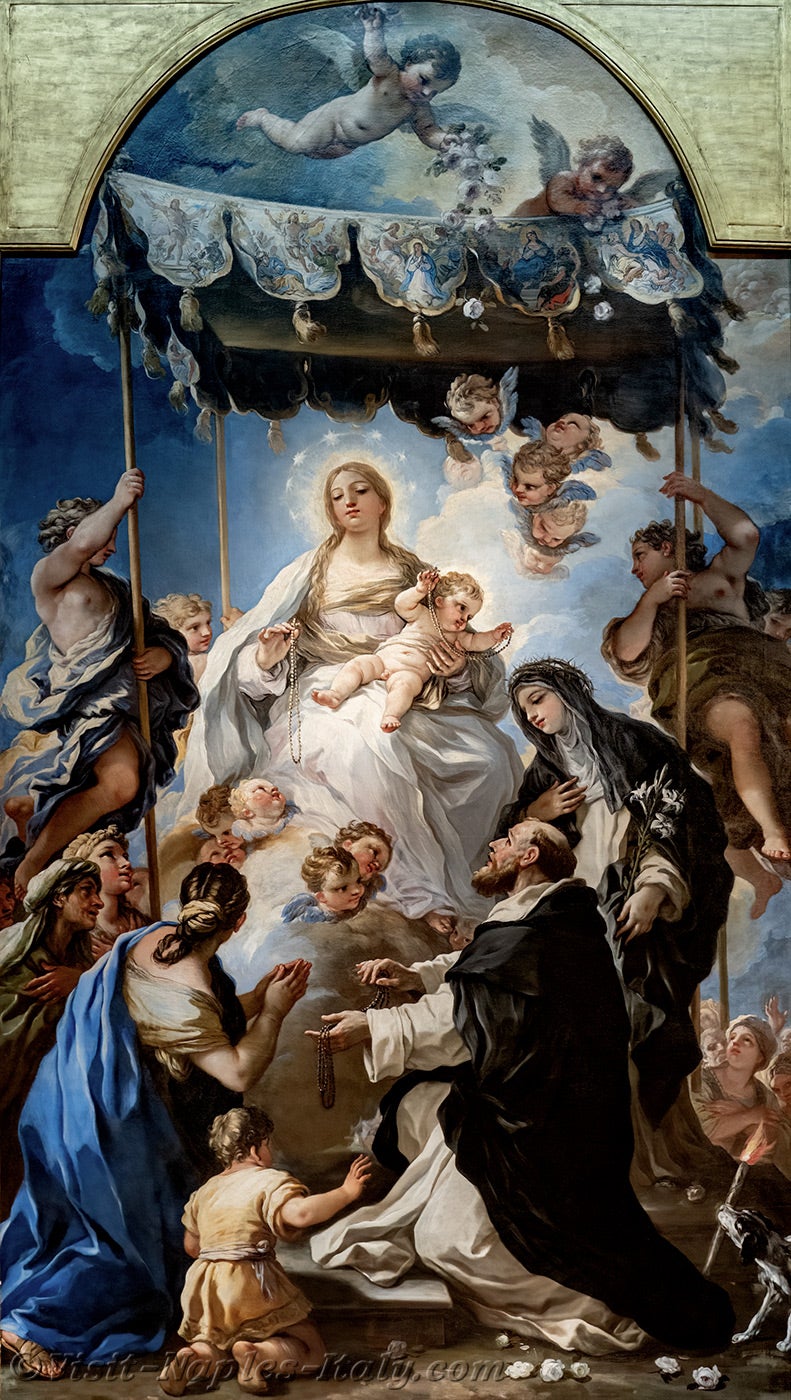
The Virgin of the Baldachin Saint Catherine of Alexandria bows before the Virgin and Child, placing her right hand on her chest, with a bouquet of lilies in her left hand.
Next to Saint Catherine, Saint Dominic is kneeling in adoration before the Virgin and Jesus, holding his rosary in his hands.
The young woman on her knees, seen from behind next to Saint Dominic, looks at the Virgin, who is offering her the rosary with her hands clasped in prayer; beside her, a young boy is kneeling looking at Saint Dominic’s rosary.
On the right, a dog holds a lit torch in its mouth symbolising the mission of Saint Dominic to enlighten the crowds by spreading the word of Christ.
The Virgin and the Infant Jesus are seated beneath a large Baldachin decorated with religious scenes and borne by angels.
The heads of pretty cherubs with plump cheeks, their little wings draped around their necks, lie at the Virgin’s feet or flutter beneath the Baldachin.
The Virgin, haloed in light, turns her beautiful face, as Queen of Heaven, towards her worshippers.
A very beautiful painting by Luca Giordano, with colours enhanced by the dazzling white of the Virgin, crowned with stars, and the blue of the sky.
Luca Giordano “The Alms of Saint Thomas of Villanova”
Painting - Oil on canvas (318 x 235 cm) 1658This painting was painted by Luca Giordano shortly after the canonisation in 1658 of Saint Thomas of Villanova (1488-1555).
Thomas of Villanova joined the Augustinian Hermits of Salamanca in 1517 and later became the preacher to Charles V.
He was Archbishop of Valencia, where he distinguished himself through his generous acts of charity.
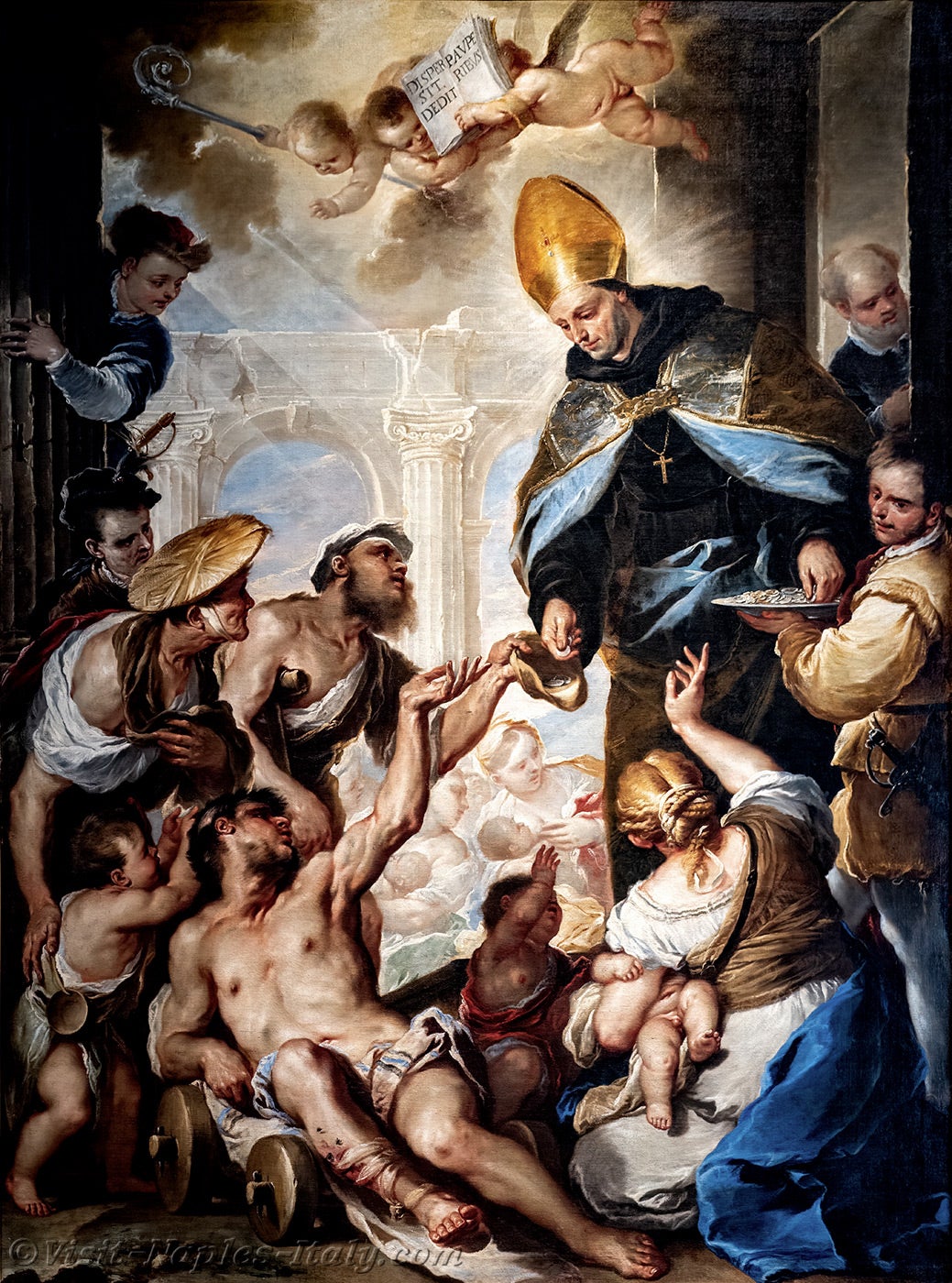
St Thomas’s Alms He is credited with the miraculous healing of a disabled beggar.
The Congregation of the Hermits of St Augustine had, moreover, been incorporated into the mendicant orders by Pius V in 1567, following the Council of Trent.
Following his canonisation, painters depicted Thomas of Villanova giving alms to the poor in an Augustinian habit, wearing his mitre and holding his bishop’s crozier.
Thomas of Villanova had been involved in the reform of the Order of the Discalced Augustinians Scalzi.
This is why the Augustinian monks of the church of Sant’Agostino degli Scalzi in Naples, better known as Santa Maria della Verità, commissioned this painting from Luca Giordano.
In Luca Giordano’s painting, celestial light emanates from the golden mitre worn by Thomas of Villanova.
He is handing out coins to the poor and the infirm who are crowding round him, holding out their hands.
In the foreground, a young woman on her knees asks him for alms whilst holding her baby under her arm.
Luca Giordano “Our Lady of the Rosary”
Painting - Oil on canvas (253 x 191 cm) 1657This beautiful painting by Luca Giordano, painted in 1657, depicts the Virgin seated on a cloud supported by cherubs and holding out a rosary to Saint Dominic.
The gentle-faced Virgin holds the Infant Jesus, who leans forward to bless the monks praying on their knees before them.
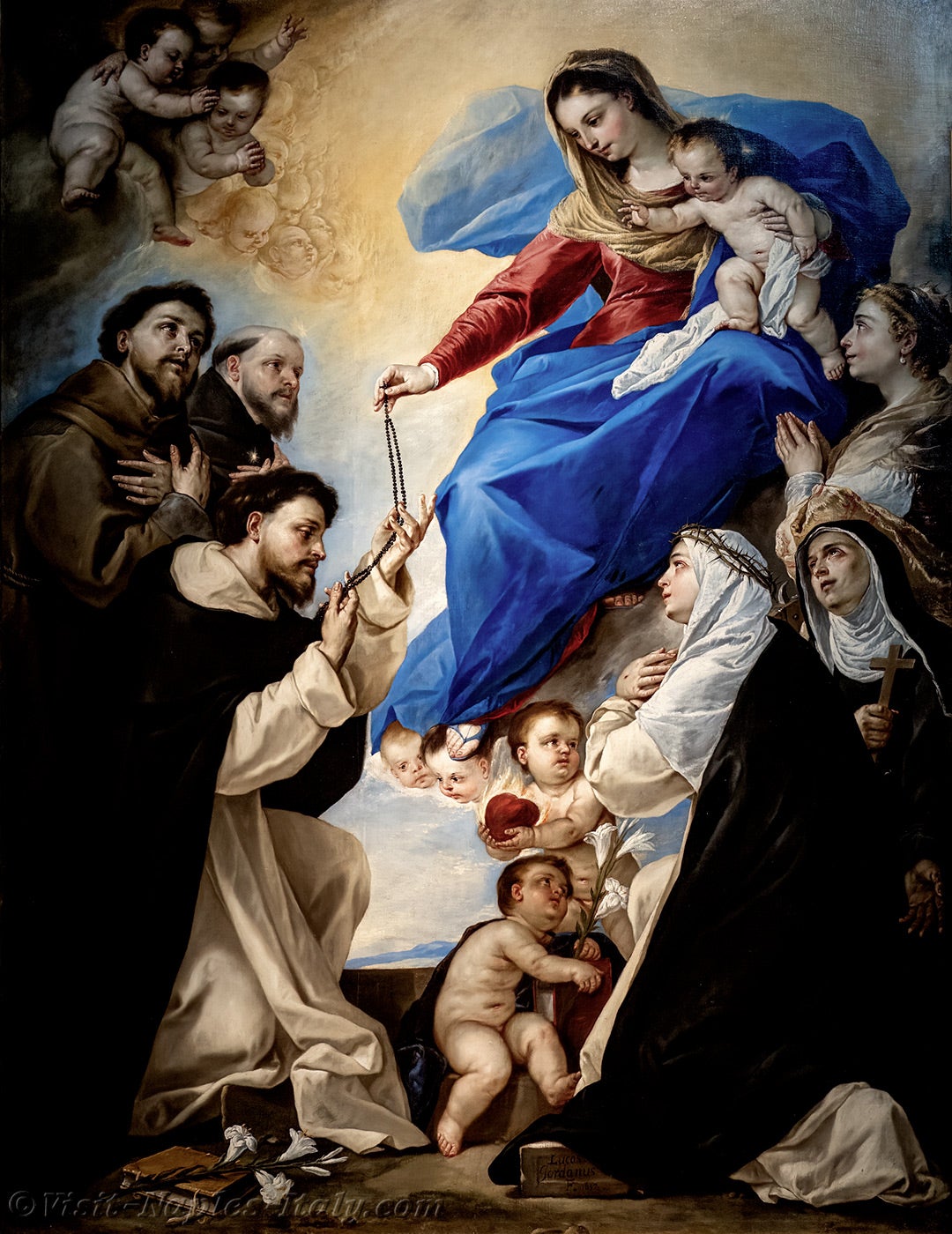
Our Lady of the Rosary She is wearing a red dress draped in a splendid blue cloak, the traditional colours used to depict the Virgin’s garments.
Saint Dominic is kneeling before the Virgin and is devoutly receiving the rosary.
At her feet, on the floor, a bouquet of lilies rests on a Bible.
To the left of Saint Dominic, Saint Francis and Saint Nicholas of Tolentino bow humbly, looking up towards the Virgin and Child whilst folding their hands over their chests.
To the right, standing, Luca Giordano has depicted Saint Elizabeth of Hungary praying with her hands clasped.
Saint Catherine of Siena, dressed in a beige robe and a white veil beneath her crown of thorns, is kneeling with her hands clasped over her chest to kiss the Virgin’s foot.
A cherub at her feet brings her the Gospel with a fleur-de-lis, whilst another, just above, holds a heart in his hands.
Saint Teresa of Ávila, dressed in black, is also kneeling before the Virgin with a crucifix in her right hand and showing her left hand bearing the stigmata.
Luca Giordano “The Holy Family Contemplating the Symbols of the Passion”
Painting - Oil on canvas (411 x 281 cm) 1660This painting by Luca Giordano, painted in 1660, depicts the Holy Family—Jesus, Mary and Joseph on their return from their flight into Egypt.
God the Father dominates the scene and commands respect through his demeanour, seated on a cloud carried by angels, a sceptre in one hand and the other pointing towards heaven.
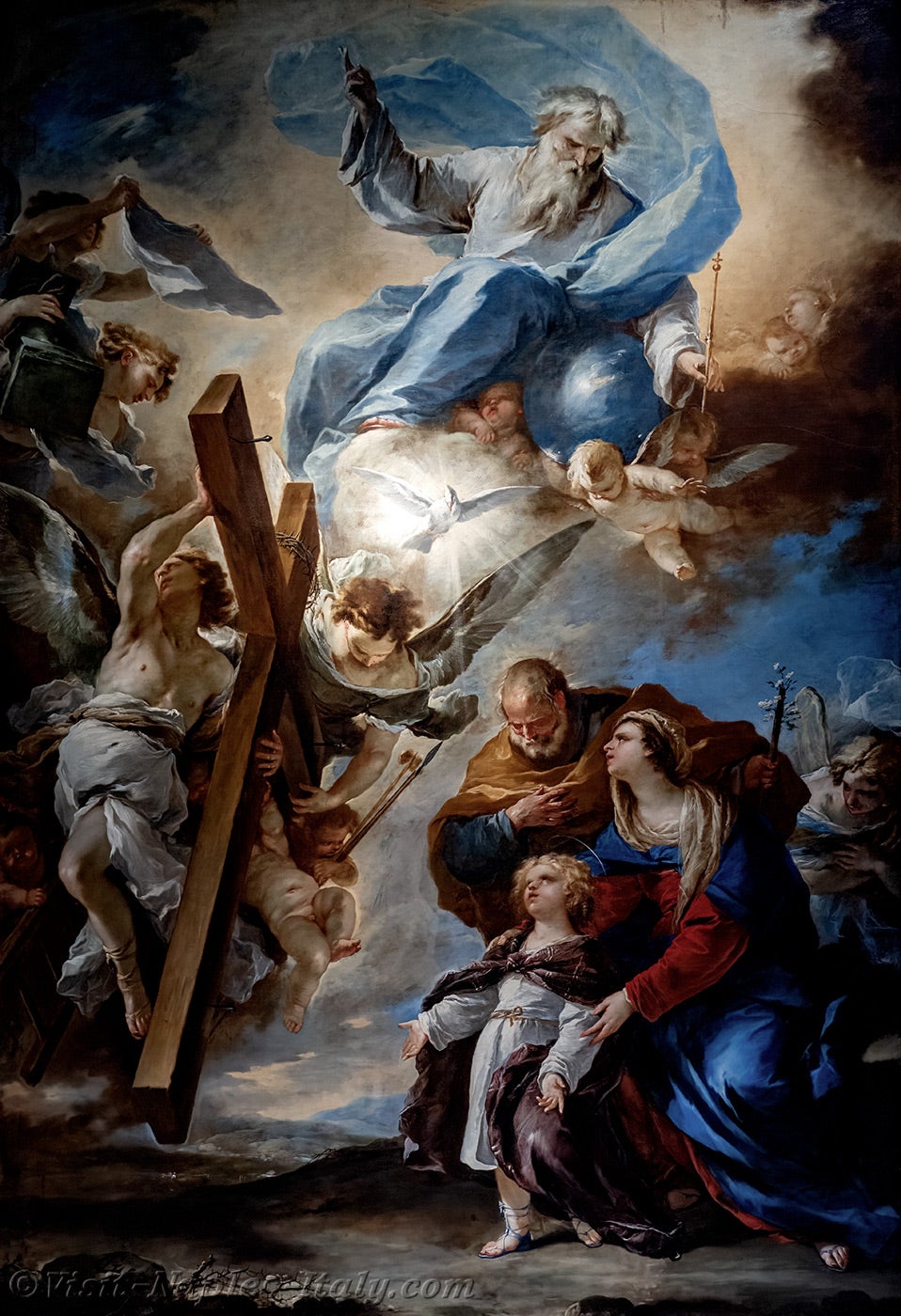
The Holy Family It is the only source of light in the painting, an intense light emanating from the dove beneath him, symbolising the power of his creative Spirit.
Jesus and Mary accept with resignation the cross of the crucifixion, carried by the angels who hold it aloft before them.
A large cross whose upper beam is encircled by a crown of thorns.
Beneath one side of the cross, a little cherub holds the staff with the sponge which will be dipped in vinegar, as well as the spear that will pierce Christ’s side.
The three nails of the crucifixion are already driven into the cross standing before the Holy Family.
The Infant Jesus stands before the cross, his arms outstretched to welcome it, holding out the palms of his little hands to show that he already accepts the mission ordained by his heavenly Father, whilst Joseph accepts his own by leaning towards the child in his care.
Luca Giordano “Christ Taken Down from the Cross”
Painting - Oil on canvas (103 x 101 cm) 1655-1660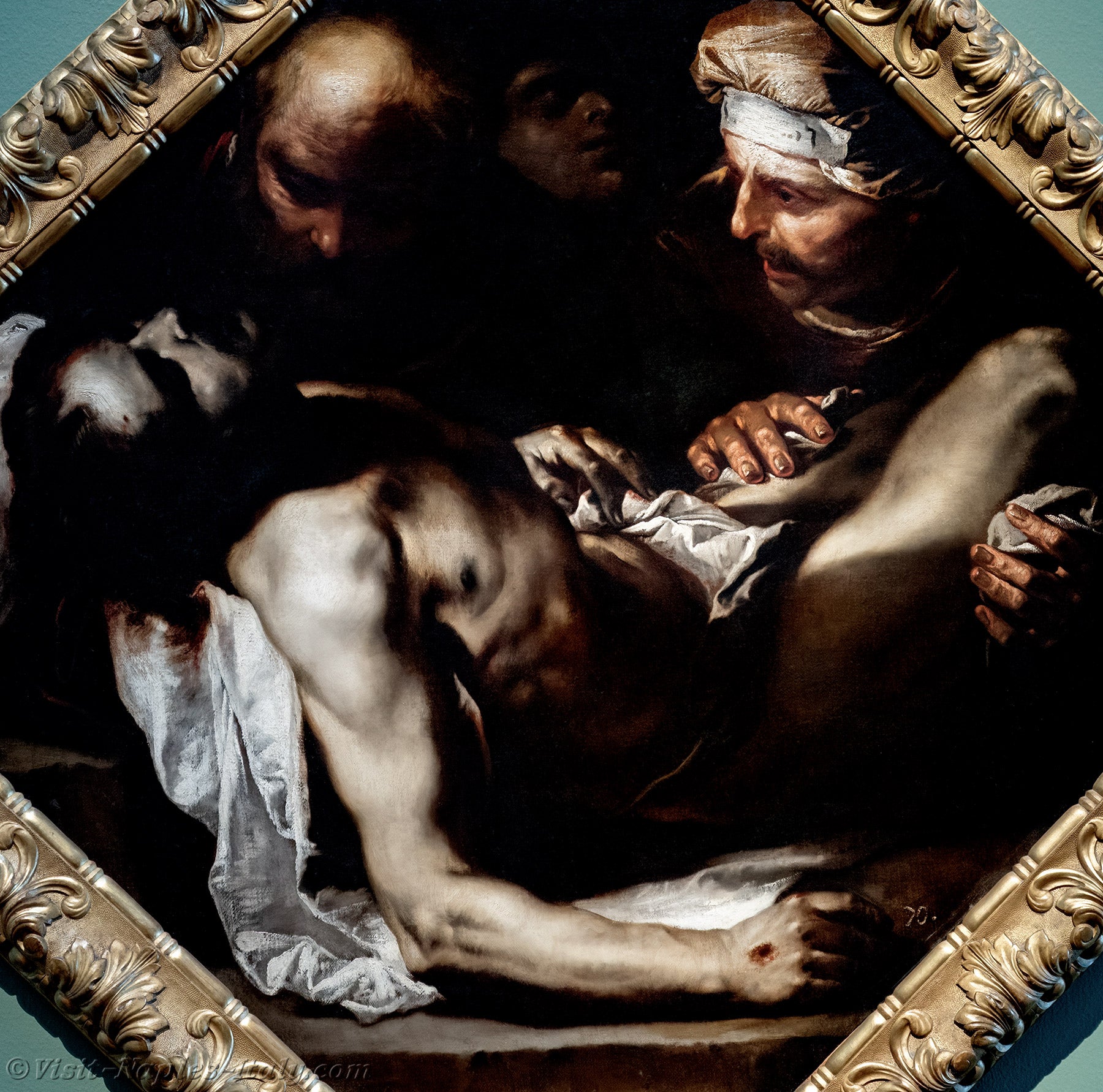
Luca Giordano, Le Christ descendu de la croix The beauty of the chiaroscuro in this painting by Luca Giordano makes it a small masterpiece worthy of Rembrandt.
The dead Christ has only just been taken down from the cross; his skin is greyish; Joseph of Arimathea gently lays him down, supporting his head, whilst his lifeless arm already rests on the ground, his hand pierced by the crucifixion, and his other hand lies limply on his stomach.
On the right, Nicodemus helps Joseph; his face etched with grief, he gazes intently at Christ whilst holding his legs; the brown skin of his hands contrasts with Christ’s deathly pallor, as if they were trying to breathe life back into him.
The black background emphasises the dramatic intensity of this Entombment that emanates from this work.
Luca Giordano “San Gennaro intercedes with the Virgin, Christ and the Eternal Father against the plague of 1656”
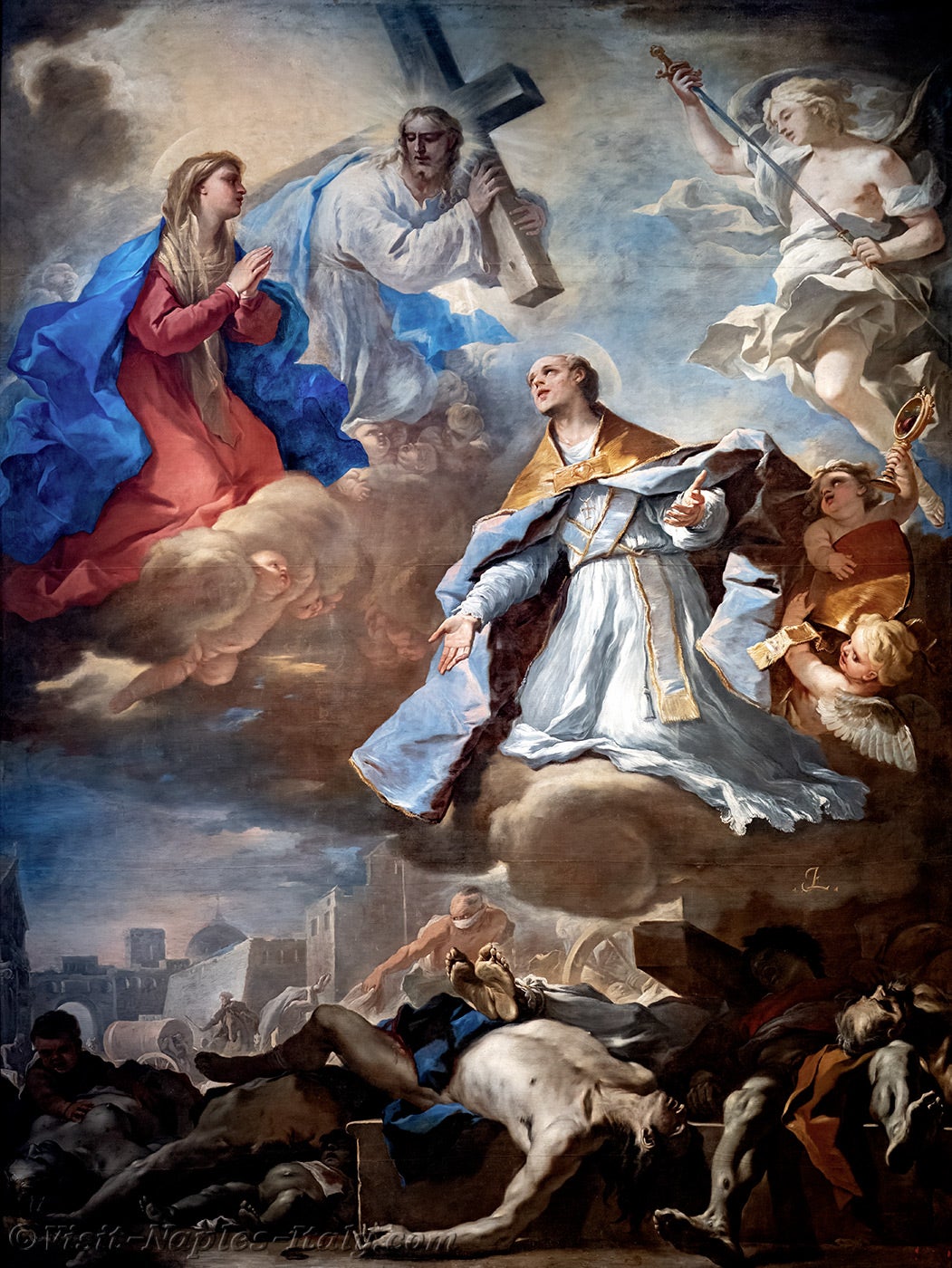
Saint Gennaro intercedes Painting - Oil on canvas (400 x 315 cm) 1660-1661
San Gennaro is depicted kneeling on a cloud, looking up to heaven to implore the Virgin Mary and Christ to put an end to the plague epidemic that was ravaging Naples and the Italian peninsula in 1656.
An epidemic during which there were more than 200,000 deaths out of a population of 450,000.
Beneath San Gennaro, one can see the city of Naples with the bodies of the plague victims lying in the open air and piled haphazardly on the ground.
Luca Giordano “Saint Francis Xavier baptising the neophytes and Saint Francis Borgia”
Painting - Oil on canvas (421 × 315 cm) 1680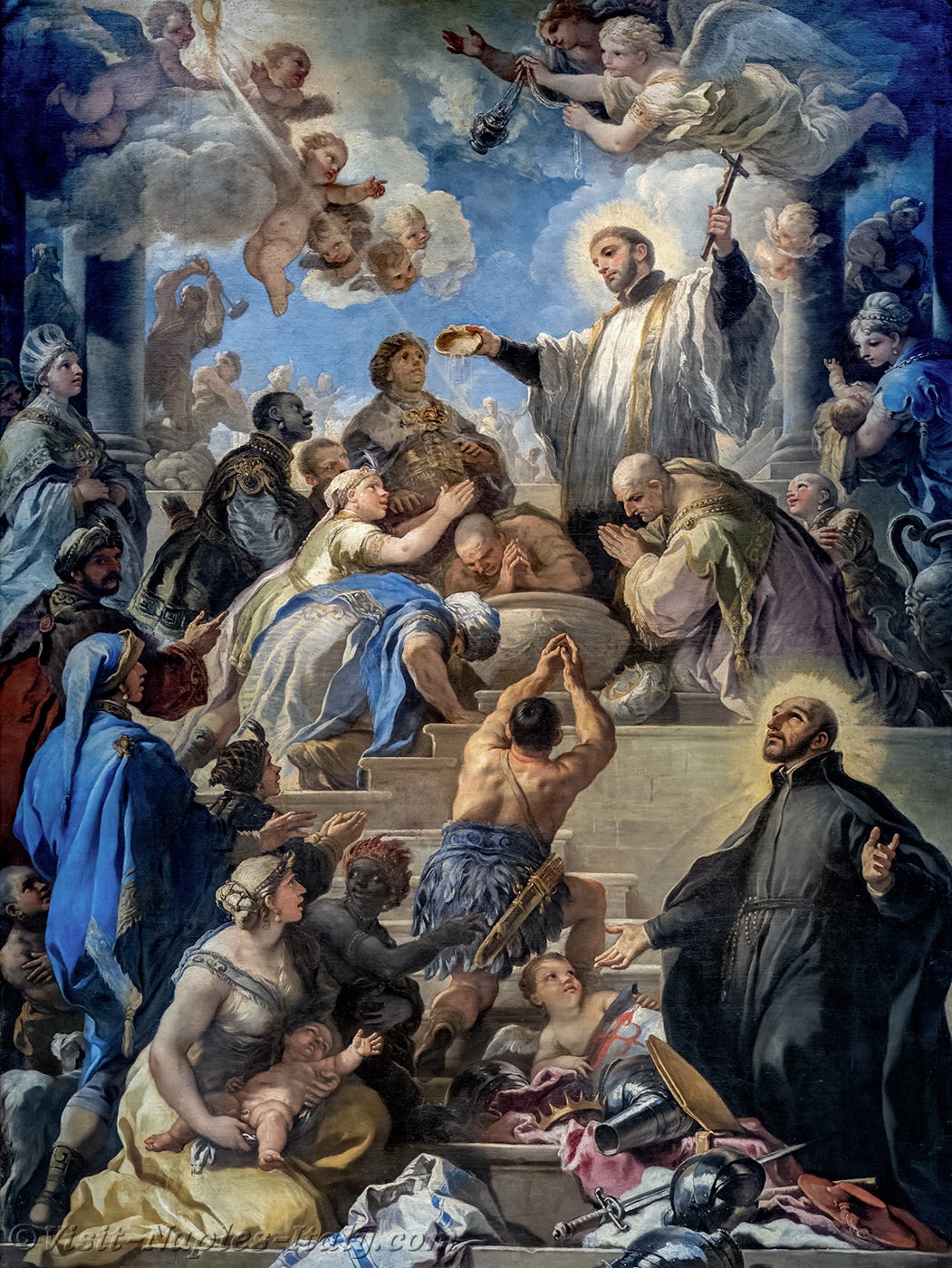
Saint Francis Xavier Saint Francis Xavier, surrounded by a halo of holy light, baptises a man by pouring holy water from a small bowl over him and holding aloft a crucifix in his other hand.
A ray of heavenly light falls upon the baptismal font from a cloud surrounded by cherubs.
The catechumens who approach as they climb the steps are in prayer and adoration before the saint; some are kneeling whilst waiting for their turn.
The great diversity of their costumes indicates that they come from all countries and are of all social backgrounds; they have gathered to become Christians, equal before God.
Luca Giordano “Saint Lucy Led to Martyrdom”
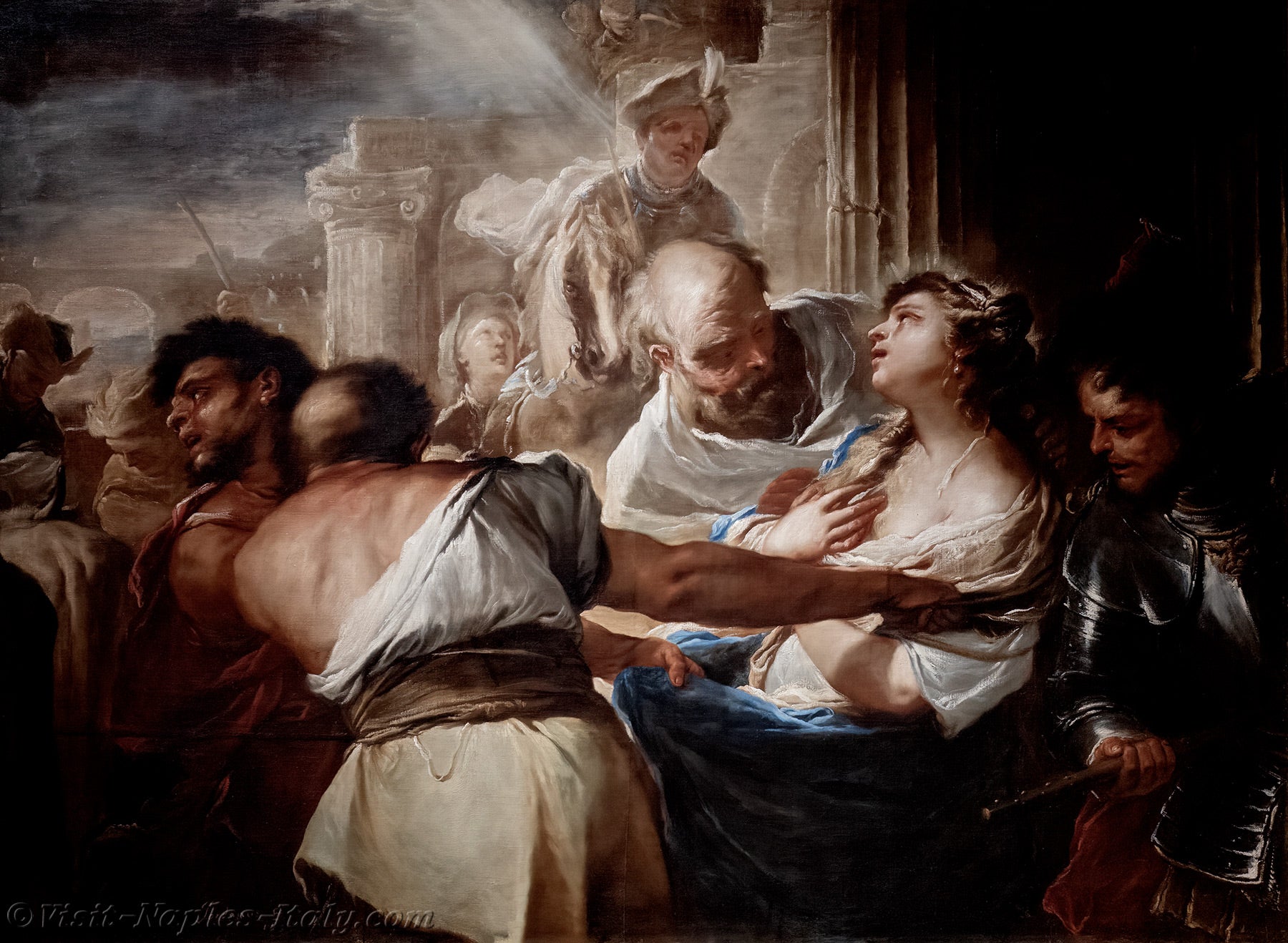
Saint Lucy led to her martyrdom Painting - Oil on canvas (142 × 191 cm) 1659
The scene is moving: Saint Lucy stands rooted to the spot, whilst surrendering to her fatal fate, her eyes raised towards the heavenly light which highlights the immaculate whiteness of her body, as well as the tunic of the old man (an apostle) who is supporting her.
Two men tasked with forcibly leading her to her martyrdom pull her by her clothes, under the gaze of Pascasio, the prefect in black armour who has ordered them to behead her.
Here too, the interplay of light and shadow lends even greater intensity to the drama unfolding before us.
Luca Giordano “The Deposition of Christ”
Painting - Oil on canvas (220 x 344 cm) 1644-1649This is the moment when Christ was taken down from the cross.
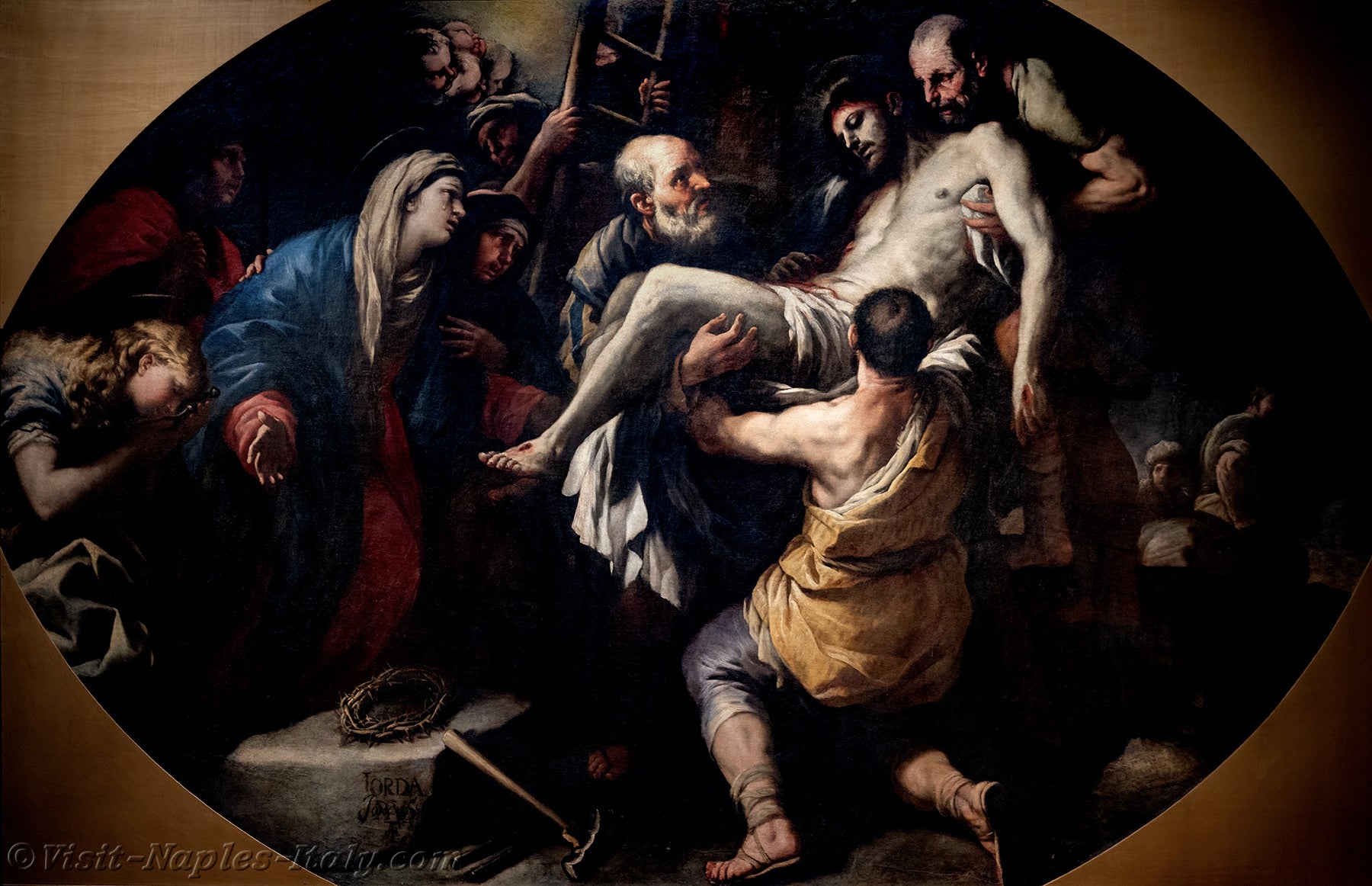
Luca Giordano, The Deposition of Christ A man removes the ladder whilst Joseph of Arimathea and Nicodemus, aided by a third disciple, hold up his body before the Virgin Mary and Mary Magdalene, who are weeping.
A hammer and pincers for removing the nails were left on the ground, next to the stone where the crown of thorns had been laid.
The extreme pallor of Christ’s dead body seems to have affected all the figures, marked by mourning and devotion.
The Virgin Mary looks at her son, spreading her arms to receive his lifeless body.
Luca Giordano “The patron saints of Naples venerate the crucifix”
Painting - Oil on canvas (400 × 315 cm) 1660-1661The five patron saints of Naples: San Bacolo di Sorrento, Saint Eusebius, Saint Francis Borgia, Saint Aspren of Naples and Saint Candida the Elder are depicted worshipping Christ on the cross.
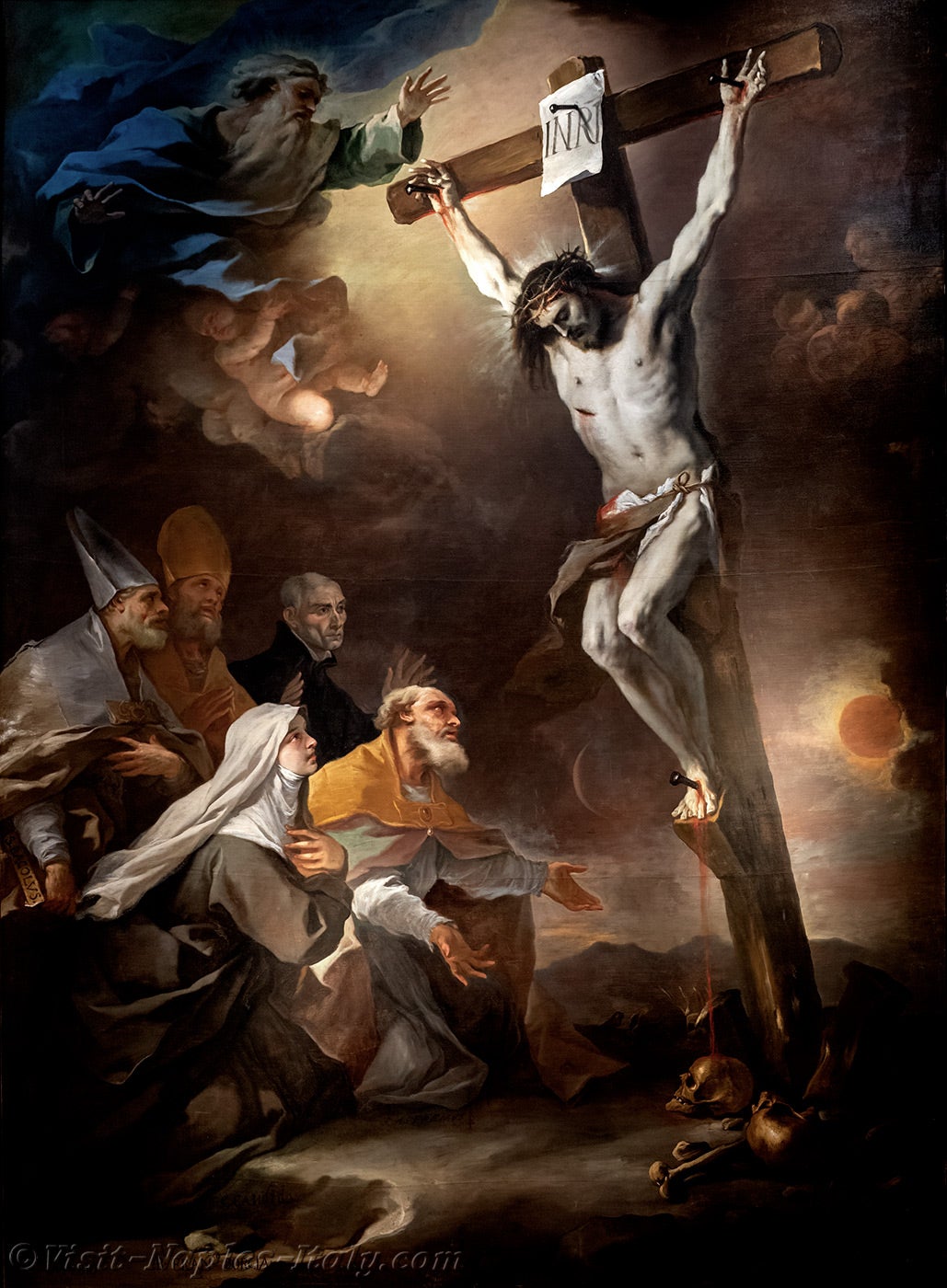
Veneration of the crucifix Christ is lifeless, the only traces of colour on his pallid flesh being those of his blood flowing from his hands, from the wound made by the spear beneath his breast, and from his feet.
The blood flowing from Christ’s feet falls in abundance onto a skull at the foot of the cross.
God the Father is depicted dressed in azure blue at the top of the painting, his hands outstretched in a protective gesture towards his Son.
The five patron saints pray on their knees, their faces expressing great devotion as they contemplate the martyrdom of God made man, who came to wash away the sins of the world.
Giordano Mythological Works | Religious Works
Artists Palace Gardens | Bellini | Botticelli | Bronzino | Brueghel | Canova | Caravaggio | Gentileschi | Giambologna | Giordano | Greco | Lotto | Luini | Mantegna | Masaccio | Masolino | Michelangelo | Palma | Parmigianino | Porta | Raphael | Reni | Titian | Van Dyck | Warhol
Capodimonte Artists Schedule Tickets Location | Authorizations
Back to Top of Page