

MANN Artworks Schedule Tickets Location | Authorizations
Artworks Sculptures | Frescoes | Eroticism
Sculptures Mythology | Persons | Animals | Bas-relief
Mythology Achilles | Aesculapius | Amazons | Aphrodite Venus | Apollo | Artemis | Athena Minerva | Atlas | Concordia | Danaids | Diomedes | Dionysus | Dirce | Flora | Ganymede | Hera Juno | Hercules | Hermes | Nike | Orestes | Psyche | River | Satyrs | Zeus
Sculptures of Athena and Minerva at the Archaeological Museum of Naples, Italy
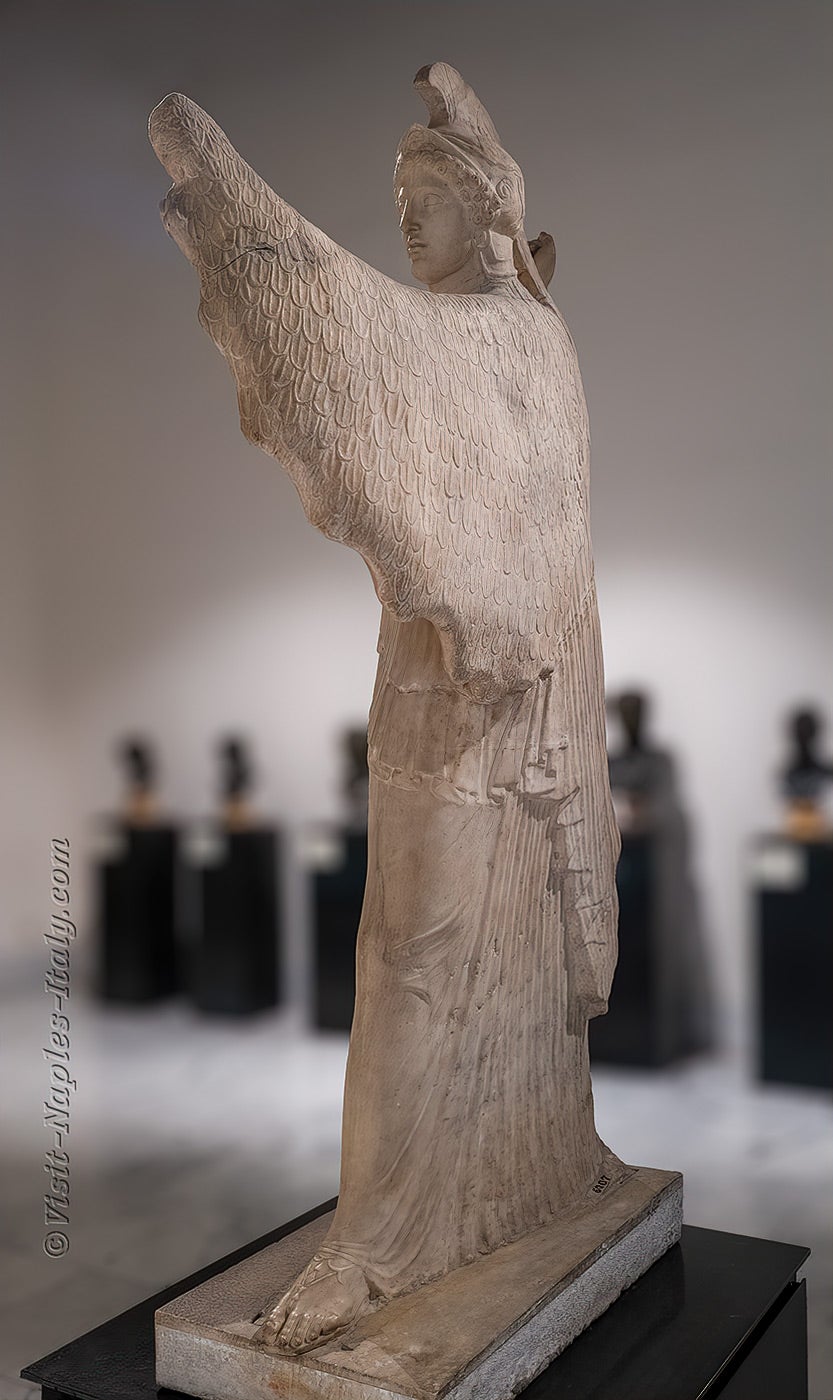
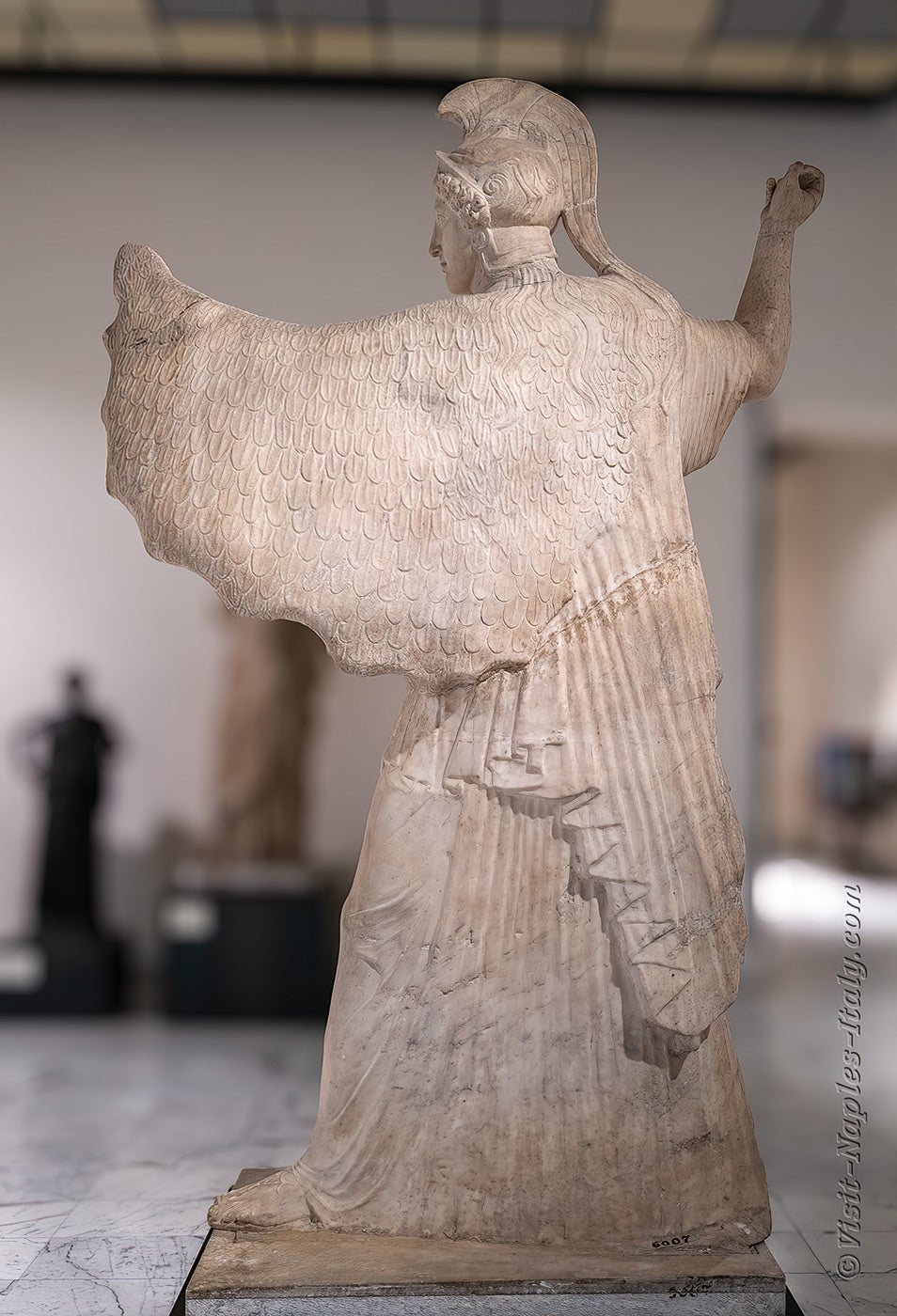
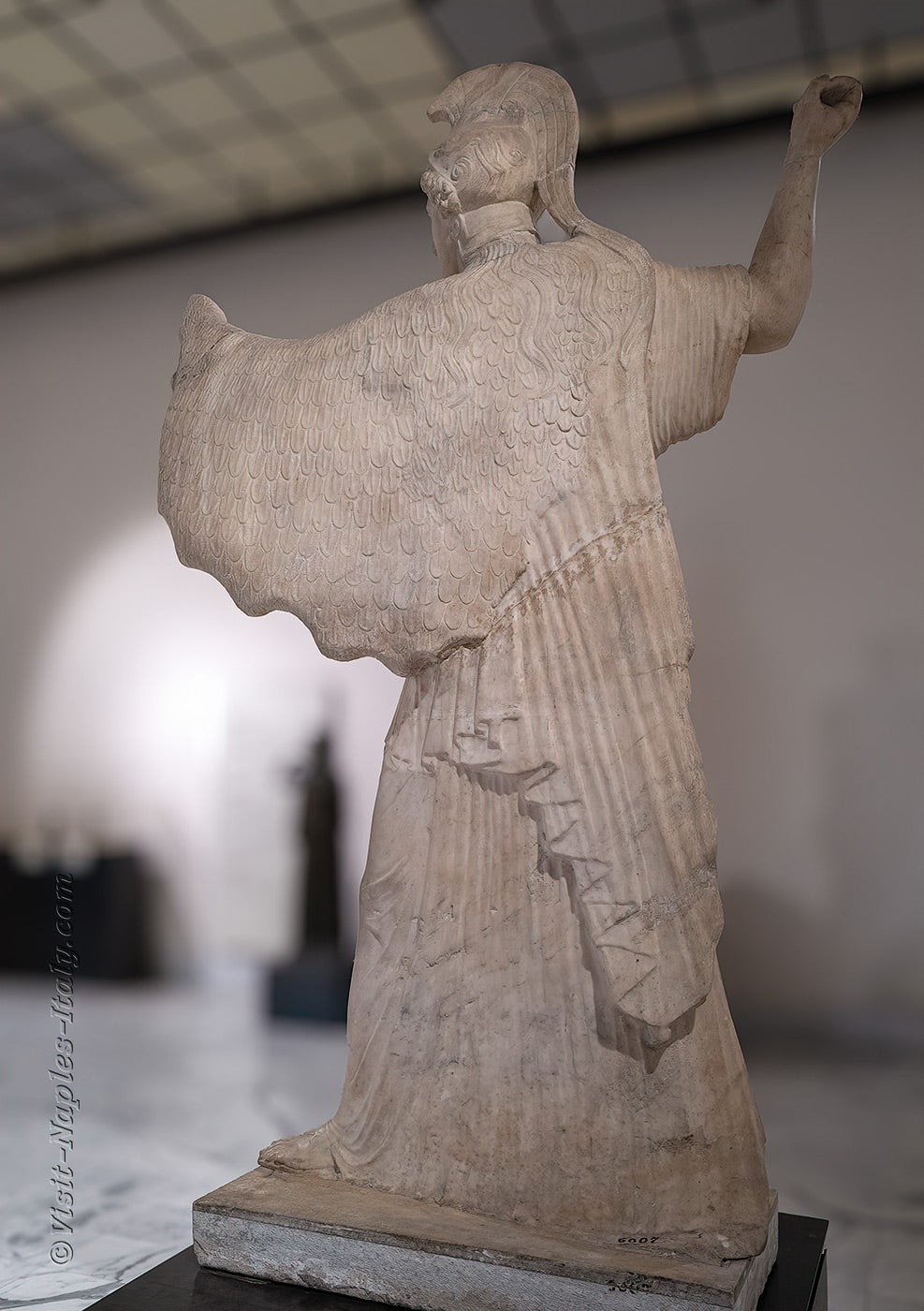
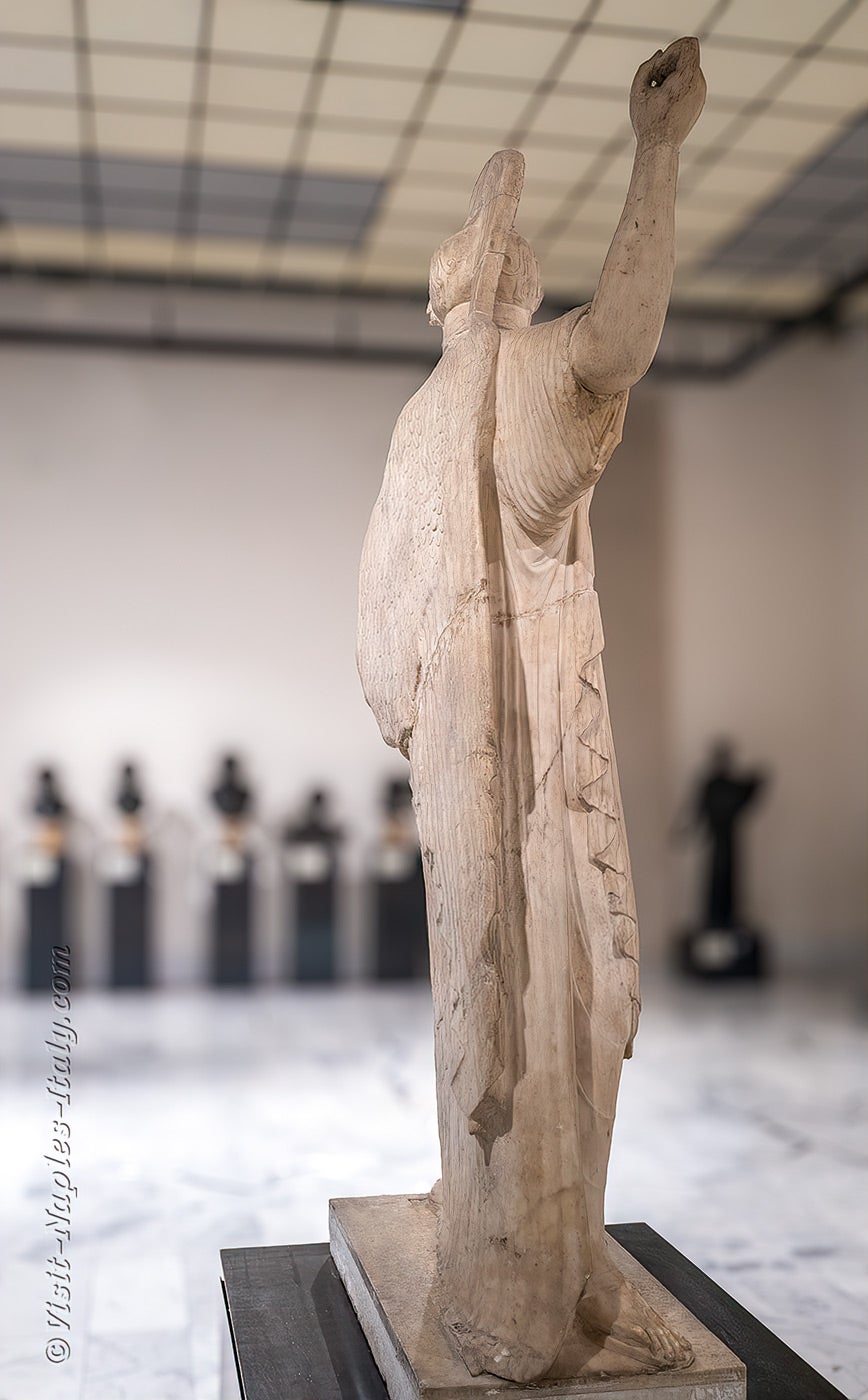
Athena Promachos, Villa dei Papiri, Herculaneum
Sculpture - Marble (Height 200 cm) 1st century BC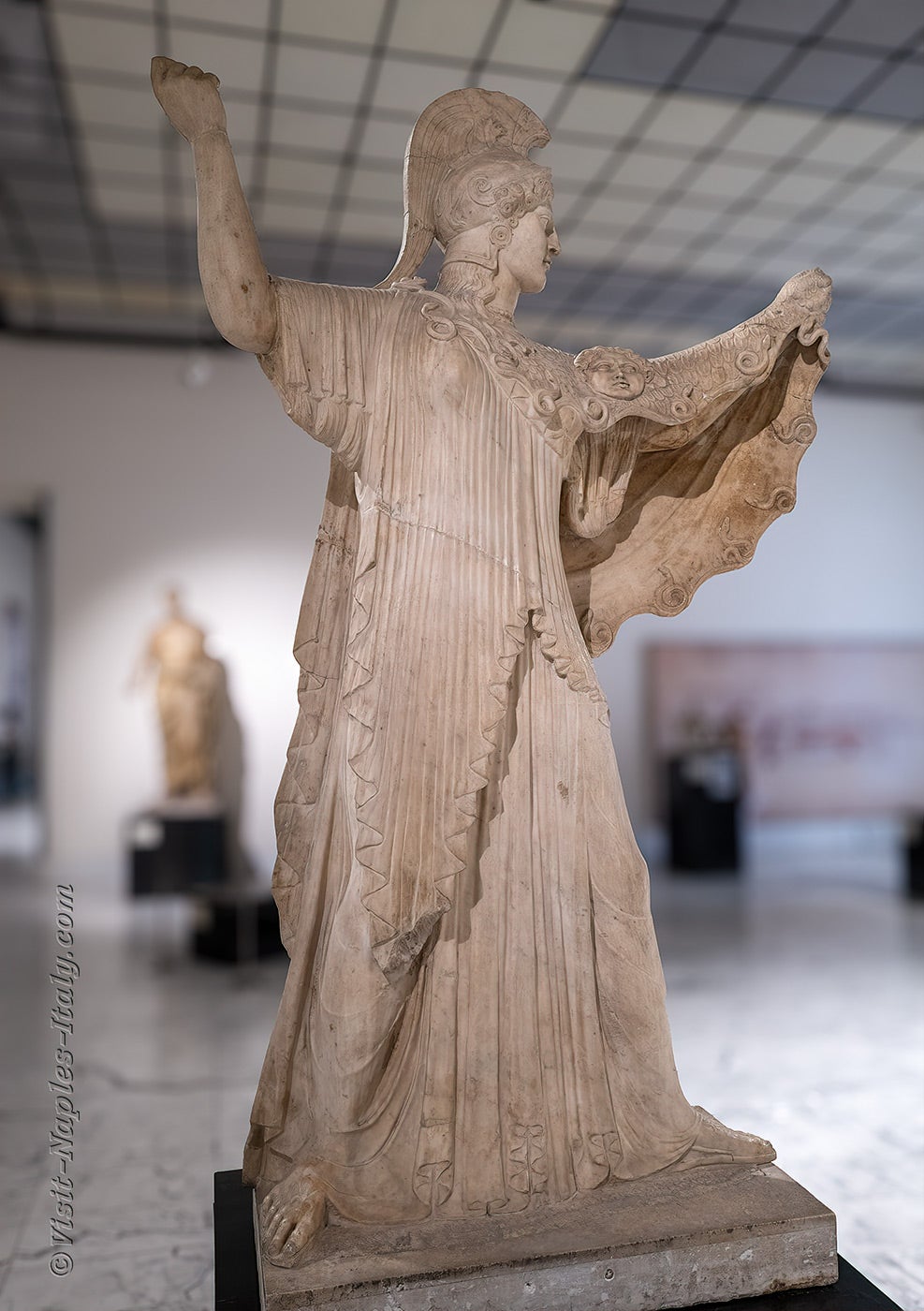
Athena Promachos This statue of Athena was discovered in 1752 at Herculaneum, in the Villa dei Papiri.
Athena, goddess of wisdom and war, appears here as a “pro-macho” that is to say, as a frontline warrior, defending the city of Athens of which she is the protective symbol.
This marble sculpture dating from the 1st century BC is a replica of the giant bronze statue of Athena Promachos created by Phidias around 480 BC, to commemorate the Greek victory over the Persians.
Phidias’ Athena Promachos stood between the Propylaea and the Parthenon on the Acropolis in Athens.
Athena stands, her left leg forward, arms raised, turning her head towards the enemy to strike him with her spear which she holds in her right hand. Her spear, now lost, was probably made of bronze.
She wears her characteristic long, short-sleeved tunic.
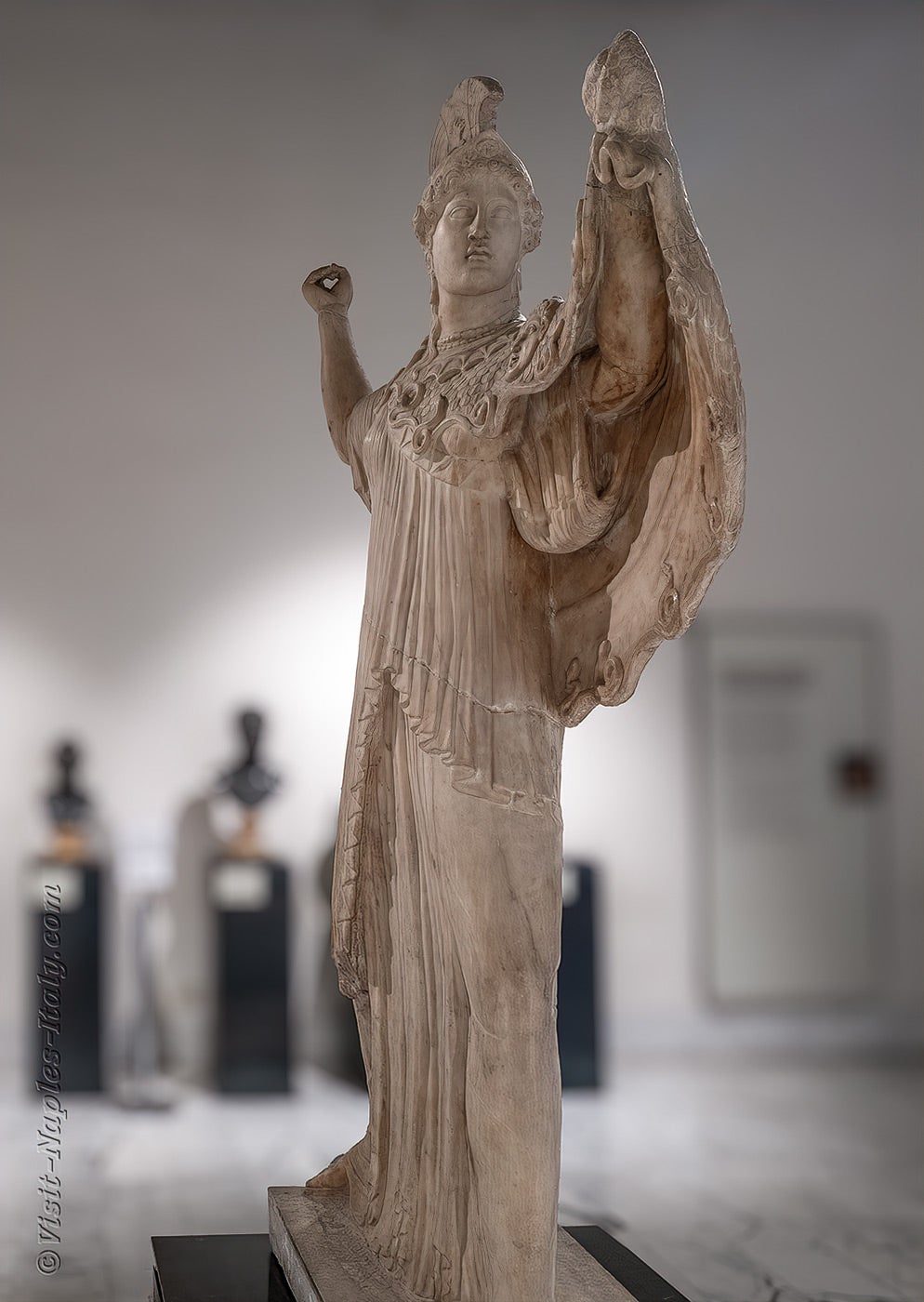
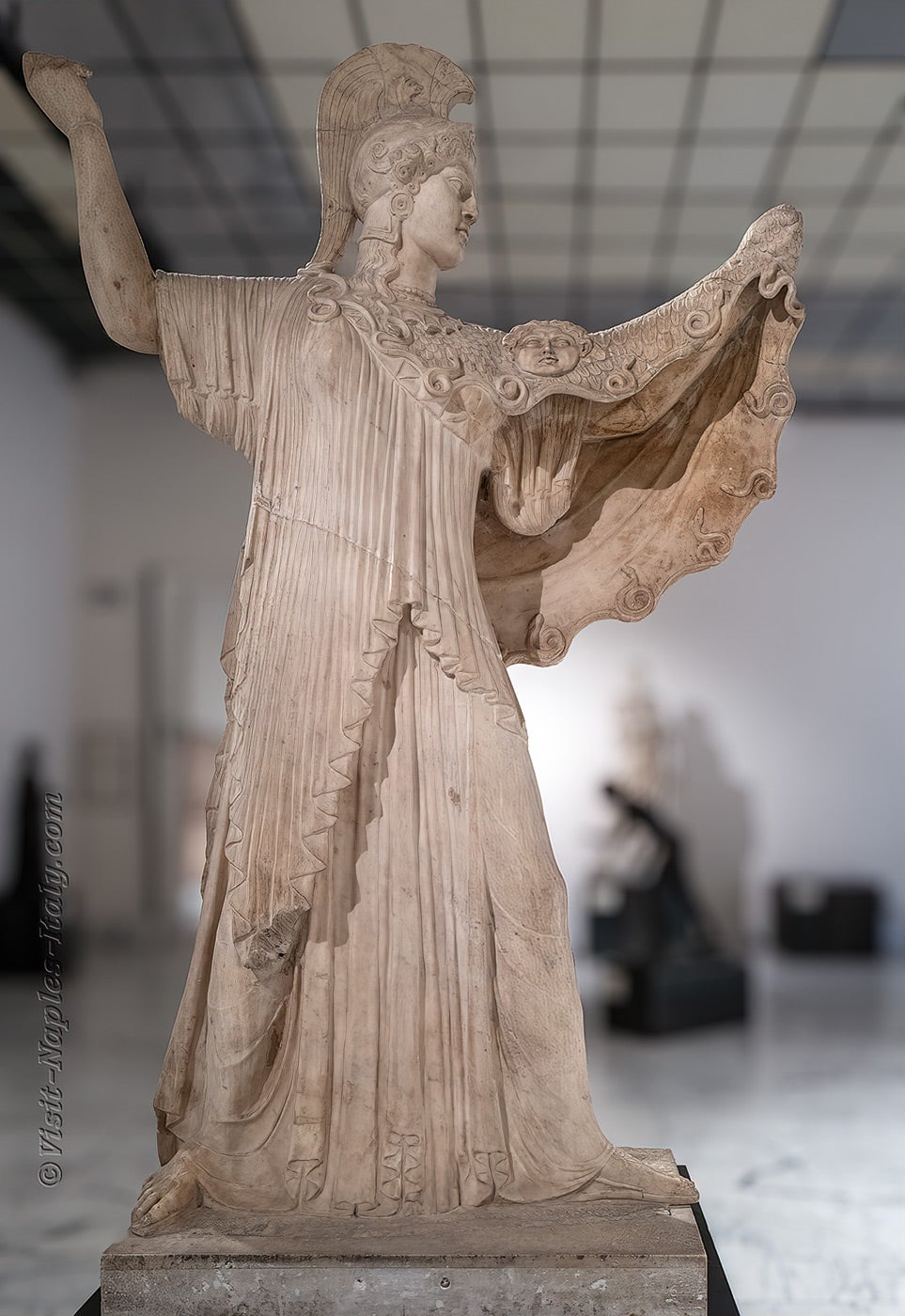
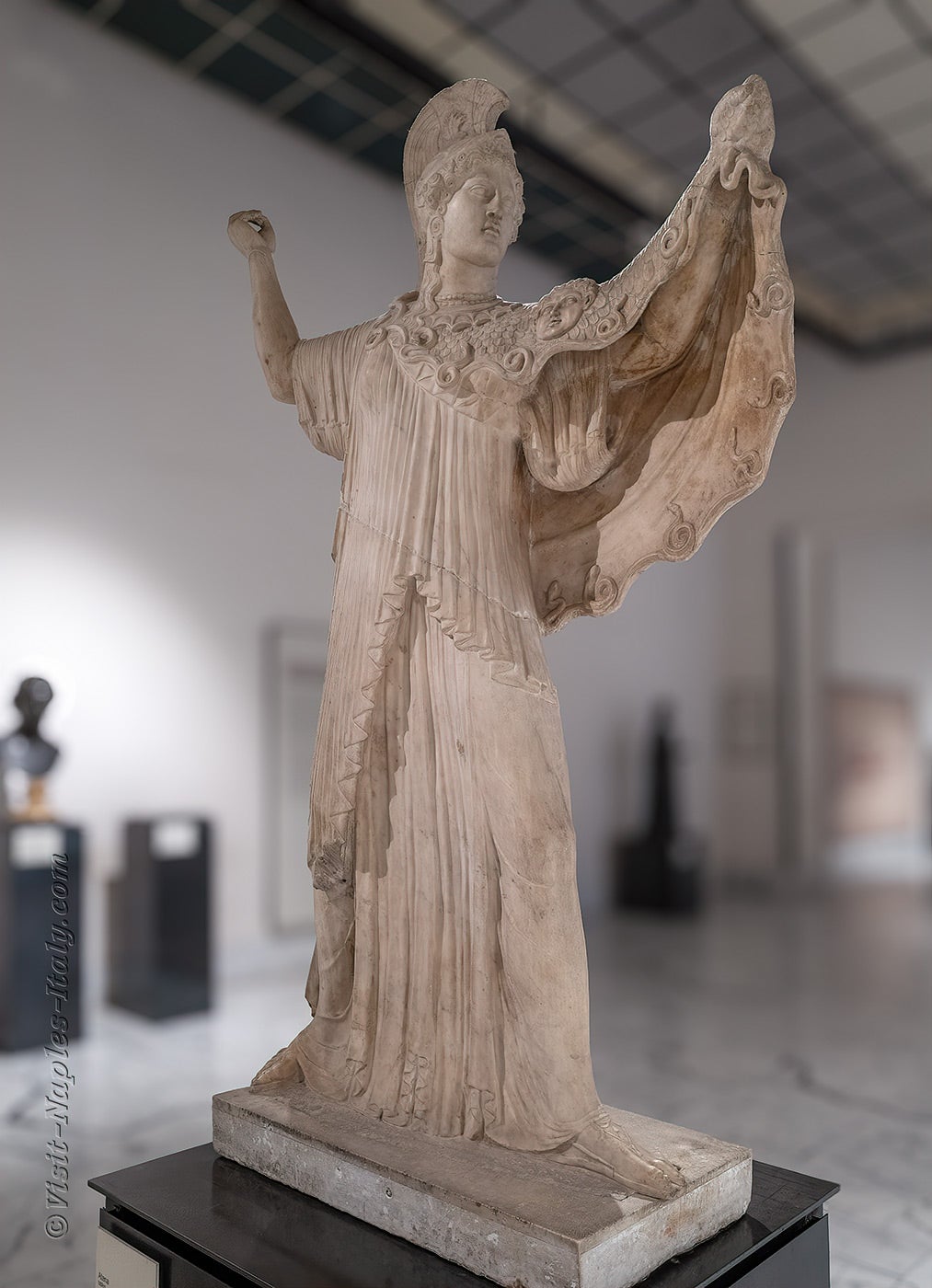
Athena Promachos The perfectly vertical pleats of her garments lend her the simplicity, stability and solidity of a Doric column.
Note the elegance of the gesture of this calm and serene Athena facing the enemy, protected by her Greek helmet adorned with griffins and by her magnificent cloak, the aegis, which covers her left arm and spreads out like a fan to serve as her shield.
Her beautiful feminine hair falls in long, curly locks over her shoulders and down her back.
The aegis, made of feather-like scales, is adorned with a Gorgon’s head and small snakes.
The snakes probably allude to Cecrops (Kekrops in Greek), the mythical founder of the city of Athens, who was half-man, half-snake.
The aegis was an indestructible cloak given by Zeus to his daughter Athena to protect her.
The aegis, the spear and the helmet were the attributes of Athena, the goddess who represented reason, the strategic mind, the scholar and the philosopher.
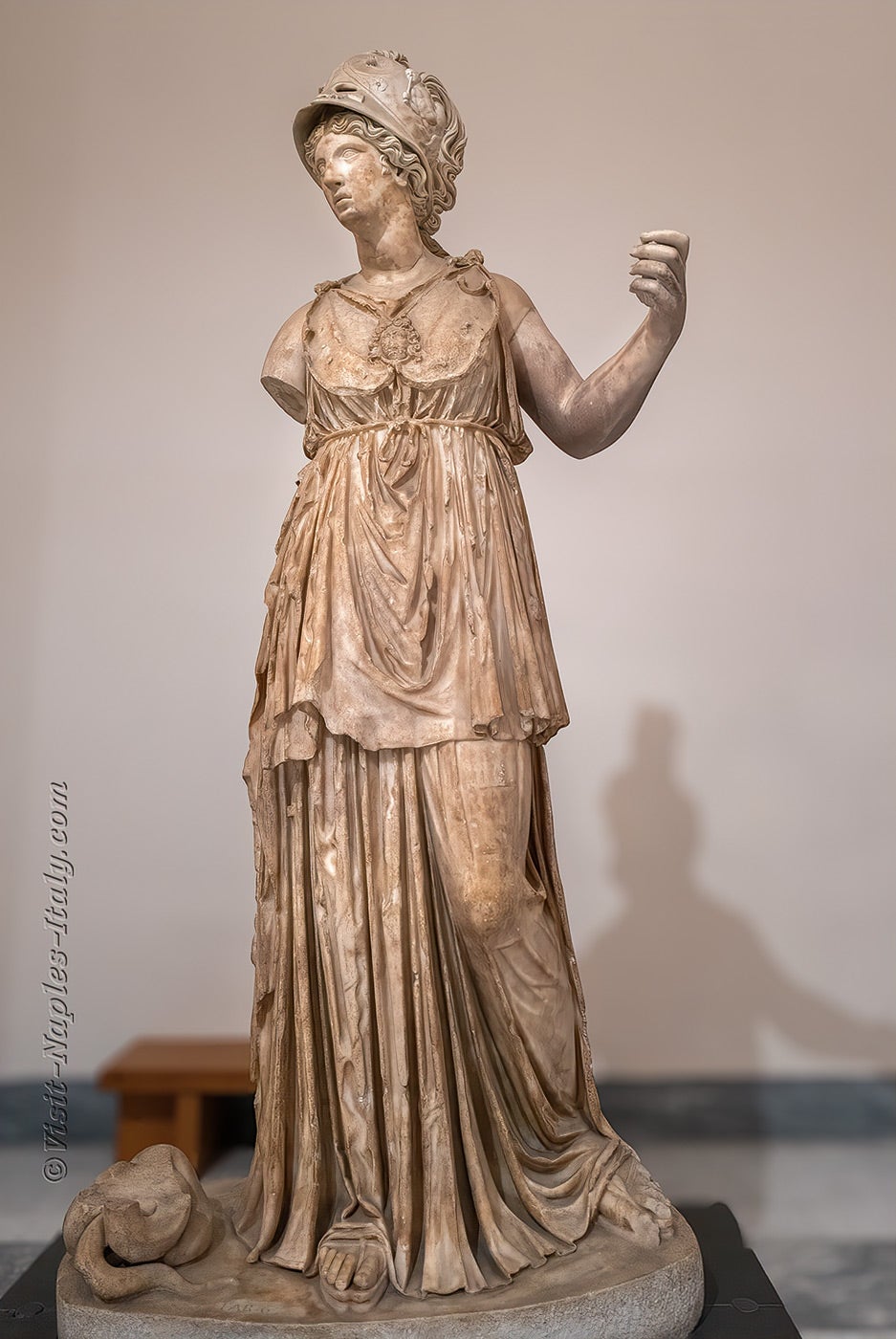
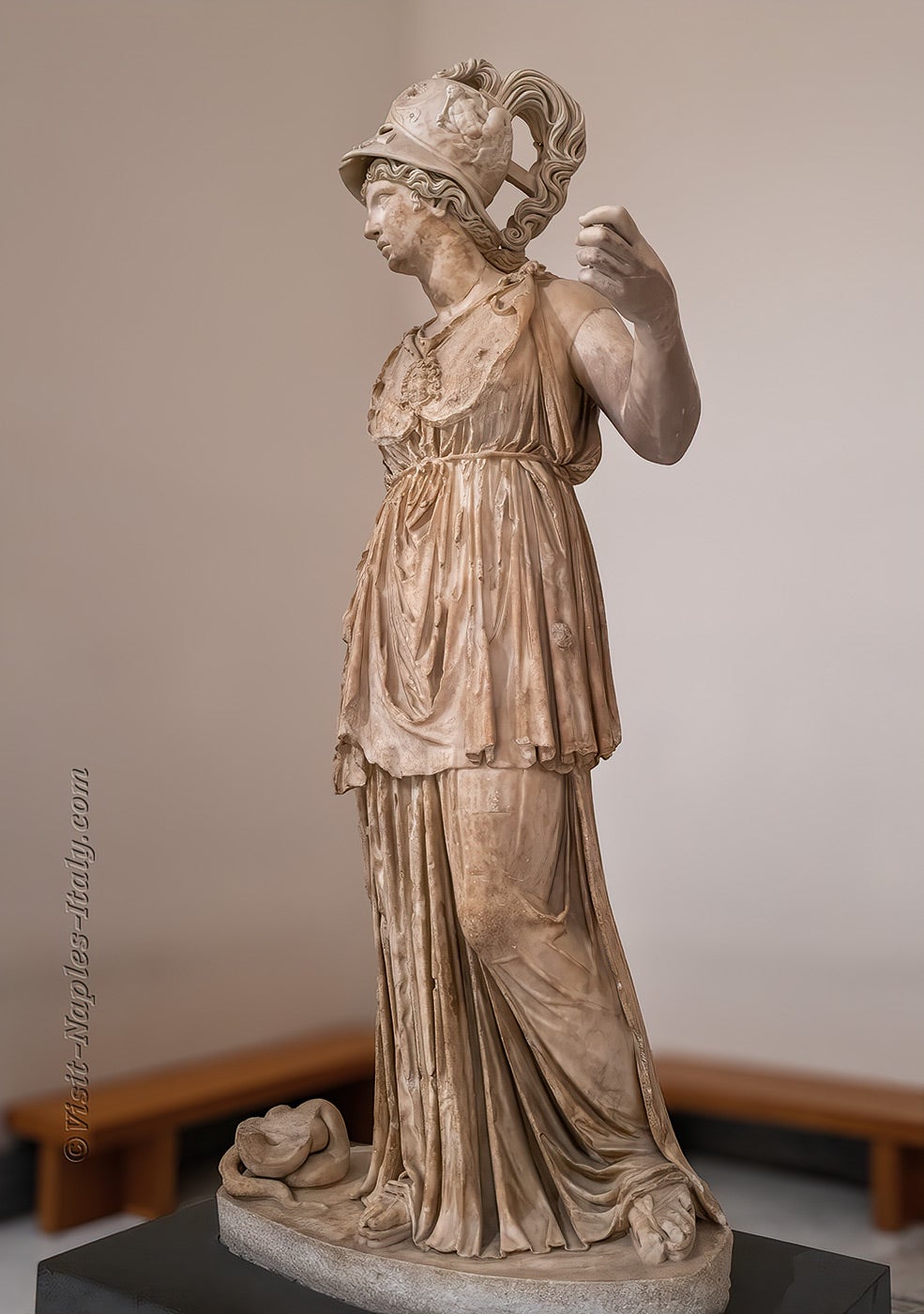
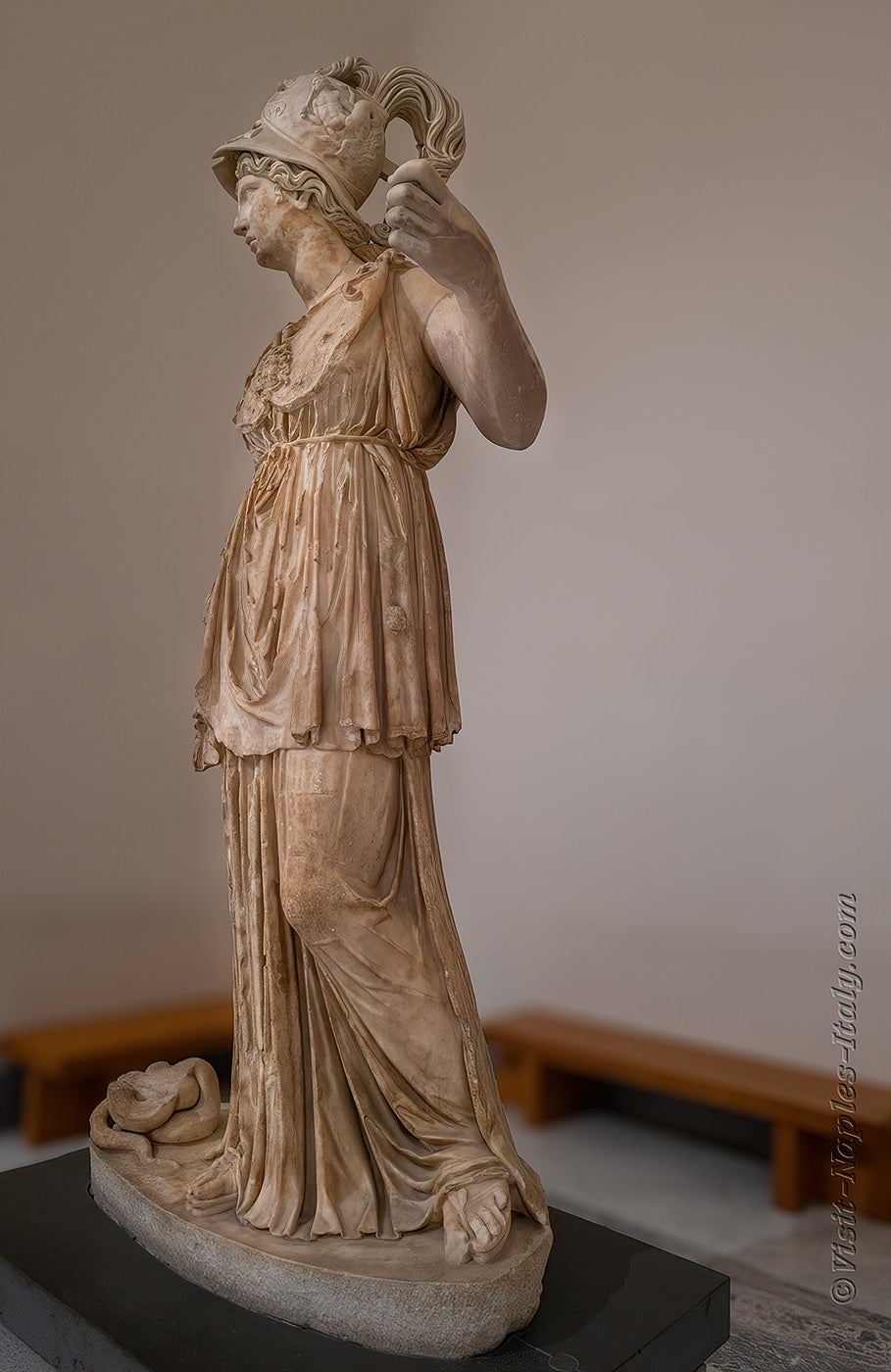
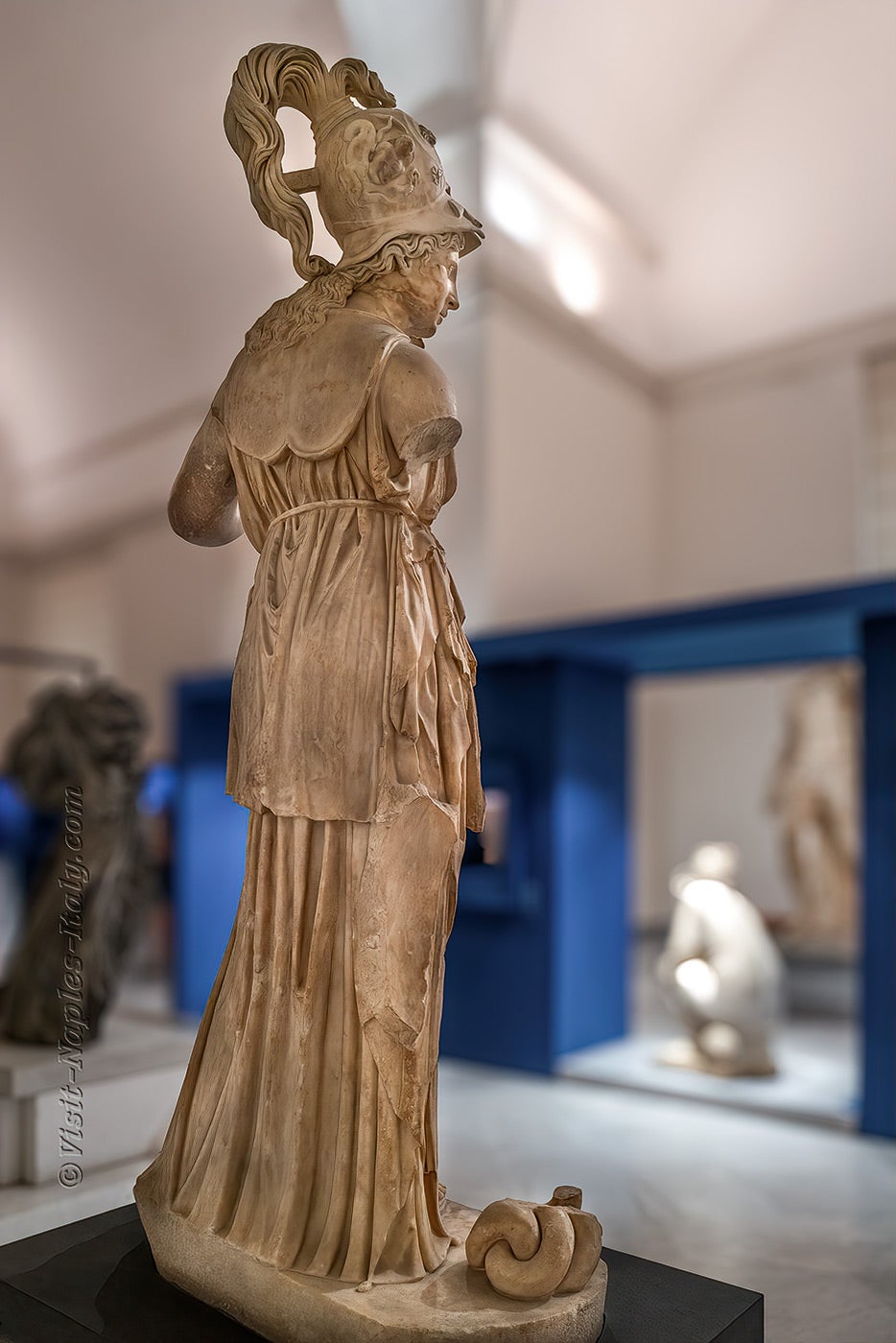
Minerva, Farnese Collection
Sculpture - Pentelic marble (Height 265 cm) 2nd century ADA Hellenistic derivative of Phidias’ Parthenos. Beside Athena stands the serpent, partly broken.
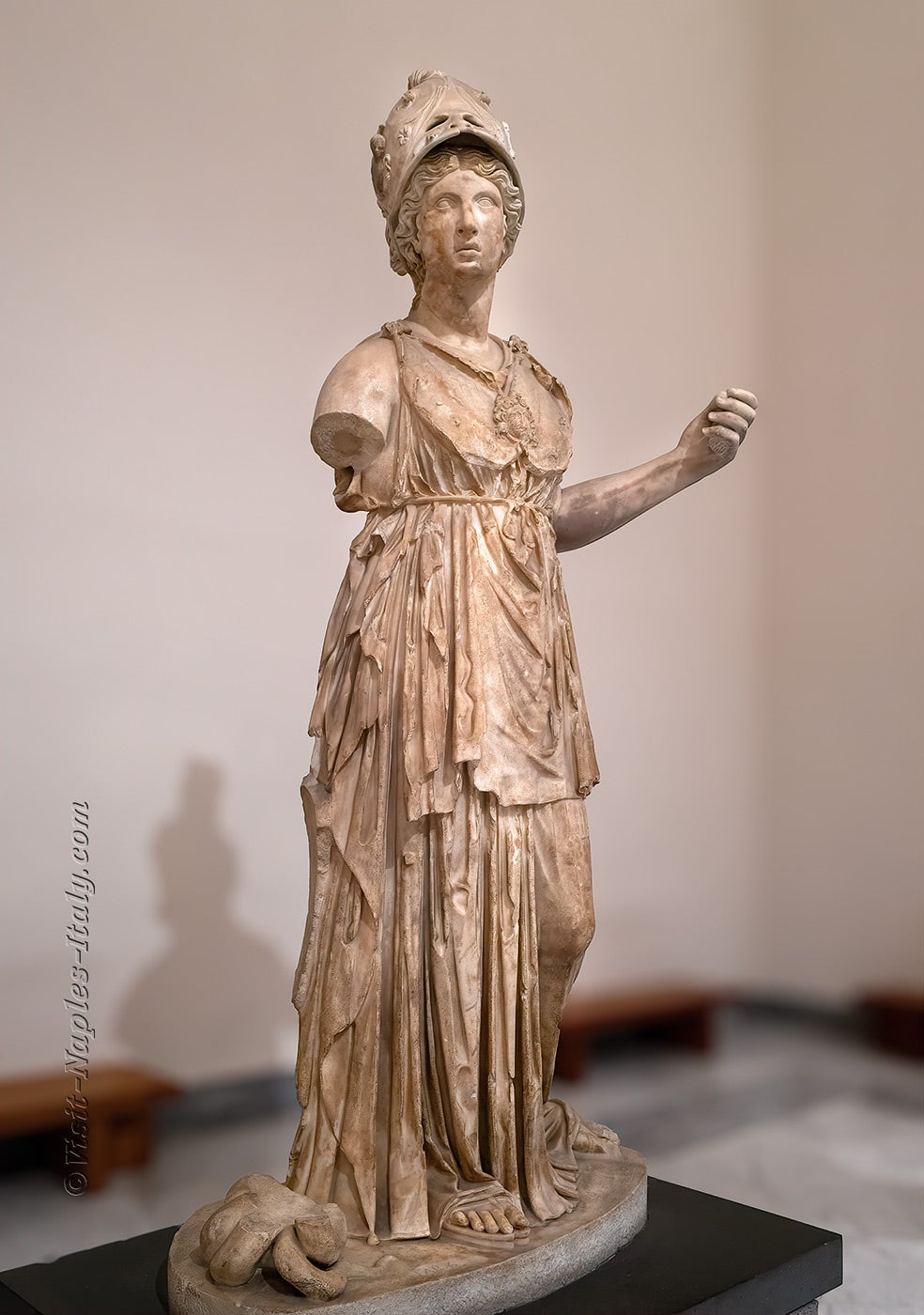
Minerva The peplos is tied very high up ; the folds are rendered with great care. The figure as a whole lacks the severity of proportion and the sense of movement characteristic of the Parthenos.
She wears an Ionic chiton with buttoned sleeves and a himation draped over her left shoulder, in the style of the Vienna ‘Kora’ Muses, attributed to Praxiteles.
This Roman-era Minerva was modelled on a Greek statue of Athena dating from the 5th century BC.
The patron goddess of Athens stands watch, wearing her Greek warrior’s helmet resting upon her beautiful hair, parted in the middle of her forehead.
Originally, the statue held her spear in her left hand and her right hand held her shield resting on the ground.
She wears her long tunic which falls in long folds to the ground, where a snake lies coiled upon itself.
The snake represents Cecrops, the child spontaneously born of the earth, half-man, half-snake, the mythical founder of the city of Athens of which he was the first ruler.
King Cecrops put an end to the rivalry between the god of the sea Poseidon and the goddess, choosing instead the olive branch offered by Athena.
Athena thus became the patron goddess of the Athenians because she had brought them the olive tree, symbolising peace and prosperity.
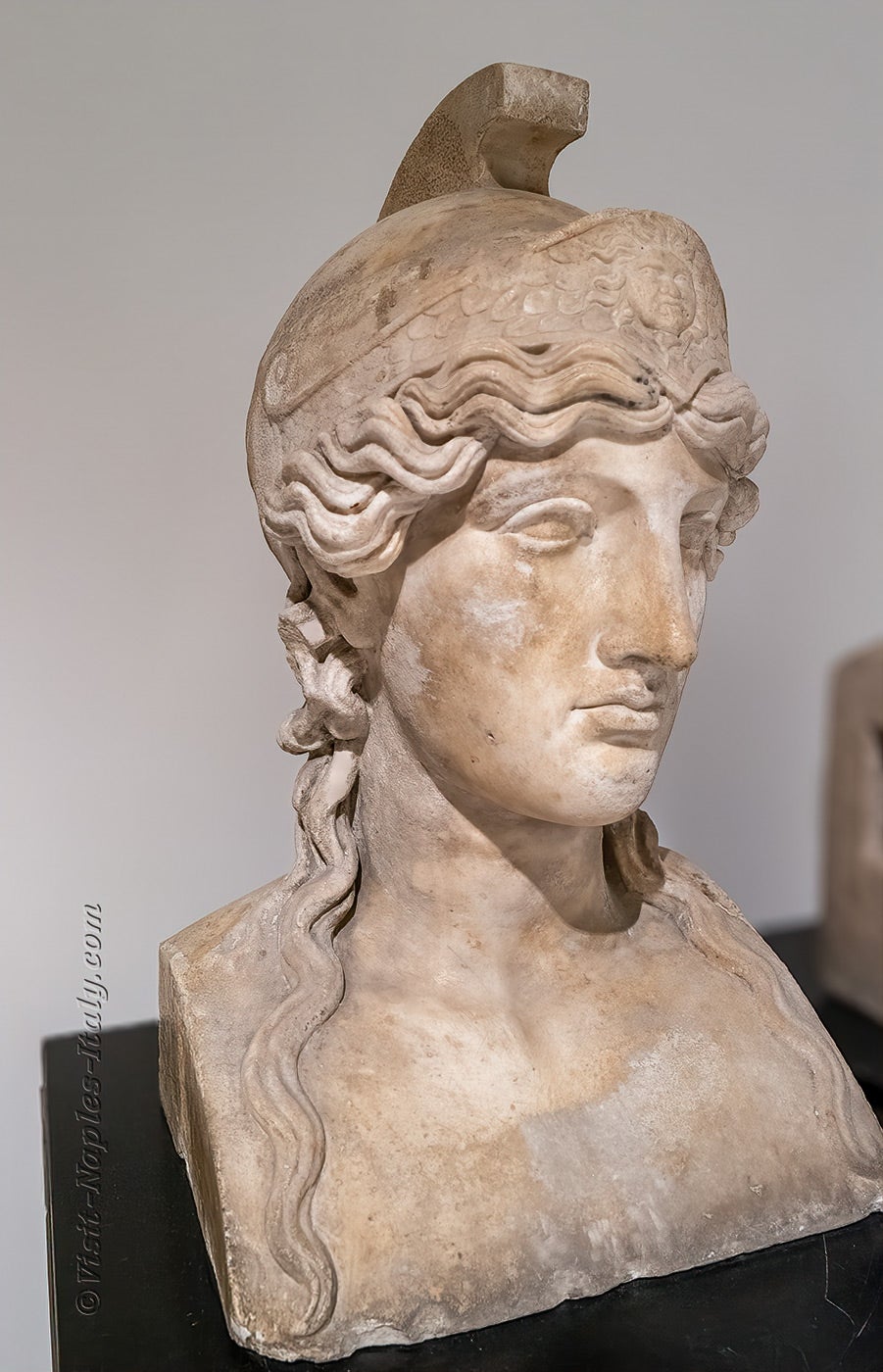
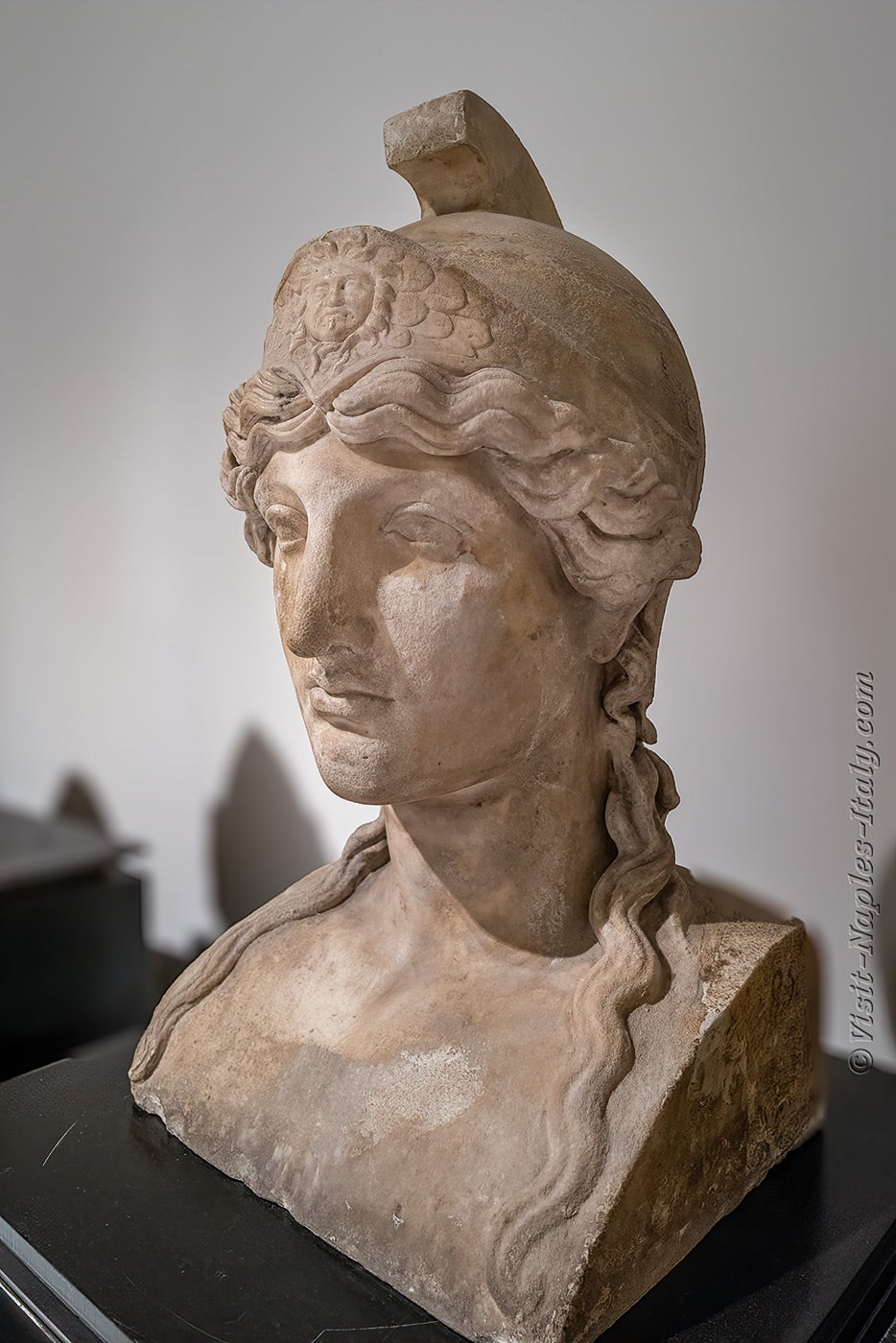
Bust of Athena, Villa dei Papiri, Herculaneum
Sculpture - Marble (Height 50 cm) 1st centuryThis sculpture depicts a young Athena wearing an Attic helmet resting on her beautiful wavy hair.
On the front of her helmet is a Gorgoneion which, as its name suggests, depicts the head of Gorgon.
Minerva, votive statuette, Pompeii
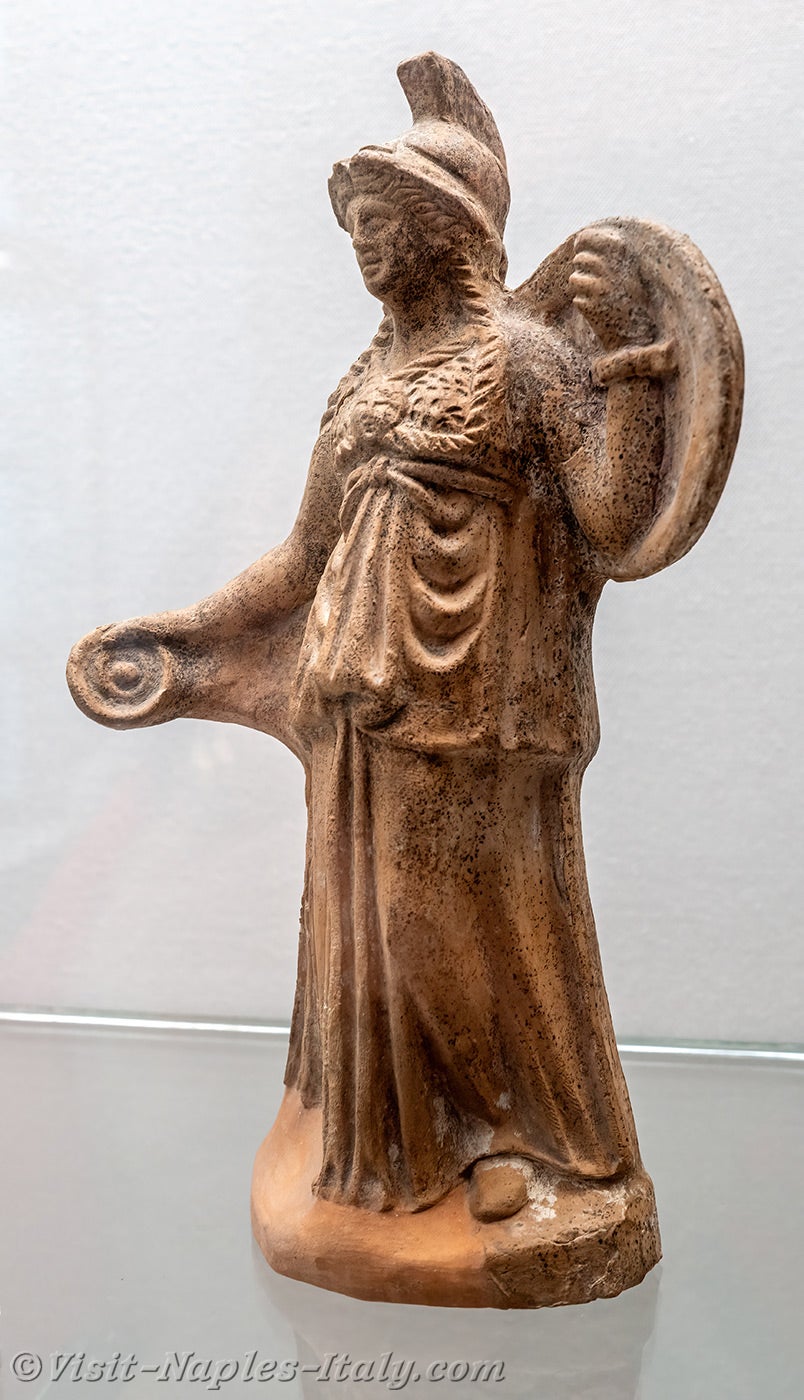
Minerva, votive statuette Sculpture - Terracotta - 1st century BC
This small terracotta sculpture of Minerva was found in a house in Pompeii.
It was a small votive statuette intended to protect the house.
The goddess is depicted standing, wearing a long chiton fastened by a cord tied beneath her chest.
She holds behind her a shield attached to her wrist.
She wears an Attic helmet from which her long, curly hair flows.
In the centre of her chest, one can see a medallion depicting Gorgon.
Statues of Minerva, Herculaneum
Sculpture - Bronze - 1st century BCThese two small statues of Minerva were found in Herculaneum.
The goddess is particularly beautiful and graceful in each of them.
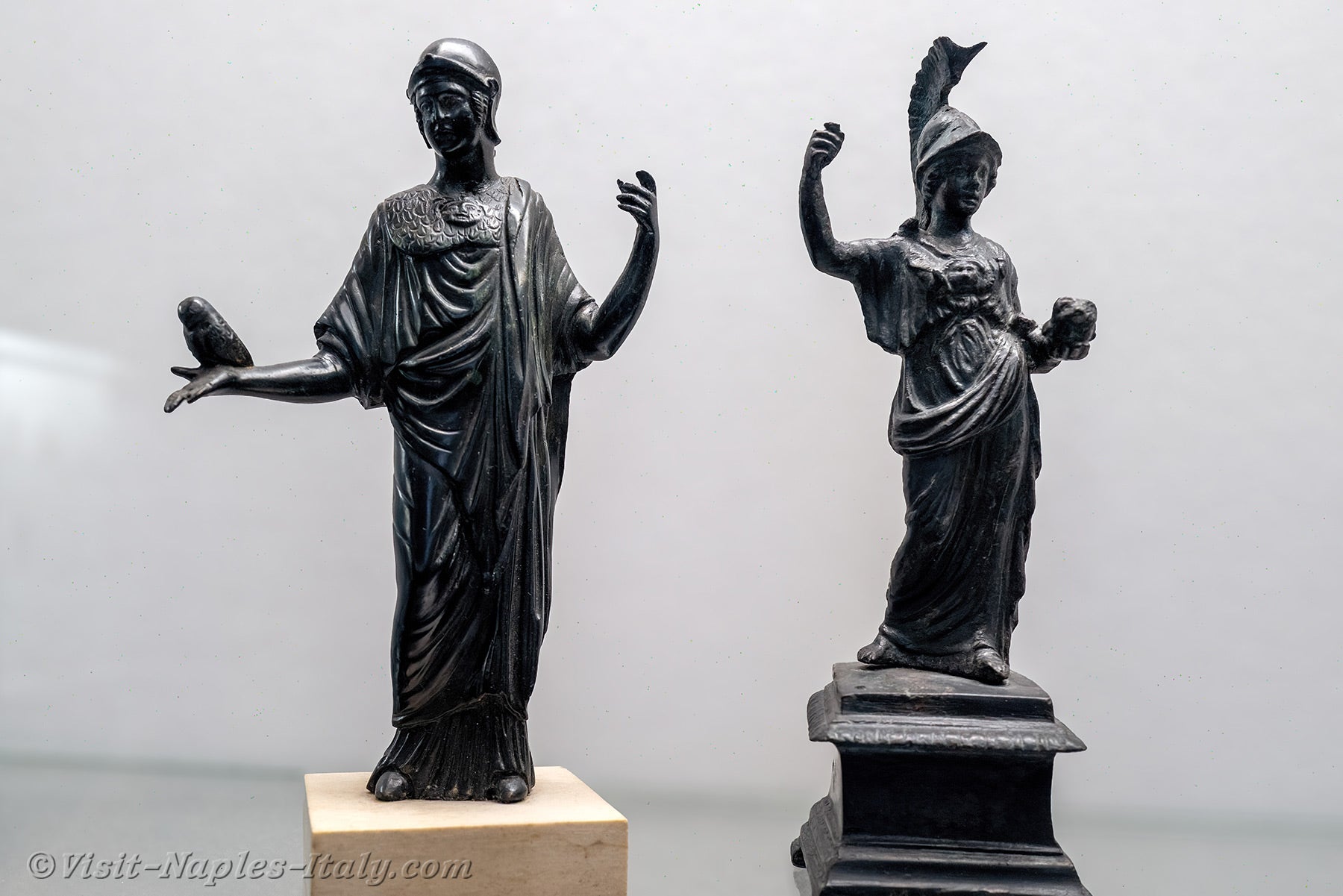
Statues of Minerva The first depicts the goddess wearing a simple helmet with an owl perched on her right hand.
An imposing pendant bearing the image of the Gorgon adorns her chest.
The second statue shows Minerva, also standing, but this time wearing a helmet with a large crest and holding the Patera in her left hand.
Her raised arm once held a spear that has since disappeared. A medallion bearing the image of the Gorgon adorns her chest.
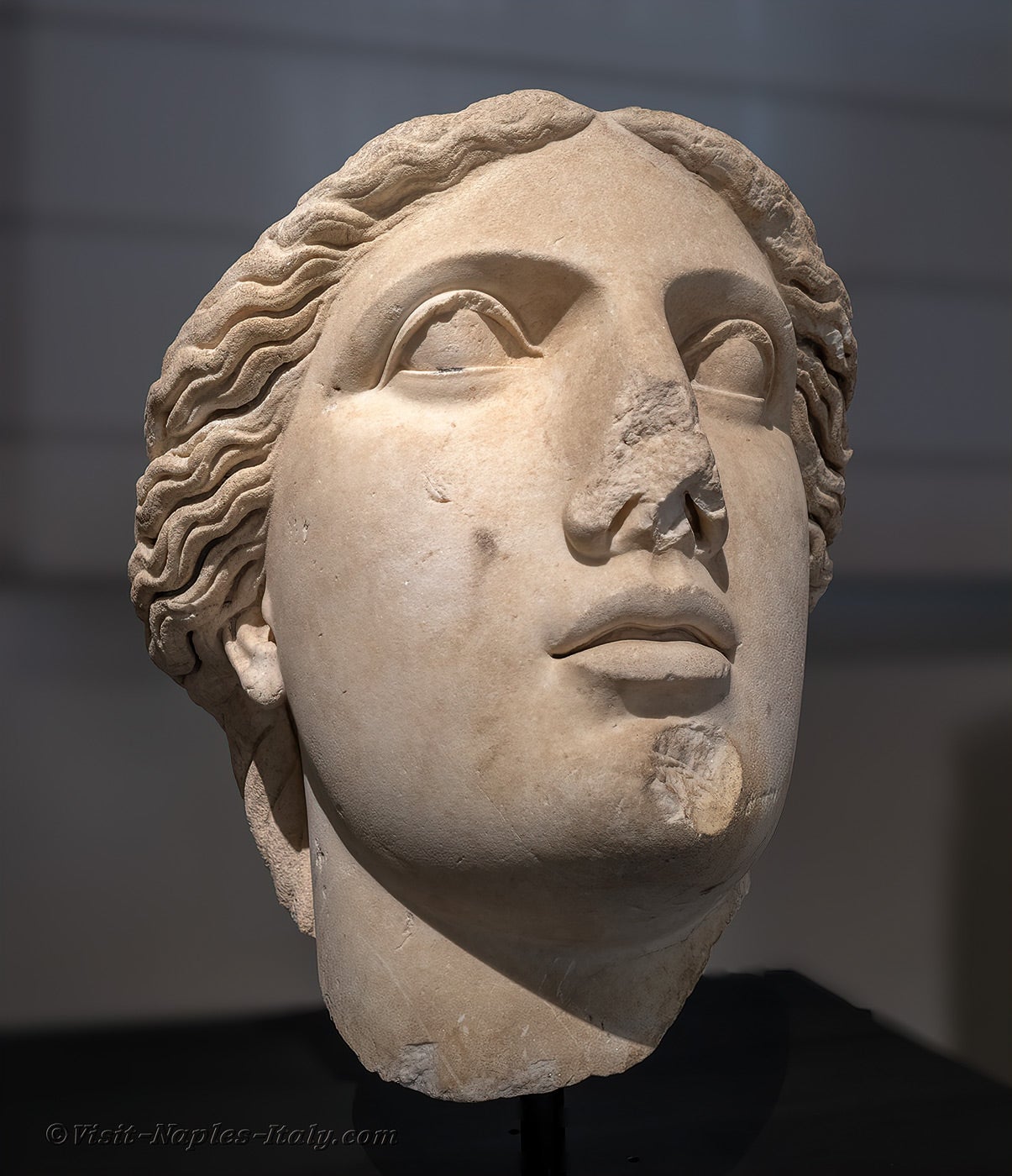
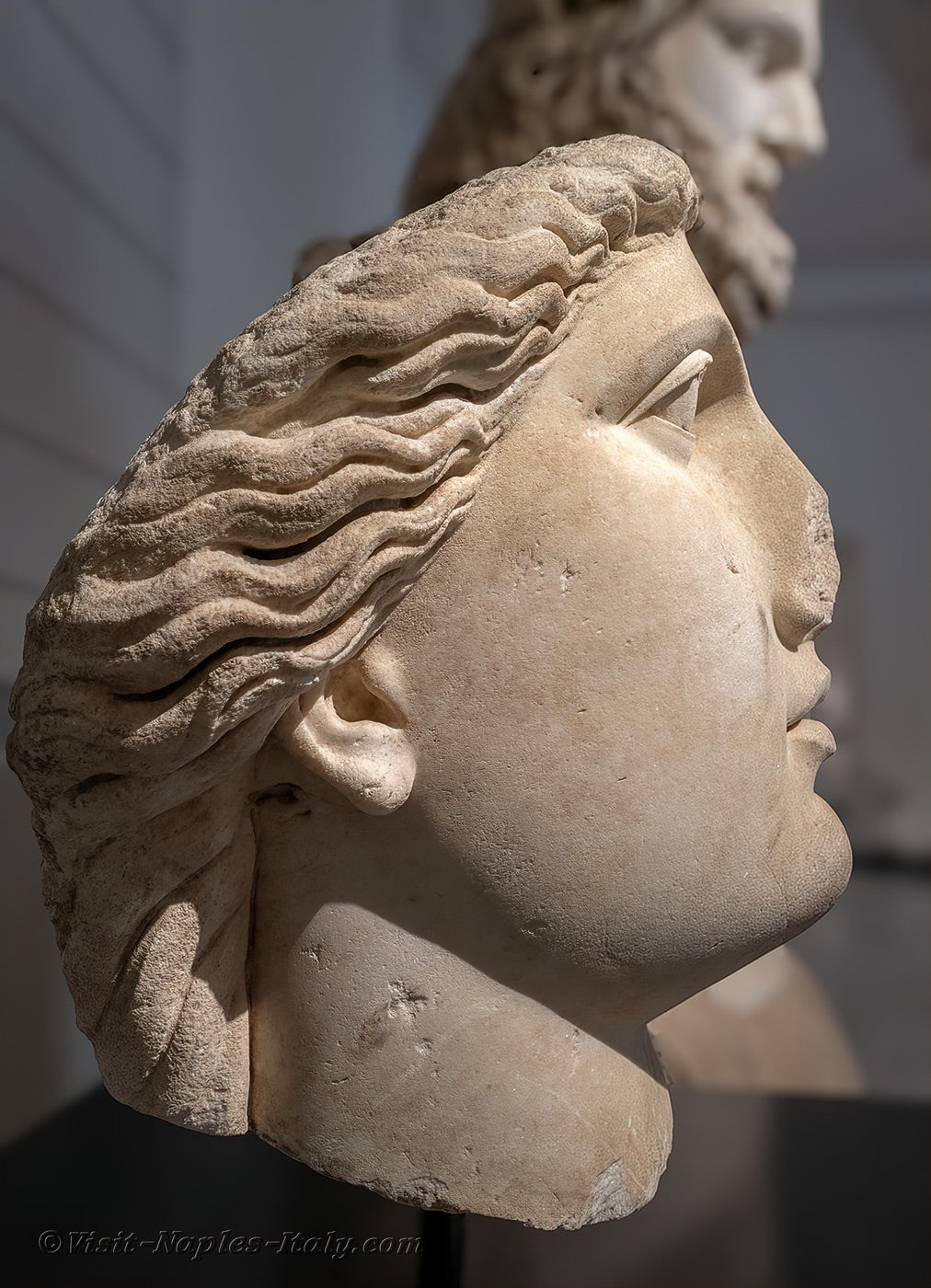
Head of Minerva, Cuma
Sculpture - Marble - 1st centuryThis beautiful head of Minerva in white marble was found at Cuma. One cannot help but admire her fine features as well as her lovely curly hair.
Mythology Achilles | Aesculapius | Amazons | Aphrodite Venus | Apollo | Artemis | Athena Minerva | Atlas | Concordia | Danaids | Diomedes | Dionysus | Dirce | Flora | Ganymede | Hera Juno | Hercules | Hermes | Nike | Orestes | Psyche | River | Satyrs | Zeus
Sculptures Mythology | Persons | Animals | Bas-relief
Artworks Sculptures | Frescoes | Eroticism
MANN Artworks Schedule Tickets Location | Authorizations
Back to Top of Page