

MANN Artworks Schedule Tickets Location | Authorizations
Artworks Sculptures | Frescoes | Eroticism
Sculptures Mythology | Persons | Animals | Bas-relief
Mythology Achilles | Aesculapius | Amazons | Aphrodite Venus | Apollo | Artemis | Athena Minerva | Atlas | Concordia | Danaids | Diomedes | Dionysus | Dirce | Flora | Ganymede | Hera Juno | Hercules | Hermes | Nike | Orestes | Psyche | River | Satyrs | Zeus
The Farnese Bull and the Torture of Dirce at the Archaeological Museum of Naples, Italy
Farnese Bull
Sculpture - Marble (370 x 295 cm) 2nd-3rd century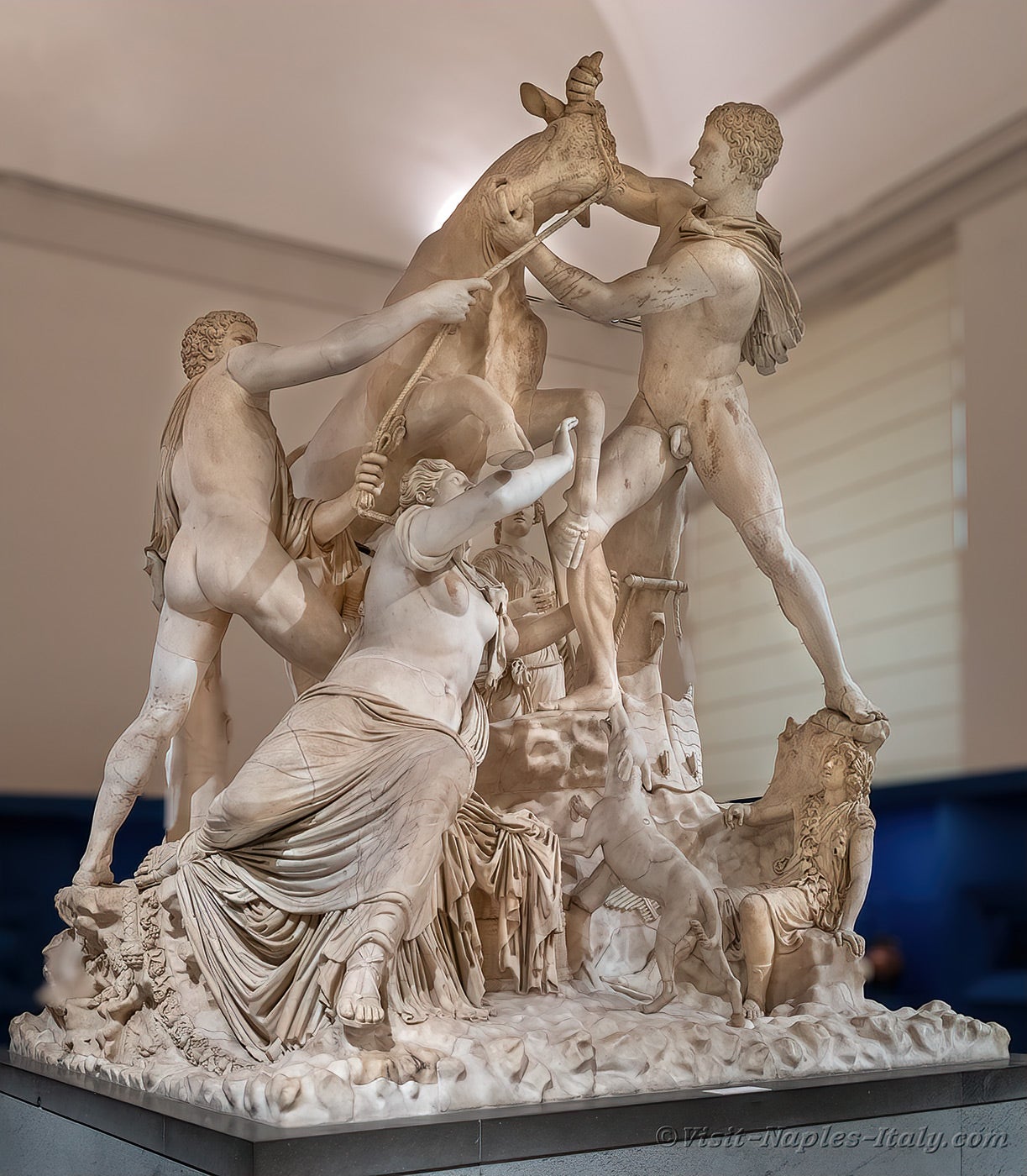
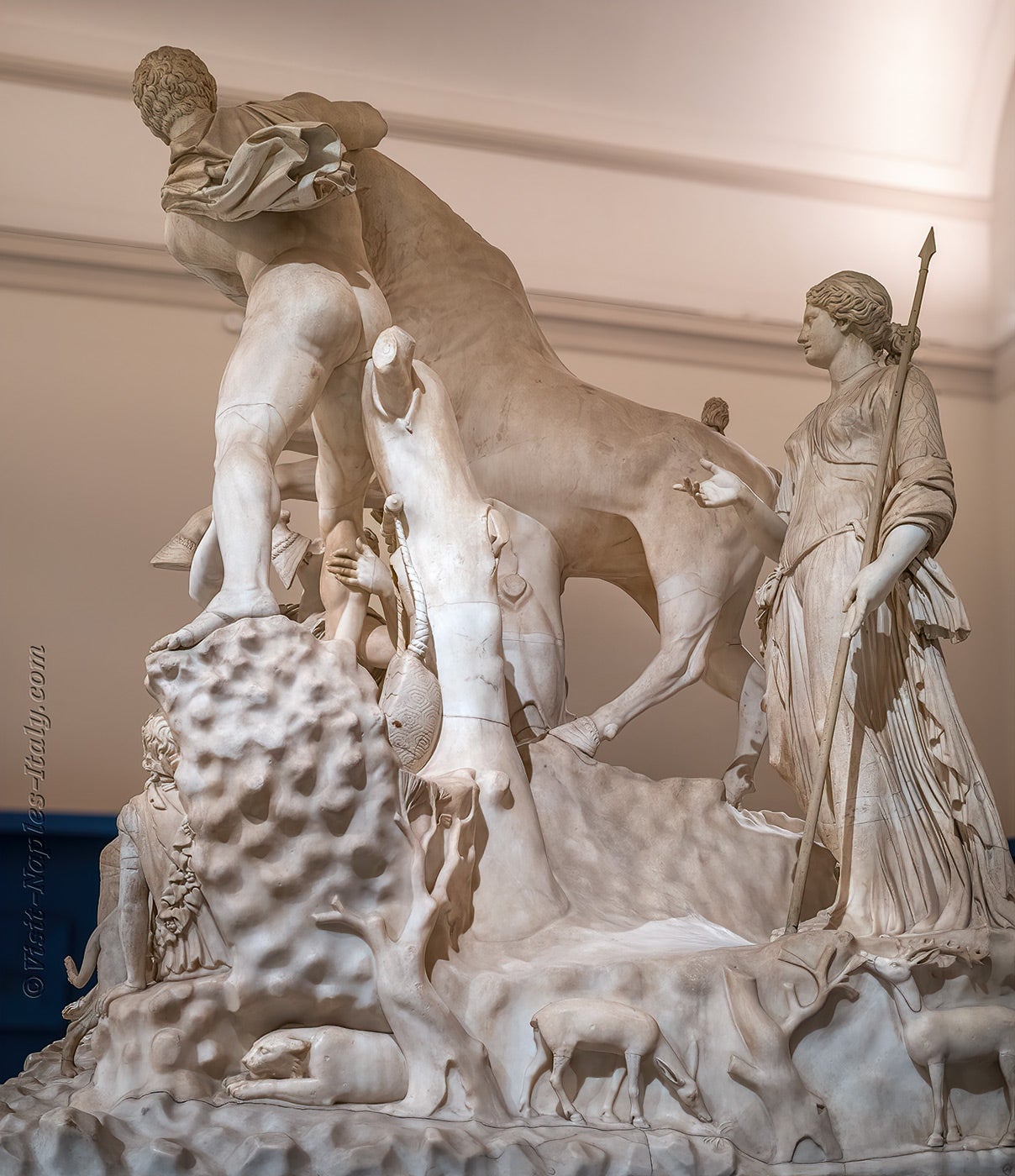
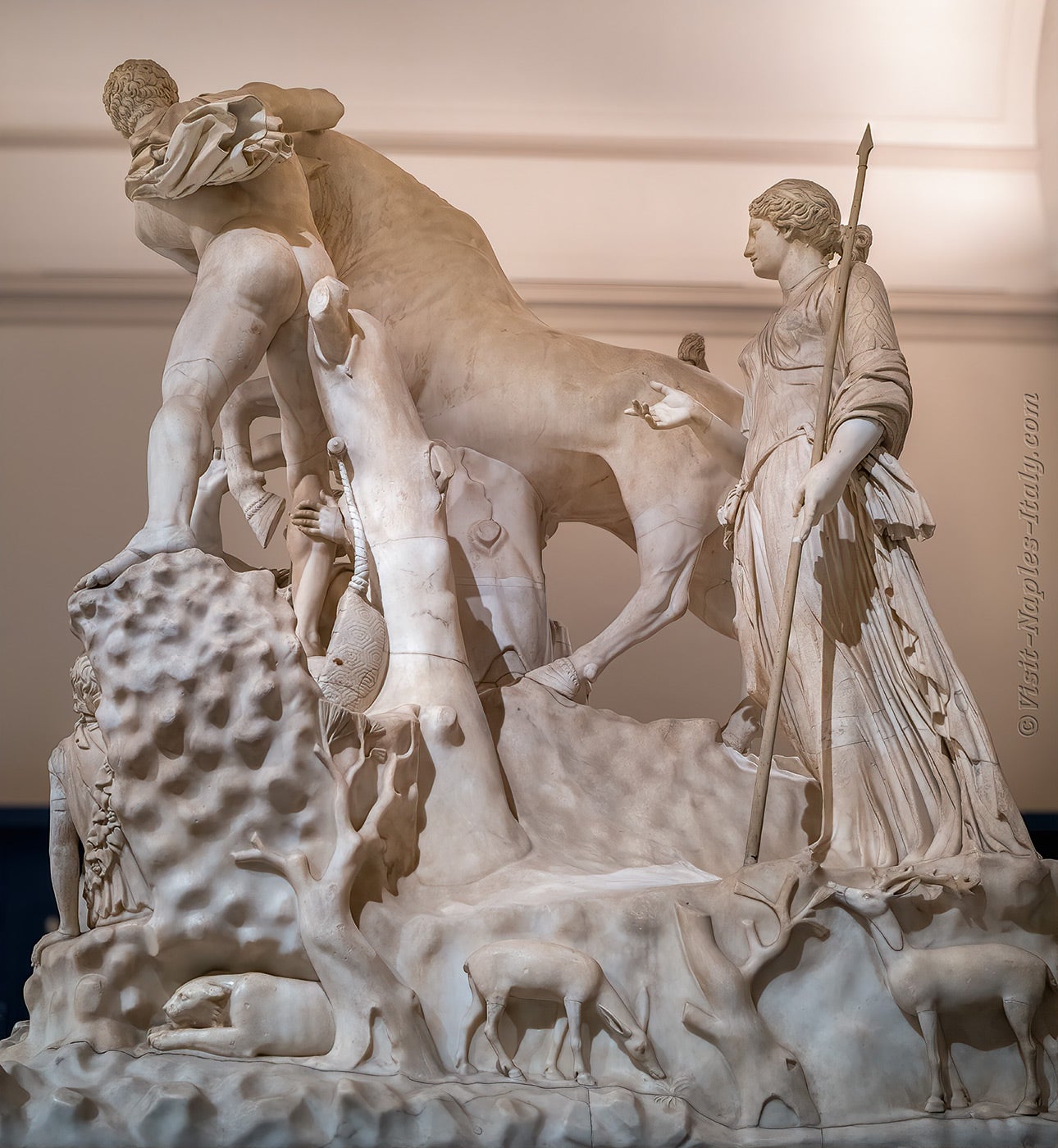
Farnese Bull The ‘Farnese Bull’ or the ‘Torture of Dirce’ is the largest surviving sculpture from antiquity.
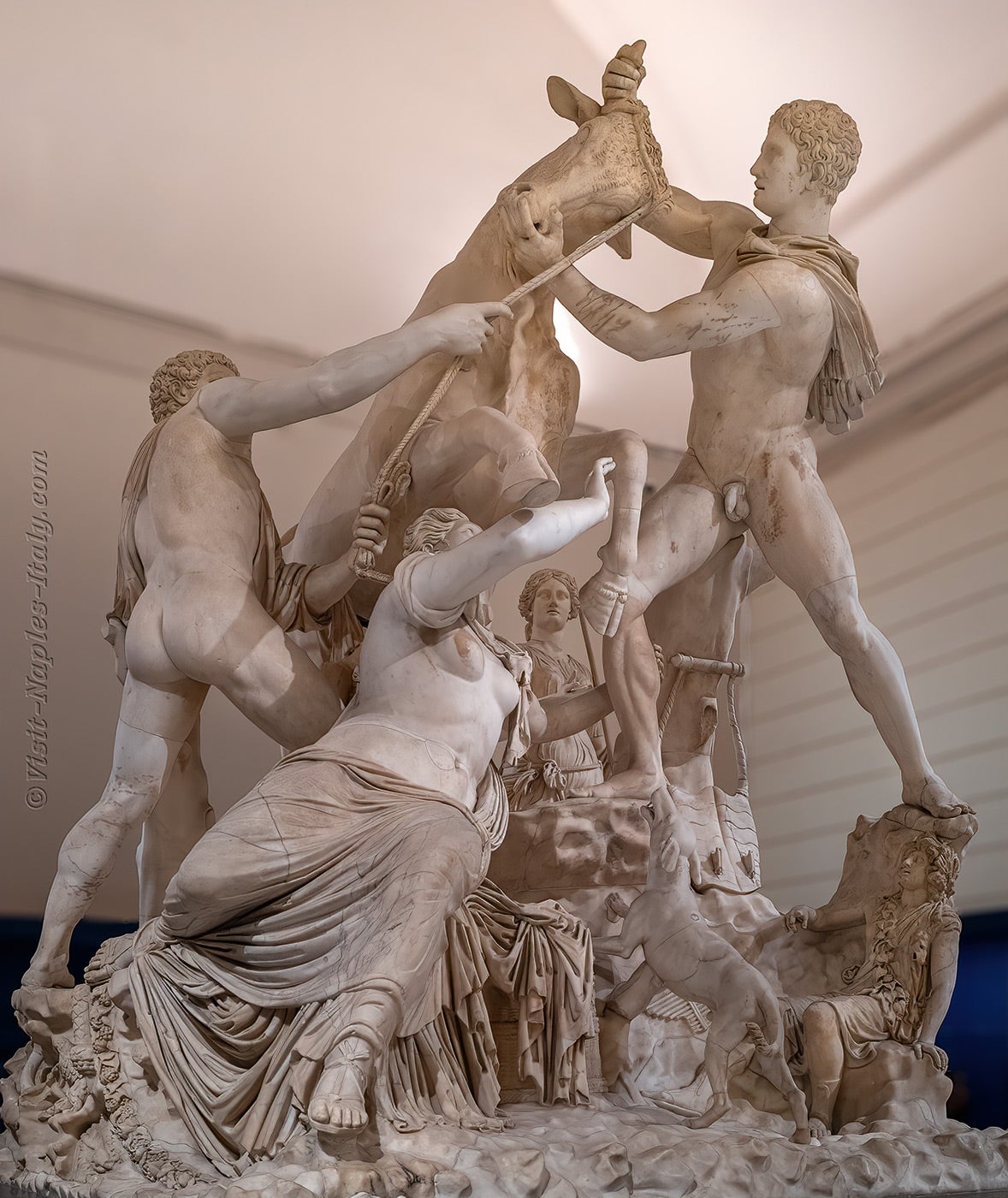
This monumental sculpture depicts the moment when Amphion and Zethos struggle to restrain the wild bull that will drag Dirce in a frenzied chase towards a gruesome death.
The “Farnese Bull” and the myth of the “Torment of Dirce”
The whole story begins with Princess Antiope, a young woman of extraordinary beauty with whom Zeus fell madly in love.Zeus transformed himself into a satyr to seduce the beauty, who found herself pregnant.
Farnese Bull Fearing her father Nyctaeus’s wrath when he discovered her condition, poor Antiope decided to flee and sought refuge with Epopeus, the king of Sicyon.
Nyctaeus, king of Thebes, ashamed and despairing at his daughter’s flight, decided to take his own life; but, before killing himself, he asked his brother, Lycos, to avenge him.
Having become king of Thebes following Nyctaeus’s suicide, Lycos attacked the kingdom of Sicyon and killed Epopeus.
Antiope was thus captured and forcibly taken back.
On the road leading from Sicyon to Thebes, Antiope gave birth to twins.
Lycos ordered that the babies be abandoned by the roadside in the forest of Mount Cithéron, where they were fortunately taken in by a shepherd who raised them and gave them the names Amphion and Zethos.
Farnese Bull Zethos loved wrestling and devoted himself to farming, whilst Amphion spent his time playing the lyre. A lyre given to him by Hermes.
Whilst her sons were growing up, Antiope was held captive by her uncle Lycos and reduced to slavery.
Queen Dirce, wife of Lycos, jealous of Antiope’s exceptional beauty, took every opportunity to humiliate and mistreat her.
But one night, after twenty years of captivity and humiliating treatment, the chains that bound Antiope fell away of their own accord.
She escaped from the palace and went to take refuge on Mount Cithéron in the hope of finding her children there.
She arrived at the shepherd’s hut, who recognised her and told Amphion and Zethos that she was their mother.
Farnese Bull Antiope explained to her sons the conditions under which Dirce and Lycos had imprisoned and mistreated her for those twenty years.
This took place at the time of the preparations for the orgies in honour of Dionysus in the forest of Mount Cithéron in Boeotia, which was the homeland of Semele, the mother of this god.
Shortly after Antiope’s arrival, Dirce, accompanied by her maids, was making her way to the forest of Cithaeron for the preparations for the festival of Dionysus.
As chance would have it, she encountered Antiope there, whom she immediately had captured by her maids; she was about to kill her when Amphion and Zethos heard their mother’s cries.
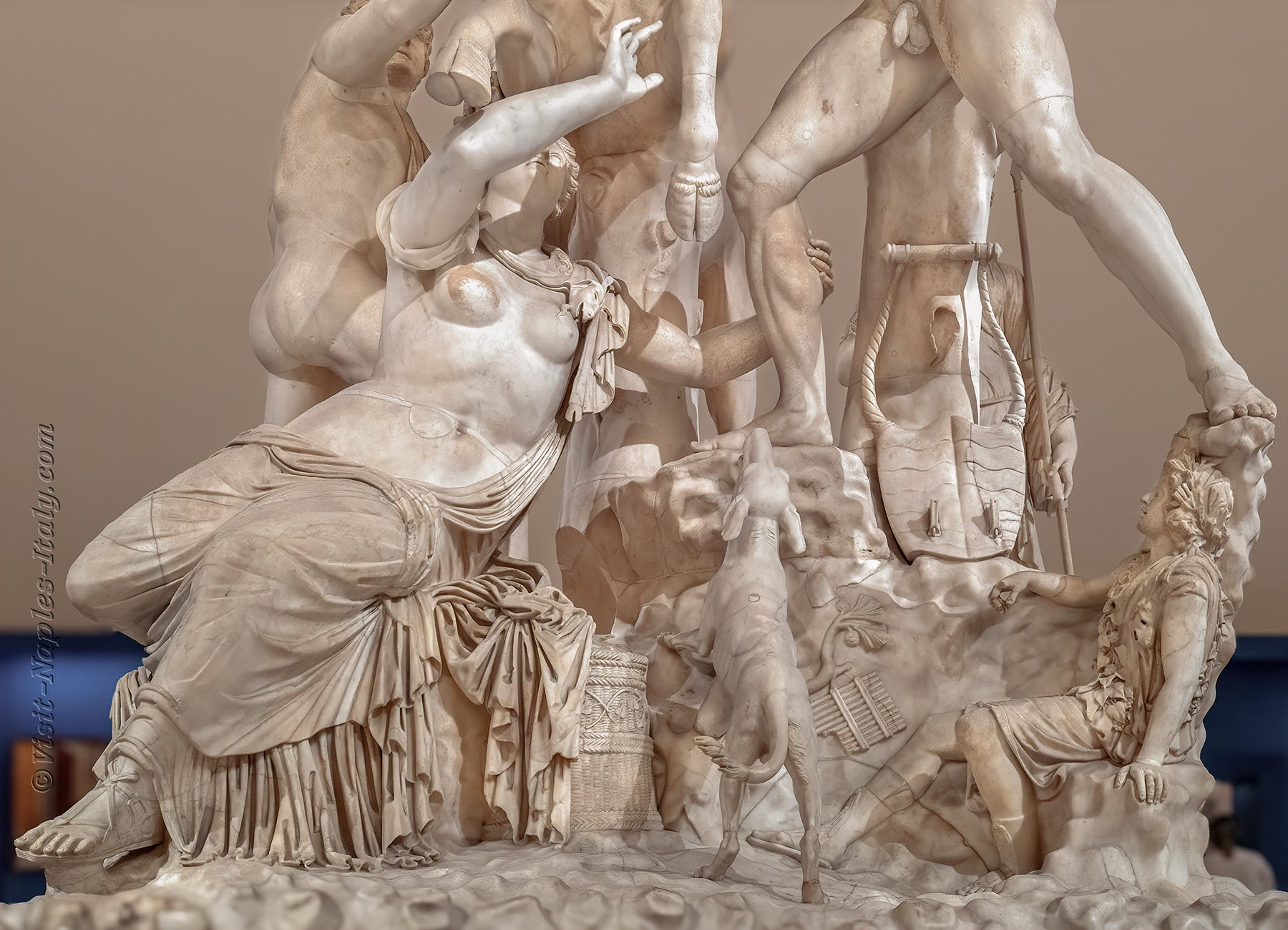
Farnese Bull They put the maids to flight and seized Dirce.
In agreement with Antiope, they decided to punish her by killing her in such a way as to make her suffer as excruciatingly as possible.
Dirce was to be tied by her hair to the horns of a wild bull which, once released, would drag her behind it as it ran, whilst her body was torn to shreds against the rocks of Cithéron.
At the spot where the remains of Dirce’s torn body had been left by the bull, a spring had gushed forth, which was subsequently called the “Spring of Dirce”.
Dirce’s husband and Antiope’s uncle, Lycos, was also killed by the two brothers who in turn became kings of Thebes.
The sculptural group known as the “Torment of Dirce”, also called the “Farnese Bull”
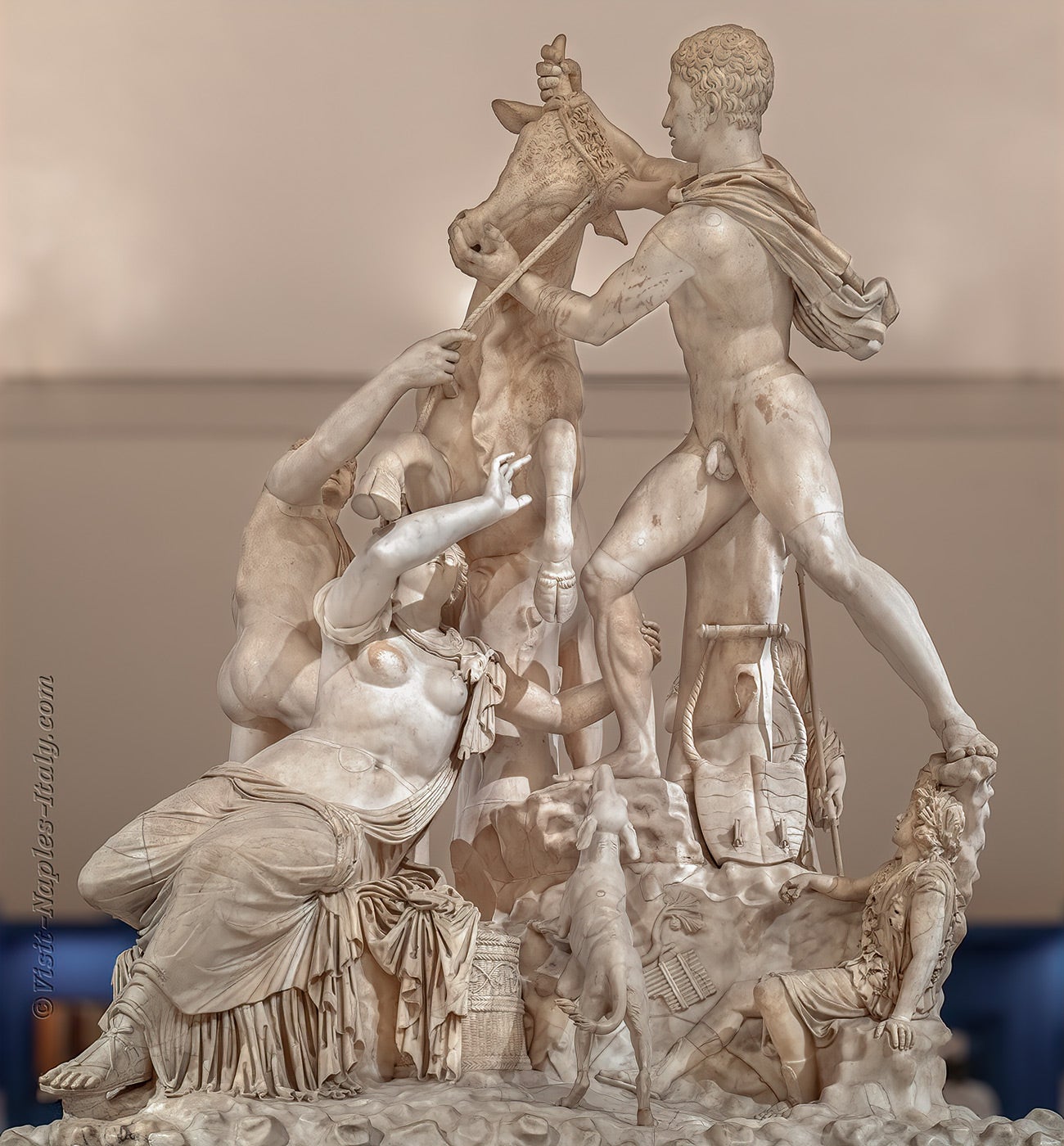
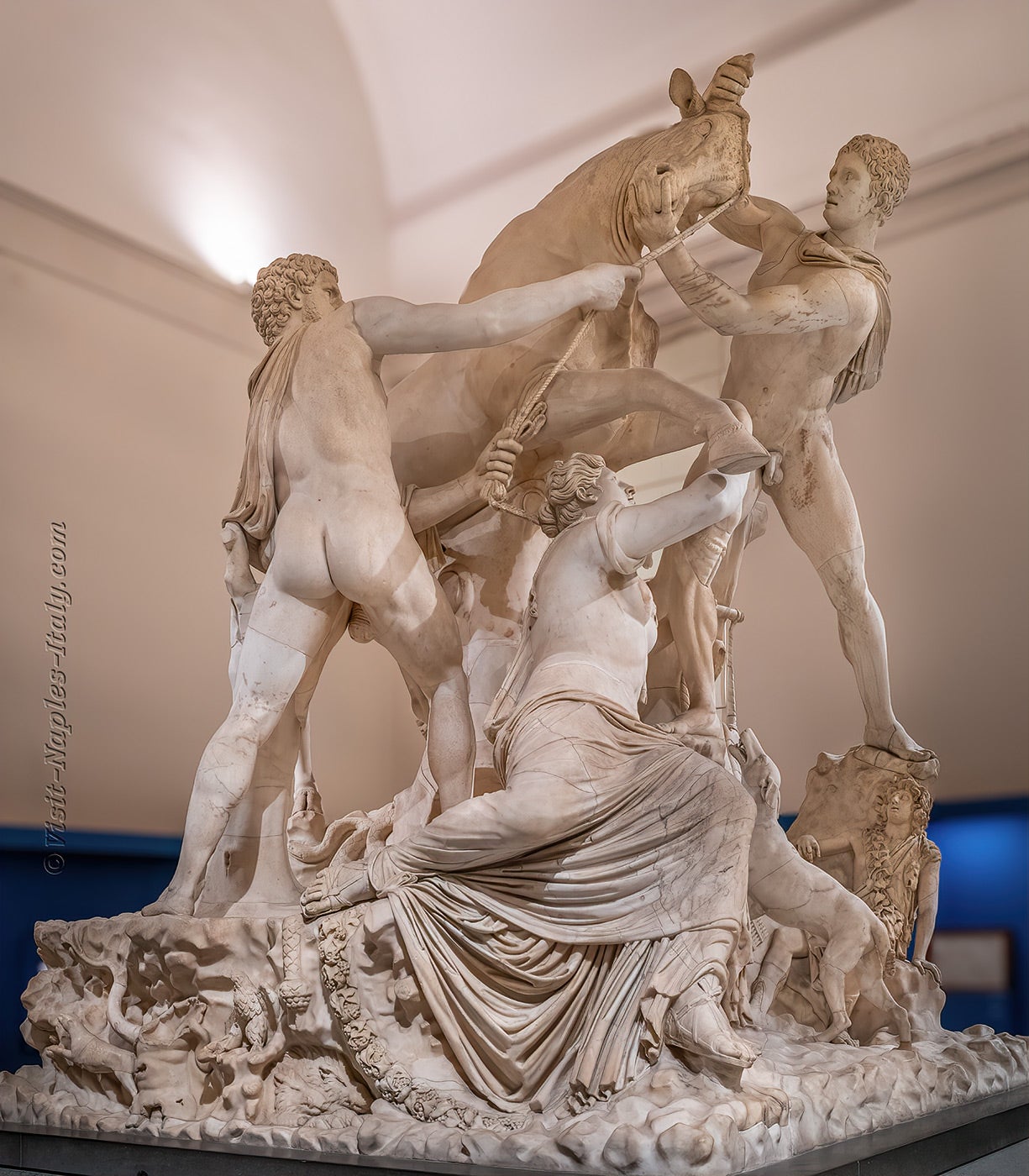
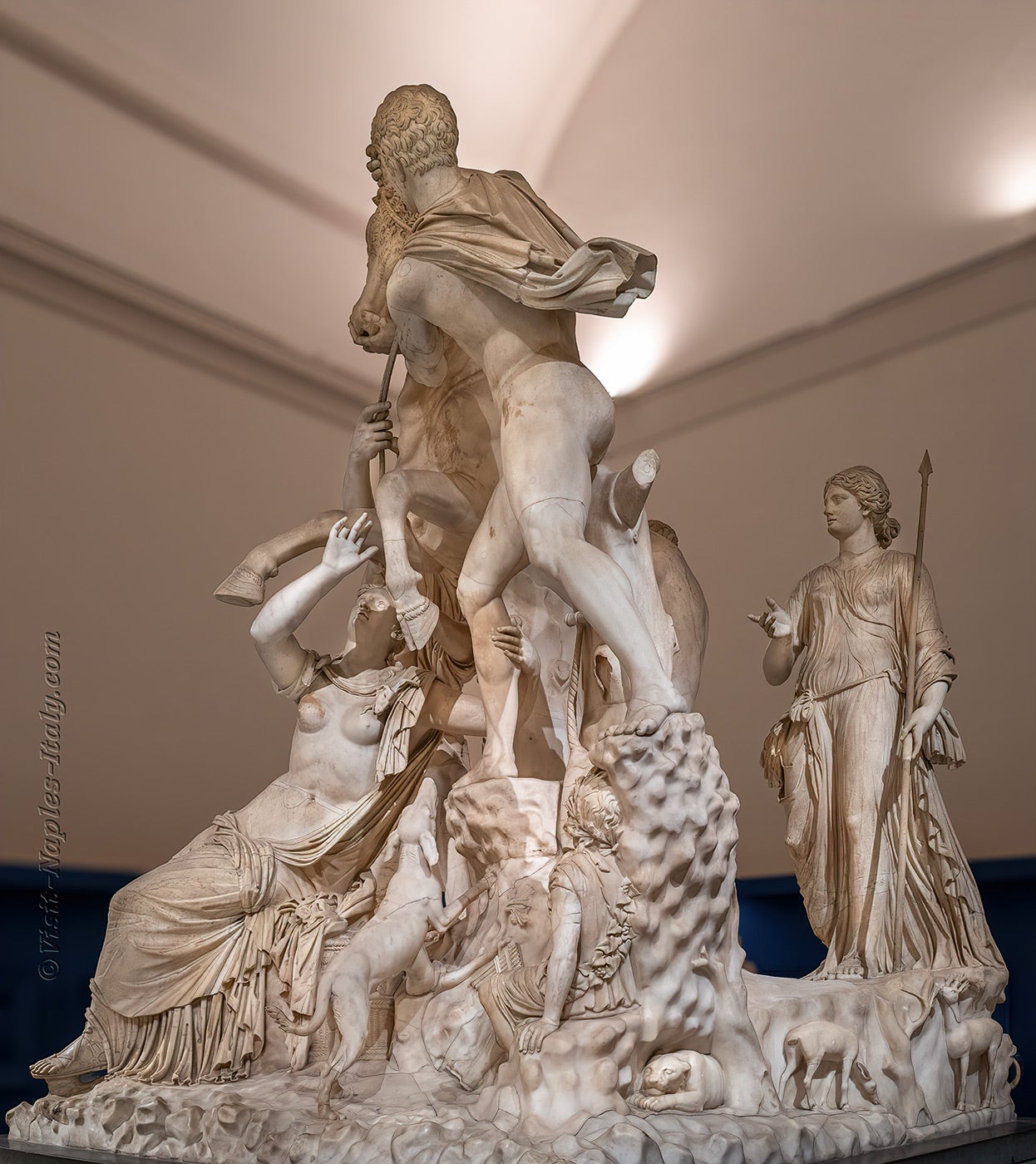
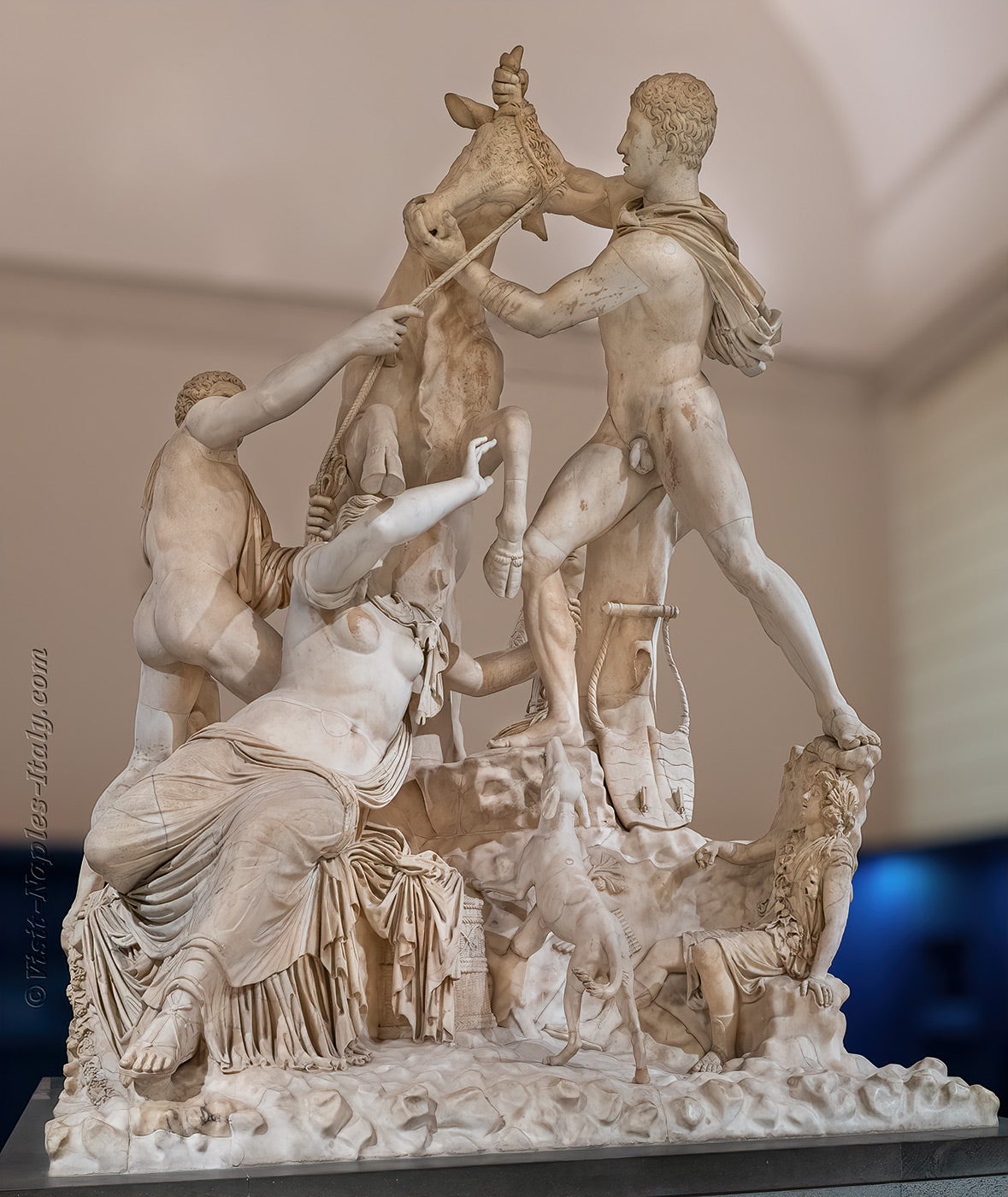
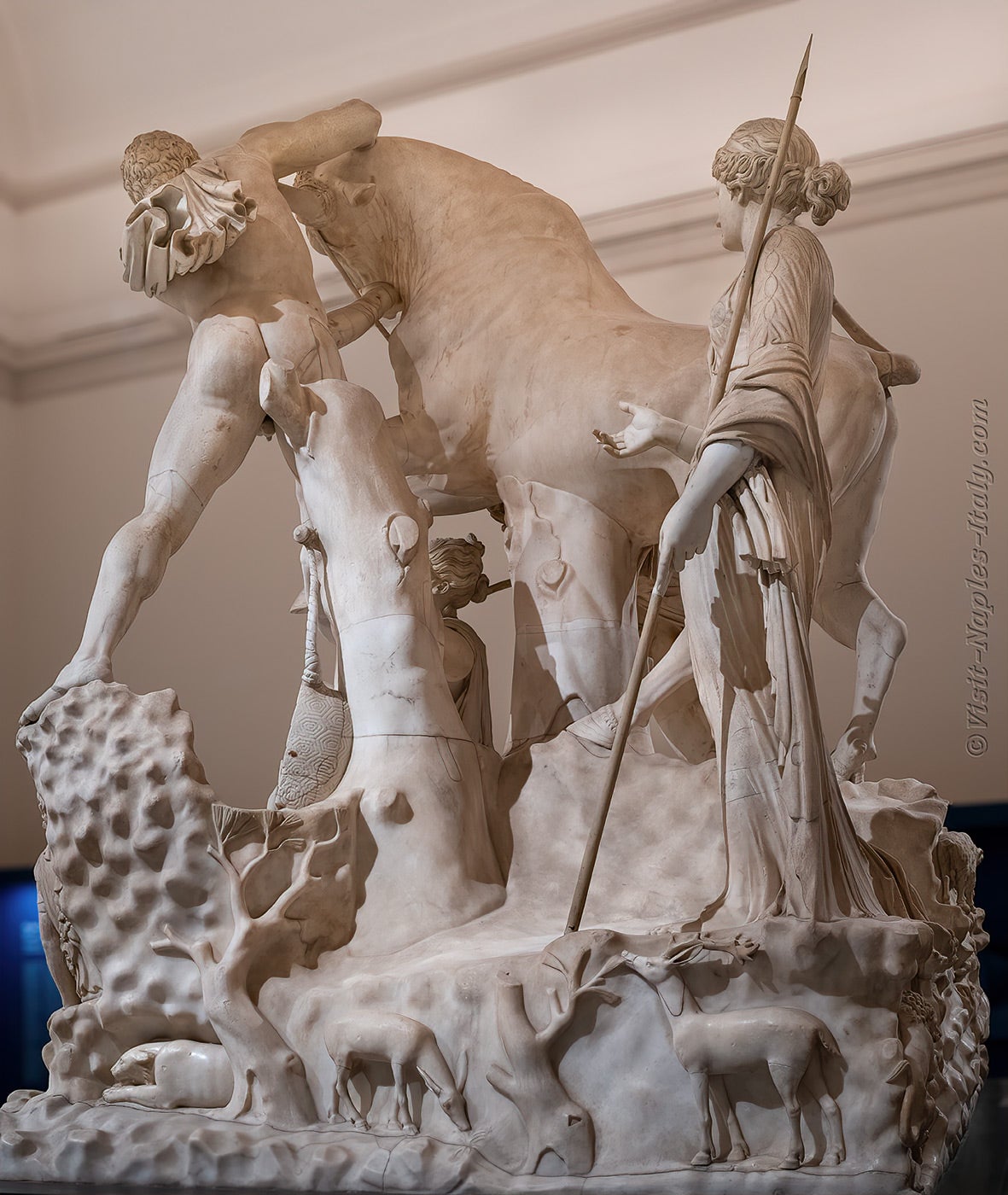
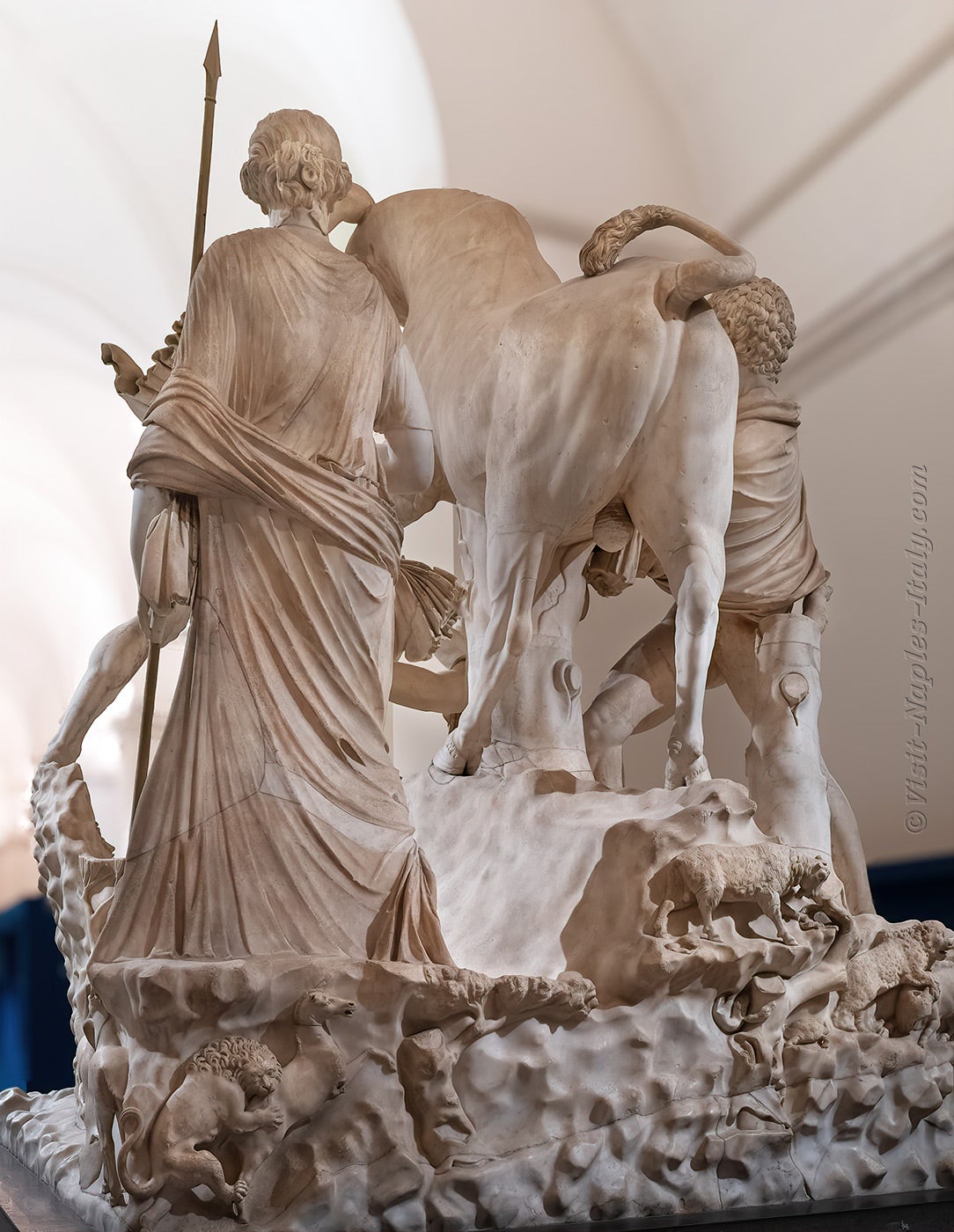
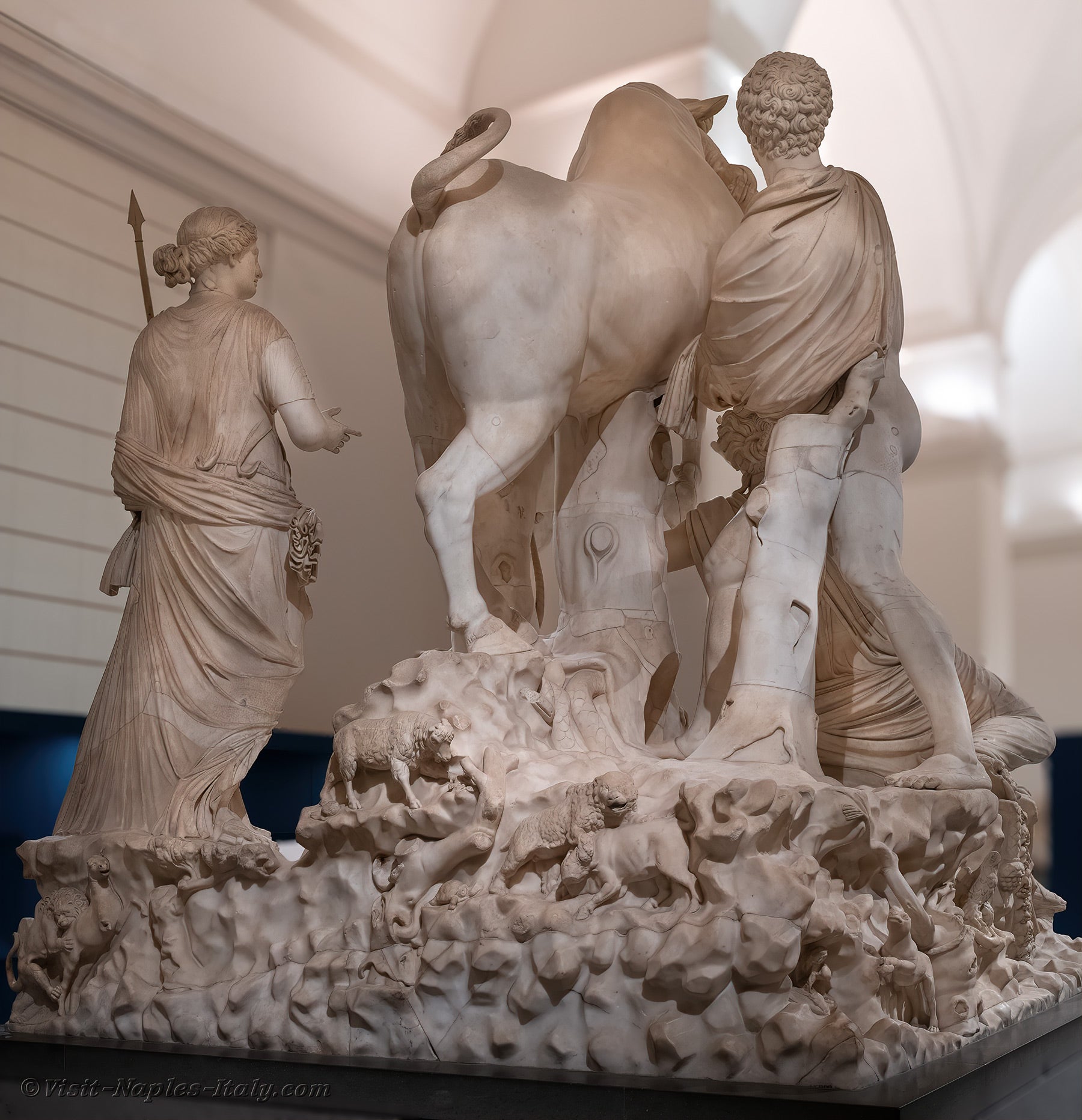
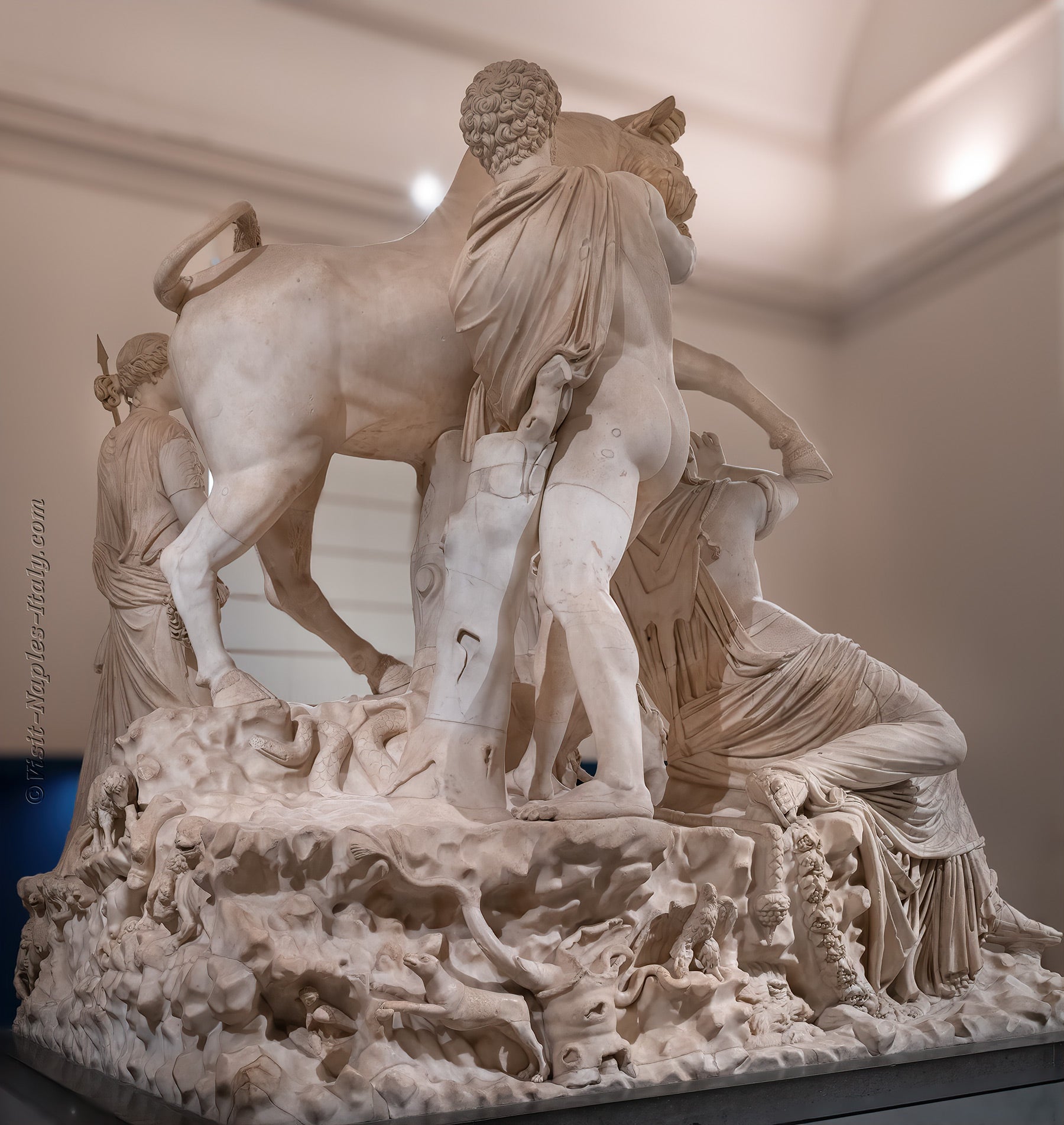
Farnese Bull The figures are arranged around a rocky outcrop in the shape of a pyramid, the apex of which is marked by a hand grasping the bull’s horn.
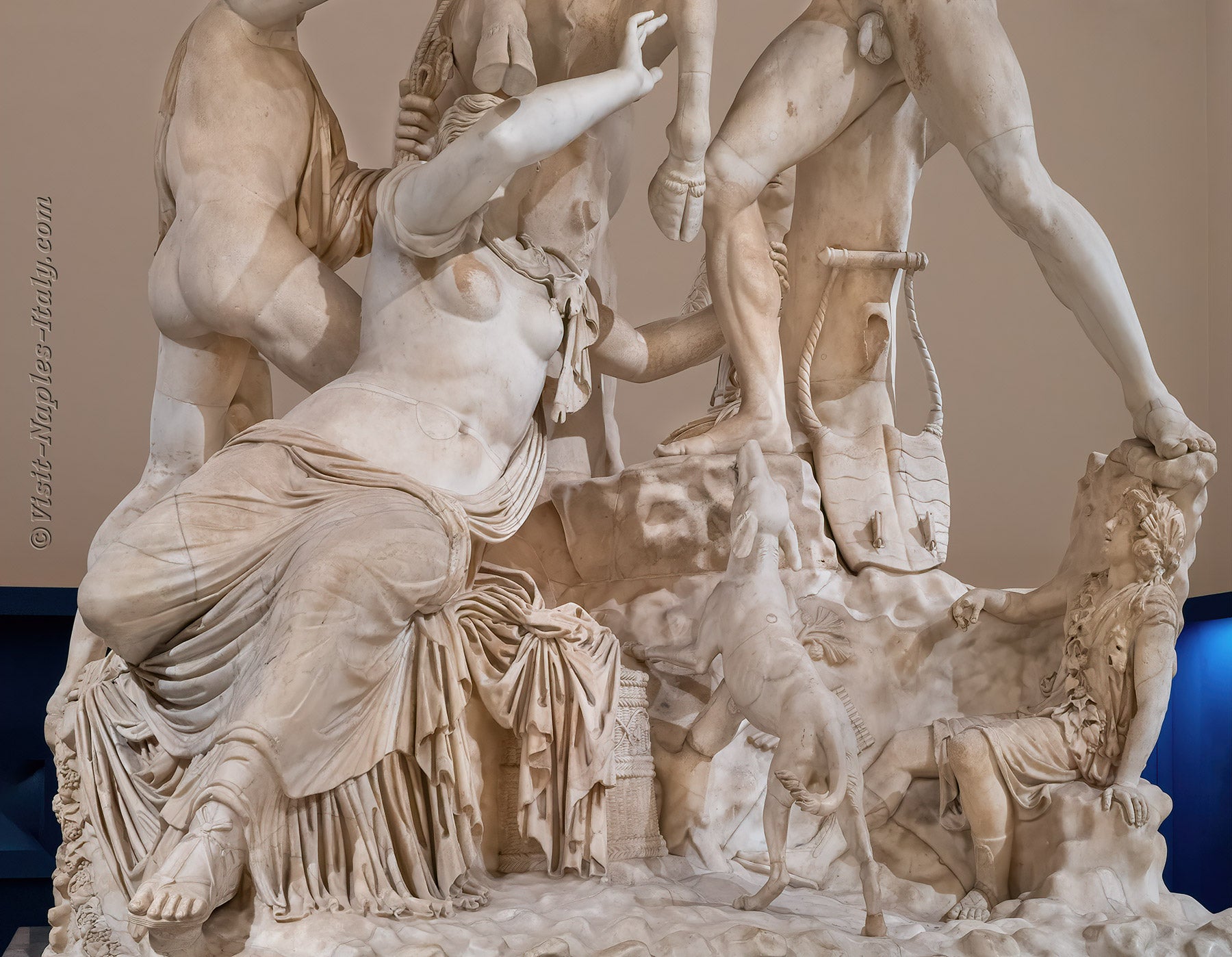
The venue of Dirce’s torment is depicted on the rocky base of the group, where trees and animals are carved, including a panther lying in a cave.
One can also see a lion in the act of catching a doe whilst another captures a bovine.
At the centre of the group, standing on its hind legs, the bull towers over the figures surrounding it.
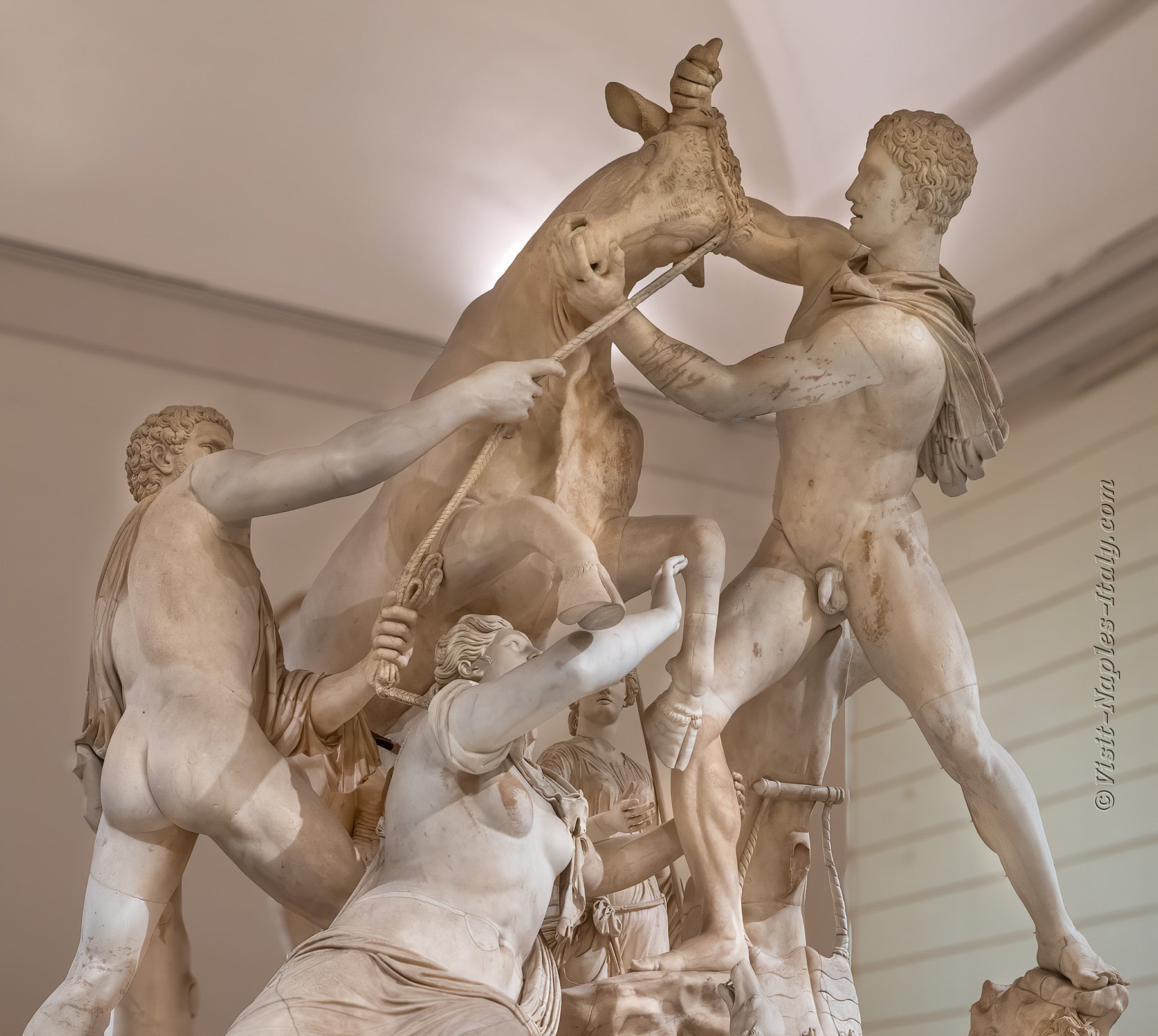
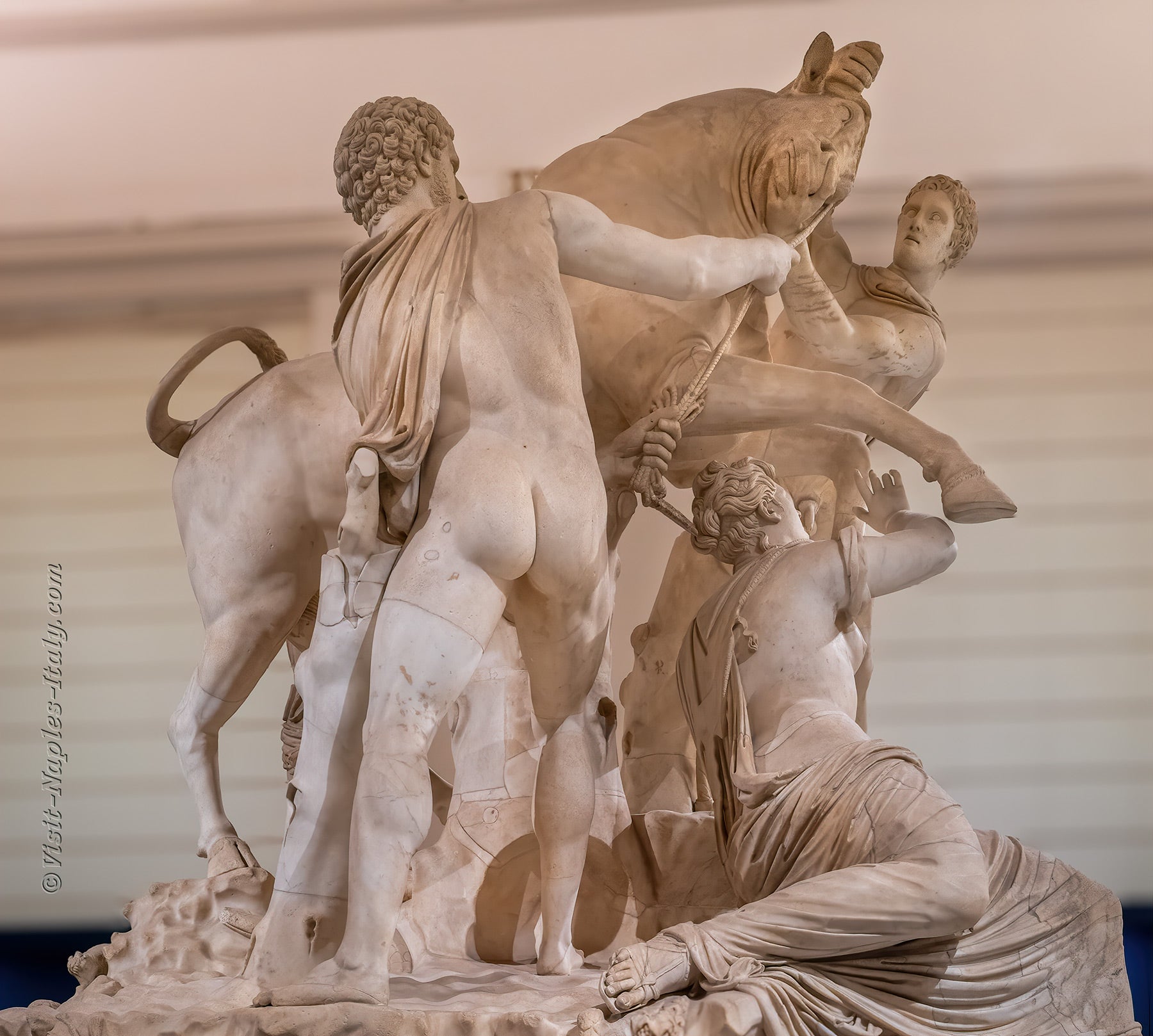
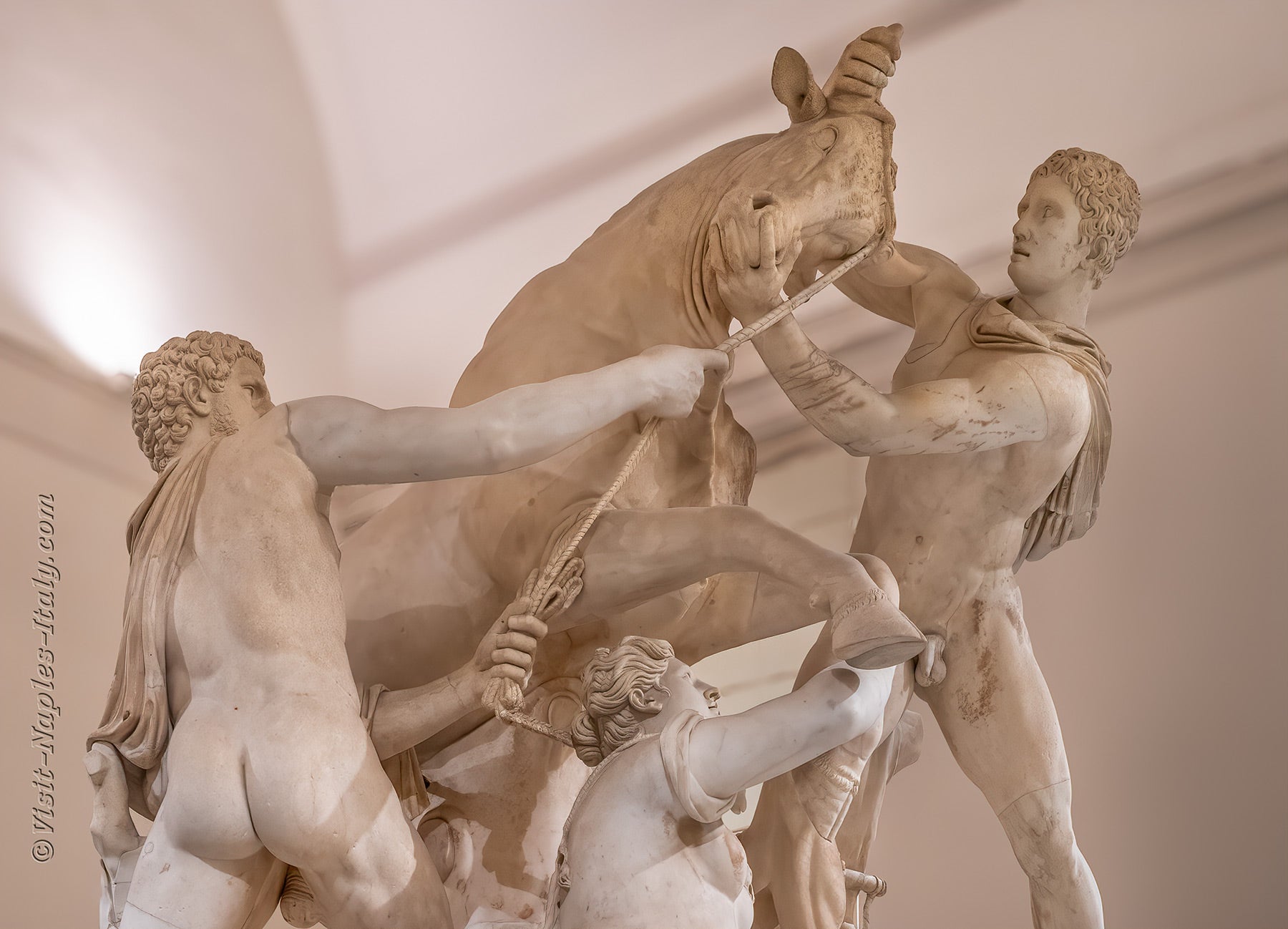
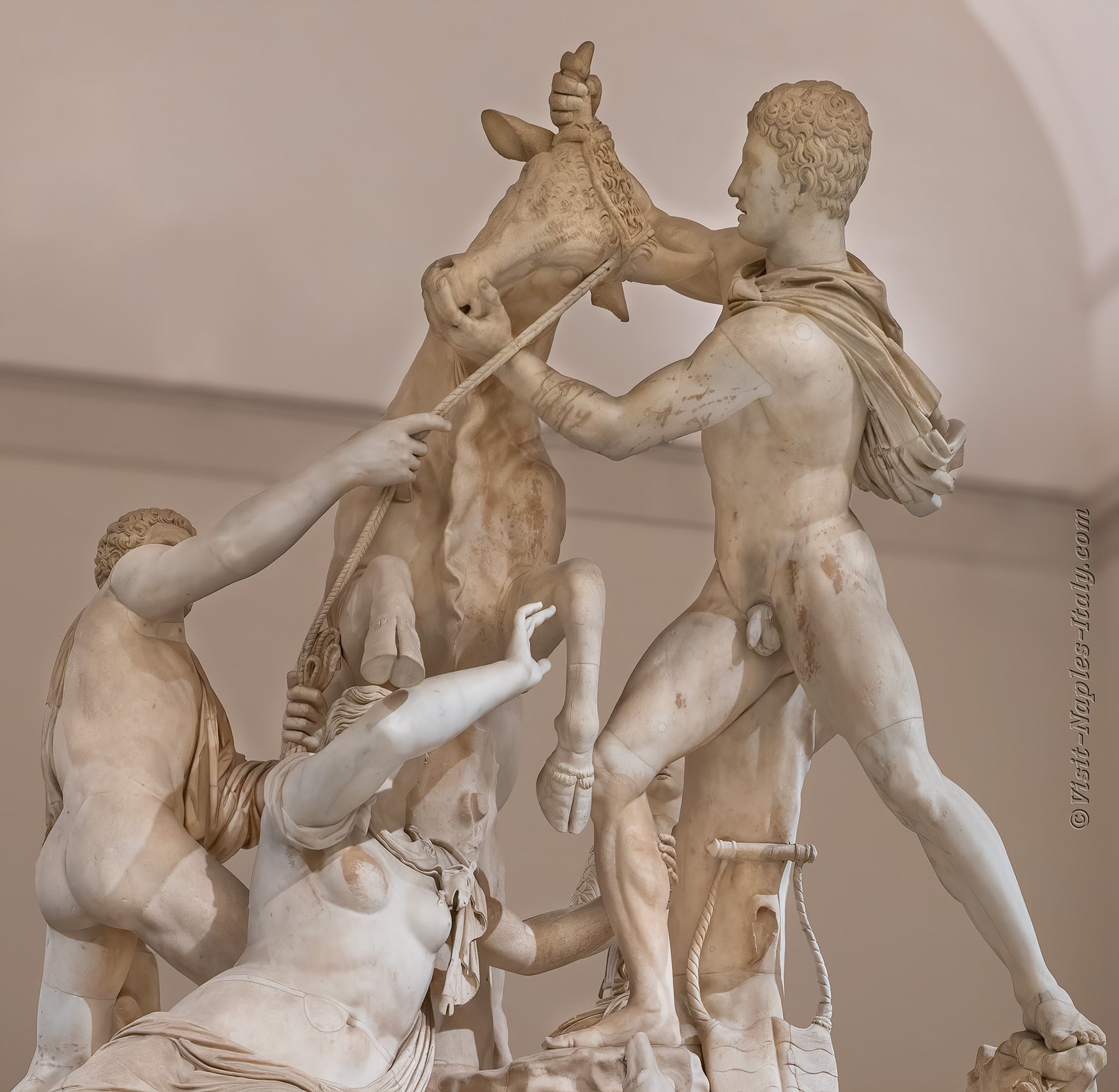
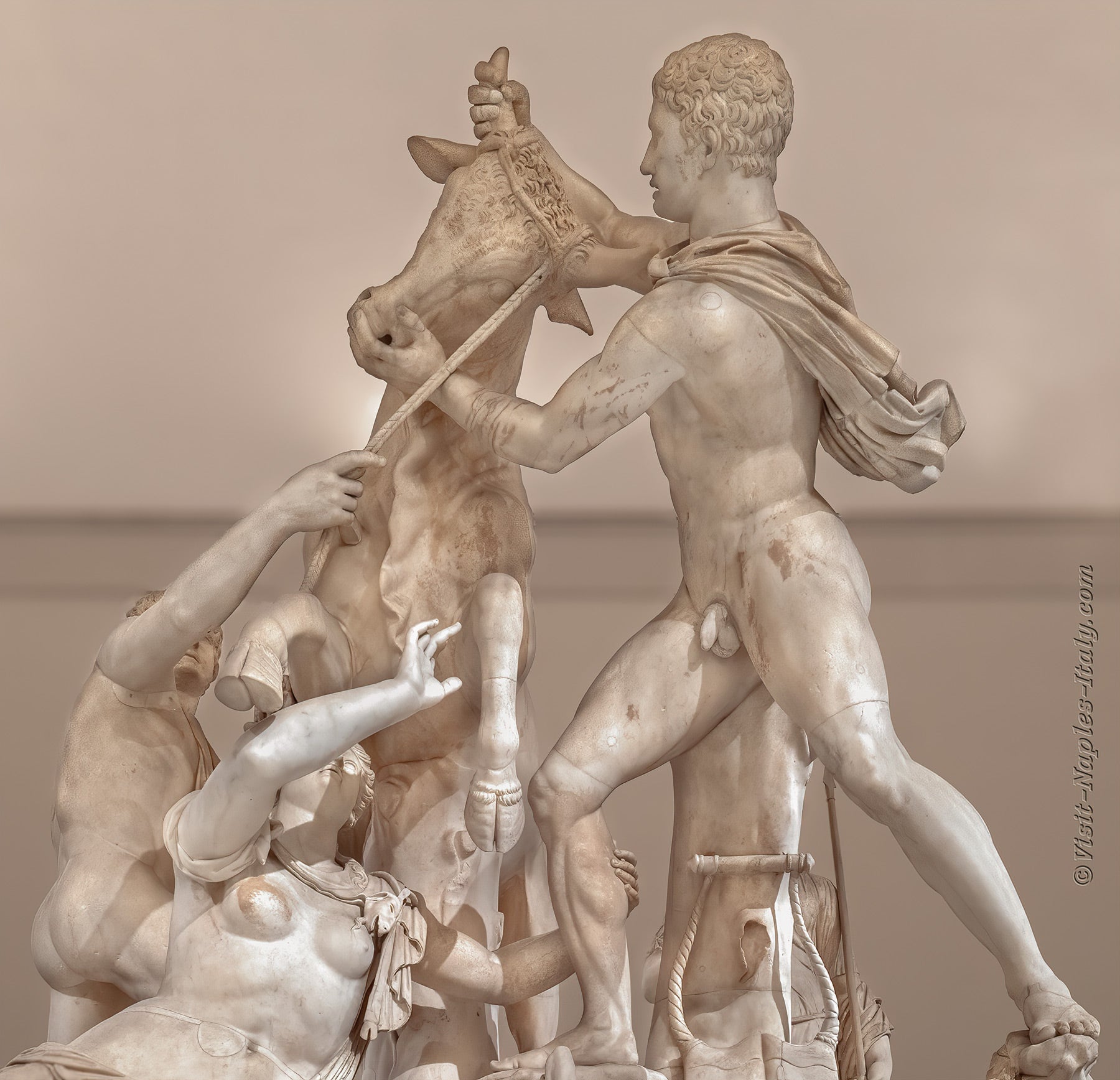
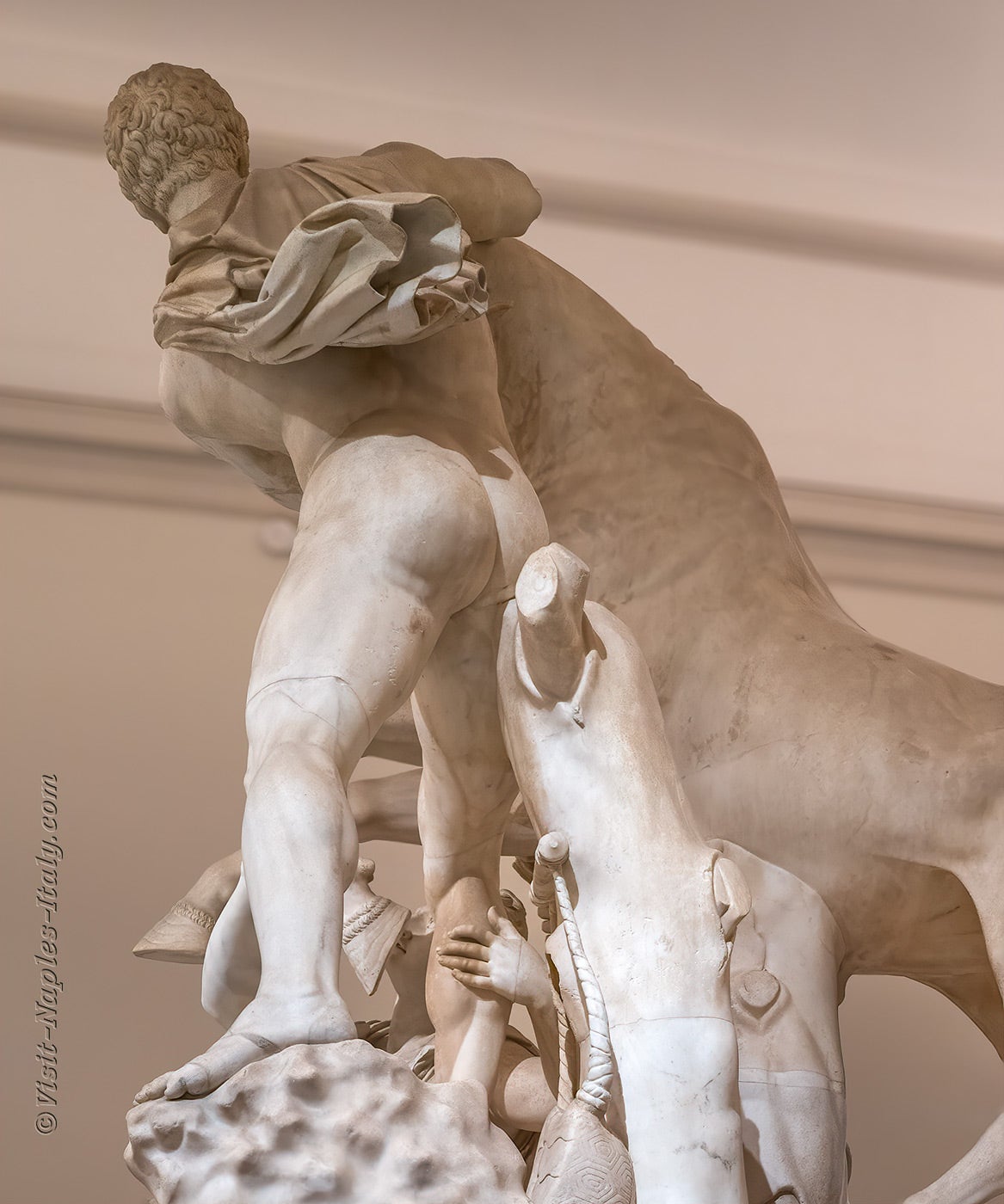
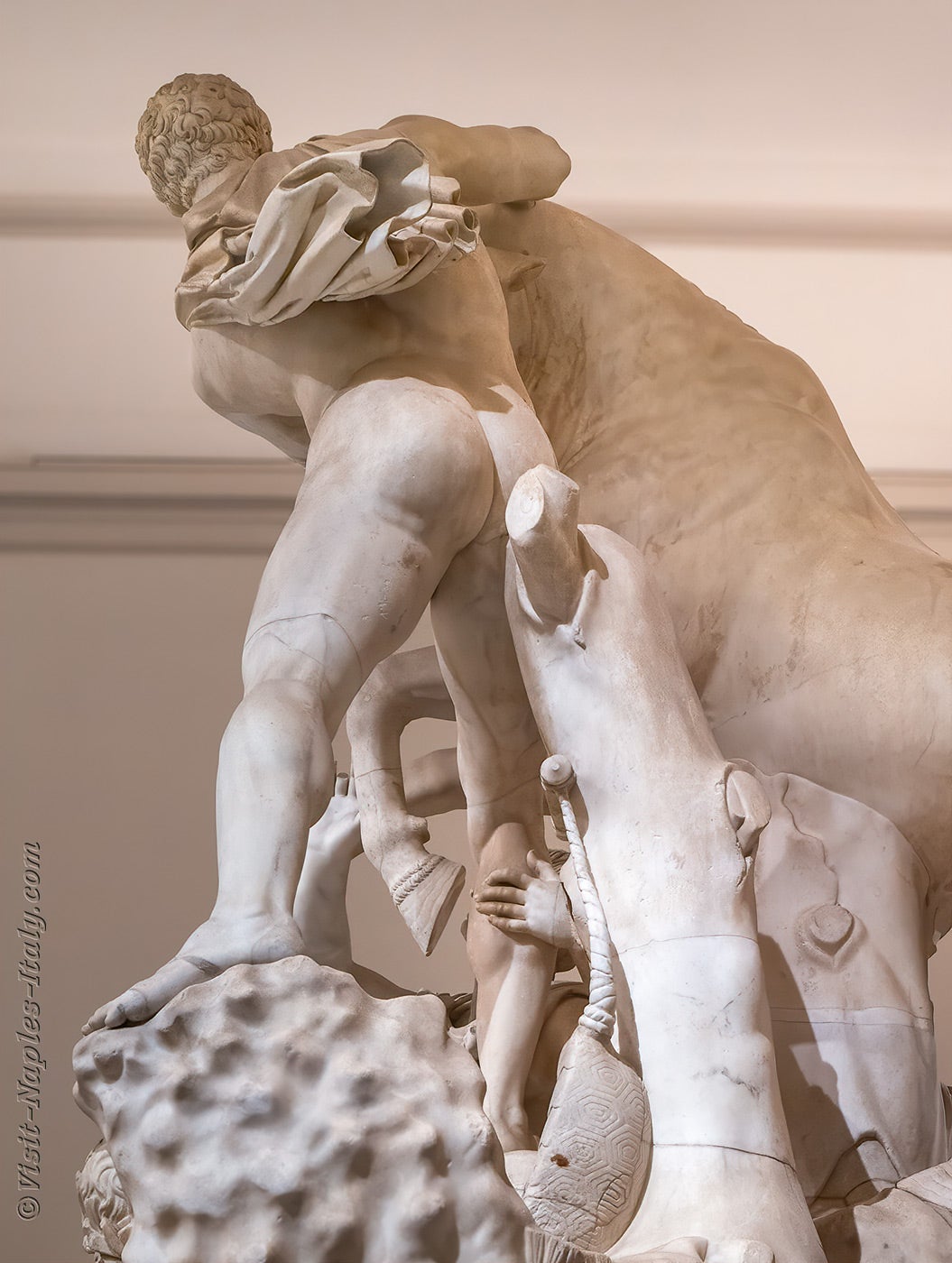
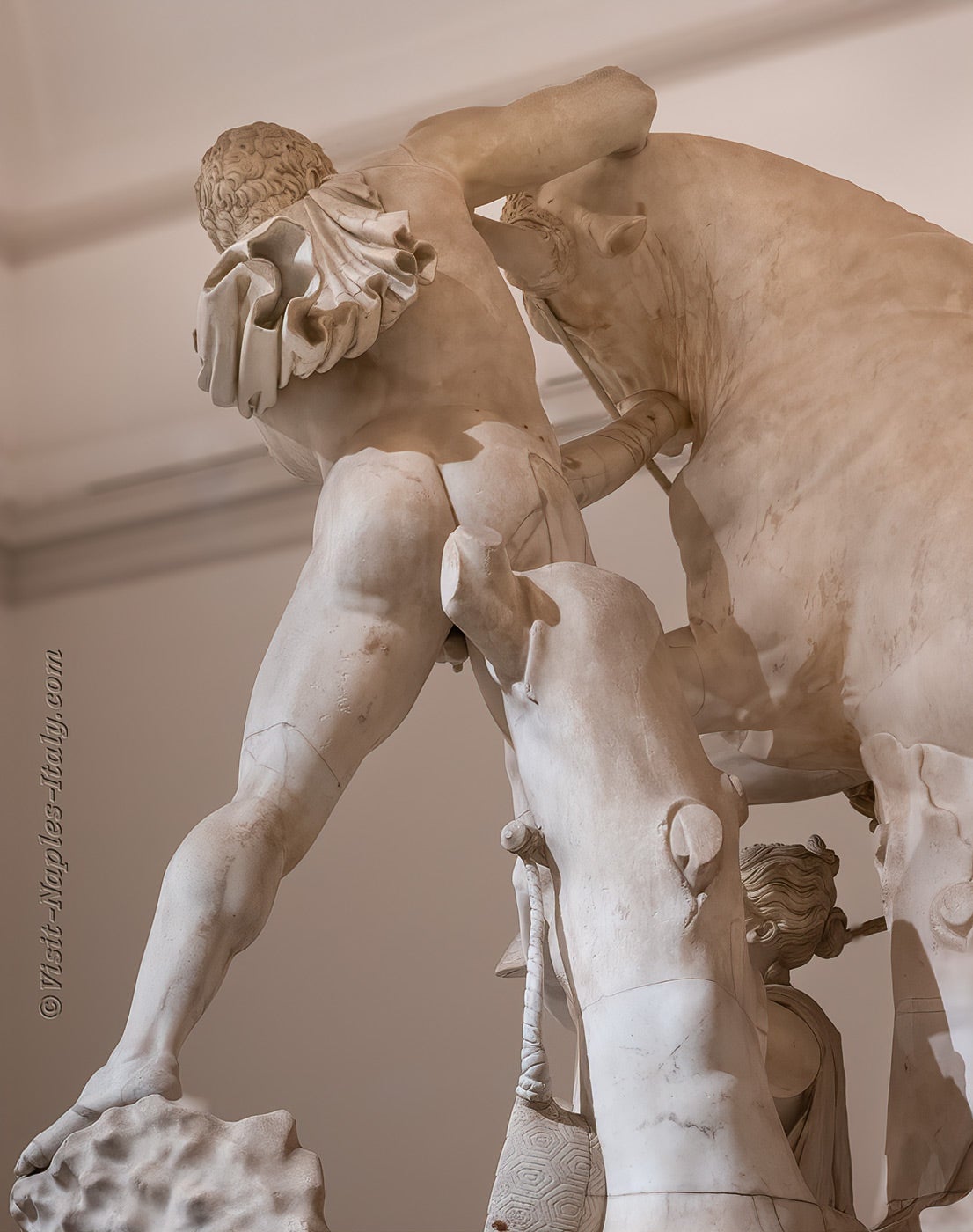
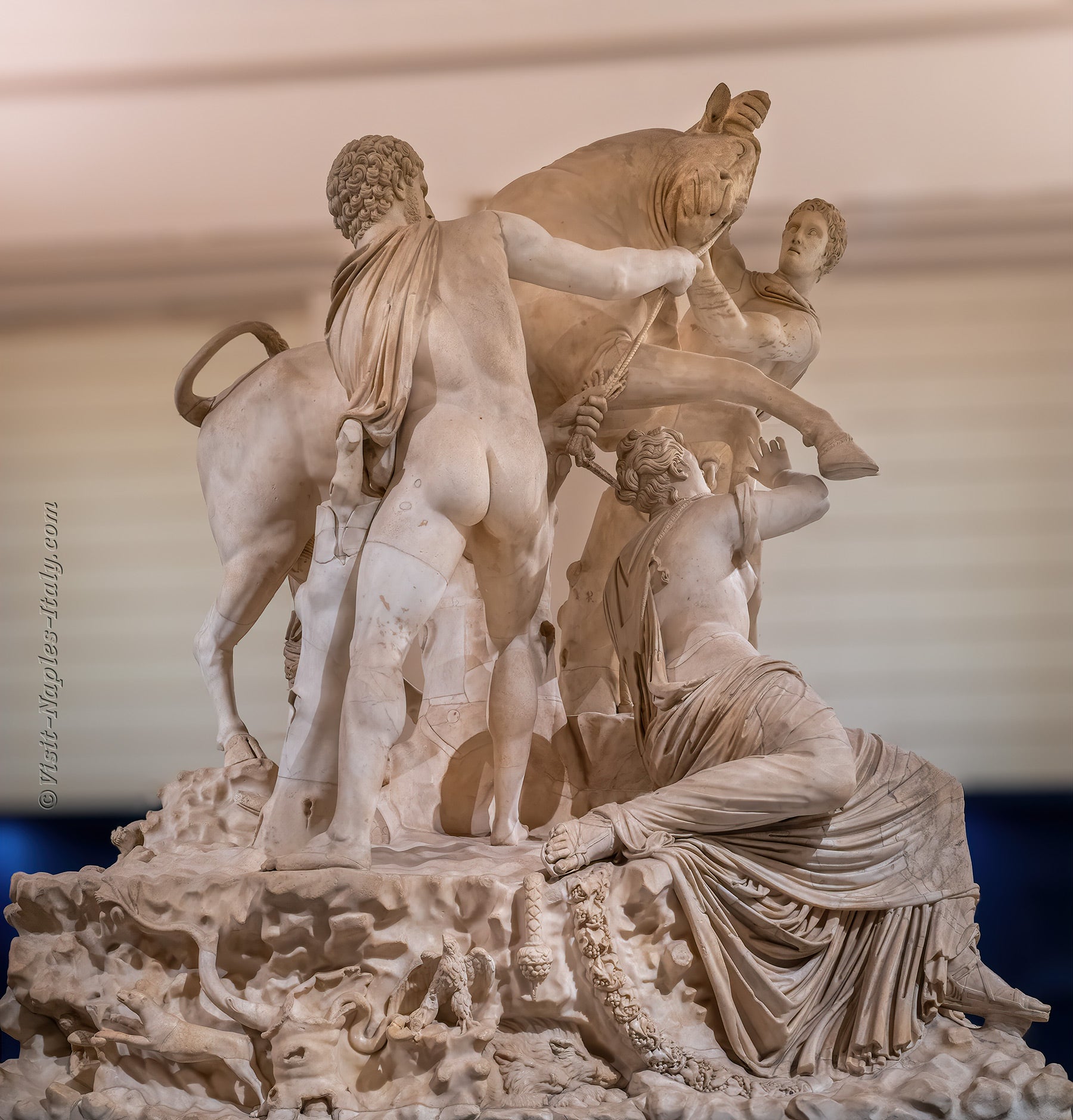
Farnese Bull Amphion holds the bull's head by one horn, clutching its muzzle in his other hand.
The animal is furious and tries to break free.
It is all the more agitated because a dog standing in front of it, at the foot of the rock, provokes it further by barking.
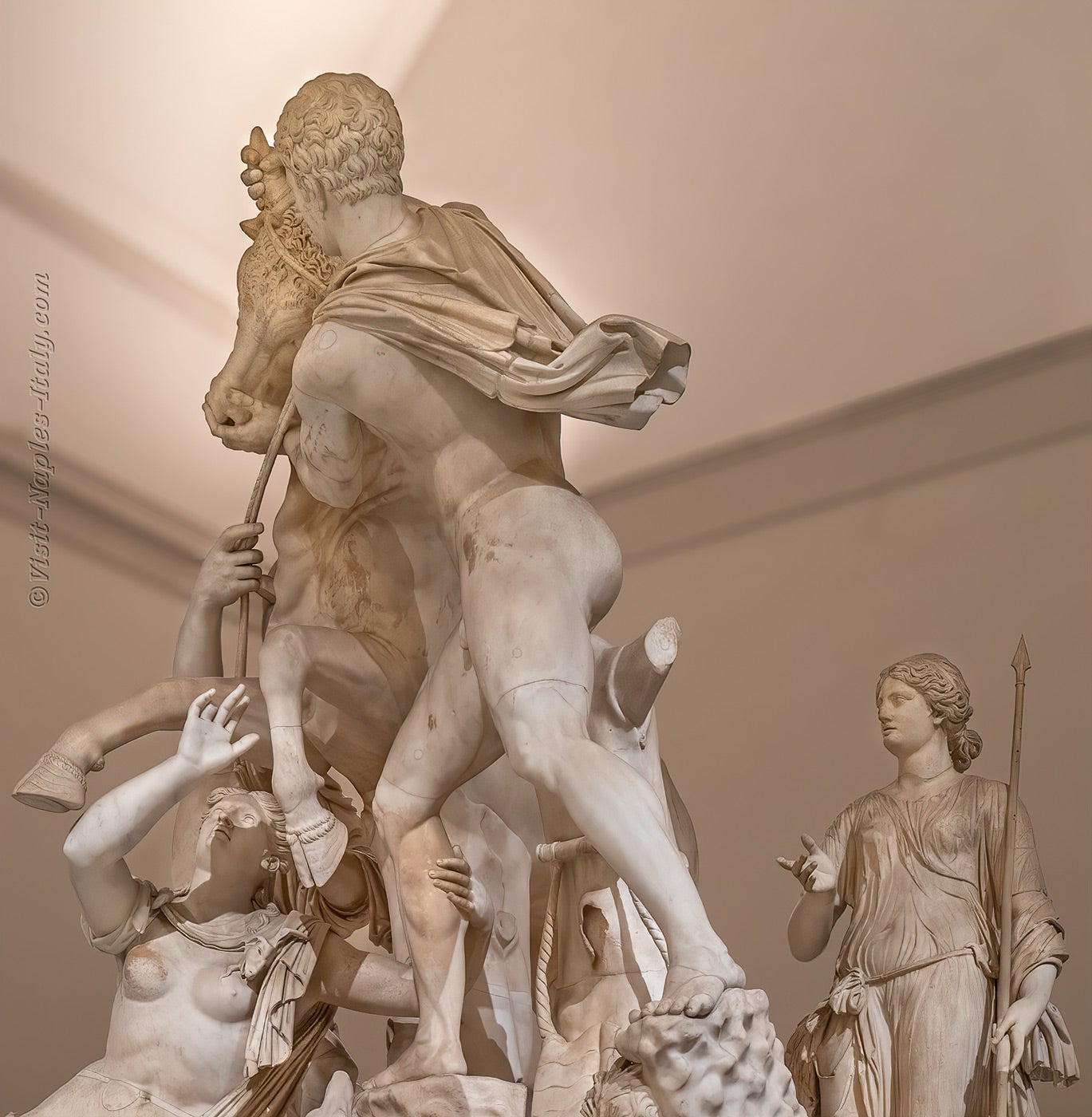
Amphion is naked, save for a chlamys draped over his shoulders, his lyre lies at his feet against the rock.
One can see the tension in his muscles as he attempts to restrain the bull, which is rearing up.
Facing Amphion, Zhétos, also naked with a chlamys draped over his shoulders, pulls with all his might on a rope attached to the bull’s other horn.
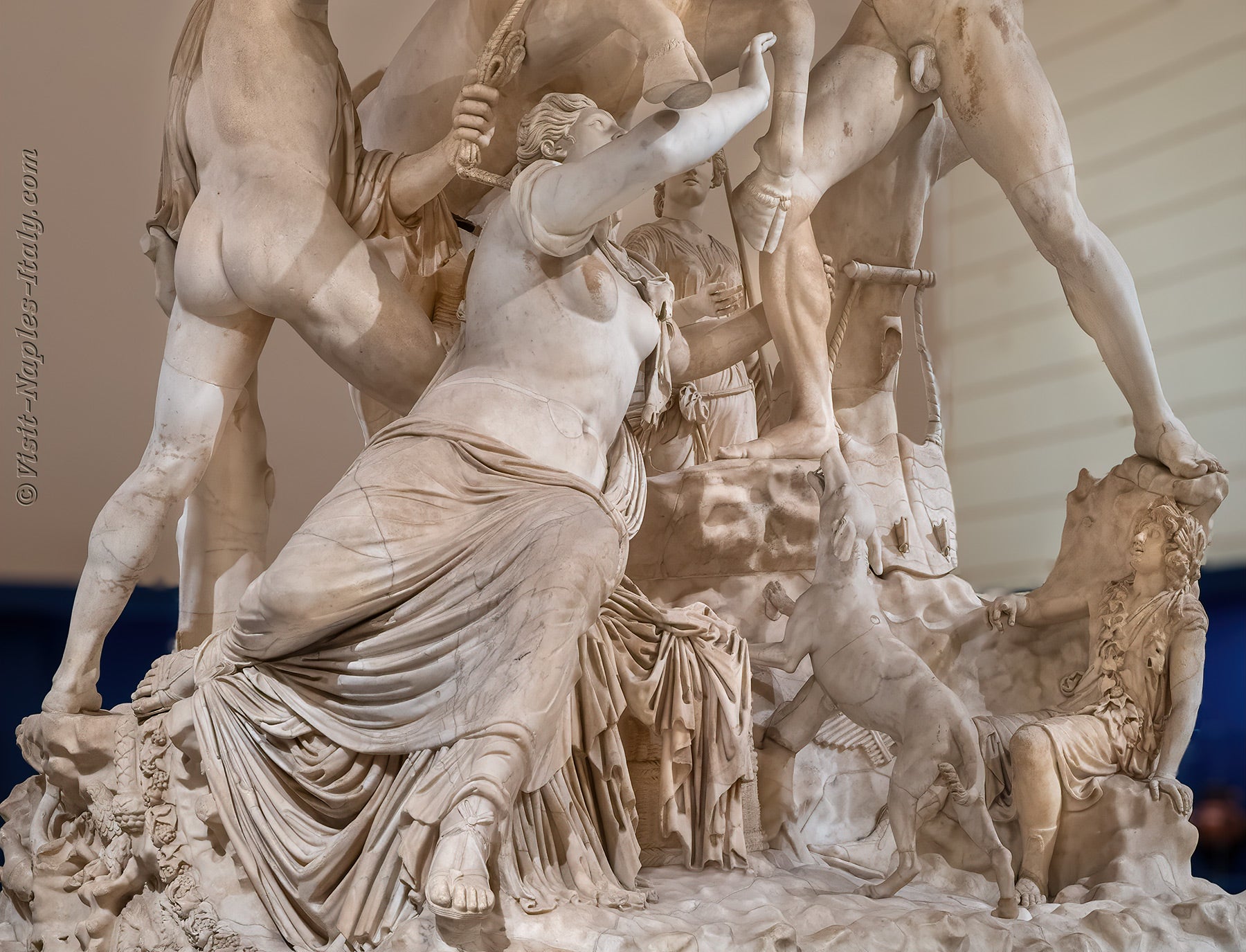
Farnese Bull A rope whose other end is already tied to Dirce’s hair.
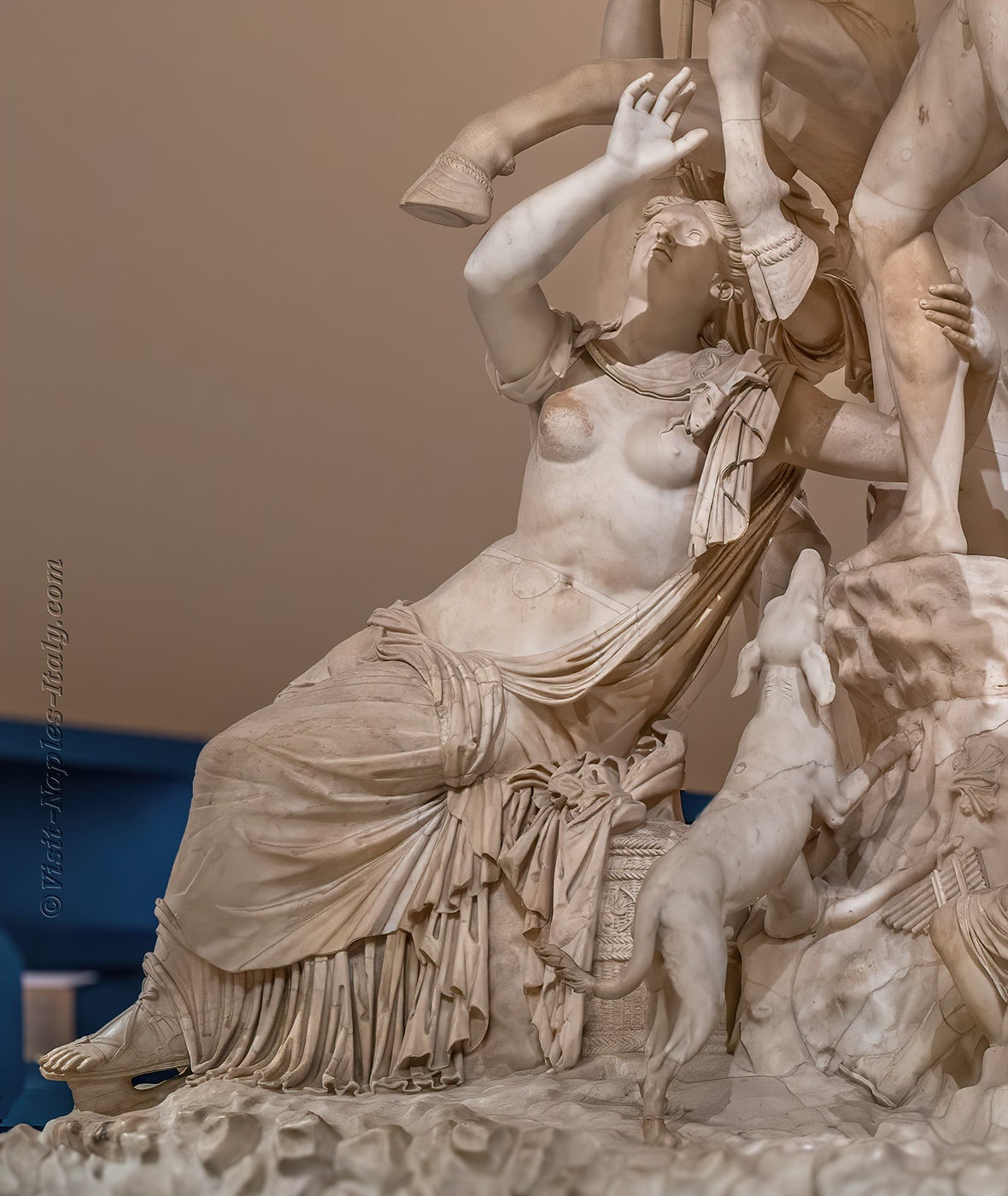
Dirce sits, terrified, beneath the bull’s legs as they thrash near her head, begging Amphion, the gentler of the two brothers, to spare her.
She clings with one hand to the young man’s leg and looks at him with a desperate expression as she reaches out her other hand towards him.
Beside her stands a small altar dedicated to Dionysus and a garland, a symbol of the god’s worship, lies at her feet.
Dirce is half-naked: her himation now covers only her lower body, and her torn chiton leaves her torso bare.
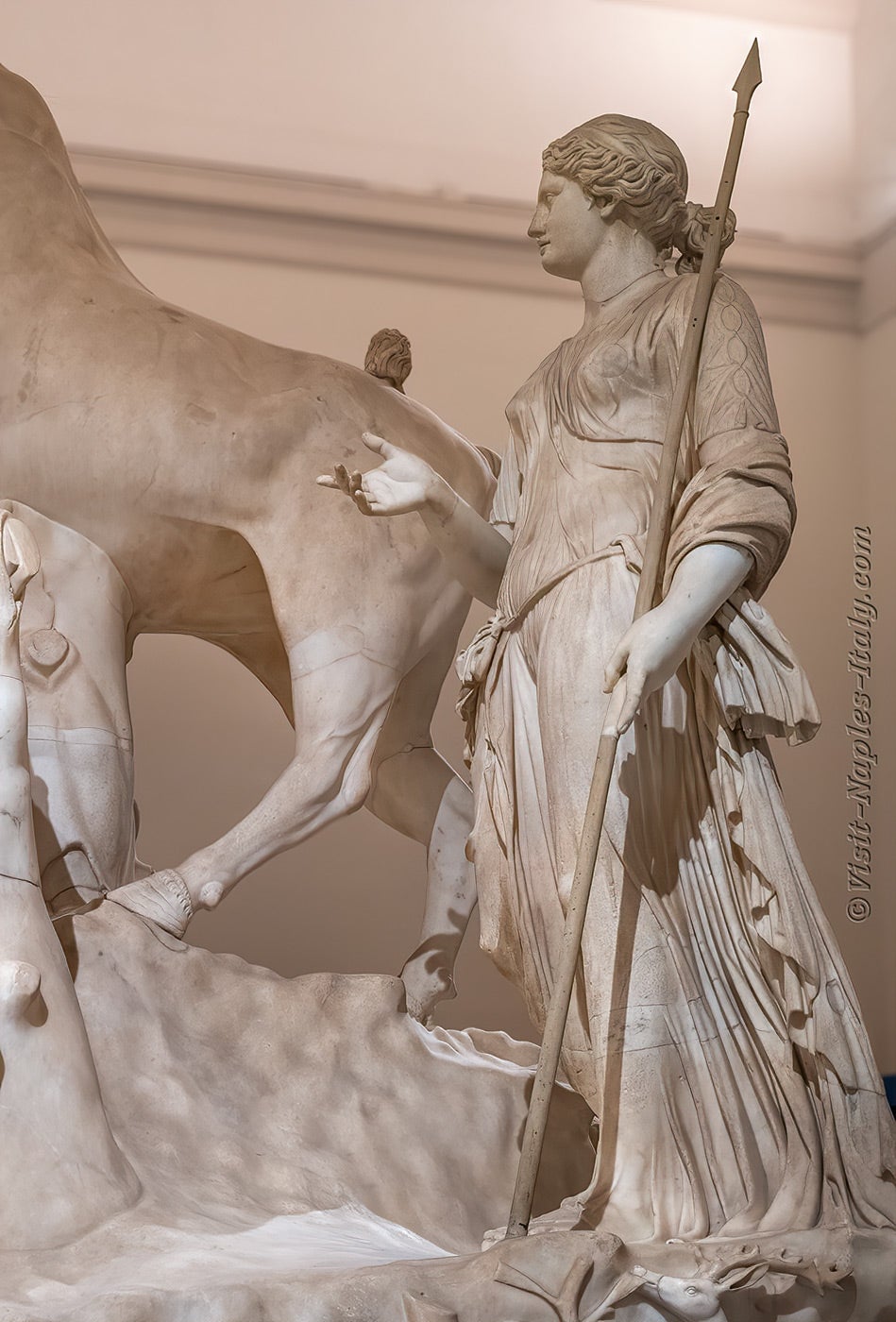
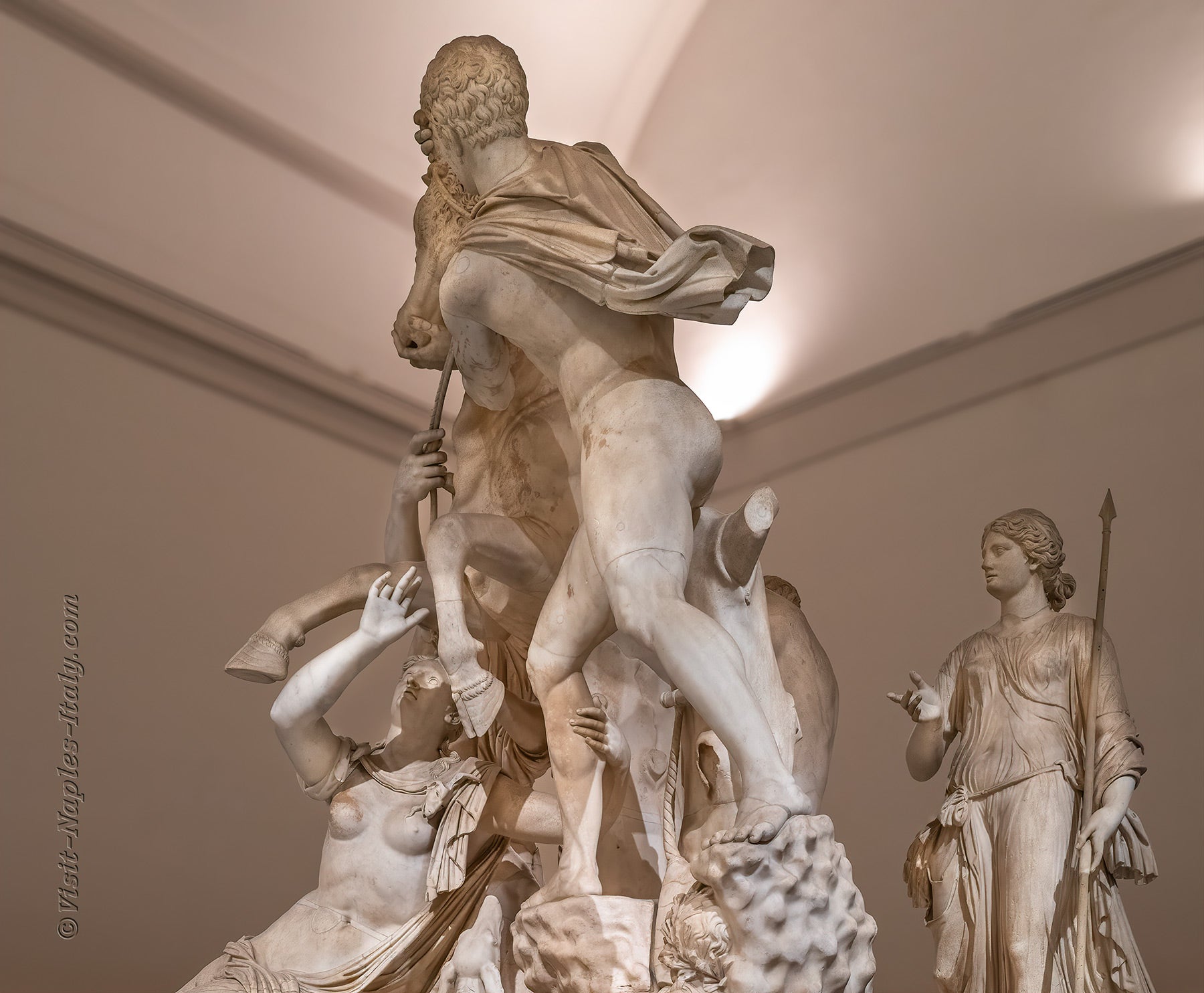
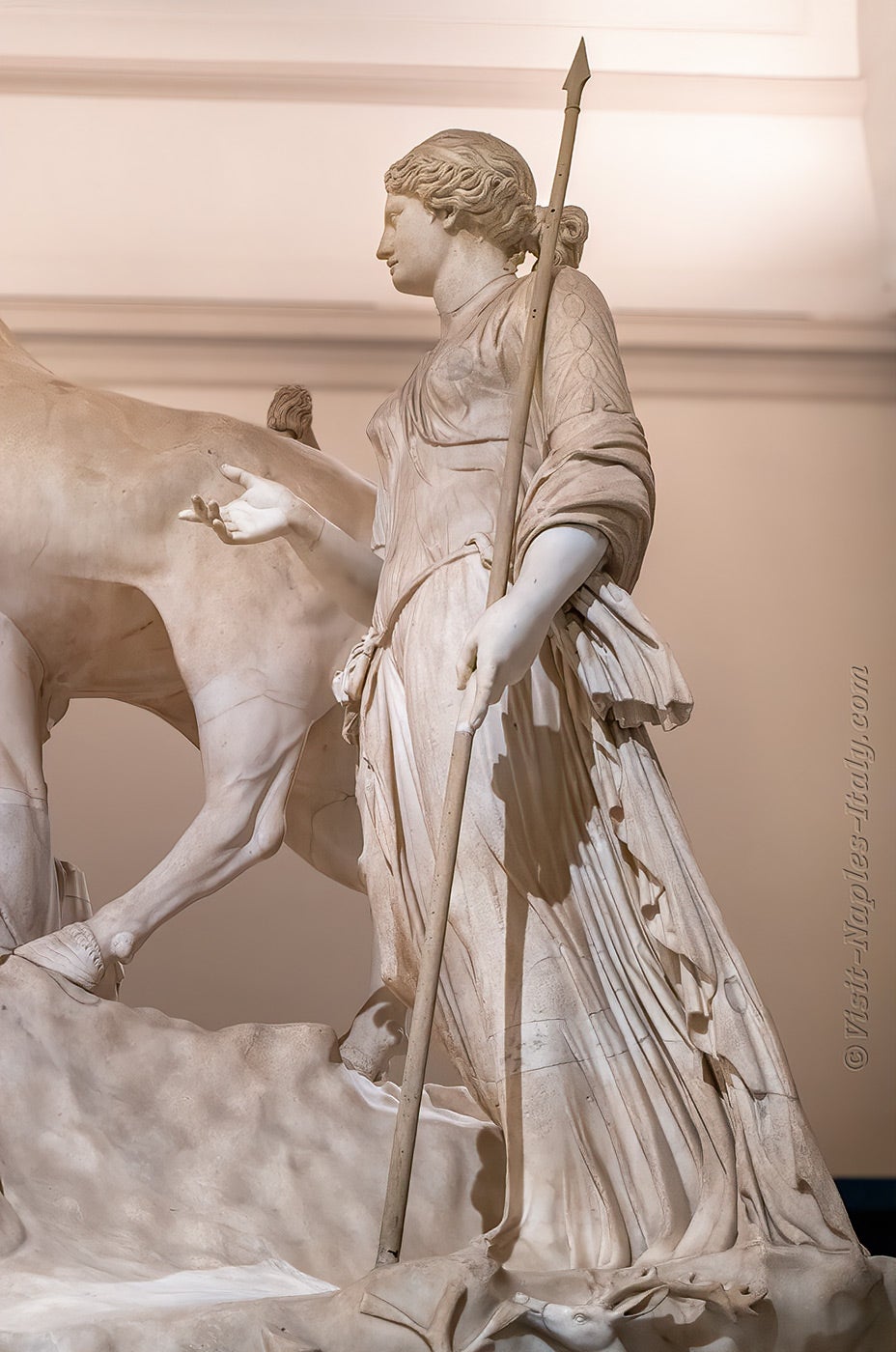
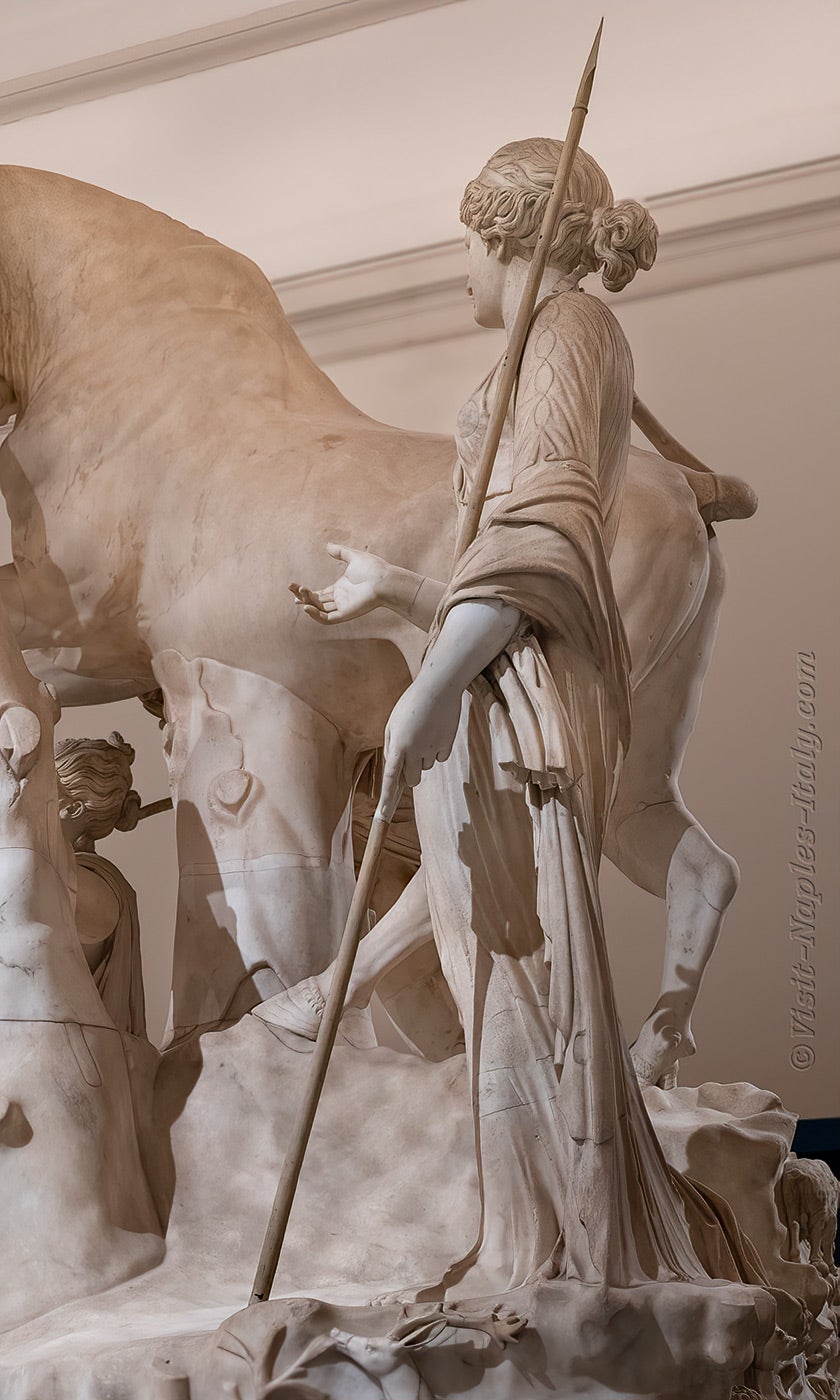
Farnese Bull Behind them, standing and dressed in a fine chiton and a cloak, Antiope calmly watches the scene.
She holds the royal spear in one hand whilst, with the other, she urges her sons to carry out her vengeance.
At Amphion’s feet, a young boy sits with a garland of flowers around his chest watching the scene with a pan flute resting beside him: he represents the spirit of the venue, Mount Cithéron.
It is clear that Dirce’s end is near, for the two brothers will no longer be able to restrain the raging bull who, as soon as they release him, will carry the young woman away to suffer her horrible torment.
The discovery of the “Farnese Bull”, its restoration and its transfer from Rome to Naples
This sculpture was unfortunately badly damaged when it was discovered in 1545 in the Baths of Caracalla in Rome.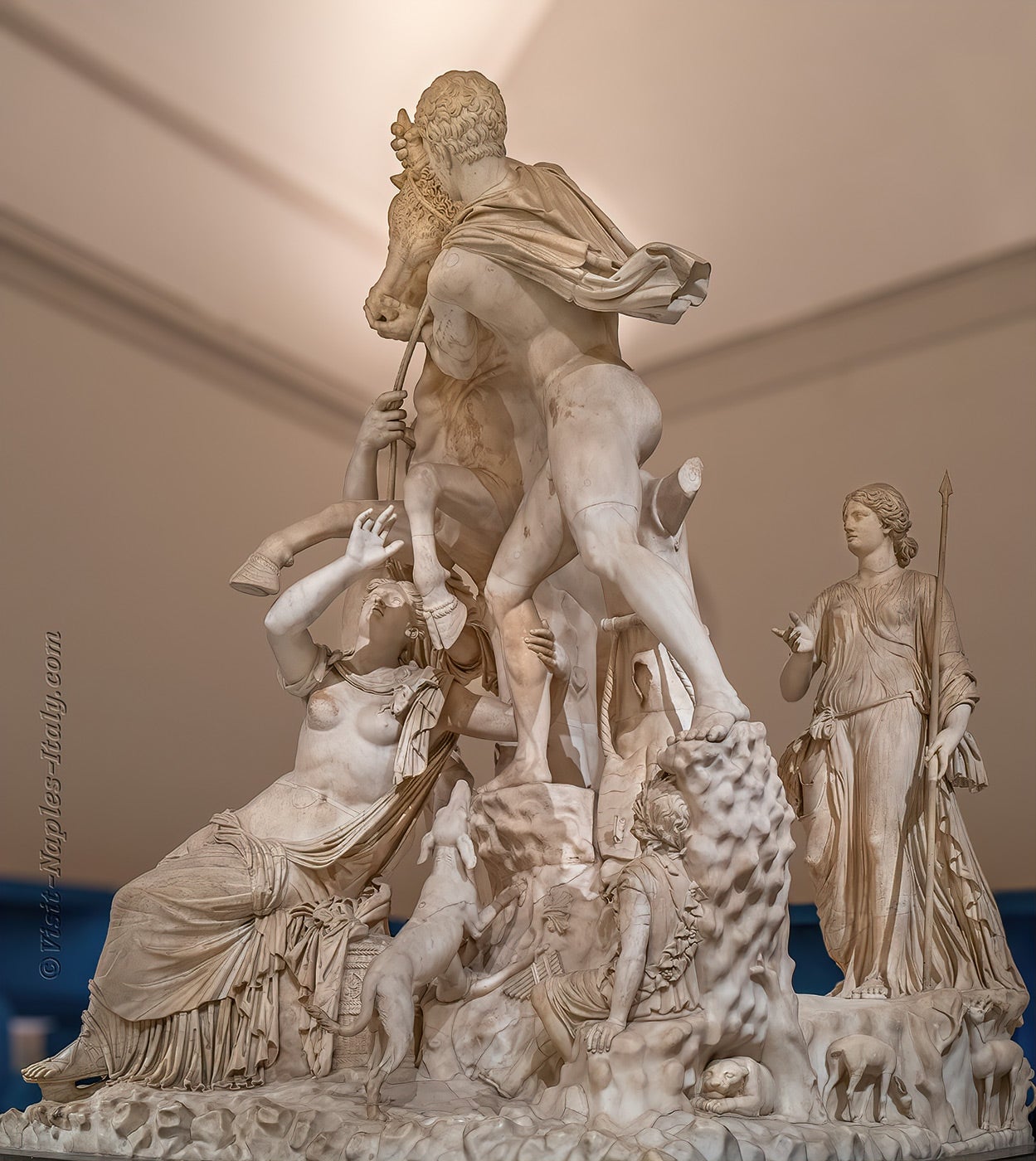
Farnese Bull This sculptural group was a Roman copy of a Greek sculpture created by Apollonios and Tauriskos.
The current ‘Farnese Bull’, dating from the second or third century, was carved from a single block of marble, a feat to create such a complex sculpture measuring 3.70 metres in height and 3 metres across.
When the “Farnese Bull” was discovered, the head, legs and one arm of Amphion; the head, legs and arms of his brother Zethos; the head and torso of Dirce, as well as the bull’s legs and tail.
Its restoration was carried out by Giacomo della Porta and by Giovan Battista Bianchi, assisted by Michelangelo to meet the challenge of recreating the missing parts.
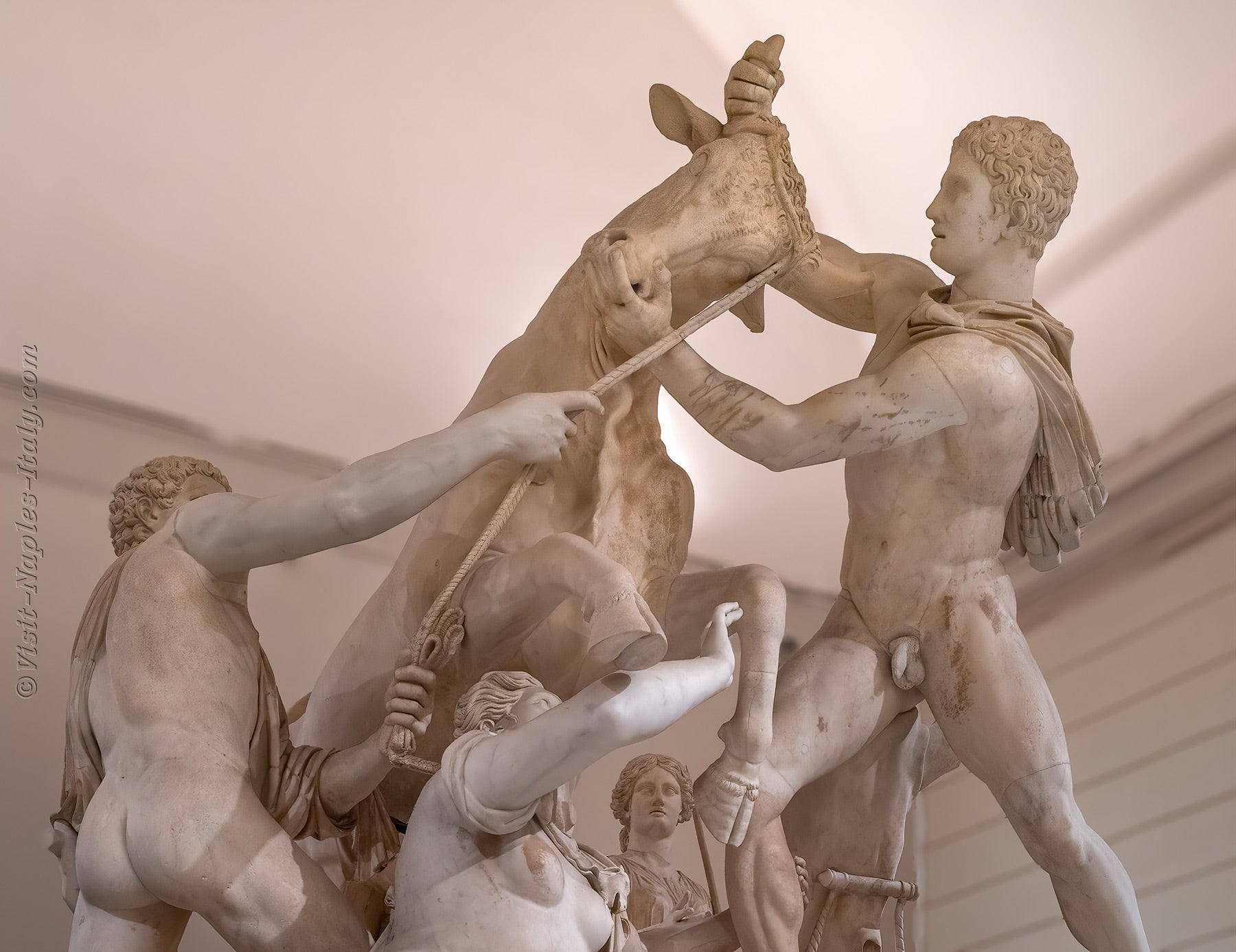
Farnese Bull The heads of Amphion and his twin brother Zethos were inspired by portraits of the Emperor Caracalla, as the sculptural group had been discovered in the baths that bear his name.
Pliny, who had seen the original of this sculpture, had described it in his “Naturalis Historia” (XXXVI, 33-34), which greatly assisted the sculptors in replacing the missing parts.
The two sculptors were also inspired by a fragment of a cameo depicting the torment of Dirce, which was part of the Farnese collection.
This reconstruction work, which lasted thirty years, was complex both intellectually and technically: care was taken to include in the decisions made the traces of support or fractures of the missing parts in order to try as best as possible to restore the original appearance of this “Torment of Dirce”.
Farnese Bull In 1734, Elisabeth, the last descendant of the Farnese family and wife of King Philip IV of Spain, inherited the Farnese collection, which thus became the property of the Bourbons.
In 1783, Ferdinand IV, King of Naples, decided to transfer all the sculptures from the Farnese collection to Naples.
Given the large dimensions and weight of the famous “Bull”, its transport did not take place until 1788, aboard a felucca specially fitted out to carry it.
It sailed down the Tiber before reaching the sea, then the sculptural group was transferred to another boat to the port of Mergellina in Naples.
Farnese Bull The “Farnese Bull” was placed on a plinth in the centre of a fountain, in the grounds of the Royal Villa of Chiaia.
However, left exposed to the elements, the sculpture began to deteriorate and Ferdinand IV finally agreed, in 1818, that it should be transferred to the Archaeological Museum of Naples, which, given the difficulties associated with its transport and its fragility, was not done until 1826.
When the “Farnese Bull” arrived at the museum, the side wall of the room where it was to be displayed had to be knocked down to allow it to be brought in, where you can still admire it today.
Mythology Achilles | Aesculapius | Amazons | Aphrodite Venus | Apollo | Artemis | Athena Minerva | Atlas | Concordia | Danaids | Diomedes | Dionysus | Dirce | Flora | Ganymede | Hera Juno | Hercules | Hermes | Nike | Orestes | Psyche | River | Satyrs | Zeus
Sculptures Mythology | Persons | Animals | Bas-relief
Artworks Sculptures | Frescoes | Eroticism
MANN Artworks Schedule Tickets Location | Authorizations
Back to Top of Page