

MANN Artworks Schedule Tickets Location | Authorizations
Artworks Sculptures | Frescoes | Eroticism
Sculptures Mythology | Persons | Animals | Bas-relief
Mythology Achilles | Aesculapius | Amazons | Aphrodite Venus | Apollo | Artemis | Athena Minerva | Atlas | Concordia | Danaids | Diomedes | Dionysus | Dirce | Flora | Ganymede | Hera Juno | Hercules | Hermes | Nike | Orestes | Psyche | River | Satyrs | Zeus
Dionysus Bacchus at the Archaeological Museum of Naples
Dionysus Narcissus, Pompeii
Sculpture - Bronze (Height 63 cm) Early 1st century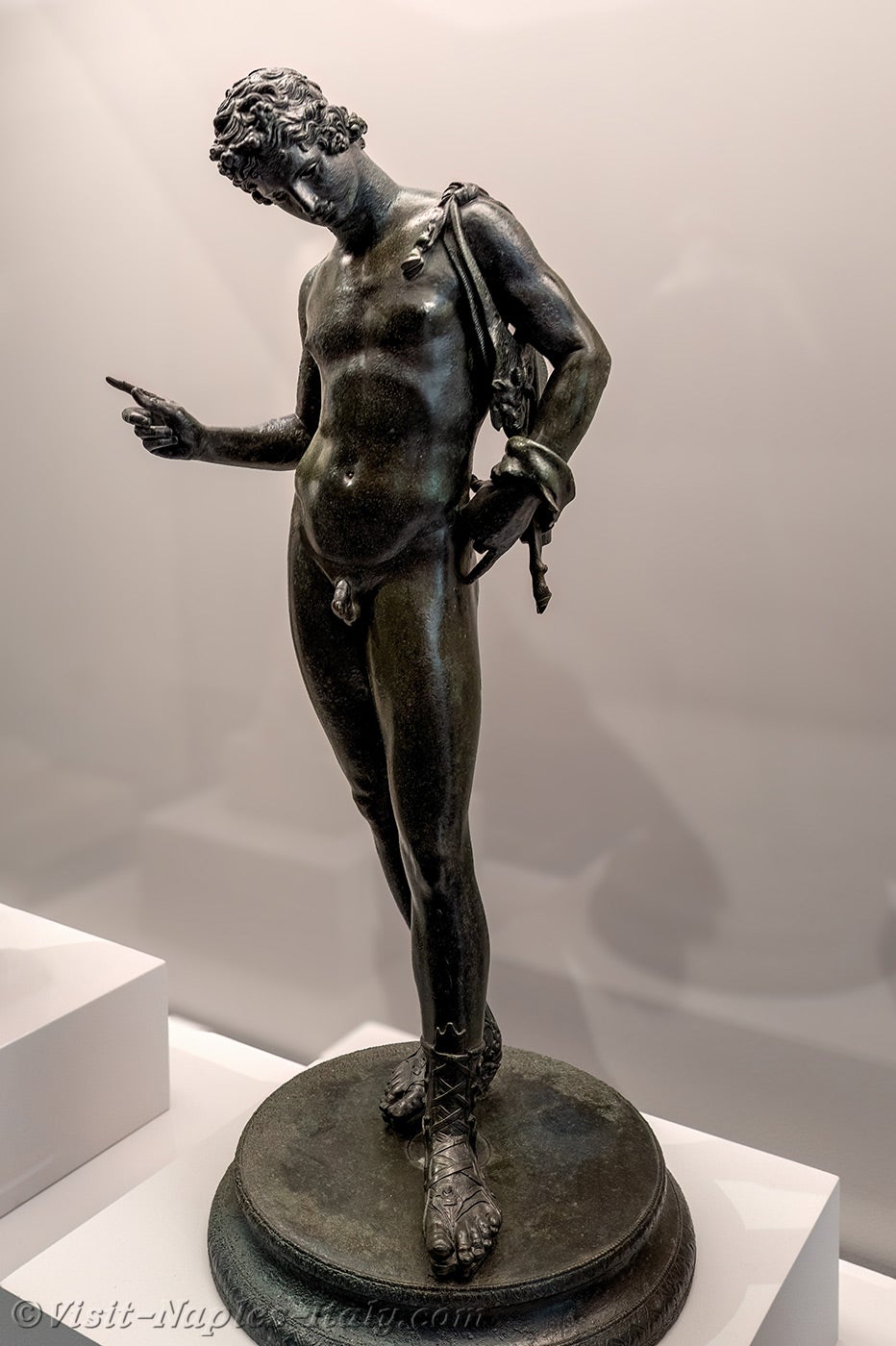
Dionysus Narcissus This beautiful bronze statuette discovered in Pompeii in 1862 is known as Narcissus, although it is undoubtedly a depiction of Dionysus.
The nebritis, an animal skin used as clothing and which he wears over his shoulder, is indeed one of the attributes of the god of intoxication and pleasures.
Dionysus is here depicted as a teenager, whose slender musculature reflects his young age.
The posture of his slender body, his arms and legs, as well as the way he tilts his head, express beauty and grace.
Unfortunately, the statuette has lost its eyes, which were made of silver.
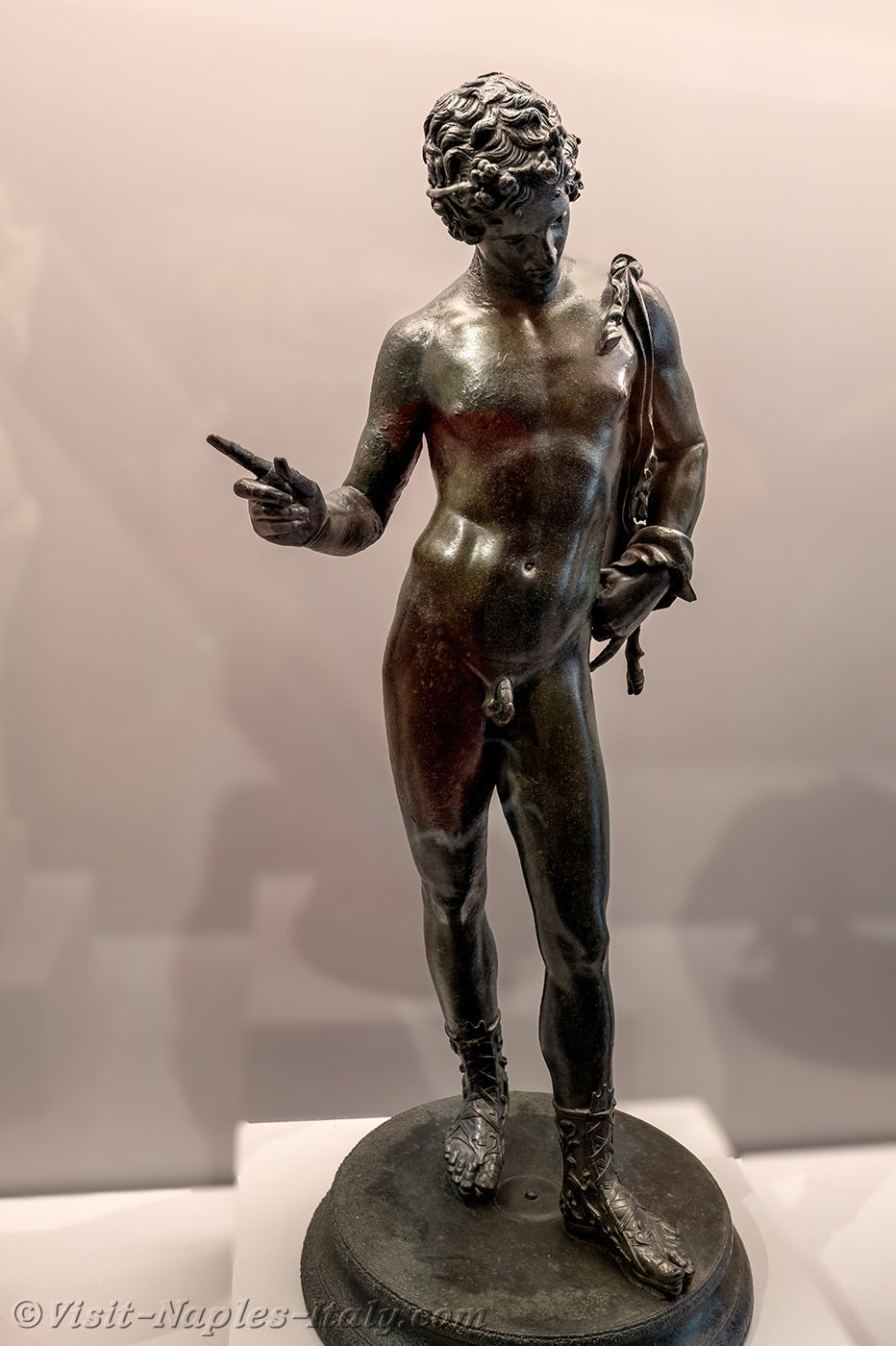
Dionysus Narcissus The young god is naked and wears sandals laced up to mid-calf.
His loincloth is a deer skin that hangs elegantly down his side.
The position of his right arm and his outstretched finger on the side towards which he tilts his head suggest that he is listening to a distant sound.
Perhaps he is trying to hear the whispers of the nymph Echo whilst observing his reflection in the water of the fountain where Narcissus drowned, captivated by his own image.
It is thought that the original of this superb sculpture came from a school influenced by the style of Praxiteles.
Dionysos et Ampélos, Casa di Pansa, Pompéi
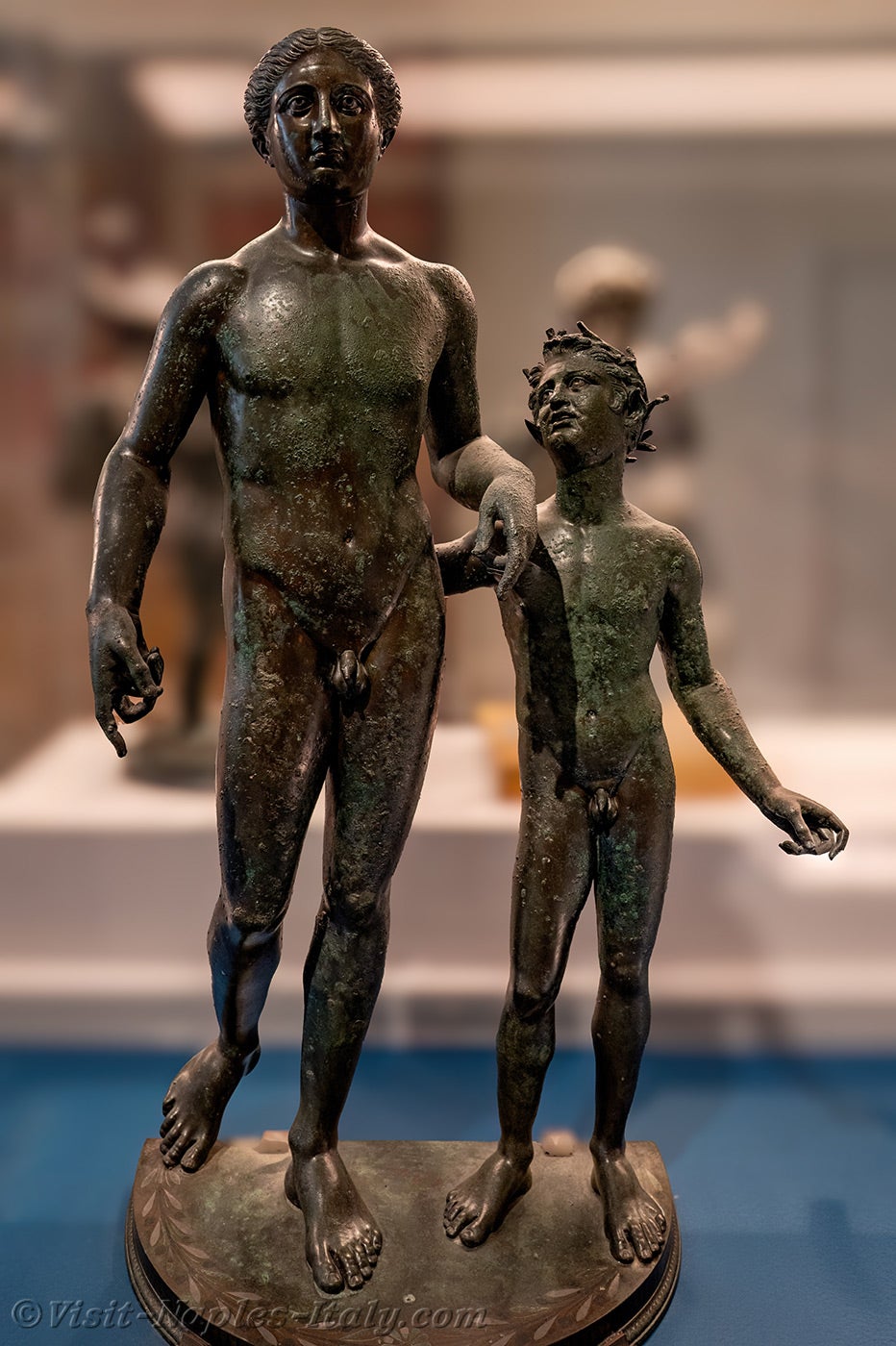
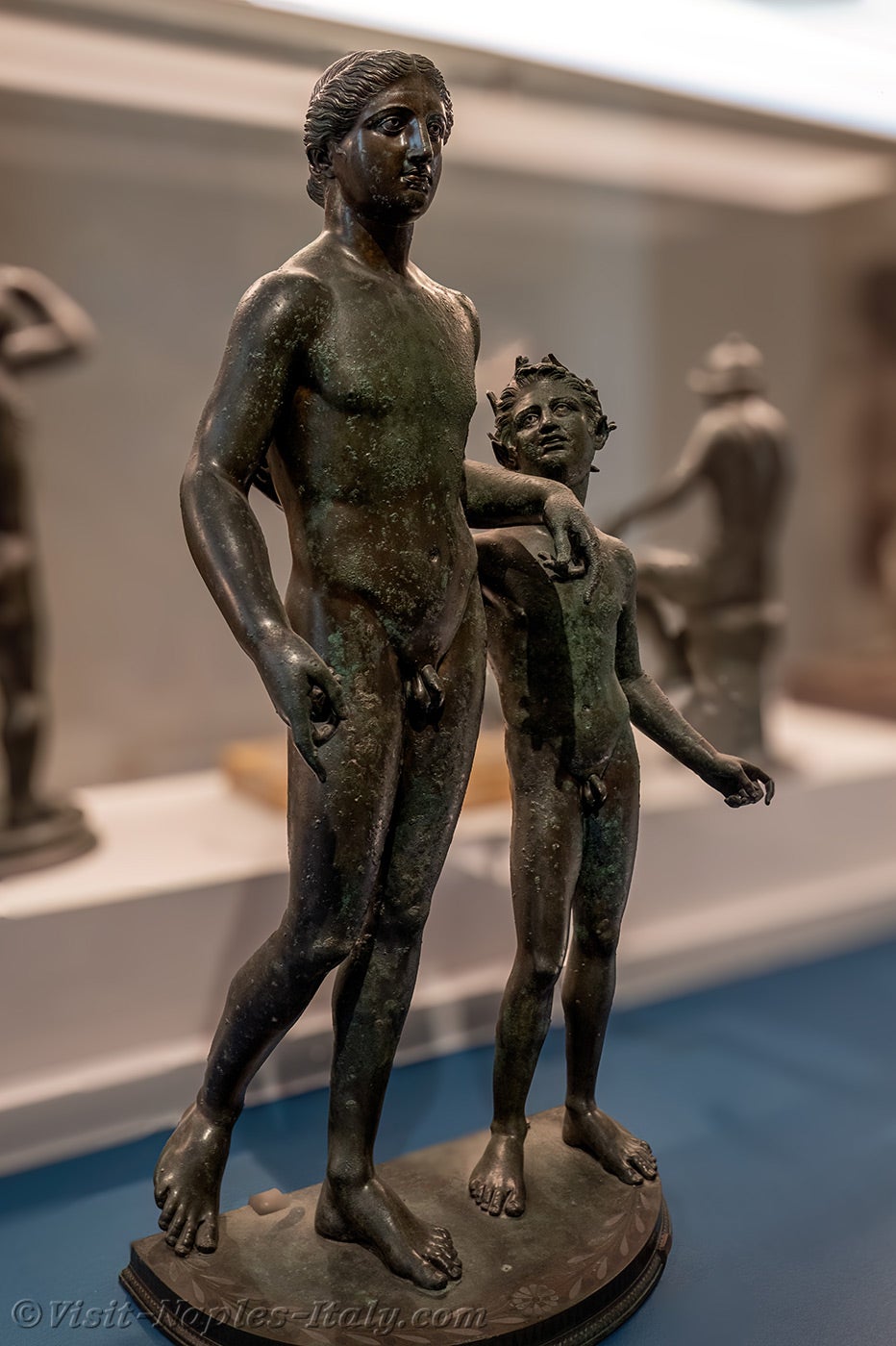
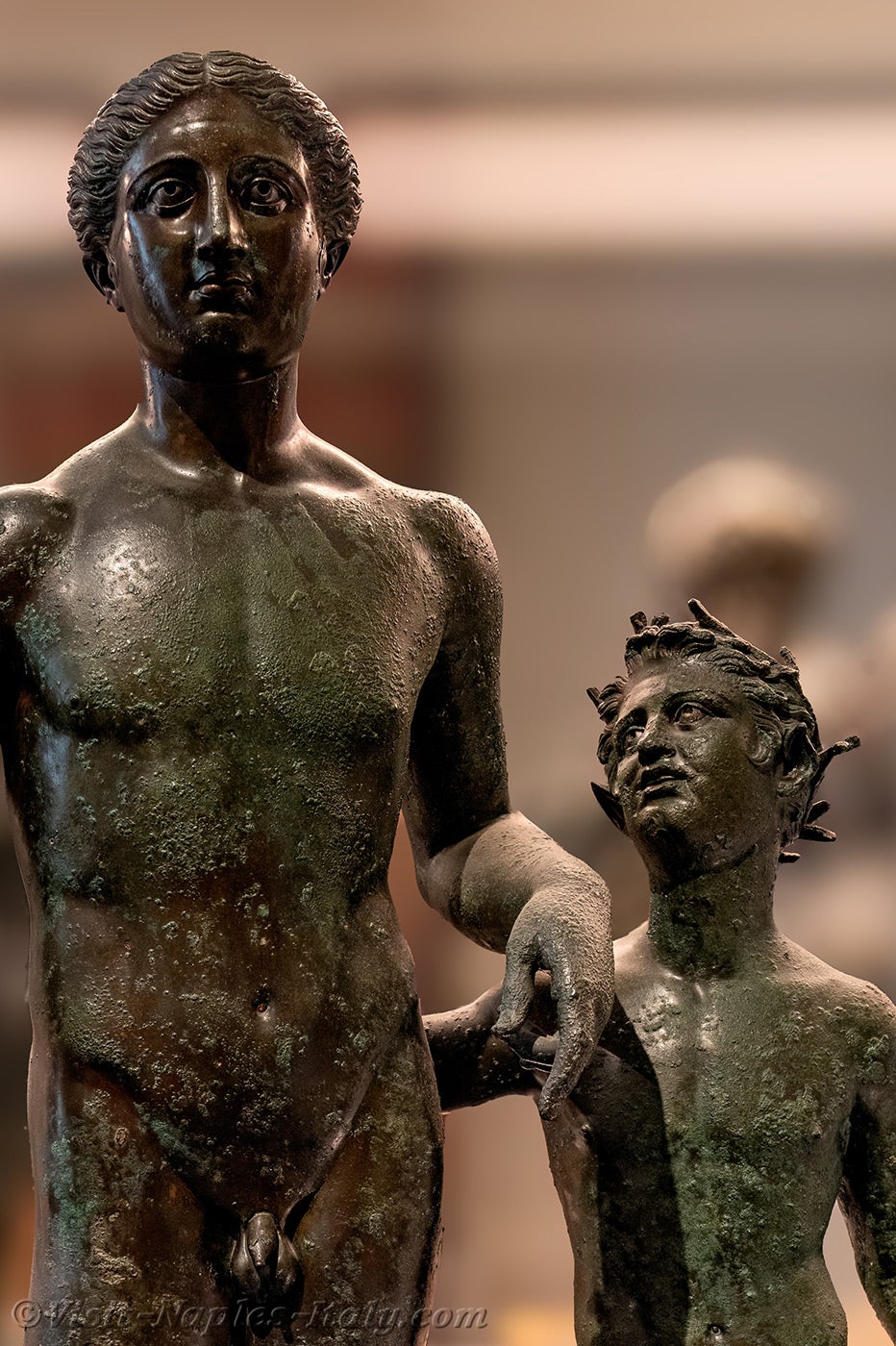
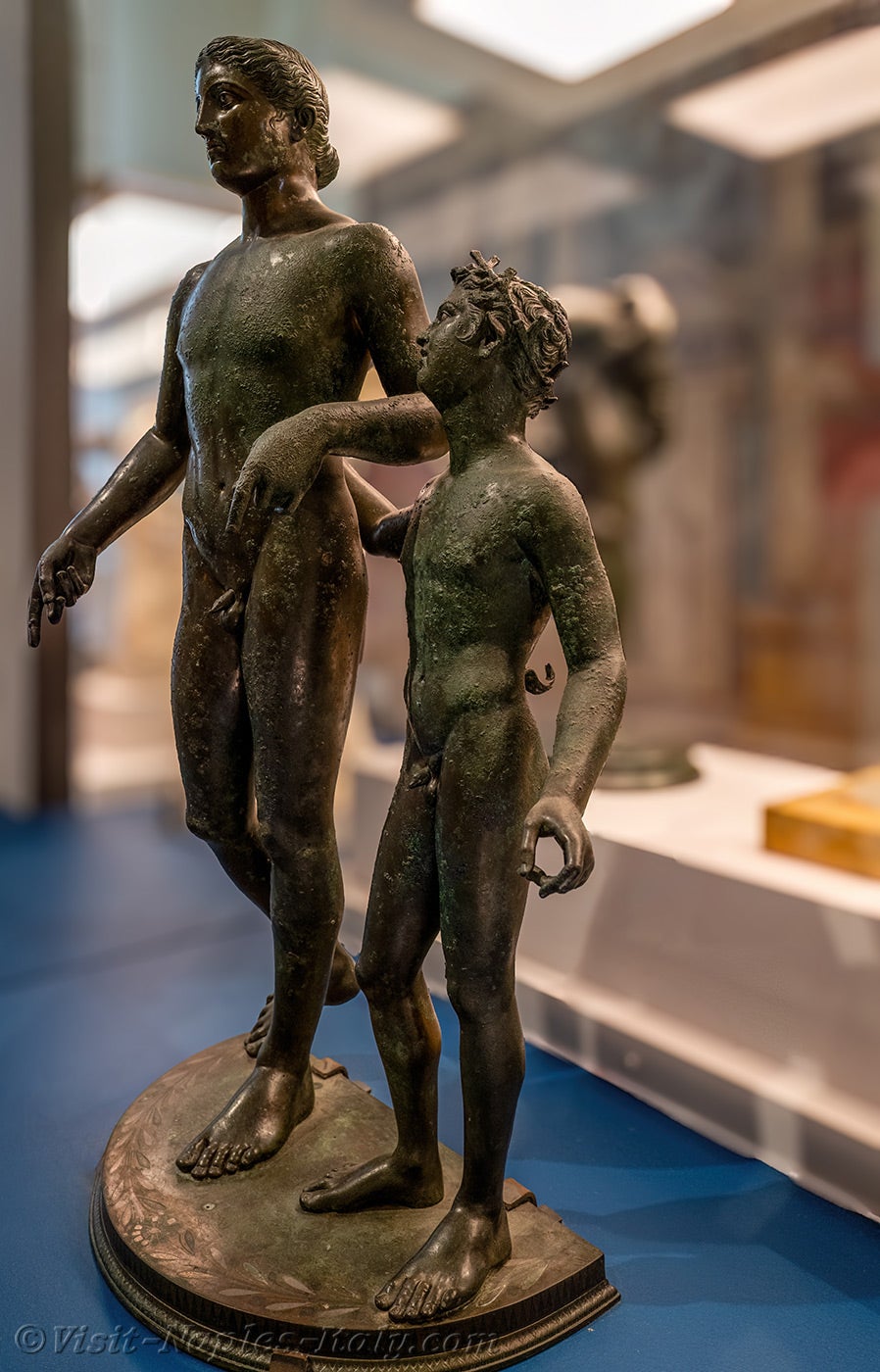
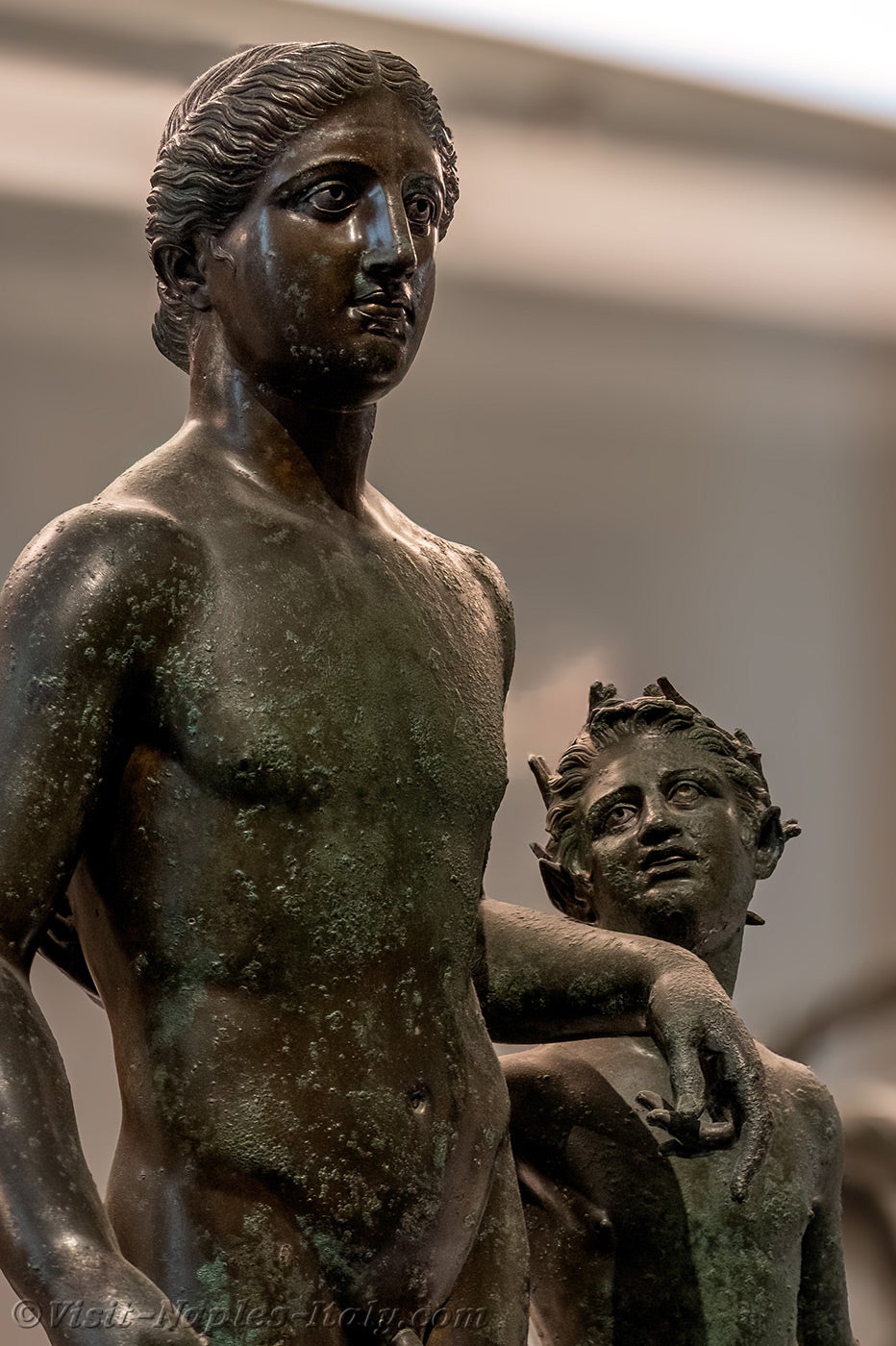
Dionysus and Ampelus Sculpture - Bronze and Silver (Height 83 cm) First half of the 1st century
This sculpture, discovered in Pompeii, depicts Dionysus with his protégé Ampelus.
Ampeus was the son of a satyr and a nymph.
Dionysus was fond of him and, to show his affection, he gave him a vine that hung from a small elm tree.
Unfortunately, this gift led to a tragic accident.
Ampeus climbed the elm tree to pick the grapes from his vine, and fell to his death.
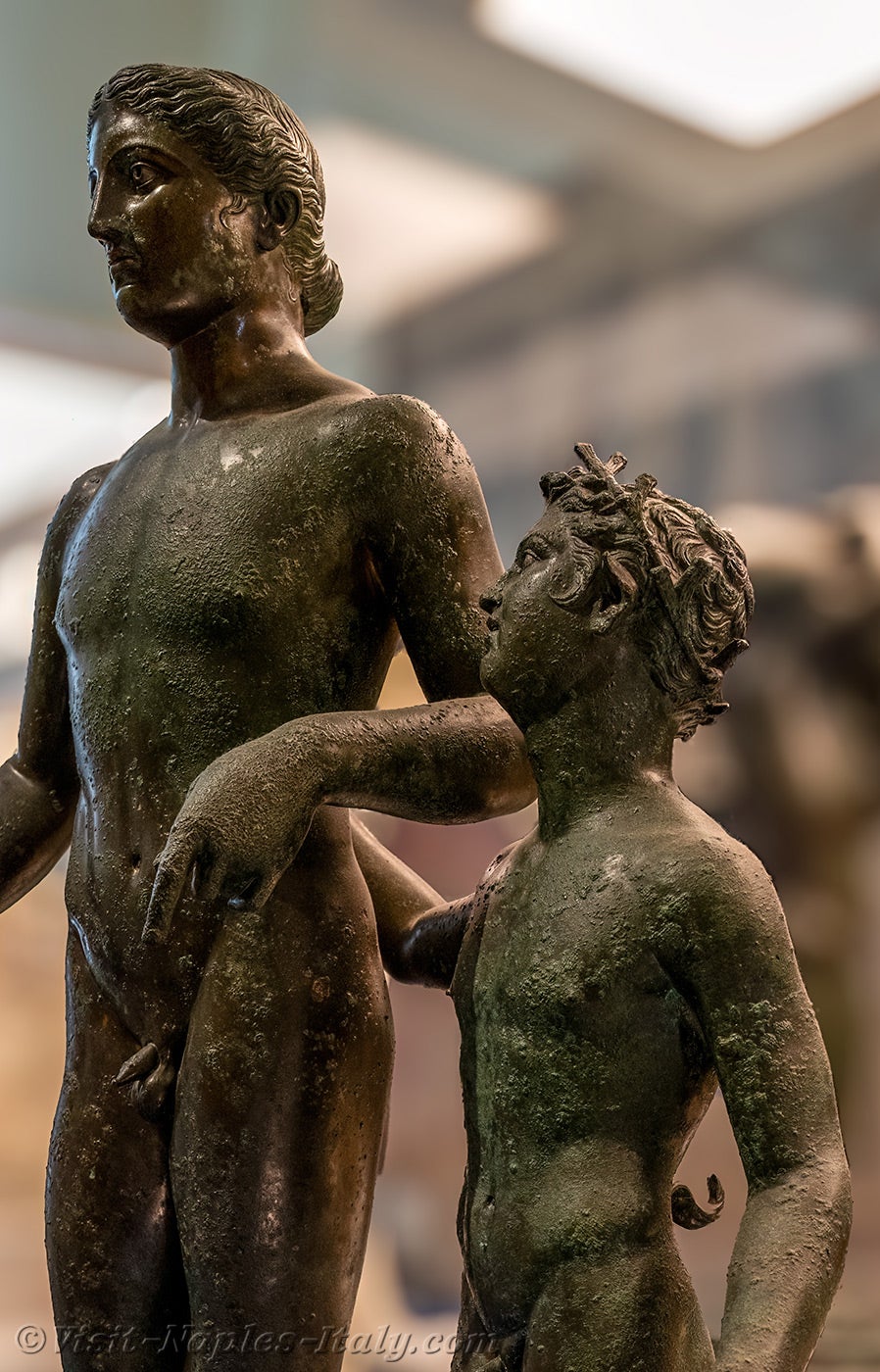
Dionysus and Ampelus Ampeus and Dionysus are both naked.
Ampeus’s face is turned towards Dionysus and his right arm rests in the hollow of Dionysus’s lower back expressing his admiration for the god, who here is without his crown of ivy leaves and bunches of grapes.
Dionysus’s body is androgynous: his musculature is barely more defined than that of the young Ampelus, his hairstyle and face are feminine as is the position of his hands.
The eyes of both figures are inlaid with silver, as is the garland adorning the statue’s semi-circular base.
Drunken Dionysus with satyrs and Bacchantes, Farnese Collection
Sculpture - Marble (57 x 80 cm) Second half of the 2nd centuryThis bas-relief, taken from a sarcophagus , depicts a Dionysian festival.
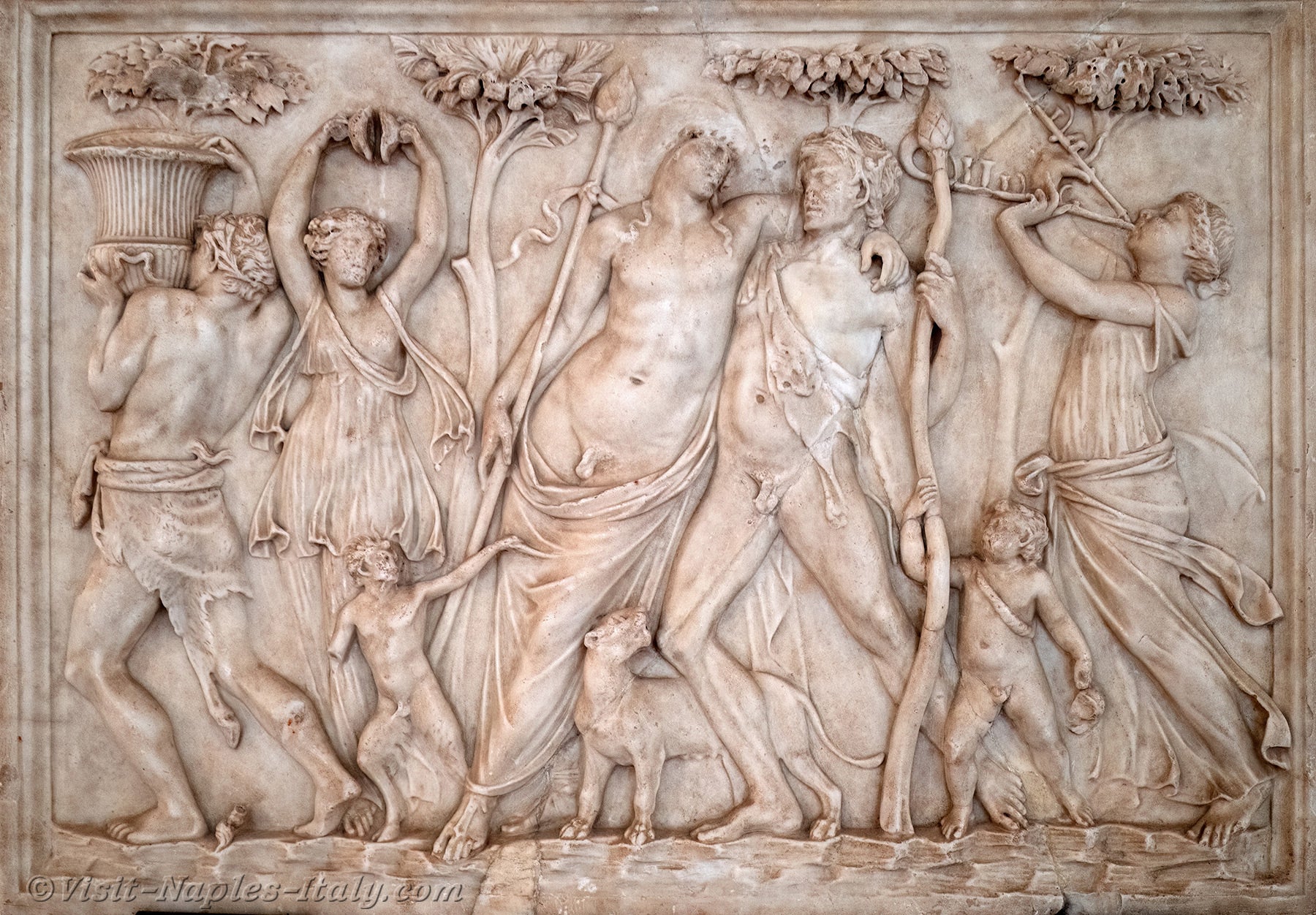
Dionysus, drunk, with satyrs and Bacchantes Dionysus, drunk, wraps his arms around the neck of a satyr whilst leaning against him to keep his balance.
He holds a thyrsus in his right hand and his garment now covers only his thighs.
On the far left, another satyr struggles to move under the weight of a large vase, a krater, no doubt filled with wine.
Just behind him, a Bacchante keeps time by striking a pair of castanets whilst the Bacchante on the right plays a double flute with all her might.
A panther lies at the feet of Dionysus Bacchus, who is always accompanied by female musicians and enjoying the pleasures of life.
Dionysus Osiris, Temple of Isis, Pompeii
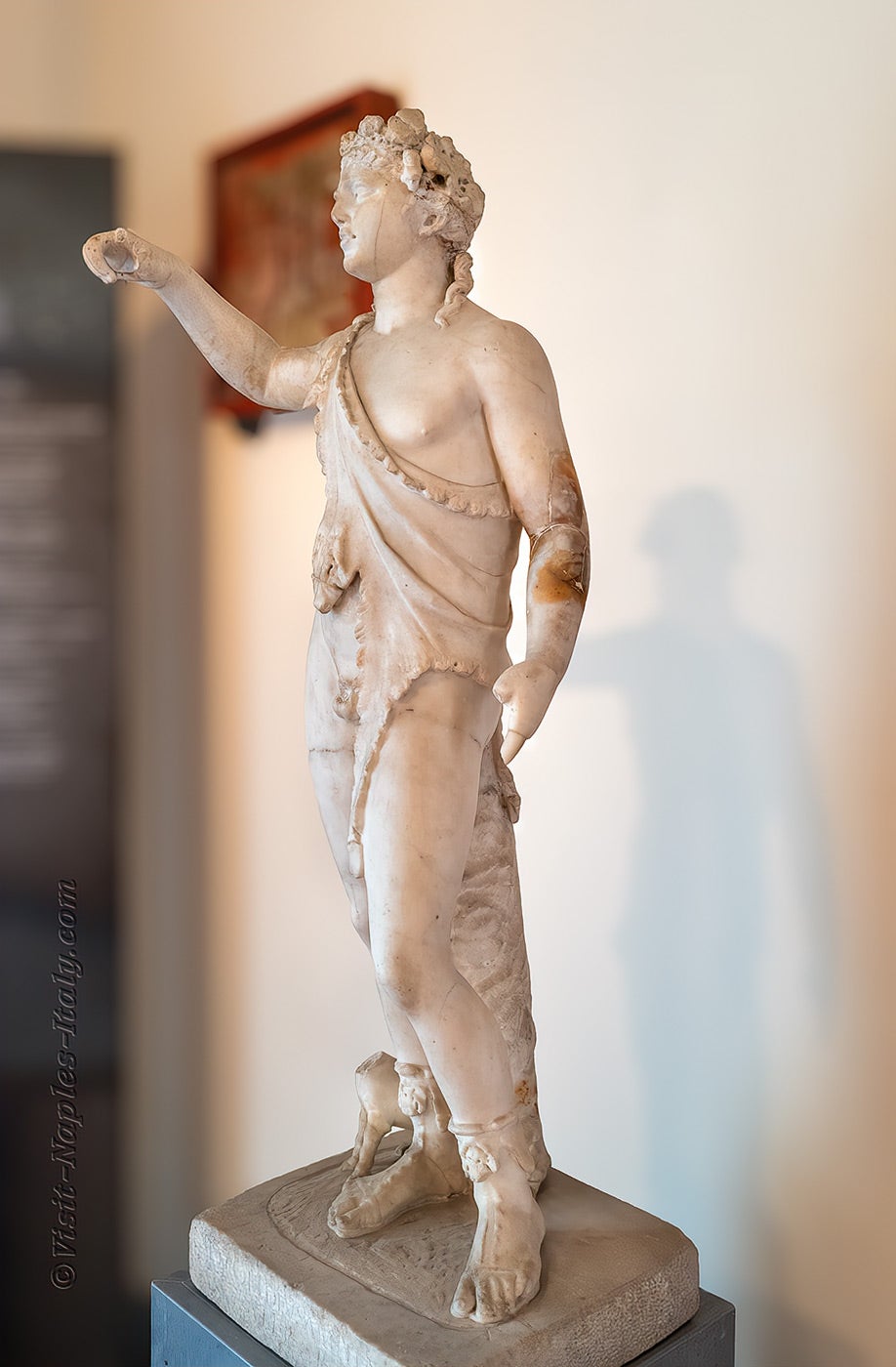
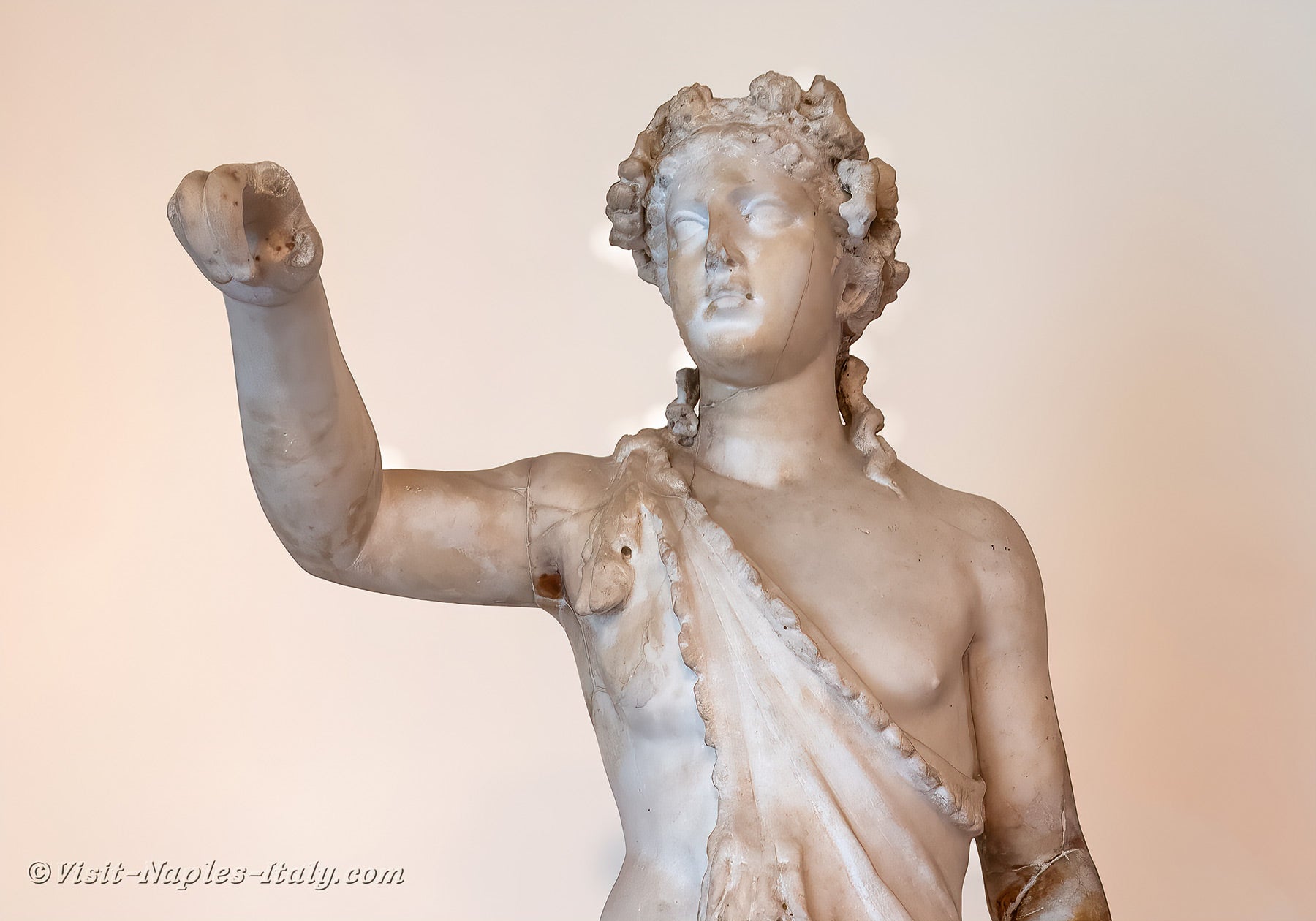
Sculpture - Marble (Height 100 cm) 27 BC - 68 ADOriginally, this marble statue was painted and gilded.
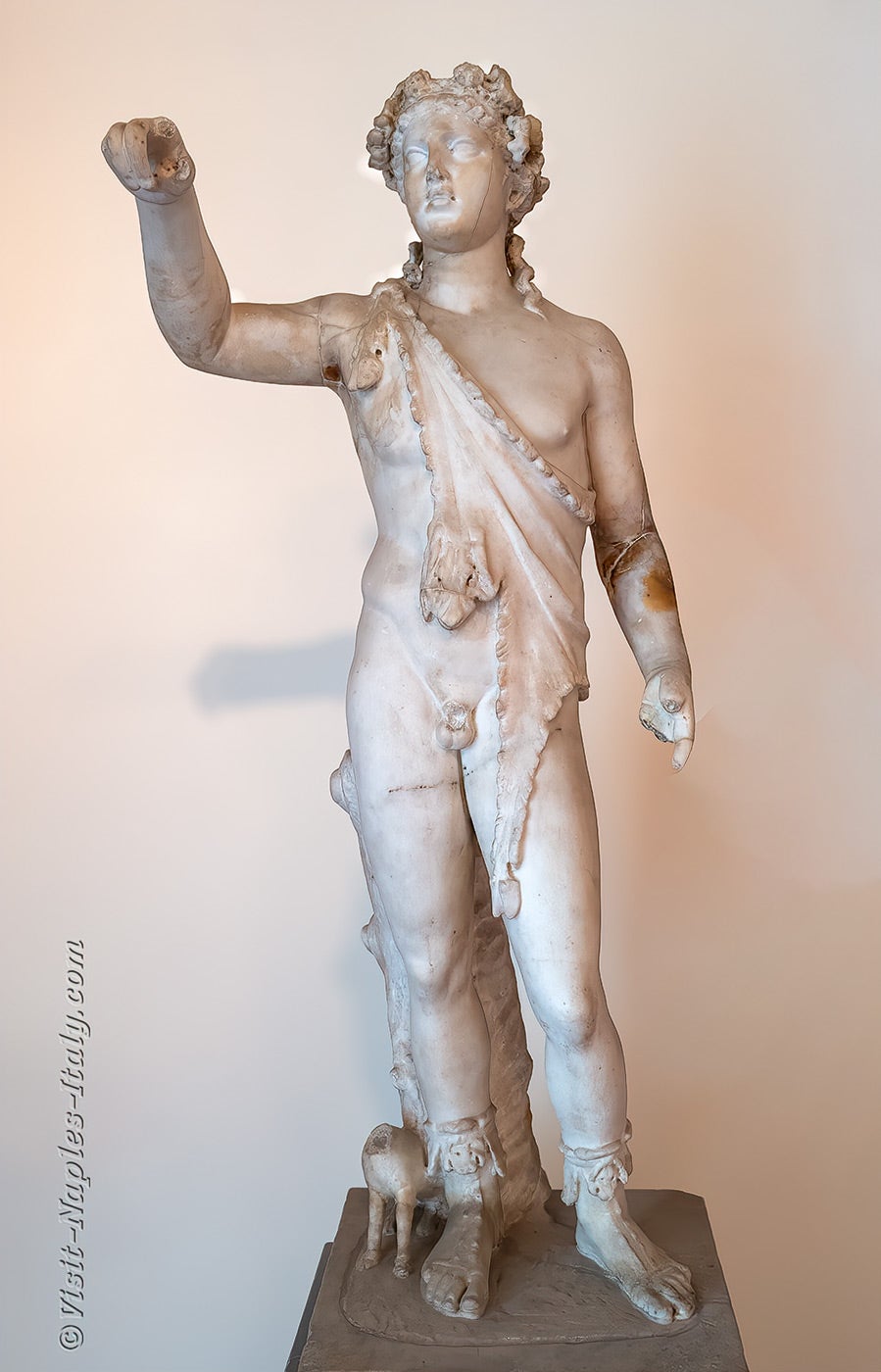
Dionysus Osiris Dionysus was holding a kantharos, now lost, to pour wine into the mouth of the panther lying at his feet, whose head is also missing.
Dionysus is clad only in a nebride fastened to his right shoulder and light sandals.
The presence of this statue of Dionysus in the Temple of Isis can be explained by the fact that Dionysus was often identified with the Egyptian god Osiris.
It was displayed in a small niche carved into the wall of the Temple of Isis.
An inscription at the foot of the statue indicates that it was a votive offering made by the father of the man who, in theory, built the temple.
Dionysius-Plato, Villa dei Papiri, Herculaneum
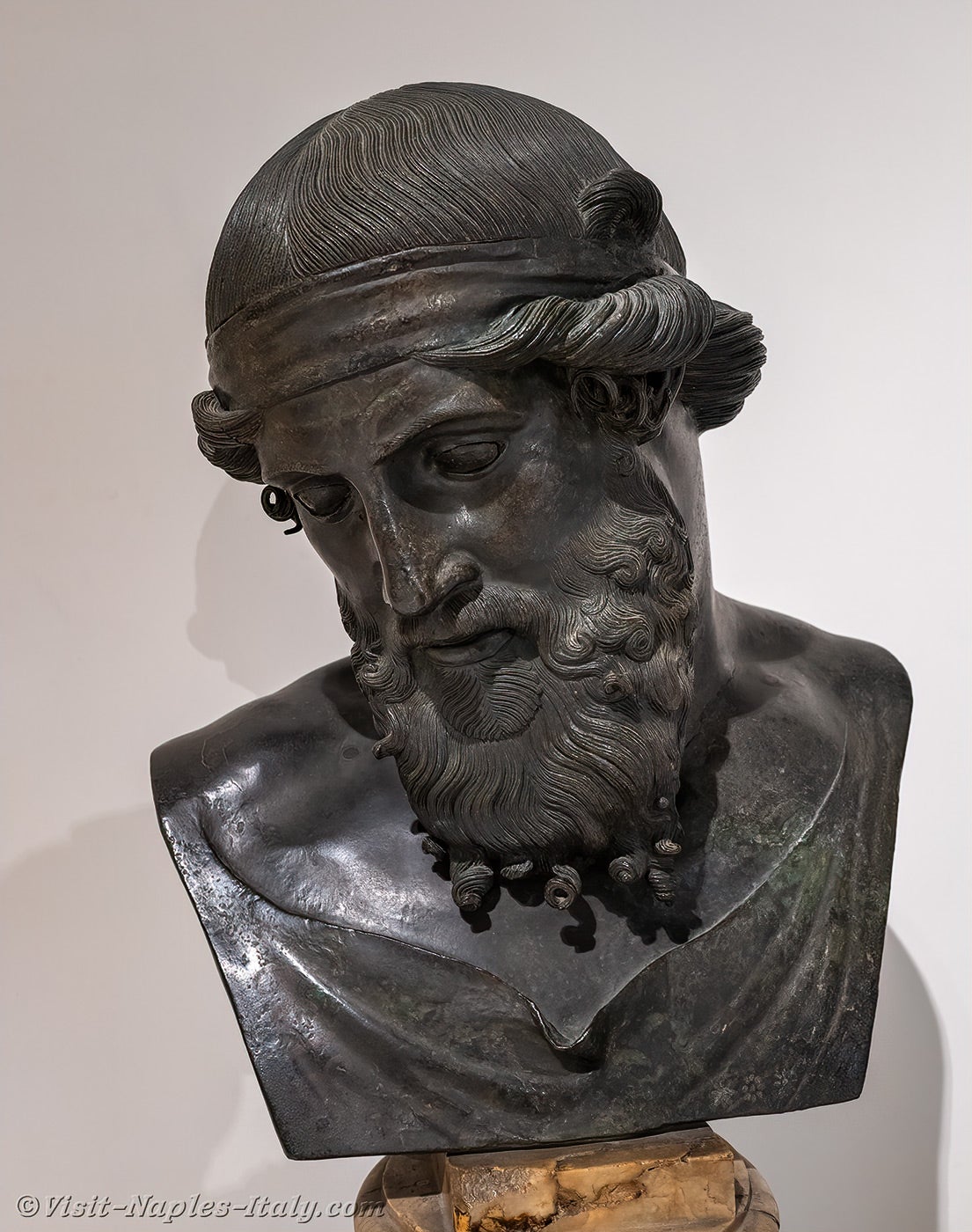
Dionysius-Plato Sculpture - Bronze (Height 60 cm) 1st century BC
This magnificent bronze bust, discovered in the Villa of the Papyri in Herculaneum, was long considered to be a portrait of Dionysus.
However, some art critics believe it could depict the philosopher Plato, hence the dual name under which this bust is displayed at the Archaeological Museum of Naples: Dionysus-Plato.
It is true that this bust appears to be that of a god with perfect features, his long, stylised hair held back by a headband.
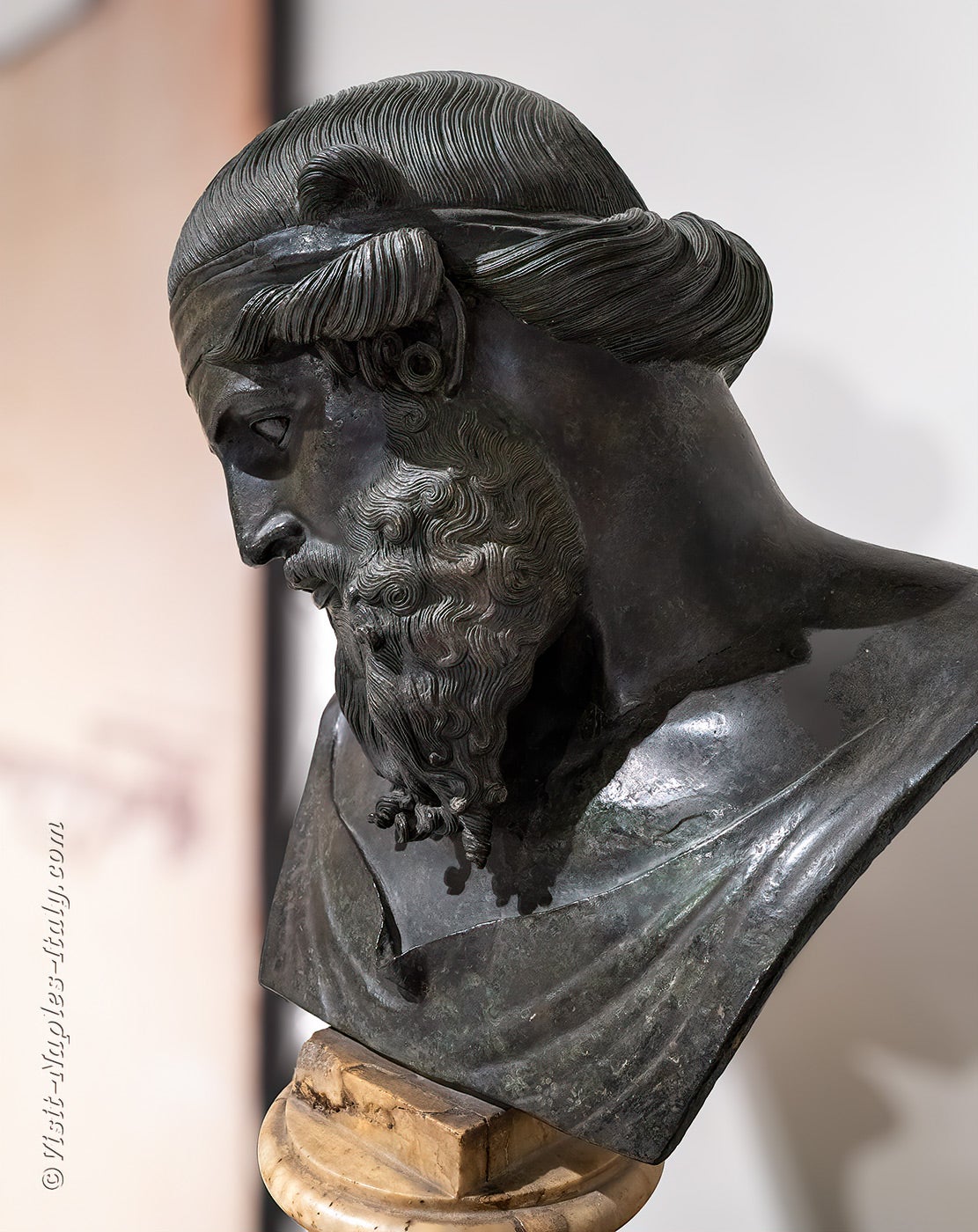
Dionysius-Plato This face is indeed reminiscent of the majestic and solemn poses of Dionysus as sculpted by Praxiteles.
A sarcophagus has also been found on which the face of a priest of Eleusis, where the cult of Dionysus took place, was similar to this one, with his beard and hair styled and tied in the same way.
God or philosopher, the figure looks thoughtfully downwards.
Finally, although a connection is obviously impossible chronologically speaking, it is striking to note the resemblance between this stylised face and that of the sculptures depicting Christ.
Antinous-Bacchus, Farnese Collection
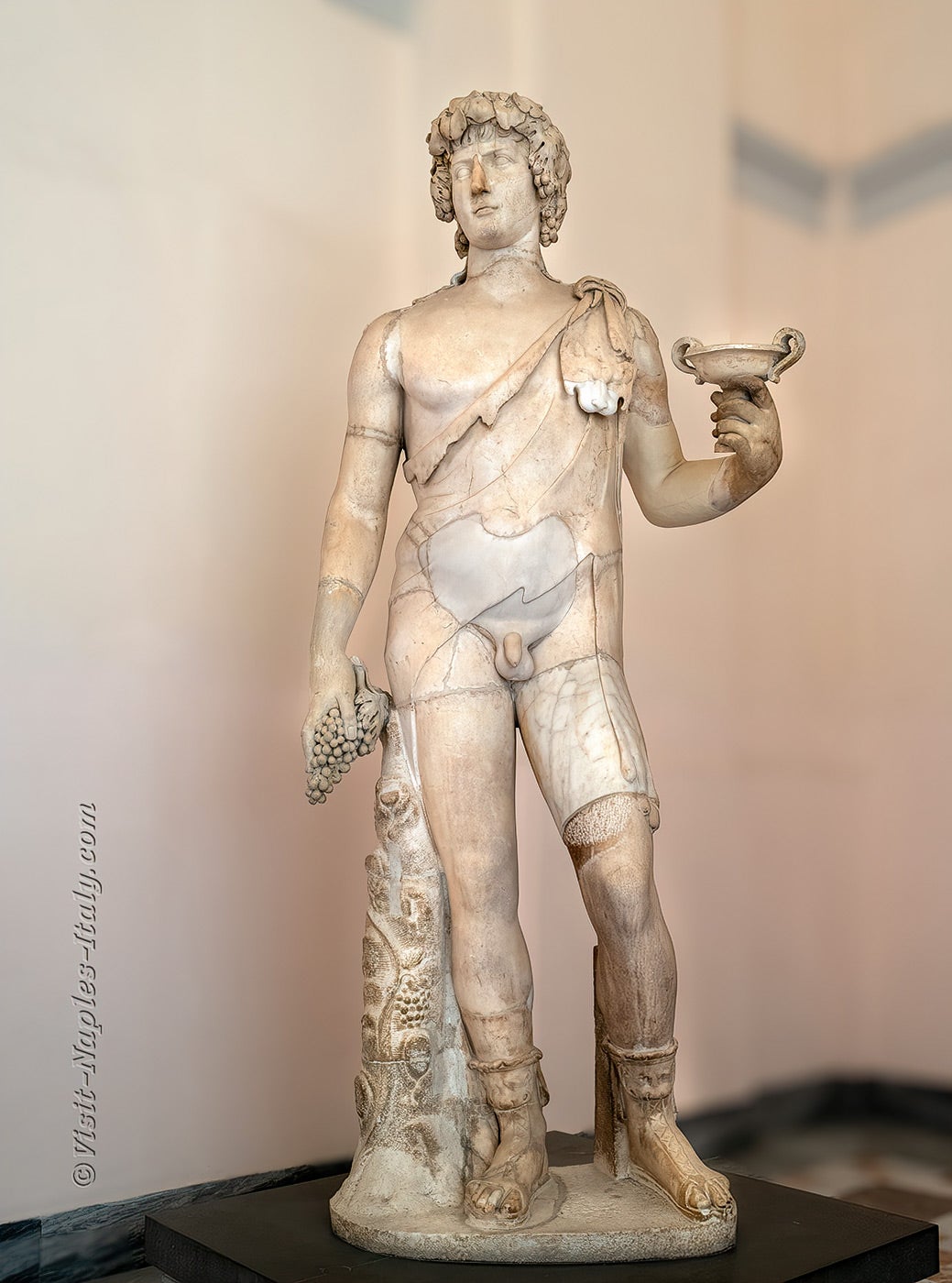
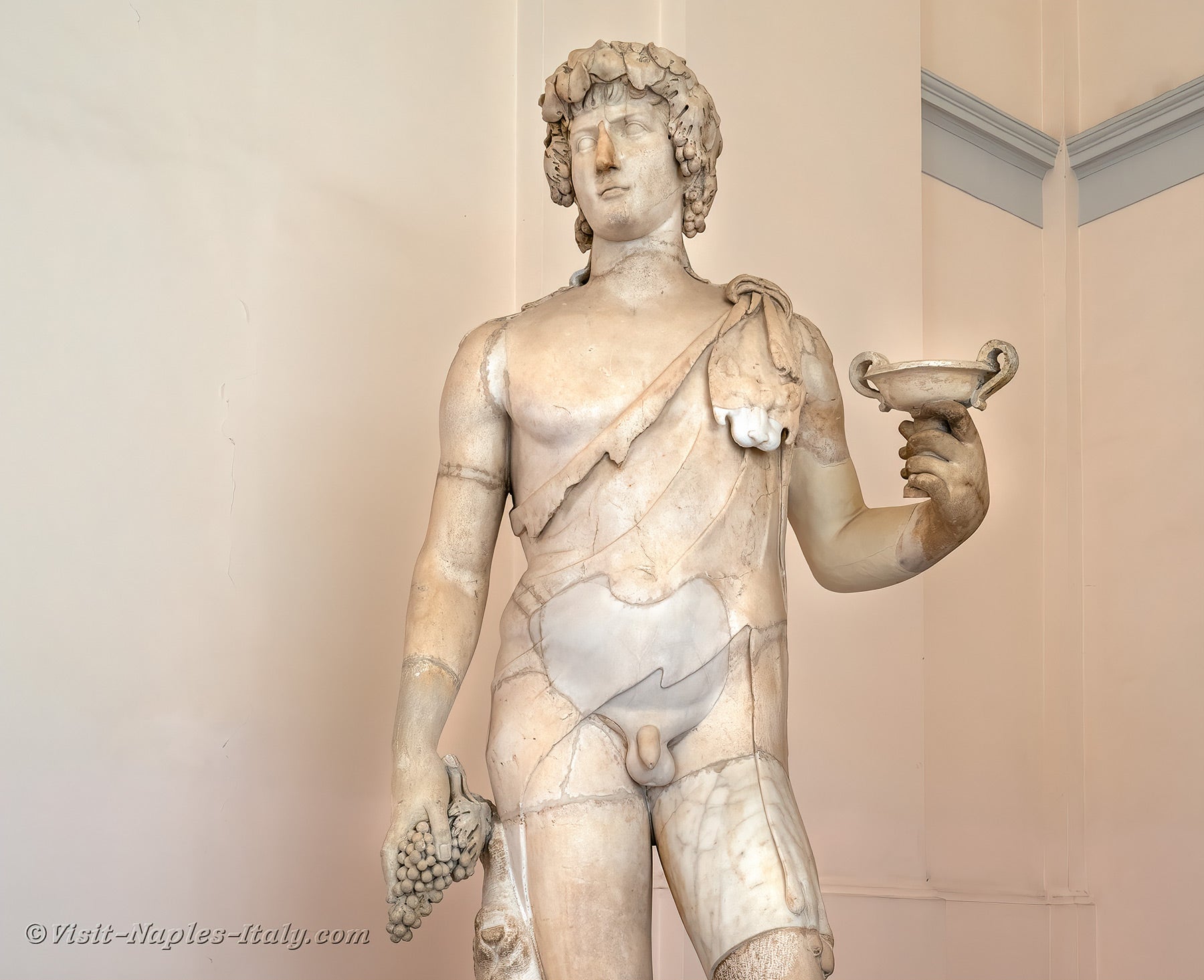
Sculpture - Marble (Height 297 cm) 130 ADThis large statue depicts Bacchus in the guise of Antinous, the favourite of Emperor Hadrian.
He wears a nebride slung over his shoulder and holds his wine cup proudly in his left hand and a bunch of grapes in his right.
On his head rests a crown made of bunches of grapes and vine leaves.
He is leaning against a column entwined with a vine garland.
His feet are elegantly shod in sandals adorned with animal heads above the ankle.
Dionysus Bacchus, Farnese Collection
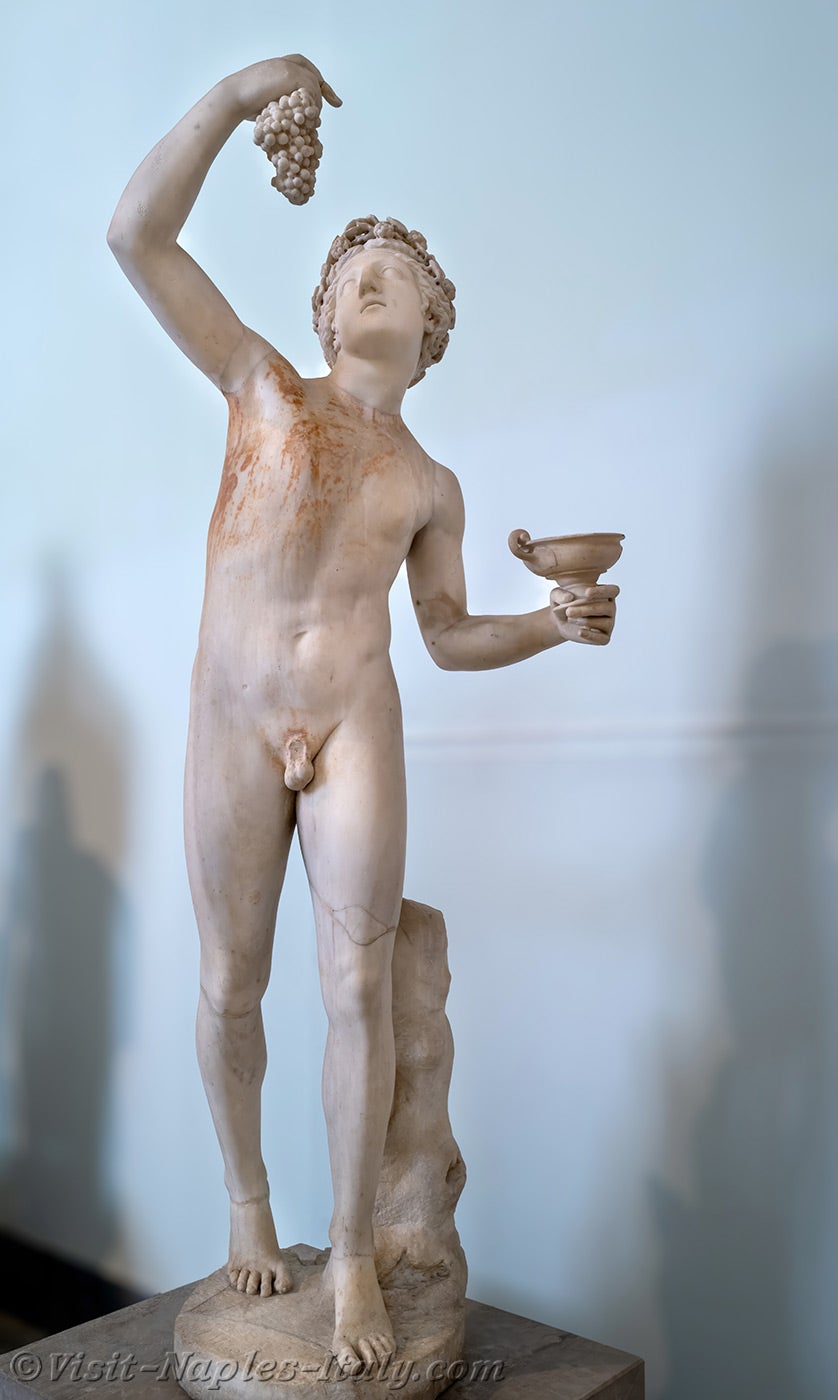
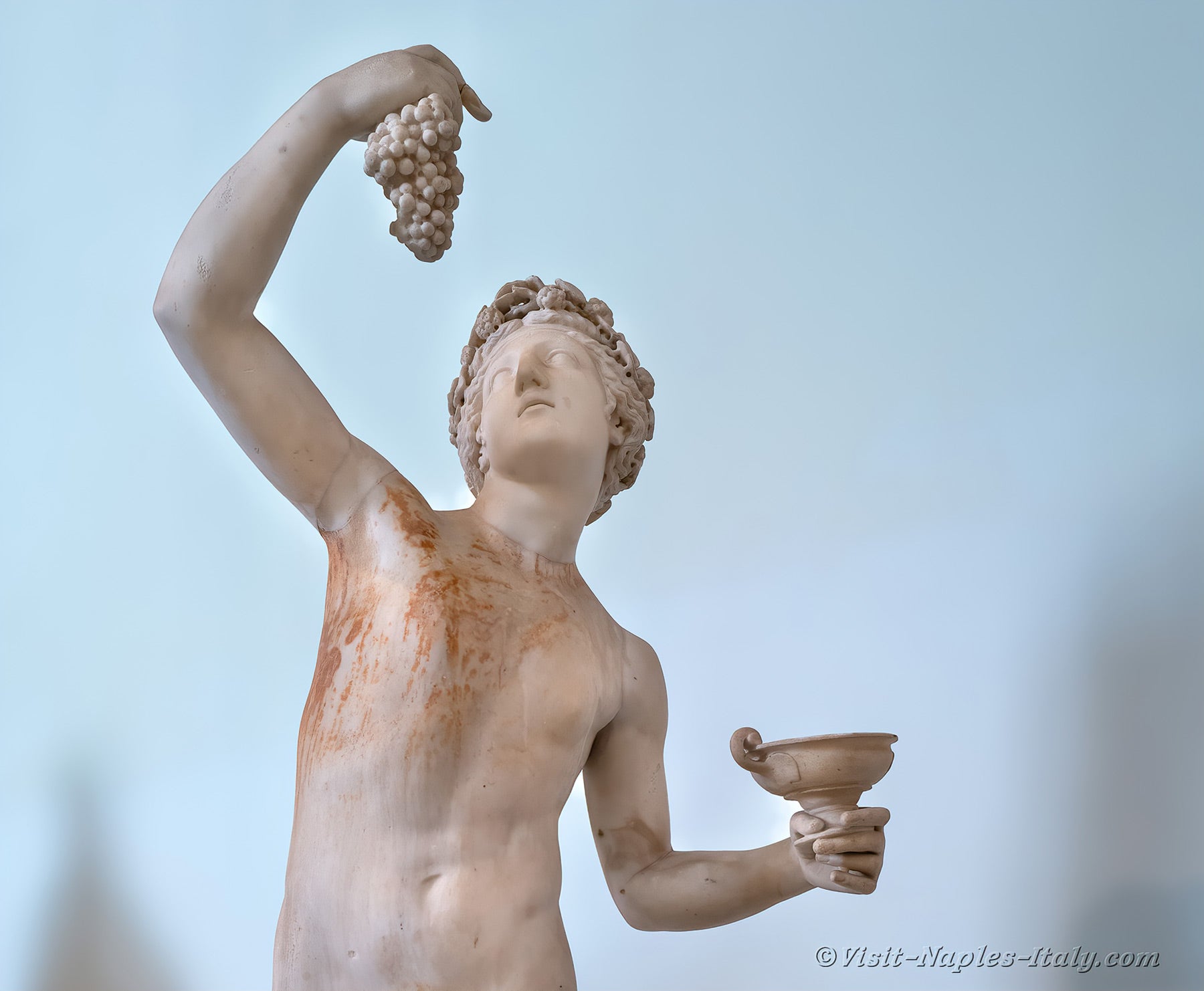
Sculpture - Marble (Height 157 cm) Late 2nd centuryDionysus is depicted here as a handsome youth with his head crowned with fruit and intertwined leaves.
He is naked and holds a cup of wine in his left hand, whilst admiring the bunch of grapes which he raises above his head in a gesture of adoration.
Dionysus as a Faun, Farnese Collection
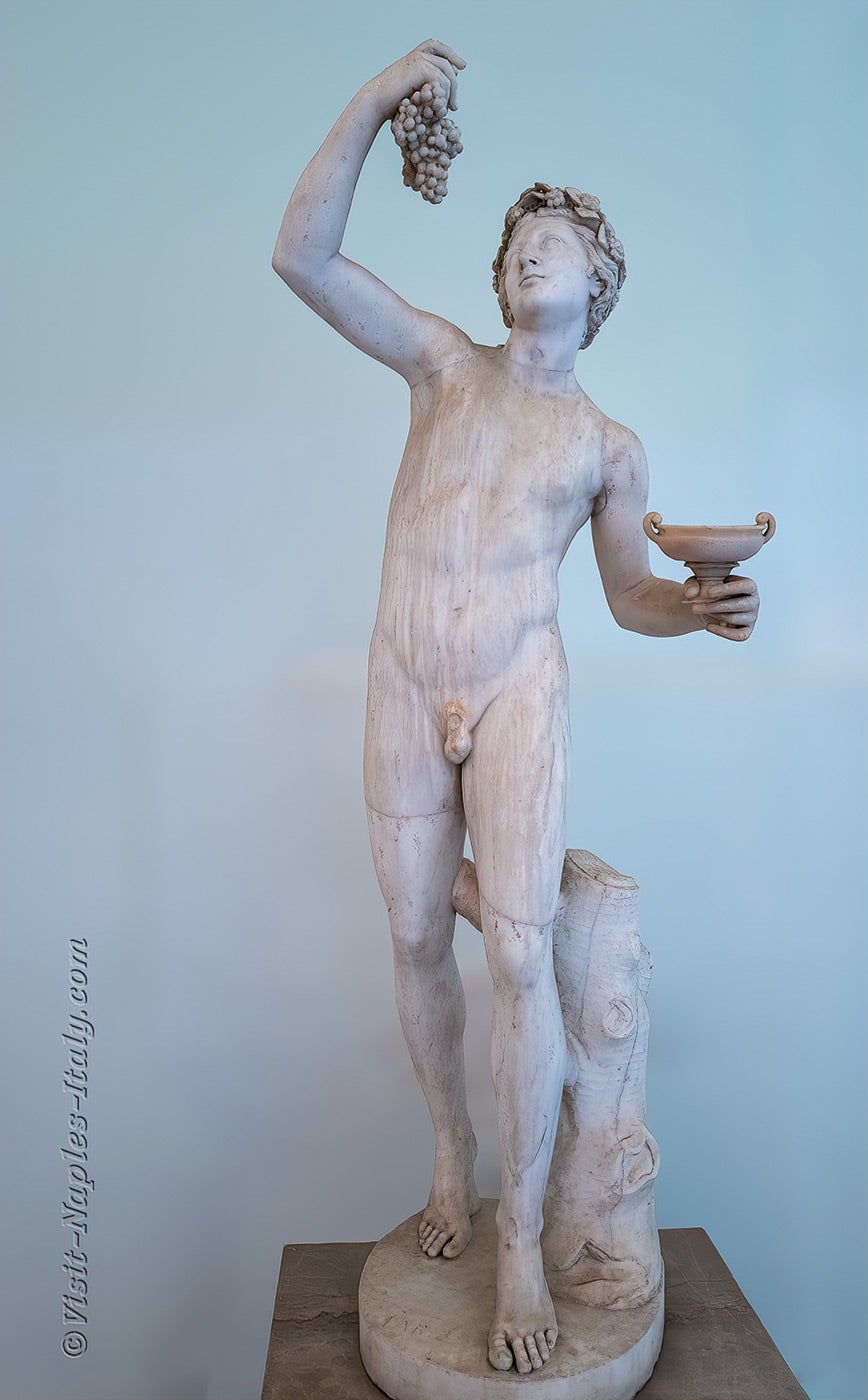
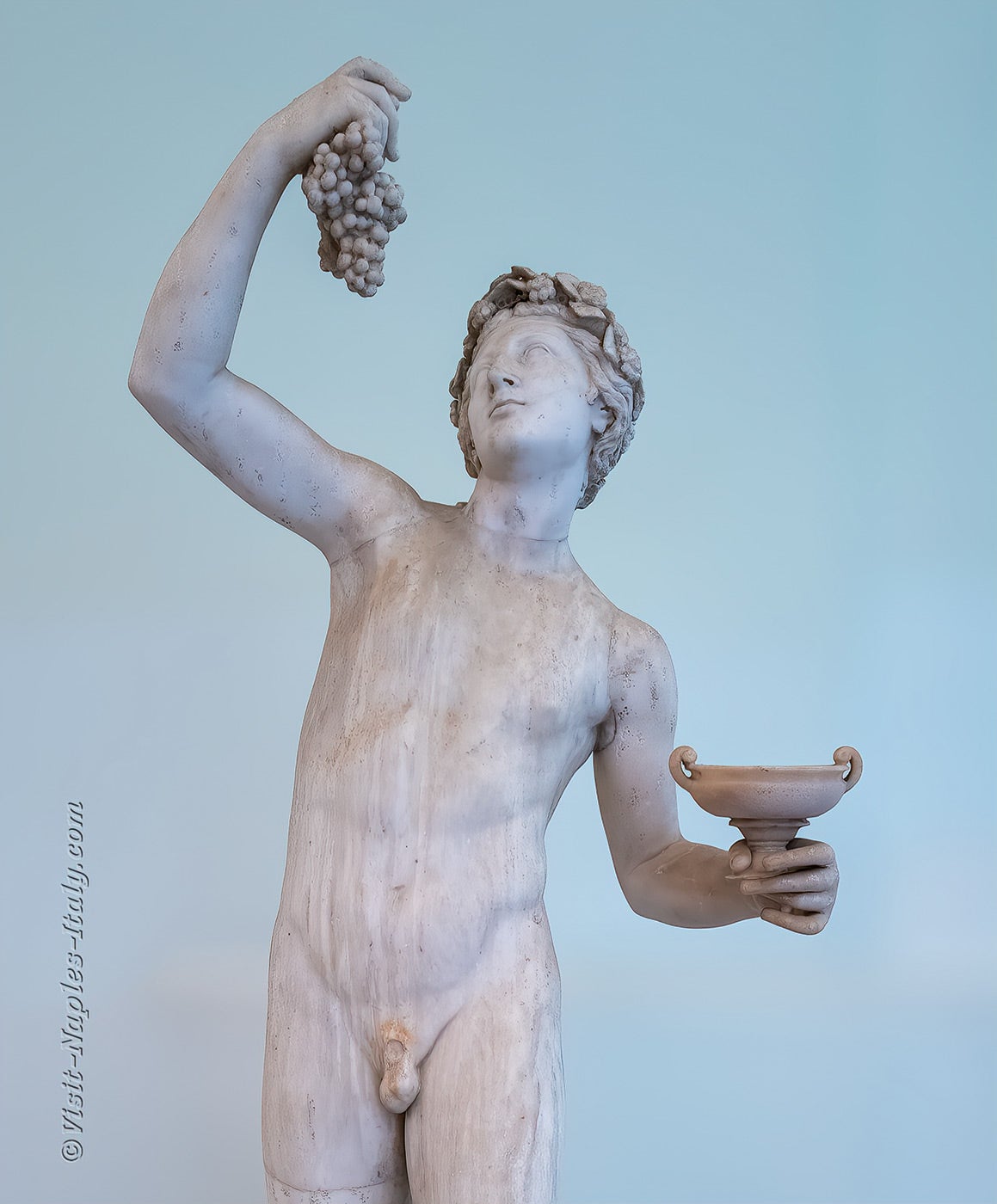
Sculpture - Marble (Height 156 cm) Late 2nd centuryHere we see the same type of ephebe in the same pose as that of the previous statue.
These two Roman copies of Greek statues were carved during the same period and are also the same size, to within a centimetre.
And to add to what seems to link them, they were part of the Farnese Collection.
Mythology Achilles | Aesculapius | Amazons | Aphrodite Venus | Apollo | Artemis | Athena Minerva | Atlas | Concordia | Danaids | Diomedes | Dionysus | Dirce | Flora | Ganymede | Hera Juno | Hercules | Hermes | Nike | Orestes | Psyche | River | Satyrs | Zeus
Sculptures Mythology | Persons | Animals | Bas-relief
Artworks Sculptures | Frescoes | Eroticism
MANN Artworks Schedule Tickets Location | Authorizations
Back to Top of Page