

MANN Artworks Schedule Tickets Location | Authorizations
Artworks Sculptures | Frescoes | Eroticism
Sculptures Mythology | Persons | Animals | Bas-relief
Mythology Achilles | Aesculapius | Amazons | Aphrodite Venus | Apollo | Artemis | Athena Minerva | Atlas | Concordia | Danaids | Diomedes | Dionysus | Dirce | Flora | Ganymede | Hera Juno | Hercules | Hermes | Nike | Orestes | Psyche | River | Satyrs | Zeus
Sculptures of Hercules at the Archaeological Museum of Naples, Italy
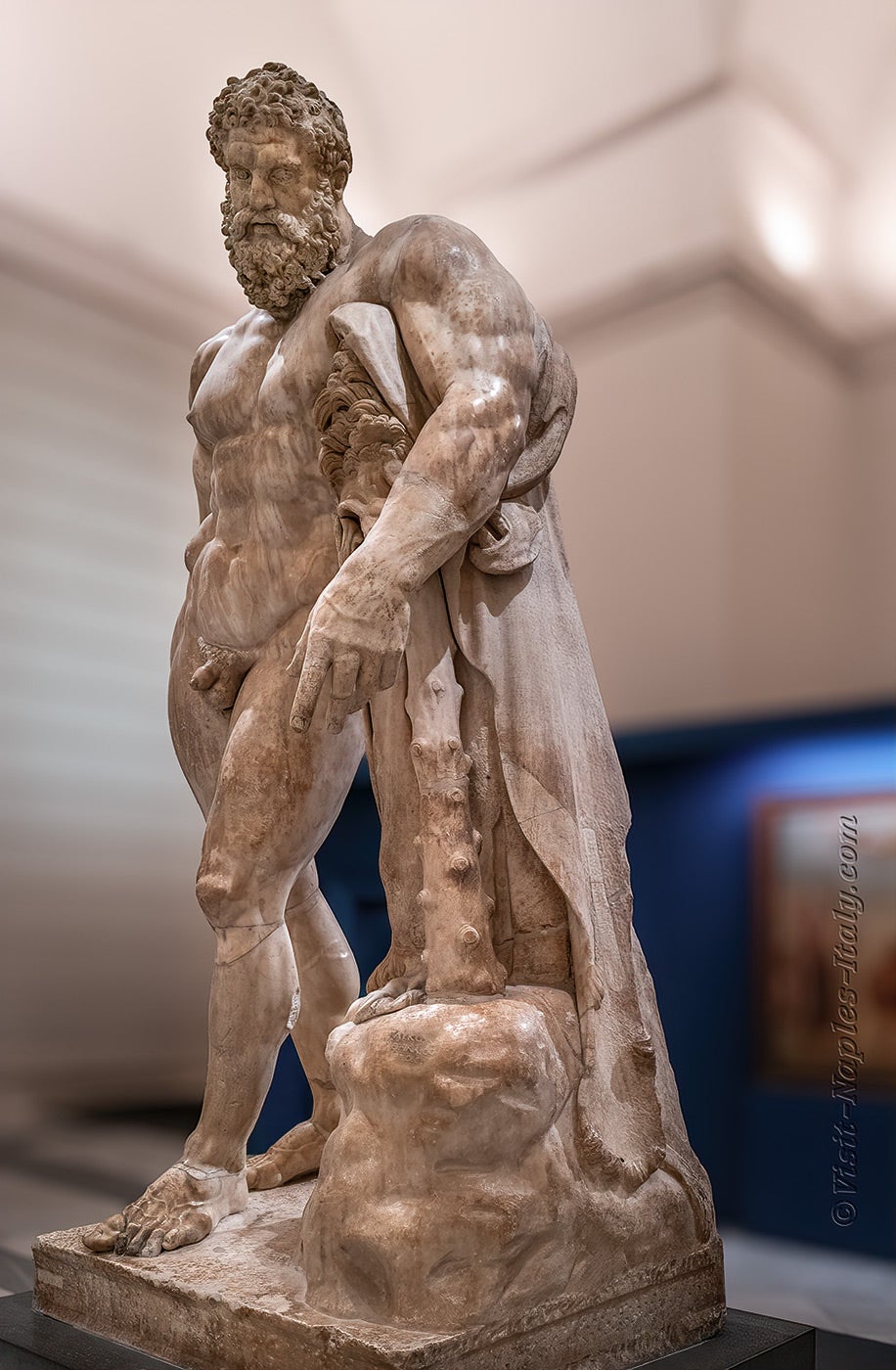
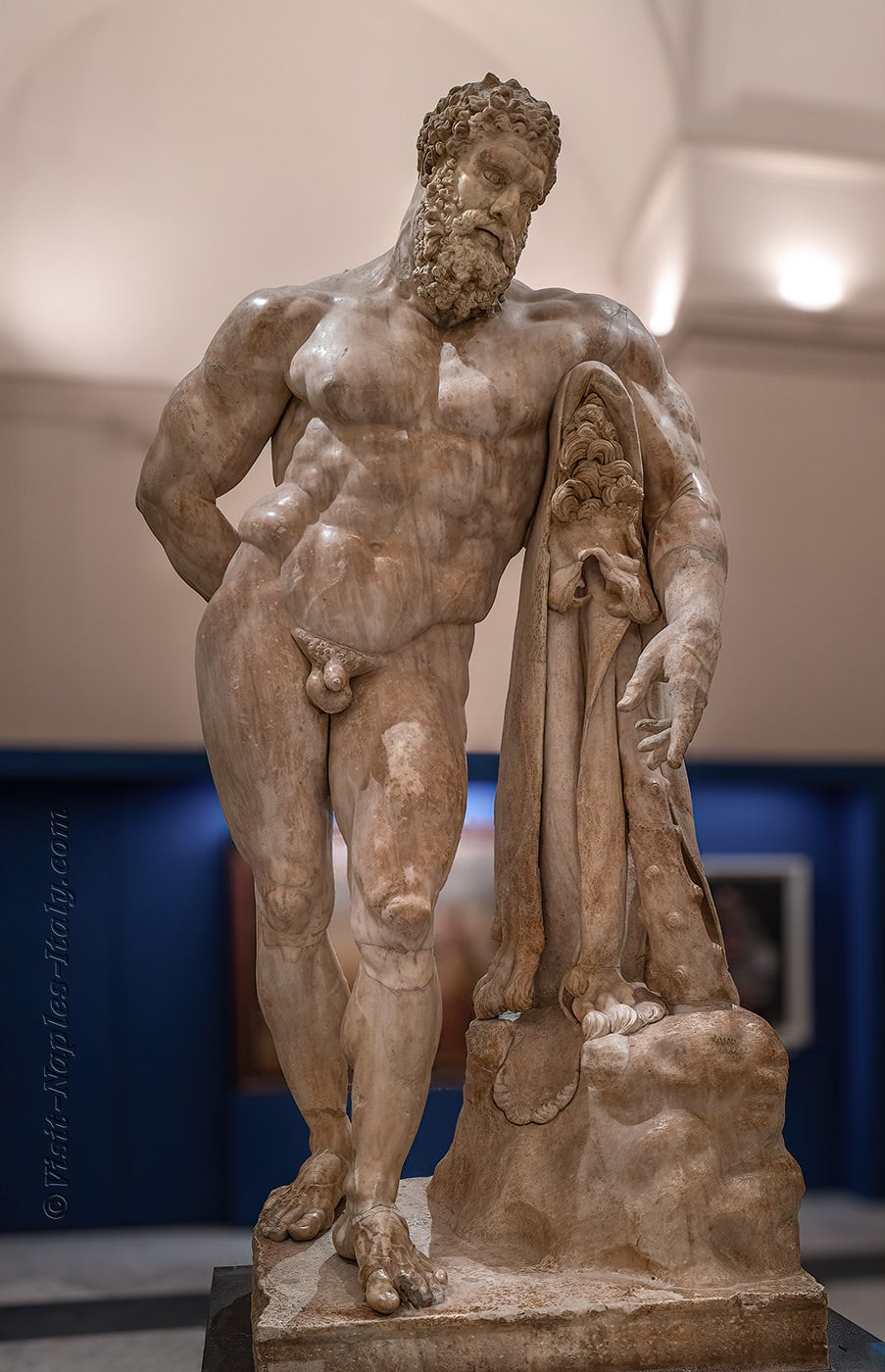
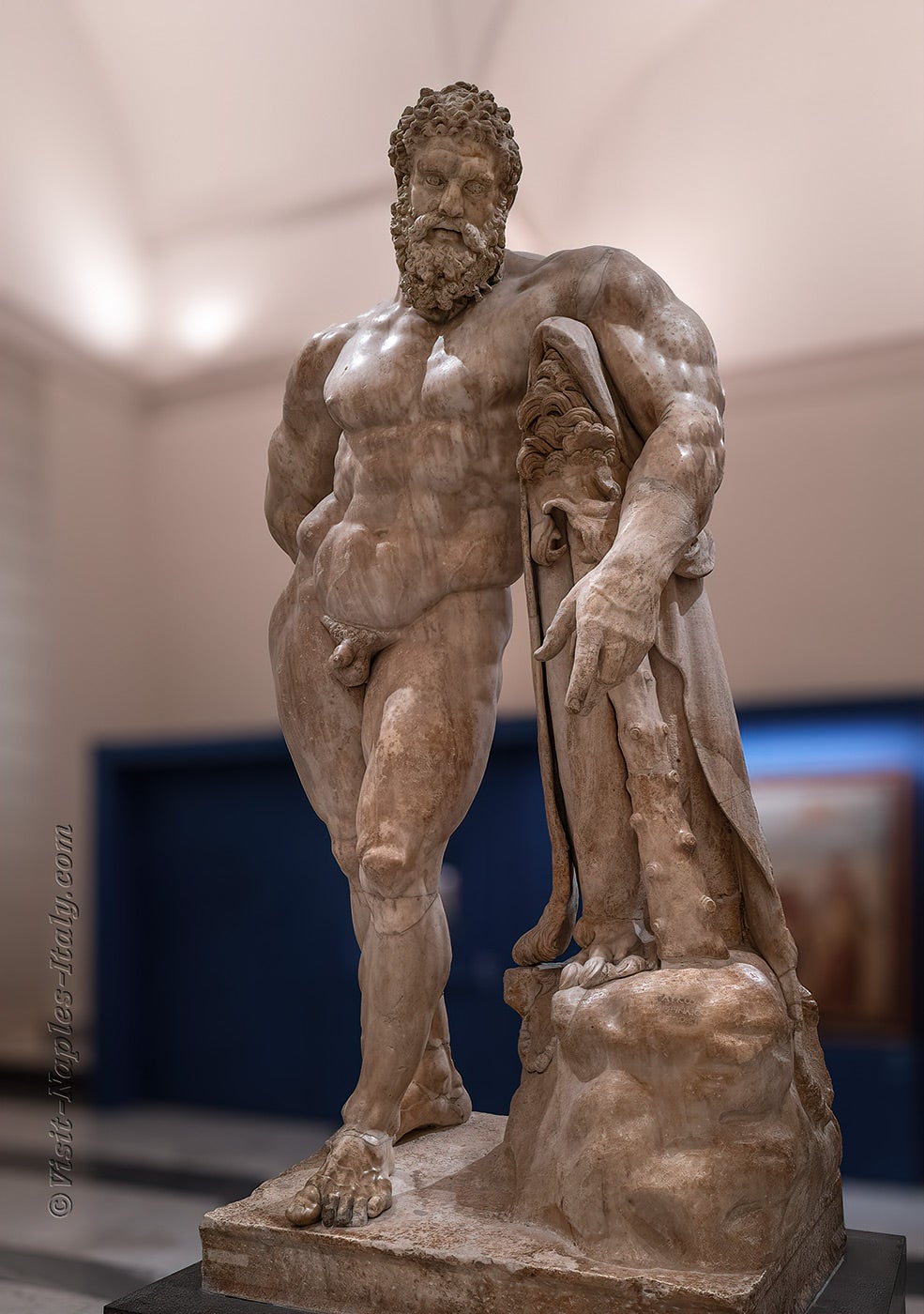
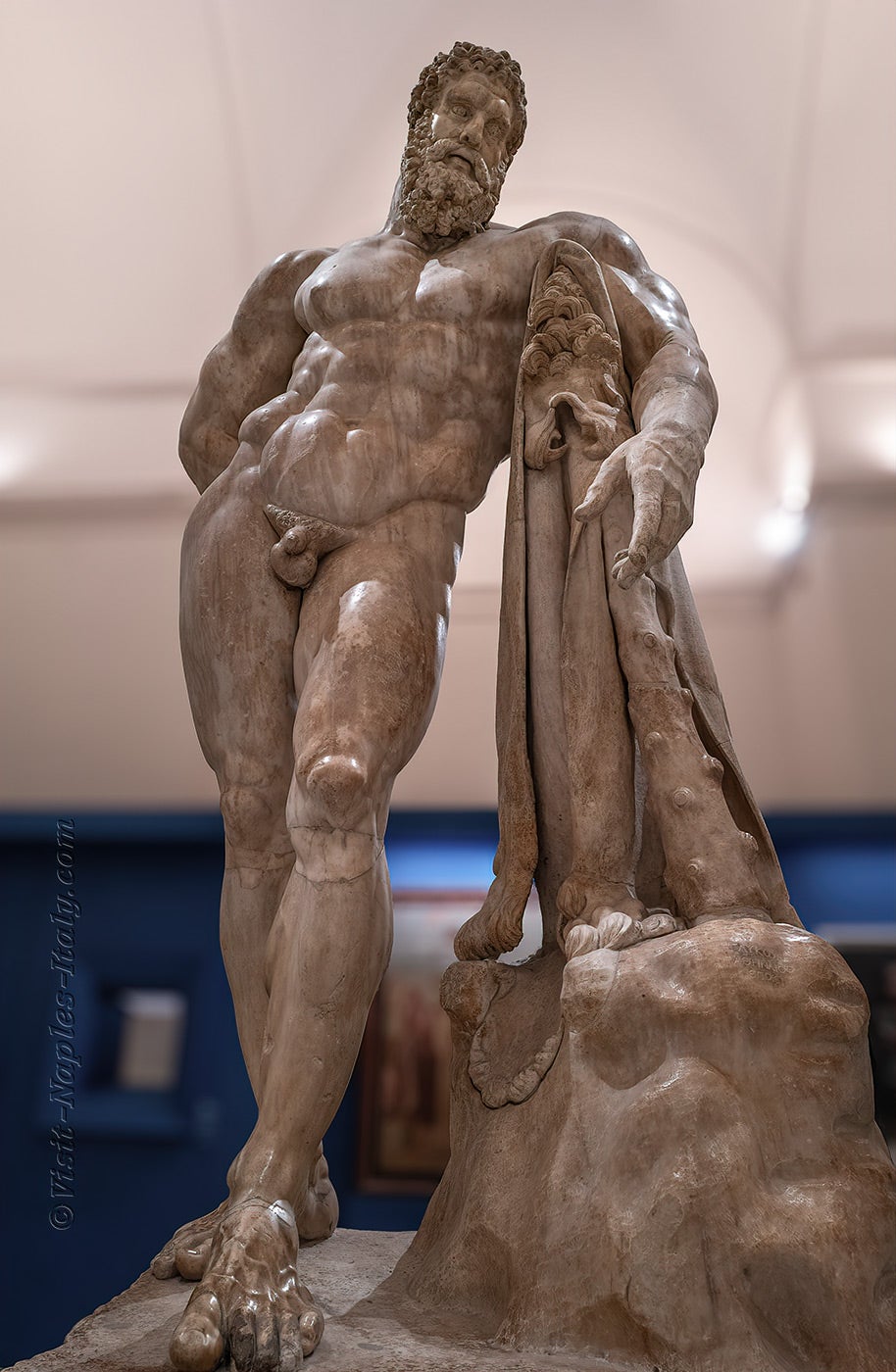
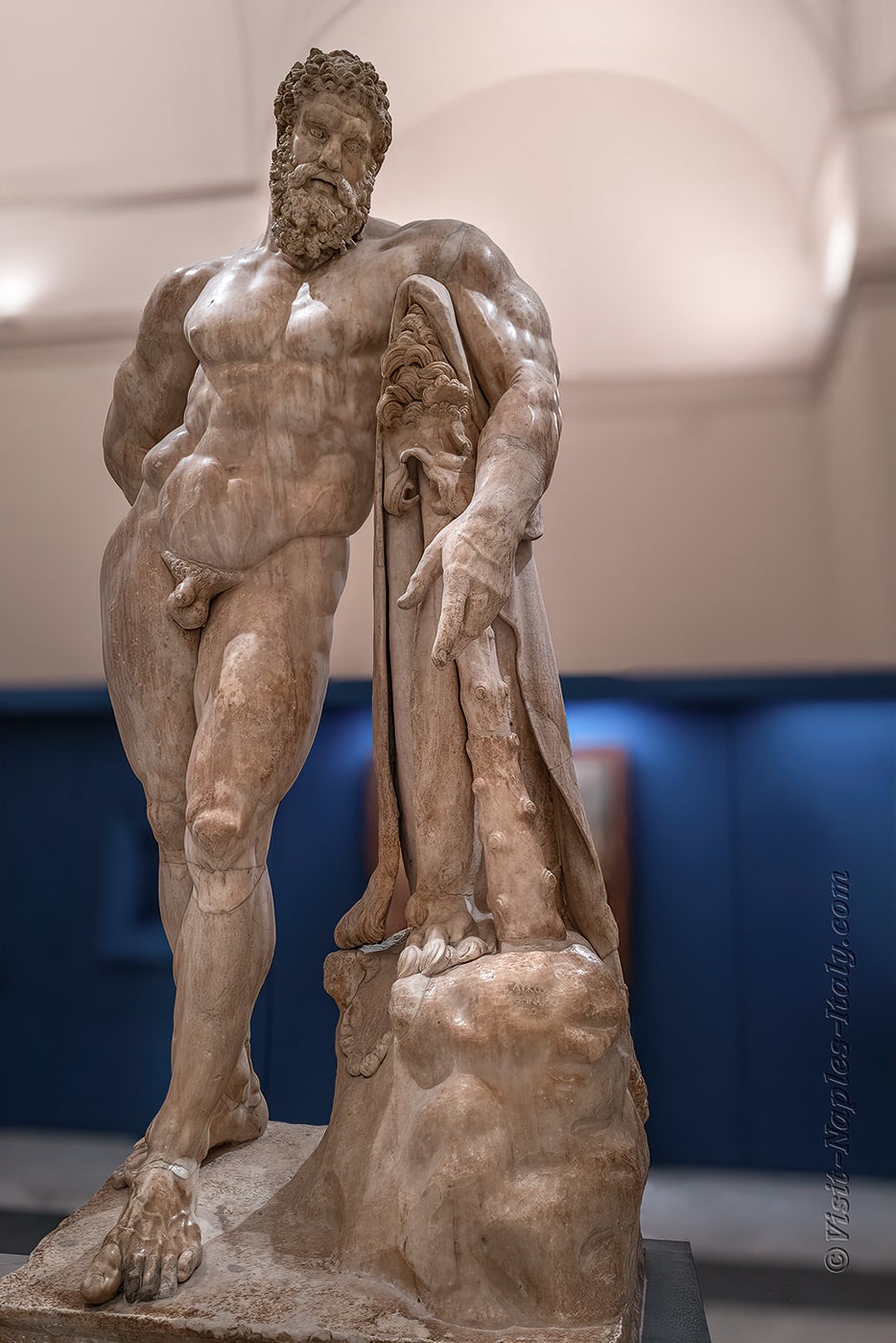
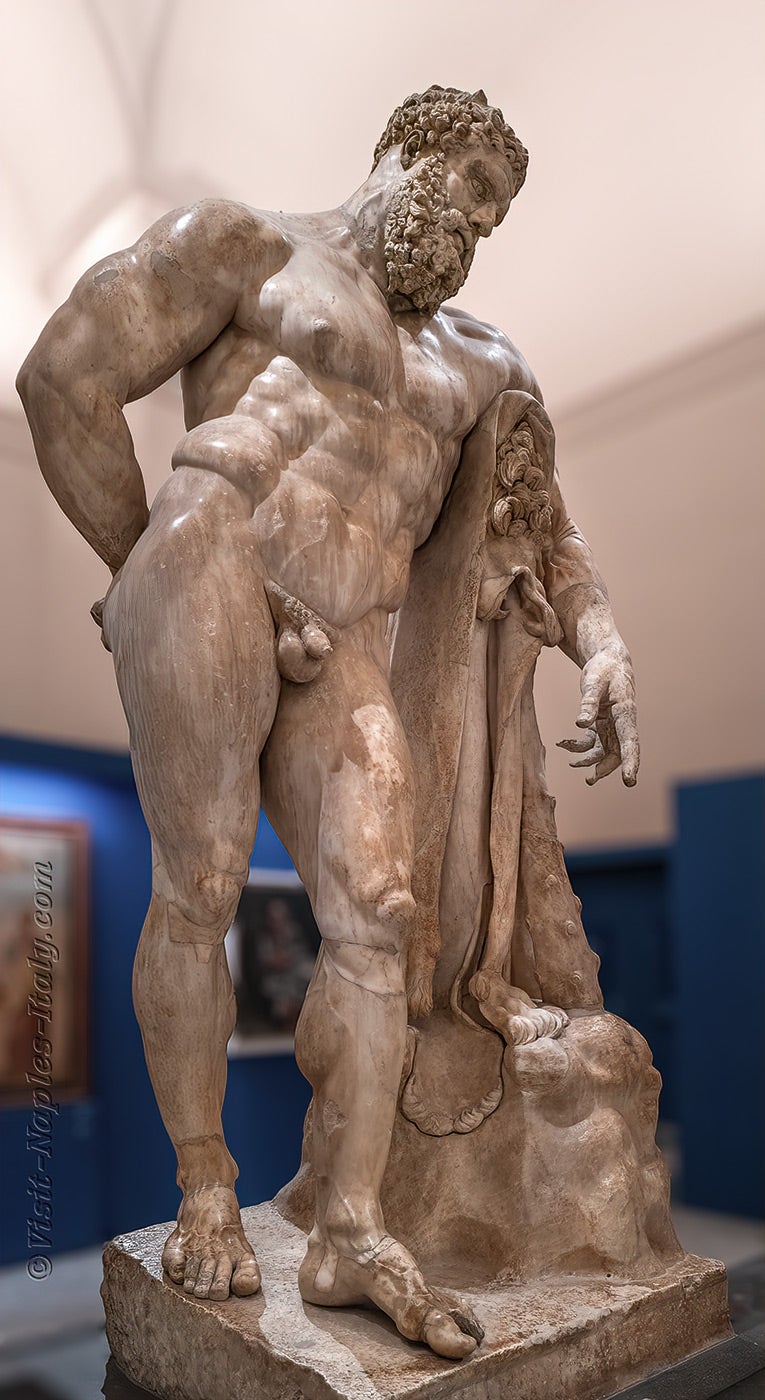
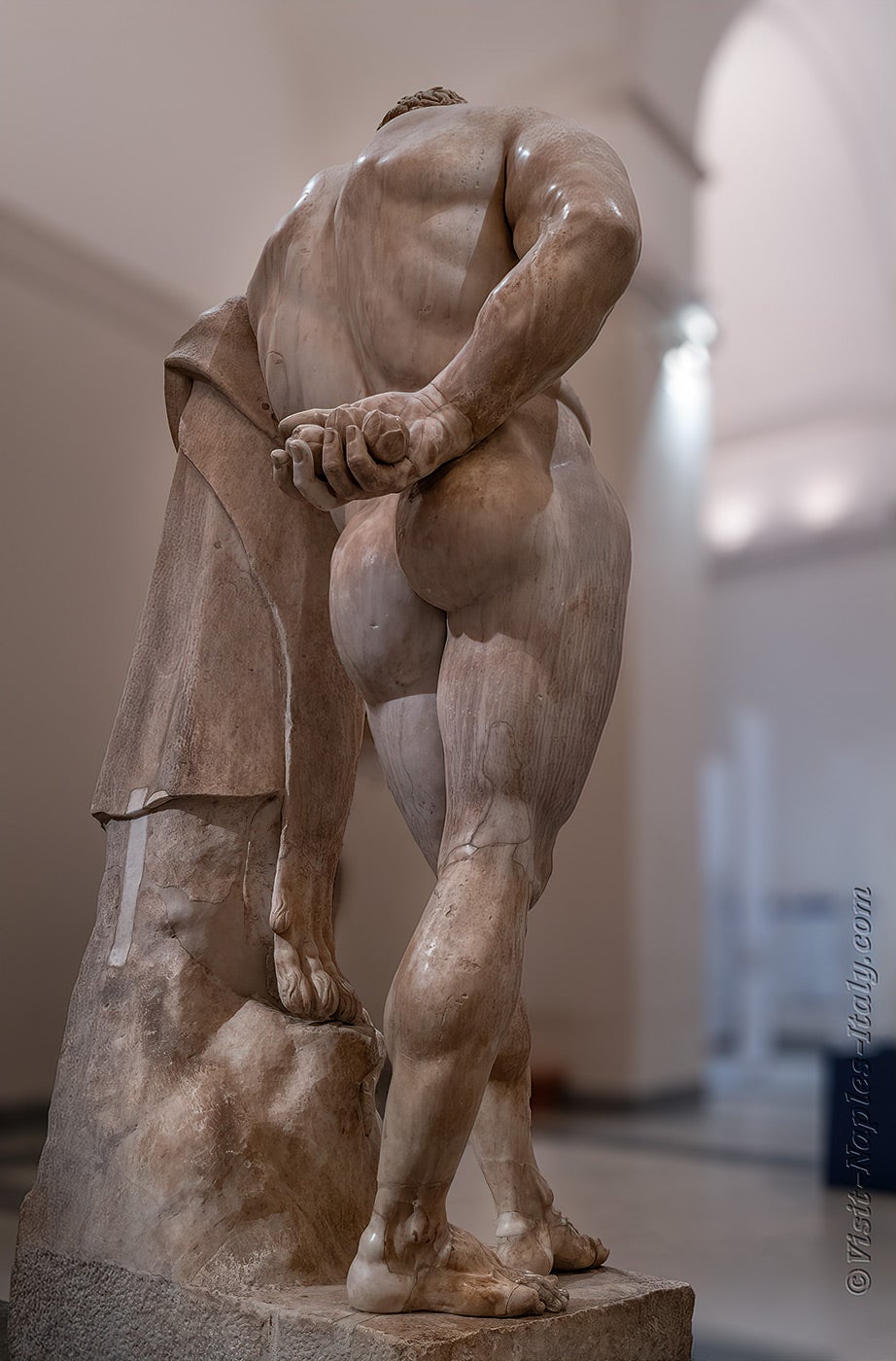
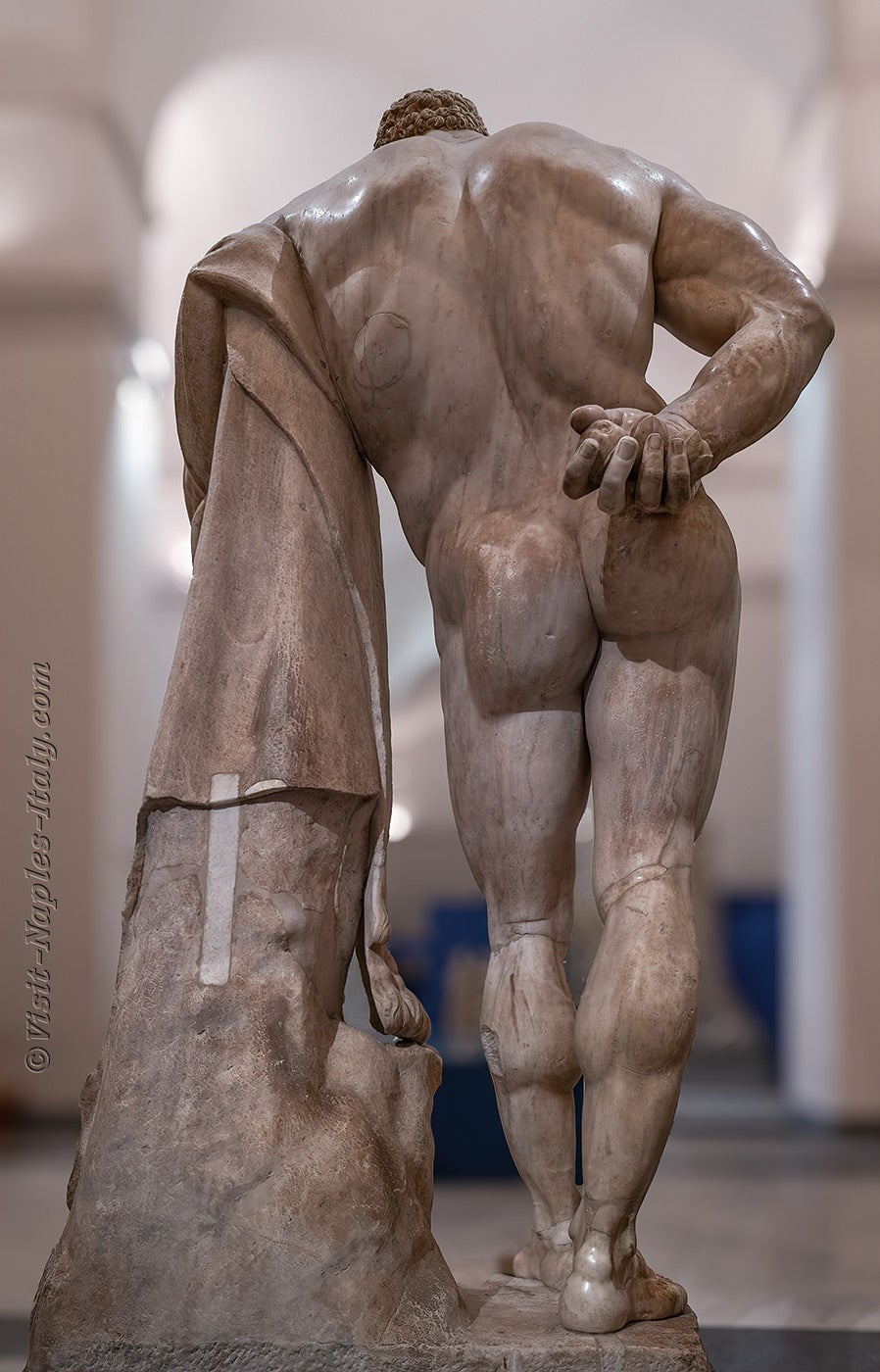
Hercules Farnese at Rest, Farnese Collection
Sculpture - Marble (Height 317 cm) 2nd-3rd centuryThis marble sculpture is a replica of a Greek original in bronze created by the sculptor Lysippos at the end of the 4th century BC.
His statue of Hercules thus became the idealised model of muscular power at its peak.
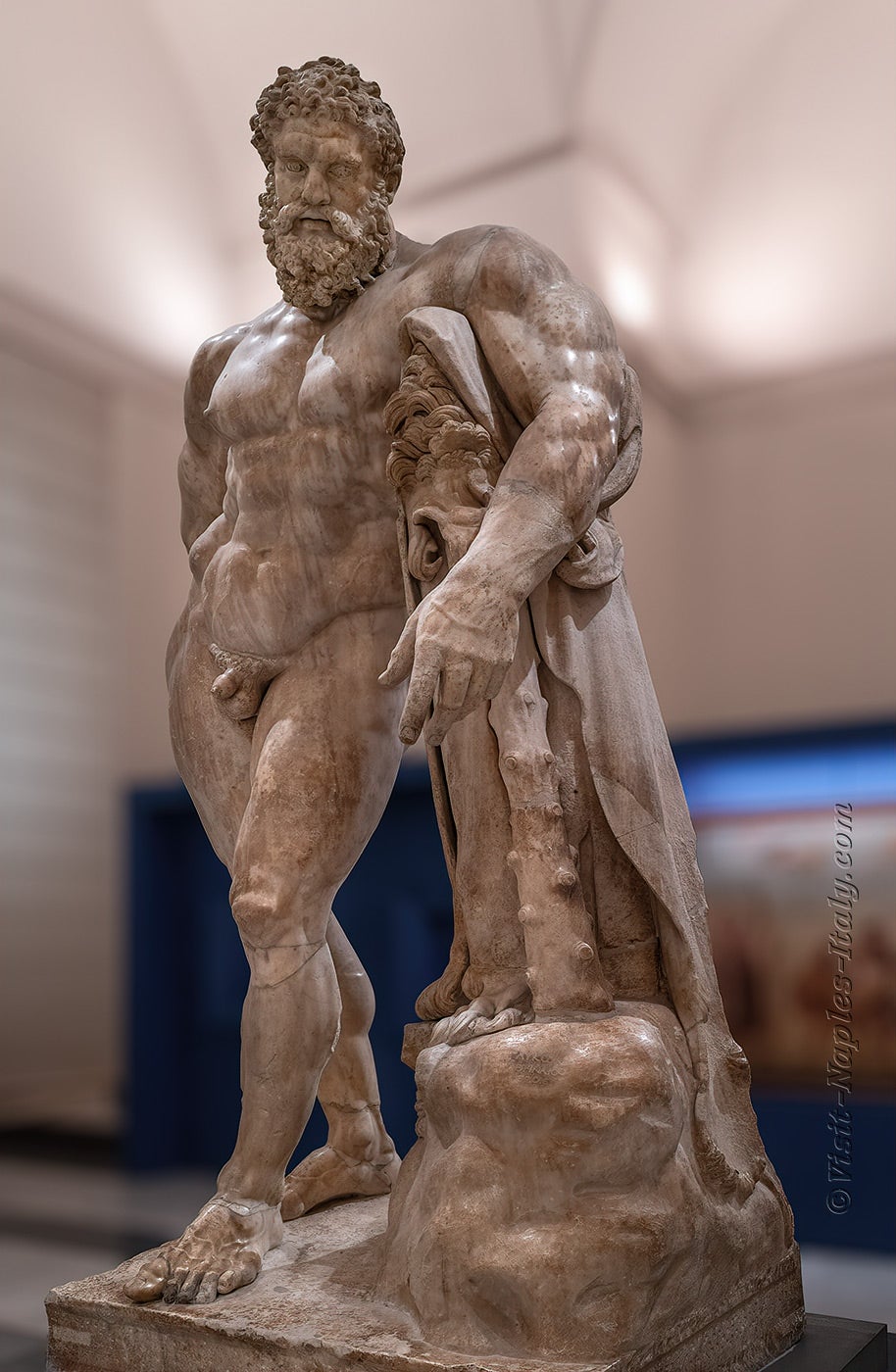
Hercules at Rest Hercules is depicted at rest, his right hand hidden behind his back, simply resting against his hip as he holds the golden apples from the Garden of the Hesperides, which he stole to complete his eleventh labour.
These golden apples which grew at the foot of Mount Atlas were guarded by the Hesperides, the three evening nymphs, aided by an immortal dragon.
Hercules had offered to hold up the heavens for Atlas whilst he went to pick three golden apples; but when Atlas refused to take up his burden again upon his return with the apples, Hercules devised a ruse to free himself and escape with the apples.
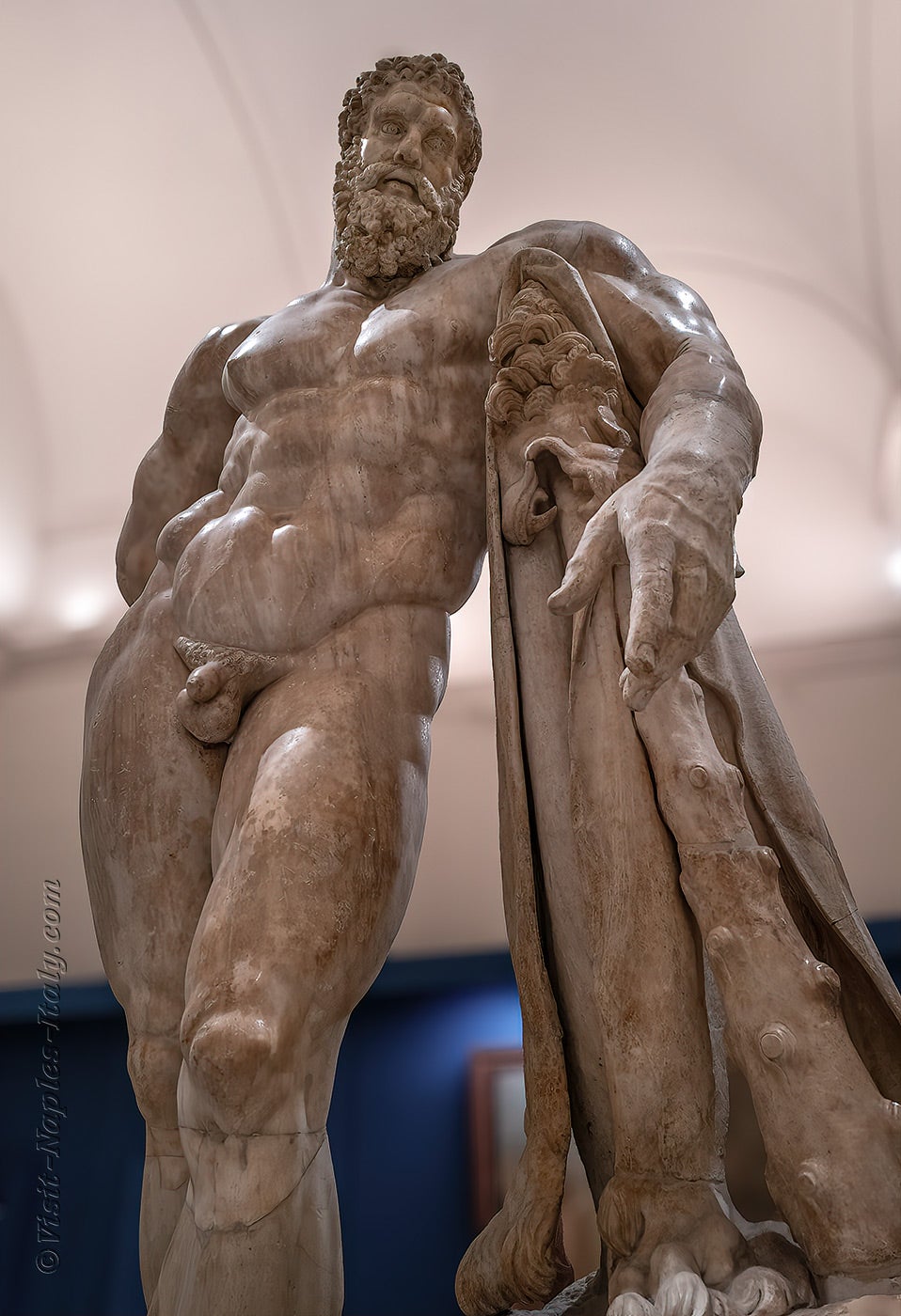
This magnificent sculpture depicts Hercules leaning on his club, clad in the skin of the Nemean lion which he had conquered whilst accomplishing the first of his twelve labours.
His musculature is impressive, hypertrophied, where every muscle is developed to the maximum to convey this image of a body that is perfectly proportioned combining strength with beauty.
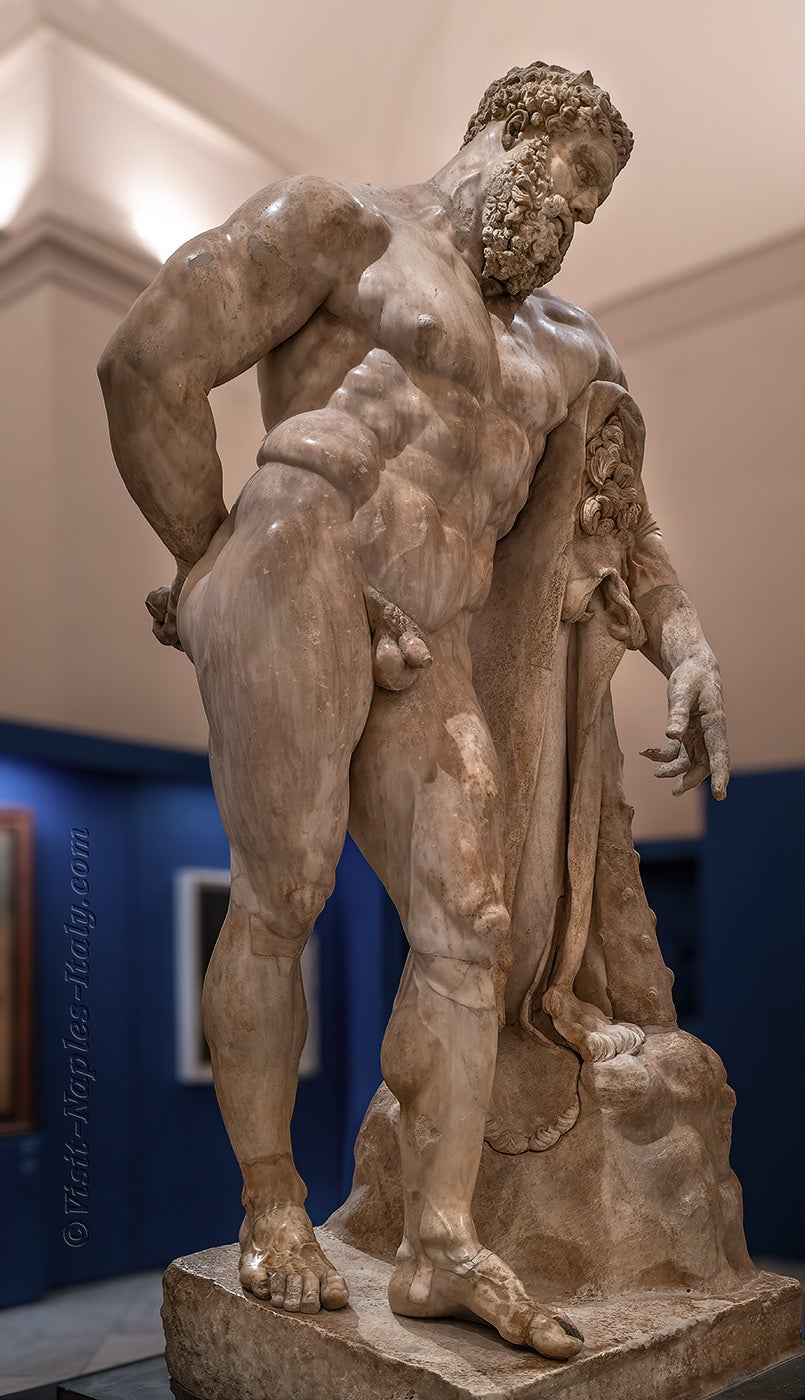
Hercules at Rest His head follows the angle of his torso, which bends and makes his muscles stand out as he leans on his club, creating this overall harmony that gives him a commanding presence.
His handsome, mature face with a beard and curly hair reveals the gravitas of this Greek hero who generously put his physical strength at the service of justice.
Hercules takes a little rest, well deserved after having already succeeded in his first eleven labours by ridding the world of its monsters, thus having accomplished a civilising work.
He is clearly deep in thought, reflecting on what he has just achieved and on the immortality promised to him by Apollo should he succeed in all the labours, and aware that one final task still awaits him: the capture of Cerberus.
At the top of the rock where the club rests is written in Greek: “ΓΛΥΚΩΝ ΑΘΗΝΑΙΟΣ ΕΠΟΙΕΙ”, stating that it was made by Glycon the Athenian.
This large sculpture was discovered without legs or a head in 1546 in the Baths of Caracalla, at the same time as the “Farnese Bull” depicting the torment of Dirce.
The head and legs were fortunately rediscovered later.
Hercules at Rest, Pozzuoli
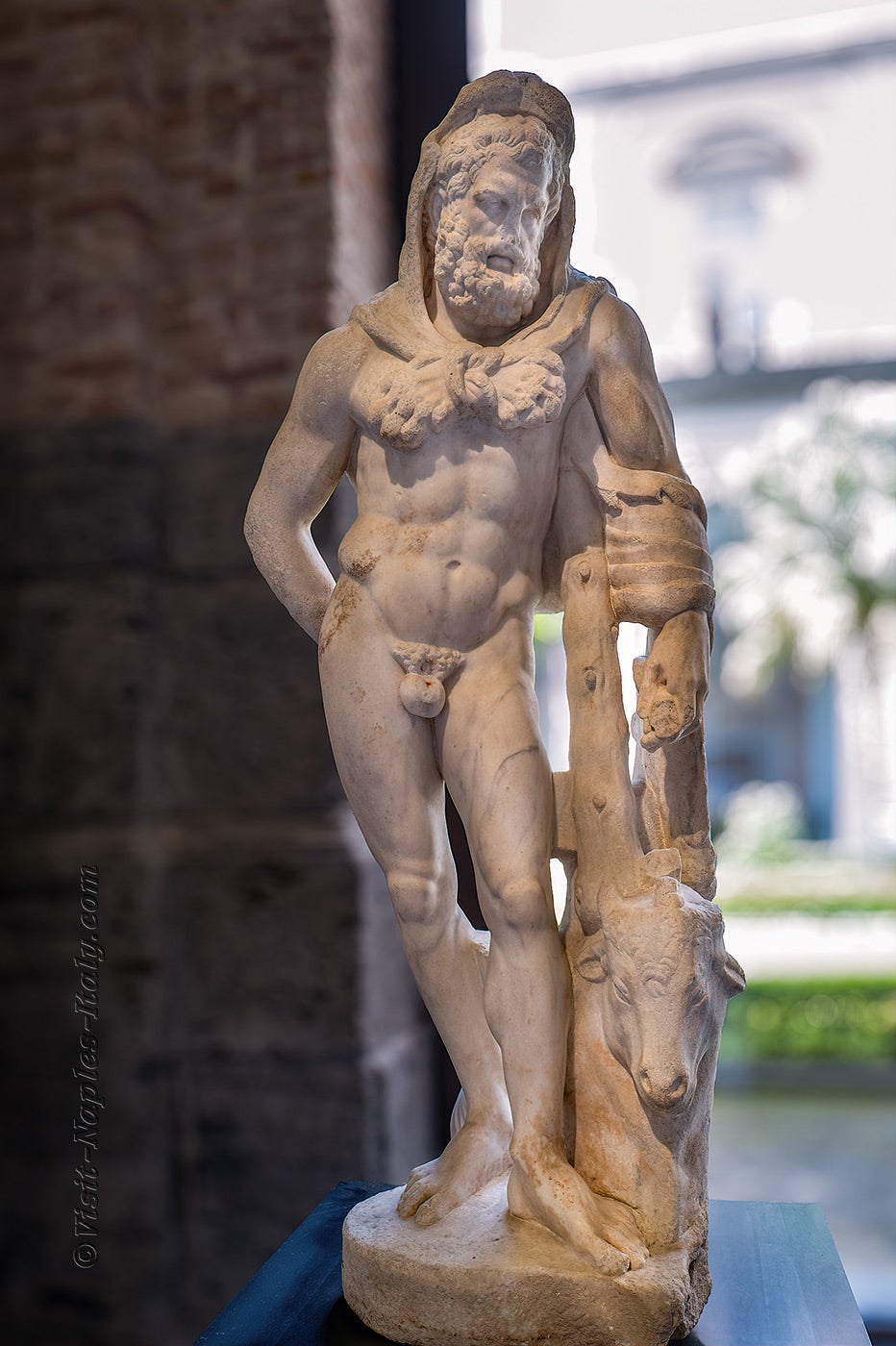
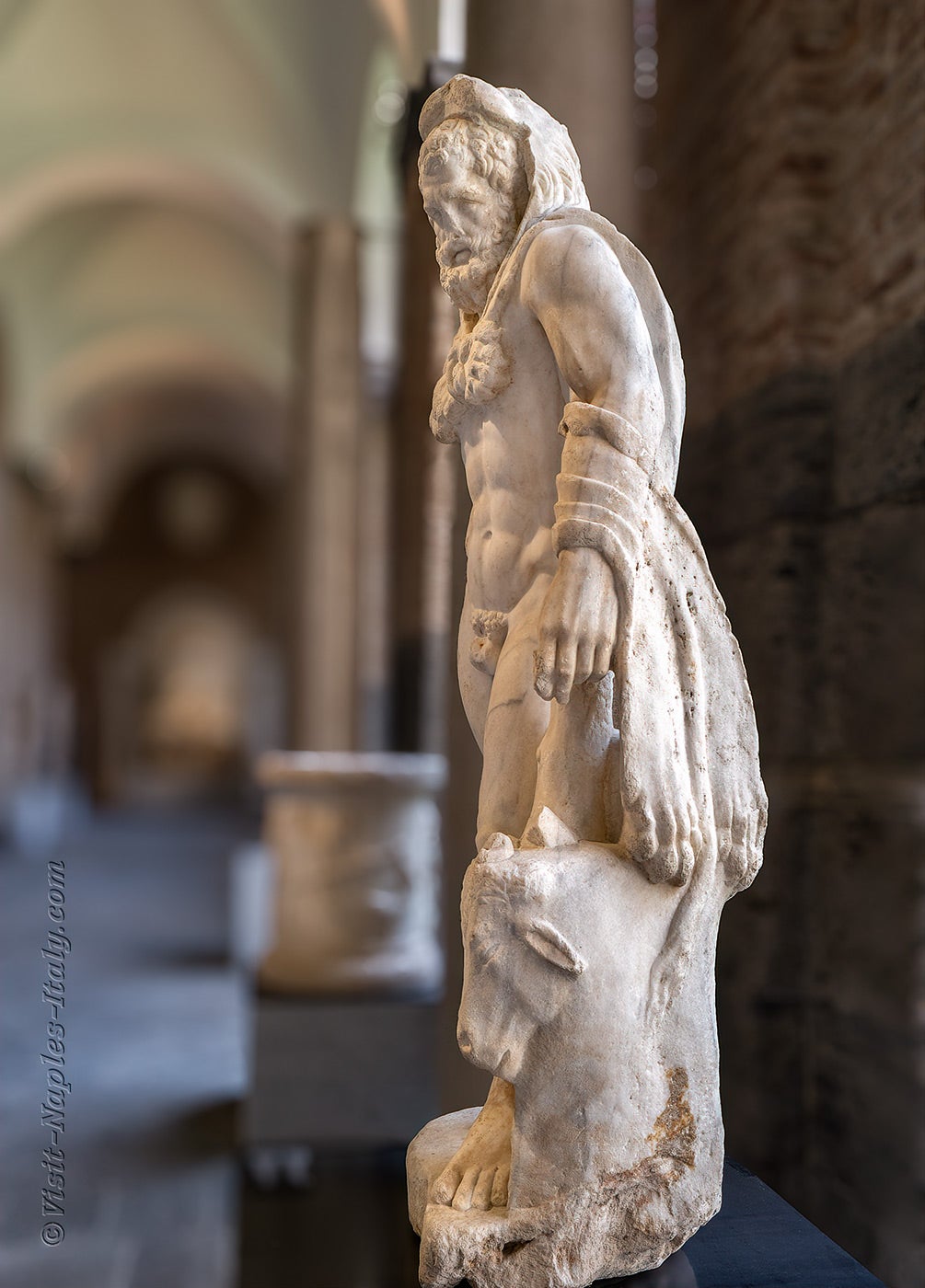
Sculpture - Marble (Height 197 cm) 1st centuryThis statue, discovered in Pozzuoli, is another replica of Lysippos’s Hercules at Rest, depicted in a pose similar to that of the Farnese Hercules.
However, the skin of the Nemean lion is here tied by its paws around his neck and the lion’s mouth covers his head.
He leans on his club, which rests on the back of an ox lying at his feet, alluding to the trial in which he had to capture the cattle of Geryon.
His musculature is not exaggerated; his physique displays perfectly human proportions that make him more attractive, but far less imposing than the majestic Farnese Hercules.
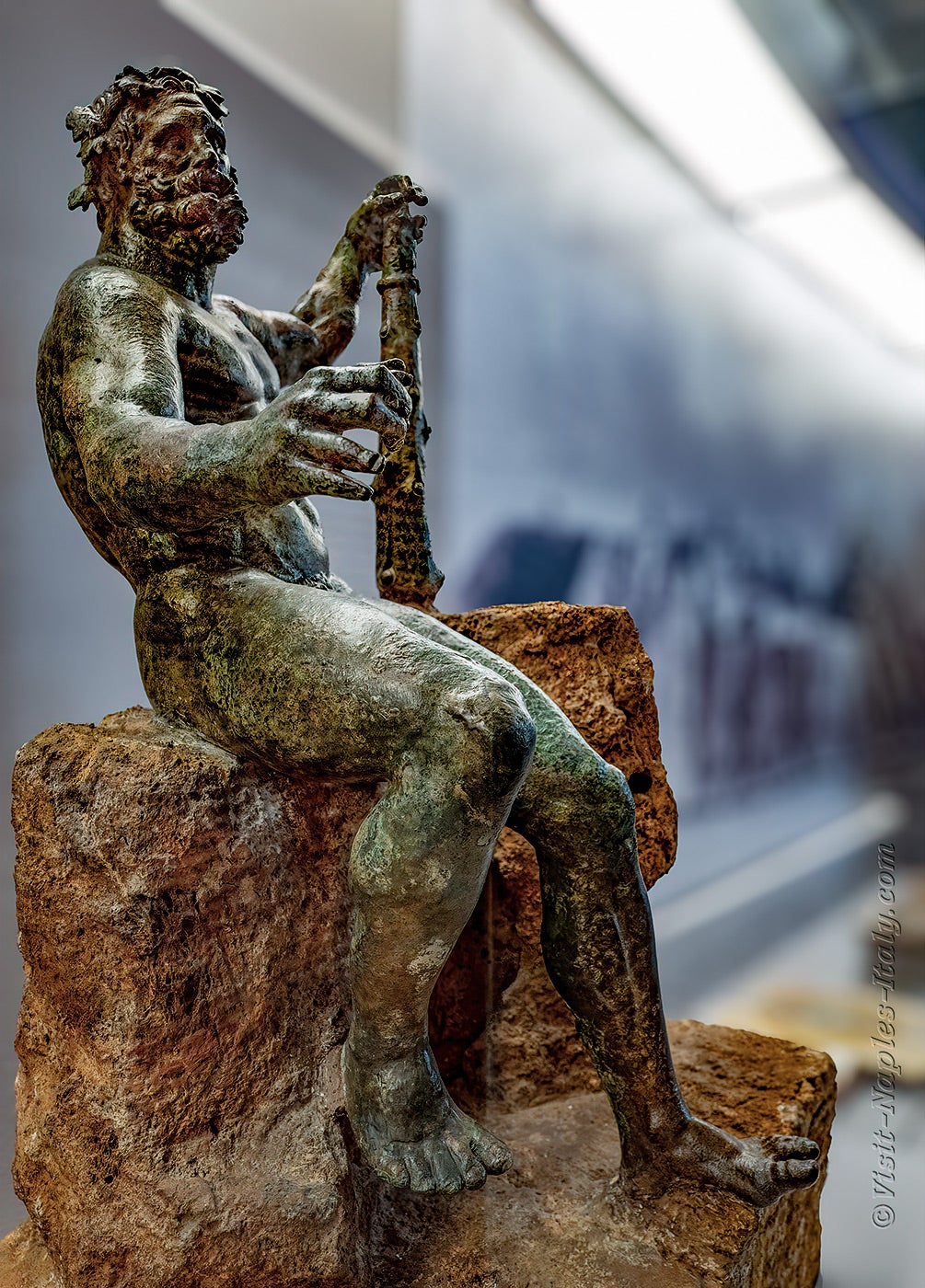
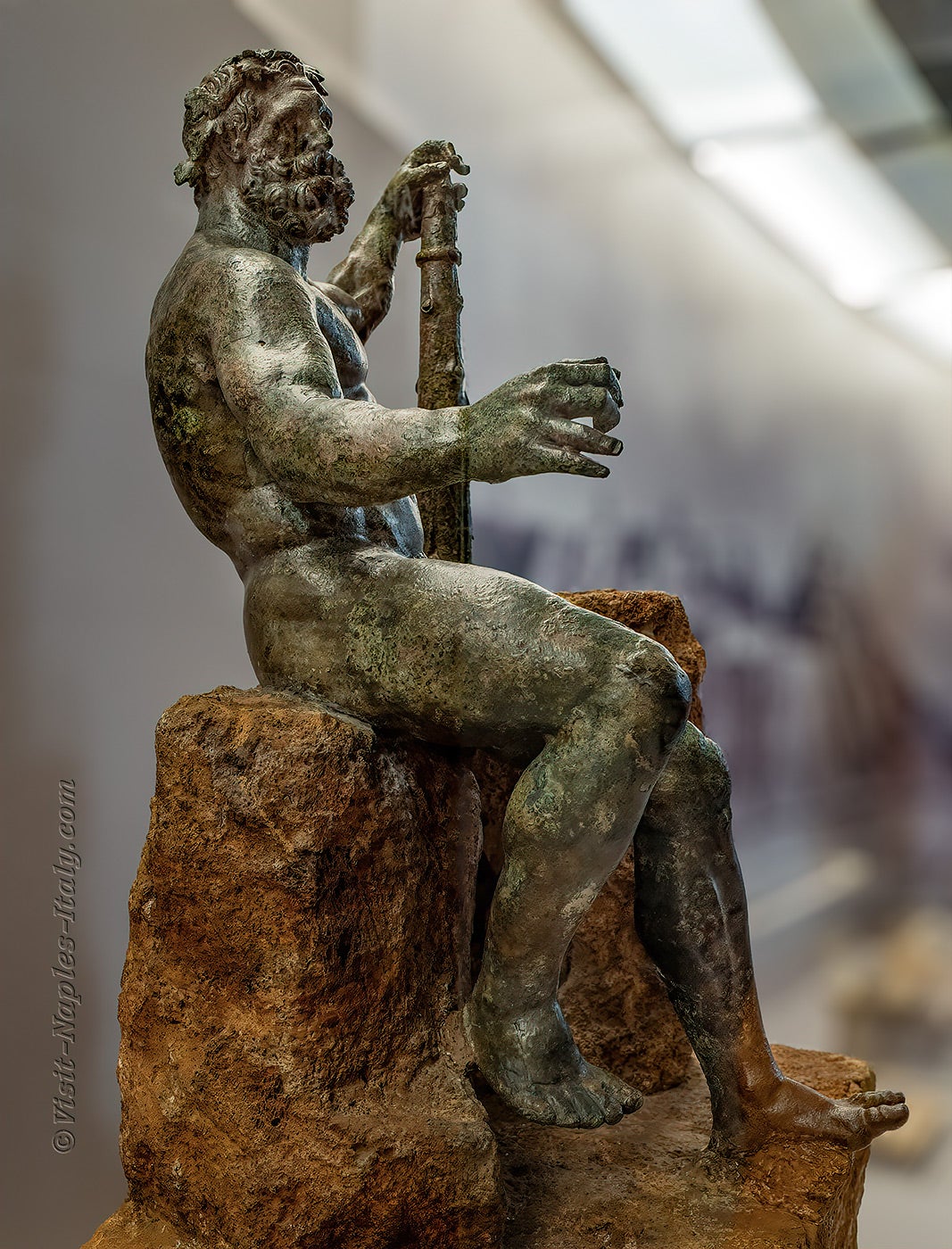
Hercules Epitrapezios at the banquet, Pompeii
Sculpture - Bronze (Height 90 cm) 1st century BC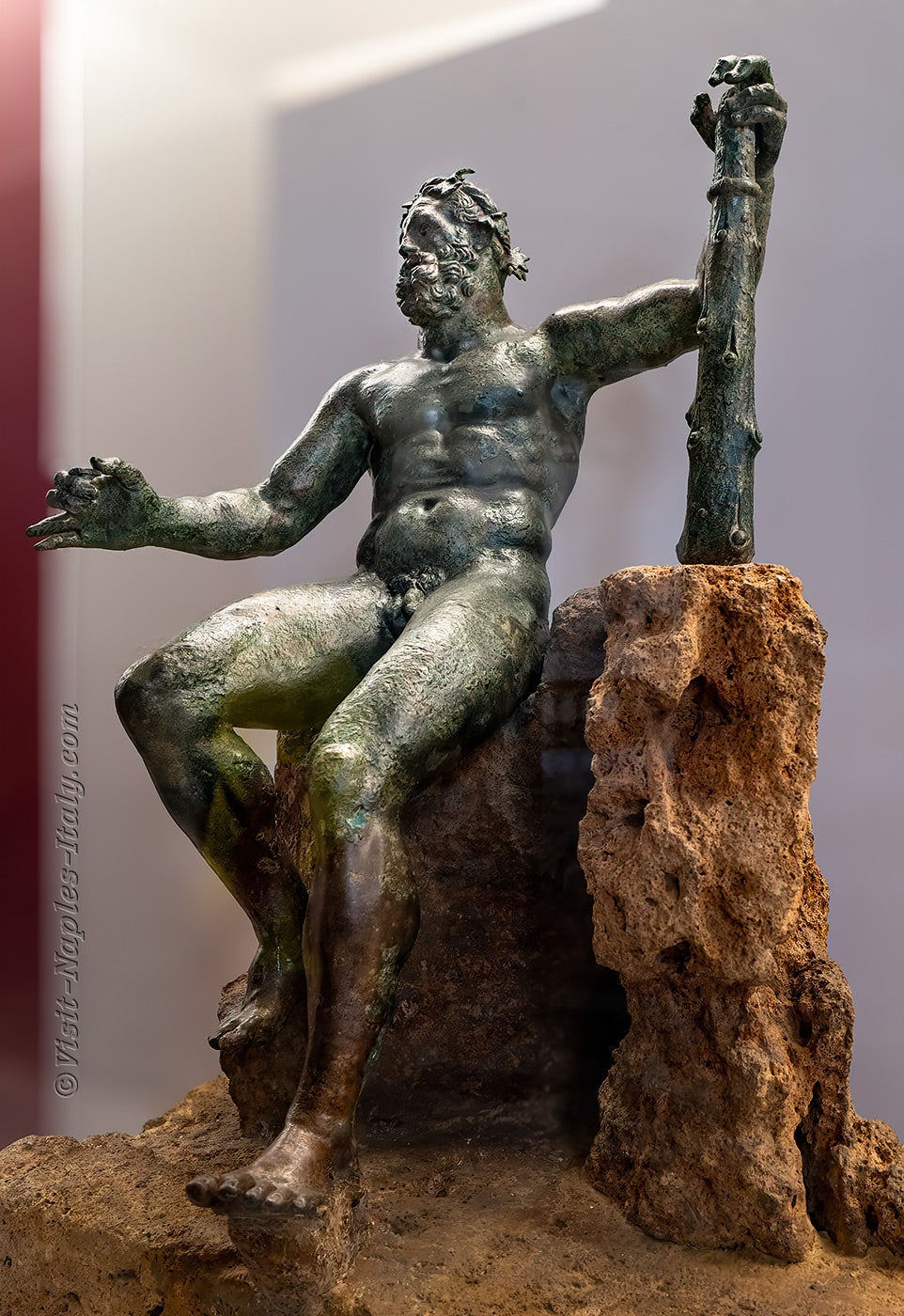
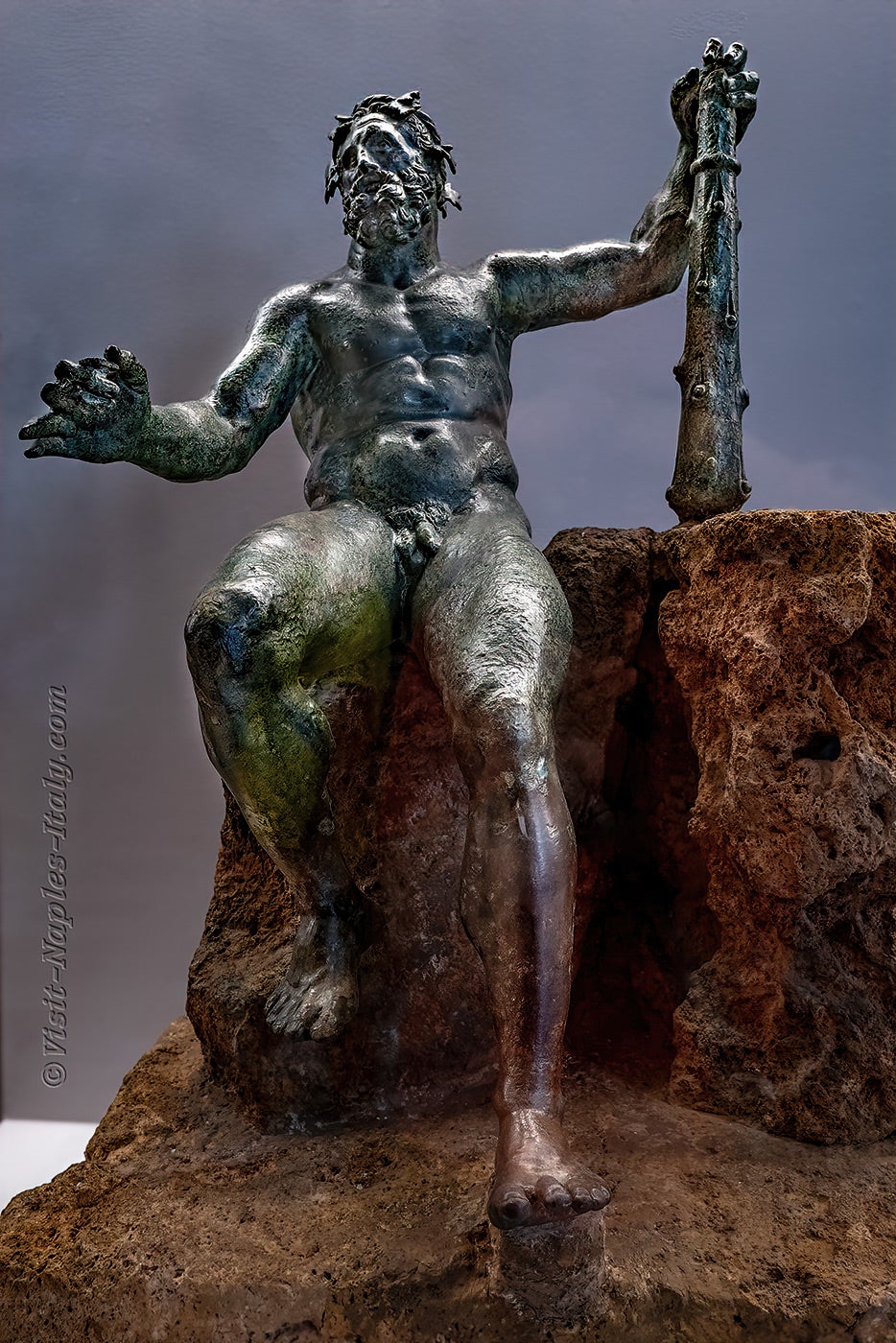
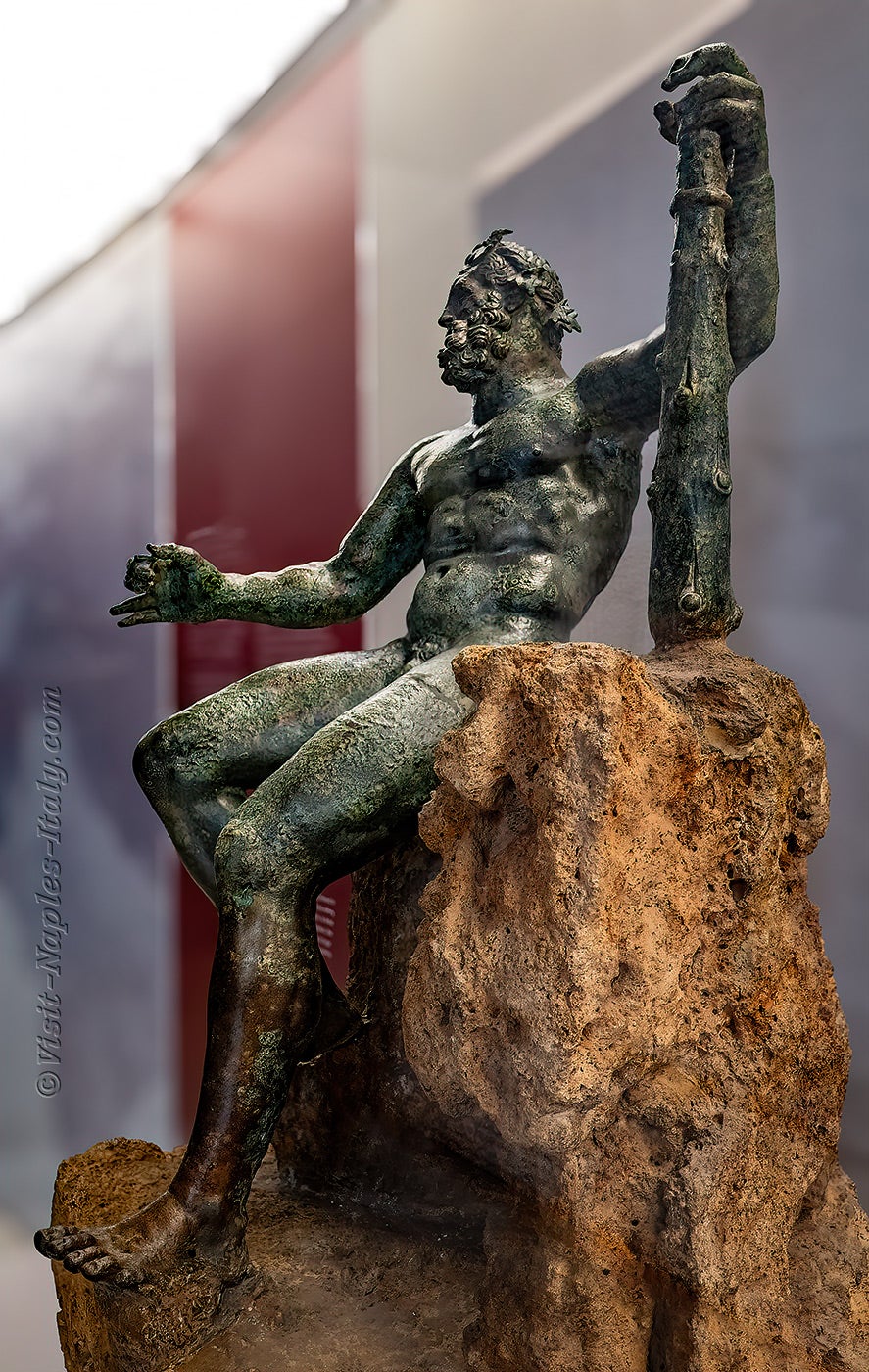
Hercule Epitrapezios The name given to this statue of Hercules Epitrapezios reflects the fact that the god is depicted seated at a table, taking part in the banquet held in his honour.
In ancient rituals, it was customary to offer a meal to the deity, a meal served on a table in front of which a bed was placed on which the god took his seat to receive this offering.
Here, Hercules is depicted in the serene posture of a king seated on his throne, naked upon a rock instead of a bed, before the banquet offered in his honour.
He raises and extends his right arm, holding the cup filled with the drink that has been offered to him, whilst resting his left hand on his club placed on the rock like a sceptre symbolising his power.
Hermes of Hercules, Farnese Collection
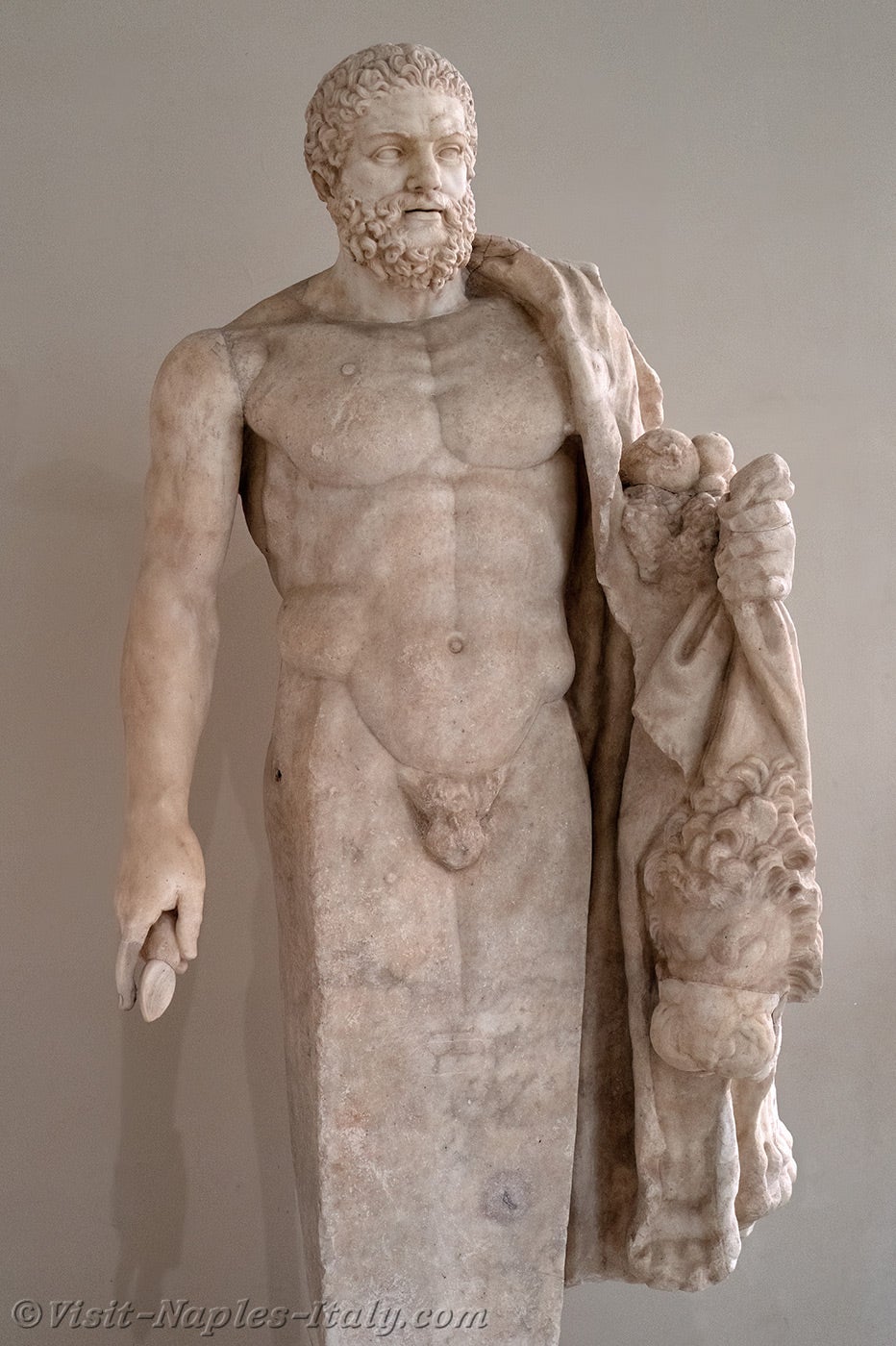
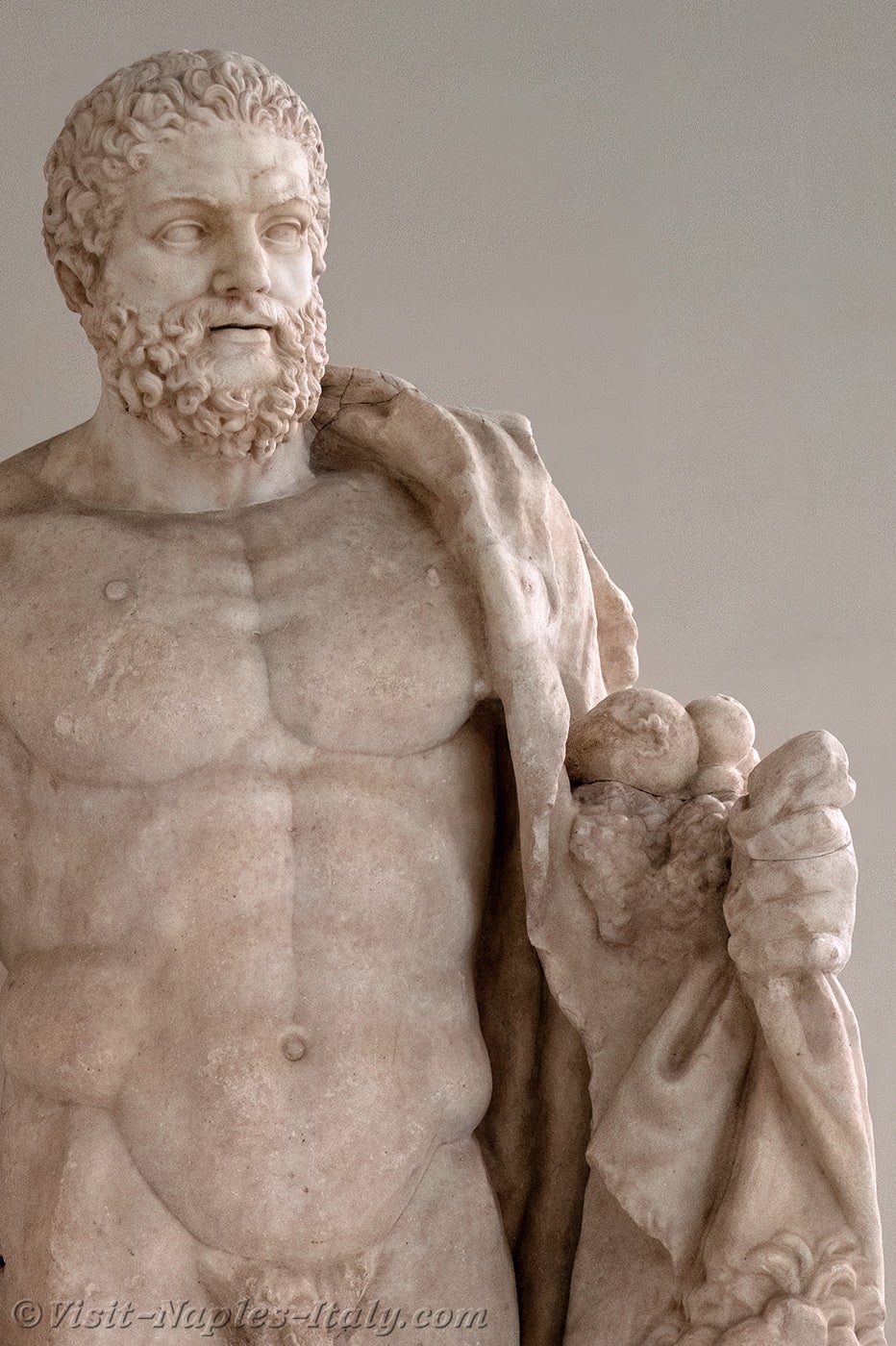
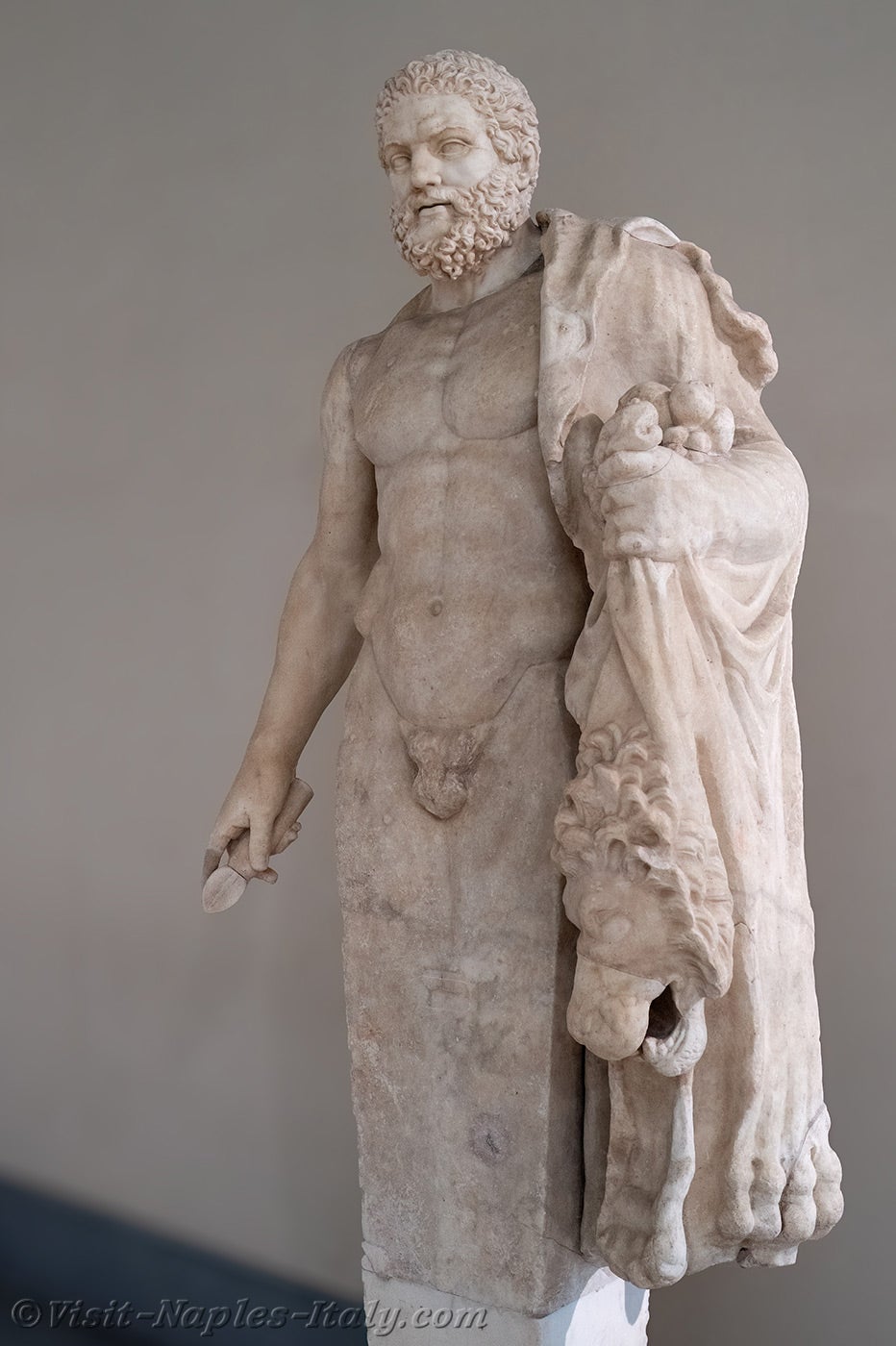
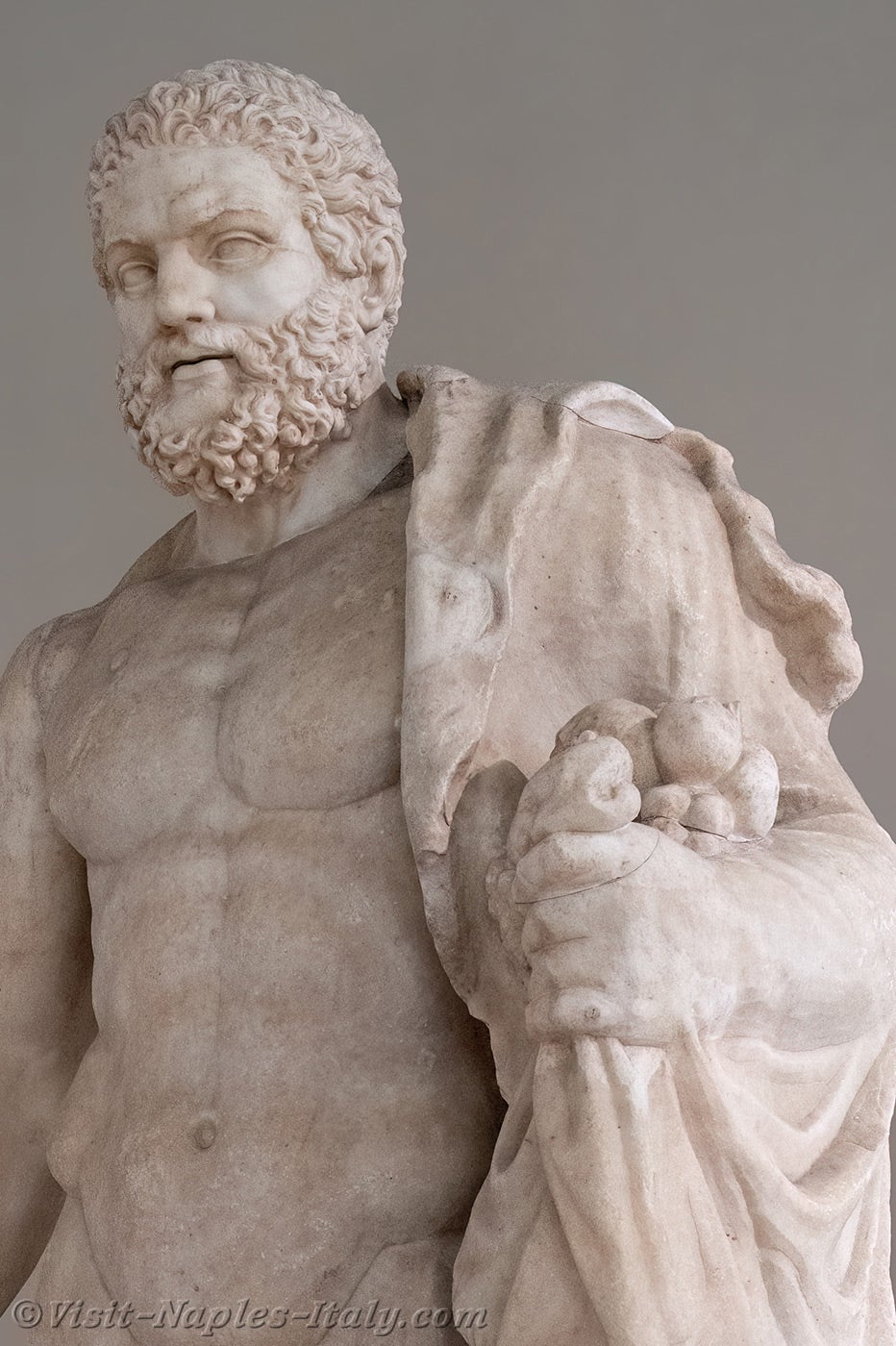
Sculpture - Marble (Height 204 cm) 2nd centuryThis large Hermes of Hercules, sculpted from the head down to the pubis, is shown with the skin of the Nemean lion draped over his shoulder.
His left arm is bent and forms a bowl with the lion’s skin, in which there are fruits.
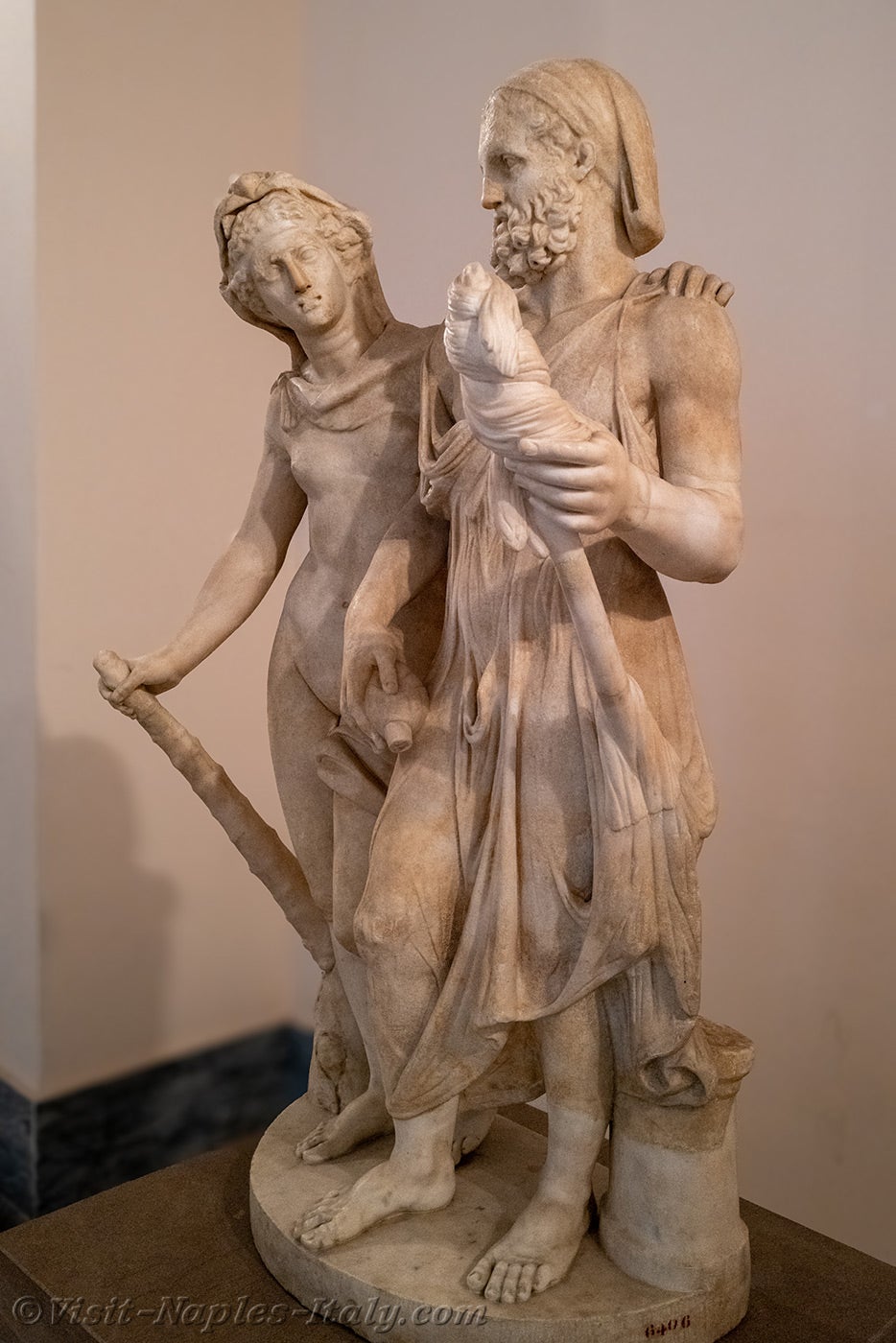
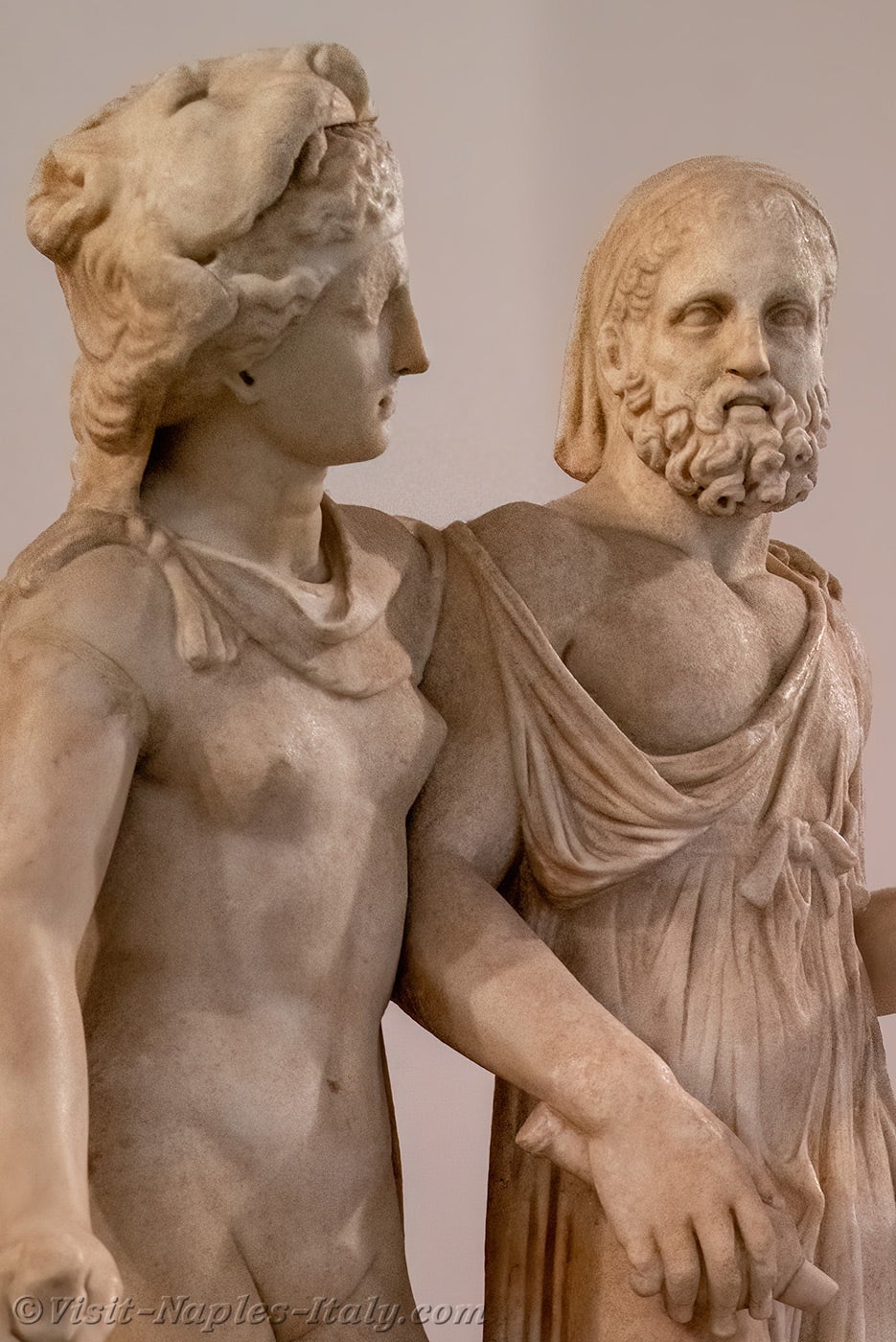
Hercules and Omphale, Farnese Collection
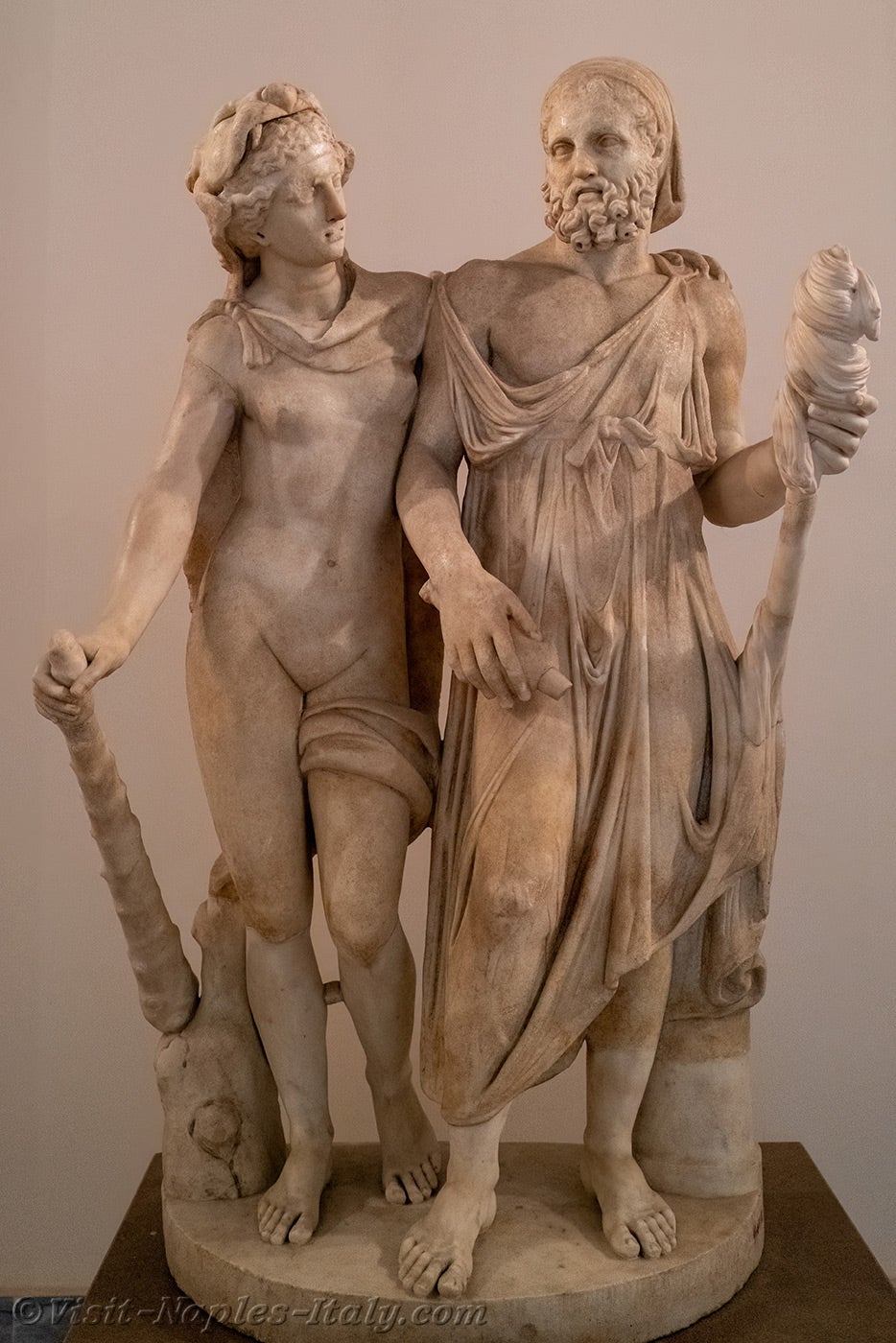
Sculpture - Marble (Height 107 cm) 1st centuryThis sculpture depicting Hercules and Queen Omphale is an ironic allegory of the reversal of roles in love.
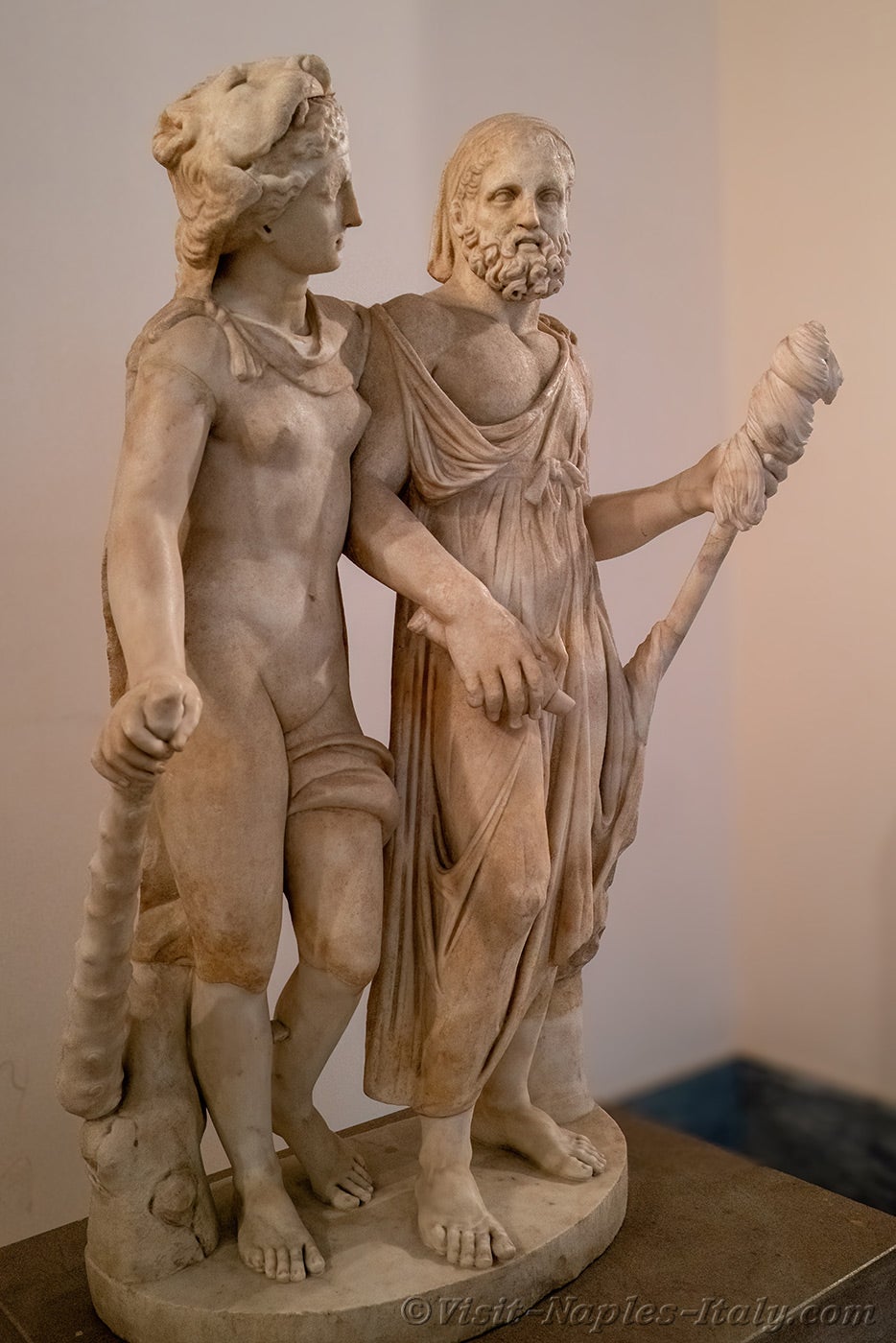
Hercules and Omphale Hercules is the woman and Omphale has become the man, the one who protects the weaker of the pair.
Omphale is naked whilst Hercules, the male, covers her nakedness to preserve her modesty.
Hercules, the hero of the twelve labours, is dressed in a light women’s chiton and holds the spinning wheel and spindle to spin the wool.
Omphale looks at him protectively, her hand resting on her lover’s shoulder as a man reassures a woman.
The skin of the Nemean lion is placed on Omphale’s head and tied around her neck.
Not content merely to display one of Hercules’ trophies in this way, she also holds the hero’s club in her right hand.
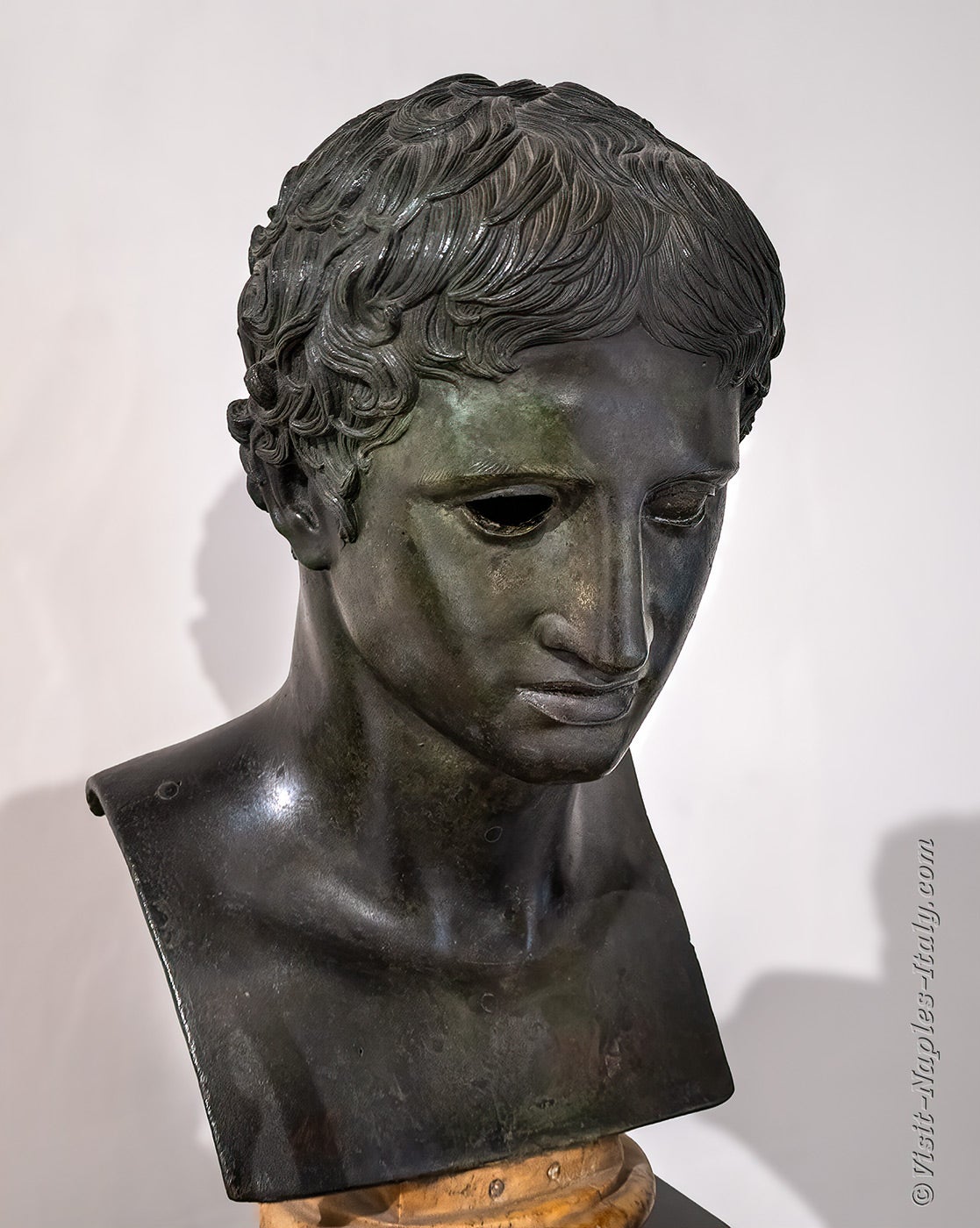
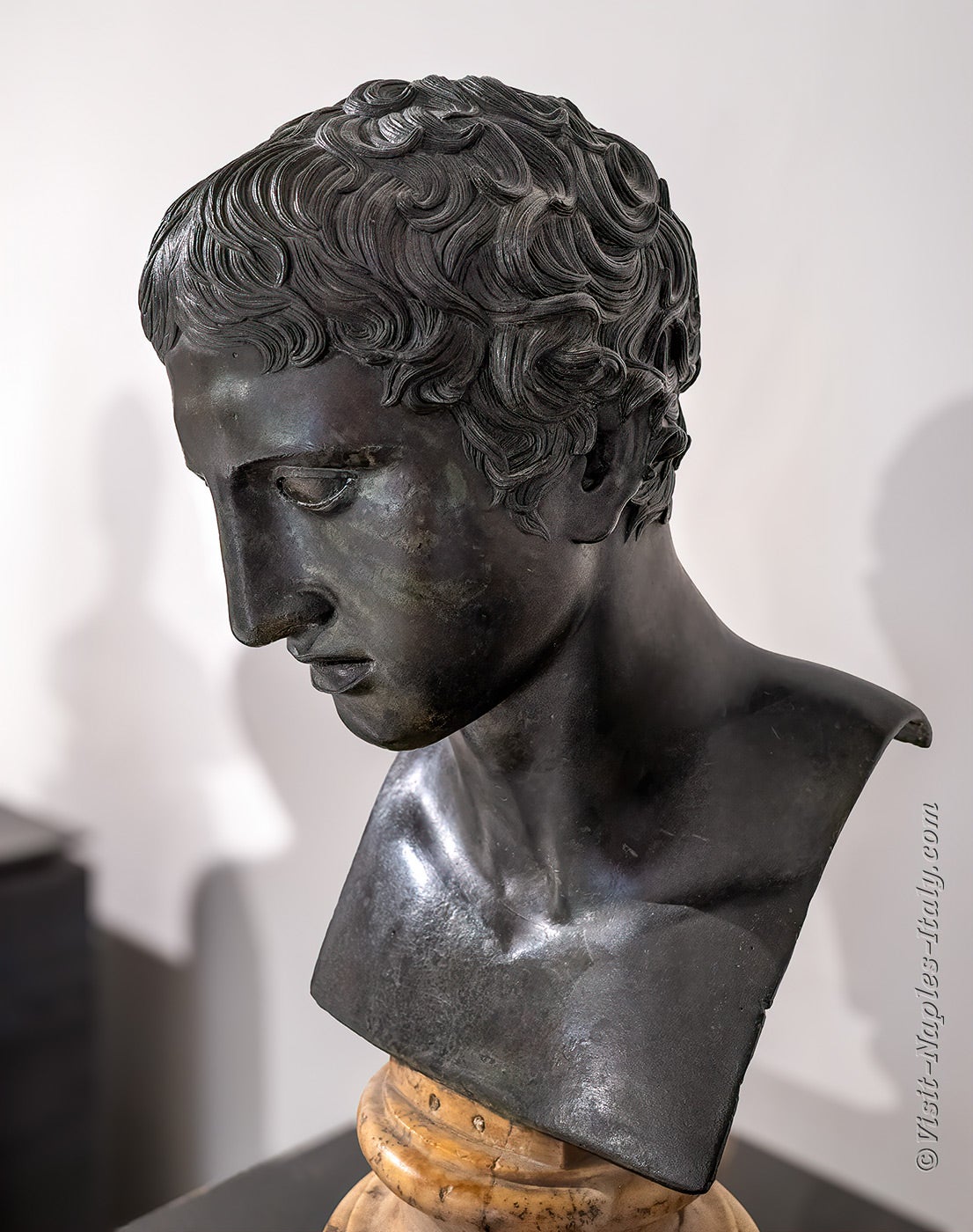
Head of Hercules, Villa of the Papyri, Herculaneum
Sculpture - Bronze - 1st century BCThis superb bronze head of Hercules, discovered in the square peristyle of the Villa of the Papyri in Herculaneum, shows us the hero in his youth.
His facial features are perfect, with a straight nose and slightly pursed lips.
The young Hercules seems to be pondering his future exploits.
Drunken Hercules, Herculaneum
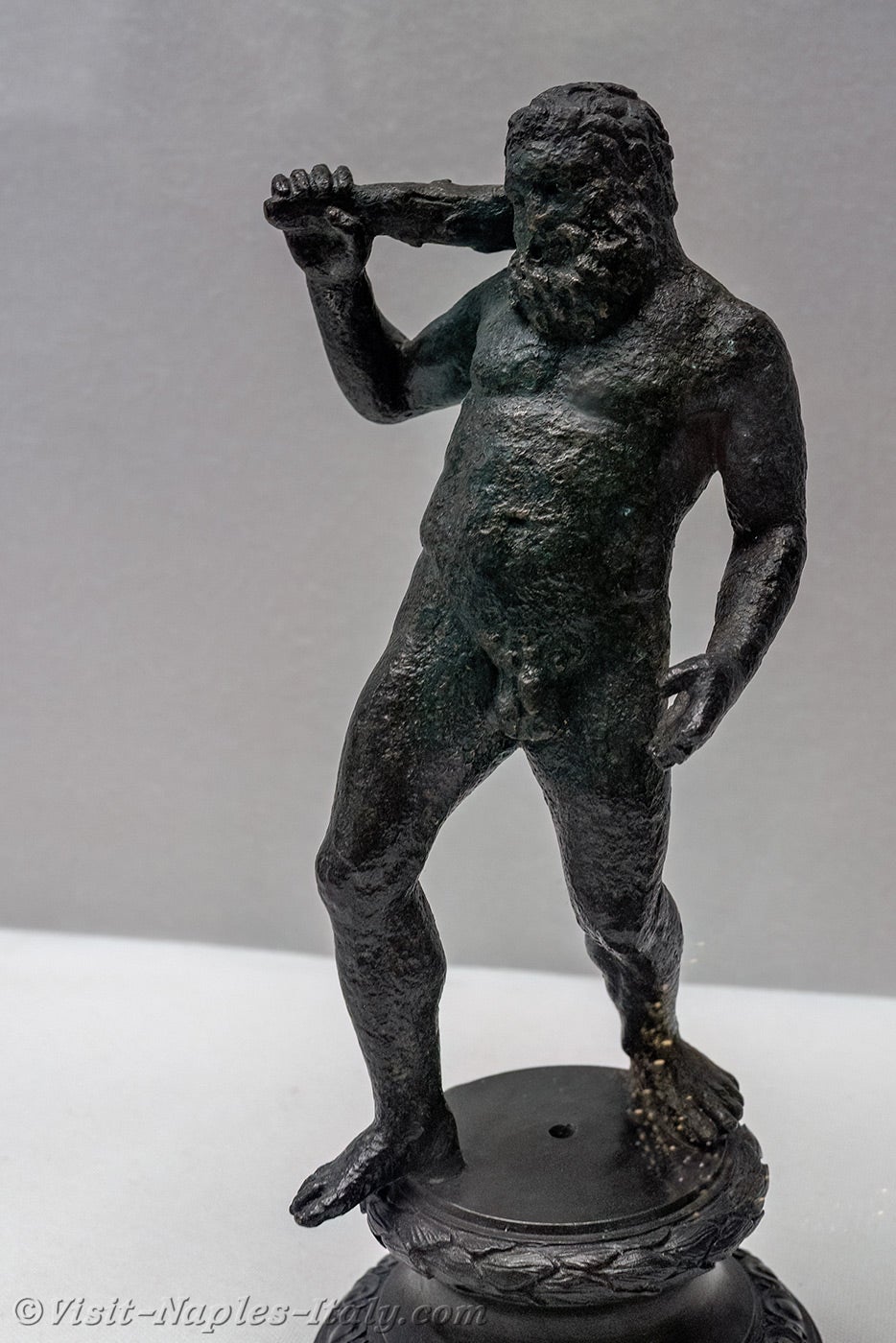
Drunken Hercules Sculpture - Bronze - 1st century BC
Hercules is naked and completely drunk, with his club resting on his shoulder, as he clearly no longer has the strength to hold it at arm’s length.
The position of his spread legs shows our hero staggering, his left arm serving as a counterweight.
He looks more like a Silenus than a hero who has accomplished superhuman feats.
His loss of balance due to alcohol is also clearly evident in the way his torso leans backwards just as he puts his right leg forward to try and take another step.
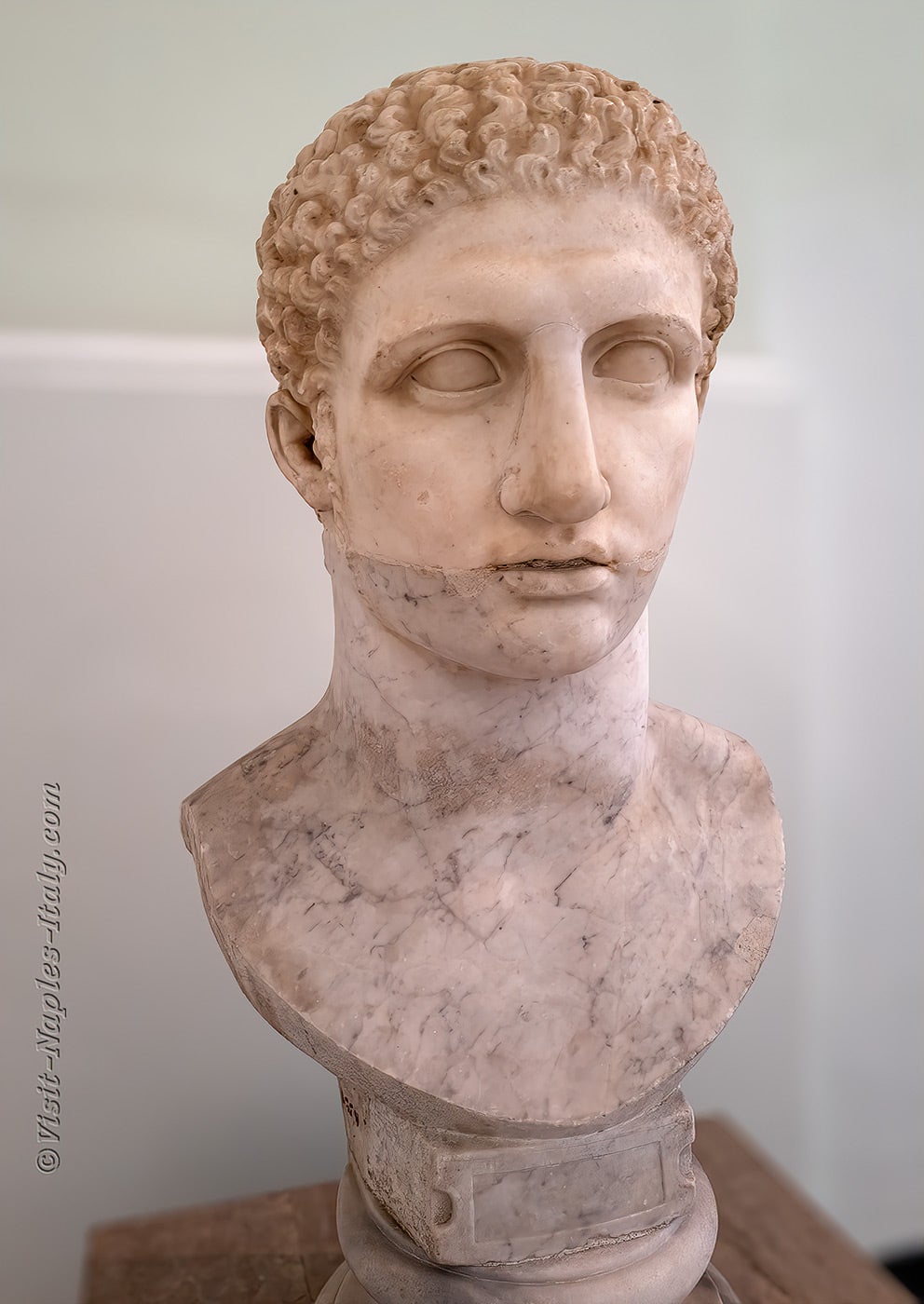
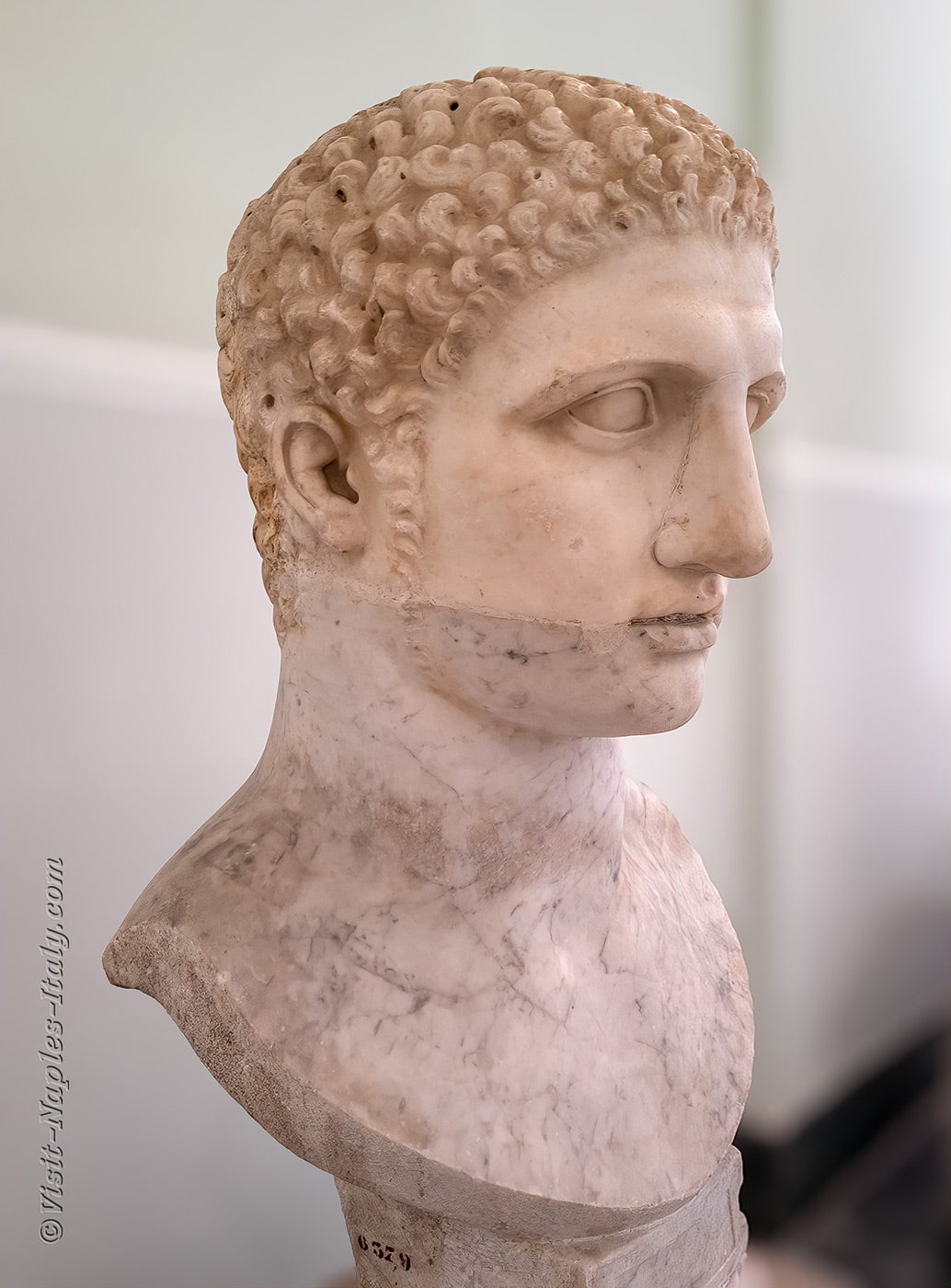
Colossal head of the young Hercules, Farnese Collection
Sculpture - Marble (Height 83 cm) 2nd centuryHercules is depicted here with the fledgling beard of a teenager and short, curly hair.
It is thought that this head was an imperial portrait presented in the guise of Hercules.
Young Hercules, Villa of the Papyri, Herculaneum
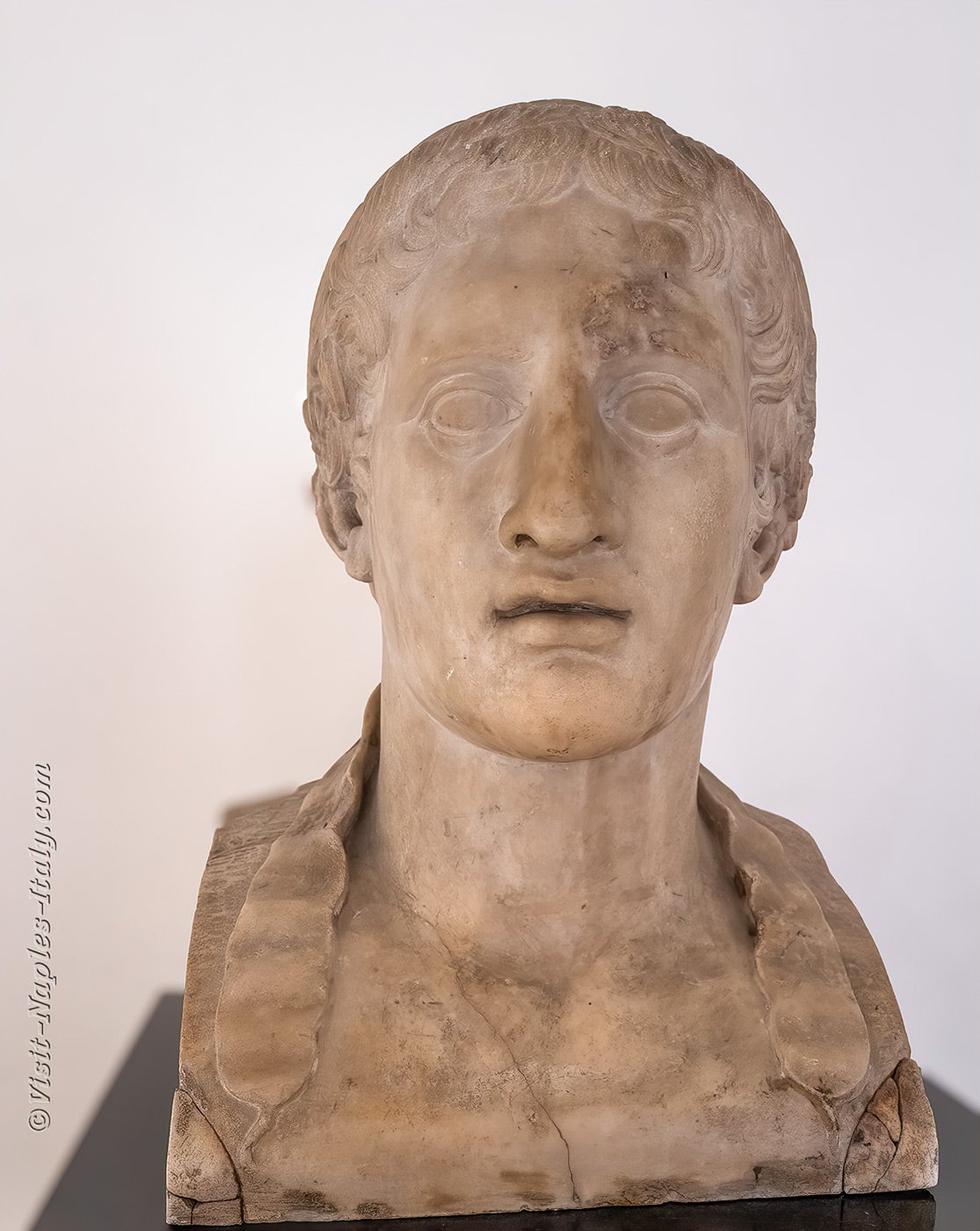
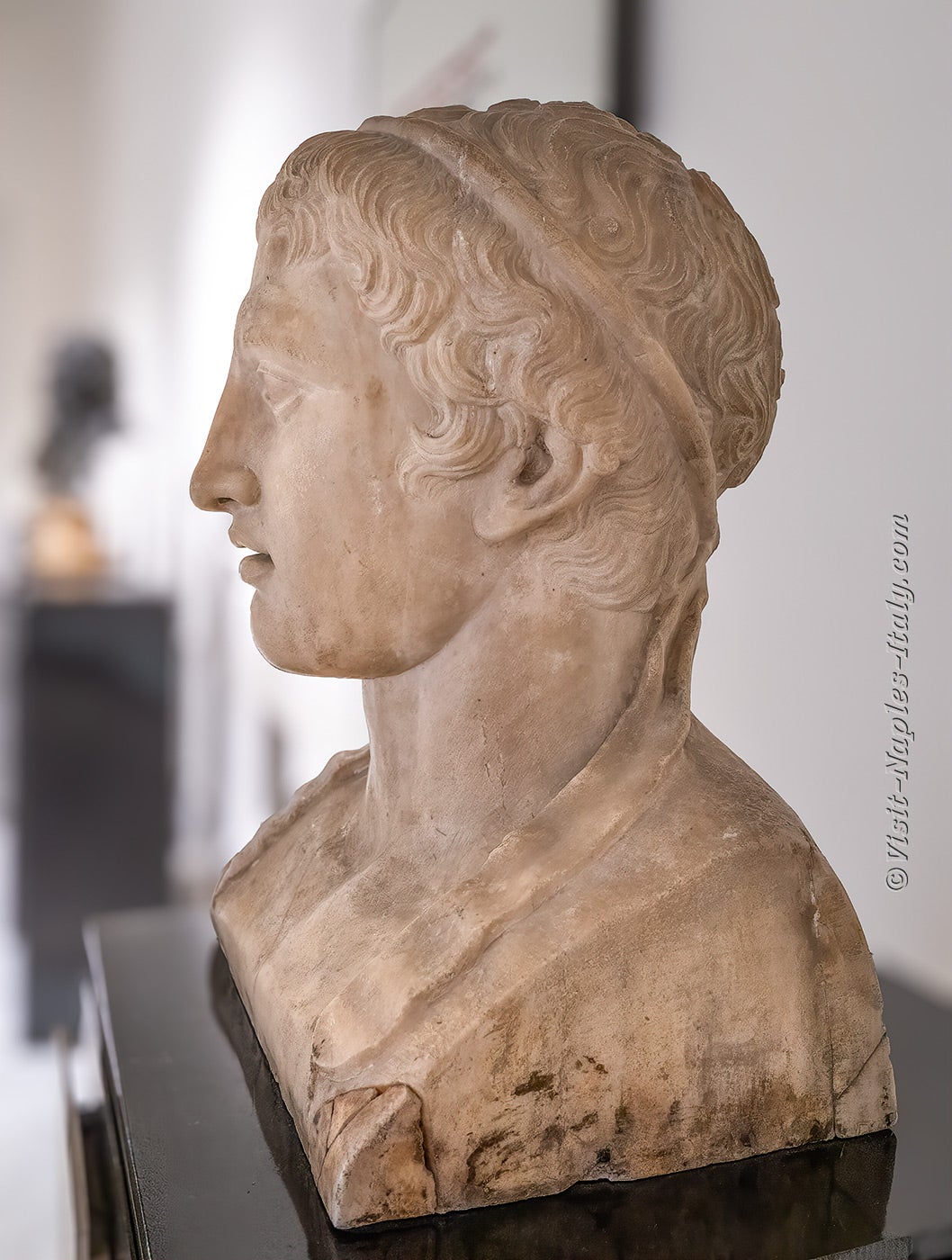
Sculpture - Marble - 1st century BCThis Head of Young Hercules, discovered in the Villa of the Papyri in Herculaneum, shows us the hero with long, curly hair, tied with a wide ribbon encircling his head, the ends of which fall over his shoulders.
Mythology Achilles | Aesculapius | Amazons | Aphrodite Venus | Apollo | Artemis | Athena Minerva | Atlas | Concordia | Danaids | Diomedes | Dionysus | Dirce | Flora | Ganymede | Hera Juno | Hercules | Hermes | Nike | Orestes | Psyche | River | Satyrs | Zeus
Sculptures Mythology | Persons | Animals | Bas-relief
Artworks Sculptures | Frescoes | Eroticism
MANN Artworks Schedule Tickets Location | Authorizations
Back to Top of Page