

MANN Artworks Schedule Tickets Location | Authorizations
Artworks Sculptures | Frescoes | Eroticism
Sculptures Mythology | Persons | Animals | Bas-relief
Mythology Achilles | Aesculapius | Amazons | Aphrodite Venus | Apollo | Artemis | Athena Minerva | Atlas | Concordia | Danaids | Diomedes | Dionysus | Dirce | Flora | Ganymede | Hera Juno | Hercules | Hermes | Nike | Orestes | Psyche | River | Satyrs | Zeus
Artemis Artemis Ephesus | Artemis-Diana
Artemis of Ephesus at the Archaeological Museum of Naples, Italy
Artemis of Ephesus, Farnese Collection
Sculpture - Alabaster, bronze (height 130 cm) 2nd century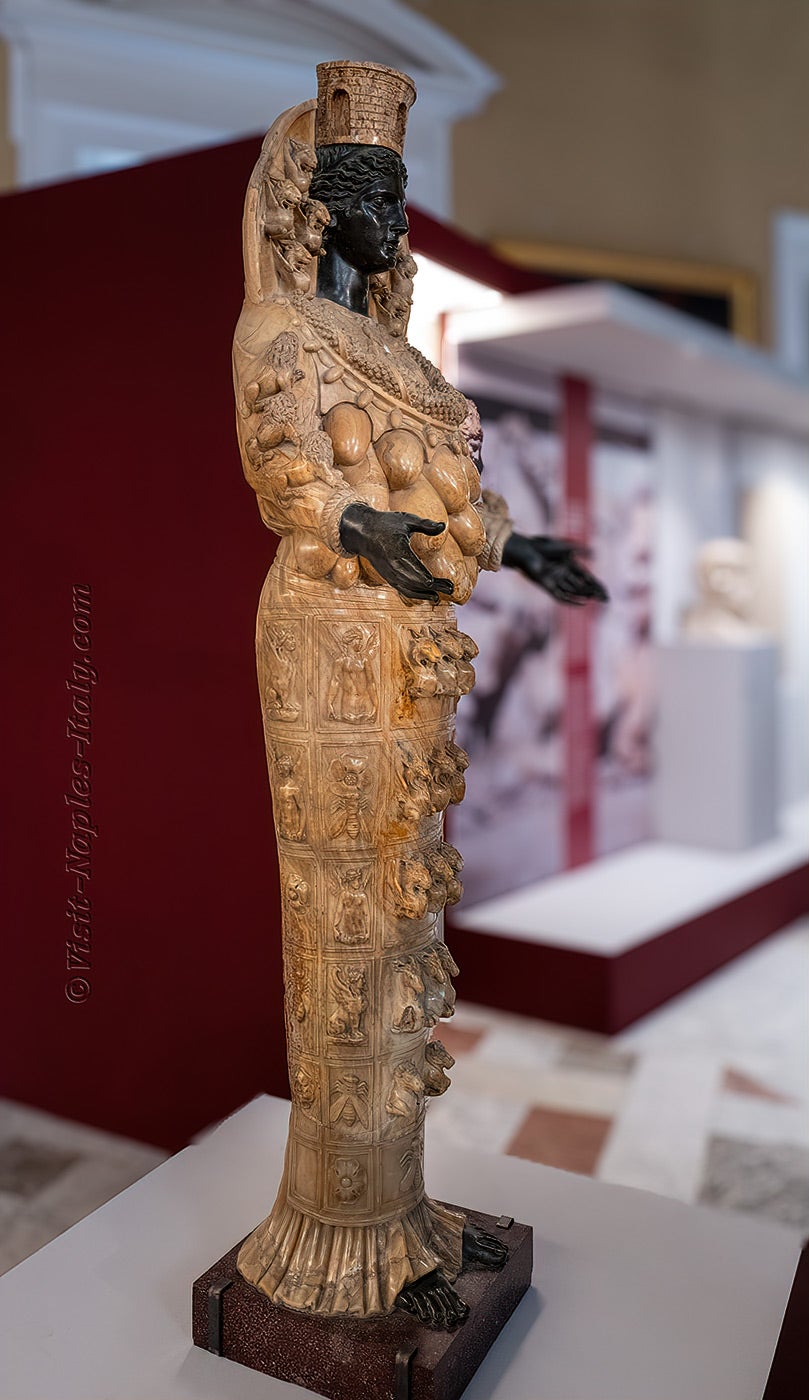
Artemis of Ephesus This statue of Artemis made of alabaster and bronze appears to be a replica of the original statue from the Great Temple of Ephesus in Asia Minor, where she was worshipped as the goddess of the wild and of fertility.
According to the ‘Hymn to Artemis’ by the Greek poet Callimachus, the cult of Artemis (Diana to the Romans) was introduced to Ephesus by the Amazons.
The cult spread so widely that, in the 6th century BC, a magnificent temple was built in her honour in Ephesus, considered in antiquity to be one of the Seven Wonders of the World.
This archaic figure of a hieratic goddess is very different from the huntress Diana dressed in a simple robe and free to move.
Her head, hands and the tips of her feet are the only visible parts of her body, encased and stiffened under the weight of garments richly decorated with relief motifs.
The garments covered in decorations are associated with the cult practised in Ephesus where Artemis, daughter of Zeus and twin sister of Apollo, was honoured as queen of the animal world and as protector of the city with her crown in the shape of a tower.
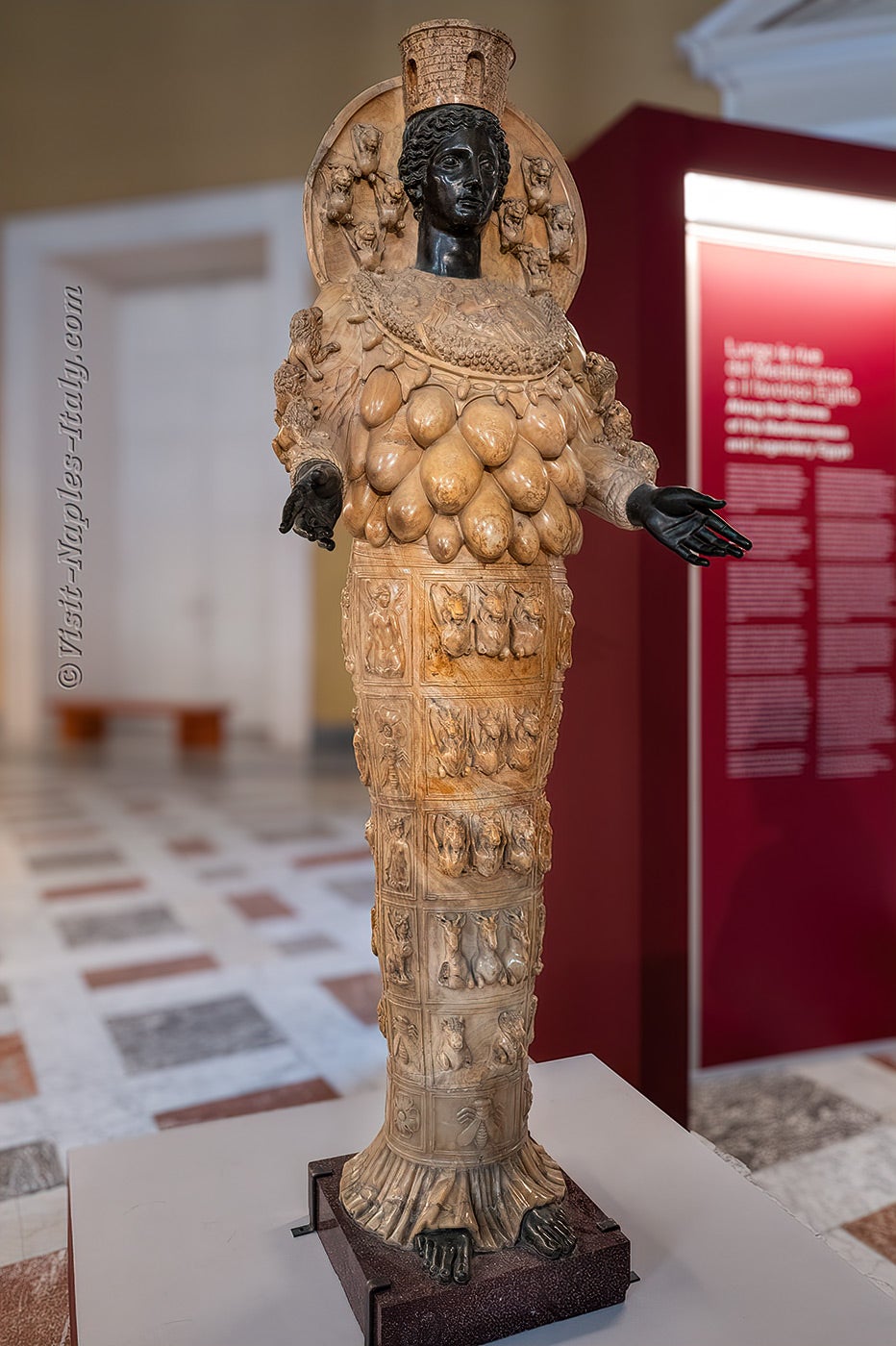
Artemis of Ephesus Artemis is depicted facing the viewer and appears serene as she opens her arms in a protective gesture, her palms turned towards the viewer.
The lions in relief clinging to her sleeves allude to her reign over the wild animals.
The beautiful bronze head of the goddess is surrounded by eight winged griffins in relief on the lunar disc behind her shoulders.
A thick necklace forms a semi-circular pectoral decorated with winged female figures and zodiac signs.
The mythical creatures refer to the mysteries of the ancient cult of the goddess Artemis in Ephesus, where bulls were sacrificed and festivals held in her honour.
Beneath the semi-circular pectoral, the rest of the bust is entirely covered by a striking cluster of oval pouches swollen like breasts.
The original statue from Ephesus, which served as a model for this one, was nicknamed “Artemis Polymastos”: “Artemis with many breasts”.
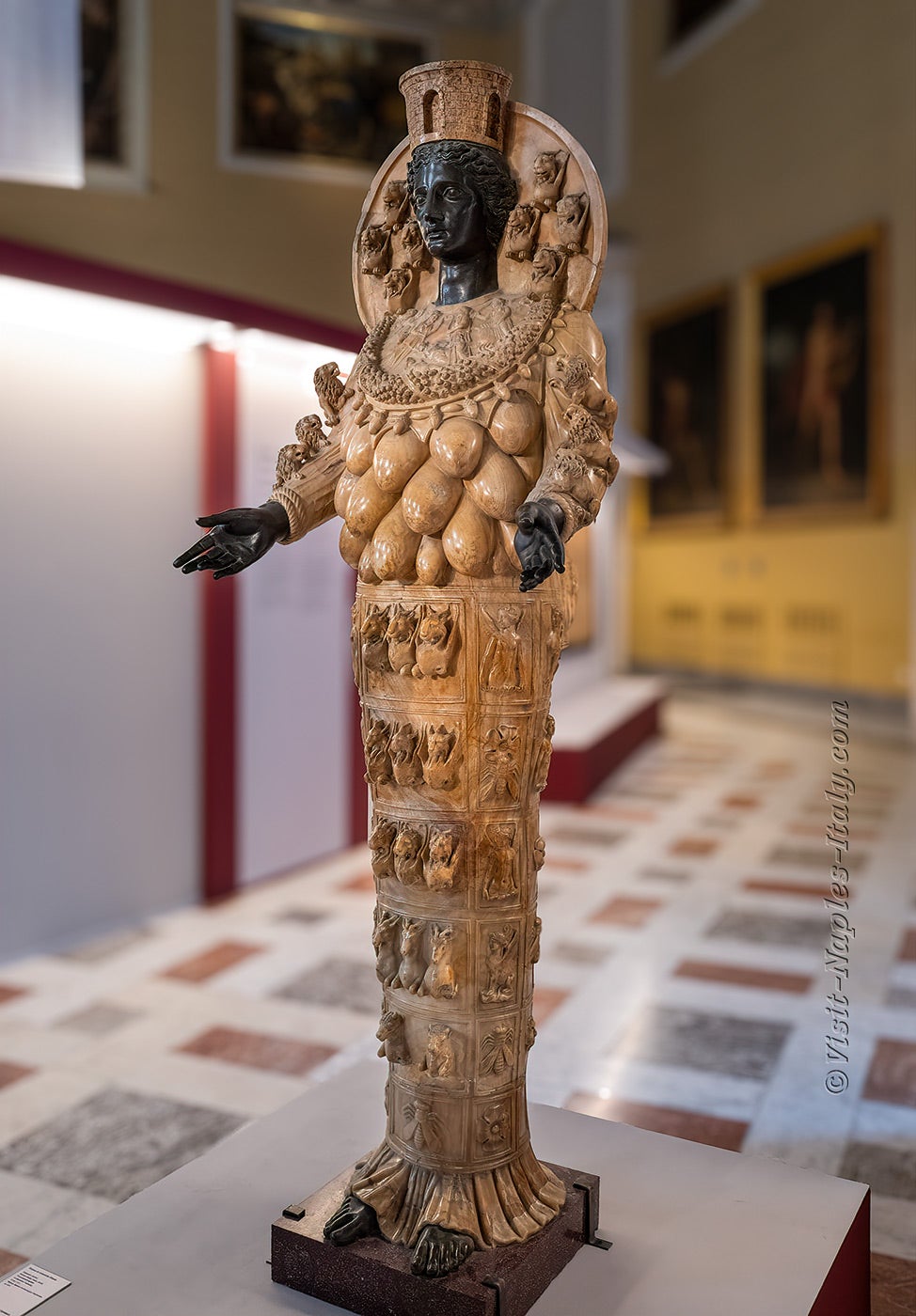
Artemis of Ephesus However, historians now believe that these oval pouches actually represent bull’s testicles, which were offered to the goddess Artemis during ceremonies.
These testicles visible on the statue are therefore an expression of Artemis’s power to ensure fertility for men.
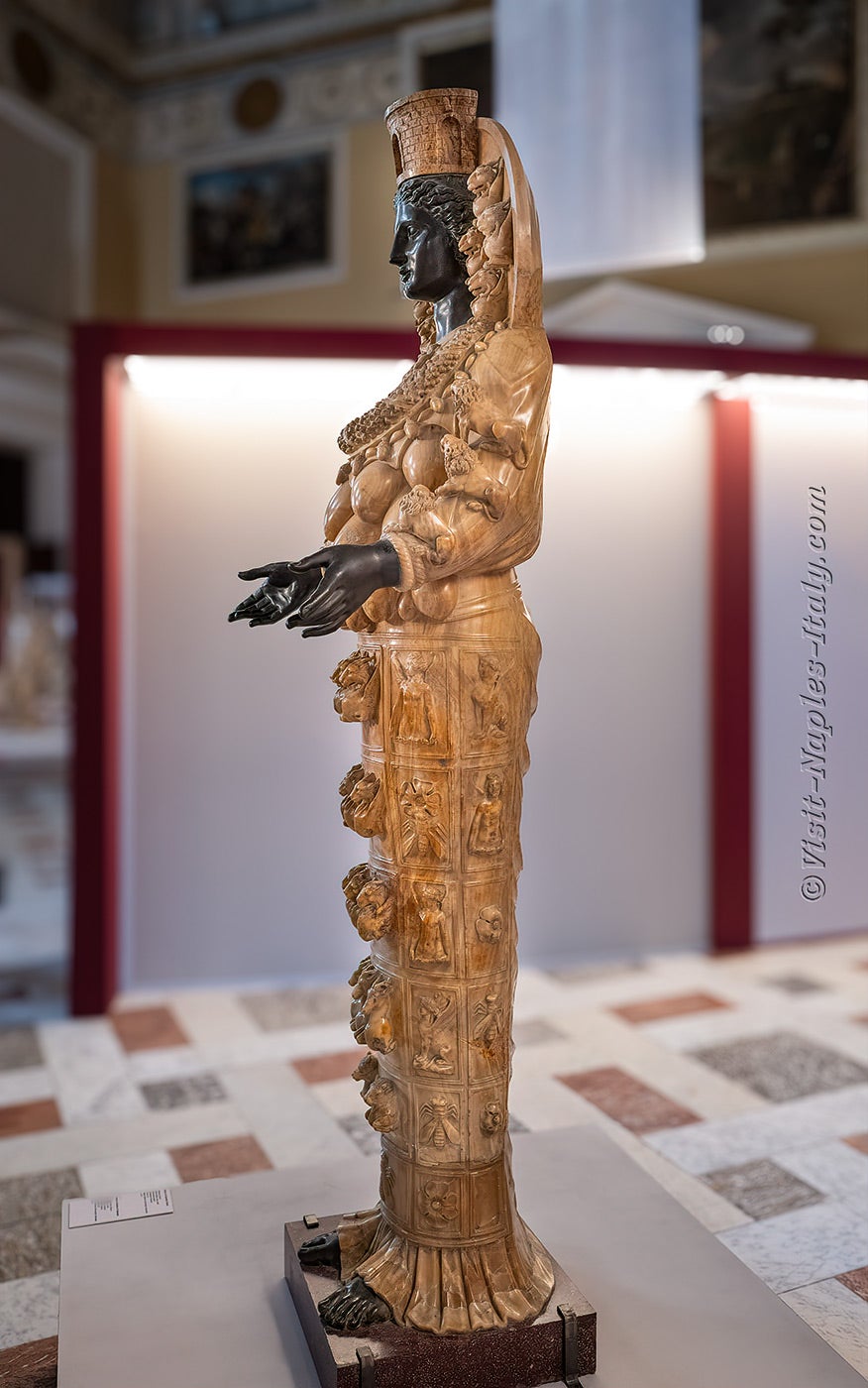
The hips and legs are encased in a sheath divided into panels with relief motifs that give them the appearance and stability of a column.
The panels are arranged vertically in six tiers.
On the front, starting from the top, the panels depict triads of winged lions, griffins, rams and bulls, and finally a bee above the folds of the robe protruding from the tunic.
The side panels depict sphinxes as well as mermaids, also winged.
We also note the presence of bees and flowers.
Artemis of Ephesus The cult of Artemis, being essentially dedicated to femininity, the officiating priests were called Esseni (drones) and the priestesses were young virgin women known as Melissa (bees).
The bee was an important symbol, as it appeared on the coins of Ephesus.
The goddess Artemis was probably worshipped as the queen of a hive-city; and her strange breasts no doubt also alluded to nourishing honey.
According to Pliny’s “Natural History”, the replica of the Artemis of Ephesus was carved from ebony or vine wood, then covered with clothes and jewellery; whilst her face, hands and bare feet were protected by coating them with oil or honey, which, over time, gave them a dark patina.
Various versions were subsequently carved from marble and black stone.
This aspect has been preserved in this ancient alabaster statue on display here, whose head, hands and feet have been restored using varnished bronze.
Artemis Artemis Ephesus | Artemis-Diana
Mythology Achilles | Aesculapius | Amazons | Aphrodite Venus | Apollo | Artemis | Athena Minerva | Atlas | Concordia | Danaids | Diomedes | Dionysus | Dirce | Flora | Ganymede | Hera Juno | Hercules | Hermes | Nike | Orestes | Psyche | River | Satyrs | Zeus
Sculptures Mythology | Persons | Animals | Bas-relief
Artworks Sculptures | Frescoes | Eroticism
MANN Artworks Schedule Tickets Location | Authorizations
Back to Top of Page