

MANN Artworks Schedule Tickets Location | Authorizations
Artworks Sculptures | Frescoes | Eroticism
Frescoes Mythology | Portraits | Life Leisure | Animals | Religion | Landscapes | Decoration
Mythology Achilles | Aeneas | Alcestis | Alexander | Aphrodite | Apollo | Arianne | Artemis | Ceres | Chryseis | Cupid | Daedalus | Dionysus | Dirce | Endymion | Flora | Galatea | Ganymede | Graces | Hephaestus | Hercules | Io Argos | Iphigenia | Isis | Leda | Marsyas | Medea | Nereids | Niobids | Odysseus | Pan | Paris | Perseus | Phaedra | Phrixus | Pirithous | Saturn | Satyrs | Sophonisba | Theseus | Troy | Zeus
Frescoes depicting Apollo, Diana, Daphne and Chiron at the Archaeological Museum of Naples in Italy
Helios Apollo, Stabiae, Villa Arianna
Fresco - Water-based pigments on coating (39 x 23 cm) 10-37 AD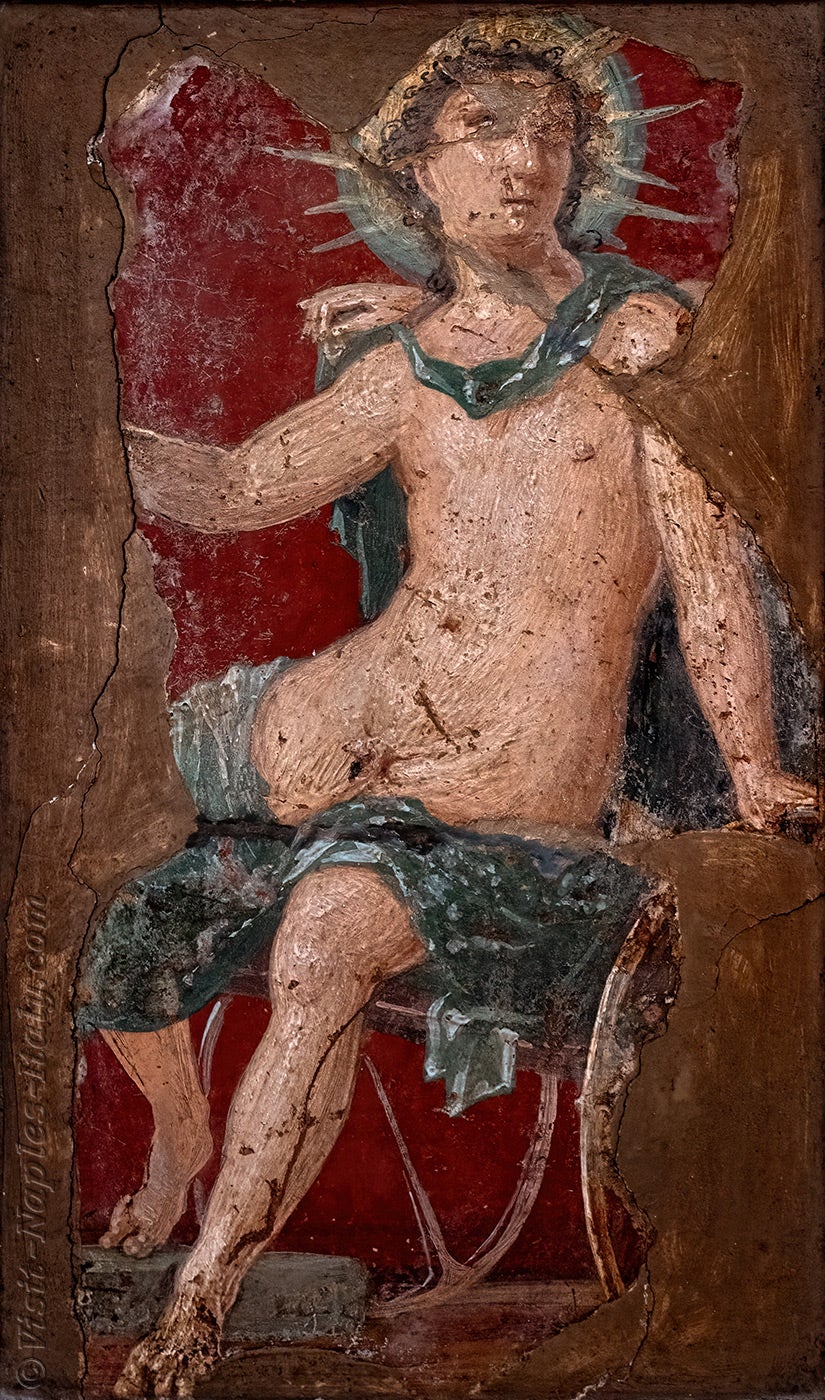
Helios Apollo He is the god of heat and light, which are essential to life, as opposed to darkness and death.
This man crowned with light is Helios, the god of the Sun, seated on his golden chariot with which he completes his daily journey across the sky.
The beauty of his body is highlighted by the green fabric surrounding his legs and the red background of twilight, indicating that he has completed his journey and is resting in the west of the ocean, on the Island of the Blessed.
Helios was the servant of Zeus, who had charged him with illuminating the earth by travelling across the sky, which allowed him to see everything that was happening there and to inform the gods of Olympus.
Helios was thus able to reveal to Hephaestus that Aphrodite was cheating on him with Ares.
Apollo, Chiron and Asclepius, Pompeii, Insula Occidentalis
Fresco - Water-based pigments on plaster (38 x 51 cm) 50 BCThis fresco illustrates the transmission of medical knowledge by presenting, from left to right: Apollo, the inventor of medicine, his disciple, the centaur Chiron, who later became the tutor of Asclepius (adopted and revered under the name Aesculapius by the Romans).
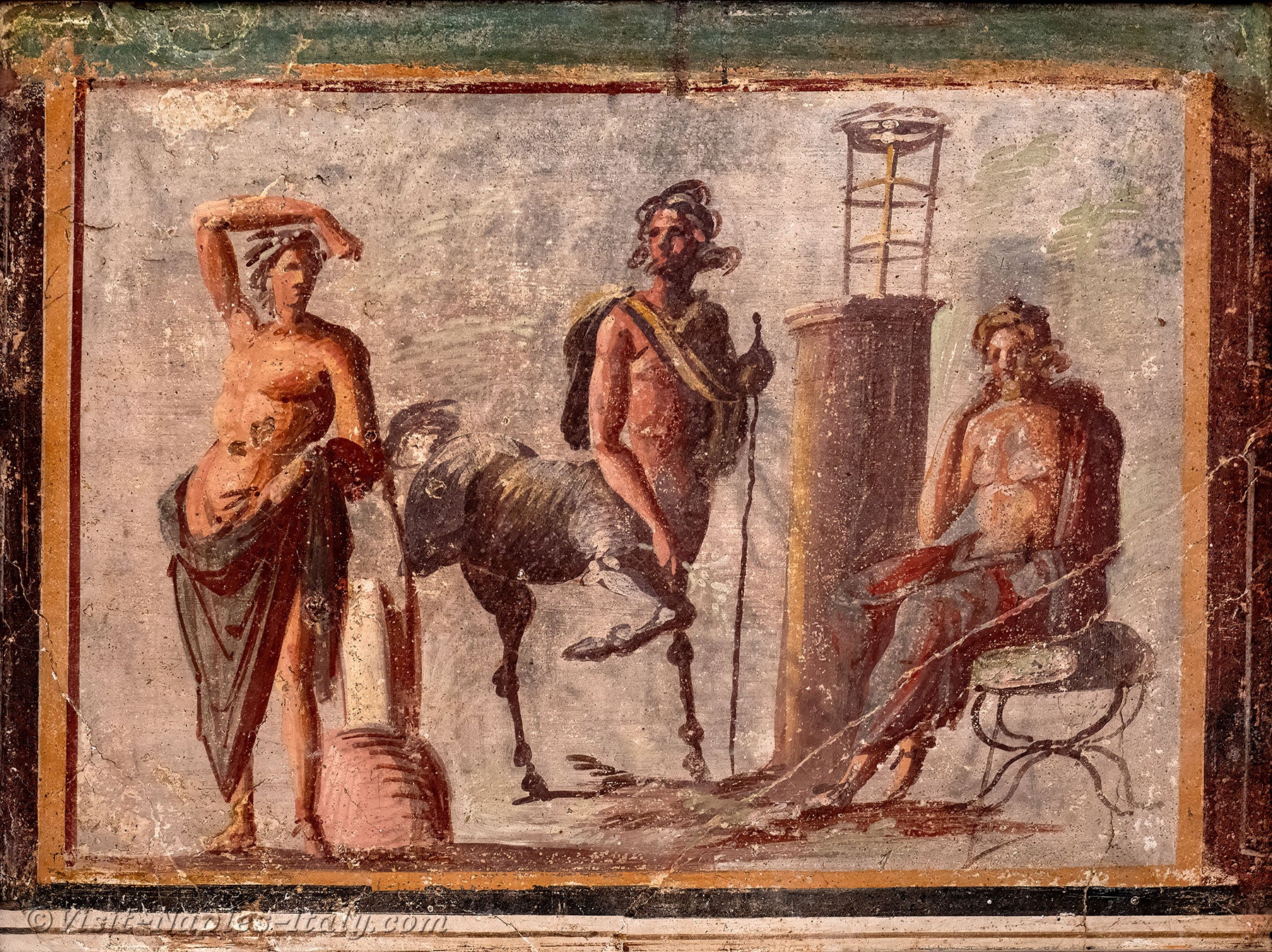
Apollo, Chiron, and Asclepius The wise Chiron was a benefactor of humanity who stood out from the other Centaurs because Apollo had taught him medicine.
According to legend, Princess Coronis became pregnant with Asclepius after being seduced by Apollo.
As soon as he learned that she was cheating on him with a mortal, Apollo killed Coronis and ripped his son alive from his mother's womb to entrust him to Chiron, who taught him the art of making remedies.
Asclepius had become a brilliant physician capable of resurrecting the dead; he therefore risked disrupting the natural order of life with all his miraculous healings, so much so that Zeus eventually struck him down with a thunderbolt.
Son of Apollo, the physician Asclepius received divine honours with the snake as his emblem: sanctuaries were dedicated to him, frequented by the infirm and the sick who went there to relieve their suffering and seek healing.
The most famous was the sanctuary of Epidaurus.
Apollo and Daphne, Pompeii, Casa di Meleagro
Fresco - Water-based pigments on Coating (56 x 49 cm) 62-79 ADThe nymph Daphne is naked and seems enchanted by the music played by the handsome Apollo unlike the usual image of her running, half-transformed into a laurel tree, to escape Apollo's embrace.
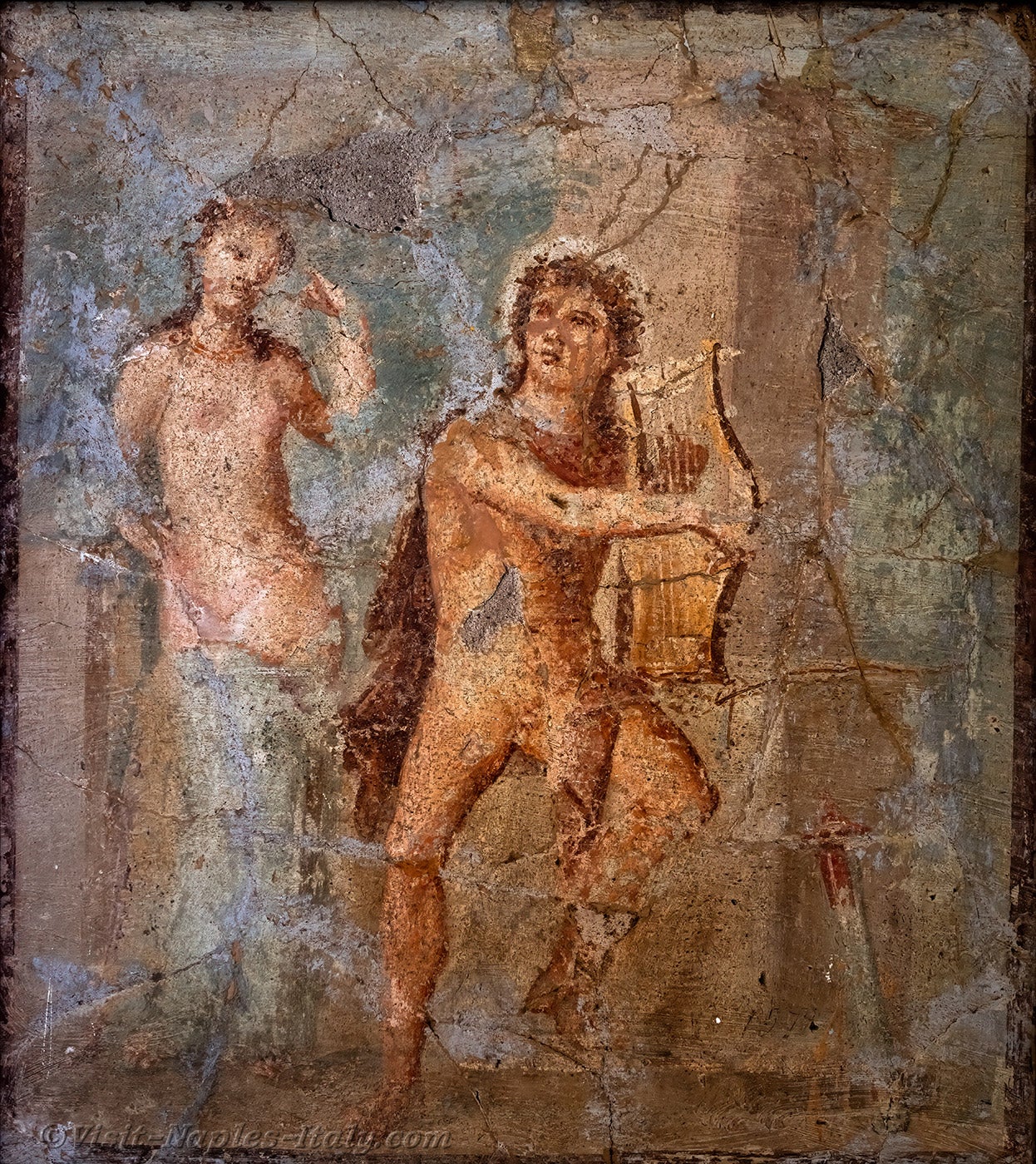
Apollo and Daphne This fresco illustrates a myth in which Daphne fell in love with a young man who had mingled with a group of nymphs by disguising himself as a woman in order to approach her, which provoked the jealousy of Apollo, who gave them the idea to undress for a swim.
The young man was thus unmasked and, during the confusion caused by the girls' anger, Apollo took the opportunity to embrace Daphne, who immediately transformed into a laurel tree.
According to Ovid's “Metamorphoses”, Apollo was madly in love with Daphne, who refused his advances and fled.
When Apollo was about to catch up with her, Daphne called Gaia (Mother Earth) to her aid, who transformed her into a laurel tree.
In memory of his love for her, Apollo wove himself a crown of laurel leaves, which became his emblem.
Apollo and Daphne, Casa Lucrezio Frontone, Pompeii
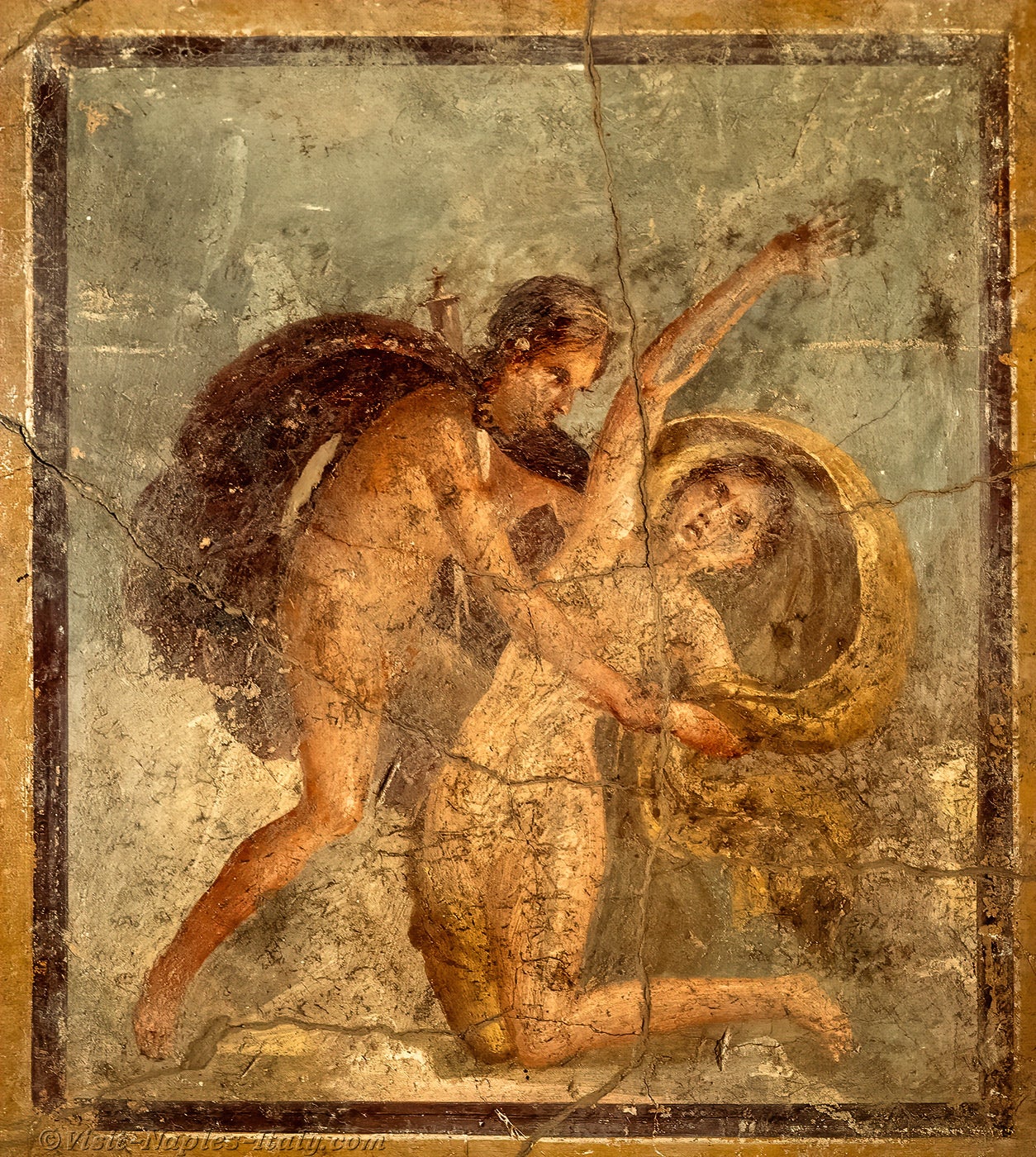
Apollo and Daphne Fresco - Water-based pigments on coating
50-79 AD
The fresco depicts the end of the chase.
Apollo seizes Daphne by one arm and rips off her garment to embrace her naked body.
She falls to her knees, exhausted, raising her other arm in desperation and begging her father to save her by transforming her.
Mythology Achilles | Aeneas | Alcestis | Alexander | Aphrodite | Apollo | Arianne | Artemis | Ceres | Chryseis | Cupid | Daedalus | Dionysus | Dirce | Endymion | Flora | Galatea | Ganymede | Graces | Hephaestus | Hercules | Io Argos | Iphigenia | Isis | Leda | Marsyas | Medea | Nereids | Niobids | Odysseus | Pan | Paris | Perseus | Phaedra | Phrixus | Pirithous | Saturn | Satyrs | Sophonisba | Theseus | Troy | Zeus
Frescoes Mythology | Portraits | Life Leisure | Animals | Religion | Landscapes | Decoration
Artworks Sculptures | Frescoes | Eroticism
MANN Artworks Schedule Tickets Location | Authorizations
Back to Top of Page