

MANN Artworks Schedule Tickets Location | Authorizations
Artworks Sculptures | Frescoes | Eroticism
Frescoes Mythology | Portraits | Life Leisure | Animals | Religion | Landscapes | Decoration
Mythology Achilles | Aeneas | Alcestis | Alexander | Aphrodite | Apollo | Arianne | Artemis | Ceres | Chryseis | Cupid | Daedalus | Dionysus | Dirce | Endymion | Flora | Galatea | Ganymede | Graces | Hephaestus | Hercules | Io Argos | Iphigenia | Isis | Leda | Marsyas | Medea | Nereids | Niobids | Odysseus | Pan | Paris | Perseus | Phaedra | Phrixus | Pirithous | Saturn | Satyrs | Sophonisba | Theseus | Troy | Zeus
Frescoes depicting Galatea and Polyphemus at the Archaeological Museum of Naples in Italy
Polyphemus and Galatea, Pompeii
Fresco - Water-based pigments on Coating (59 x 65 cm) 45-79 BCGalatea was a sea goddess from the family of Nereids, who appeared as beautiful creatures personifying an aspect of the sea surface.
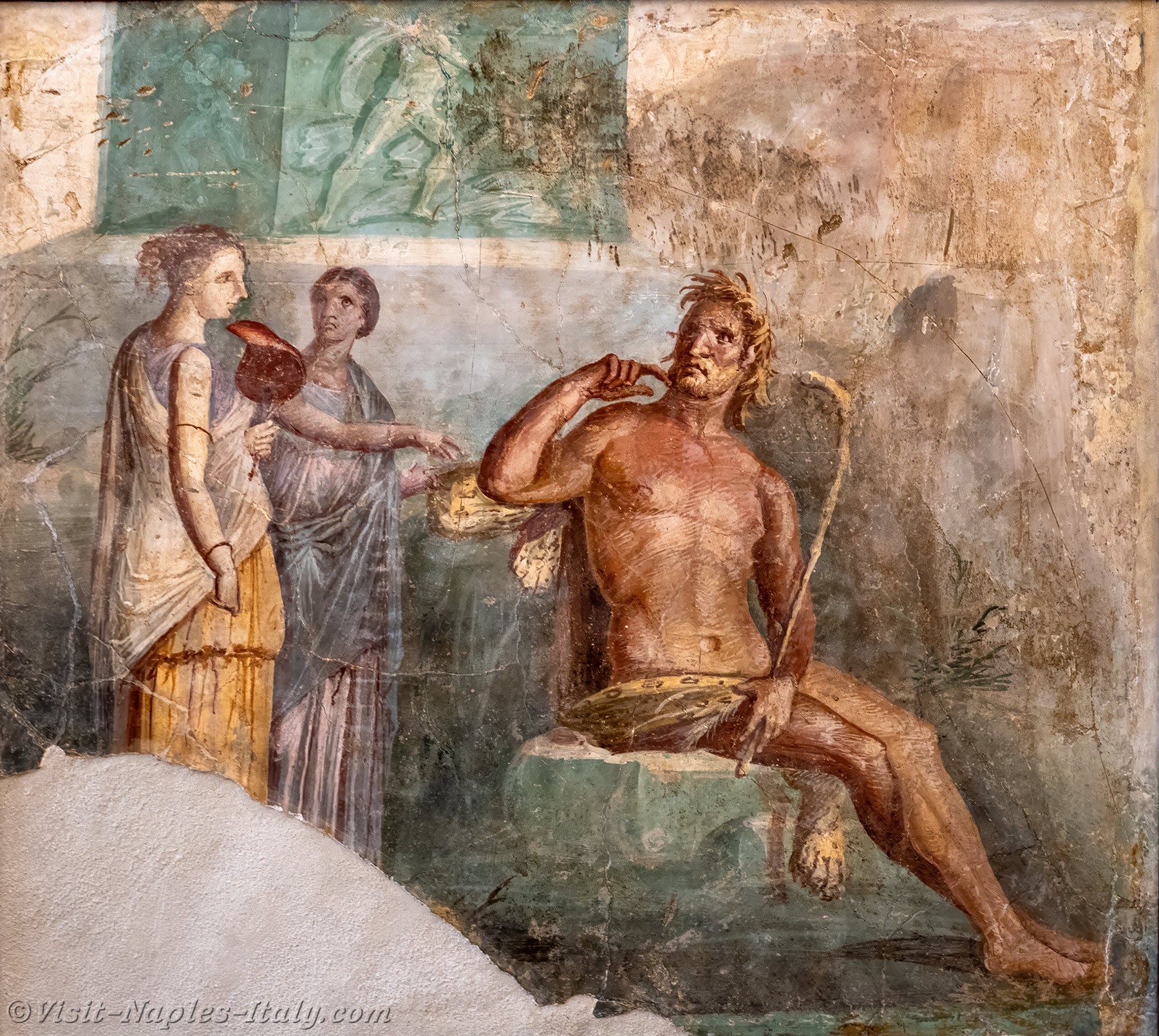
Polyphemus and Galatea Polyphemus was a giant cyclops who lived in a cave near Mount Etna.
He had fallen madly in love with Galatea, who shunned him because of his ugliness and cruelty.
He captured and devoured sailors who landed in Sicily; above the three figures, we can see Odysseus, who put an end to this horrible habit by gouging out his eye with a stake before escaping from his cave.
The fresco was probably inspired by Ovid's Metamorphoses, in which Scylla listens to Galatea telling her how Polyphemus killed the man she loved after trying in vain to seduce her by playing the flute and singing of his passion.
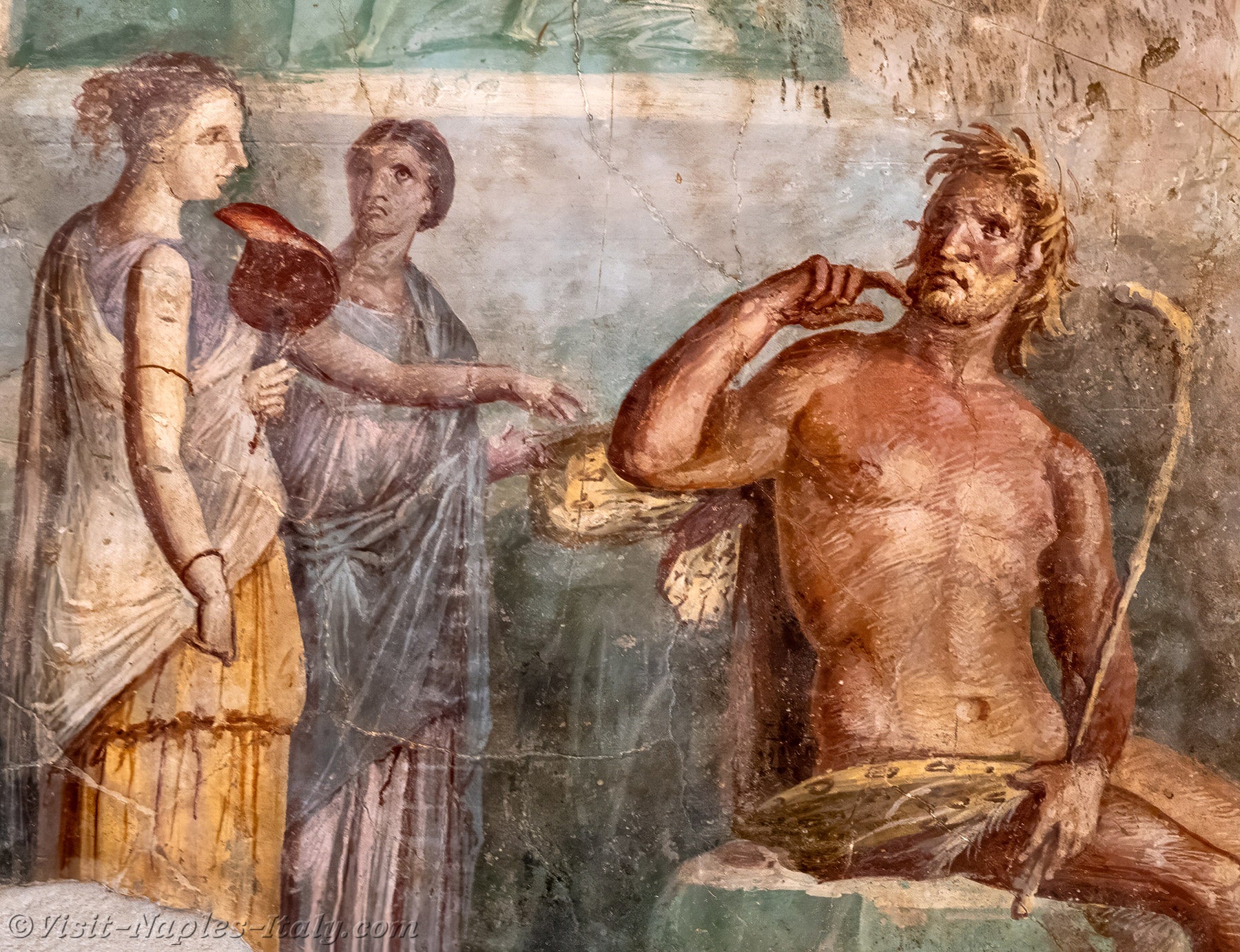
Polyphemus and Galatea Polyphemus had taken care of himself and had softened thanks to love; here he is depicted sitting on a rock, barely covered by an animal skin, with his legs crossed and casually holding his shepherd's crook, in the thoughtful pose of an inspired poet.
The gentle Galatea stands behind him with a fan in her hand, accompanied by Scylla, dressed in purple, who displays the skin of the animal killed by the author of these beautiful words:
“You are whiter, Galatea, than the snowy petals of the privet, more flowery than the meadows, more slender than the alder, brighter than crystal, more playful than a kid, smoother than the shell polished relentlessly by the waves, more delightful than the sun in winter, etc.”
Ovid - Metamorphoses
Then he tries to convince her by listing his riches and begging her, in vain.
He takes revenge by throwing a rock at poor Acis, Galatea's beloved.
Acis, Galatea and Polyphemus, Herculaneum
Fresco - Water-based pigments on Coating (37 x 57 cm) 50-20 BCThe scene depicts the love affair between Acis and Galatea threatened by the cyclops Polyphemus, based on the story by the Latin poet Ovid.
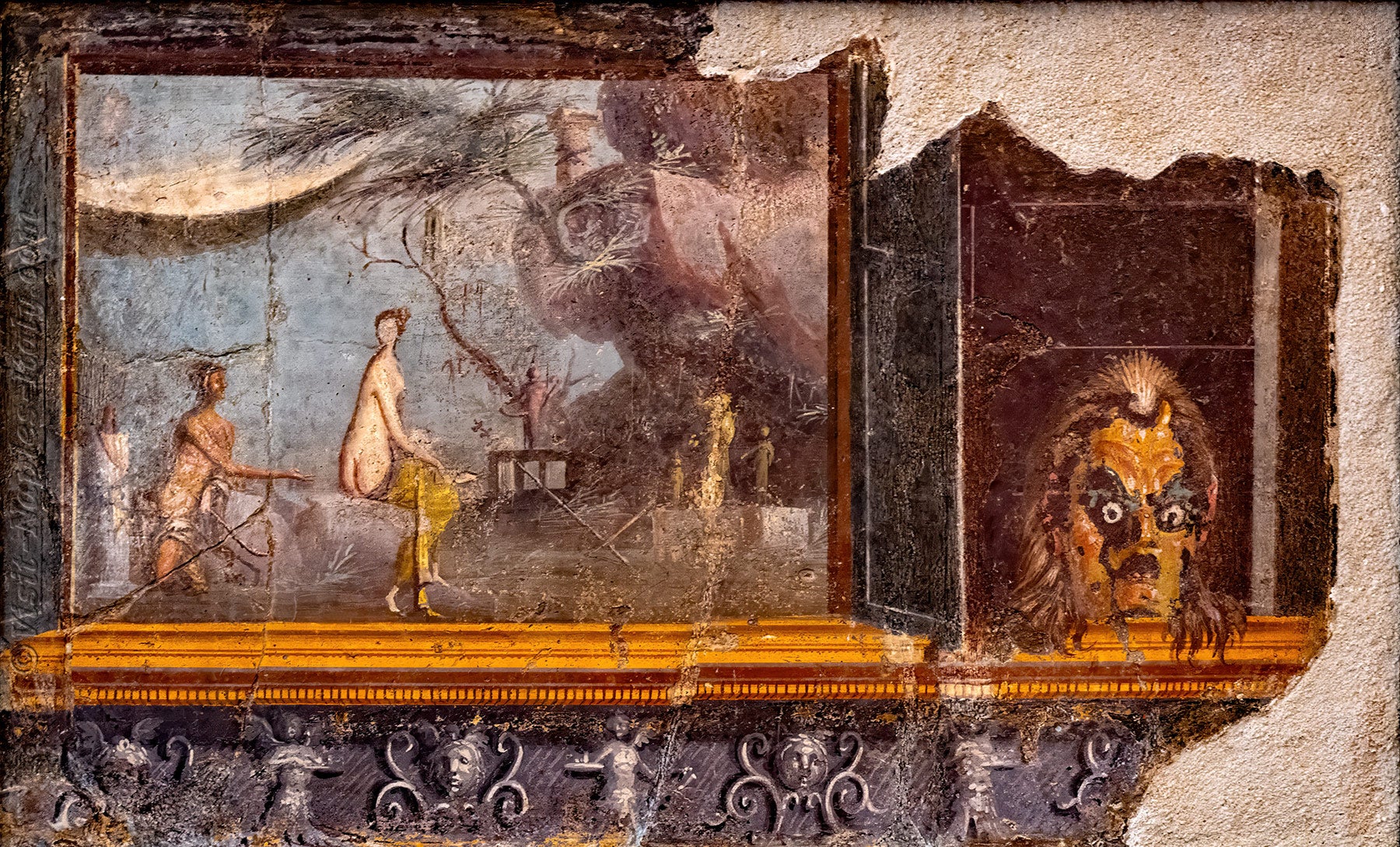
Acis, Galatea and Polyphemus On the left, Acis the shepherd is kneeling and turning towards the beautiful body of Galatea sitting on the white rock, his arm outstretched.
The simple canvas stretched above them to protect them from the sun and the blue background offer an idyllic image unfolding in the open air, in the presence of the statues of deities on the right; the one of Priapus standing on a pedestal is closest to the couple.
Galatea loved Acis, son of Faunus and a nymph.
“Acis was the joy of his parents and even more so of mine; for he was the only one who had managed to win my favour.
He was handsome, sixteen years old, and a faint down was just beginning to show on his delicate cheeks.
I followed him ceaselessly, and the Cyclops followed me.”
Ovid - Metamorphoses
After unsuccessfully attempting to seduce Galatea, the hideous man-eating Cyclops who despised the gods of Olympus decided to kill Acis.
The jealous monster had managed to catch the lovers by surprise: his deformed head appears here on the right in the form of an enormous rock with a tree in the middle of his face leaning towards them.
Galatea recounted the tragic aftermath:
“I can see you, he shouted at us, I shall ensure that this tryst is your last.”
Ovid - Metamorphoses
Galatea the Nereid had fled by plunging into the nearby sea, whilst the Cyclops pursued Acis who cried out: “Come to my aid, O my parents” !
Polyphemus hurled a block of stone which crushed the unfortunate Acis, under the horrified gaze of his father Faunus, depicted separately on the right.
The amorous adventures of Polyphemus and Galatea, Casa Capitelli Colorati, Pompeii
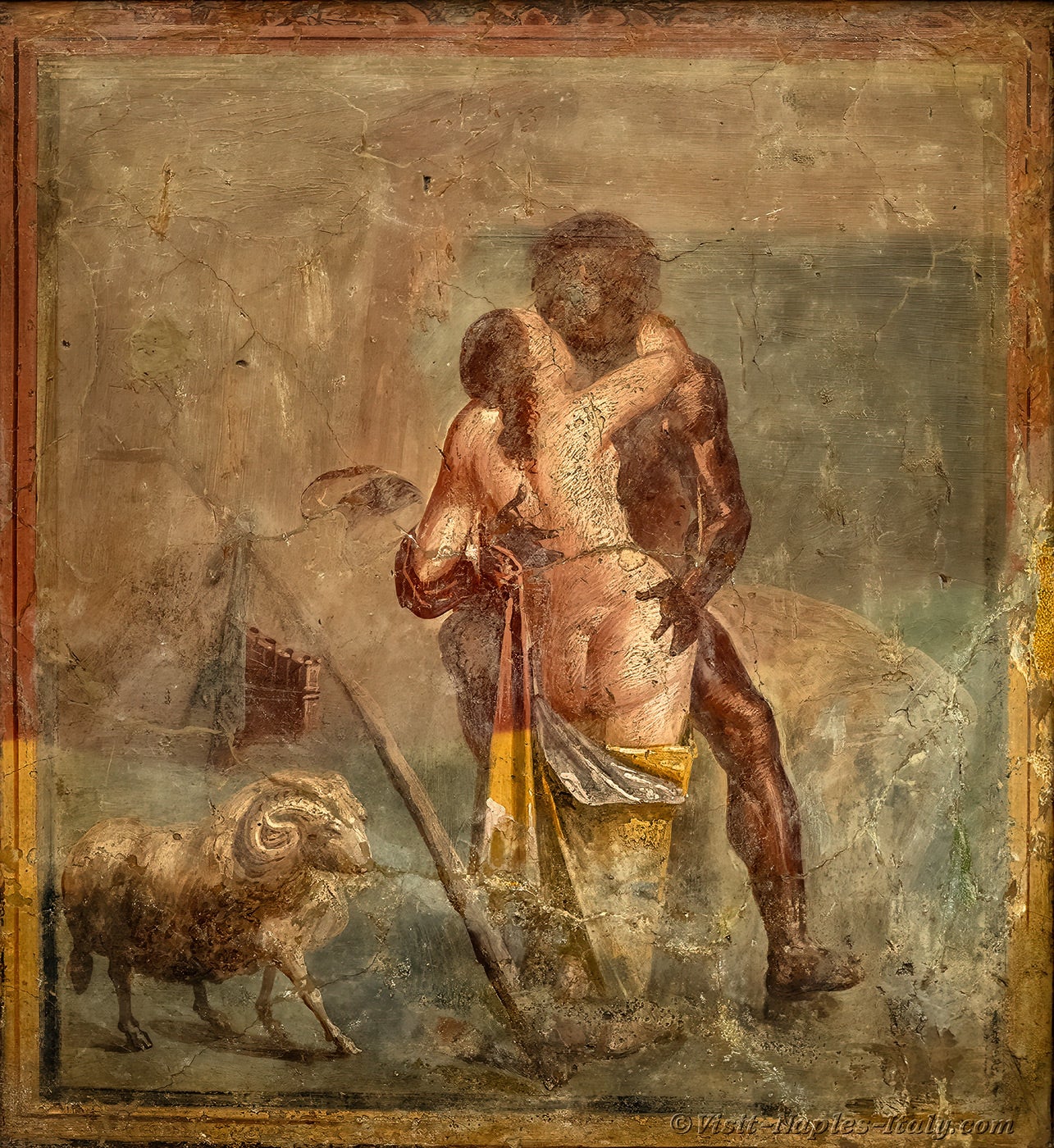
Polyphemus and Galatea Fresco - Water-based pigments on coating - 1-50 AD
Unlike Ovid’s account, Galatea passionately embraces the Cyclops instead of fleeing from him.
Polyphemus finally holds the woman of his dreams in his arms whom he has managed to seduce by singing and playing the flute.
Galatea’s dress slips down her body her fair skin contrasting with her lover’s dark complexion.
Polyphemus is a shepherd accustomed to hunting the wild beasts that threaten his flocks.
Mythology Achilles | Aeneas | Alcestis | Alexander | Aphrodite | Apollo | Arianne | Artemis | Ceres | Chryseis | Cupid | Daedalus | Dionysus | Dirce | Endymion | Flora | Galatea | Ganymede | Graces | Hephaestus | Hercules | Io Argos | Iphigenia | Isis | Leda | Marsyas | Medea | Nereids | Niobids | Odysseus | Pan | Paris | Perseus | Phaedra | Phrixus | Pirithous | Saturn | Satyrs | Sophonisba | Theseus | Troy | Zeus
Frescoes Mythology | Portraits | Life Leisure | Animals | Religion | Landscapes | Decoration
Artworks Sculptures | Frescoes | Eroticism
MANN Artworks Schedule Tickets Location | Authorizations
Back to Top of Page