

MANN Artworks Schedule Tickets Location | Authorizations
Artworks Sculptures | Frescoes | Eroticism
Frescoes Mythology | Portraits | Life Leisure | Animals | Religion | Landscapes | Decoration
Mythology Achilles | Aeneas | Alcestis | Alexander | Aphrodite | Apollo | Arianne | Artemis | Ceres | Chryseis | Cupid | Daedalus | Dionysus | Dirce | Endymion | Flora | Galatea | Ganymede | Graces | Hephaestus | Hercules | Io Argos | Iphigenia | Isis | Leda | Marsyas | Medea | Nereids | Niobids | Odysseus | Pan | Paris | Perseus | Phaedra | Phrixus | Pirithous | Saturn | Satyrs | Sophonisba | Theseus | Troy | Zeus
Frescoes depicting Ariadne, Theseus and Dionysus at the Archaeological Museum of Naples in Italy
The frescoes in Pompeii illustrating Theseus abandoning Ariadne fall into two categories:
-The old-style frescoes (4th and 3rd centuries BC) showing Theseus leaving Ariadne, who is still asleep, and preparing to board his ship to leave the island of Naxos.
-The Roman-style frescoes (1st century AD) showing Ariadne waking up and realising that Theseus has left her, and weeping as she watches his ship sail away into the distance.
The story of Ariadne was similar to that of Dido, the queen of Carthage, who wept as she watched the ship of Aeneas sailing away, abandoning her for Italy where his descendants founded Rome.
Theseus abandoning Ariadne, Pompeii, Casa Caecilius Lucundus
Fresco - Water-based pigments on Coating (124 x 106 cm) 35-45 AD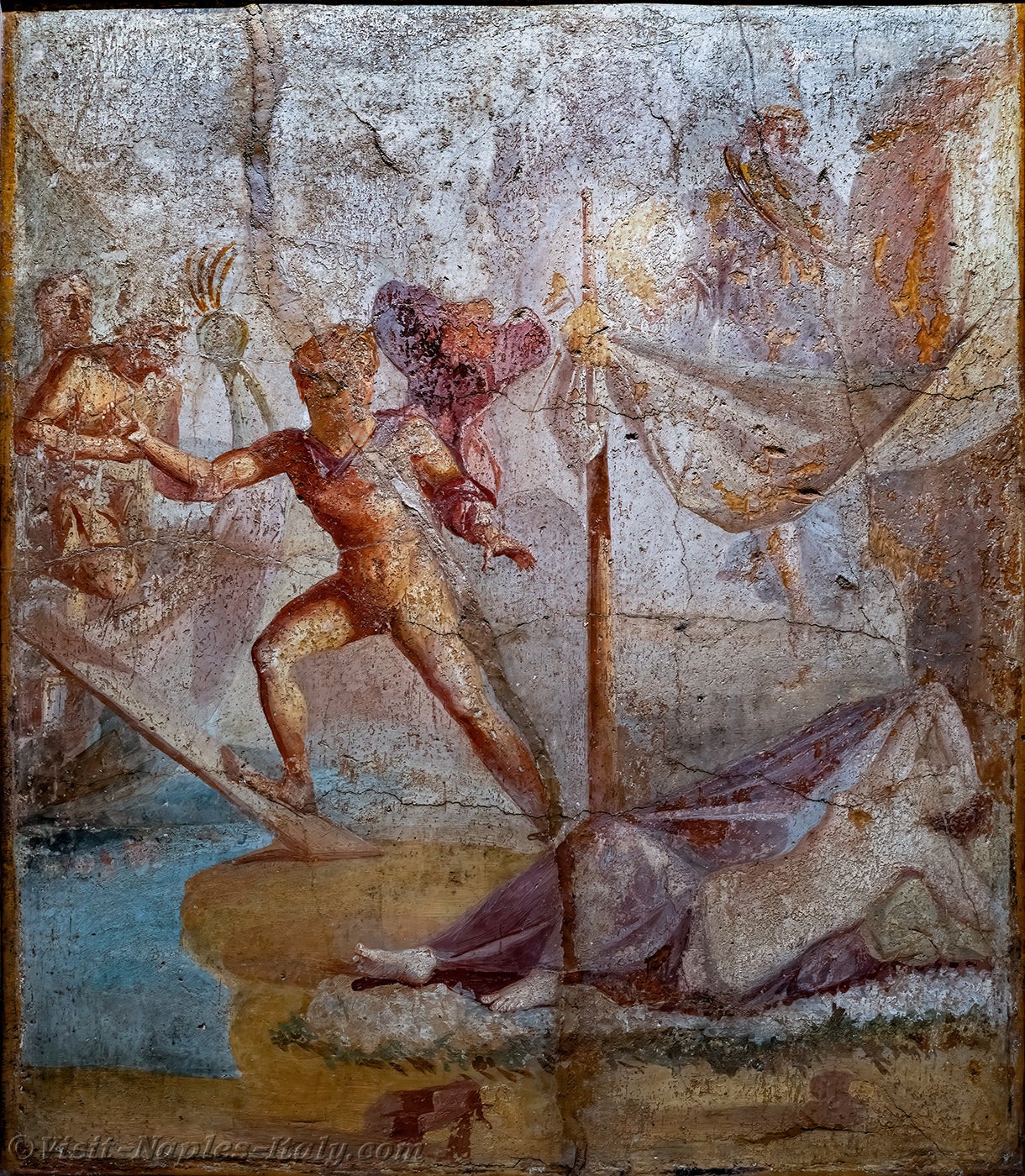
Theseus abandons Ariadne After killing the Minotaur without getting lost in the labyrinth thanks to Ariadne's thread, Theseus fled Crete with her to the island of Naxos.
The fresco depicts Theseus preparing to leave Naxos, hurrying to board the ship that will take him back to Athens, taking care not to wake Ariadne, who is lying on a bed of flowers.
Ariadne sleeps soundly, unaware that she will never see her lover again as he leaves her, following the orders of Athena, who appears in the upper right corner with her helmet and round shield.
The post supporting the canvas above the beautiful sleeping woman, standing in the middle of the scene, marks the separation of the two lovers.
A Hellenic-style fresco, admirably composed and rich in colour.
Theseus abandons Ariadne, Pompeii, Casa dei Capitelli Colorati
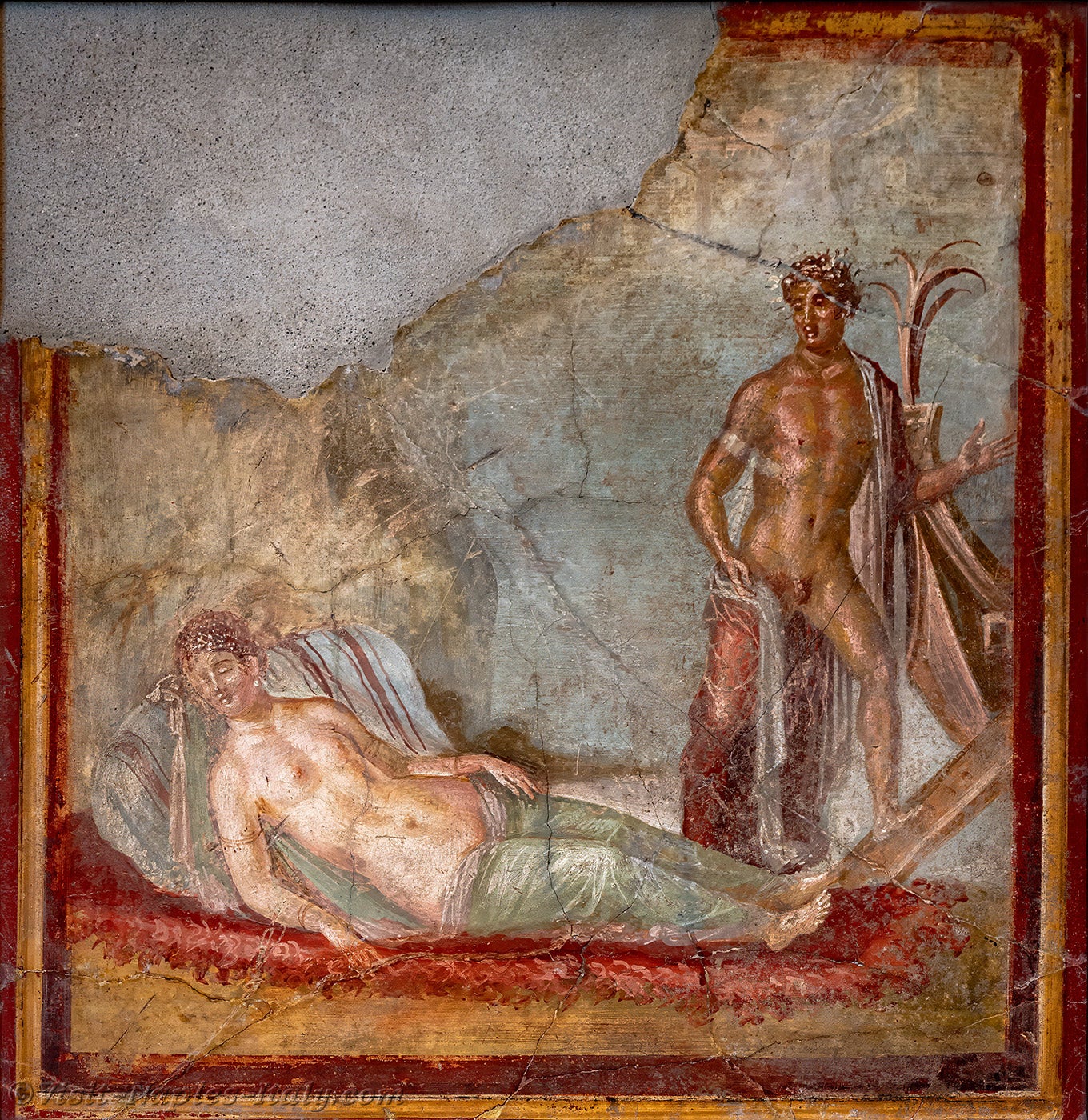
Theseus abandons Ariadne Fresco - Water-based pigments on coating (61 x 59 cm) 45-79 AD
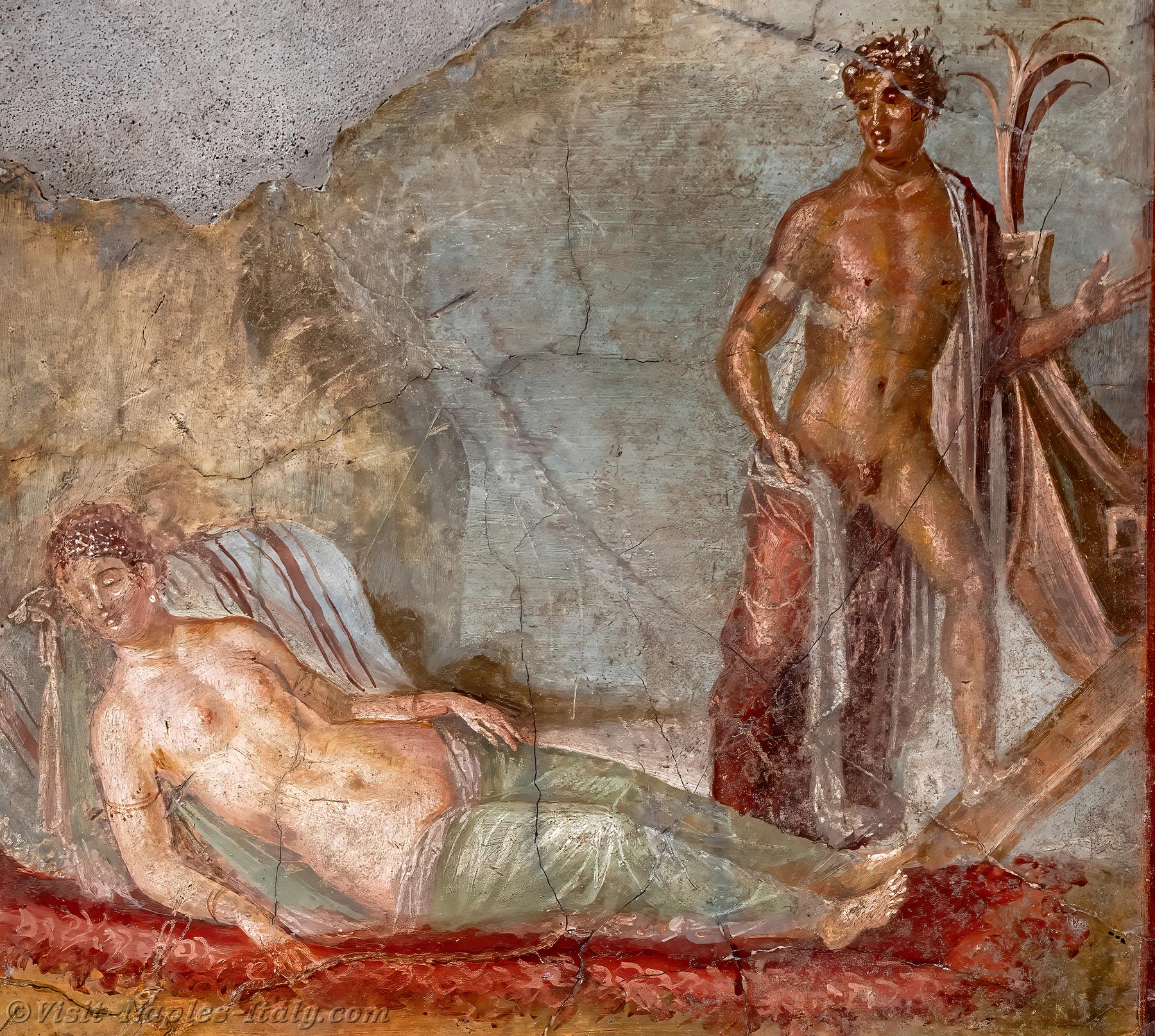
Ariane is still asleep, leaning half-naked on a large striped pillow, her legs covered with an emerald green drape.
The flowered headband that holds her curly hair in place, the gold ring adorning her ear, the necklace and bracelets highlight the femininity of the Cretan princess immersed in innocent sleep, while her lover leaves her furtively as he gets dressed to board his boat.
Theseus has his head crowned with flowers, a reminder of the last banquet shared the night before with Ariadne.
He looks one last time at the woman who helped him escape the labyrinth.
Abandoned Ariadne, Pompeii, House of Meleager
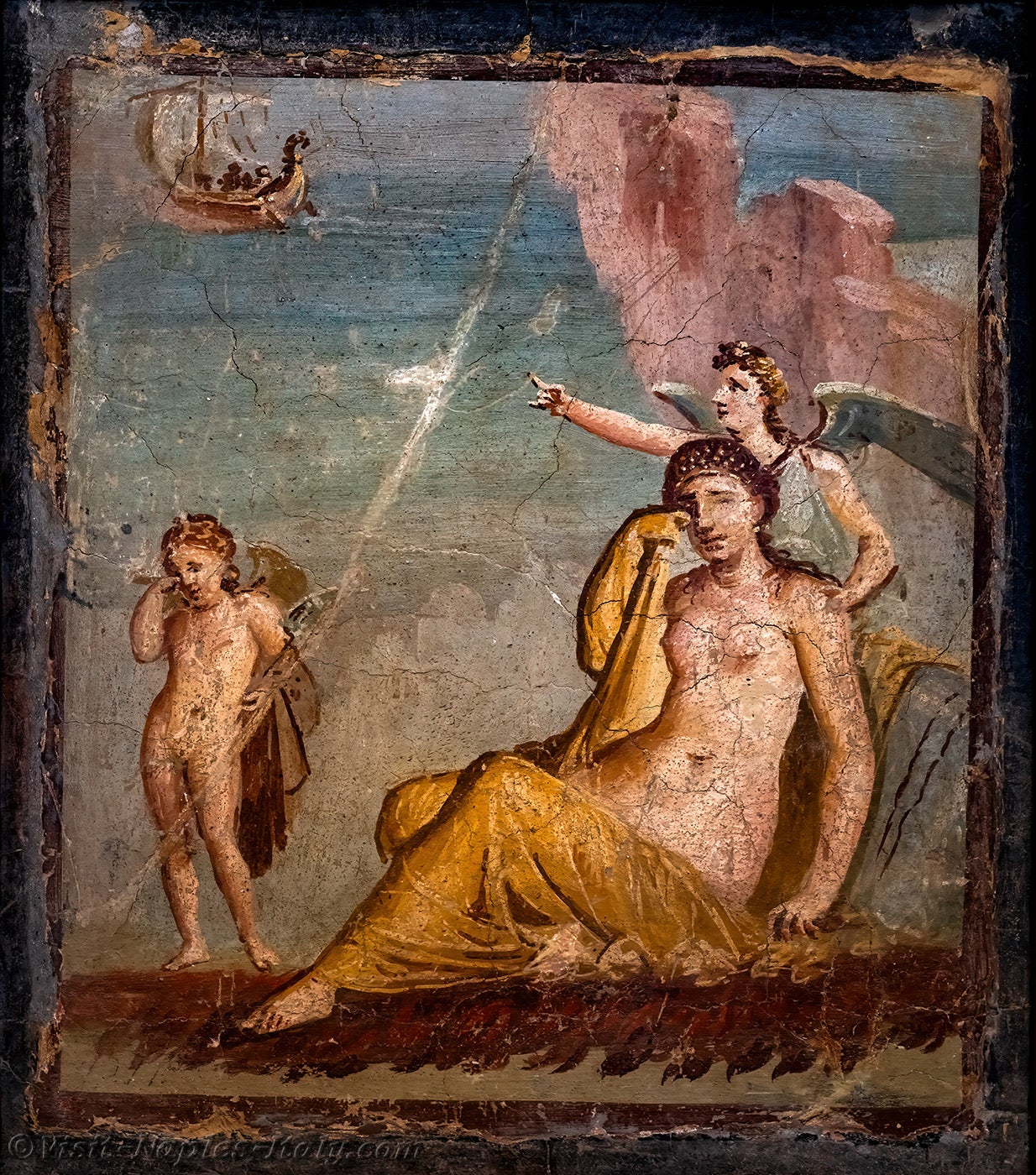
Abandoned Ariane Fresco - Water-based pigments on coating (47 x 42 cm) 62-79 AD
Ariadne has just woken up and is crying, sitting on her bed while Theseus' ship sets sail, leaving her alone with the little love who shares her despair.
Behind Ariadne stands Nemesis, the winged goddess of righteous anger and divine punishment, demanding retribution by pointing out the unfaithful man.
During his journey back to Athens, Theseus forgot that he had promised his father to hoist white sails on his ship as a sign of victory over the Minotaur.
Seeing the dark sails, Aegeus believed that his son was dead and committed suicide by throwing himself off a cliff into the Aegean Sea, so named to honour his memory.
Epiphany of Dionysus with Ariadne, Pompeii, Casa Capitelli Colorati
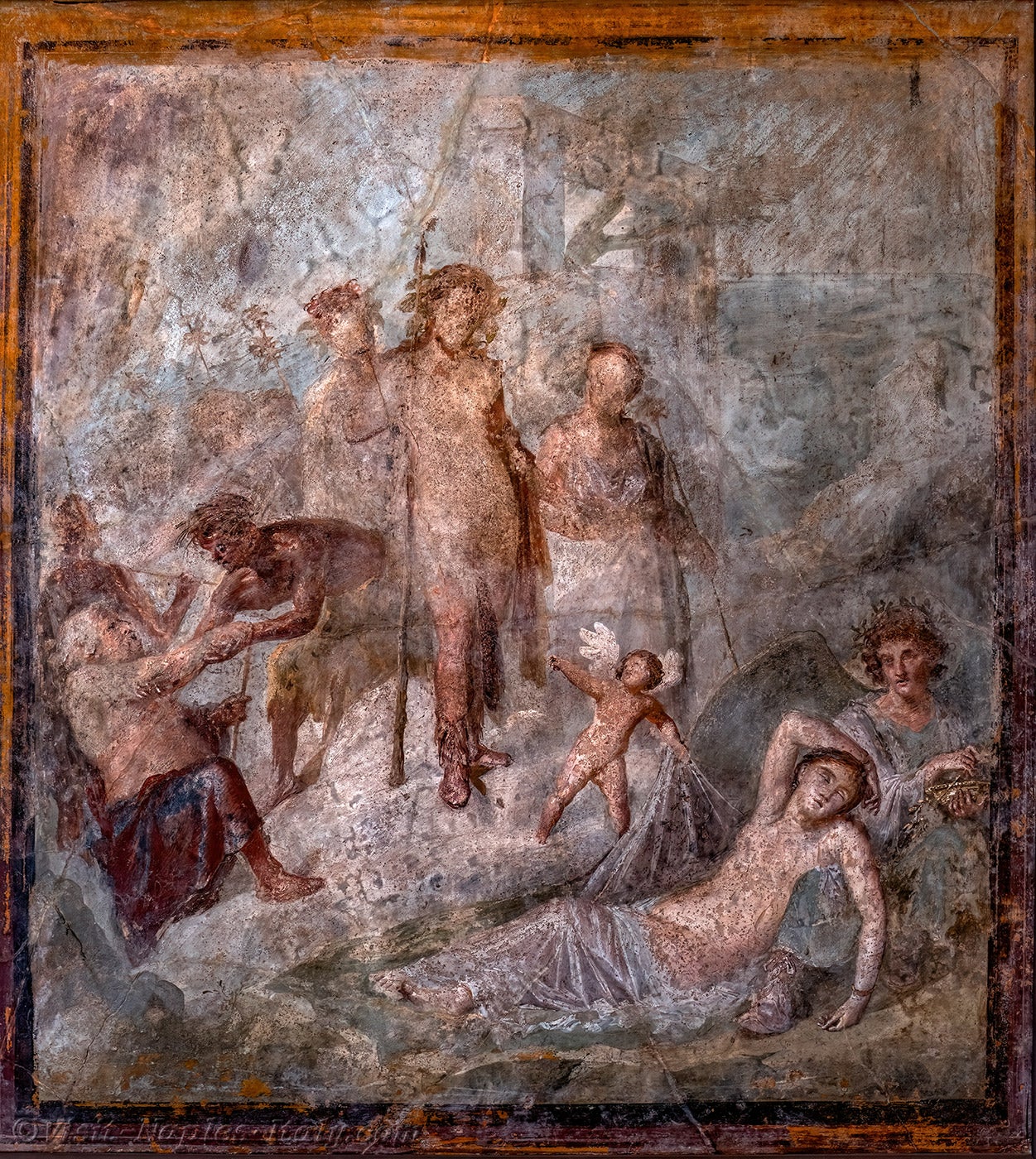
Epiphany of Dionysus Fresco - Water-based pigments on coating (118 x 106 cm) 45-79 AD
Dionysus, the god of wine and celebration, has just landed on the island of Naxos with his entourage of satyrs, Maenads, Sileni and musicians.
Standing in the centre of the fresco, Dionysus approaches, following the winged cherub who reveals Ariadne's beauty to him by lifting a corner of the cloth covering her nakedness.
Abandoned Ariadne sleeps peacefully, her head and shoulders resting on Hypnos, the god of sleep, crowned with foliage and dressed in a long robe, who holds a container of soporific plants.
Dionysus married Ariadne and gave her a golden crown as a wedding gift, which he then placed among the constellations.
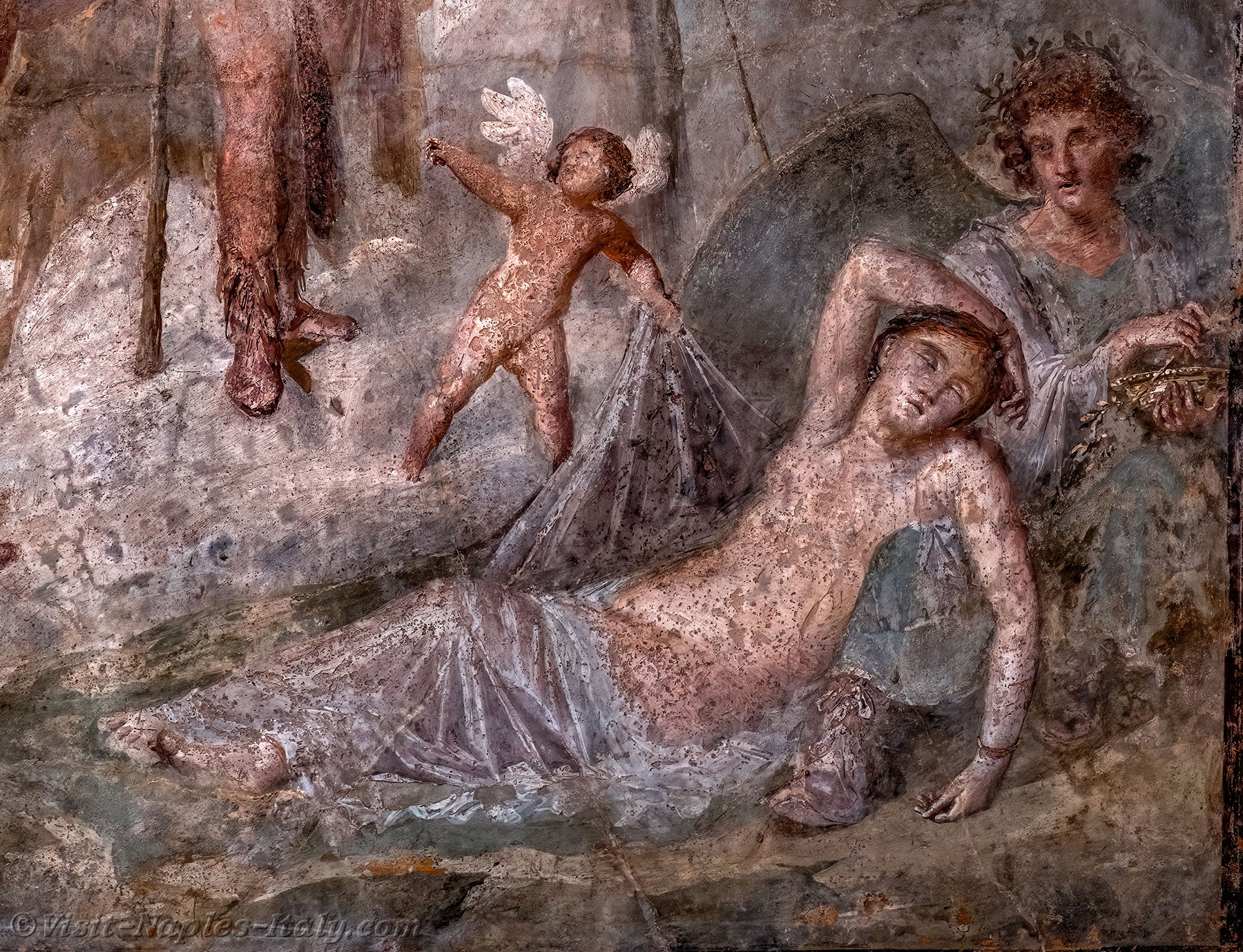
Dionysus discovers Ariadne abandoned on the beach, Pompeii
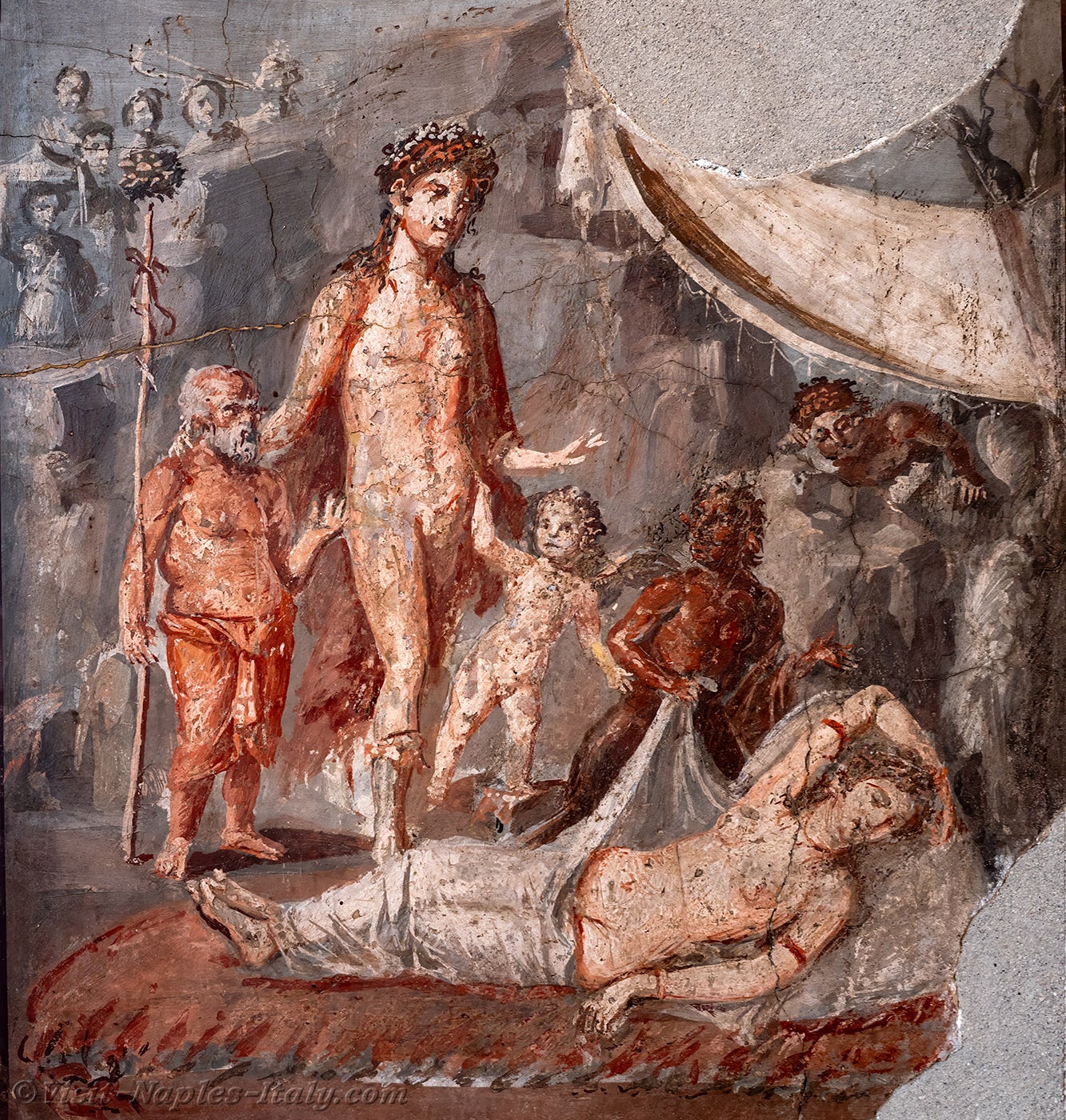
Dionysus and Ariadne Fresco - Water-based pigments on coating (76 x 63 cm) 45-79 AD
Here is a slightly different version of Dionysus discovering Ariadne asleep on the beach at Naxos.
Dionysus has his hand resting amicably on the shoulder of a Silenus and lets himself be guided by Eros while a kneeling satyr lifts a corner of the sheet to show him the beautiful naked body of Ariadne lying comfortably on a bed of stacked blankets.
She is fast asleep, her right arm behind her head, which is framed by beautiful curly hair.
Dionysus, crowned with ivy, looks at her with admiration.
He approaches her, accompanied by his friends who watch the scene with interest.
Ariane and Dionysus in flight, Stabiae, Villa Arianna
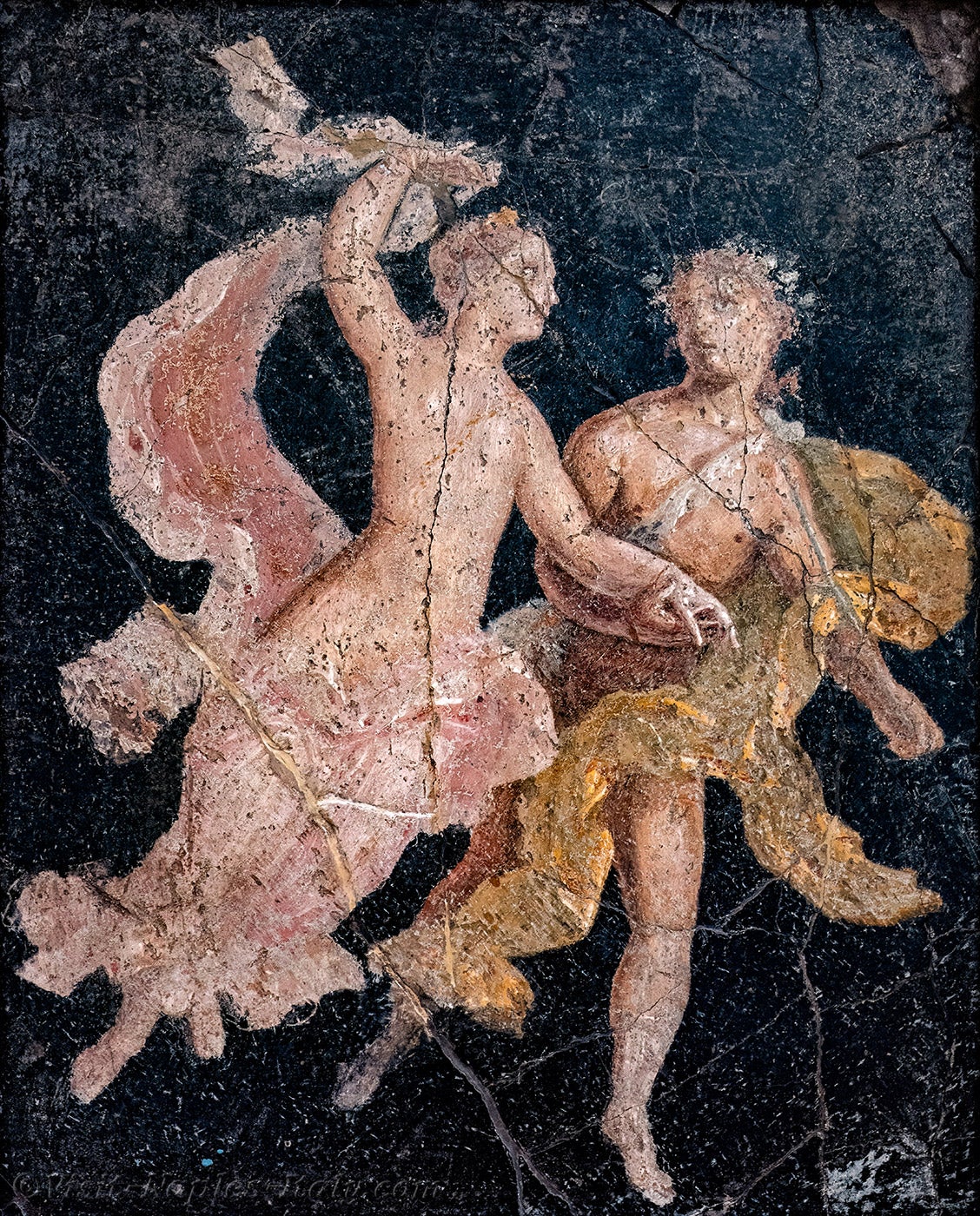
Ariane Dionysus in flight Fresco - Water-based pigments on coating (40 x 51 cm) 10-37 AD
Dionysus carries off Ariadne, who rises gracefully, holding her veil.
They fly, holding hands lovingly.
Their clothes float around their light bodies, which light up the night sky.
Ariadne, who was originally synonymous with purity, then luminosity, ascends to the sky with Dionysus, who had given her a golden crown as a wedding gift, which he then placed among the stars.
Mythology Achilles | Aeneas | Alcestis | Alexander | Aphrodite | Apollo | Arianne | Artemis | Ceres | Chryseis | Cupid | Daedalus | Dionysus | Dirce | Endymion | Flora | Galatea | Ganymede | Graces | Hephaestus | Hercules | Io Argos | Iphigenia | Isis | Leda | Marsyas | Medea | Nereids | Niobids | Odysseus | Pan | Paris | Perseus | Phaedra | Phrixus | Pirithous | Saturn | Satyrs | Sophonisba | Theseus | Troy | Zeus
Frescoes Mythology | Portraits | Life Leisure | Animals | Religion | Landscapes | Decoration
Artworks Sculptures | Frescoes | Eroticism
MANN Artworks Schedule Tickets Location | Authorizations
Back to Top of Page