

MANN Artworks Schedule Tickets Location | Authorizations
Artworks Sculptures | Frescoes | Eroticism
Frescoes Mythology | Portraits | Life Leisure | Animals | Religion | Landscapes | Decoration
Mythology Achilles | Aeneas | Alcestis | Alexander | Aphrodite | Apollo | Arianne | Artemis | Ceres | Chryseis | Cupid | Daedalus | Dionysus | Dirce | Endymion | Flora | Galatea | Ganymede | Graces | Hephaestus | Hercules | Io Argos | Iphigenia | Isis | Leda | Marsyas | Medea | Nereids | Niobids | Odysseus | Pan | Paris | Perseus | Phaedra | Phrixus | Pirithous | Saturn | Satyrs | Sophonisba | Theseus | Troy | Zeus
Frescoes depicting Io, goddess of the moon, Argos and Isis at the Archaeological Museum of Naples in Italy
Io and Argos, Pompeii, Casa di Meleagro
Fresco - Water-based pigments on coating (102 × 107 cm) 62-79 AD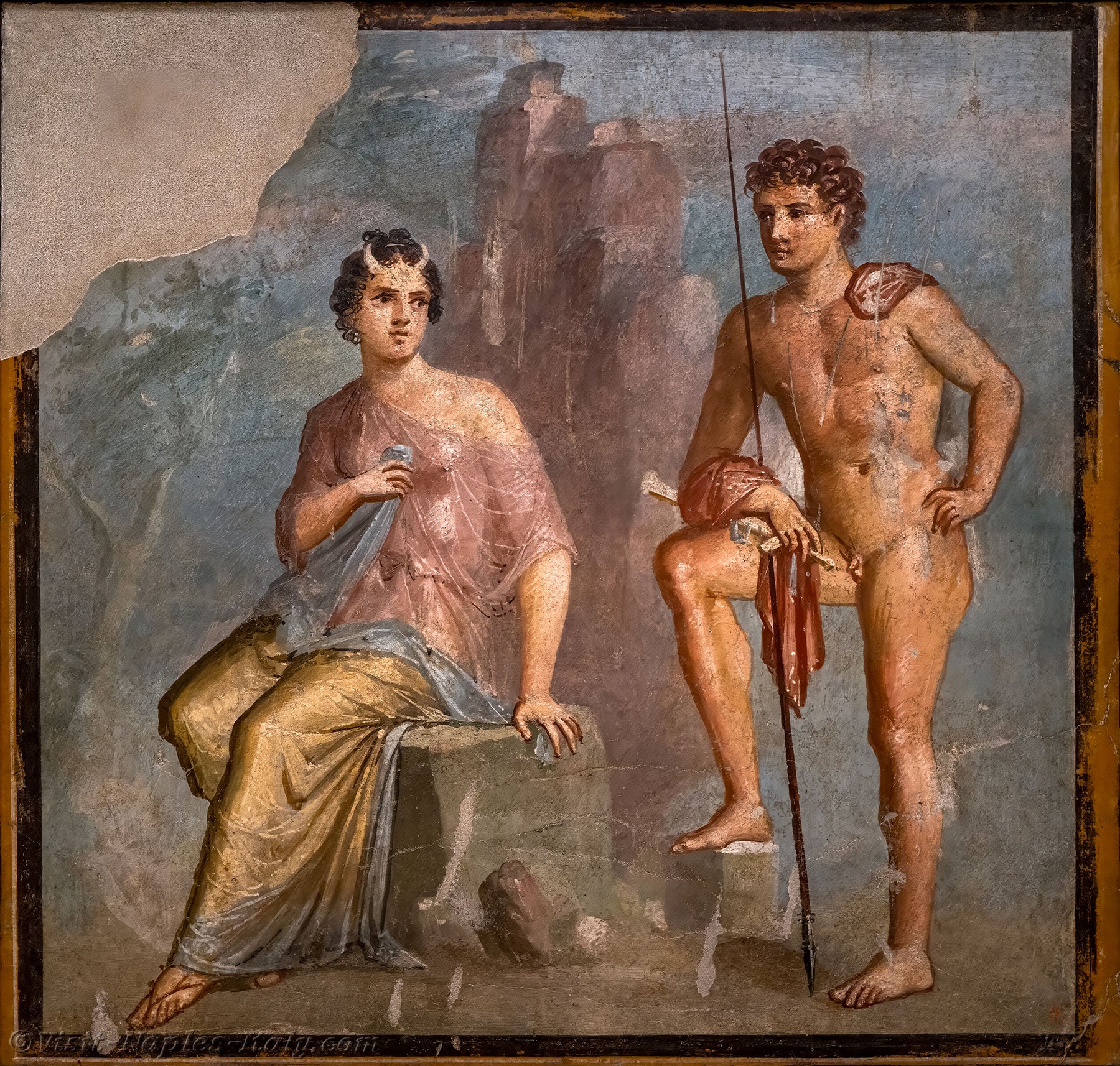
Io and Argos Zeus, the Olympian Don Juan, was often overcome with lustful desire whenever he saw a young virgin, a desire he easily satisfied thanks to his divine powers.
Io was one of his victims, whom he then transformed into a heifer of immaculate whiteness so that she could escape the wrath of Hera, who had no other means of taking revenge on her unfaithful husband.
Hera was not fooled by the deception, and Zeus could not refuse to give her this heifer of exceptional beauty.
To prevent her husband from finding the heifer, she hastened to place it under the infallible guard of Argos, the shepherd with a hundred eyes.
The fresco depicts Io sitting on a rock, recognisable by the small horns on her forehead ; she modestly pulls her garment up towards her chest, turning her torso to note the presence of Argos nearby, who never takes his eyes off her.
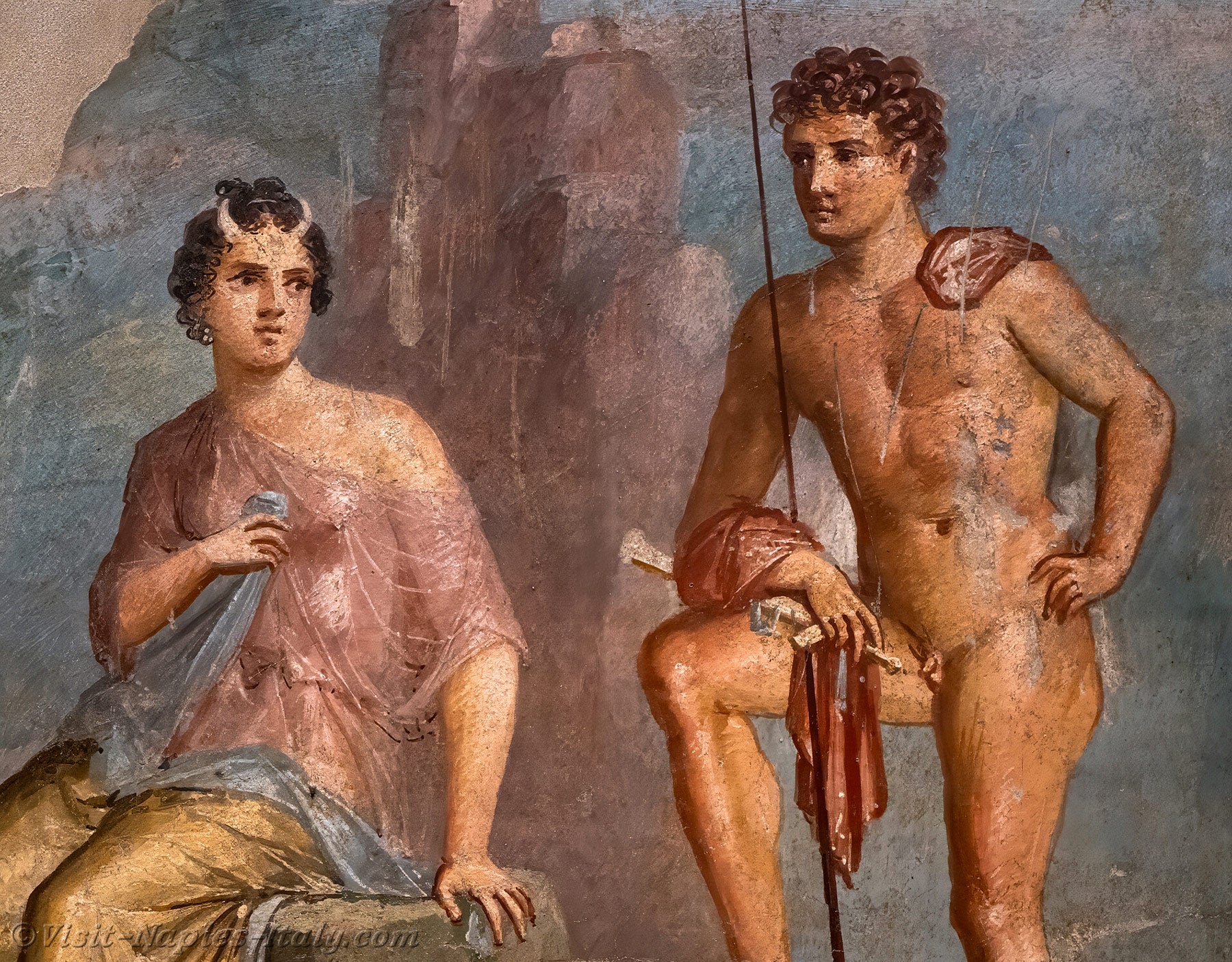
Io and Argos Argos is naked, his clothing falling behind his shoulder and wrapping around his right arm, which holds his sword, leaning on his thigh.
It was indeed impossible to escape Argos' vigilance, as described by the Latin poet Ovid:
“Argos had a head surrounded by a hundred eyes; they rested in turns, in groups of two at a time; all the others kept watch and remained on guard.
Whatever his posture, he looked towards Io; he had Io before his eyes, even when his back was turned.”
Ovid, Metamorphoses, Book I
Io, Hermes and Argos, Pompeii, Temple of Isis
Fresco - Water-based pigments on Coating - 45-79 ADZeus had transformed his lover Io into a heifer to hide her from Hera, his wife, but it was a wasted effort since he had to give her this exceptionally beautiful animal as a gift.
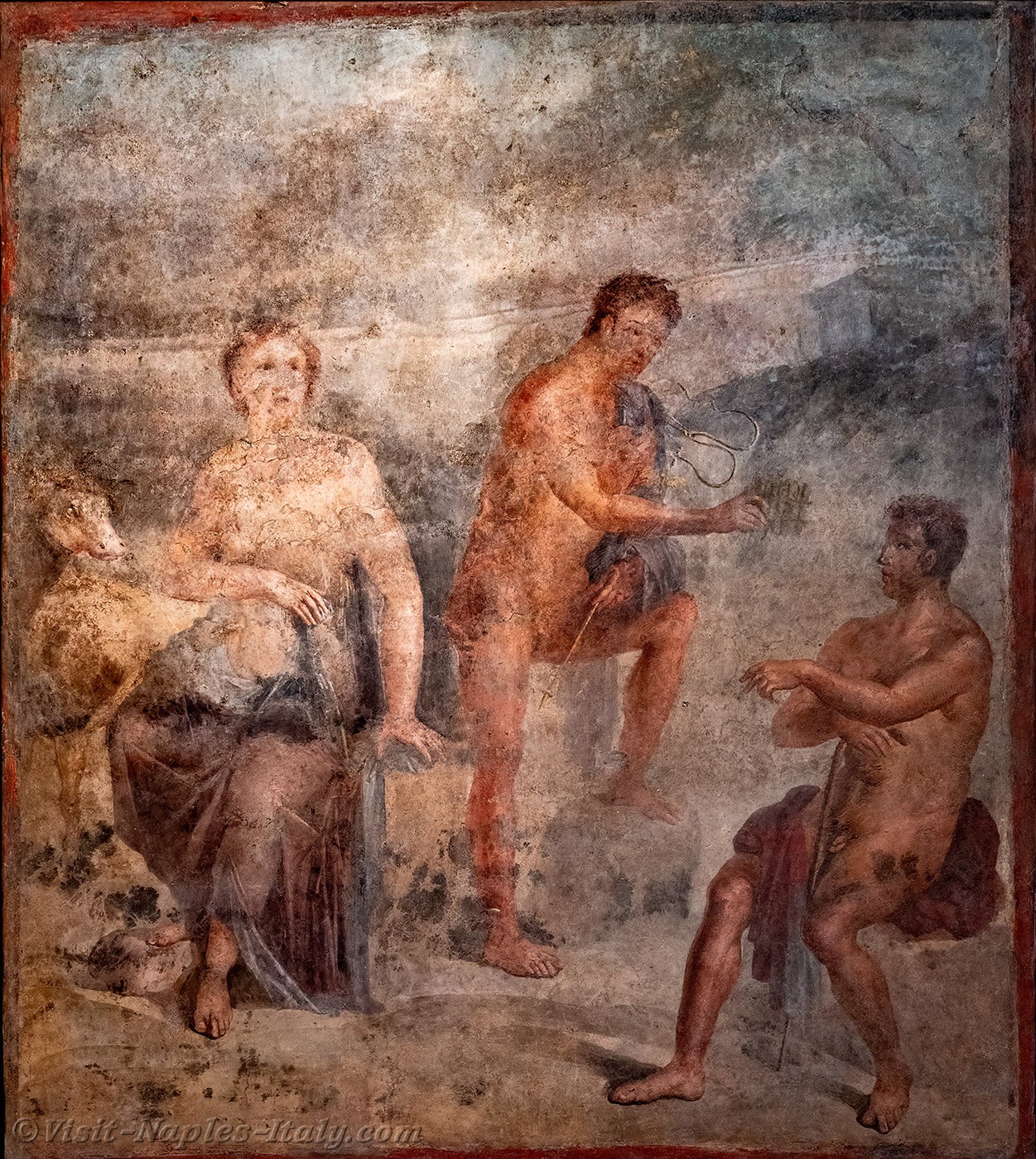
Io, Hermes and Argos Hera then placed the innocent young girl, reduced to the state of an animal and deprived of speech, under the watchful eye of Argos, the hundred-eyed shepherd, who had even driven away Io's father when he recognised his daughter among the herd.
Zeus wanted to end Io's suffering by sending Hermes to kill Argos; when Argos saw Hermes passing by with his herd of goats, he invited him to sit with him while his animals grazed on the tender grass.
The fresco depicts Io with her small horns on her forehead, sitting on a rock, while Hermes prepares to play the pan flute to charm Argos.
The melodious sounds of the music began to lull Argos' vigilance as he struggled to overcome the sweetness of sleep, and he then wanted to know the story of the invention of the pan flute.
Argos eventually fell asleep before the end of the story, and immediately afterwards, Hermes decapitated him, and his bloody head rolled down the rock.
Argos' eyes were collected by Hera, who scattered them like precious stones on the plumage of the bird she cherished, the peacock.
By spreading its tail feathers, the peacock offers us a beautiful reminder of the “hundred eyes of Argos”.
Io welcomed by Isis at Canopus, Pompeii, Temple of Isis
Fresco - Water-based pigments on Coating - 45-79 AD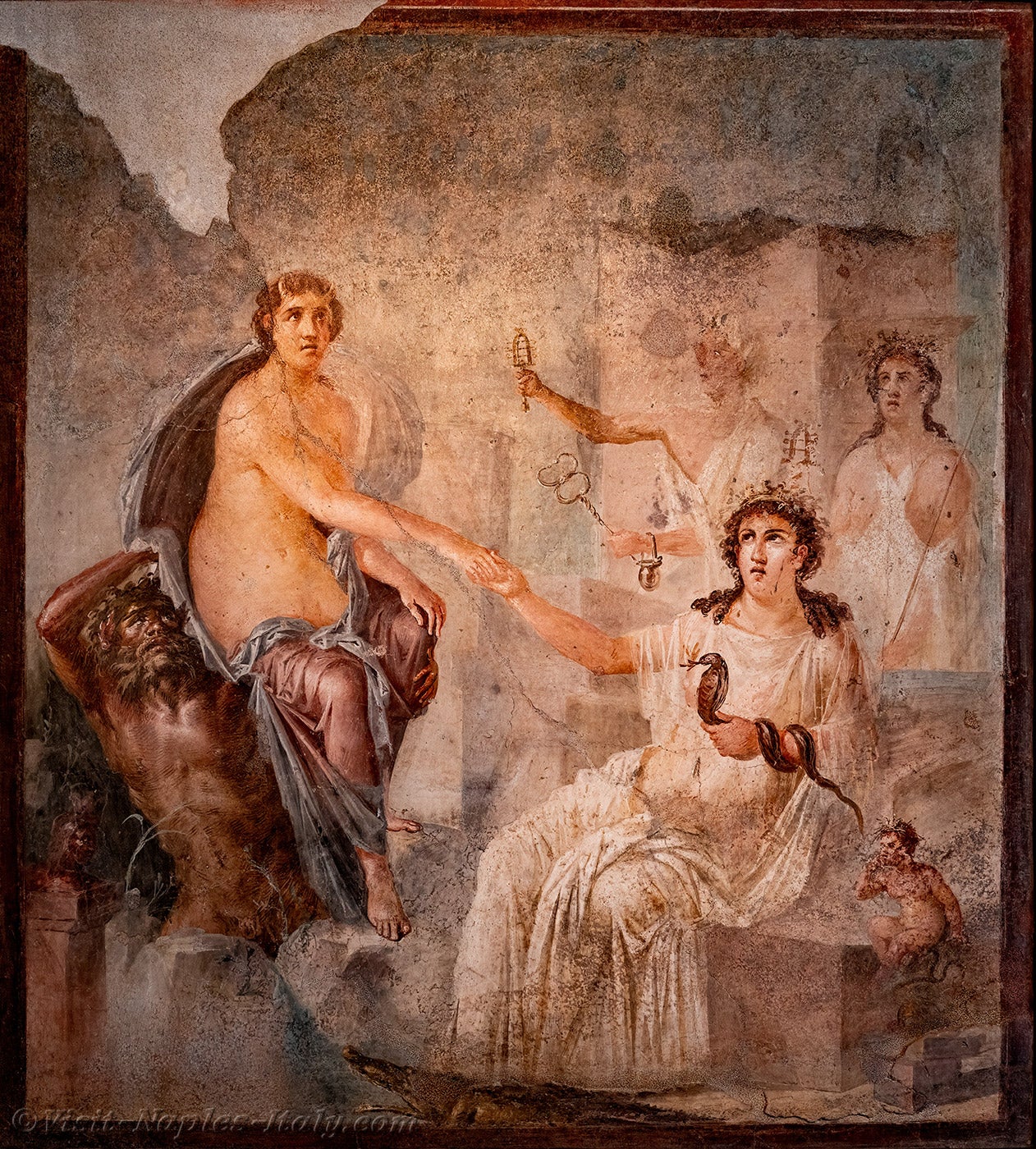
Io and Isis at Canopus By killing Argos to end Io's suffering, Hermes gave her back her freedom, but this did not stop Hera from continuing to torment her.
The heifer was relentlessly pursued by the Erinyes, who had probably taken the form of horseflies that bit her flanks and drove her mad.
The unfortunate creature thus wandered throughout Greece without finding peace, crossed the Bosphorus, reached Egypt and the banks of the Nile where she regained her human form, because the Olympian couple had finally reconciled.
The fresco depicts the Nile in the form of a man placing Io before the great Egyptian goddess Isis, who welcomes her with outstretched arms, surrounded by her priestesses dressed like her in immaculate white.
Io was thus assimilated into Isis, whose cult had spread throughout the Roman Empire.
Mythology Achilles | Aeneas | Alcestis | Alexander | Aphrodite | Apollo | Arianne | Artemis | Ceres | Chryseis | Cupid | Daedalus | Dionysus | Dirce | Endymion | Flora | Galatea | Ganymede | Graces | Hephaestus | Hercules | Io Argos | Iphigenia | Isis | Leda | Marsyas | Medea | Nereids | Niobids | Odysseus | Pan | Paris | Perseus | Phaedra | Phrixus | Pirithous | Saturn | Satyrs | Sophonisba | Theseus | Troy | Zeus
Frescoes Mythology | Portraits | Life Leisure | Animals | Religion | Landscapes | Decoration
Artworks Sculptures | Frescoes | Eroticism
MANN Artworks Schedule Tickets Location | Authorizations
Back to Top of Page