

MANN Artworks Schedule Tickets Location | Authorizations
Artworks Sculptures | Frescoes | Eroticism
Frescoes Mythology | Portraits | Life Leisure | Animals | Religion | Landscapes | Decoration
Mythology Achilles | Aeneas | Alcestis | Alexander | Aphrodite | Apollo | Arianne | Artemis | Ceres | Chryseis | Cupid | Daedalus | Dionysus | Dirce | Endymion | Flora | Galatea | Ganymede | Graces | Hephaestus | Hercules | Io Argos | Iphigenia | Isis | Leda | Marsyas | Medea | Nereids | Niobids | Odysseus | Pan | Paris | Perseus | Phaedra | Phrixus | Pirithous | Saturn | Satyrs | Sophonisba | Theseus | Troy | Zeus
Frescoes depicting Isis, Osiris, Bes, and Harpocrates at the Archaeological Museum of Naples in Italy
Isis Fortuna, Pompeii, Bottega IX 7, 22
Fresco - Water-based pigments on coating (72 × 86 cm) 45-79 AD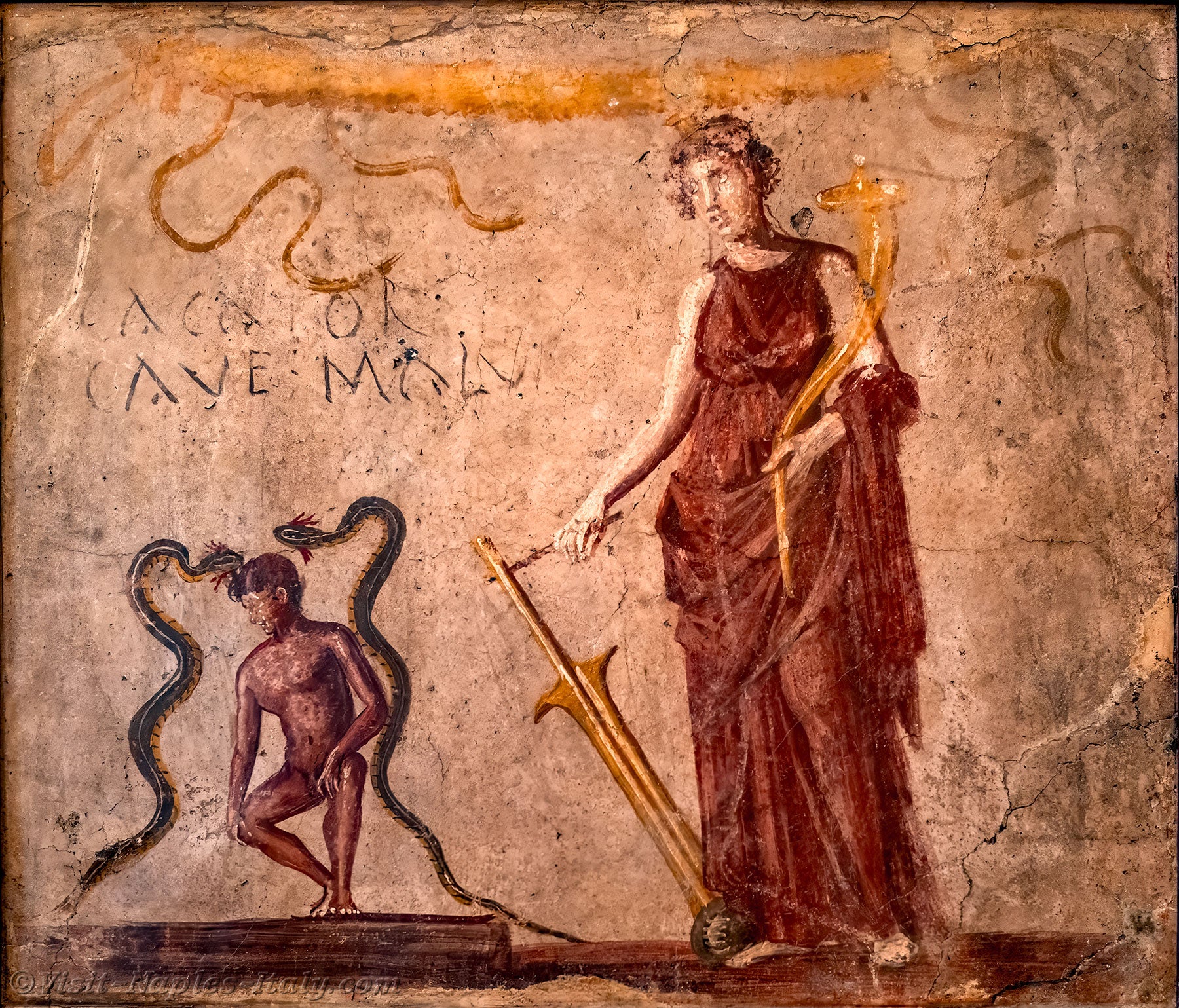
Isis Fortuna The goddess of fortune, who presides over the events of human life, appears here accompanied by Harpocrates, the Greek name for Horus, son of Isis and Osiris.
Fortuna wears a diadem topped with a cylindrical modius symbolising fertility, reminiscent of the Roman modius which served as a unit of measurement for the grain trade.
She holds a ship's rudder in her right hand resting on a globe, showing that she guides world affairs, and a cornucopia in her left hand.
Isis Fortuna differs from the formidable Fortuna of luck and chance; she looks towards the half-crouching young boy, who is her son Harpocrates, surrounded by the protective snakes of the place.
Winged Isis Fortuna, Pompeii
Fresco - Water-based pigments on coating (37 × 39 cm) 62-79 ADThe figure of winged Isis Fortuna possesses both the attributes of Isis and those of Fortuna.
The crescent moon on her head and the sistrum (a small percussion instrument made of shells and metal pieces) she holds in her right hand belong to Isis.
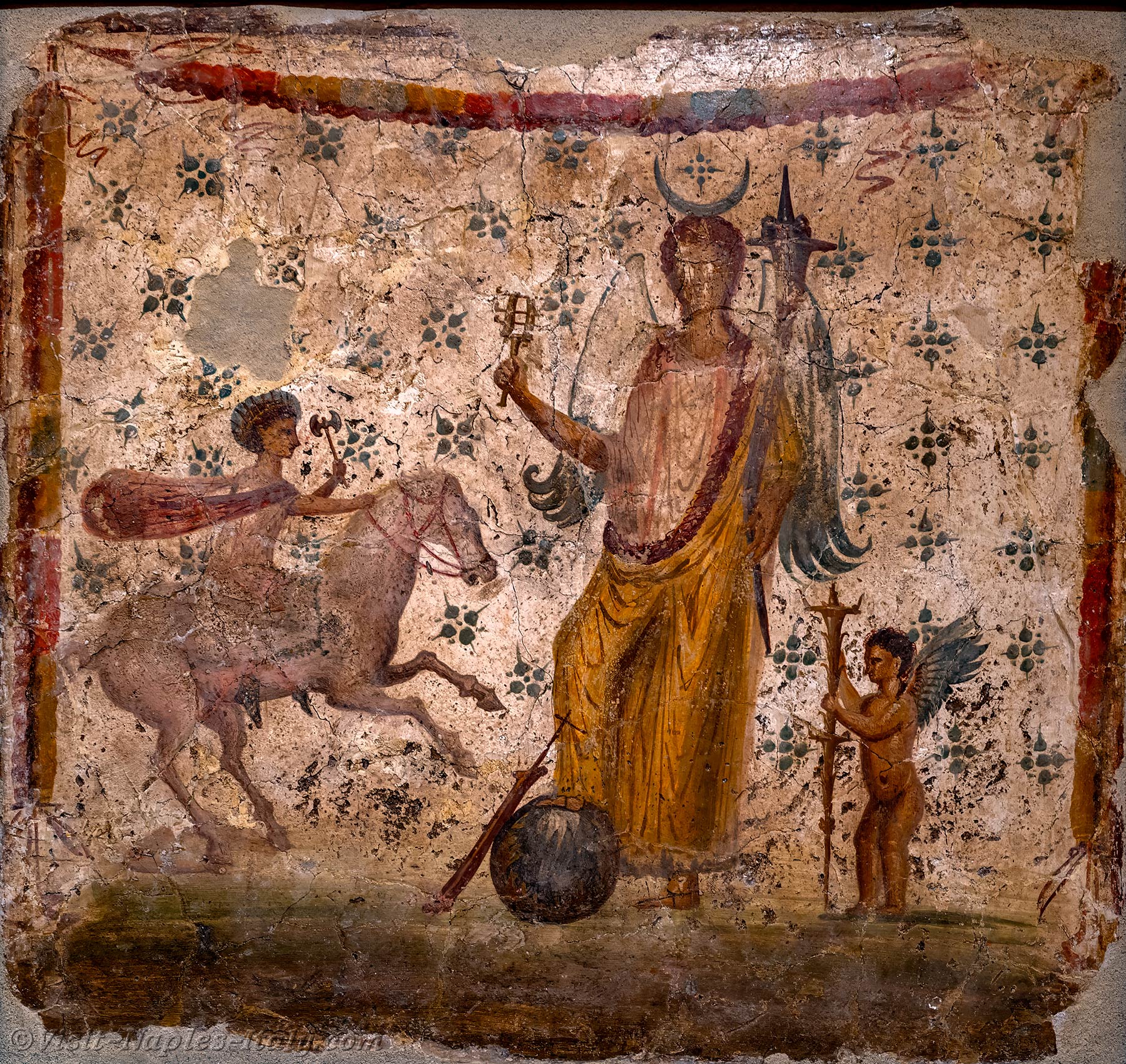
Winged Isis Fortuna The cornucopia she holds in her left hand and the ship's rudder resting against the blue globe held under her foot symbolise the power of Fortuna.
She is dressed in pink and gold, and her wings against a light background dotted with patterns show that Isis is the goddess of the sky.
She is dressed in pink and gold, and her wings on a light background studded with patterns show that Isis is associated with the moon travelling across the starry sky.
A small winged cherub stands beside her, holding a candelabra identical to those that carry the light during ceremonies in the temple of Isis.
On the left, her son Harpocrates is the young boy on horseback galloping towards her, his cape blowing in the wind, holding a small double-edged axe.
The young Horus, son of Isis and Osiris, was named Harpocrates by the Greeks and Romans.
According to Plutarch, Osiris, the sun god, questioned Horus, asking him which he would prefer if he had to choose between a lion and a horse to go into battle; Horus-Harpocrates chose the horse.
Harpocrates and the Serpent, Herculaneum, Casa del Colonnato Tuscanico
Fresco - Water-based pigments on coating (40 × 50 cm) 45-79 AD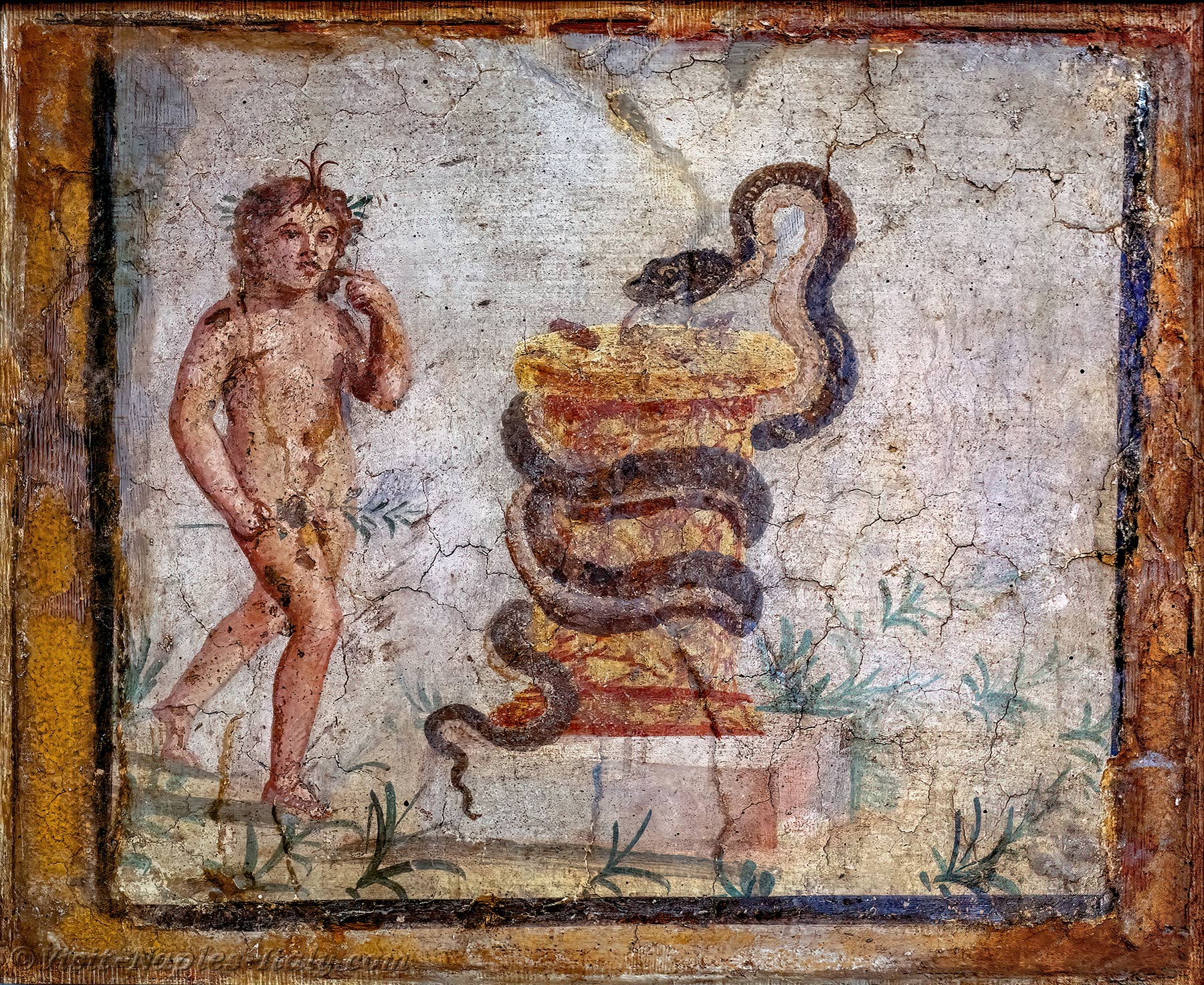
Harpocrates and the Serpent Harpocrates is the naked child who fearlessly approaches the serpent eating the offerings placed on the altar.
He advances slowly, holding a branch of foliage identical to that which encircles his forehead, while placing his index finger to his lips to invite silence.
Harpocrates, the god of silence, indicates that one must remain silent when the protective spirit of the place, embodied by the serpent, comes to coil around the altar to consume the offerings placed there, in this case eggs and fruit.
The ancient Greeks believed that snakes protected the place where they settled; for them, the snake could be a “daimon ”, a guardian spirit of their home.
Isis pulls the boat with Osiris' body, Pompeii, Temple of Isis
Fresco - Water-based pigments on Coating - 45-79 ADOsiris, the god symbolising the sun, was murdered by his brother Seth and dismembered into fourteen pieces.
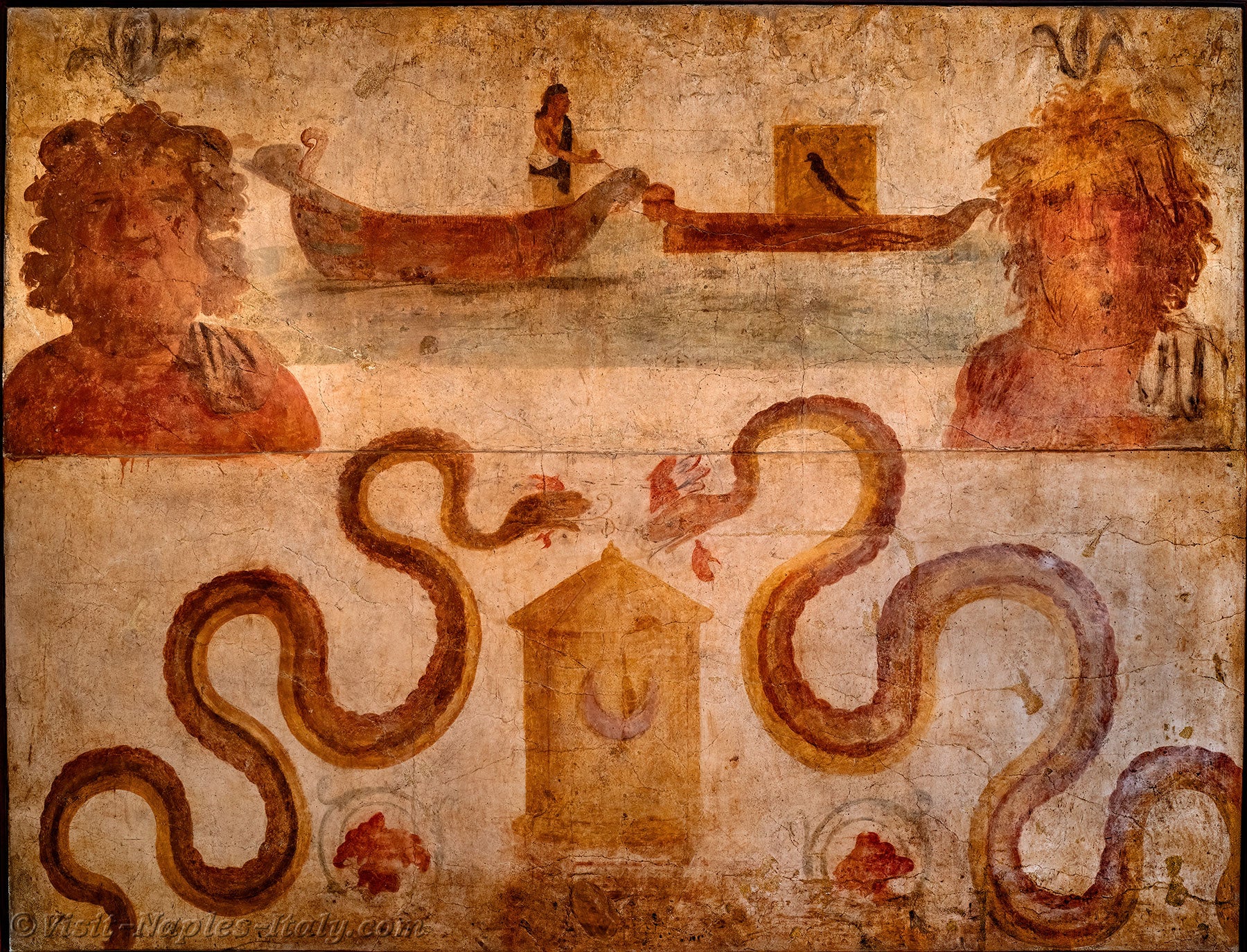
Isis pulls the boat carrying Osiris's body Isis, his sister-wife, took it upon herself to bring him back to life; having lost his kingdom on earth, he received the underground kingdom of the dead.
The fresco depicts Isis standing on a boat, pulling the boat laden with a cube containing her husband's sarcophagus.
The cult of sacred water celebrated in the temples of Isis was linked to Osiris, who was assimilated to the water of the Nile; the sacred water presented in the vase carried by the priest was venerated by the faithful, symbolising the water of the Nile and the life force that purifies the soul and body.
The two portraits on either side of the fresco resemble Serapis, who dominates the lower part occupied by two protective serpents of a funerary urn.
Osiris Sarapis on a throne, Pompeii, Temple of Isis
Fresco - Water-based pigments on Coating - 45-79 ADSerapis was a Greco-Egyptian god created in the 3rd century BC, during the reign of Ptolemy, who wanted to unify the Greek and Egyptian populations in the practice of the same cult.
The cult of Serapis then spread throughout the Greco-Roman world. It owes its name to the synthesis of Osiris and Apis (Osirapis), Serapis.
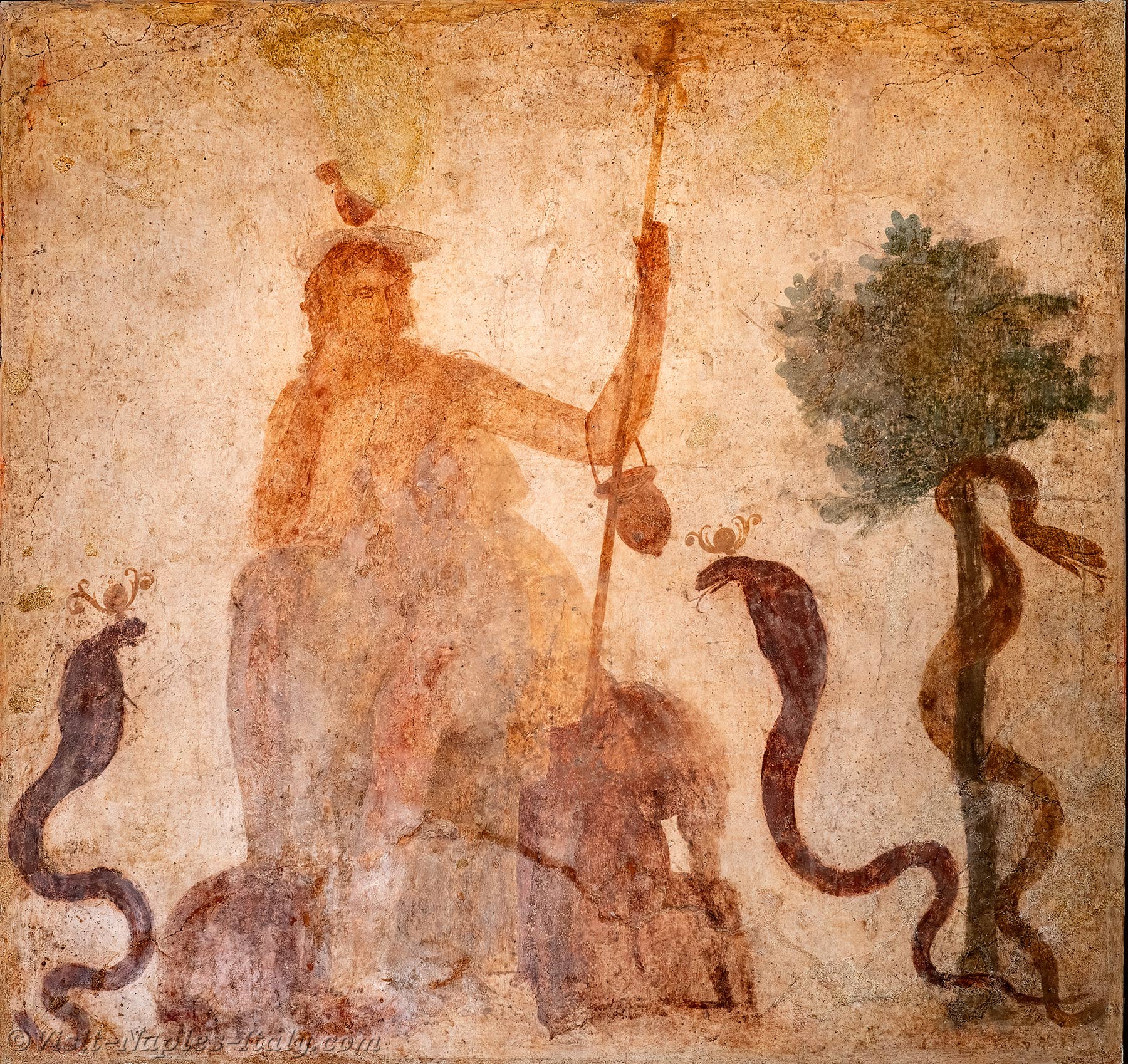
Osiris Serapis on the throne Osiris, the Egyptian god of the afterlife, was associated with the earth, fertility and resurrection.
Apis, the divine bull, was also represented in the form of a Greek god.
The powers of transformation, resurrection, fertility, healing and benevolence of Serapis were associated with those of Demeter, Dionysus, Asclepius for healing, and Hades for death.
Asclepius, Aesculapius to the Latins, was the Greek god of medicine who had brought the dead back to life; his cult was associated with snakes.
The fresco shows Serapis surrounded by snakes, one of which is wrapped around a staff to which it has restored life and foliage.
He is seated like a sovereign holding a long sceptre, with a dog (half erased) at his feet. Serapis was often depicted with Cerberus, the three-headed dog that guarded the entrance to the underworld.
God Bes, Pompeii, Temple of Isis, Sacrarium
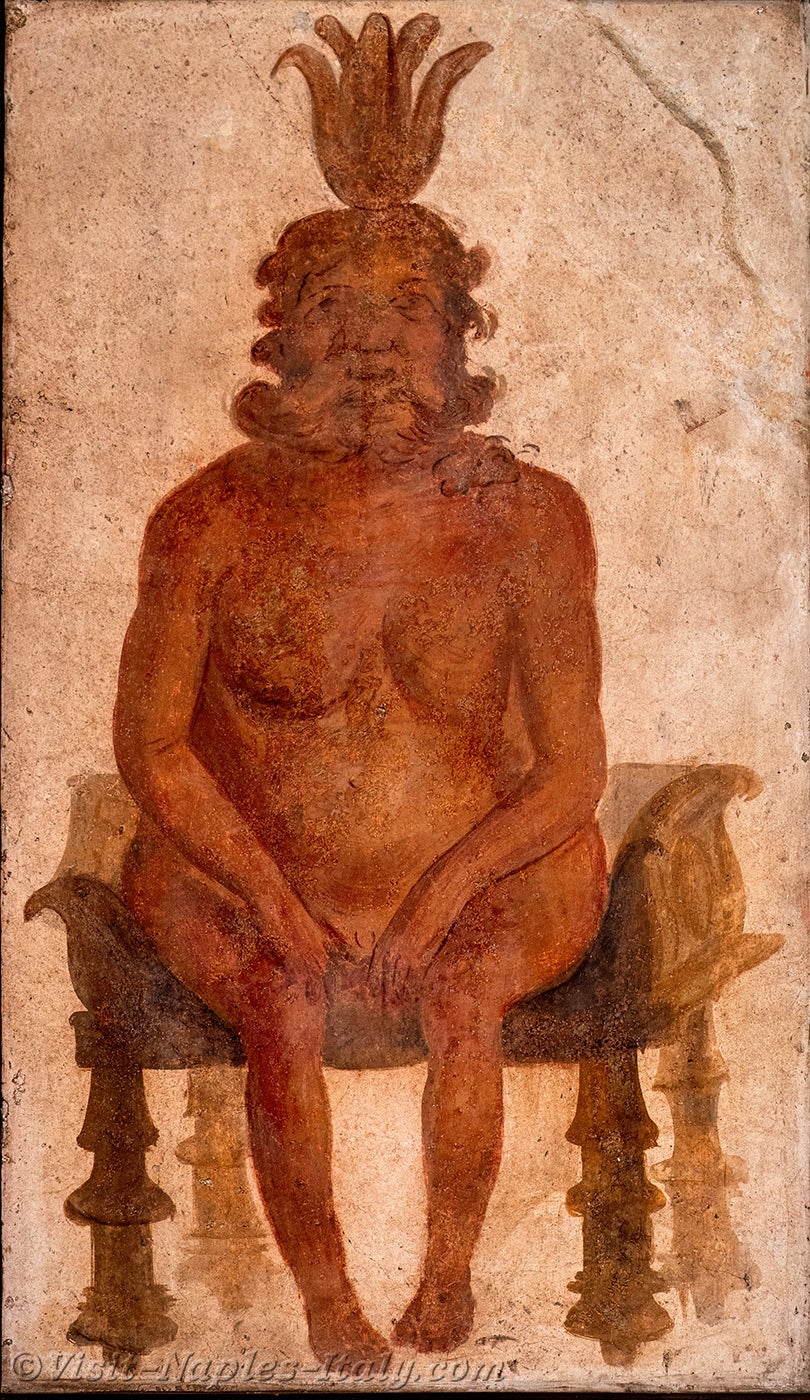
The God Bes Fresco - Water-based pigments on coating - 45-79 AD
Bes was the protector of the family, pregnant women and children.
This strangely ugly god was always depicted seated and facing forward, unlike other Egyptian gods.
His deformed body and grotesque appearance as a bearded dwarf with prominent eyes, crowned with ostrich feathers, served to ward off evil forces.
During the mysteries of Osiris, celebrated with songs and dances to the sound of flutes and sistrums, a masked man representing Bes danced to ward off evil spirits.
The god of fertility, protector of the family, was also the god of joy.
Mythology Achilles | Aeneas | Alcestis | Alexander | Aphrodite | Apollo | Arianne | Artemis | Ceres | Chryseis | Cupid | Daedalus | Dionysus | Dirce | Endymion | Flora | Galatea | Ganymede | Graces | Hephaestus | Hercules | Io Argos | Iphigenia | Isis | Leda | Marsyas | Medea | Nereids | Niobids | Odysseus | Pan | Paris | Perseus | Phaedra | Phrixus | Pirithous | Saturn | Satyrs | Sophonisba | Theseus | Troy | Zeus
Frescoes Mythology | Portraits | Life Leisure | Animals | Religion | Landscapes | Decoration
Artworks Sculptures | Frescoes | Eroticism
MANN Artworks Schedule Tickets Location | Authorizations
Back to Top of Page