

MANN Artworks Schedule Tickets Location | Authorizations
Artworks Sculptures | Frescoes | Eroticism
Frescoes Mythology | Portraits | Life Leisure | Animals | Religion | Landscapes | Decoration
Mythology Achilles | Aeneas | Alcestis | Alexander | Aphrodite | Apollo | Arianne | Artemis | Ceres | Chryseis | Cupid | Daedalus | Dionysus | Dirce | Endymion | Flora | Galatea | Ganymede | Graces | Hephaestus | Hercules | Io Argos | Iphigenia | Isis | Leda | Marsyas | Medea | Nereids | Niobids | Odysseus | Pan | Paris | Perseus | Phaedra | Phrixus | Pirithous | Saturn | Satyrs | Sophonisba | Theseus | Troy | Zeus
Frescoes depicting Dionysus Bacchus at the Archaeological Museum of Naples in Italy
Bacchus and Vesuvius, Pompeii, Casa del Centenario
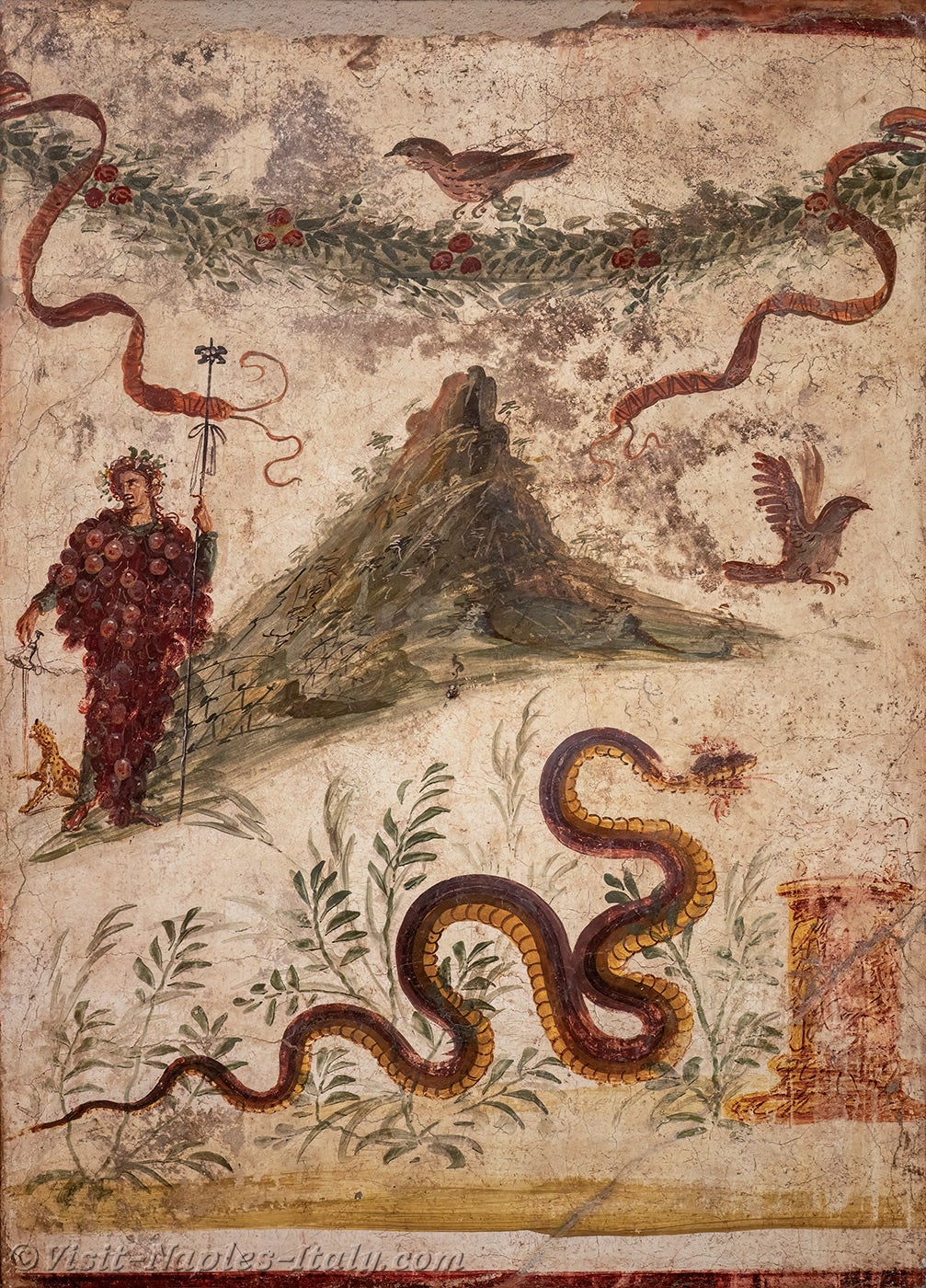
Bacchus and Vesuvius Fresco - Water-based pigments on coating (140 x 102 cm) 68-79 AD
Bacchus appears here next to the verdant Vesuvius planted with vines: Vesuvius before its tragic eruption in the year 79 that buried Pompeii.
Bacchus wears his traditional crown of woven vine branches; the grapes arranged in a magnificent bunch covering his body honour this god who brings fertility and prosperity to the householder's profession of Vinarius.
The god spreads joy and merriment by emptying his kantharos (canthare) filled with wine to offer it to the panther, who feasts on it.
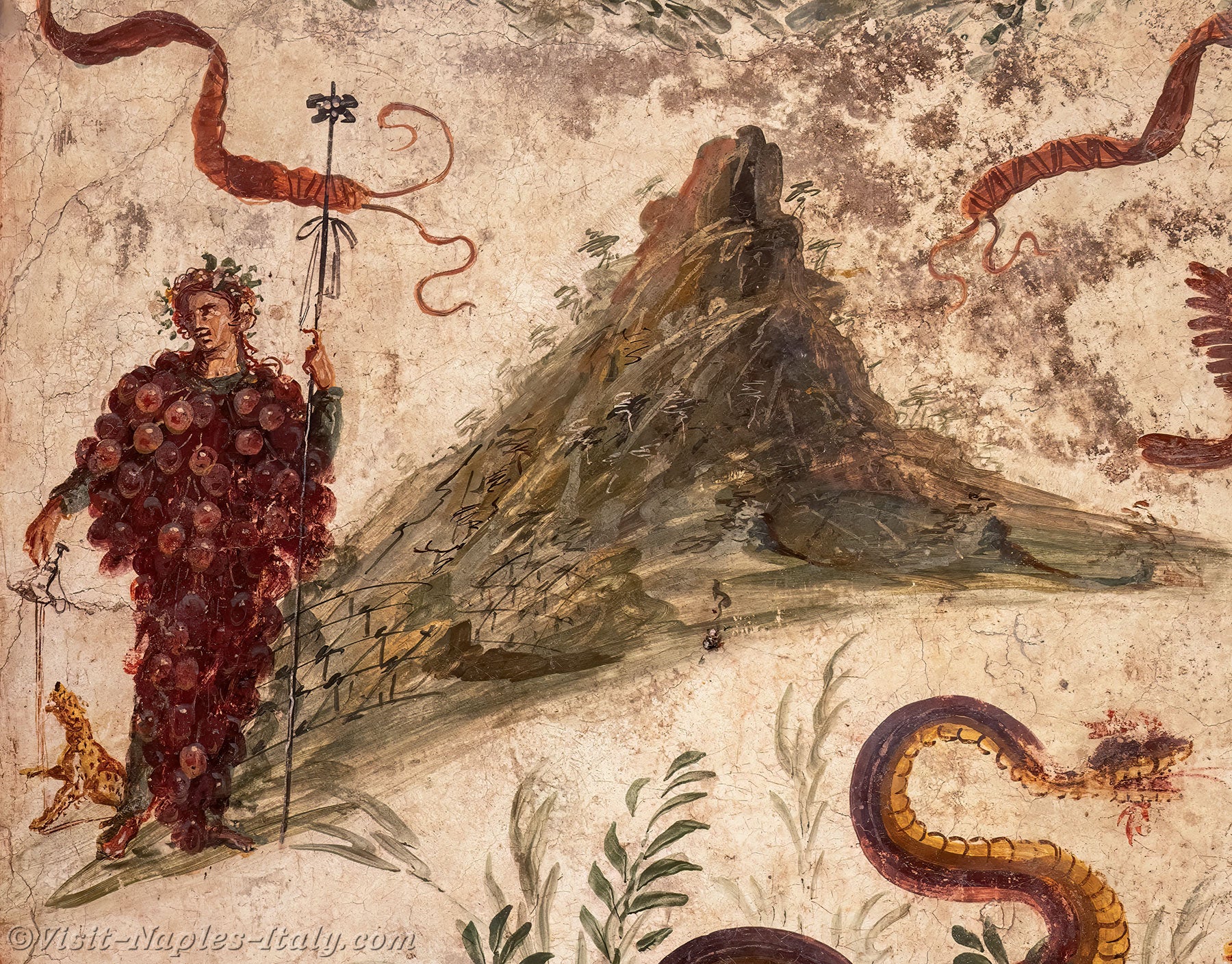
Bacchus and Vesuvius Like a master of ceremonies, he leans on his thyrsus decorated with a long red ribbon that flutters in the wind, identical to the one on the right that flies away near the festive garland where a bird is perched.
The fresco is completed with the quintessential terrestrial animal: the demon protector of the place, which appears in the form of a large serpent undulating among the foliage to approach the lararium located at the bottom right.
The lararium was a private sanctuary where statues of the Lares gods, the protectors of the home, were placed.
The figurine of Bacchus was often present in lararia.
Dionysus and a Maenad, Pompeii
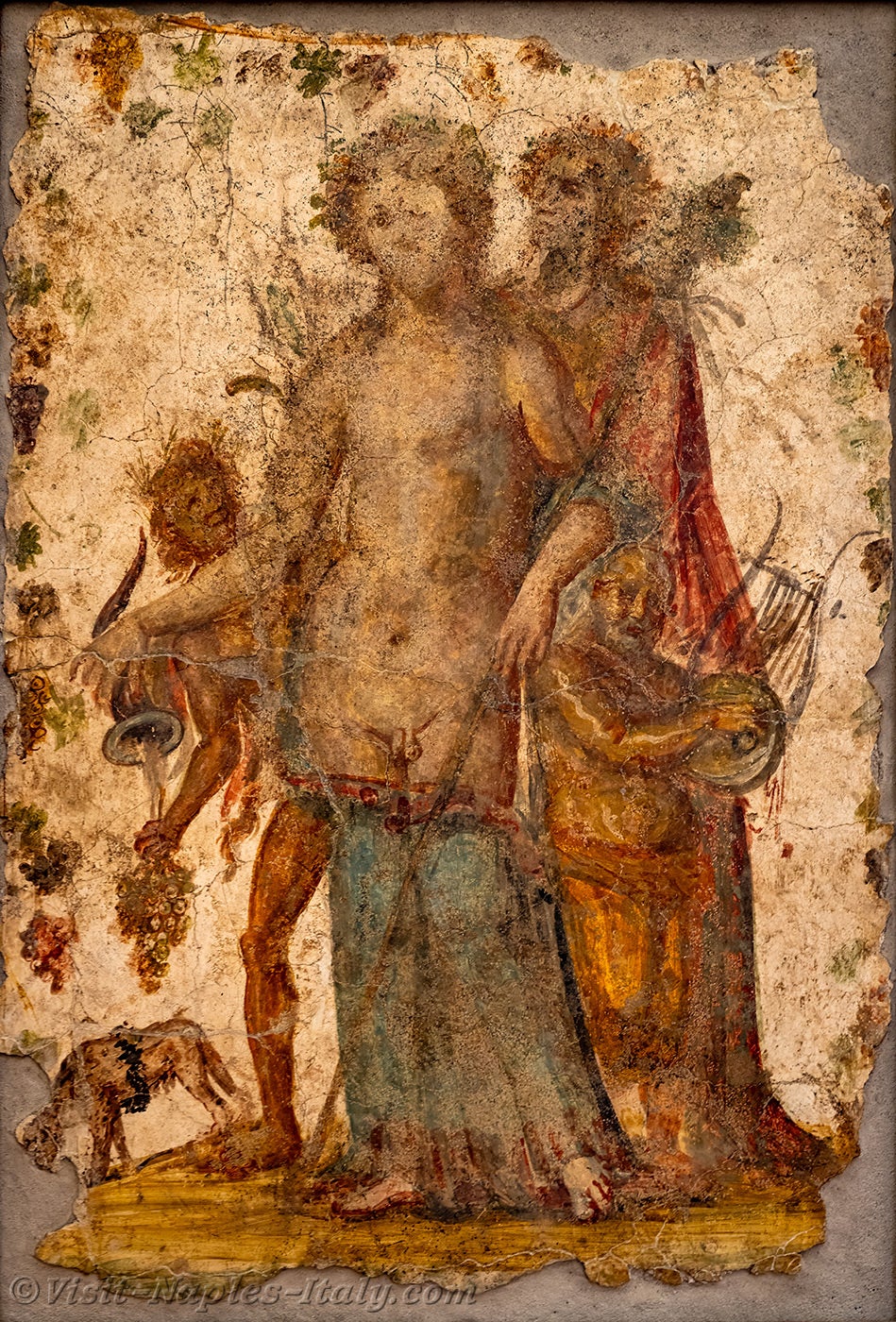
Dionysus and a Maenad Fresco - Water-based pigments on plaster (109 x 77 cm) 62-79 AD
Dionysus and the characters who usually form part of his retinue are gathered in a small group.
They are framed by vine stocks laden with bunches of grapes.
Bacchus, crowned with ivy and vine leaves, is half naked, his long blue garment covering only his legs.
He holds his long thyrsus decorated with ribbons and the sacred pine cone in his left hand.
With his other hand, he pours wine onto a bunch of grapes held by a young naked satyr who appears behind him.
A small Silenus with a bare chest plays the lyre to his left.
He is closely followed by a fascinated disciple, a Maenad dressed in red and crowned with ivy like him.
The group of Bacchus' friends is completed by the animal that joins in the festivities by drinking the spilled wine.
Dionysian Stibadium, Pompeii, Casa Gavius Rufus
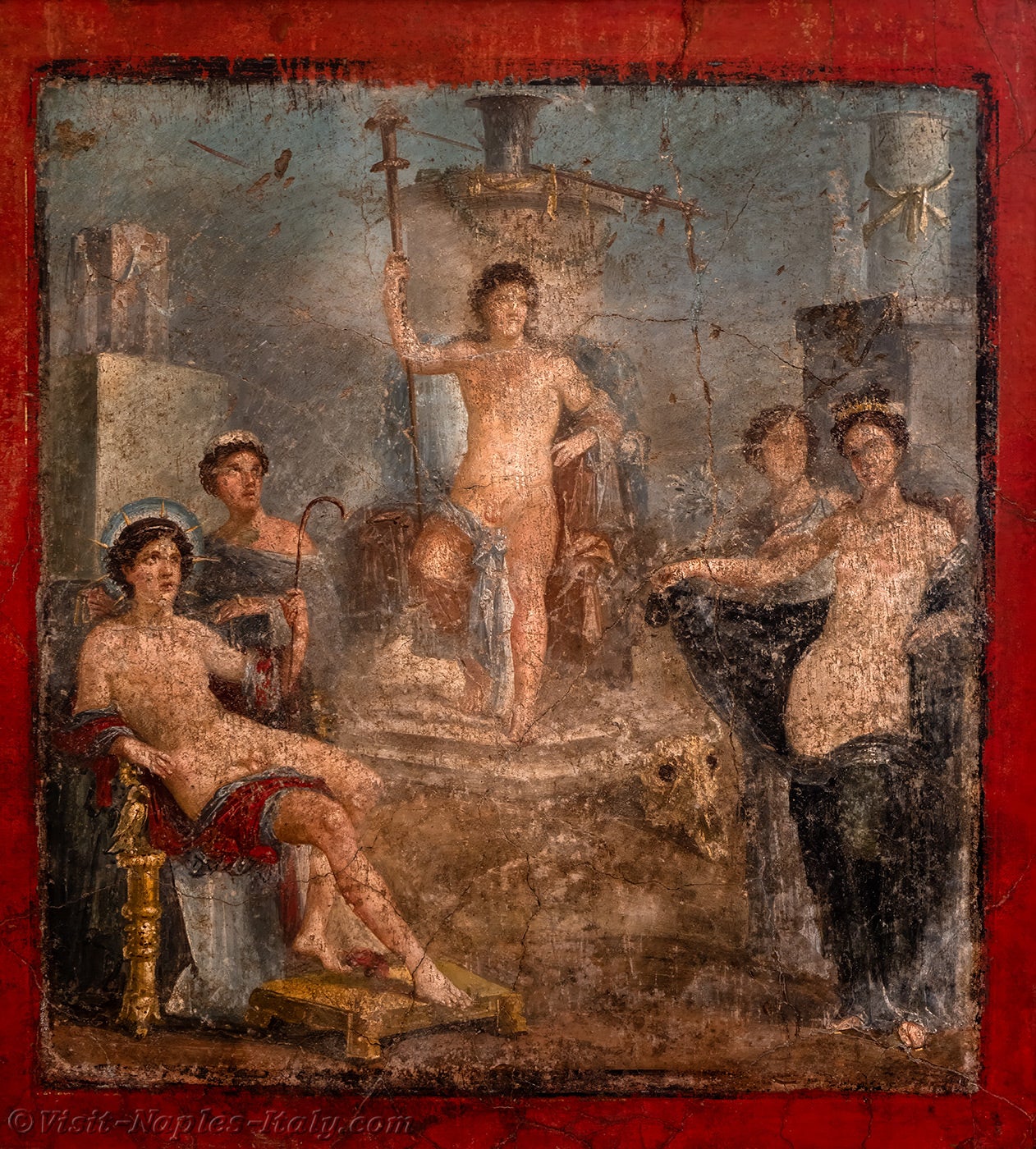
Dionysian Stibadium Fresco - Water-based pigments on coating (100 x 93 cm) 45-79 AD
The stibadium was a kind of large semi-circular divan where the guests sat; the meal was served on a table placed in the centre.
The stibadium was sometimes made of stone, on which cushions were placed.
It was initially created during the Imperial period for outdoor use, allowing guests to enjoy the beauty of the surrounding landscape.
The characters in this fresco are arranged in a semicircle, with Bacchus placed high up, who seems to preside over this assembly, which brings together Helios-Apollo, seated on the left on a throne decorated with a bird, with his twin sister Artemis behind him.
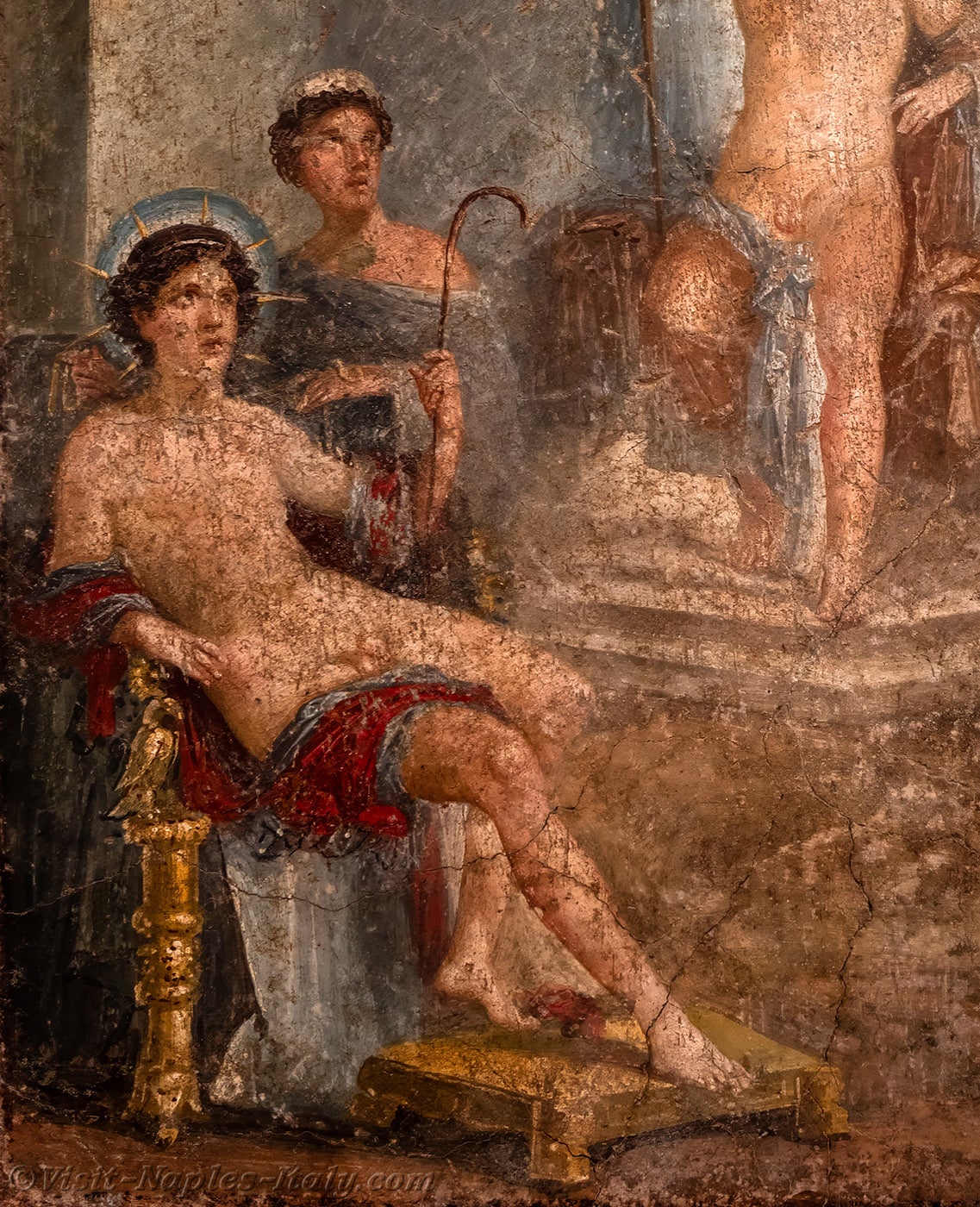
Dionysian Stibadium On the right, Venus with her queen's crown of beauty, revealing her lovely body with an elegant gesture, accompanied by Ceres holding a bouquet of wheat ears.
Apollo the physician, Bacchus the god of fertility, and Venus are half-naked, showing off their eternally young and beautiful bodies.
This is an imaginary stibadium consecrated by the presence of these gods, who are indispensable to the ideal banquet.
Surrounding this stibadium are Bacchus, the god of wine and celebration, Apollo, the god of poets and musicians, Artemis, the goddess of the hunt accompanied by a small wild animal, Venus, the goddess of love, and Ceres, the goddess of abundance.
Dionysus, Satyr and Panther, Pompeii, Casa dei Dioskouros
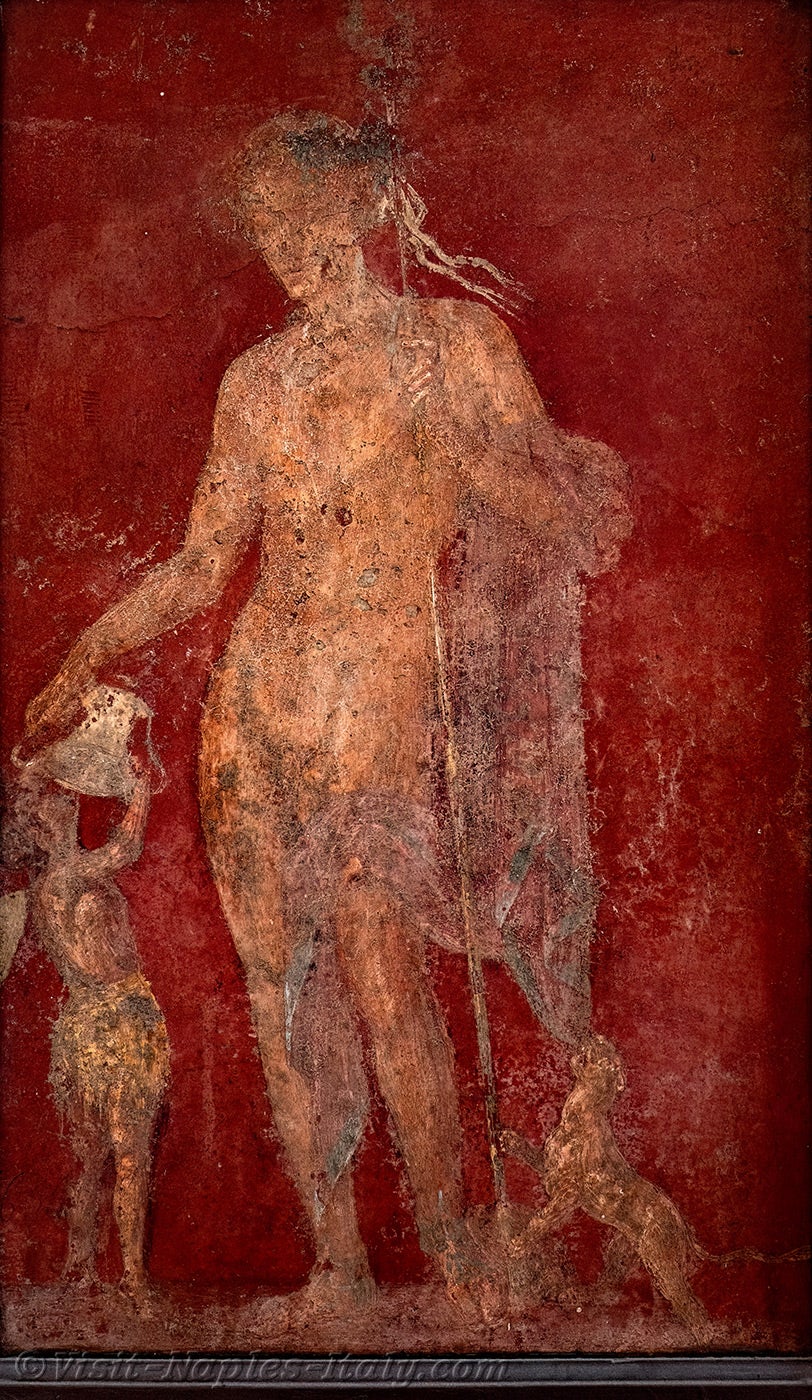
Dionysus and Satyr Fresco - Water-based pigments on coating (86 x 55 cm) 62-79 AD
Bacchus is depicted naked against a red background, his clothing draped over his left elbow being pulled by a small panther.
The god of wine and fertility wears his crown of ivy and woven vine shoots, his left hand holding his long thyrsus decorated with ivy, ribbons and topped with a pine cone.
Bacchus is standing in contrapposto.
His head is tilted towards the little satyr who is greedily drinking the wine he is pouring from his kantharos.
The little panther bites and pulls at his clothing to attract his attention and drink in turn.
Predella, Dionysian Initiation, Obscene Bacchus, Herculaneum
Fresco - Water-based pigments on Coating (19 x 52 cm) 45-79 ADThis fresco is thought to depict the initiation of a young woman into the Dionysian mysteries, which consisted of five degrees of purification.
The new initiate is an elegant patrician woman seated on a stool on the left side of the fresco.
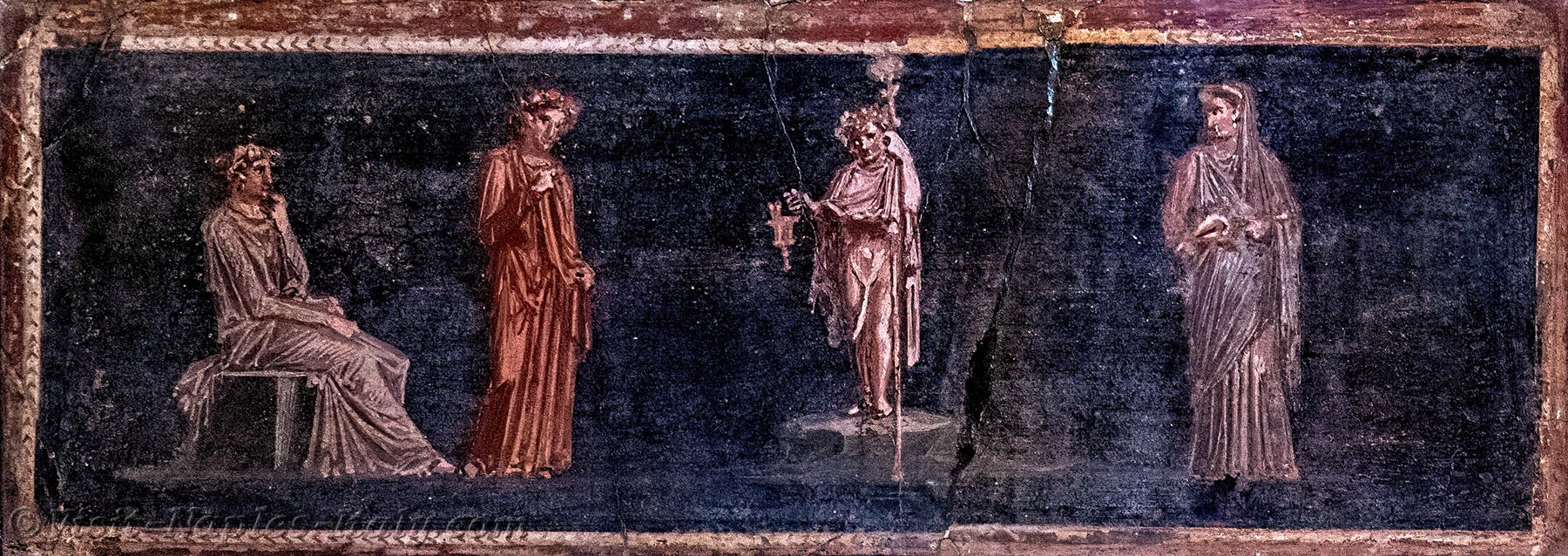
Dionysian initiation, obscene Bacchus She looks intrigued at the statue of Bacchus and the priestess placed in front of her, following the speech of the young man wearing a long scarlet robe and a crown of ivy and grapes.
The statue of Bacchus placed on a podium faces the viewer.
He wields his thyrsus in his left hand and holds a situla in his right hand; the situle containing wine was an attribute of the Silenus and Bacchantes in the Dionysian cult.
On the right, the priestess has her face turned towards the statue and the young woman.
She is wearing a diadem that holds her veil in place and is dressed in a long chiton covered with a drape; she is holding a sickle close to her body.
This fresco depicts the symbols of the Dionysian mysteries: the situle, the phallus of Dionysus which represented the secret revealed to the initiate, and the sickle that the priestesses wore at their belts.
The ritual names of Dionysus were numerous: Bromius, the trembling one; Lyæus, the one who delivers from worries; Leneus, god of wine presses; Nyctelius, god of nocturnal mysteries; Eleeleus, the personification of the cry of the Bacchantes.
Dionysus as a child with a panther, Pompeii
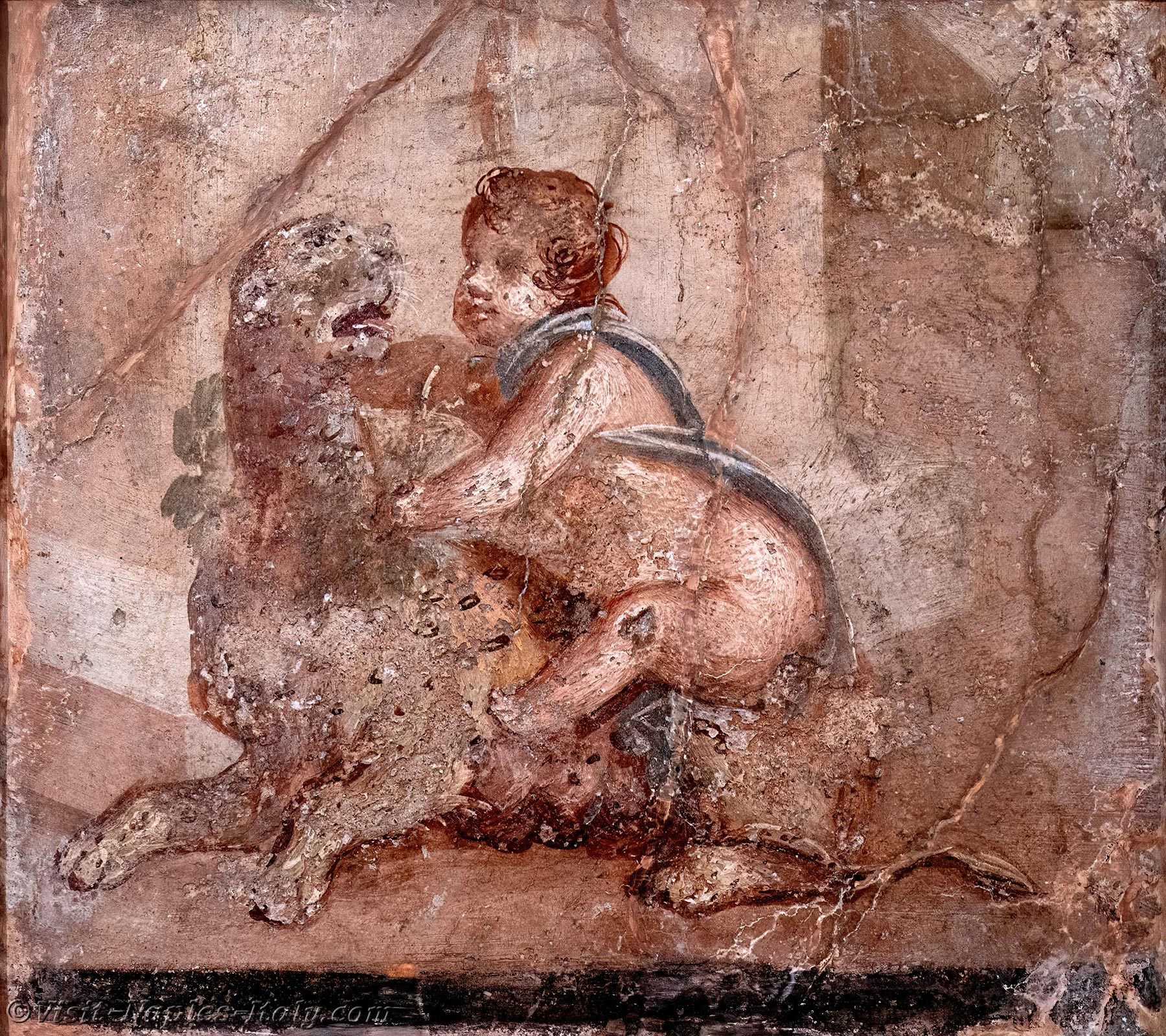
Dionysus as a child with a panther Fresco - Water-based pigments on coating (35 x 37 cm)
62-79 AD
This young boy riding a panther is thought to be a representation of the child Dionysus taming it by placing a collar of vine branches around its neck.
The subdued panther crouches under the weight of the child, turning its head towards him.
Dionysus had travelled to India, from where he had brought back panthers that had thus become sacred animals forming part of his retinue.
Mythology Achilles | Aeneas | Alcestis | Alexander | Aphrodite | Apollo | Arianne | Artemis | Ceres | Chryseis | Cupid | Daedalus | Dionysus | Dirce | Endymion | Flora | Galatea | Ganymede | Graces | Hephaestus | Hercules | Io Argos | Iphigenia | Isis | Leda | Marsyas | Medea | Nereids | Niobids | Odysseus | Pan | Paris | Perseus | Phaedra | Phrixus | Pirithous | Saturn | Satyrs | Sophonisba | Theseus | Troy | Zeus
Frescoes Mythology | Portraits | Life Leisure | Animals | Religion | Landscapes | Decoration
Artworks Sculptures | Frescoes | Eroticism
MANN Artworks Schedule Tickets Location | Authorizations
Back to Top of Page