

MANN Artworks Schedule Tickets Location | Authorizations
Artworks Sculptures | Frescoes | Eroticism
Frescoes Mythology | Portraits | Life Leisure | Animals | Religion | Landscapes | Decoration
Mythology Achilles | Aeneas | Alcestis | Alexander | Aphrodite | Apollo | Arianne | Artemis | Ceres | Chryseis | Cupid | Daedalus | Dionysus | Dirce | Endymion | Flora | Galatea | Ganymede | Graces | Hephaestus | Hercules | Io Argos | Iphigenia | Isis | Leda | Marsyas | Medea | Nereids | Niobids | Odysseus | Pan | Paris | Perseus | Phaedra | Phrixus | Pirithous | Saturn | Satyrs | Sophonisba | Theseus | Troy | Zeus
The frescoes depicting satyrs, Actaeon, Hermes and the Maenads at the Archaeological Museum of Naples in Italy
The satyrs and Maenads were part of the procession of Dionysus.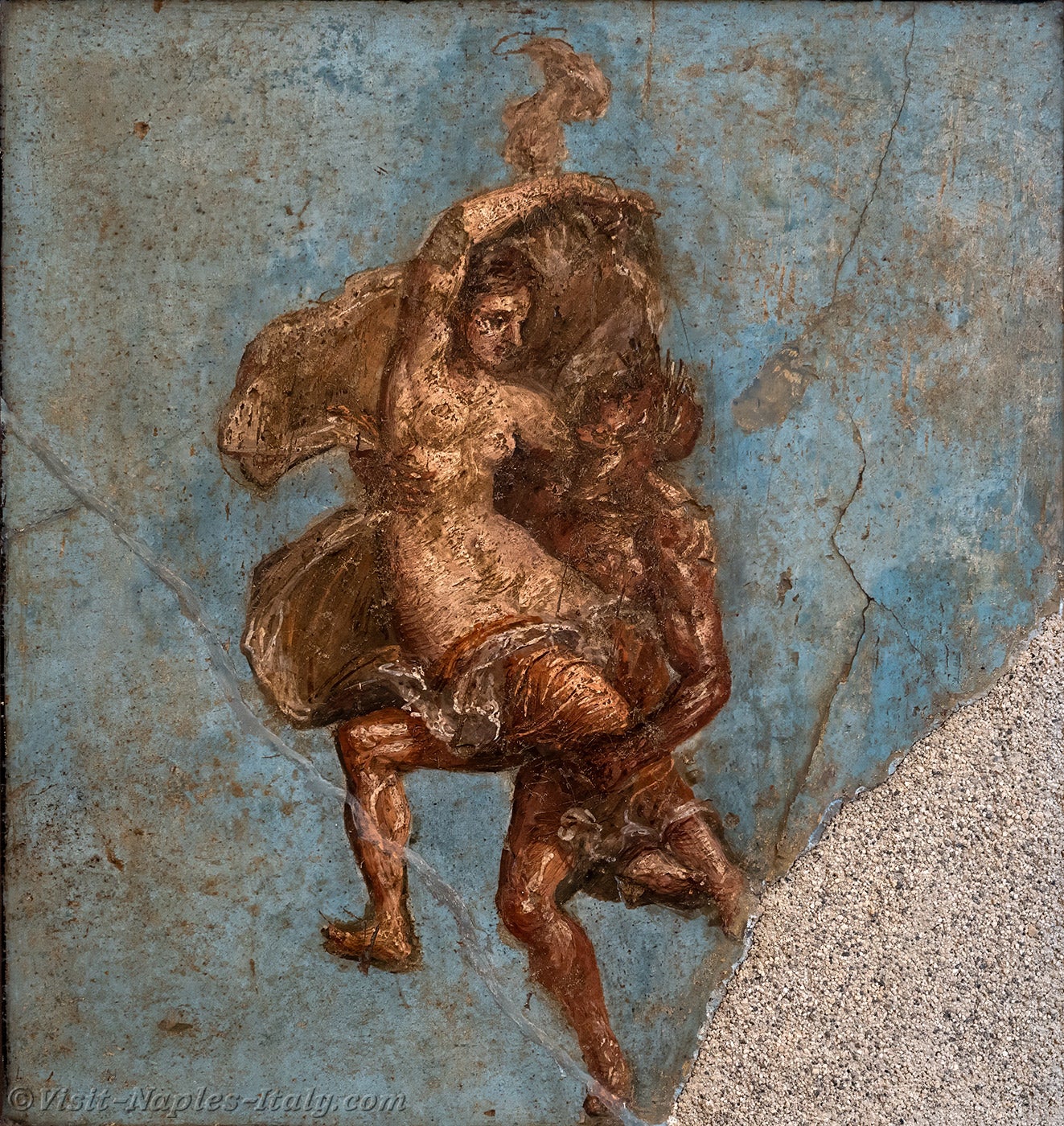
Satyr and Maenad The Maenads were women possessed by the spirit of the god, who inspired in them a mystical frenzy that manifested itself in wild dances to the sound of flutes and tambourines.
The satyrs drank a great deal of wine; they were generally depicted with goat’s feet and a goat’s penis symbolising their lechery, running through the woods and countryside in pursuit of the Maenads and nymphs.
During the Dionysian festivals, the satyrs and maenads personified the orgiastic spirits and the power of natural urges.
Satyr and Maenad in Flight, Pompeii, House of the Dioskouros
Fresco - Water-based pigments on coating (47 × 44 cm) 62-79 ADA satyr dances joyfully, carrying a pretty, half-naked Maenad beneath the blue sky ; she looks at him whilst holding onto her garment, billowing like a sail, light, carried away by the joy of flying towards the pleasures in his company.
Maenad and Satyr in Flight, Pompeii, Casa dei Dioskouros
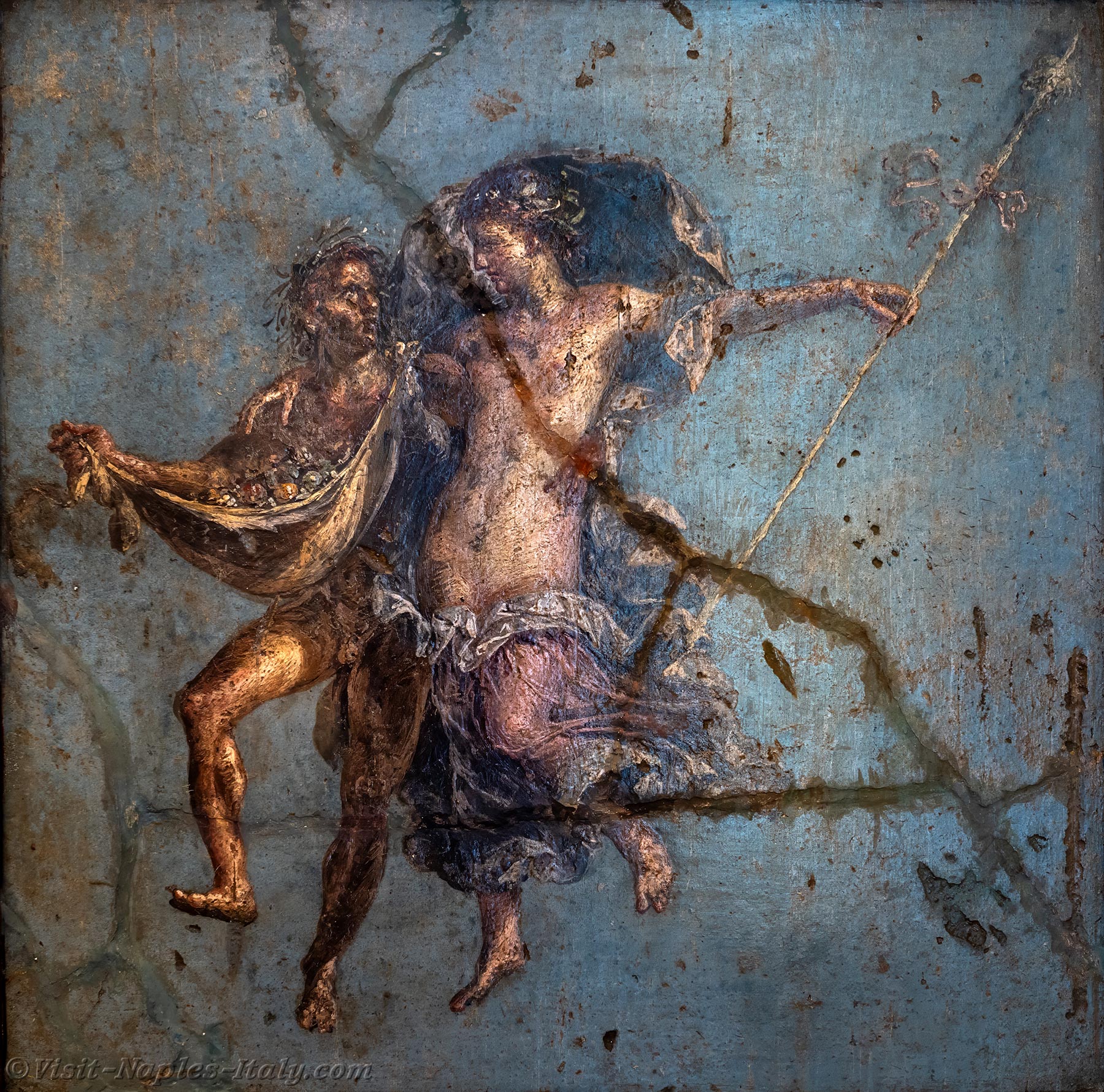
Maenad and Satyr in flight Fresco - Water-based pigments on coating (45 × 45 cm)
62-79 AD
This fresco presents us with a magical image of a satyr and a Maenad dancing in perfect harmony, closely entwined as they gaze at one another.
The dark, naked body of the satyr contrasts with the whiteness of the beautiful, half-naked body of the Maenad, swept up in a light drape as she holds her thyrsus at the end of her outstretched arm.
The magnificent folds of the fabric floating around the Maenad, crowned with ivy leaves, emphasise her delicacy, whilst the satyre, crowned with vine leaves and bunches of grapes, dances carrying a sack filled with fruit.
Tightrope-walking satyr, Pompeii, Villa di Cicerone
Fresco - Water-based pigments on coating (40 × 131 cm) 1-37 AD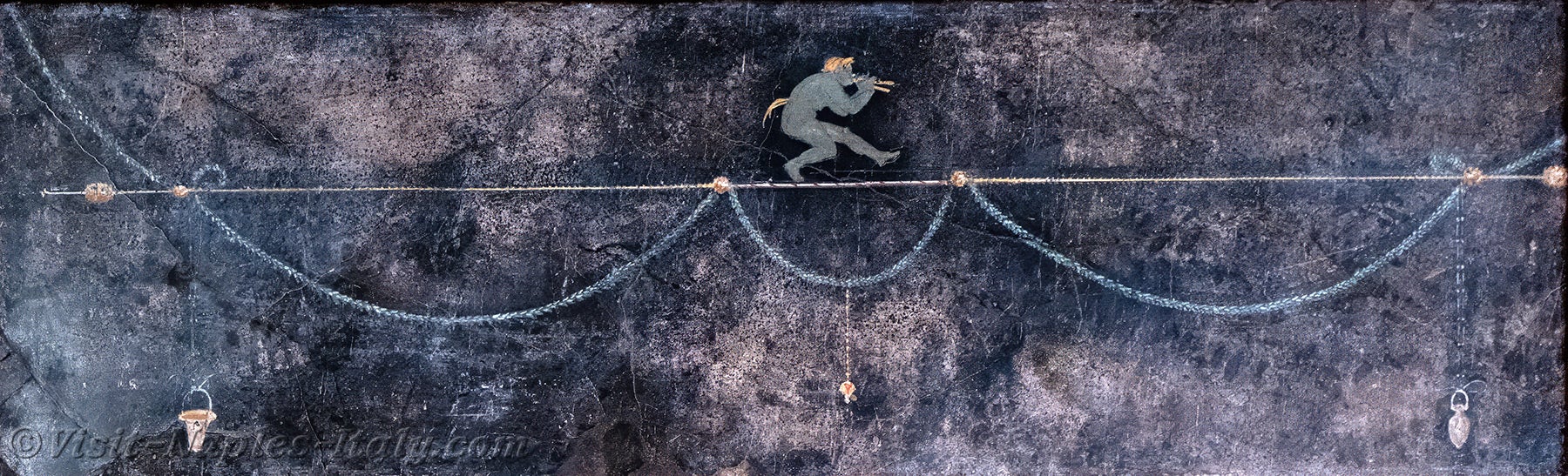
The Tightrope-Walking Satyr This musician satyr is an excellent rope dancer: his graceful figure, silhouetted against a dark background, highlights his artistic and athletic abilities.
He maintains perfect balance, moving whilst playing the flute without disturbing the buckets filled with liquid suspended from the rope stretched across the void.
Dancing satyrs, Pompeii, Villa di Cicerone
Fresco - Water-based pigments on coating (24 × 103 cm) 1-37 ADThe fresco depicts a procession of satyrs dancing on a rope adorned with garlands hanging over the void.
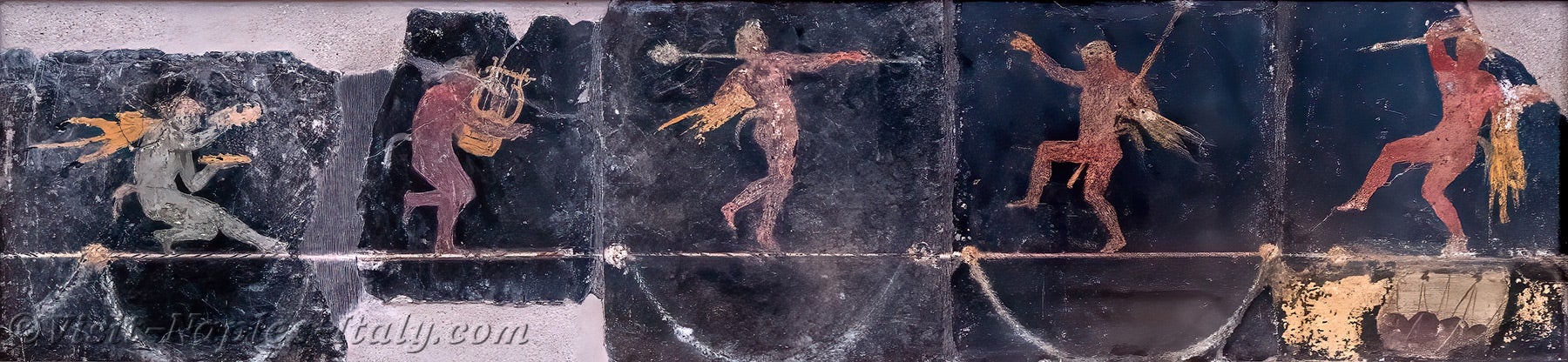
Dancing satyrs Each of them performs a dance whilst playing an instrument or brandishing a thyrsus, a long staff adorned with ivy; the first strikes the cymbals, the second plays the lyre, and the others dance with the thyrsus and a panther.
Dionysus, god of wine and inspiration, was honoured not only through boisterous processions evoking the spirits of the earth and fertility, but also through theatrical and artistic performances.
Dionysus, Satyrs and Nymphs, Pompeii, Casa di Meleagro
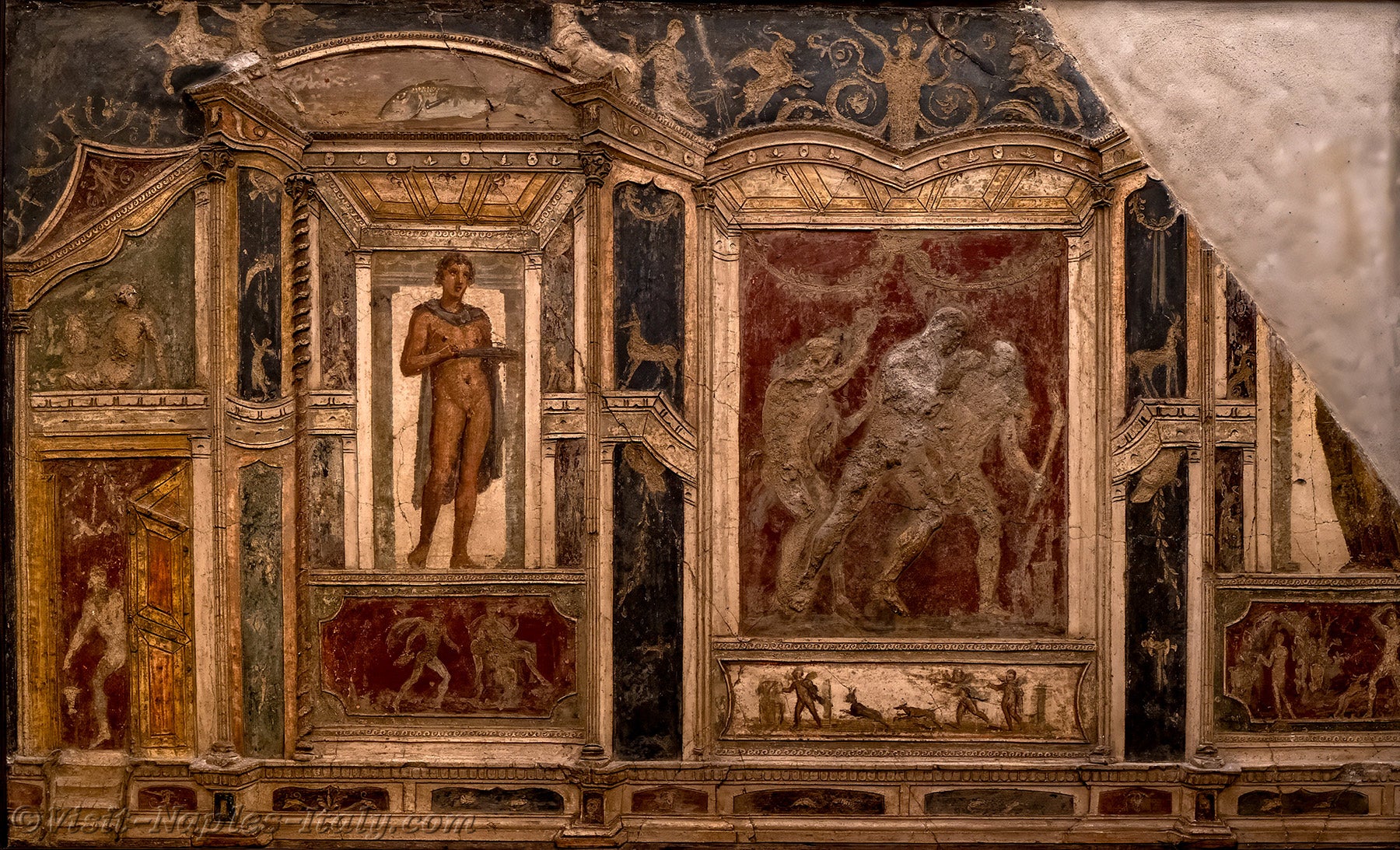
Dionysus, Satyrs and Nymphs Fresco - Water-based pigments on coating (159 × 285 cm) 62-79 AD
This is the left-hand section of a large panel detached from a wall of the house, where we see a man dressed in a simple cloak holding a tray, in symmetry with the lady who is bringing wine in a jug to make an offering.
Apart from this couple with their offerings, the rest of the panel depicts figures from Greek mythology.
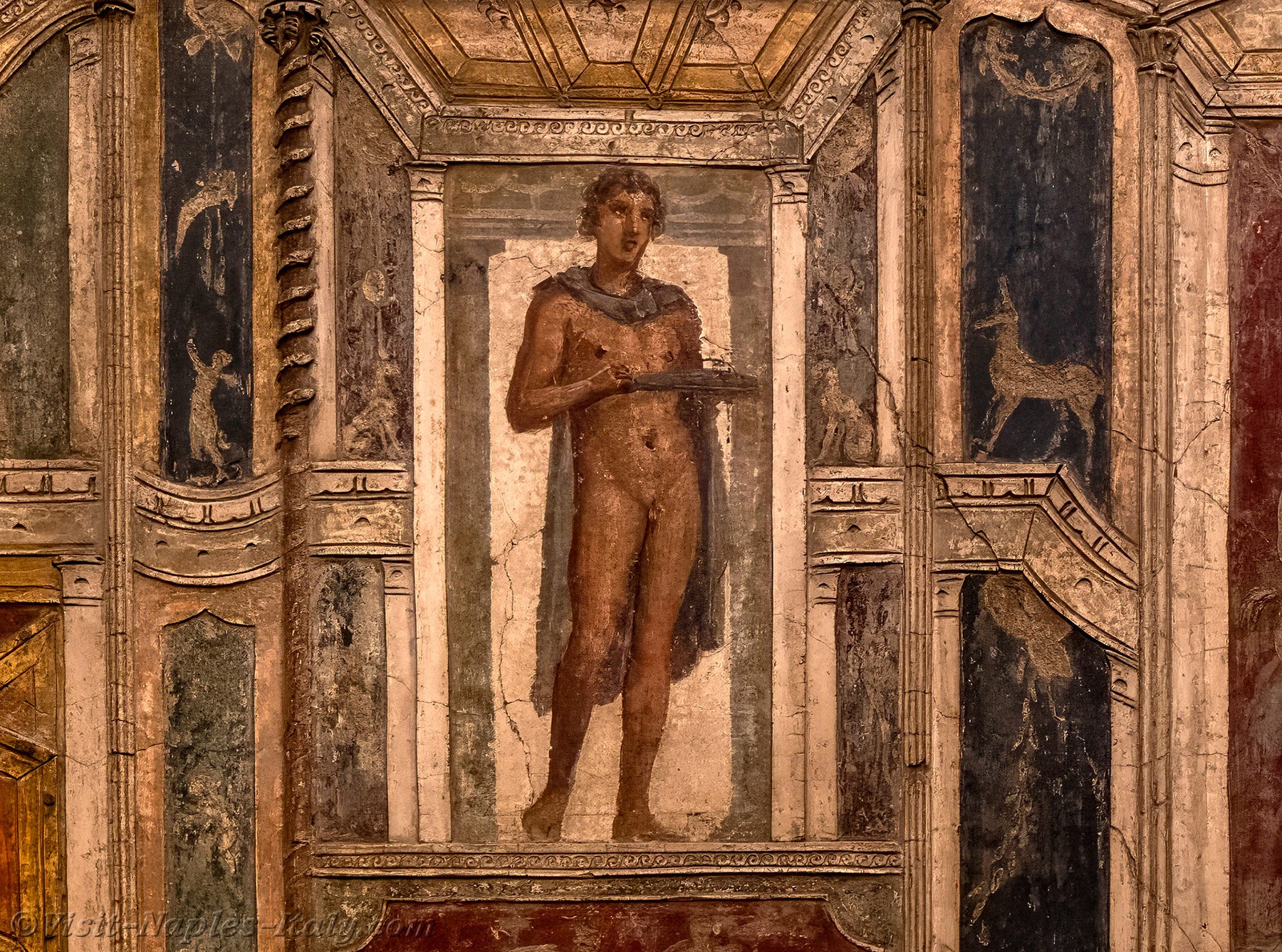
Dionysus, Satyrs and Nymphs The small fresco located below the donor depicts Hylas with a jug, drawing water from the river where he encounters the nymphs who lure him towards them.
His friend Hercules had gone out to search for him, in vain, whilst the Argonauts set sail without them.
The large fresco on the right depicts Dionysus in a drunken state, supported by satyrs.
Beneath this fresco, one can see a hunting party led by small winged cupids.
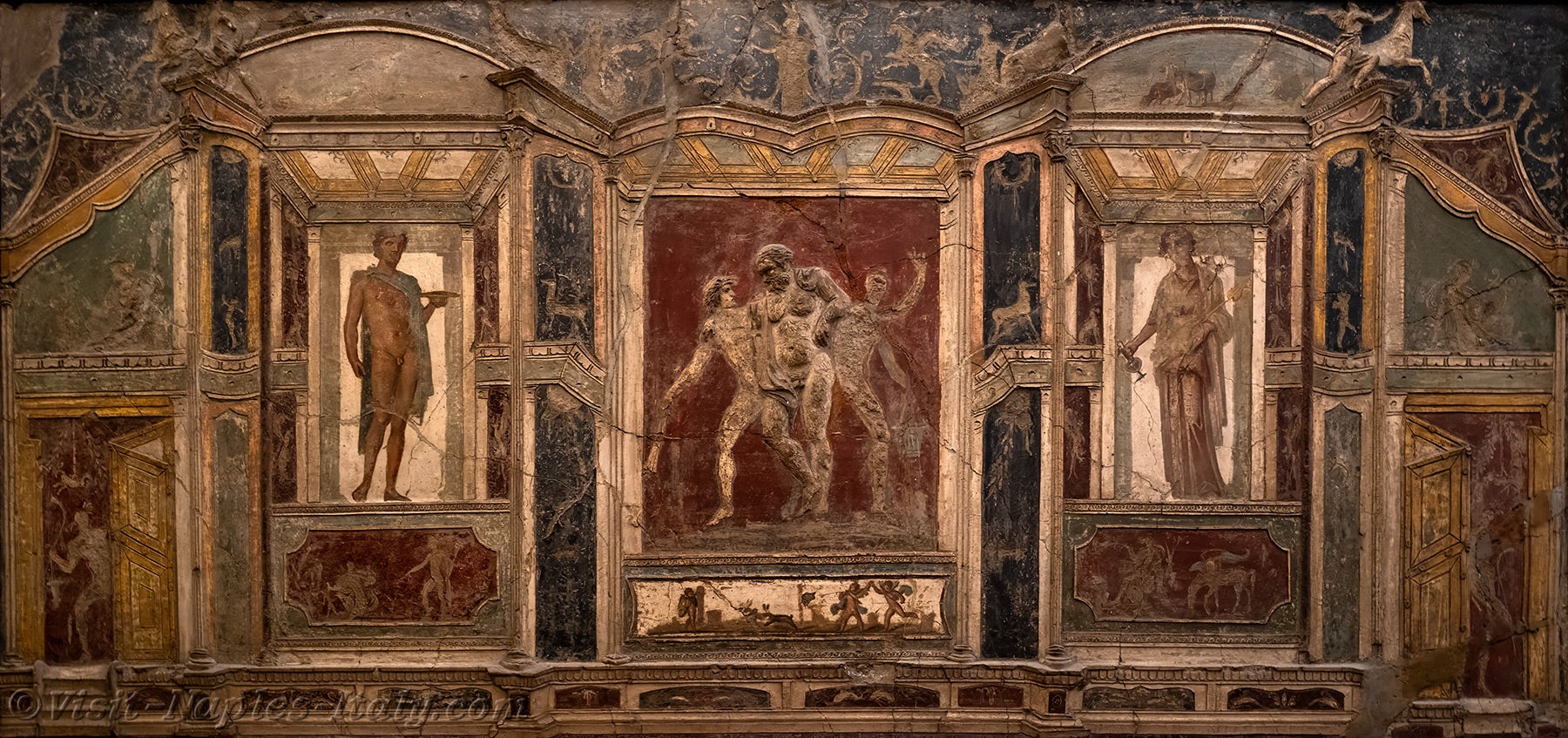
Hermes, Satyrs and Nymphs In the bottom right-hand corner, the hunter Actaeon stumbles upon a naked Diana near a spring, an encounter that led to him being turned into a stag and attacked by his own hounds.
Hermes, Satyrs and a Nymph, Pompeii, Casa di Meleagro
Fresco - Water-based pigments on coating (156 × 338 cm)62-79 AD
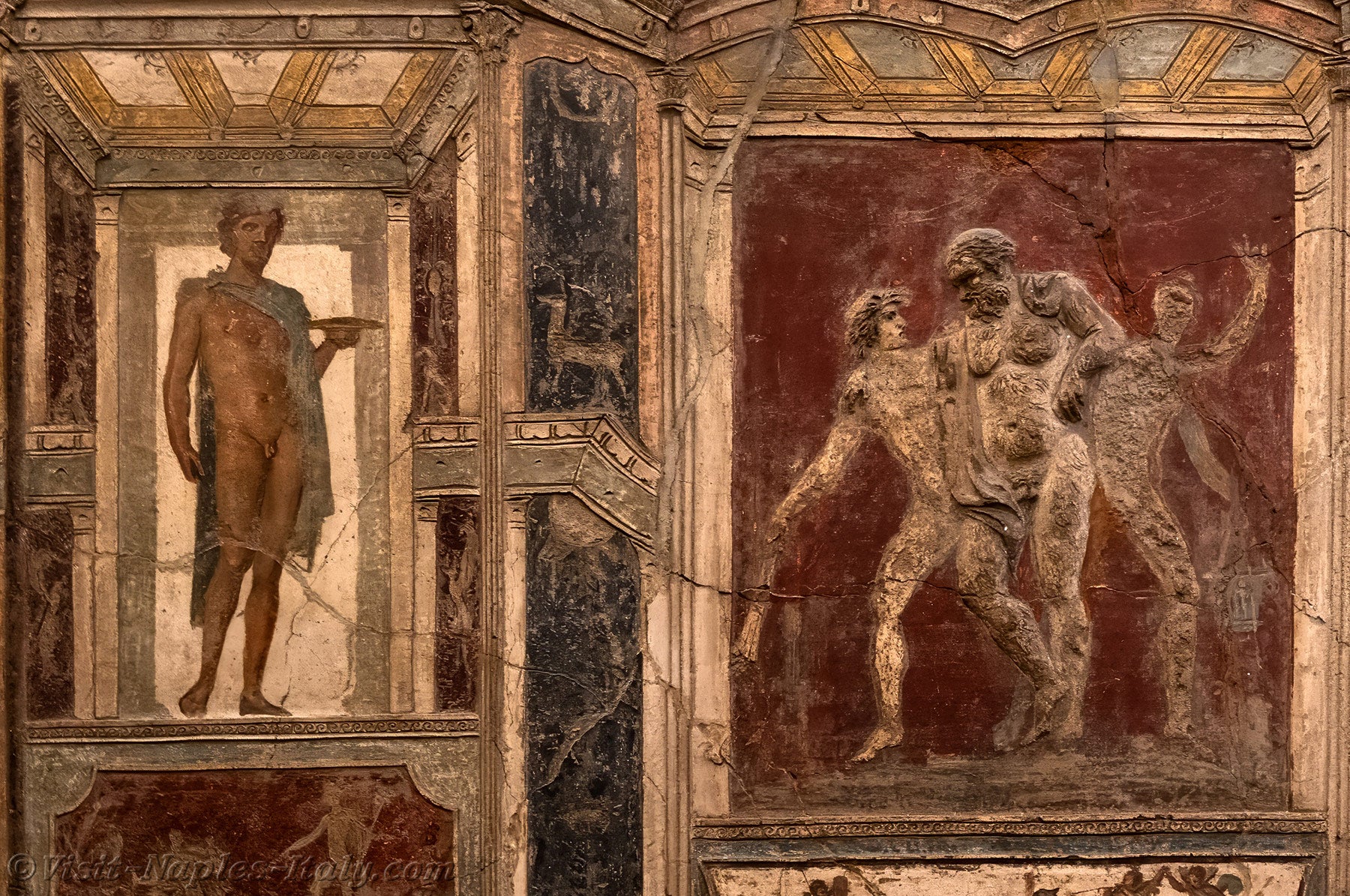
Hermes, Satyrs and Nymphs In the centre, two young satyrs support a Silenus who is staggering.
The small fresco below depicts cupids joyfully chasing a hare.
At the bottom left, Hermes with a woman and her two children.
At the bottom right, the winged horse Pegasus drinking from a spring alongside a nymph.
Mythology Achilles | Aeneas | Alcestis | Alexander | Aphrodite | Apollo | Arianne | Artemis | Ceres | Chryseis | Cupid | Daedalus | Dionysus | Dirce | Endymion | Flora | Galatea | Ganymede | Graces | Hephaestus | Hercules | Io Argos | Iphigenia | Isis | Leda | Marsyas | Medea | Nereids | Niobids | Odysseus | Pan | Paris | Perseus | Phaedra | Phrixus | Pirithous | Saturn | Satyrs | Sophonisba | Theseus | Troy | Zeus
Frescoes Mythology | Portraits | Life Leisure | Animals | Religion | Landscapes | Decoration
Artworks Sculptures | Frescoes | Eroticism
MANN Artworks Schedule Tickets Location | Authorizations
Back to Top of Page