

MANN Artworks Schedule Tickets Location | Authorizations
Artworks Sculptures | Frescoes | Eroticism
Frescoes Mythology | Portraits | Life Leisure | Animals | Religion | Landscapes | Decoration
Mythology Achilles | Aeneas | Alcestis | Alexander | Aphrodite | Apollo | Arianne | Artemis | Ceres | Chryseis | Cupid | Daedalus | Dionysus | Dirce | Endymion | Flora | Galatea | Ganymede | Graces | Hephaestus | Hercules | Io Argos | Iphigenia | Isis | Leda | Marsyas | Medea | Nereids | Niobids | Odysseus | Pan | Paris | Perseus | Phaedra | Phrixus | Pirithous | Saturn | Satyrs | Sophonisba | Theseus | Troy | Zeus
Hercule Omphale | Telephus | Nessus
Frescoes depicting Hercules and the Centaur Nessus at the Archaeological Museum of Naples in Italy
Hercules and Nessus, Pompeii, Casa del Centauro
Fresco - Water-based pigments on Coating (152 x 124 cm) 30-45 ADHercules looks at the centaur Nessus who bows down before him with his arms outstretched while offering to take Deianira on his back to safely cross the deep waters of the river Evenus.
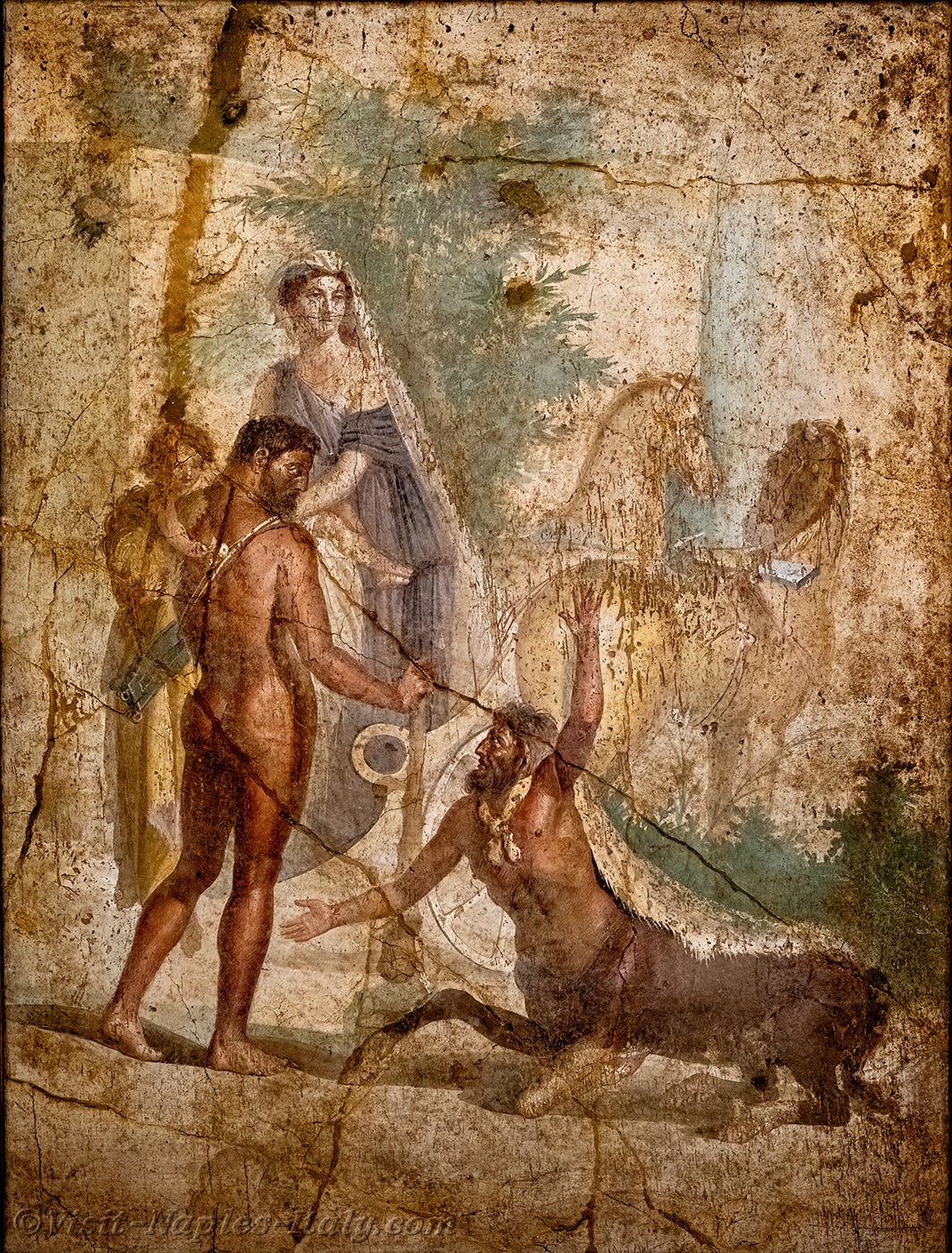
Hercules and Nessus The powerful musculature, quiver and club are the characteristic signs of the hero who accomplished his legendary exploits, the twelve labours of Hercules.
Hercules is naked, while his wife Deianira is sumptuously dressed in a long gown and wearing a long white veil; before stepping down from the chariot, she gave Hyllus to Hercules, who took him in his arms.
The spotted skin of a wild beast around the neck of the centaur indicates his intermediate lifestyle between animal and man: he is a predator who offers his help with the intention of possessing Deianira.
Nessus had taken advantage of the crossing of the river to try to kidnap and rape Deianira, who called her husband for help; Nessus was stopped and mortally wounded by an arrow shot by Hercules.
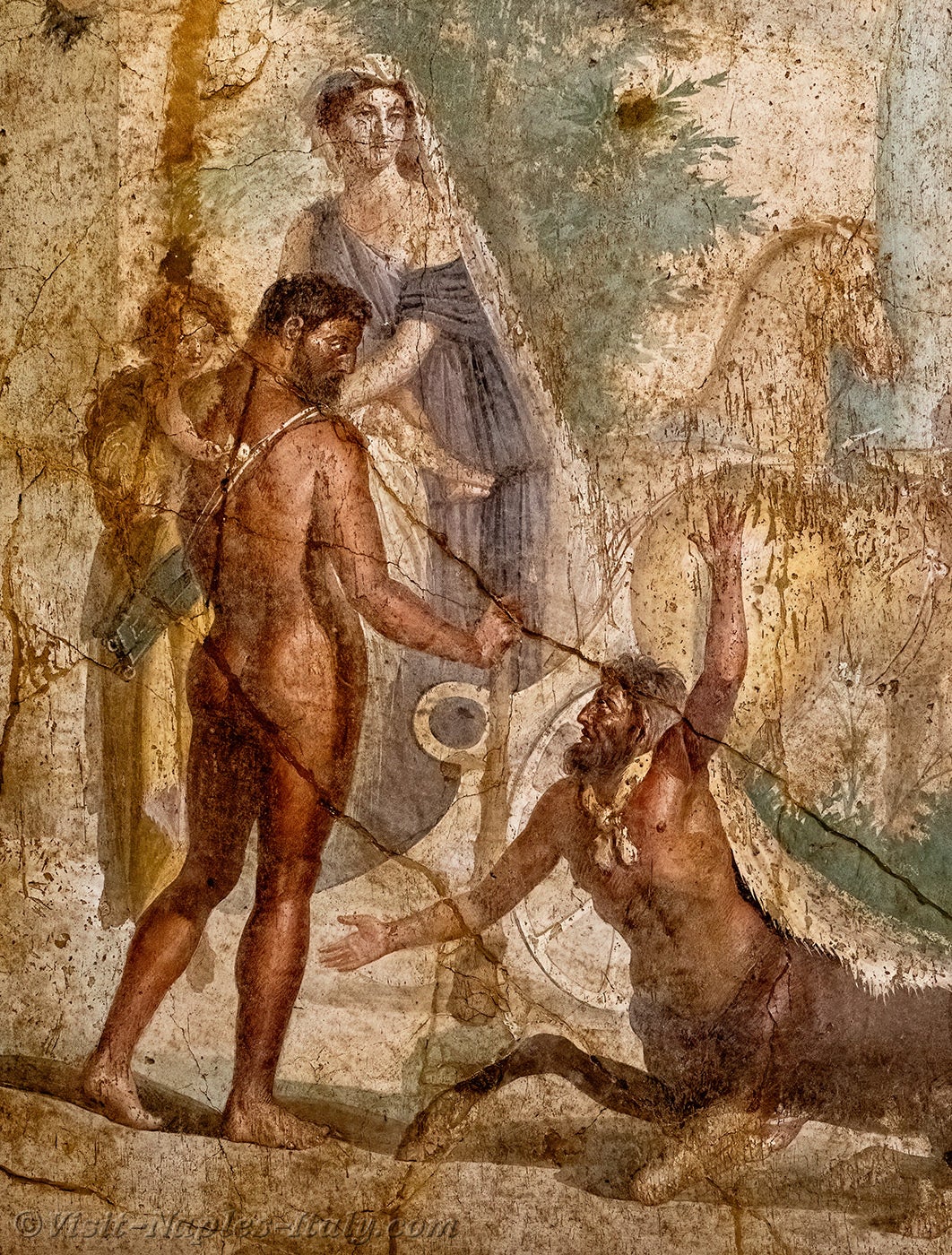
Hercules and Nessus Before he died, he gave Deianira a vial containing a mixture of his semen and blood, telling her that she need only spill it on one of Hercules' garments to ensure that he would be faithful to her forever.
Hercules, victim of “the tunic of Nessus”
When Deianira learned that Hercules had found Iole, the young girl who had once been promised to him by a king who had broken his word, she sent him a tunic impregnated with Nessus's liquid in the hope of bringing him back to her.The suffering endured by Hercules after putting on this poisoned tunic was so excruciating that he had himself burned on a pyre at the summit of Mount Oeta.
Desperate at having caused Hercules' death, Deianira killed herself.
Hyllus became the leader of the Heracleidae, the descendants of Hercules who divided up the lands of the Peloponnese.
Hercules and Nessus, Pompeii, Casa di Giasone
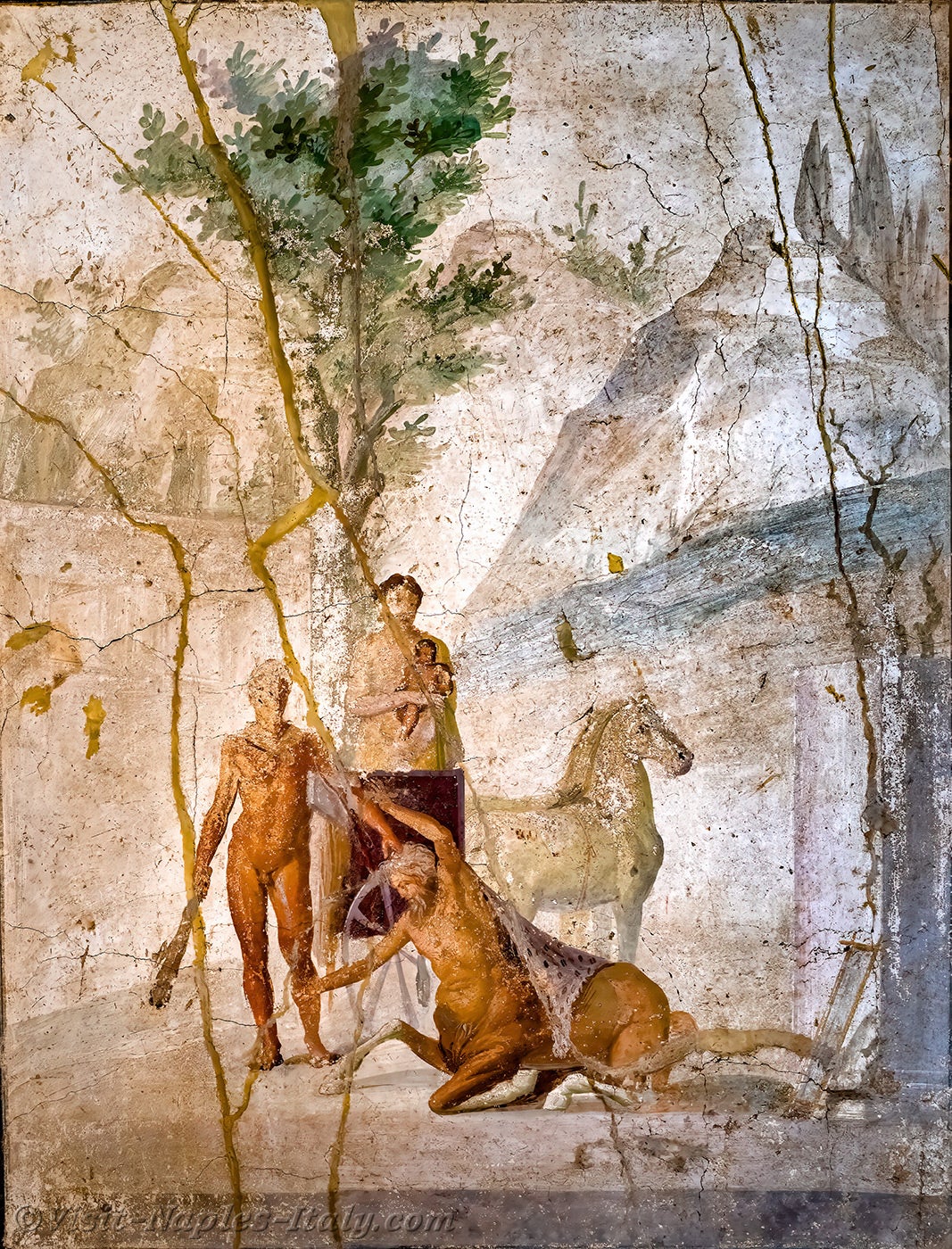
Hercules and Nessus Fresco - Water-based pigments on coating (125 x 95 cm) 20-25 AD
The fresco depicts Hercules and Deianira, his wife, and their son Hyllus, who meet the centaur Nessus on the banks of the river Evenus, which they must cross to continue their journey.
Hercules, armed with his club, has grabbed the hair of the fiery Nessus, who kneels before him, spreading his arms vertically to show the depth of the river, and offering to take Deianira on his back to carry her to the other side.
The scene takes place under the gaze of Deianira, who waits calmly, standing on the small cart with the child in her arms.
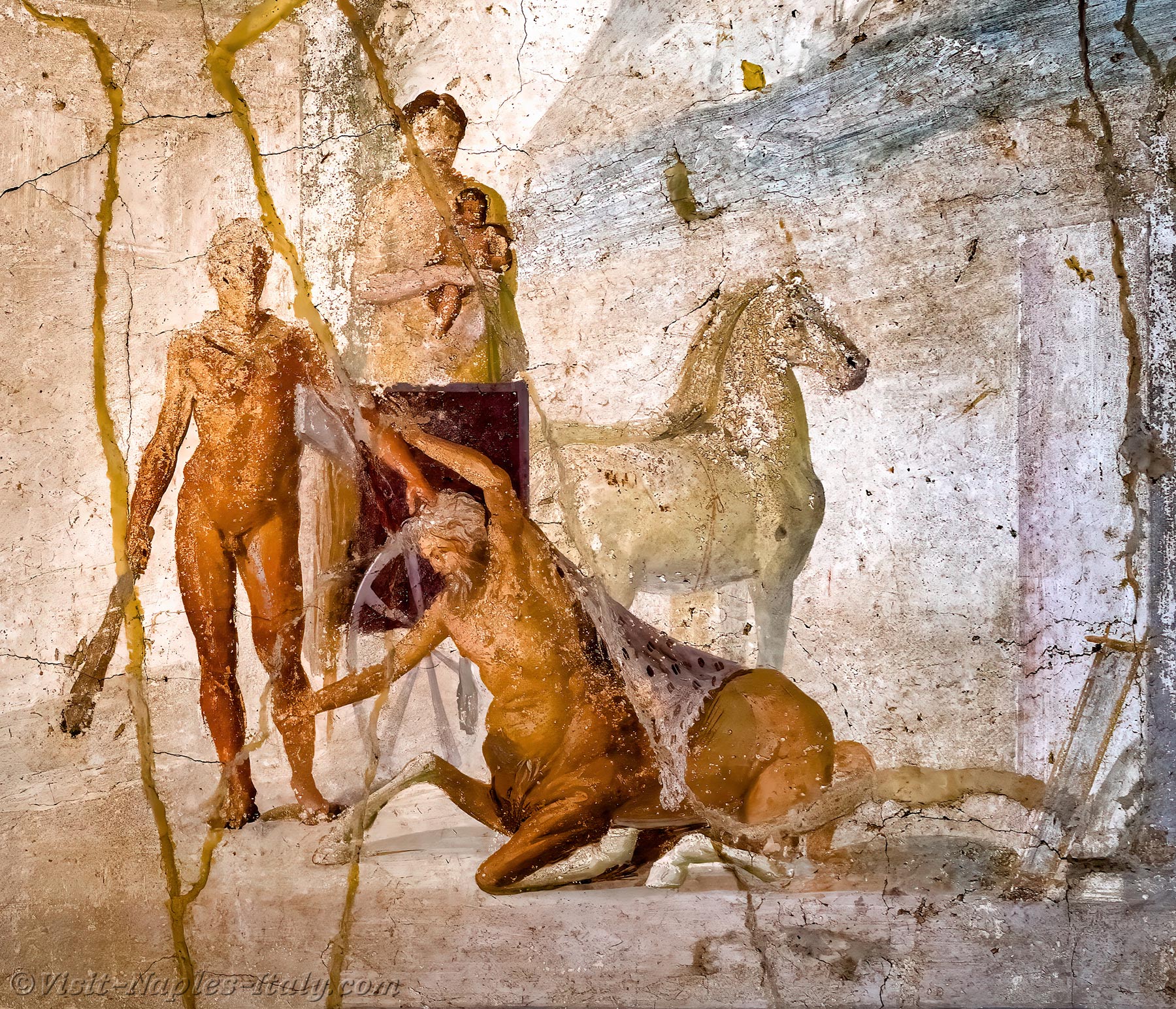
Hercules and Nessus Hercules and Deianira represent a couple of human beings, standing up to the savagery of a half-man, half-animal creature.
The savagery of Nessus quickly became apparent during the crossing when he attempted to abduct and possess Deianira, who called to her husband for help.
Hercules saved Deianira by mortally wounding the centaur with an arrow.
The three figures are arranged in a triangle, with Nessus in the foreground forming the base, Deianira in the middle and at the top: this composition is thought to be derived from a work by Artemon, a Greek painter from the 3rd century AD.
Hercule Omphale | Telephus | Nessus
Mythology Achilles | Aeneas | Alcestis | Alexander | Aphrodite | Apollo | Arianne | Artemis | Ceres | Chryseis | Cupid | Daedalus | Dionysus | Dirce | Endymion | Flora | Galatea | Ganymede | Graces | Hephaestus | Hercules | Io Argos | Iphigenia | Isis | Leda | Marsyas | Medea | Nereids | Niobids | Odysseus | Pan | Paris | Perseus | Phaedra | Phrixus | Pirithous | Saturn | Satyrs | Sophonisba | Theseus | Troy | Zeus
Frescoes Mythology | Portraits | Life Leisure | Animals | Religion | Landscapes | Decoration
Artworks Sculptures | Frescoes | Eroticism
MANN Artworks Schedule Tickets Location | Authorizations
Back to Top of Page